On Friday afternoon, March 3, 1911, two men climbed into an airplane at Fort McIntosh in Laredo, Texas. Lieutenant Benjamin Foulois was an Army officer. Phil Parmalee was a pilot for the Wright brothers, the men who invented the airplane. They sat side by side on the front edge of the bottom wing, with nothing around them but air. Each man had a revolver. The hometown paper said they also packed “a quantity of chocolate bonbons, for emergency.”
At 2 o’clock the airplane rose, circled the fort, and headed north up the Rio Grande toward Eagle Pass. Two days later, hundreds of people in Laredo would sit in a field all day, waiting for it to come home.

“Army Air Ship Breaks Record.” Laredo Weekly Times, Laredo, Texas, March 5, 1911, page 1. Library of Congress, Chronicling America. Click the clipping to read it full size.
An Army Airplane Comes to Laredo, Texas
In 1911, the United States Army owned just one airplane, kept at Fort Sam Houston in San Antonio, Texas. Then Robert J. Collier, who published Collier’s magazine, bought a new Wright biplane and lent it to the Army. A biplane has two wings, one above the other, made of wood, wire and cloth.
A revolution was going on across the river in Mexico, and American soldiers were guarding the Texas side. The Army wanted to know if an airplane could scout a border from the sky. So the biplane rode to Laredo in pieces in a railroad car, along with Foulois, Parmalee and a mechanic named Simmons. They put it together in a tent in two hours, “record time for assembling,” the Laredo Weekly Times said.
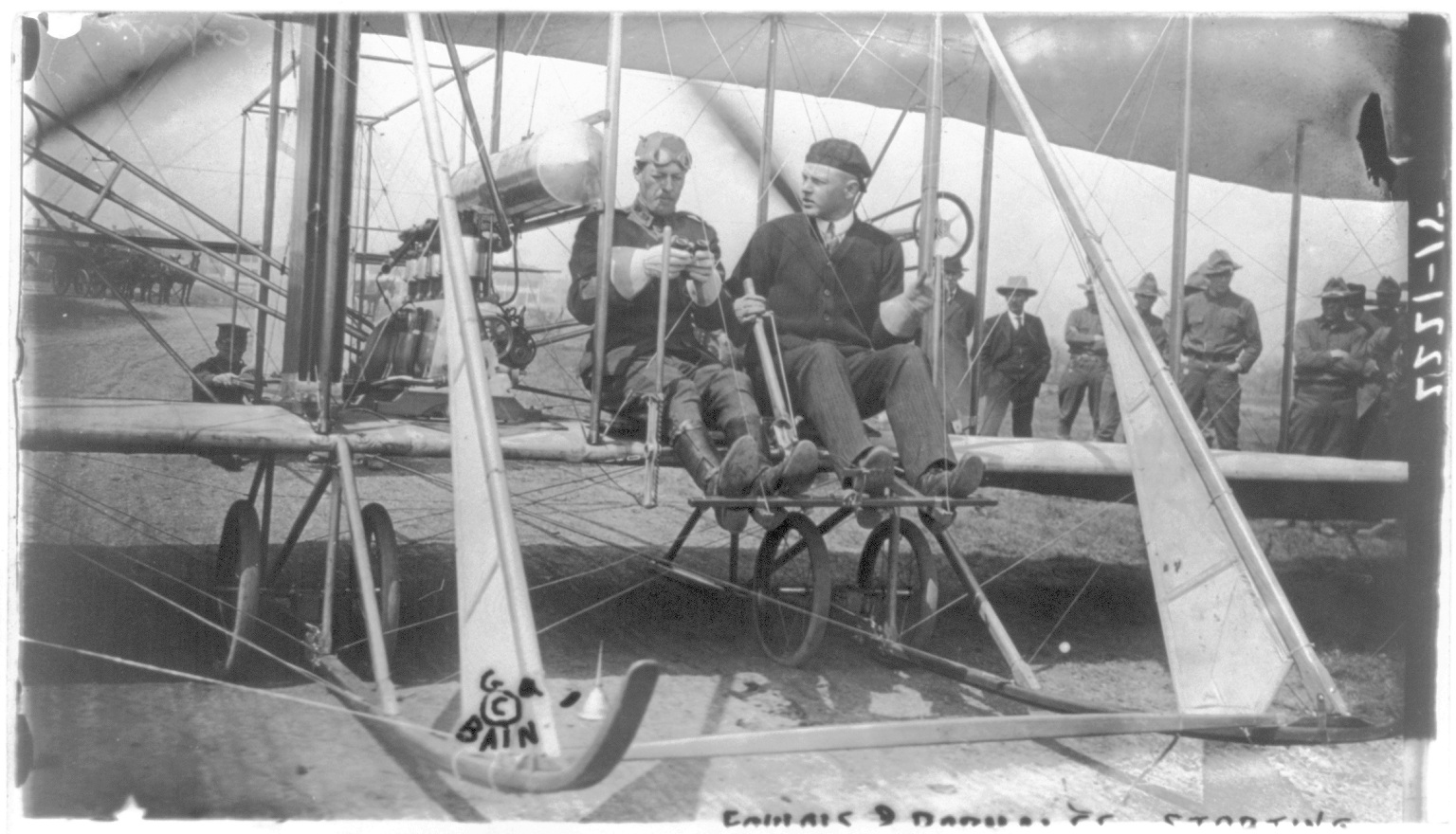
Foulois and Parmalee in a Wright biplane. The Bain News Service print gives their names but no place or date. Library of Congress. Click the picture to see it full size.
Rooftops on Both Sides of the Rio Grande
Laredo sits on the north bank of the Rio Grande, and Nuevo Laredo, Mexico, sits right across the water. People in both towns climbed up high to see the airplane. In Nuevo Laredo, they stayed “on roofs and housetops all during the afternoon,” the Times said, while it was still being put together. In Laredo, they watched from the roofs downtown.
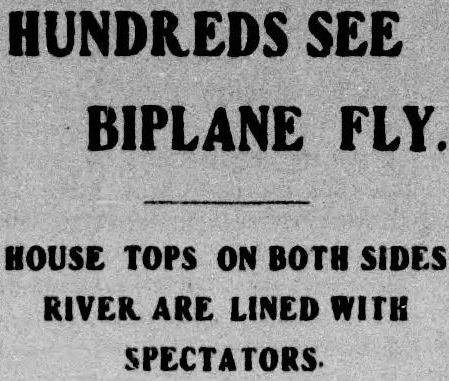
“House Tops on Both Sides River Are Lined With Spectators.” Laredo Weekly Times, March 5, 1911, page 3. Library of Congress, Chronicling America. Click the clipping to read it full size.
One afternoon the flyers passed over an automobile carrying General Joseph W. Duncan, the Army’s commander in Texas. They signaled down to him. “There was an answering honk, honk, from the auto horn as the aeroplane glided on its course.”
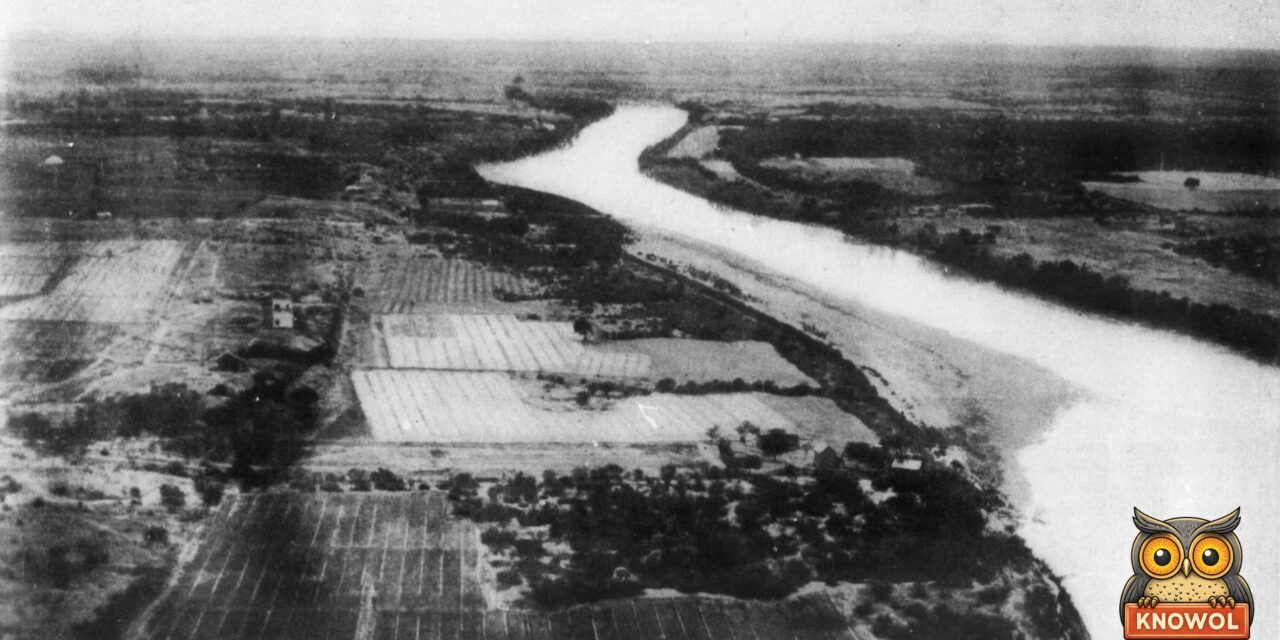
On March 1, Parmalee took up James H. Hare, a famous news photographer for Collier’s. Hare took what the magazine later called “The First Photograph of the Mexican Frontier Taken from an Aeroplane.” It is the picture at the top of this page, looking across the Rio Grande near Laredo into Mexico.

Laredo, Texas, in 1920, with Nuevo Laredo, Mexico, across the river in the distance. San Antonio Photo Service, Library of Congress. Click the picture to see it full size.
What Two Flyers Packed for 106 Miles
In Laredo, the big test for Foulois and Parmalee came on Friday, March 3. They would fly to Eagle Pass, more than 100 miles up the river, without stopping. The paper listed what went along:
- 25 gallons of gasoline, enough for about five hours
- “the little compass between the two seats”
- two Army revolvers “strapped to the bars on the right and left of the seats,” and forty rounds of ammunition for each man
- food for two days, and “a quantity of chocolate bonbons, for emergency”
- field glasses, a government map, and a pencil and pad
- an American flag, “nailed to the lower plane,” which meant the bottom wing
The food made sense. If the airplane came down in the brush, miles from any town, the two men might wait a while for help.
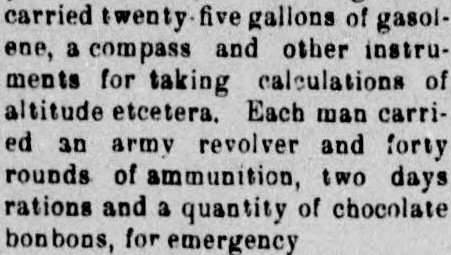
What the flyers carried. Laredo Weekly Times, March 5, 1911, page 14. Library of Congress, Chronicling America. Click the clipping to read it full size.
The Flight From Laredo to Eagle Pass
On the big day in Laredo, Lieutenant Foulois “smoked a big black cigar vigorously,” the paper said. Then the airplane climbed away and passed out of sight about seven miles out. Simmons, the mechanic, watched through Army field glasses. He “was the last man to turn his gaze from the northwest.”
A telephone call came from Minera, a town up the river. The airplane had gone over at 2:30, “high in the air and flying swiftly.” Then nothing. At last a telegram came from Foulois at Eagle Pass: “Arrived four seven without stop.” That meant 4:07 in the afternoon. He added that they “didn’t see a thing on Mexican side.”
The trip took 2 hours and 7 minutes. The Laredo paper said it covered 116 miles and broke three world’s records. Collier’s said 106 miles and called it, more carefully, a new American record for a nonstop flight with a passenger.
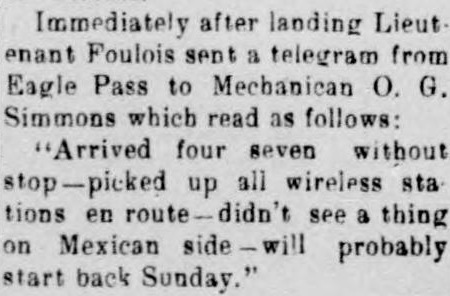
The telegram from Eagle Pass. Laredo Weekly Times, March 5, 1911, page 14. Library of Congress, Chronicling America. Click the clipping to read it full size.
The next day the Times wrote, “Laredo woke up this morning to find itself as famous for its airships as for its onions.” Laredo farmers grew a lot of onions.
Laredo, Texas, Gives the Airplane a Name
The Laredo Weekly Times had an idea: name the Army’s airplane “Laredo.” The Board of Trade, a club of local businessmen, liked it, and Simmons agreed. So the town made a badge to fasten onto the airplane when it flew back from Eagle Pass. It read “Worlds Record,” “Foulois-Parmalee,” “Collier’s Laredo” and “March 3, 1911.”
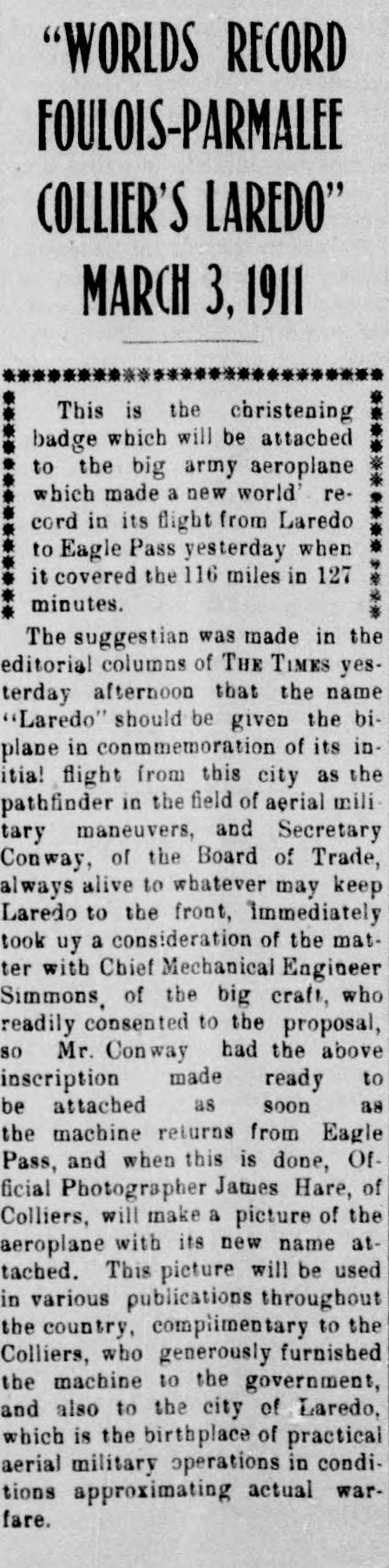
The badge Laredo made for the airplane. Laredo Weekly Times, March 5, 1911, page 1. Library of Congress, Chronicling America. Click the clipping to read it full size.
The paper wanted the airplane to have a mascot, too. The flyers didn’t want any of “the Laredo boys,” and the town was “not willing to part with any of the Laredo girls.” So people suggested “a pelon dog, a bob cat and a cayote,” the last two “of course to be tame animals.” A pelón dog is a hairless dog. Pelón is Spanish for bald.
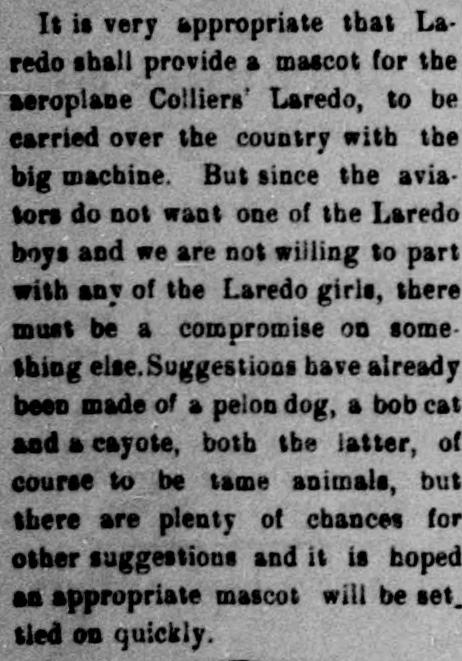
A mascot for the airplane. Laredo Weekly Times, March 12, 1911, page 6. Library of Congress, Chronicling America. Click the clipping to read it full size.
Waiting All Day in a Field in Laredo
On Sunday morning, March 5, word reached Laredo that the Army airplane had left Eagle Pass at 8:10 to fly home. It could not reach Laredo before 10 o’clock. Even so, “hundreds of people had gathered in advance of that time and were waiting.”
Then a stiff wind came up, about 35 miles an hour, right in the airplane’s face. Simmons figured it could not get there before 1 o’clock. The crowd went off for “a hurried lunch” and came back bigger. All afternoon they waited. A few fell asleep in the shade.
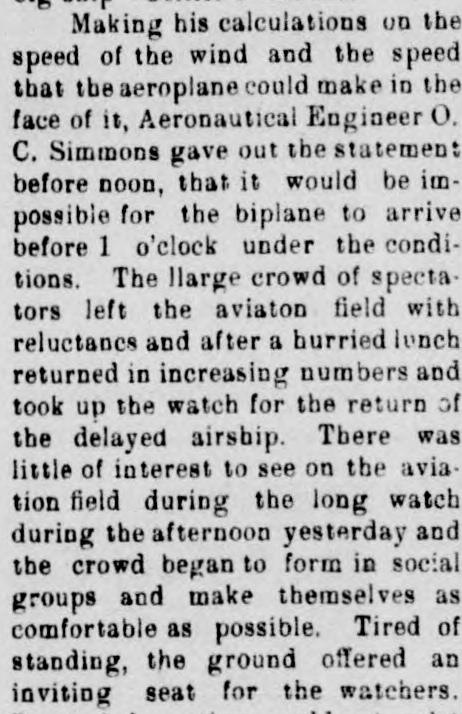
The long wait. Laredo Weekly Times, March 12, 1911, page 7. Library of Congress, Chronicling America. Click the clipping to read it full size.
By 5 o’clock the crowd had given up and gone home, “weary of waiting for the return of ‘Collier’s Laredo.'” At 7 o’clock a telegram came. Something had gone wrong in the wind, and the flyers had been forced down about 12 miles from Eagle Pass. Neither man was badly hurt.
The next day Laredo learned the rest. They had come down in the Rio Grande itself, on purpose, “to save the machine from being torn and damaged by coming in contact with the thick cacti and dense growth of trees along the rocky slopes.” They picked a wet landing over a prickly one.
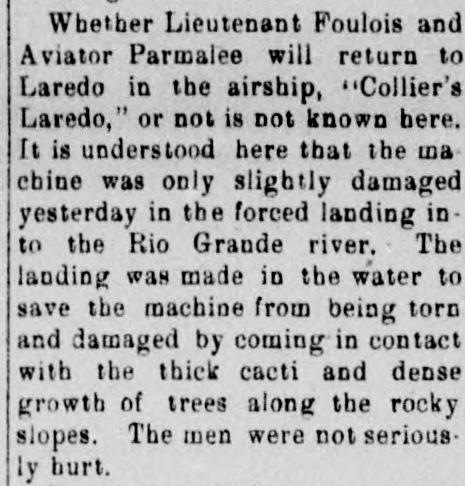
“The landing was made in the water.” Laredo Weekly Times, March 12, 1911, page 7. Library of Congress, Chronicling America. Click the clipping to read it full size.
Laredo Mailed the Badge to the Wright Brothers
The Army airplane never flew back to Laredo. It was shipped to San Antonio to be fixed. “I’m sorry it could not make the return flight from Eagle Pass to Laredo,” Hare told the San Antonio Light. In Laredo, Simmons took down the tent hangar.
The badge had been made for the airplane’s homecoming. Instead, the Board of Trade printed copies and mailed them out as souvenirs. One went to “the Wright Bros., designers and makers of the biplane.” Others went to Robert J. Collier, to the head of the Army Signal Corps, and to the head of the Aero Club in New York.
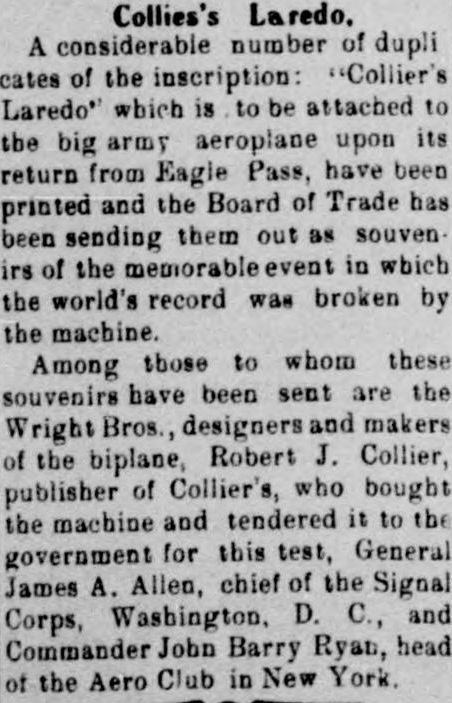
Where the badges went. Laredo Weekly Times, March 12, 1911, page 6. Library of Congress, Chronicling America. Click the clipping to read it full size.
After Laredo, Texas
A week after the flight, the Laredo Weekly Times printed news that three airplanes were joining 20,000 soldiers at Fort Sam Houston in San Antonio. Foulois said the Laredo airplane would go back to work on the border once it was fixed. The Times had a joke ready: “After taking a drink out of the Rio Grande, not a thing on the face of the earth can help coming back.”
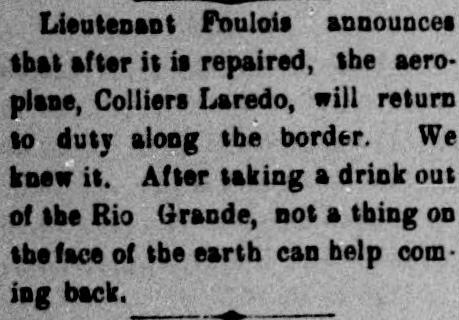
“We knew it.” Laredo Weekly Times, March 12, 1911, page 12. Library of Congress, Chronicling America. Click the clipping to read it full size.
As far as we could find, it never flew over Laredo again. But for one week in 1911, the people of Laredo climbed onto their roofs to watch it, gave it a name, tried to find it a mascot, and sat in a field all day waiting for it to come home. When it didn’t, they mailed its name badge to the Wright brothers. Not many airplanes have been loved that much by a whole town.
Sources
- “Army Air Ship Breaks Record” and the christening badge, Laredo Weekly Times (Laredo, Texas), March 5, 1911, page 1. Same issue: “Hundreds See Biplane Fly,” page 3; “Laredo Witnesses First Ascent,” page 9; “Make Trip to Minera” and “The Biplane Flights,” page 10; “Army Biplane Is Off on Trip,” page 11; “Army Air Ship Breaks Record” (concluded) and the editorial page, page 14. Library of Congress, Chronicling America.
- “Three Aeroplanes Join Movement of Soldiers,” Laredo Weekly Times, March 12, 1911, page 1. Same issue: the mascot item and “Collier’s Laredo,” page 6; “All Off With the Biplane,” page 7; the editorial page, page 12. Library of Congress, Chronicling America.
- “Hare Has Praise for Daring of Lieut. Foulois and Parmalee,” San Antonio Light and Gazette (San Antonio, Texas), March 7, 1911, page 5. Library of Congress, Chronicling America.
- “What the World Is Doing,” Collier’s, March 18, 1911, pages 13 and 14, photographs by James H. Hare. Internet Archive. The photograph at the top of this page is the one on page 13.
- Lt. Benjamin Foulois and Philip O. Parmalee, Bain News Service. Library of Congress Prints and Photographs Division. No known restrictions on publication.
- City of Laredo, Texas and Nuevo Laredo, Mex., 1920, San Antonio Photo Service. Library of Congress Prints and Photographs Division. No known restrictions on publication.
- The newspapers and the magazine were printed before 1931 and are in the public domain.