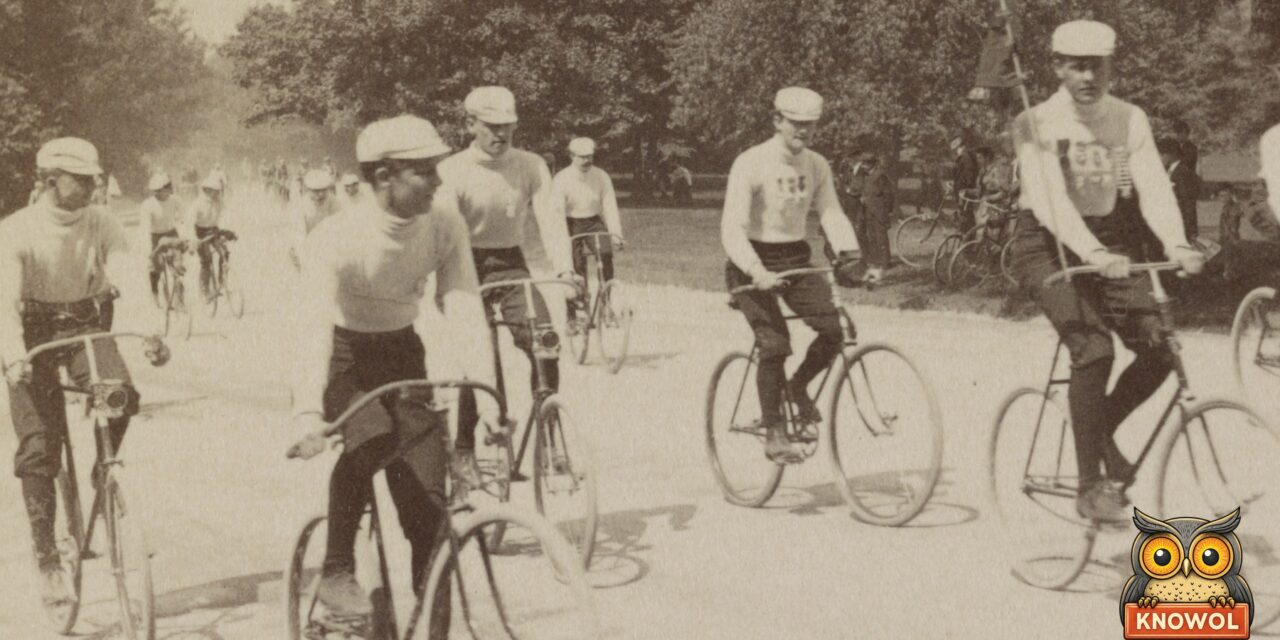
At 8 o’clock on the night of July 5, 1897, a brass band climbed into a big wagon in Warren, Rhode Island, and started to play. Behind it rolled bicycles, lit up for the dark. It was Warren’s illuminated bicycle parade, the last big show of a Fourth of July party that had started soon after midnight.
The Providence News said Warren celebrated “with more vim and vigor than for a number of years past.” Vim and vigor means pep and energy, and Warren had plenty. Its day ran from bonfires in the dark to bicycle races, fireworks and, at the very end, those glowing wheels.
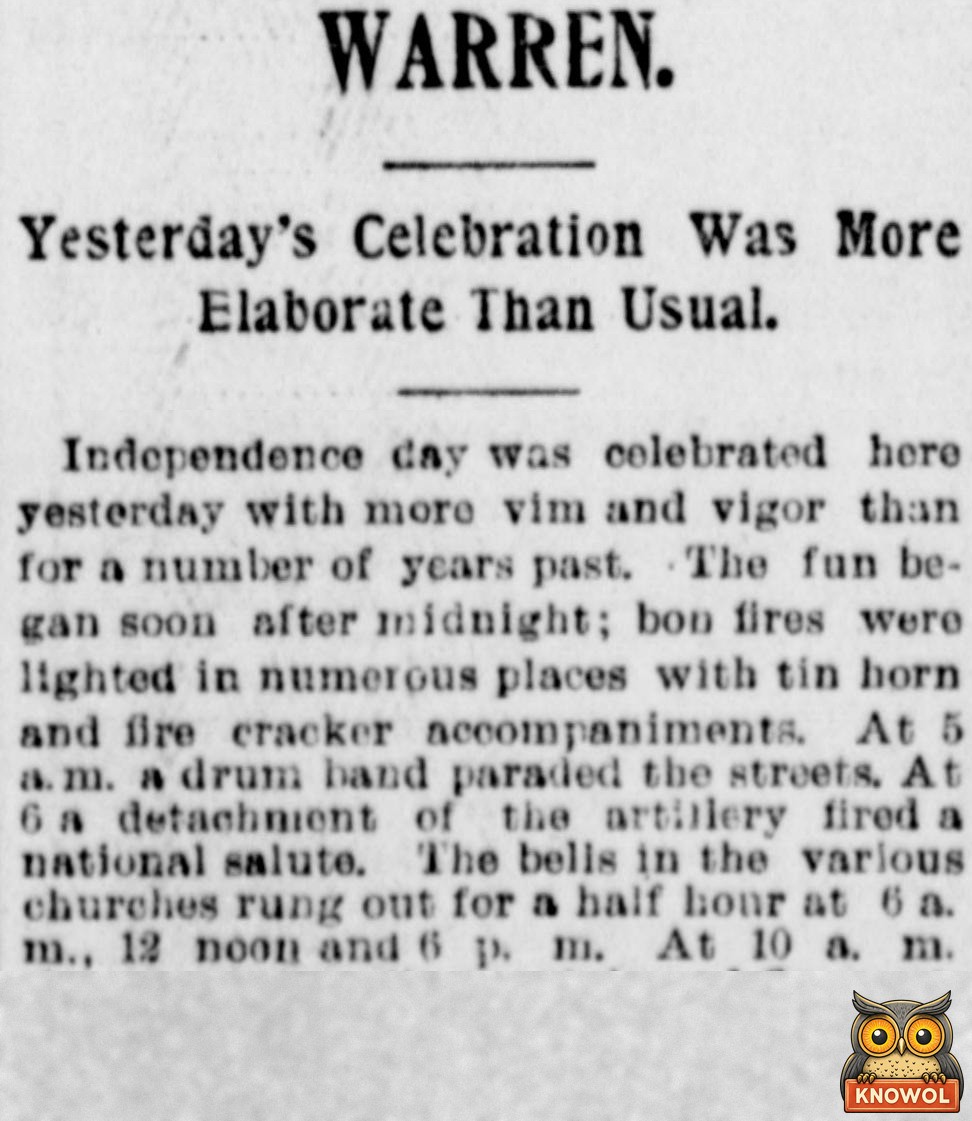
“Yesterday’s Celebration Was More Elaborate Than Usual.” The Providence News, Providence, Rhode Island, July 6, 1897, page 3. A second headline line about other Warren news is left out. Library of Congress, Chronicling America. Click the clipping to read it full size.
Why Warren, Rhode Island, Moved the Band
In 1897, July 4 fell on a Sunday, so Warren saved its noise and parades for Monday, July 5. On Saturday, the Providence News printed the town’s plans. Six riders had signed up for each of the two bicycle races, and the illuminated parade “promises to be a success.”
The same report had a kinder piece of news. Warren had planned a band concert on the common, the town’s open green. But Mrs. Ezra M. Martin was sick. She was the mother of Joseph W. Martin, president of the Town Council, and the Martin home stood right beside the common. So the committee moved the music to “a stand to be erected in front of the Baptist church on Main street, instead of the common as announced.” The paper didn’t explain. It didn’t need to. Brass bands are loud.
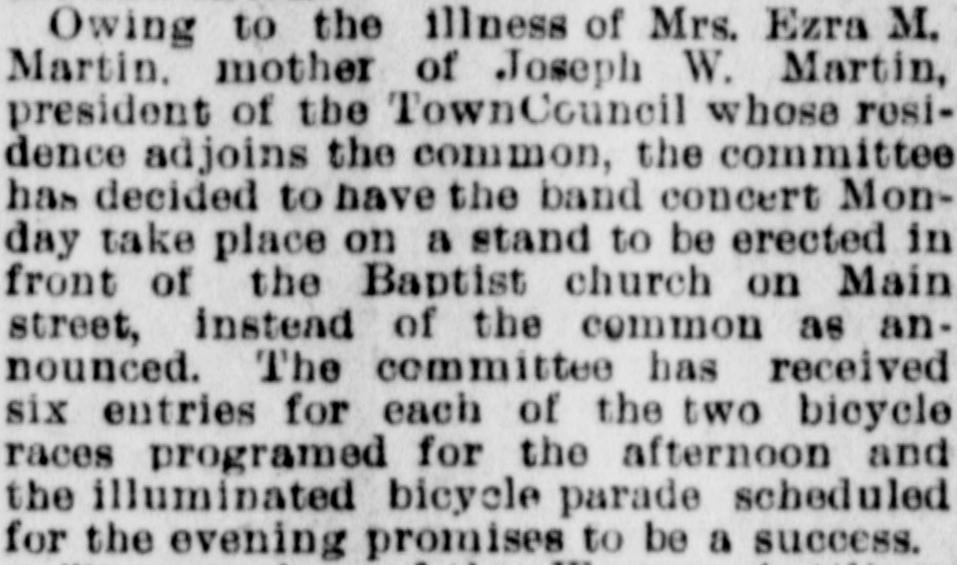
The concert moves for a sick neighbor. The Providence News, July 3, 1897, page 3. Library of Congress, Chronicling America. Click the clipping to read it full size.
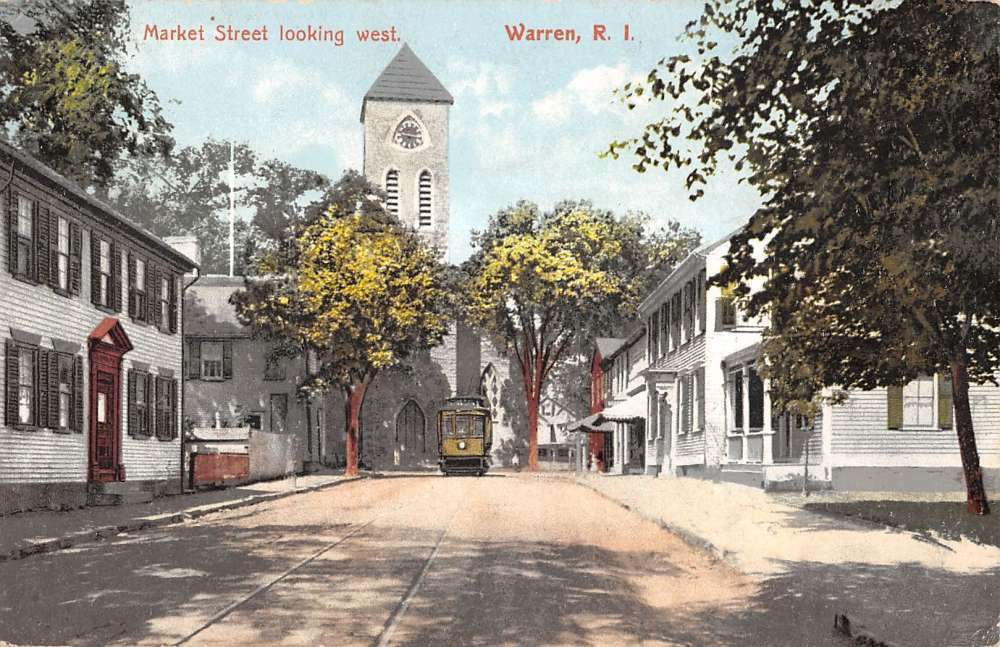
Market Street in Warren, Rhode Island, on a postcard from about 1907 to 1915. The Baptist church stands at the end of the street. Wikimedia Commons, public domain. Click the picture to see it full size.
A Fourth of July That Began at Midnight in Warren
In Warren, the Fourth started as soon as Monday did. “The fun began soon after midnight; bon fires were lighted in numerous places with tin horn and fire cracker accompaniments,” the News reported. That’s bonfires, horns and firecrackers in the middle of the night.
At 5 a.m., a drum band marched through the streets. At 6, men from the artillery fired a national salute, and the church bells rang for half an hour. They rang for another half hour at noon, and again at 6 p.m.
At 10 a.m. came the big parade. A 26-piece brass band from Norton, Massachusetts, marched near the front. The Warren Artillery marched 40 men with two field pieces, small cannons on wheels. The town’s fire companies joined in, too. One steam fire engine was “beautifully decorated with bunting and flowers.” Bunting is strips of red, white and blue cloth.
Bicycle Races From Warren to Barrington and Back
In Warren that afternoon, the Norton band played “a grand concert on the stand erected in front of the Baptist church.” At 3, the Warren baseball club beat the Pastimes of Providence, 14 to 3.
At 4:30, Warren’s bicycle racers lined up in front of Goff’s Hotel. The course ran out to Maxwell’s Corner in Barrington, the next town over, and back, three miles in all. “This event attracted a big crowd and there was much interest shown,” the News said. Horace R. Seymour won in 9 minutes 46 seconds. That’s about 18 miles an hour, and the paper said he “made a record.”
Then came the boys’ one-mile race, with five starters. Roland Dana won in 3 minutes, 59 seconds.
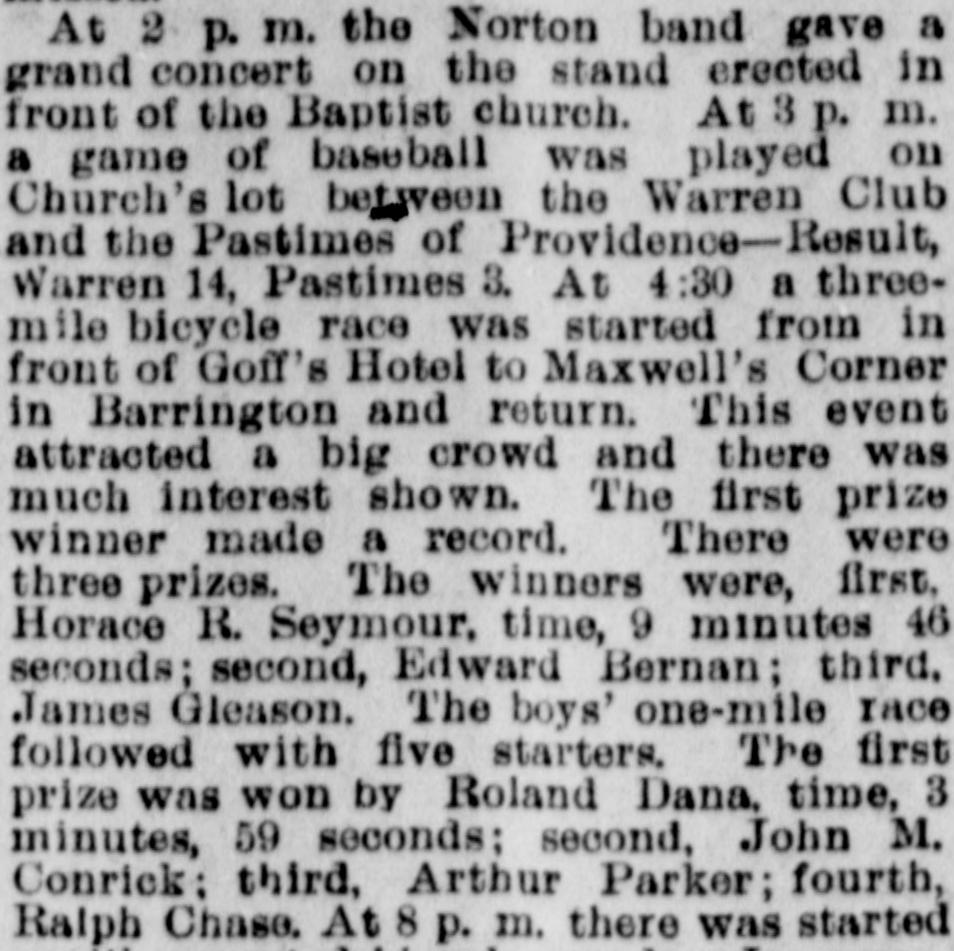
The concert, the ball game and the bicycle races. The Providence News, July 6, 1897, page 3. Library of Congress, Chronicling America. Click the clipping to read it full size.
The Night the Bicycles Glowed in Warren
At 8 p.m., Warren’s illuminated parade began. “The Norton band rode in a barge, led the line and played selections while going over the route.” In New England, a barge was a big open wagon that carried a crowd, pulled by horses.
The News was honest about one thing. “In numbers it did not come up to the expectations of the committee or spectators.” Four divisions had been planned, and fewer riders came than hoped.
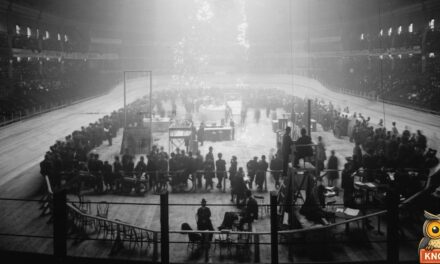
But the riders who came made it count. First prize for best appearance went to visitors: the Indian Cycle Club of Fall River, Massachusetts, led by Capt. Frank A. Flynn. They came “with their mascot boy rider, Master Frank Crawson.” Master was the polite old word for a boy, the way Mister is for a man. Their prize was “a silver tilting ice pitcher set.” Heon Bros. took second prize, “a Dresden clock,” which meant a clock with a fancy china case. The picture at the top of this page shows a different bicycle club, on parade in Central Park, New York, in 1895.
Single riders won prizes, too. George Gregory won among the men, Miss Brown among the “Lady riders” and Charles Bliss among the boys. At 9 p.m., the band played one more concert on the Main Street stand, and the fireworks went up. The paper called it all “a most pleasing and successful demonstration.”
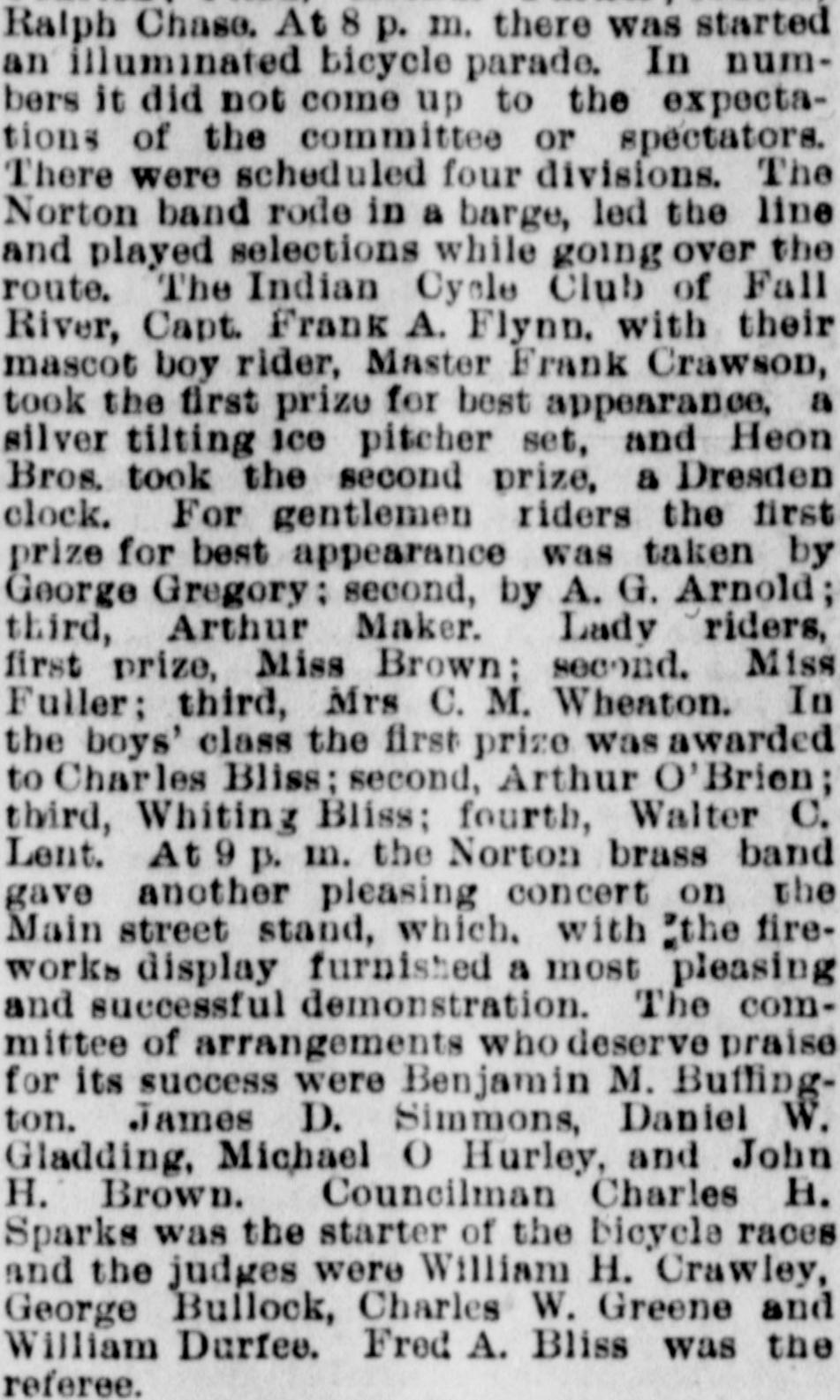
The illuminated bicycle parade and its prizes. The Providence News, July 6, 1897, page 3. Library of Congress, Chronicling America. Click the clipping to read it full size.
How Riders Lit Up a Bicycle in 1897
The Warren report doesn’t say how its riders lit their bicycles. But that same night, up the coast in Portland, Maine, the Portland Daily Press described its own “bicycle lantern parade” wheel by wheel. In 1897, “wheel” was another word for a bicycle, and riders were “wheelmen.”
Portland riders hung lanterns from frames, arches and canopies built over their bicycles. Miss Belle Tolman “represented the Goddess of Liberty,” and her bicycle carried “a large arch on which were hung many lights.” T. F. Tolman built “a miniature yacht” on his, and “from the mast and yard arms hung many lanterns.” George O. Barker “rode a wheel with a big white butterfly stretching out in front of the handle bars.” Boys from Portland’s Butler school rode in white, with big triangles hung with lanterns.
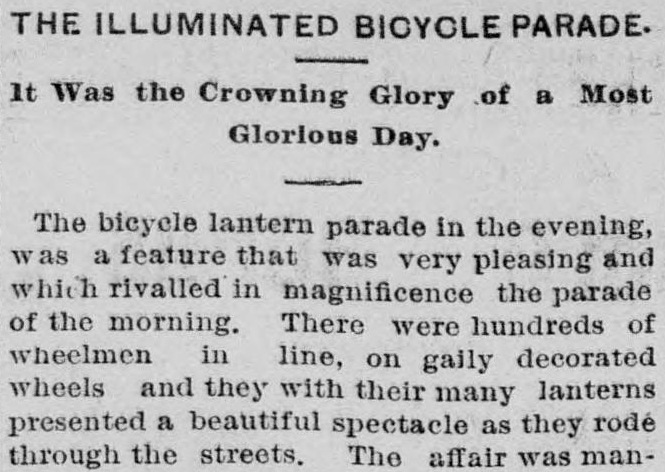
“The Illuminated Bicycle Parade.” Portland Daily Press, Portland, Maine, July 6, 1897, page 5. Library of Congress, Chronicling America. Click the clipping to read it full size.
Portland’s paper also explained why there weren’t more decorated bicycles. On the Fourth, “the wheelmen all wanted to use their bicycles during the day and could not afford the time decorate them.” That may explain Warren’s small parade, too.
What a Silver Ice Pitcher Meant in 1897
Warren was not the only place to give bicycle riders a silver pitcher. At a big bicycle meet in New Haven, Connecticut, in 1896, the prize list read like a jewelry store: gold watches, diamonds, a silver tea set, a “French marble clock,” even a “custom made suit.” A “silver tilting ice pitcher” was a second prize. Only the professional races paid cash, $50 for first place.
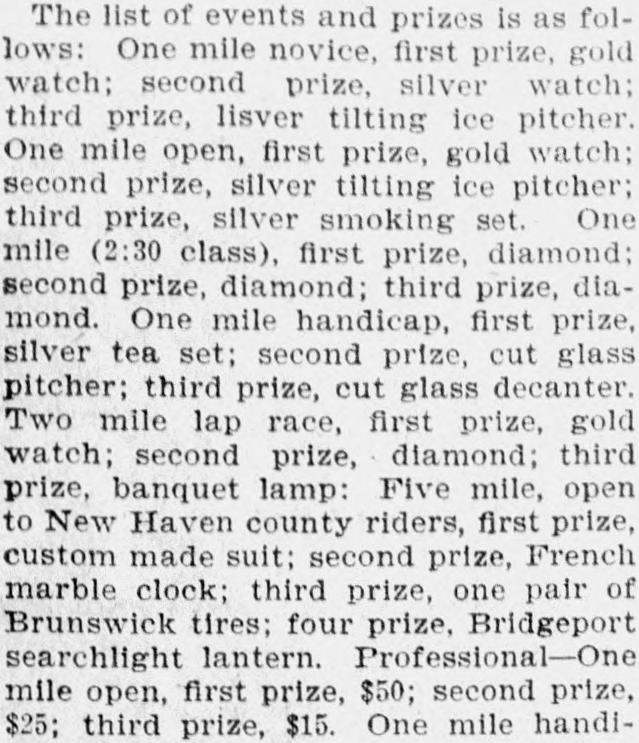
Bicycle prizes in New Haven, Connecticut. Daily Morning Journal and Courier, June 20, 1896, page 3. Library of Congress, Chronicling America. Click the clipping to read it full size.
A tilting ice pitcher sat in a tall metal stand. Instead of lifting a heavy pitcher of ice water, you tipped it forward in its stand to pour. The Smithsonian’s National Museum of American History has a stand for one, made of silver plate in New Bedford, Massachusetts, sometime between 1880 and 1900. It is more than 19 inches tall, with a spot in front for the matching goblet.
Also in Warren That Week: A Big Snapping Turtle
The same Saturday paper that printed Warren’s plans had one more surprise. Joseph Chase, son of William Chase, had caught a snapping turtle “in the duck pond, so-called, in Childswoods.” It weighed “twenty-two and one-half pounds,” and the paper said it was “believed to be the largest of his species seen in this vicinity for many years.”
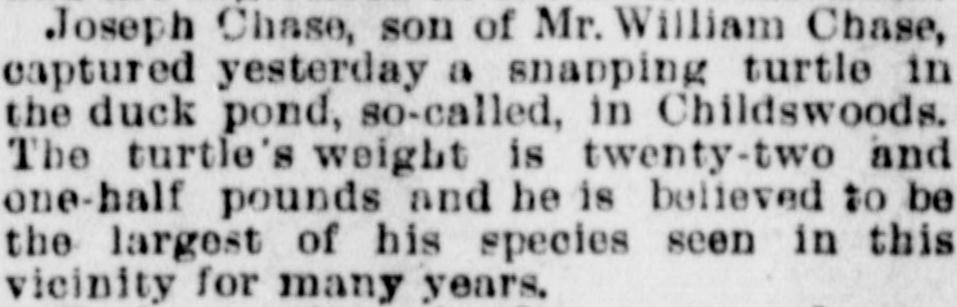
The snapping turtle. The Providence News, July 3, 1897, page 3. Library of Congress, Chronicling America. Click the clipping to read it full size.
After the Fourth in Warren, Rhode Island
On Tuesday, Warren’s Town Council paid its holiday bills. They included “eight extra policemen July 4 and 5, at $2.50 per day.”
The silver pitcher went home to Fall River with a bicycle club and its boy mascot. Warren’s parade had been smaller than everyone hoped. But a town that started its party at midnight and ended it with glowing bicycles had nothing to apologize for.
Sources
- “Warren. Yesterday’s Celebration Was More Elaborate Than Usual,” The Providence News (Providence, Rhode Island), July 6, 1897, page 3. Library of Congress, Chronicling America.
- “Warren,” The Providence News, July 3, 1897, page 3: the band concert moved, the race entries, the artillery’s church service and the snapping turtle. Library of Congress, Chronicling America. (No link here on purpose: the same column also carries an item we left out.)
- The Warren column, The Providence News, July 7, 1897, page 3: the extra policemen’s pay. Library of Congress, Chronicling America.
- “The Illuminated Bicycle Parade,” Portland Daily Press (Portland, Maine), July 6, 1897, page 5. Library of Congress, Chronicling America.
- “A Big Bicycle Meet,” Daily Morning Journal and Courier (New Haven, Connecticut), June 20, 1896, page 3. Library of Congress, Chronicling America.
- Tilting ice pitcher stand, Pairpoint Corporation, New Bedford, Massachusetts, 1880 to 1900. National Museum of American History, Smithsonian Institution.
- Bicycle parade, Central Park, New York, U.S.A., stereograph, Strohmeyer & Wyman, 1895. Library of Congress Prints and Photographs Division. No known restrictions on publication. The cover is one half of the card, cropped.
- Postcard of a streetcar on Market Street, Warren, Rhode Island, about 1907 to 1915. Wikimedia Commons, public domain.
- The newspapers were printed before 1931 and are in the public domain.