One minute before midnight on Saturday, January 11, 1896, two young women were riding bicycles side by side inside Madison Square Garden in New York City. Their names were Frankie Nelson and Helen Baldwin. They had been racing for six days, and each had ridden more than 418 miles around the same small wooden track. Thousands of people were watching. Then Frankie Nelson made one last spurt (a sudden burst of speed) and finished “just three wheels ahead of Helen Baldwin.” After a whole week of pedaling, the race came down to the length of three bicycle wheels.
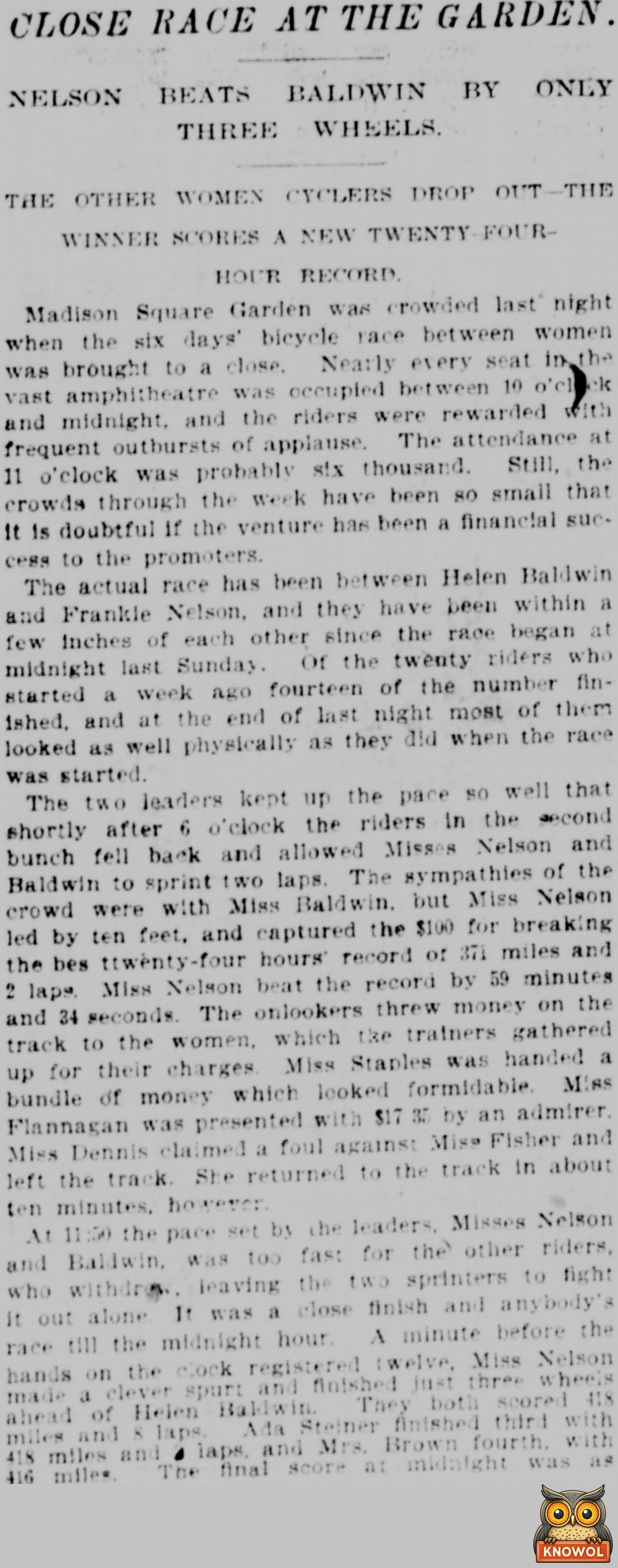
“Close Race at the Garden. Nelson Beats Baldwin by Only Three Wheels.” New-York Tribune, New York, New York, January 12, 1896, page 2. Library of Congress, Chronicling America. Click the clipping to read it full size.
A track made of pine boards
The race began just after midnight on Sunday night, January 5. The Journal, a New York paper, said the floor of the Garden had been turned into a “glistening ten-lap elipse of white pine.” That means a shiny oval track of pine boards, so small that ten trips around it made one mile. The Sixty-ninth Regiment Band played until the start, at 12:05 in the morning.
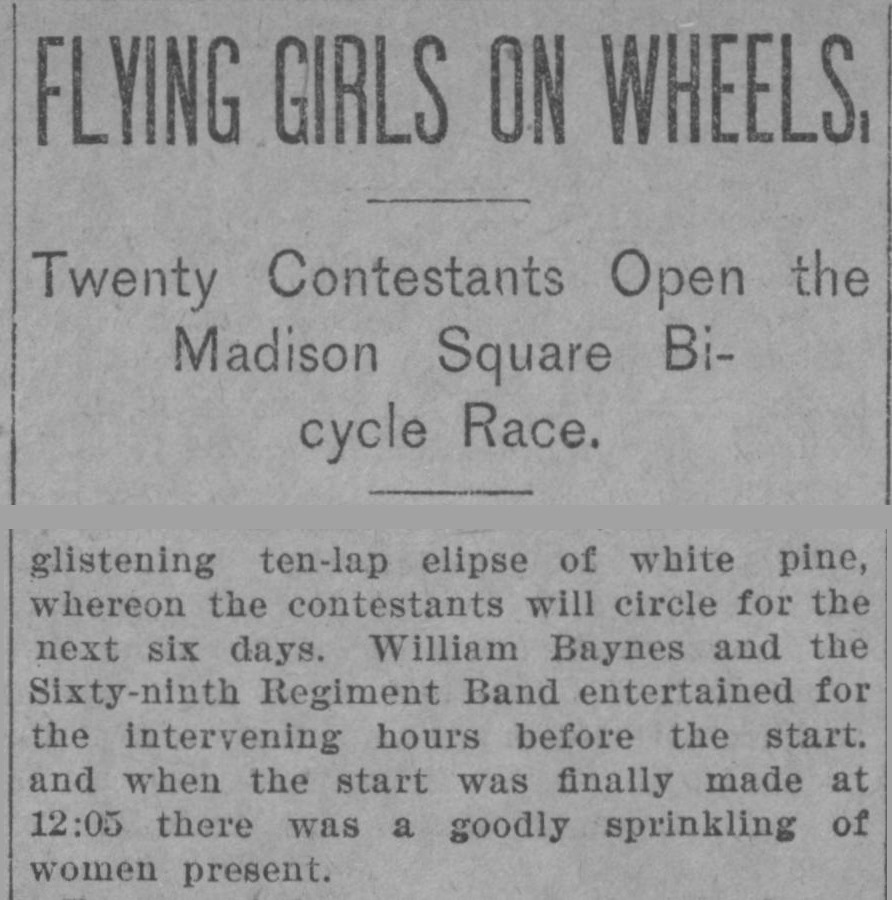
“Flying Girls on Wheels.” The Journal, New York, New York, January 6, 1896, page 5 (the headline and a later paragraph of the same story, joined). Library of Congress, Chronicling America. Click the clipping to read it full size.
Twenty women started. Each rider could stay on the track only “two hours at a time,” so they were split into two squads (groups) of ten that took turns. Whoever rode the most miles by Saturday midnight would win. Some of them were already champions. Frankie Nelson was a professional racer, and Helen Baldwin was a champion from California. Catharine Flannagan of Syracuse, New York, rode in a costume of “radiant, vari-shaded green.”
A few days before the race, a dozen riders tried out the new boards. “The general verdict was that the track was ‘just splendid,'” the Journal reported.
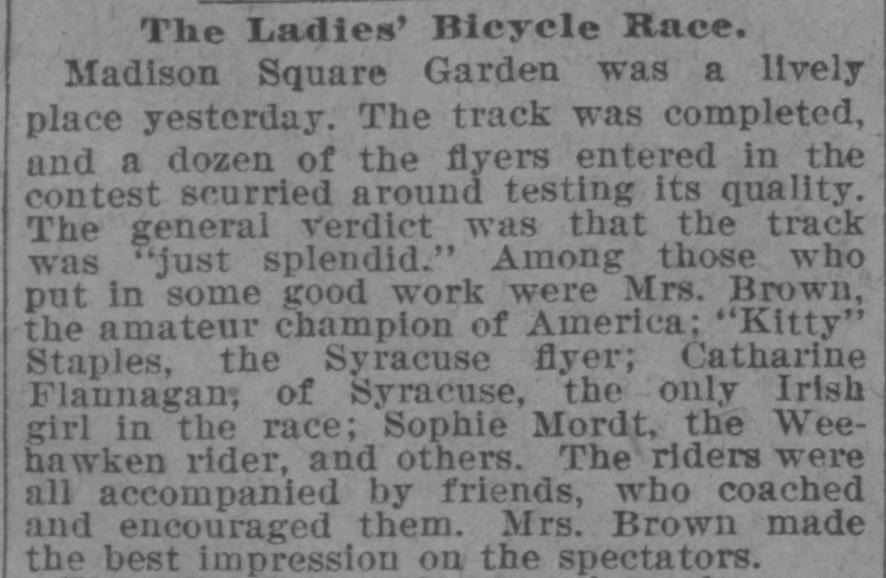
“The Ladies’ Bicycle Race,” the riders’ first spin on the new track. The Journal, New York, New York, January 3, 1896, page 10. Library of Congress, Chronicling America. Click the clipping to read it full size.
Hardly anyone came
The first nights were lonely. “There was only a handful of people at Madison Square Garden last night,” the New-York Tribune wrote on Tuesday. It counted four or five hundred people in a hall with seats for thousands. “The venture is sure to be a dismal failure,” the paper said.
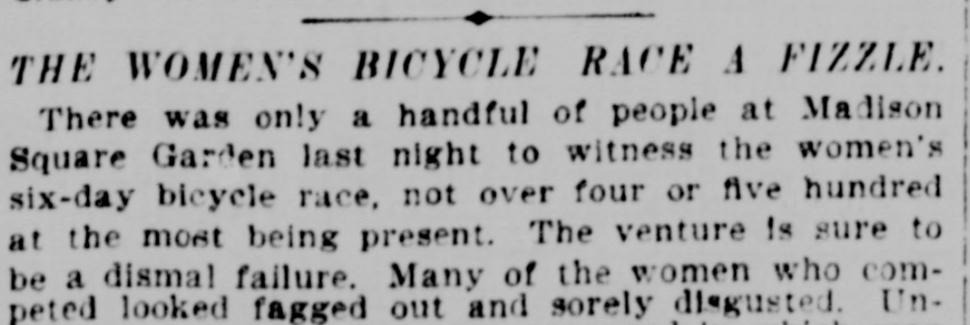
“The Women’s Bicycle Race a Fizzle.” New-York Tribune, New York, New York, January 7, 1896, page 9. Library of Congress, Chronicling America. Click the clipping to read it full size.
The riders kept going anyway. Kitty Staples of Syracuse had the hardest time. “She fainted several times yesterday, and had to be carried to her room,” the Journal said, “but after recovering she always insisted upon again going on the track.” All week, Helen Baldwin stayed right on the leader’s back wheel. A Journal headline said Frankie Nelson “Cannot Shake Off Helen Baldwin, Who Haunts Her.”
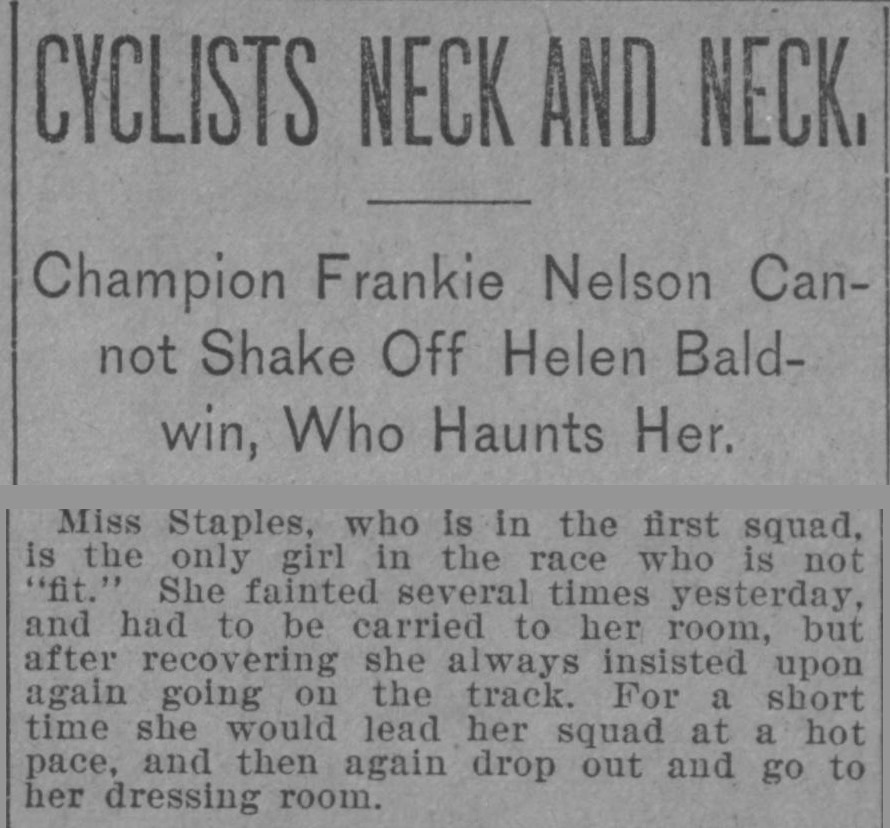
“Cyclists Neck and Neck,” and Kitty Staples, who kept getting back on the track. The Journal, New York, New York, January 9, 1896, page 5 (the headline and a later paragraph of the same story, joined). Library of Congress, Chronicling America. Click the clipping to read it full size.
A parrot that cheered
By Friday, the riders had fans. Catharine Flannagan was given bouquets of flowers and “an unusually green parrot,” a fine match for her green costume. She told the Tribune that the parrot “has learned already how to say, ‘Go it, Flannagan!'”
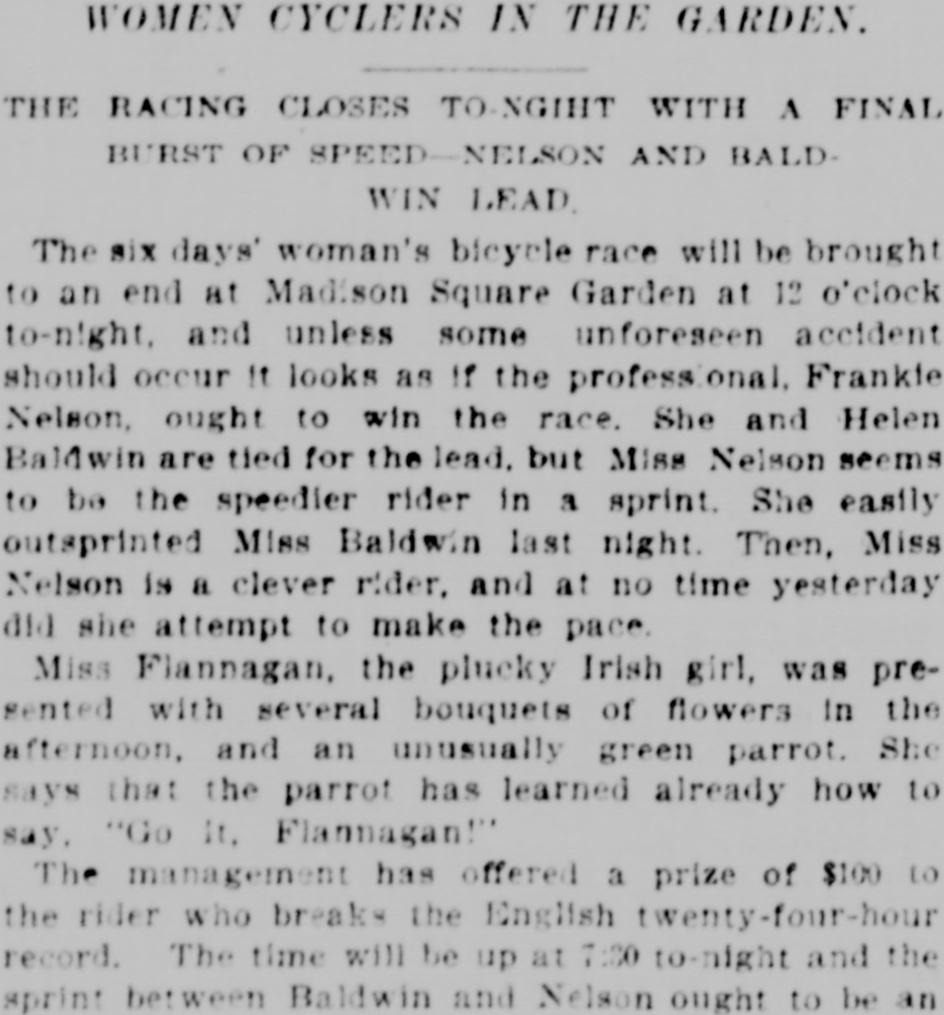
“Women Cyclers in the Garden,” with Miss Flannagan’s green parrot. New-York Tribune, New York, New York, January 11, 1896, page 3. Library of Congress, Chronicling America. Click the clipping to read it full size.
On the last night, the crowd sounded just like that parrot. The New York Times wrote that people kept calling out “Go it, Flannagan!” and cheering for Helen Baldwin.
What it cost, and what they ate
- First prize was $250 in gold and a diamond medal. Second place won $100 in gold, and every rider who made 200 miles got $20 in gold.
- There was a $100 prize for the rider in the prettiest costume.
- A good new bicycle that winter cost $50 to $75, the Tribune said, and the very best would cost at least $100. So first prize could buy three good bicycles.
- The Tribune said few of the riders were “properly trained.” Some would not even give up sweets. “Some of the riders positively refused to have their candy and ice-cream cut out of their meals,” the paper reported.
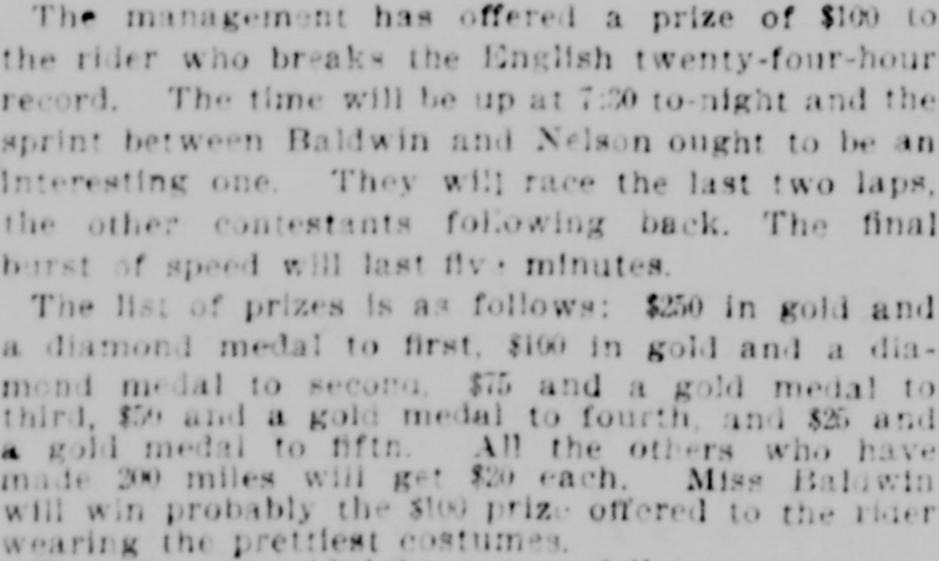
The list of prizes. New-York Tribune, New York, New York, January 11, 1896, page 3. Library of Congress, Chronicling America. Click the clipping to read it full size.
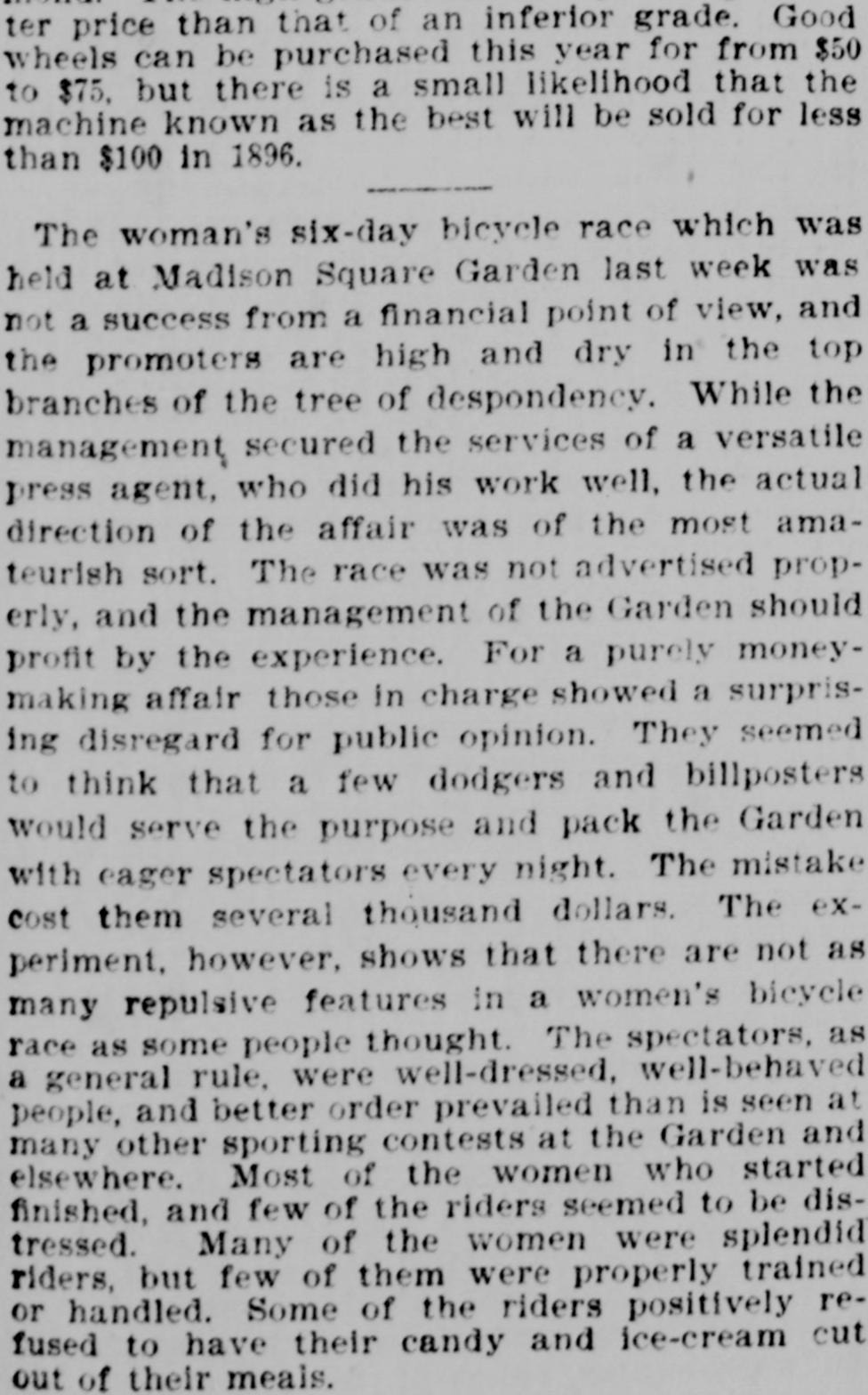
Bicycle prices, and the riders who would not give up candy and ice cream. New-York Tribune, New York, New York, January 12, 1896, page 23. Library of Congress, Chronicling America. Click the clipping to read it full size.
The last night
On Saturday the Garden finally filled up. The Tribune guessed 6,000 people were there by 11 o’clock. The New York Times counted “fully 4,000” and added, “strange to relate.” People were so excited that they tossed money onto the track. “The onlookers threw money on the track to the women,” the Tribune said, and the trainers picked it up for their riders.
That evening the two leaders raced for records, too. The English record for 24 hours of racing was 371 miles and 2 laps. Frankie Nelson rode that far 59 minutes and 34 seconds sooner, and that won her an extra $100. Then Helen Baldwin won a second side race, and the Times said she set a world’s 24-hour mark of 386 miles and 9 laps.
Five minutes before midnight, the other riders left the track so the two leaders had it to themselves. Then came the clock, the spurt and the three wheels. Ada Steiner finished third, and Mrs. Brown of Syracuse was fourth. Of the twenty women who started, fourteen finished.
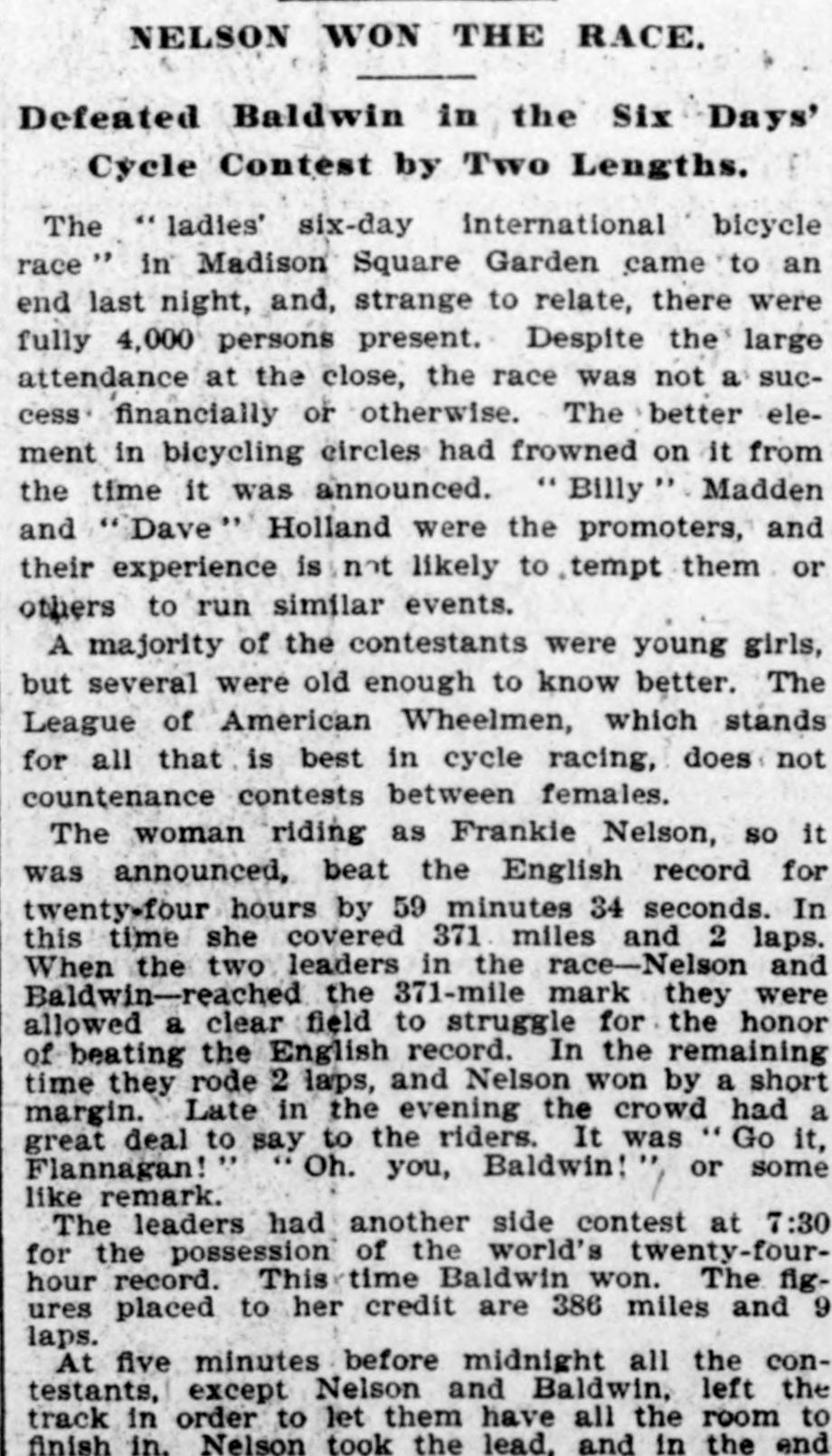
“Nelson Won the Race.” The New York Times, New York, New York, January 12, 1896, page 6. Internet Archive, public domain. Click the clipping to read it full size.
Not everyone cheered
Many grown-ups in 1896 thought women shouldn’t race in public. The Times said the League of American Wheelmen, the big national bicycle club, did not approve of races between women. The Tribune’s editors hoped that no more races like this “will ever again be held.” They wrote that it “ill becomes our fair sisters” to race in front of a crowd “for so much cash.” In other words, they thought it wasn’t ladylike.
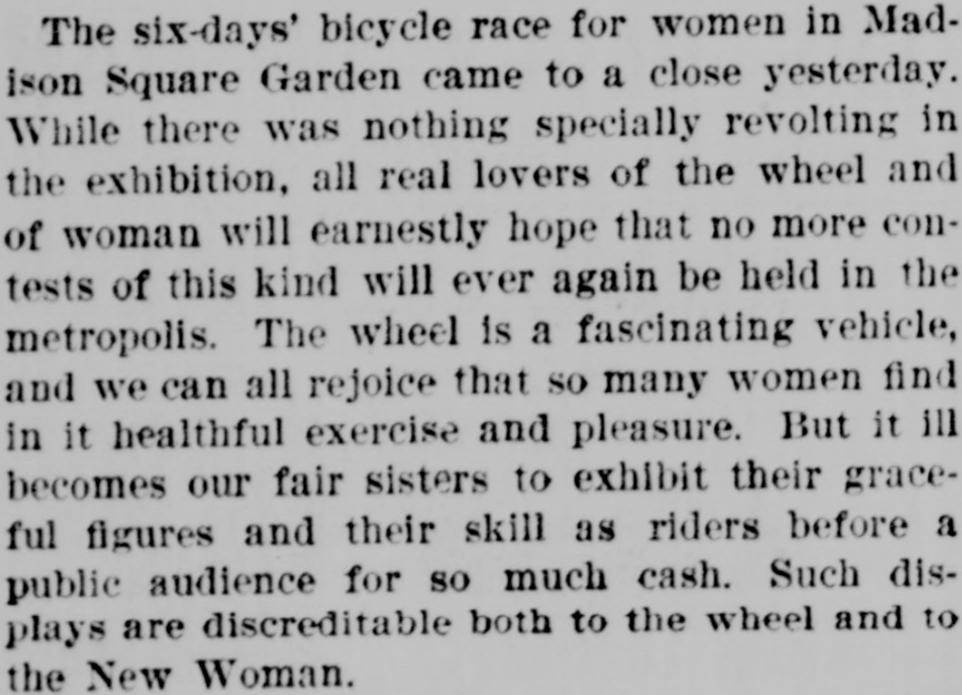
The Tribune’s editors did not approve. New-York Tribune, New York, New York, January 12, 1896, page 6. Library of Congress, Chronicling America. Click the clipping to read it full size.
But the Tribune’s own bicycle writer saw something different. The fans were “well-dressed, well-behaved people,” he wrote, and “Many of the women were splendid riders.” The race lost money, but the riders did what they came to do.
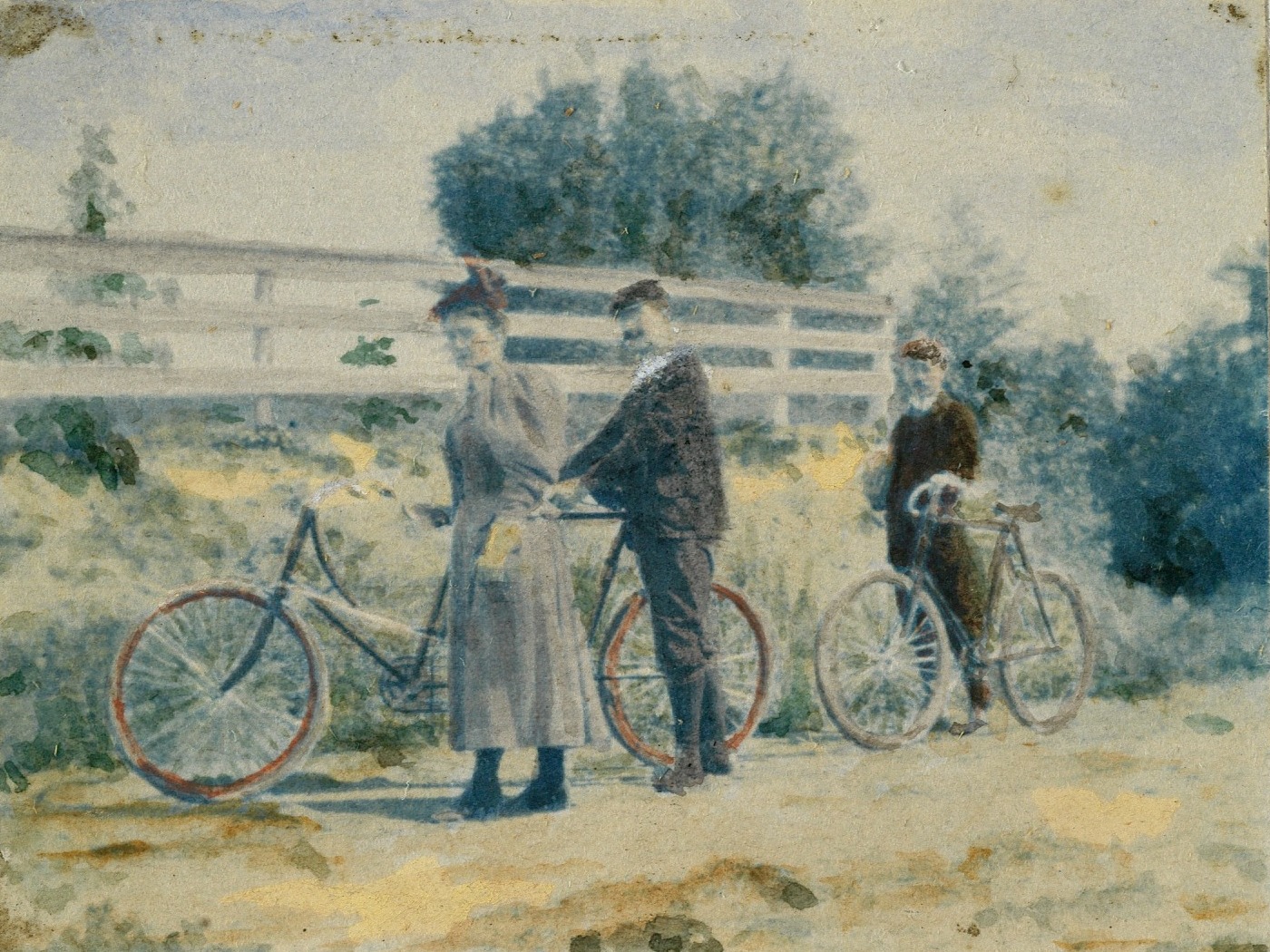
A woman and her bicycle in a tiny hand-colored “Pocket Kodak” snapshot made after 1895. The photographer is unknown, and the people are not the racers. Smithsonian American Art Museum, Gift of Mr. and Mrs. Charles H. Moore, CC0. Click the picture to see it full size.
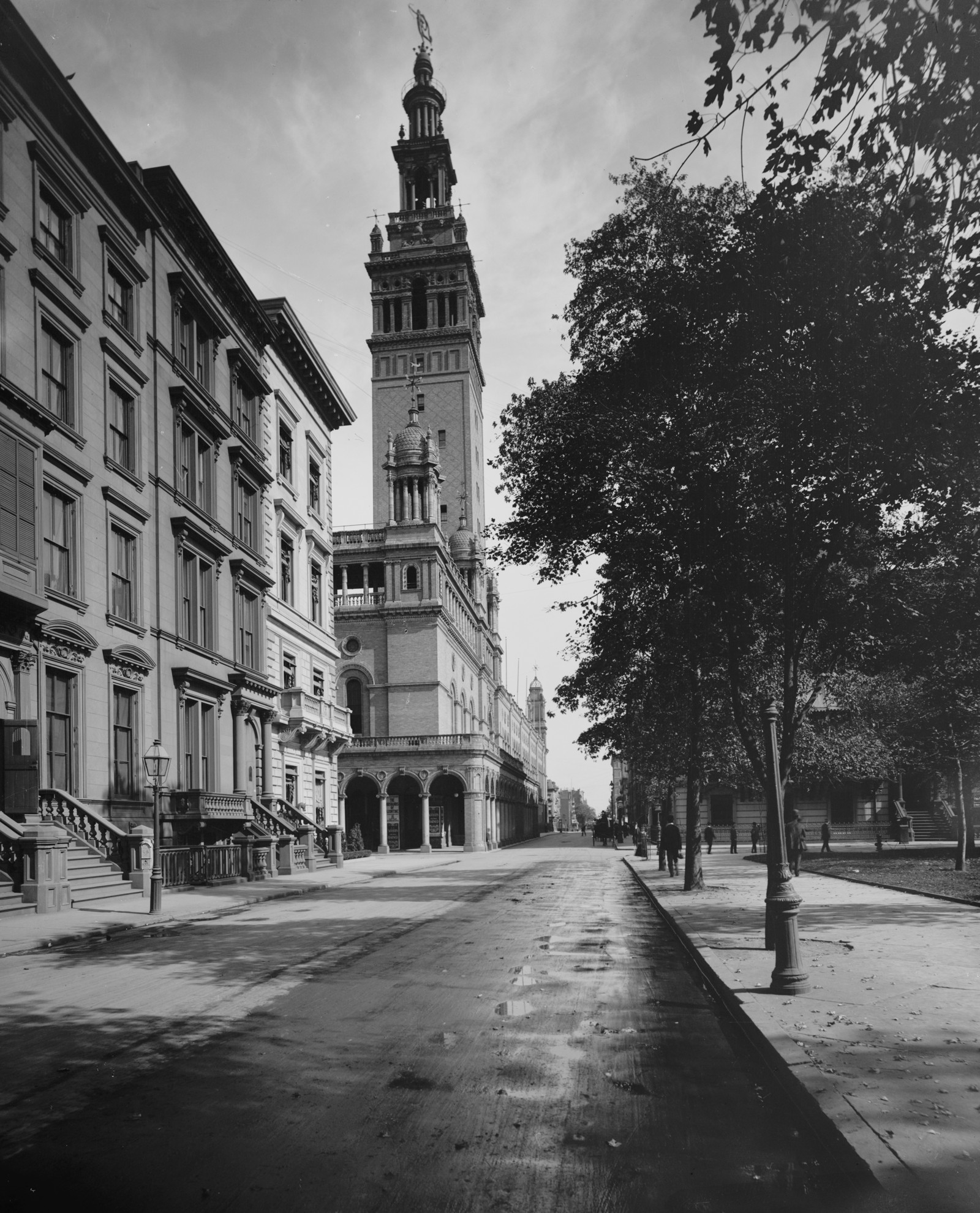
Madison Square Garden, the building where the race was held, about 1901. Detroit Publishing Co., Library of Congress. Click the picture to see it full size.
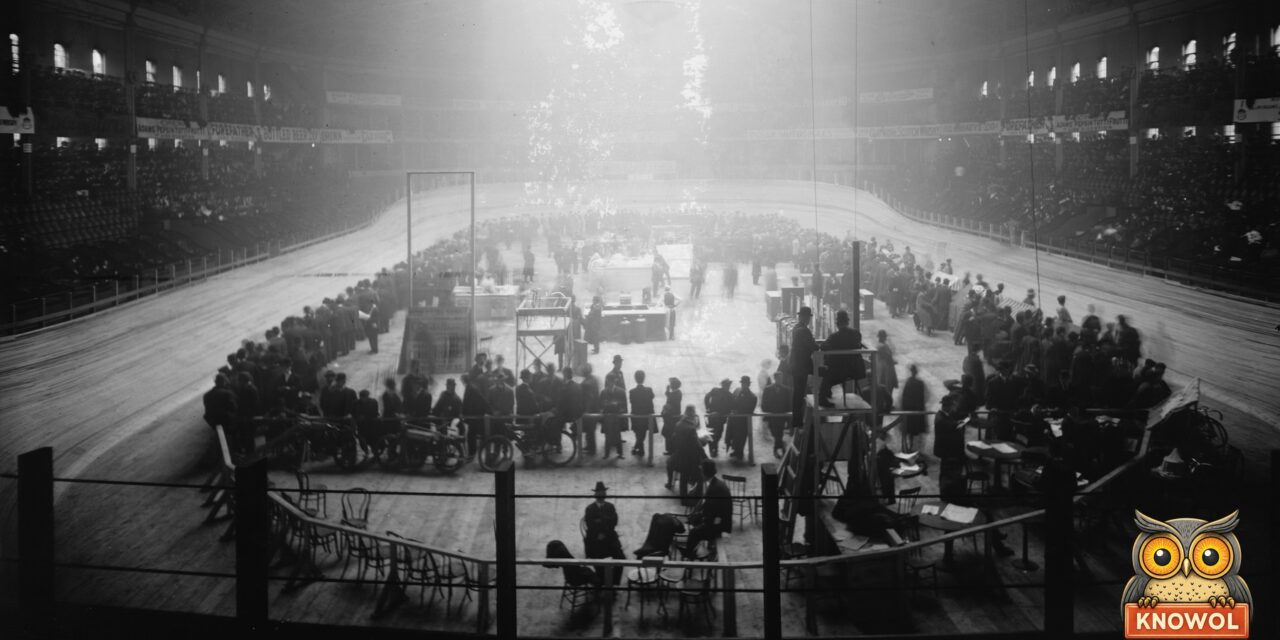
The Garden kept its bicycle races, too. The photo at the top of this story shows a later six-day bicycle race inside the same Madison Square Garden, and a note on the glass negative says December 1908. The track looks steeper by then, but the idea is the same one those twenty women tried in 1896: ride around and around, day after day, and see who is out front when the clock strikes twelve. In 1896 that was Frankie Nelson, by three wheels, with a green parrot somewhere in the crowd.
Sources
- New-York Tribune (New York, New York): “The Women’s Bicycle Race a Fizzle,” January 7, 1896, page 9; “Women Cyclers in the Garden,” January 11, 1896, page 3; “Close Race at the Garden,” January 12, 1896, page 2; the editors’ opinion, January 12, 1896, page 6; bicycle prices and the race’s lessons, January 12, 1896, page 23. Library of Congress, Chronicling America.
- The Journal (New York, New York): “The Ladies’ Bicycle Race,” January 3, 1896, page 10; “Flying Girls on Wheels,” January 6, 1896, page 5; “Cyclists Neck and Neck,” January 9, 1896, page 5. Library of Congress, Chronicling America.
- “Nelson Won the Race,” The New York Times, January 12, 1896, page 6. Internet Archive. Published 1896, public domain.
- Photos: “6-Day Bicycle Race, Madison Sq. Garden” (the cover; Bain News Service, glass negative marked Dec. ’08) and “Madison Square Garden, New York, N.Y.” (Detroit Publishing Co., about 1901), Library of Congress Prints and Photographs Division, no known restrictions on publication; “Woman on Bicycle” (unidentified photographer, after 1895), Smithsonian American Art Museum, CC0.