Late in January 1897, a keg of beer sat in the railroad depot at Kyle, Texas, waiting to be picked up. Some German neighbors who lived down the creek from town had ordered it. Then a hard freeze rolled in, and the weather was too miserable to travel. For three days, nobody came for the keg. When its owners finally did, the beer inside would not slosh or pour. It was “frozen solid.”
Kyle’s correspondent for The Austin Weekly Statesman, who sent in the town’s news, called it “quite an amusing incident that happened here growing out of the freeze.” The owners got some advice. In the paper’s words, “When assured by some who pretended to know that it would take it a month to thaw, they concluded to take it home, knock off the staves, saw it up and disseminate it in chunks.” Concluded means decided, and disseminate means to spread around, so the plan was to take the keg apart, saw the beer like a block of ice, and share it out piece by piece.
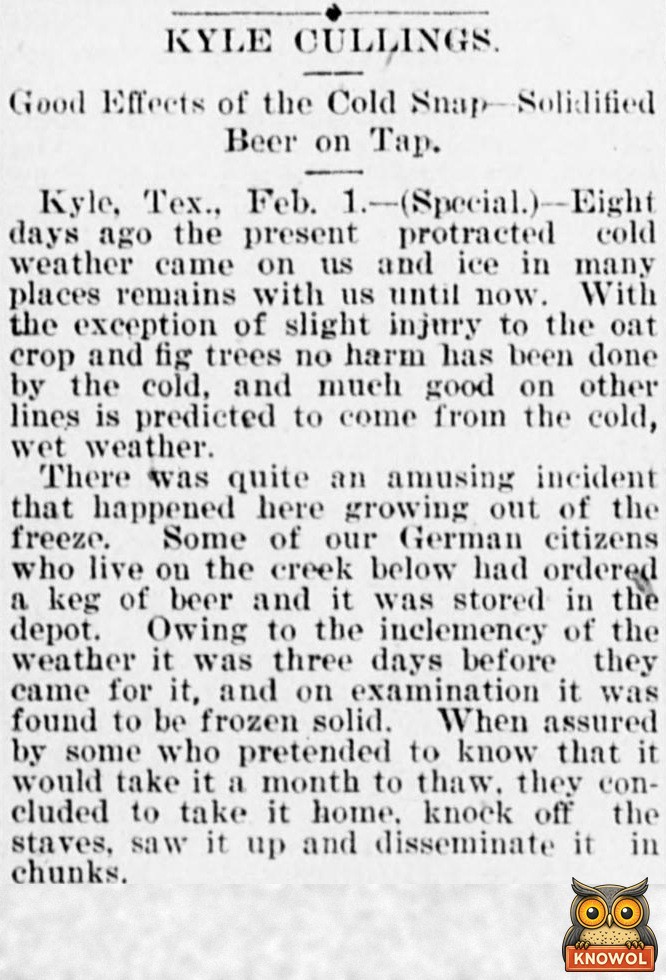
The Austin Weekly Statesman, Austin, Texas, February 4, 1897, page 6. Library of Congress, Chronicling America. Click the clipping to read it full size.
How to Saw Up a Frozen Keg in Kyle
A keg in 1897 was a small wooden barrel, built from long, curved boards called staves and held tight by hoops around the outside. The plan in Kyle, Texas, was simple: knock off the staves, and the wooden barrel falls away like a shell. What’s left is a solid block of frozen beer in the shape of the keg. Then you saw it into chunks small enough to carry, the way an iceman cut a big block of ice.
The paper’s words “some who pretended to know” were a wink, because nobody in Kyle really knew how long a frozen keg would take to thaw. The paper never said how the sawing went, or how the beer tasted once the chunks melted. Freight like the Kyle keg came by train and waited at the depot until its owner showed up with a wagon.
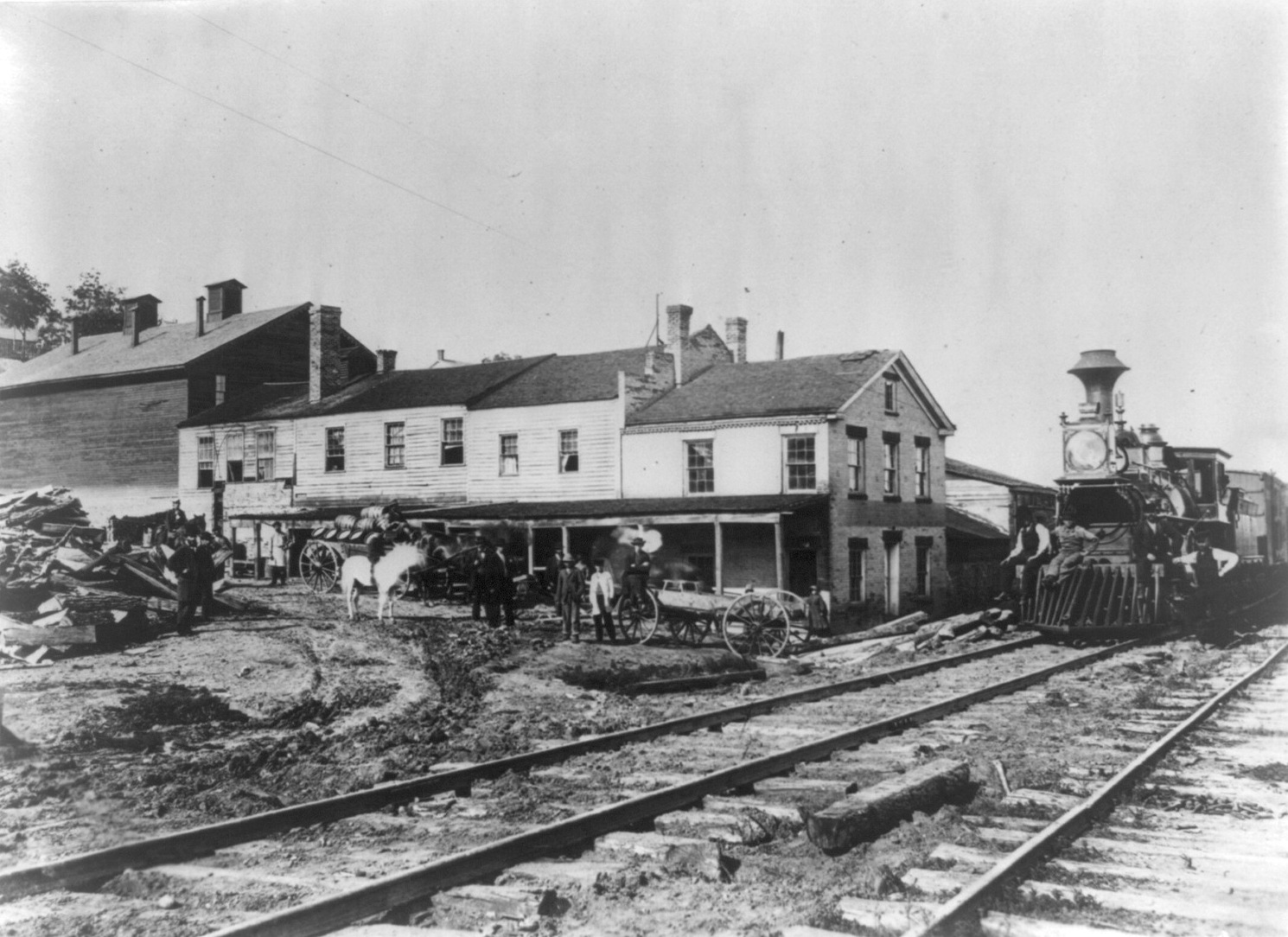
Men stand by a wagon piled with kegs next to a steam train in Peru, Illinois, in 1866. The Library of Congress thinks the building may have been a brewery. Photo by D. W. S. Rawson, Library of Congress. Click the picture to see it full size.
The Week Texas Froze Solid
The freeze that caught the Kyle keg hit much of Texas at once. “Eight days ago the present protracted cold weather came on us and ice in many places remains with us until now,” Kyle’s writer said on February 1. Protracted means long-lasting, and around Kyle, the only harm the writer saw was “slight injury to the oat crop and fig trees.”
In San Antonio, Texas, farther down the railroad, January 26 never warmed up past freezing. The San Antonio Daily Light’s weather record gave the high as 32 degrees and the low as 17.5, when a normal day at that time of year was 53. The paper called it “the lowest recorded thus far during the present winter.”
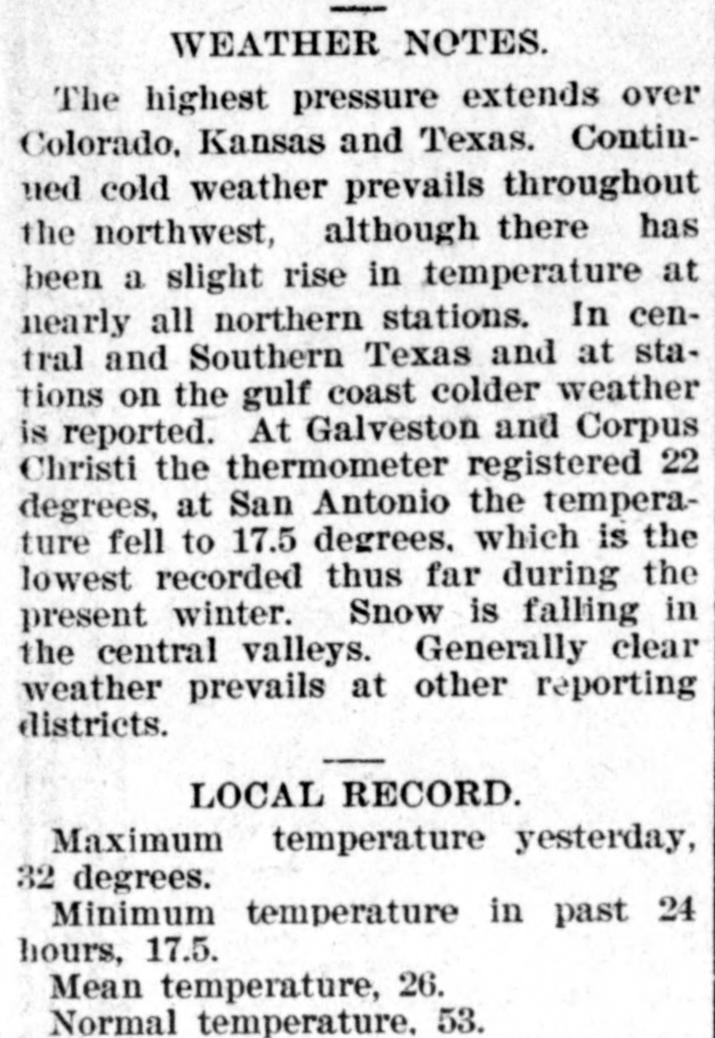
San Antonio Daily Light, San Antonio, Texas, January 27, 1897, page 5. Library of Congress, Chronicling America. Click the clipping to read it full size.
Even the fizzy water froze. The Light reported that “Seltzer in siphons at some of the saloons in this city this morning were frozen solid while standing on the bar shelves.” A seltzer siphon was a heavy glass bottle of bubbly water with a spout and a lever on top. Out on San Pedro Avenue, a workmen’s hose froze solid “and had to be thawed out over a fire built for the purpose.”
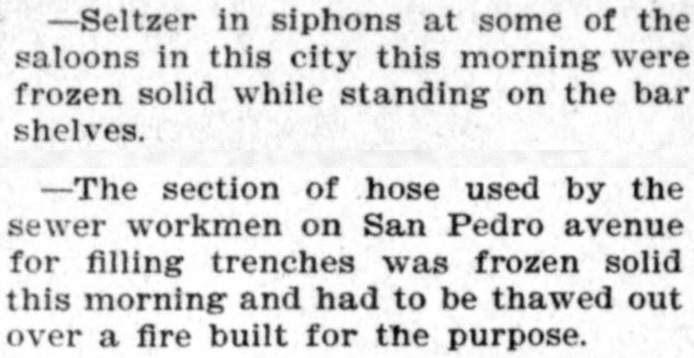
Two items from one column of the San Antonio Daily Light, San Antonio, Texas, January 27, 1897, page 4. Library of Congress, Chronicling America. Click the clipping to read it full size.
Sleds and Sleigh Bells in Austin and Taylor, Texas
In Austin, Texas, the capital, the Statesman’s “Sidewalk Notes” kept score. “This kind of weather maketh the coal dealers fat,” one note said, meaning that the men who sold coal for stoves were making money. Another note said, “The bicyclists have been walking for the past few days.” Nobody wanted to pedal over ice.
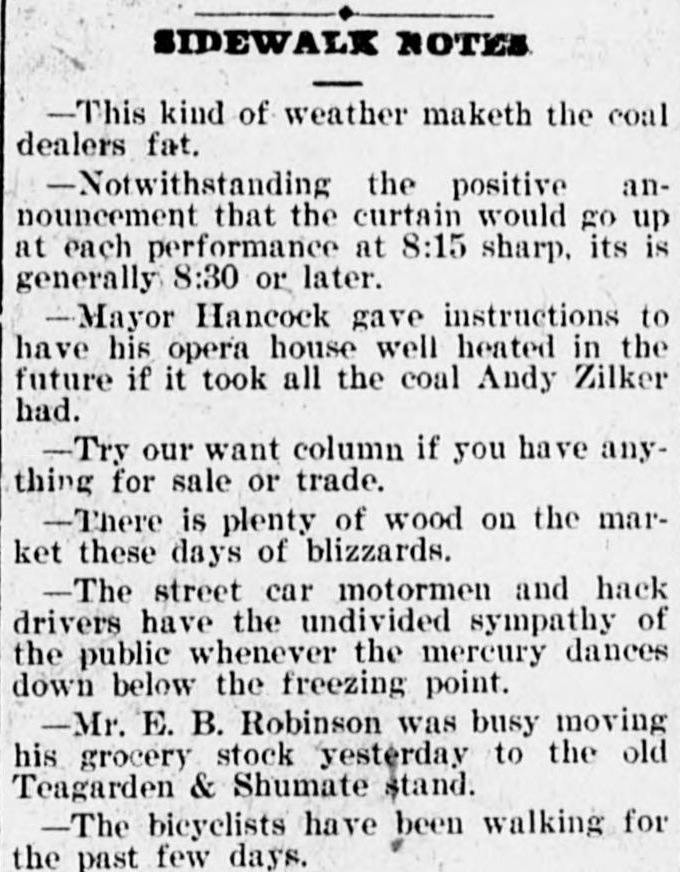
The Austin Weekly Statesman, Austin, Texas, January 28, 1897, page 5. Library of Congress, Chronicling America. Click the clipping to read it full size.
In Taylor, Texas, northeast of Austin, people made the best of it. They went out “on improvised sleds, and the merry jingle of sleigh bells are again heard upon the streets.” Improvised means made on the spot, out of whatever was handy. In the hills at Burnet, Texas, a thermometer “registered 8 degrees above zero.”
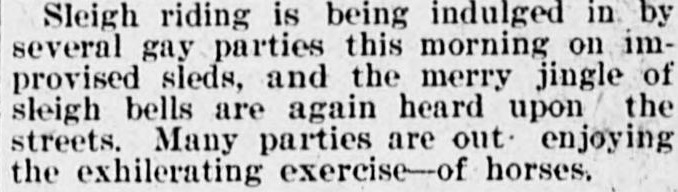
From a report sent from Taylor, Texas, in The Austin Weekly Statesman, January 28, 1897, page 5. Library of Congress, Chronicling America. Click the clipping to read it full size.
Frozen Kegs in Wyoming and Texas
Frozen beer was no shock in a cold place. In Rock Springs, Wyoming, two winters earlier, the Rock Springs Miner reported that “Curt Von-Knobloch received a car load of beer from St Louis, every keg of which was frozen solid.” A car load meant a whole railroad car full, and in Wyoming, that was just winter. In Texas, where a normal late-January day in San Antonio was 53 degrees, a frozen keg was news worth sending to the Austin paper.
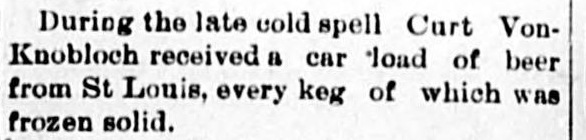
Rock Springs Miner, Rock Springs, Wyoming, February 14, 1895, page 4. Library of Congress, Chronicling America. Click the clipping to read it full size.
Waiting at the Kyle Depot for Bryan
The Kyle depot saw a second letdown that same cold week. William Jennings Bryan, who had run for president a few months earlier and lost to William McKinley, was touring Texas to give lectures. A group from Hays County, Kyle’s county, went to hear him in Austin. Seats cost $1.50, and when they got home, they said, “Well, we hardly got the worth of our dollar and fifty cents.”
Kyle was promised a free look. Word went out that on his way back from San Antonio, Bryan would “address the citizens of Kyle from the platform of the car,” which meant the open porch at the end of a railroad passenger car. When the train stopped, the first face on the platform belonged to a Kyle doctor named Martin. Next came former Texas governor James S. Hogg. “The governor announced the non-presence of Mr. Bryan,” the paper said. In plain words, there would be no Bryan for Kyle that day.
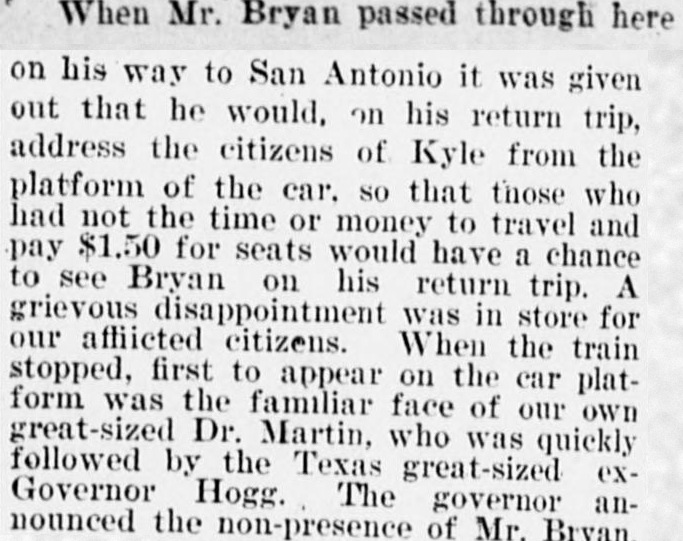
The same Kyle report goes on in the next column. The Austin Weekly Statesman, February 4, 1897, page 6. Library of Congress, Chronicling America. Click the clipping to read it full size.
Kyle, Texas, a Railroad Town
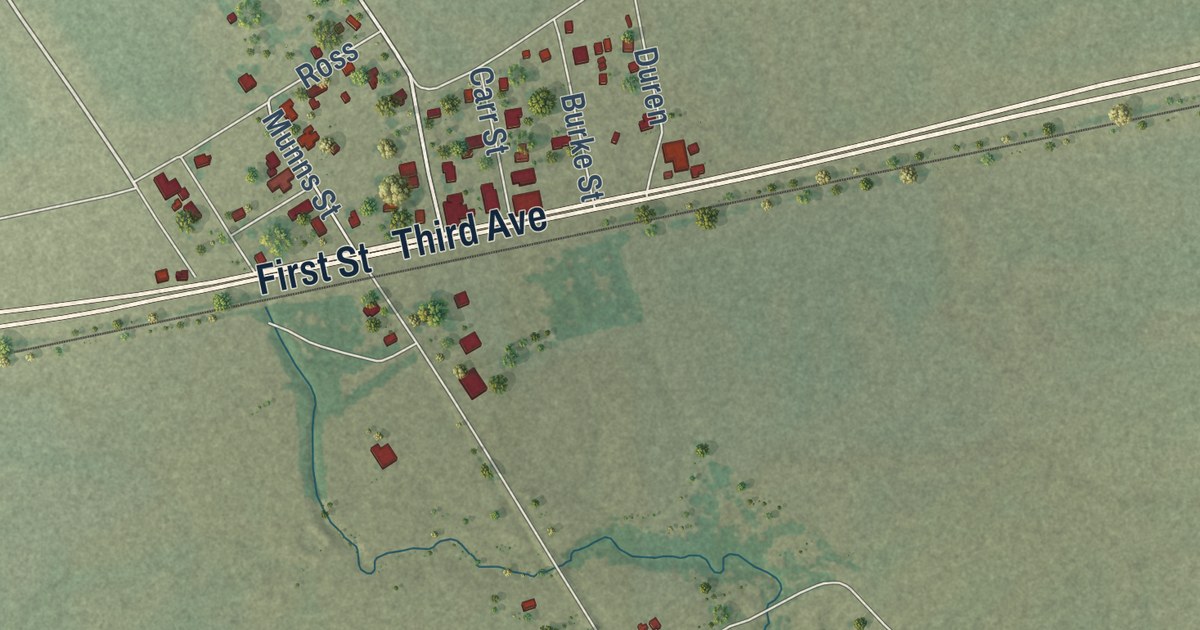
Kyle was a railroad town, and an 1882 state report on Texas listed it as one of three stations of the International and Great Northern Railway in Hays County, and called it “a thriving town of 500 inhabitants.” The depot was the town’s front door. Travelers, mail and freight came and went through it, and in the hardest freeze in years, so did a keg of beer that turned to ice.
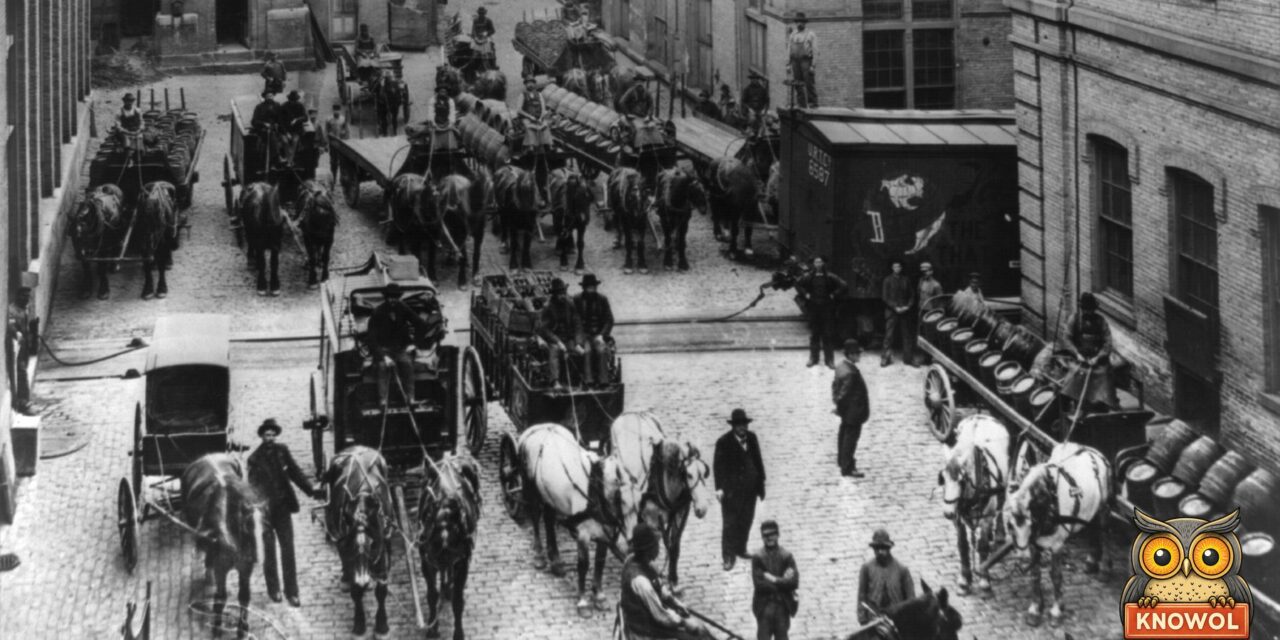
The Austin paper never printed what became of the chunks. But for one cold week in 1897, a keg in a Texas depot froze as hard as a block of ice, and its owners decided the way to get it home was with a saw. The photo at the top of this page is not Kyle. It shows wagons loaded with beer kegs at the Schlitz brewery in Milwaukee, Wisconsin, about 1900, with a railroad car in the yard.
Sources
- “Kyle Cullings,” The Austin Weekly Statesman (Austin, Texas), February 4, 1897, page 6. Library of Congress, Chronicling America.
- San Antonio Daily Light (San Antonio, Texas), January 27, 1897, page 5, “Weather Notes” and “Local Record.” Library of Congress, Chronicling America.
- San Antonio Daily Light, January 27, 1897, page 4, the seltzer and hose items. Library of Congress, Chronicling America.
- The Austin Weekly Statesman, January 28, 1897, page 5, “Sidewalk Notes” and “Taylor Temperature.” Library of Congress, Chronicling America.
- The Austin Weekly Statesman, February 4, 1897, page 9, “Burnet Budget.” Library of Congress, Chronicling America.
- Rock Springs Miner (Rock Springs, Wyoming), February 14, 1895, page 4. Library of Congress, Chronicling America.
- The Resources, Soil, and Climate of Texas, 1882, page 143 (Hays County). Internet Archive.
- Horse-drawn delivery trucks, Schlitz Brewery, Milwaukee, Wisconsin, about 1900 (the cover). Library of Congress Prints and Photographs Division. No known restrictions on publication.
- View of a brewery? in Peru, Ill., showing a wagon loaded with kegs and a railroad train, D. W. S. Rawson, 1866. Library of Congress Prints and Photographs Division. No known restrictions on publication.
- The newspapers, the book and the photographs above were all published or made before 1931 and are in the public domain.