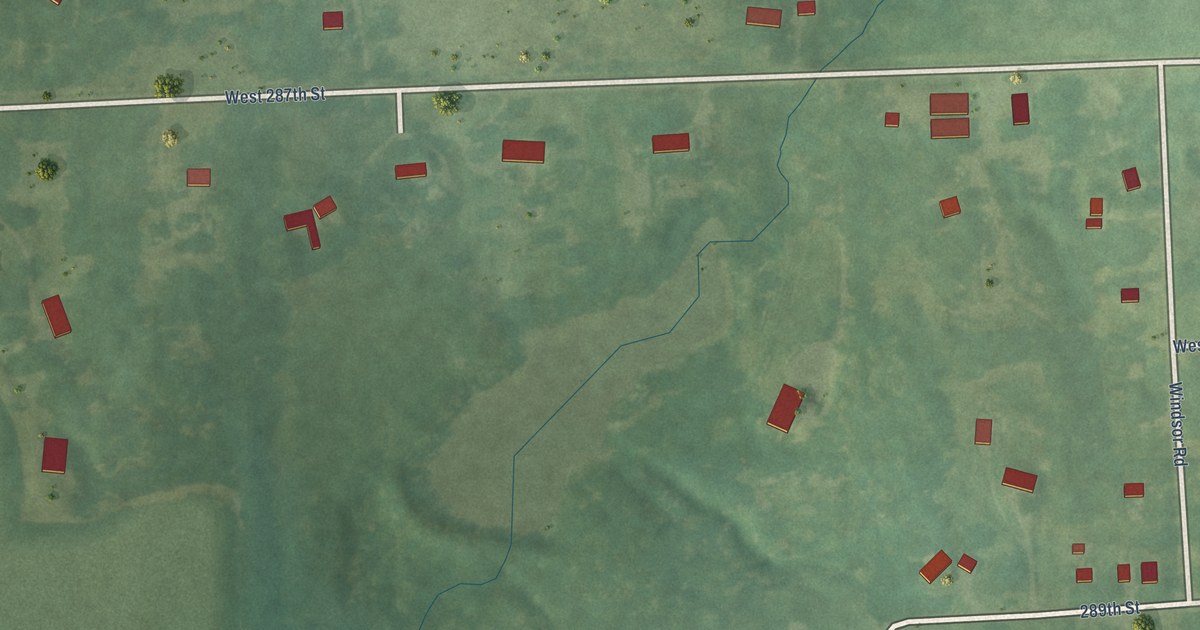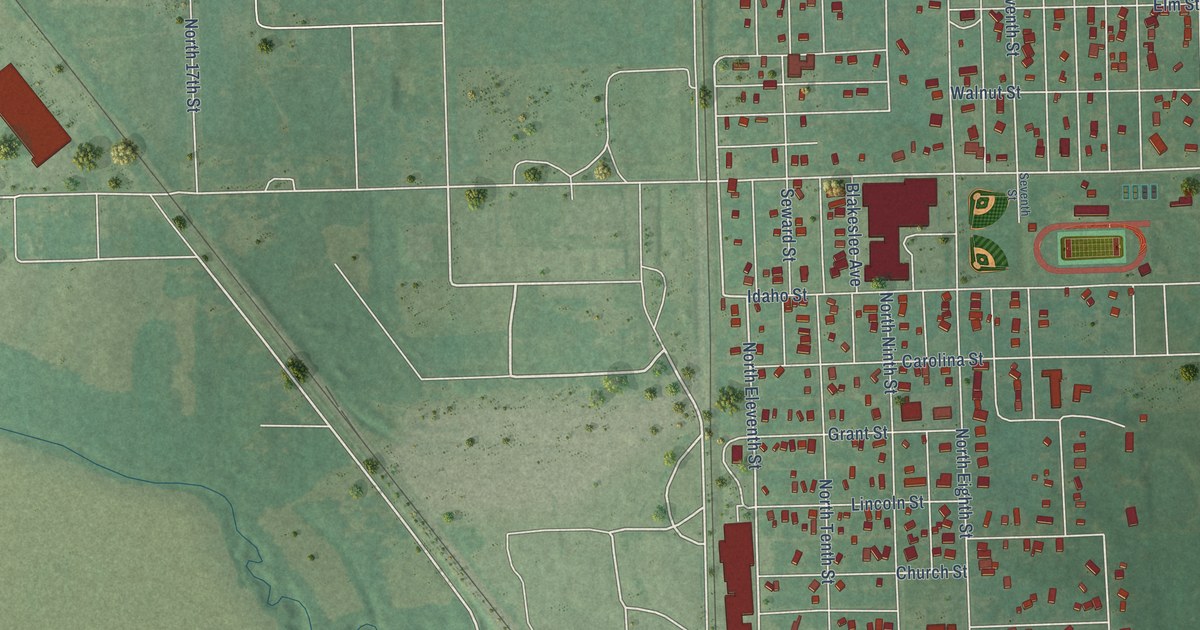
On Sunday evening, December 20, 1908, five days before Christmas, a ball of fire slid down the sky over Kansas at dusk. In Lincoln Center, Kansas, a small county-seat town that most people just called Lincoln, folks said it came down right in town. Two days later the Topeka State Journal printed the news from Lincoln Center: “A large meteor fell in the main street of the city Sunday evening, lighting up the entire town and causing great consternation.” Consternation means alarm, the kind that sends everybody out the front door to look.
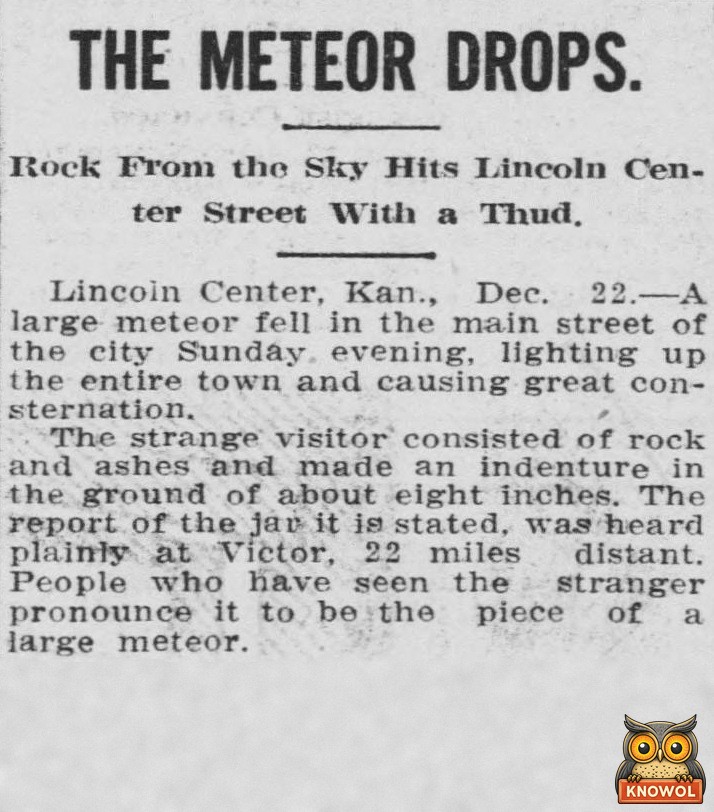
The Topeka State Journal, Topeka, Kansas, December 22, 1908, page 9. Library of Congress, Chronicling America. Click the clipping to read it full size.
The headline promised a “Rock From the Sky” that hit the street “With a Thud.” The paper said “the strange visitor consisted of rock and ashes and made an indenture in the ground of about eight inches.” An indenture here just means a dent, about as deep as a new pencil is long. The bang, the paper said, “was heard plainly at Victor, 22 miles distant.”
What Lincoln Center Found in Its Street
On Christmas Eve, the Abilene Weekly Reflector told more. Abilene, Kansas, sits about 50 miles east of Lincoln Center, and “so many Abilene people” had watched the meteor “fall through the sky Sunday evening about 5.” Now word had come that it “struck in the street of Lincoln” and “burst in a million pieces, not more than two blocks from the center of the town.” It “came down through the air with a thunderous noise and illuminated the county for miles around.”
The paper also told what was left in Lincoln Center’s street. “A small mound of black dust shows distinctly where the meteor fell,” the Reflector said, with bigger bits around it, “none larger than a common marble.” People in Lincoln said it looked like “the soot which comes out of stove when cleaning it,” only grittier, and “coal black.”
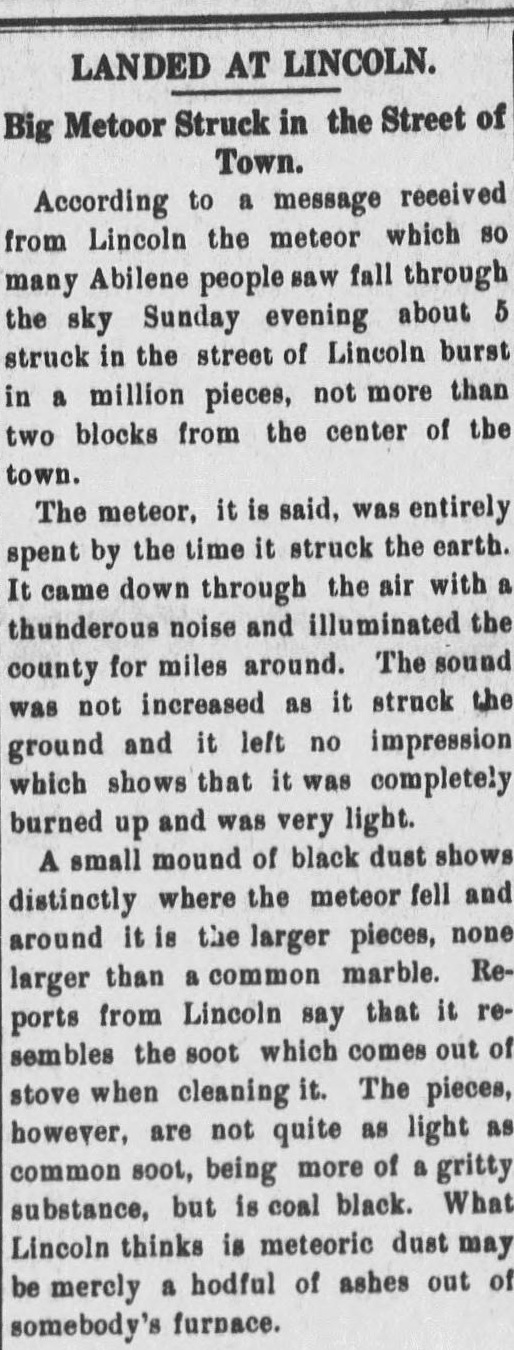
The Abilene Weekly Reflector, Abilene, Kansas, December 24, 1908, page 7. Library of Congress, Chronicling America. Click the clipping to read it full size.
This report did not agree with Topeka’s. The Abilene paper said the meteor “left no impression,” no dent at all, which showed “that it was completely burned up and was very light.” One paper had an eight-inch dent. The other had a little pile of dust.
The Abilene Editor’s Furnace-Ash Idea
The Abilene editor in Kansas saved one more line for the end, and you can almost hear the grin: “What Lincoln thinks is meteoric dust may be merely a hodful of ashes out of somebody’s furnace.” A hod is a tall metal bucket. People used one to carry coal in to the stove and carry the ashes back out. In December, stoves and furnaces all over Lincoln Center were making ashes.
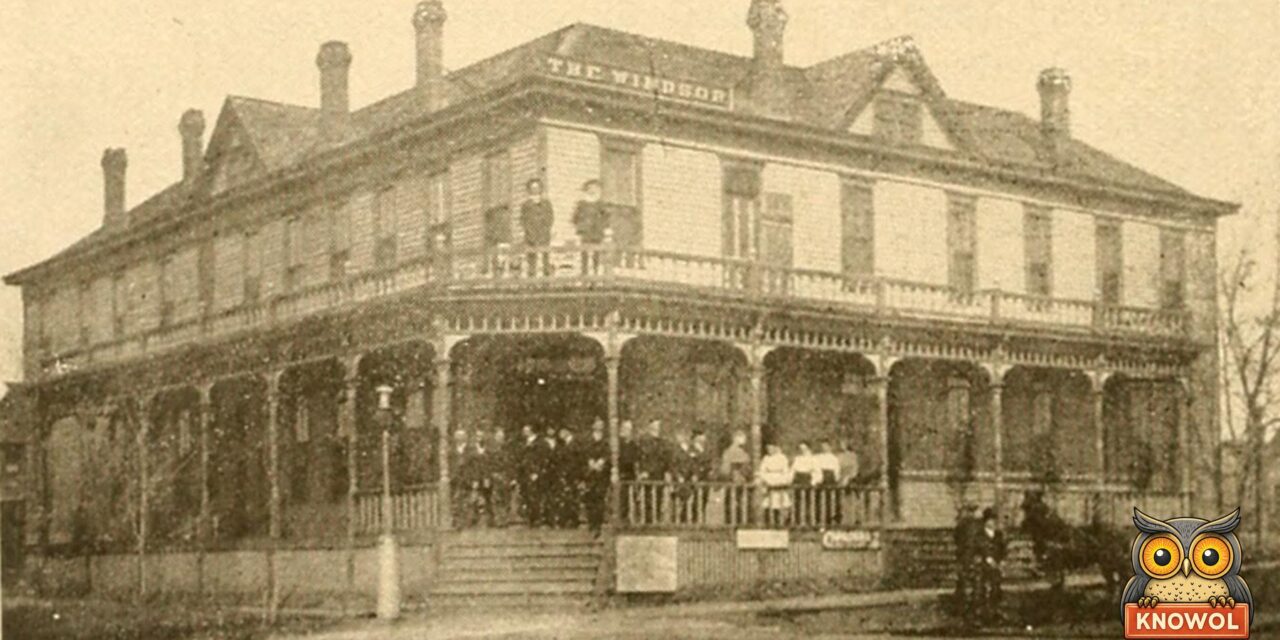
Lincoln Center was a proud little city in 1908. A county history printed that year said it had “city waterworks, electric lights, excellent public schools, a college, fine residences, two blocks of flourishing business houses, a sanitarium, and a lot of automobiles.” A sanitarium was a kind of hospital where people went to rest and get well. Nearly all its stores were “built of native rock,” the local stone. The photo at the top of this page comes from that same 1908 book. It shows the Windsor Hotel in Lincoln Center, with its guests lined up on the porch, a street lamp out front, and a horse and buggy waiting in the dirt street. The hotel’s ad, for “MRS. H. ALLEN, Proprietor,” promised “ELECTRIC LIGHTS” and rates of “$2.00 PER DAY.”
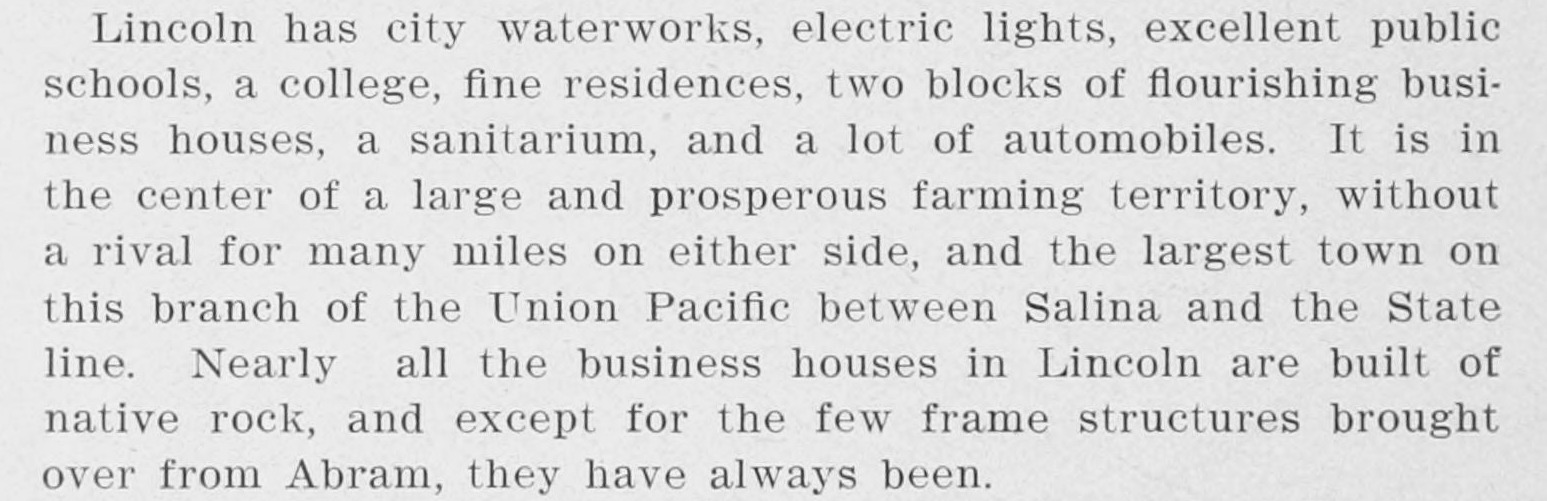
A Souvenir History of Lincoln County, Kansas, by Elizabeth N. Barr, 1908, page 66. Library of Congress copy, Internet Archive, public domain. Click the clipping to read it full size.
Everybody Saw the Meteor, From St. Joseph to Wichita
Lincoln Center was far from the only town looking up that night. In St. Joseph, Missouri, about 180 miles to the east, “several hundred persons” watched it between 5 and 6 o’clock. A news story sent out from St. Joseph that night ran in papers from Los Angeles to Honolulu. The story called it “the strangest meteor ever seen in this part of the country.” It “had the appearance of a ball of fire about the size of a street lamp,” with a tail of sparks “several feet in length,” and it shone for “about thirty seconds.”
Then came the strangest part. “A peculiar white streak” stayed in the sky where the meteor had passed, and it “was visible for fifteen minutes.” It “seemed to waver in its course, as if blown by the wind, and gradually faded from sight.”
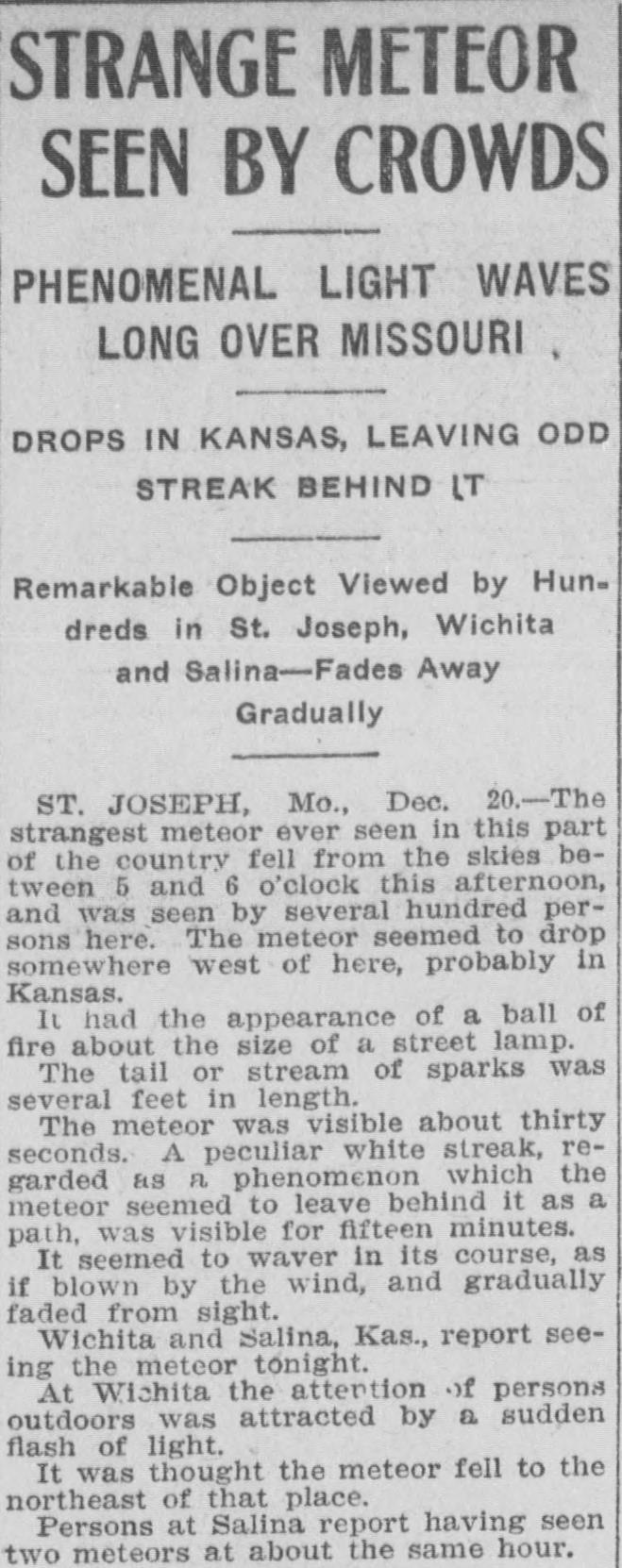
Los Angeles Herald, Los Angeles, California, December 21, 1908, page 2. Library of Congress, Chronicling America. Click the clipping to read it full size.
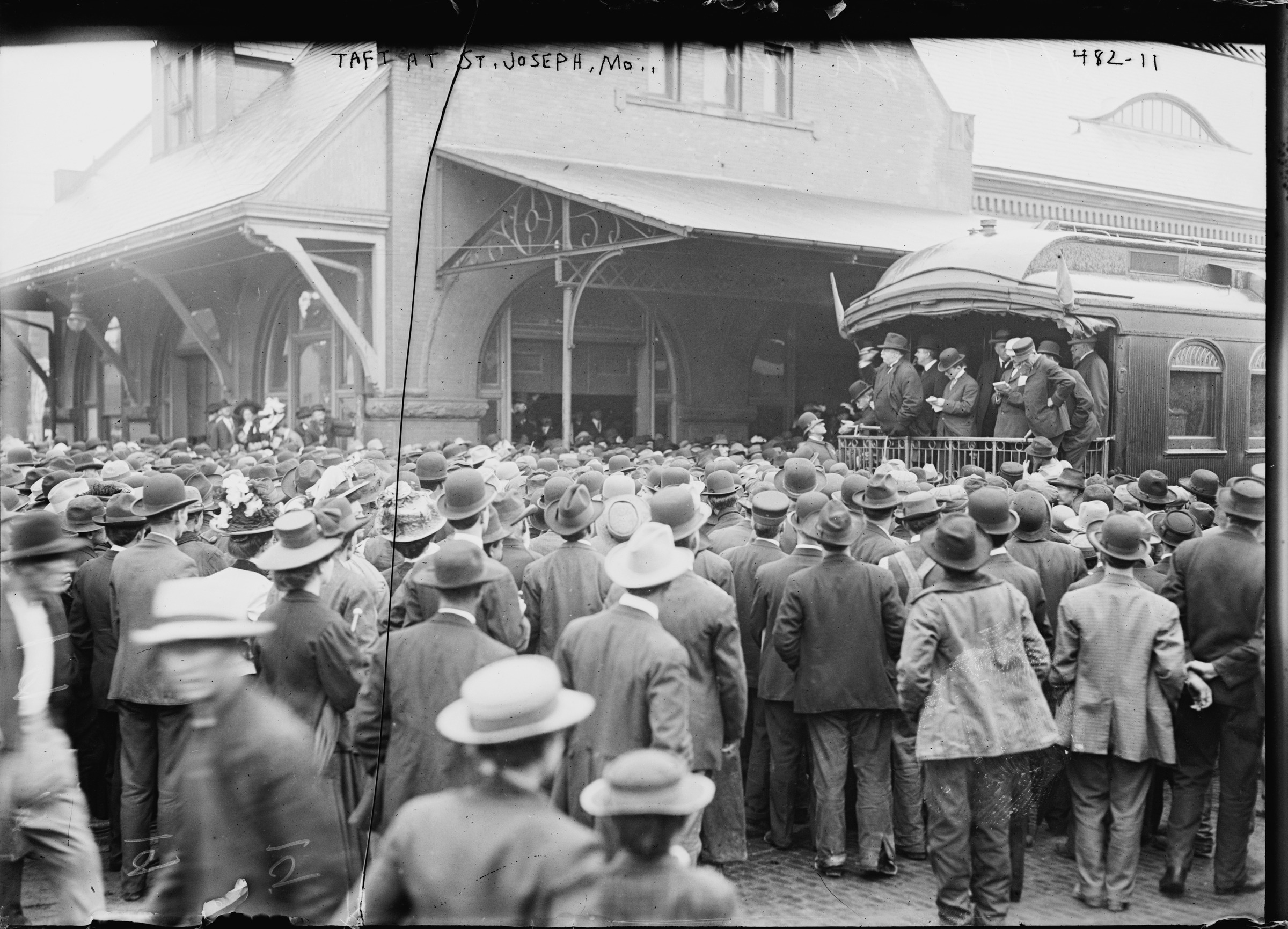
St. Joseph, Missouri, knew how to turn out a crowd. Here hundreds of people pack around a railroad car to see William Howard Taft in 1908, the year of the meteor. Bain News Service, Library of Congress. Click the picture to see it full size.
In Butler, Missouri, the editor of the Butler Weekly Times and his wife were out in their front yard between five and six. They saw it in the west, “bright as an electric light,” and it “left a white streak in its wake which was visible for several minutes.” To them it “had much the appearance of the flight of a very large sky rocket.”
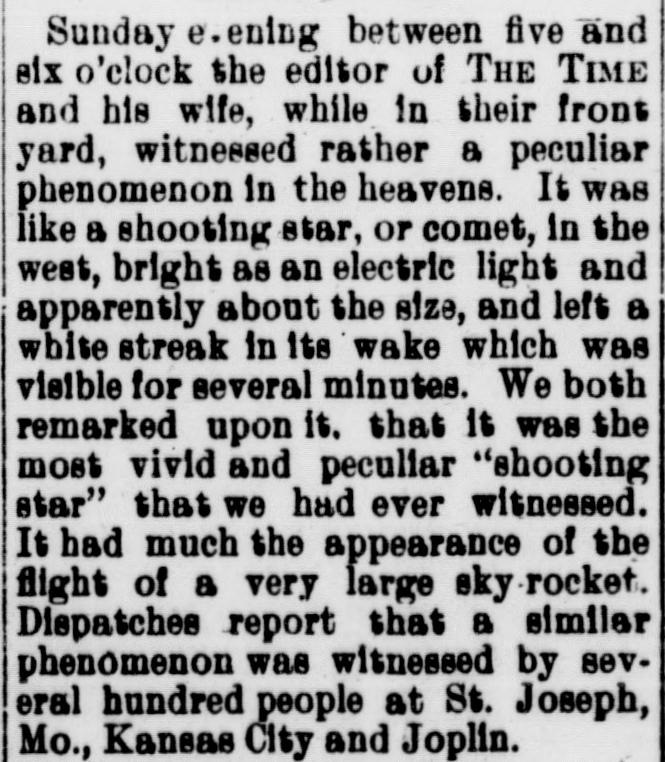
The Butler Weekly Times, Butler, Missouri, December 24, 1908, page 4. Library of Congress, Chronicling America. Click the clipping to read it full size.
In Wichita, Kansas, “the northern sky was brightly illuminated” at about 6 o’clock, and the people who saw it “are all of the opinion that it struck not many miles north of the city.” In Salina, Kansas, people counted “two meteors” that “shot across the heavens from the northeast and were very low.” The Salina report added, “Each star broke in two before it disappeared.”
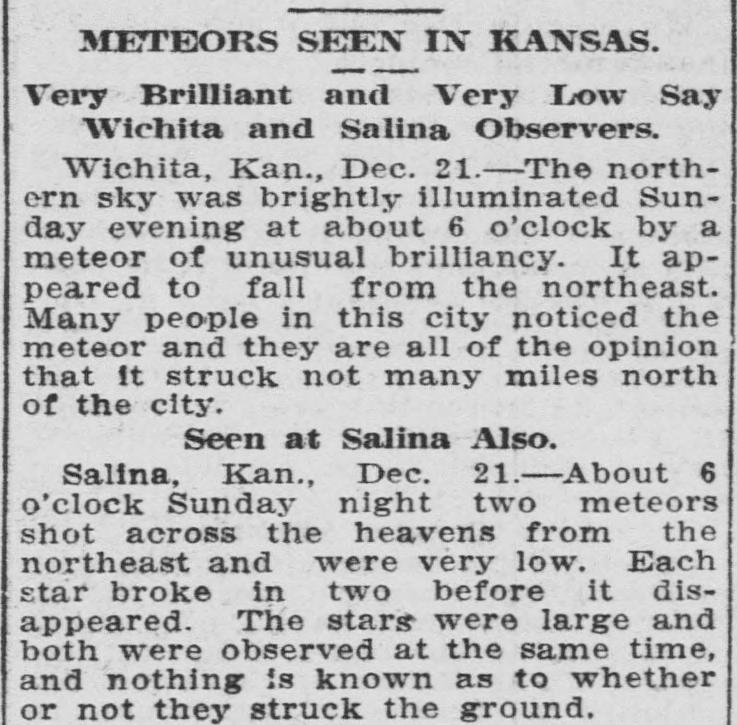
The Topeka State Journal, Topeka, Kansas, December 21, 1908, page 2. Library of Congress, Chronicling America. Click the clipping to read it full size.
In Rich Hill, Missouri, the word was that the meteor came down in the Marais des Cygnes bottoms, the flat farmland along the Marais des Cygnes River. There it “bounded along the ground for some distance before landing.”
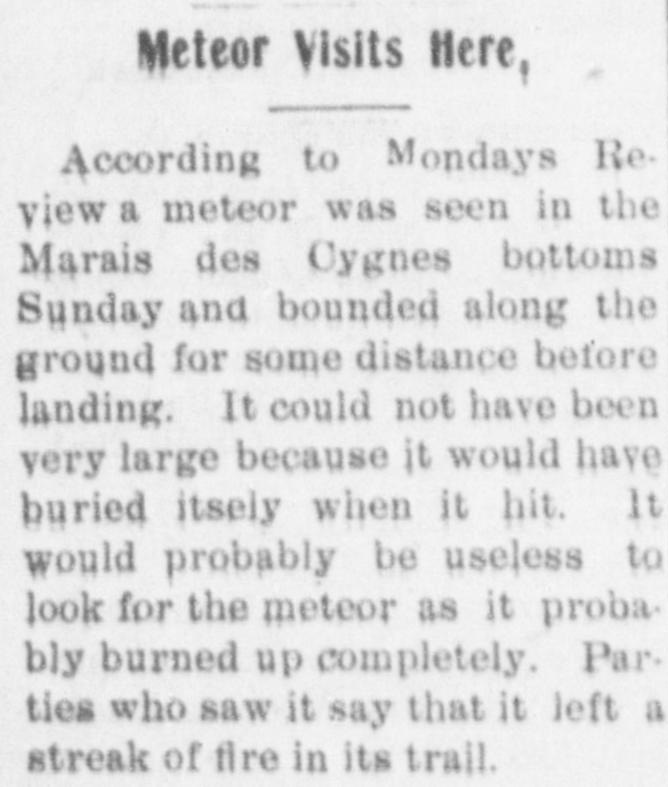
The Rich Hill Tribune, Rich Hill, Missouri, December 24, 1908, page 1. Library of Congress, Chronicling America. Click the clipping to read it full size.
The Topeka State Journal could not pass up a joke. Nobody in Topeka seemed to have seen “that marvellous meteor which was frisking around Wichita, Salina and St. Joseph,” it said, maybe “because they have other things to do besides star-gazing.” Then it added, “As might be expected, the Salina folks did a little better than any of the rest of them. They saw two meteors.”
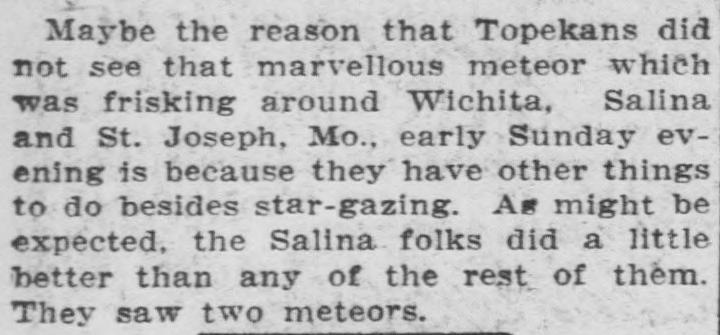
The Topeka State Journal, Topeka, Kansas, December 22, 1908, page 4. Library of Congress, Chronicling America. Click the clipping to read it full size.
Why Every Town Thought the Meteor Landed Close By
Here is the puzzle. Rich Hill, Missouri, and Lincoln Center, Kansas, are about 215 miles apart as the crow flies. St. Joseph and Wichita are almost 200 miles apart. One meteor could not have landed next to all of them.
The answer is how high meteors are. The American Meteor Society says most meteors glow about 50 to 75 miles above the ground. From way up there, one fireball can light the sky over two states at once. To each person watching, it seems to sink just past the edge of their own town. Really, it is far away and still miles up when it goes out.
Most meteors never reach the ground at all. The society says bits of space rock from the size of dust up to a few kilograms, or several pounds, usually burn up completely in the air. The Rich Hill paper guessed right: “It would probably be useless to look for the meteor as it probably burned up completely.”
The white streak over St. Joseph has a name, too. Scientists call it a train. The society’s fireball page says most trains last only a few seconds, but once in a while one lasts several minutes. A long-lasting train can change shape as winds high in the air blow it around. So the people in St. Joseph had it right. Their streak really was “blown by the wind,” miles above their heads. A train that lasted fifteen minutes would have been a rare sight.
The bang people heard may have been real, too. The society says a very bright fireball can make a sonic boom, a bang like thunder that reaches the ground a minute and a half to four minutes after the flash.
One Meteor, Three Drawings, in 1860
People had disagreed about one meteor before. On Friday, July 20, 1860, a great meteor was seen from Detroit, Michigan, all the way out to sea, “200 miles east of the Bay of New York.” Harper’s Weekly, a big New York magazine, printed three drawings of it, made by three men in three places. The magazine had reports from “some forty observers,” and they did not agree. “Most of them describe it as ‘two large balls of fire,'” Harper’s said. “But observers at Buffalo, Syracuse, Boston, Philadelphia, New York, Newburgh, and Long Island say that there was but ‘one ball.'”
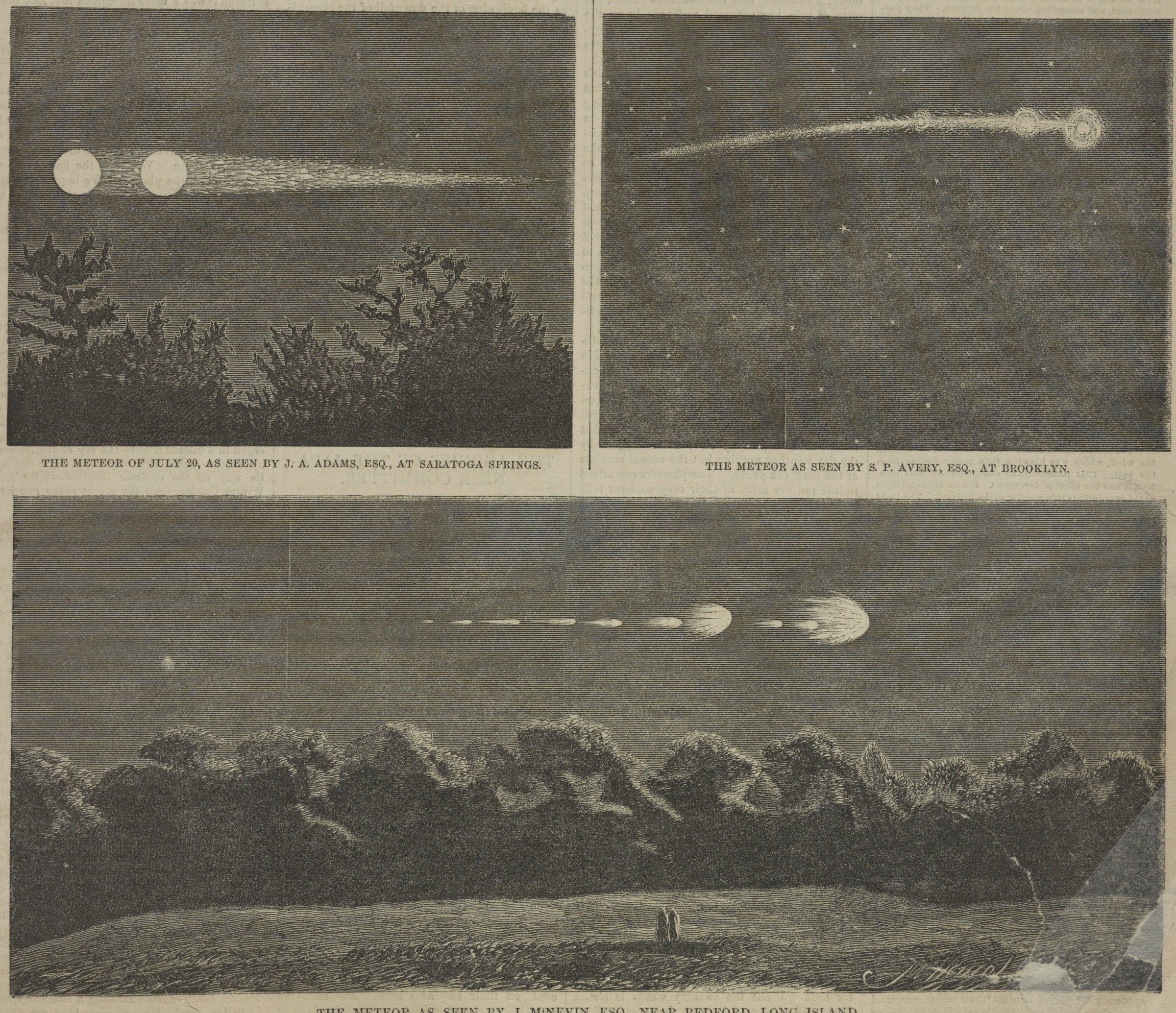
The great meteor of July 20, 1860, as three men drew it at Saratoga Springs, at Brooklyn and near Bedford, Long Island, all in New York. Harper’s Weekly, August 4, 1860. Library of Congress. Click the picture to see it full size.
How the Lincoln Center Meteor Story Ended
As far as we can find, nobody ever turned up a real meteorite from that Sunday night in 1908. Four days later the Rich Hill Tribune in Missouri said, “No parties as yet have reported finding the meteor.” We found no later report of one in the Kansas or Missouri papers, or of anybody coming to Lincoln Center to study the black pile in the street.

The Rich Hill Tribune, Rich Hill, Missouri, December 24, 1908, page 1. Library of Congress, Chronicling America. Click the clipping to read it full size.
Nobody can say now what that little mound of coal-black grit two blocks from the middle of Lincoln Center really was. It may have been dust from the sky, or it may have been a hodful of somebody’s furnace ashes, just as the Abilene editor guessed. Either way, for half a minute around suppertime, five days before Christmas, hundreds of people in two states stood in their yards and streets and looked up at the same light. Every town got its own story out of it. Salina, as the Topeka paper said, got two.
Sources
- “The Meteor Drops,” The Topeka State Journal (Topeka, Kansas), December 22, 1908, page 9. Library of Congress, Chronicling America.
- “Landed at Lincoln” and “Did You See It,” The Abilene Weekly Reflector (Abilene, Kansas), December 24, 1908, page 7. Library of Congress, Chronicling America.
- “Strange Meteor Seen by Crowds,” Los Angeles Herald (Los Angeles, California), December 21, 1908, page 2. Library of Congress, Chronicling America.
- The Hawaiian Star (Honolulu), December 29, 1908, page 6, the same St. Joseph story. Library of Congress, Chronicling America.
- The Butler Weekly Times (Butler, Missouri), December 24, 1908, page 4. Library of Congress, Chronicling America.
- “Meteors Seen in Kansas,” The Topeka State Journal, December 21, 1908, page 2. Library of Congress, Chronicling America.
- The Topeka State Journal, December 22, 1908, page 4 (the star-gazing joke). Library of Congress, Chronicling America.
- “Meteor Visits Here,” The Rich Hill Tribune (Rich Hill, Missouri), December 24, 1908, page 1. Library of Congress, Chronicling America.
- A Souvenir History of Lincoln County, Kansas, by Elizabeth N. Barr (Topeka, 1908), page 66 (the town) and page 70 (the Windsor Hotel photo, the cover). Library of Congress copy, Internet Archive. Public domain.
- The Meteor, Harper’s Weekly, August 4, 1860, page 481, wood engravings, artist J. McNevin. Library of Congress Prints and Photographs Division. No known restrictions on publication.
- Taft at St. Joseph, Mo., Bain News Service, 1908. Library of Congress Prints and Photographs Division. No known restrictions on publication.
- American Meteor Society, Meteor FAQ and Fireball FAQ.
- The newspapers, book and pictures above were all published before 1931 and are in the public domain.