On Friday, June 21, 1850, readers of the New-York Daily Tribune in New York City turned to page 3 and found the usual things. There was news from around the city, a list of new patents that included a better tooth for hay rakes, and an ad for leeches fresh off a steamer from Europe. In the middle of it all sat a poem with a Latin title, “Resurgemus,” which means “We shall rise again.” At the bottom was the name of a 31-year-old newspaperman from Brooklyn: “WALTER WHITMAN.”
Five years later, the same man, who by then called himself Walt, put that poem inside a thin, odd book that had no name on its title page. The book was Leaves of Grass, and it would make him one of the most famous poets America ever had.
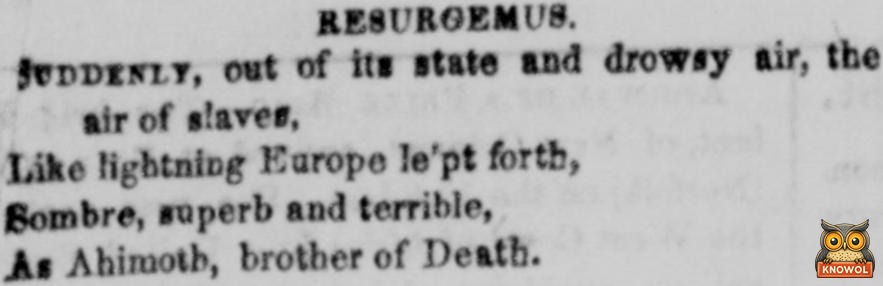
The title and first lines of “Resurgemus.” New-York Daily Tribune, New York, New York, June 21, 1850, page 3. Library of Congress, Chronicling America. Click the clipping to read it full size.
A Brooklyn Newspaperman Between Jobs
Walter Whitman was born on Long Island on May 31, 1819. His family moved to Brooklyn in 1823, when he was 4. Brooklyn was still a village then, with “but seven thousand inhabitants,” his early biographer Bliss Perry wrote in 1906. Walter grew up to be a printer and a newspaperman. At 27 or 28, Perry wrote, he became the editor of the Brooklyn Eagle.
The spring of 1850 was a thin time for him. Emory Holloway, who gathered Whitman’s early writings into a book in 1921, put it plainly: “instead of being in charge of a paper, he had to resort to what odd jobs he could get.” He also sent poems to Horace Greeley’s New York Tribune. Holloway listed three of them: “Blood-Money,” “The House of Friends” and “Resurgemus.”
What the Poem Was About
Whitman’s poem in the New York Tribune looked back across the ocean to 1848, the year people in France, Italy, the German states and the Austrian Empire rose up against their kings and emperors. “Like lightning Europe le’pt forth,” the poem says. Within a year or so, though, most of the old rulers were back in power, and the poem says that too: “And frightened rulers come back.”
The middle of the poem mourns the people who died in the fighting, and then it turns hopeful. Every grave, Whitman wrote, “is growing its seed of freedom,” a seed “Which the winds shall carry afar and resow, And the rain nourish.” Then came the ending, the lines people still quote:
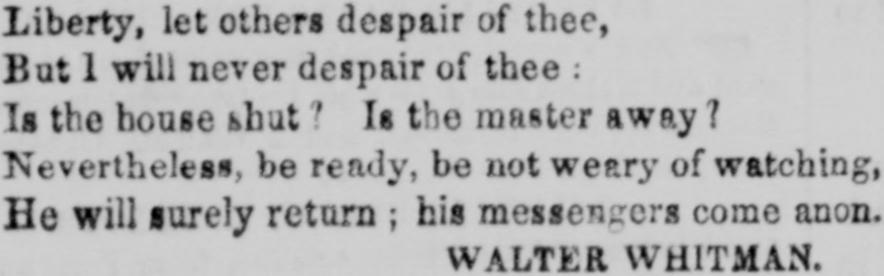
The last lines of “Resurgemus,” signed “WALTER WHITMAN.” New-York Daily Tribune, June 21, 1850, page 3. Library of Congress, Chronicling America. Click the clipping to read it full size.
In Whitman’s picture, Liberty is like the master of a house who has gone away for a while. Even when the house looks shut up and empty, the master will come back, so the people inside should stay ready and keep watching for him.
What Else Was on Page 3 of the Tribune
The same page of the New York paper carried the plain business of a busy country. A list headed “List of Patents” named inventions approved “during the week ending June 18, 1850.” Zephaniah Breed of Ware, New Hampshire, had improved the “Spring-Teeth of Hay-Rakes.” Lemuel Gilbert of Boston had a patent for “upright Piano Fortes.” Nathan Post of East Cleveland, Ohio, had invented “Safety Stirrups.”
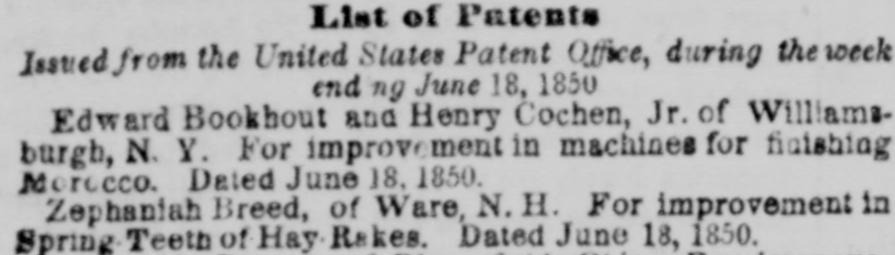
The top of the patent list on the same page as the poem. New-York Daily Tribune, June 21, 1850, page 3. Library of Congress, Chronicling America. Click the clipping to read it full size.
Nearby, an ad shouted “LEECHES! LEECHES! LEECHES!” A shop at 36 John Street had “JUST received by the last steamer from Europe, a large supply of Swedish, German and Smyrna Leeches, warranted healthy.” In 1850, doctors still used leeches to draw blood from sick people, believing it helped them get well.
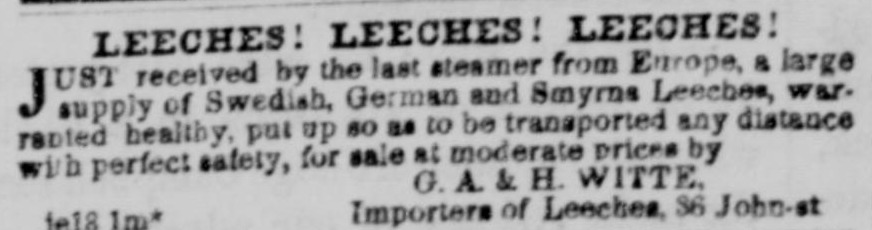
A leech ad on the same page. New-York Daily Tribune, June 21, 1850, page 3. Library of Congress, Chronicling America. Click the clipping to read it full size.
Building a Book in Brooklyn
Over the next five years in Brooklyn, Whitman kept writing and scribbled lines wherever he went. “The first drafts of his ‘copy’ had been written in theatres or ferry-boats and omnibuses, or wherever he happened to be,” Bliss Perry wrote. An omnibus was a big horse-drawn coach that carried riders along the city streets.
Then Whitman put down the carpenter’s tools he had been working with. “In the spring of 1855 Whitman dropped his saw and hammer and began to set up with his own hands the type for his book,” Perry wrote. He used the print shop of Andrew and James Rome “at the corner of Cranberry and Fulton Streets, Brooklyn.”
The book came out that summer, and its title page said only “Leaves of Grass. Brooklyn, New York: 1855.” There was no author’s name anywhere on it.
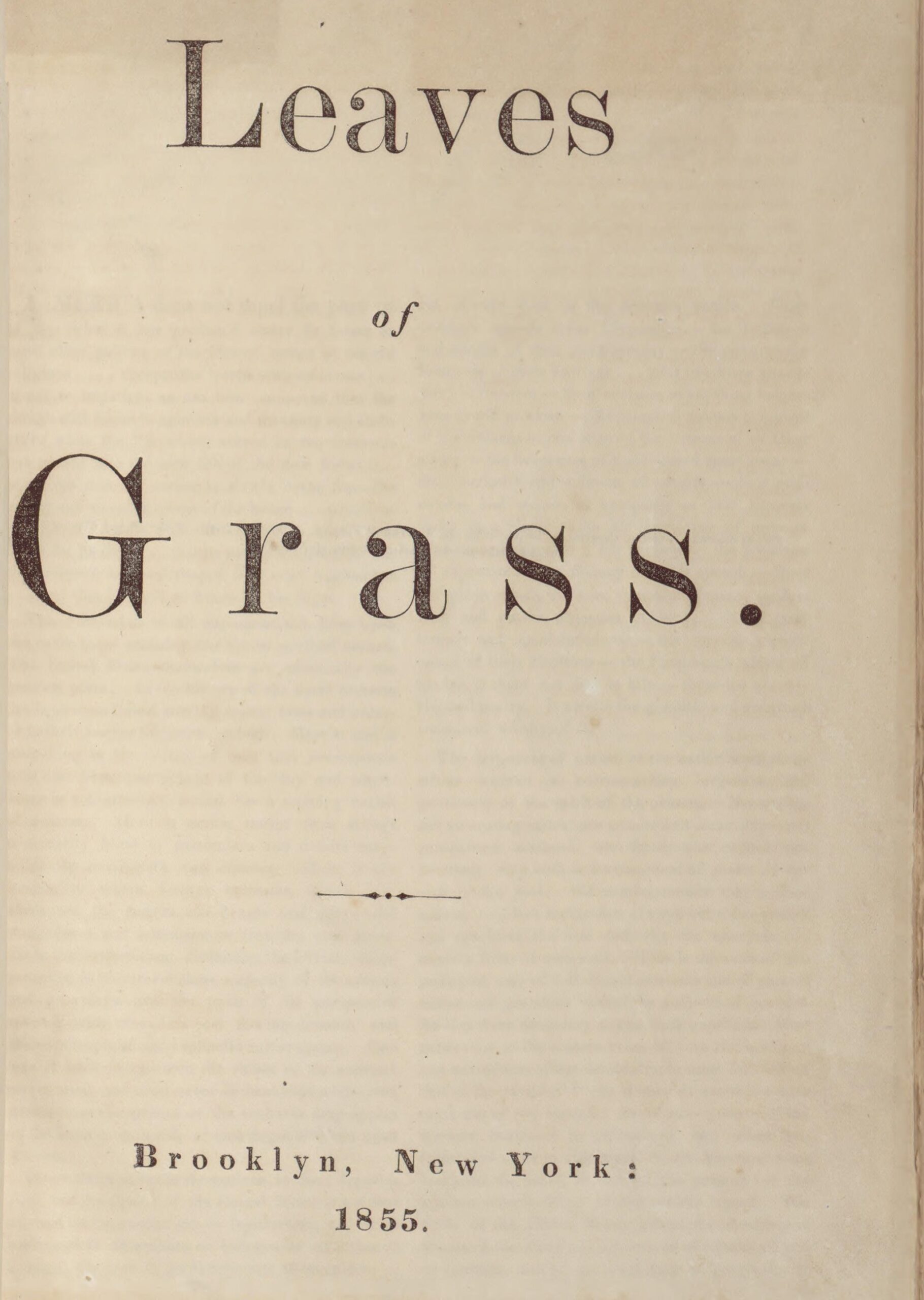
The title page of the first Leaves of Grass, with no author’s name. Library of Congress copy, Rare Book and Special Collections Division. Published 1855, public domain. Click the clipping to read it full size.
Across from it was a picture of a bearded man in a work shirt, his collar open, his hat tipped, one hand on his hip and the other in his pocket. That was the author, though the book did not say so.
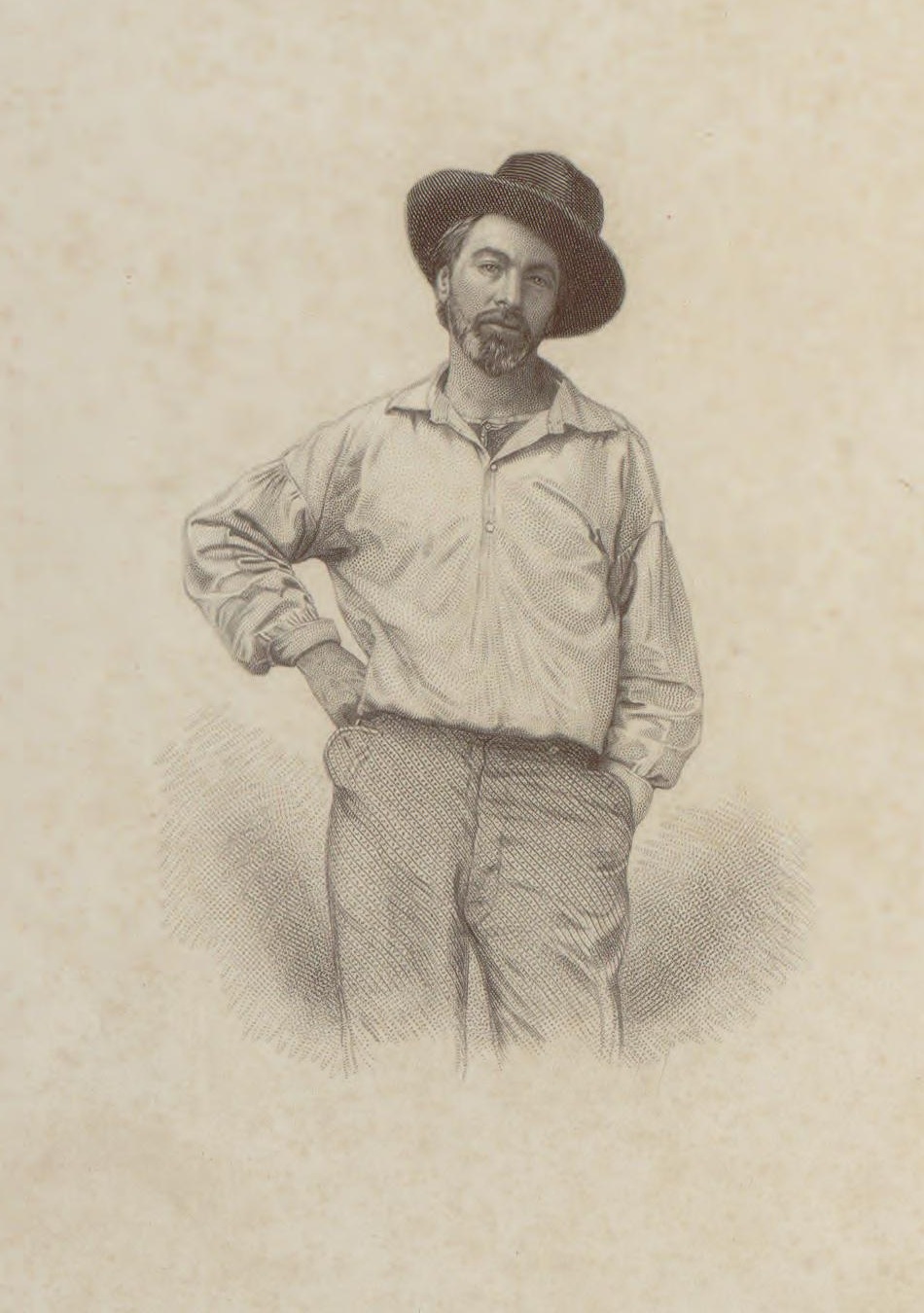
The picture of the author at the front of the 1855 Leaves of Grass. Library of Congress copy. Published 1855, public domain. Click the picture to see it full size.
His name was tucked into the small print on the back of the title page. The copyright notice said the book was “Entered according to Act of Congress in the year 1855, by WALTER WHITMAN.” It was the same name, in the same capital letters, that had stood under the poem in the Tribune five years before.

The copyright notice in the 1855 Leaves of Grass, with the name Walter Whitman. Library of Congress copy. Published 1855, public domain. Click the clipping to read it full size.
Some of the lines inside the book were as simple and gentle as a question from a child:

Lines from page 16 of the 1855 Leaves of Grass. Library of Congress copy. Published 1855, public domain. Click the clipping to read it full size.
Readers who kept going found the name Walt on page 29, in a line where the poet introduced himself: “Walt Whitman, an American, one of the roughs, a kosmos.” A rough was a plain, tough working man, and a kosmos is the whole world in good order.
The Tribune Poem Comes Home
Near the back of Whitman’s Brooklyn book, on page 87, a reader with a good memory could have spotted an old friend. After a line across the page came a big capital S, and then: “SUDDENLY out of its stale and drowsy lair, the lair of slaves, Like lightning Europe le’pt forth.” It was “Resurgemus,” with its Latin title gone.
Whitman had changed the poem in several ways. The short Tribune lines were joined into long ones, and “thee” became “you.” The winds still carried the seeds of freedom, but now they were nourished by “the rains and the snows,” and the line “He will surely return” became “He will soon return.”
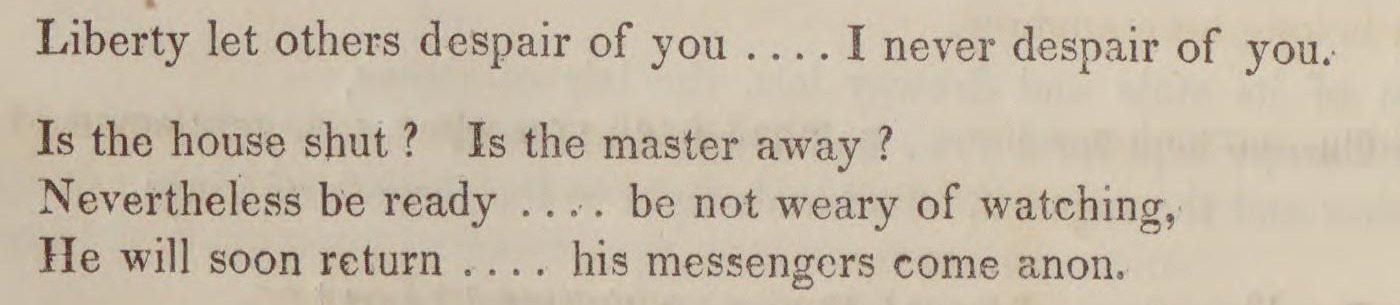
The Tribune poem’s ending as Whitman rewrote it on page 88 of the 1855 Leaves of Grass. Library of Congress copy. Published 1855, public domain. Click the clipping to read it full size.
In 1921, Emory Holloway explained why the 1850 Tribune poem matters.

From The Uncollected Poetry and Prose of Walt Whitman, edited by Emory Holloway (1921), page liv. Internet Archive. Public domain. Click the clipping to read it full size.
What It Cost on Broadway in 1855
On July 23, 1855, a small ad ran on the front page of the New York Tribune, and unlike the book’s own title page, it gave the poet’s name.

New-York Daily Tribune, July 23, 1855, page 1. Library of Congress, Chronicling America. Click the clipping to read it full size.
The Tribune itself sold for “TWO CENTS,” so at $2, the book cost as much as 100 copies of the newspaper.
That same day, page 3 of the Tribune reviewed the book. The reviewer judged the author by his picture and decided he looked like one of the “loafers,” with “a ‘wide-awake’ perched jauntily on his head.” A wide-awake was a soft felt hat with a wide brim.
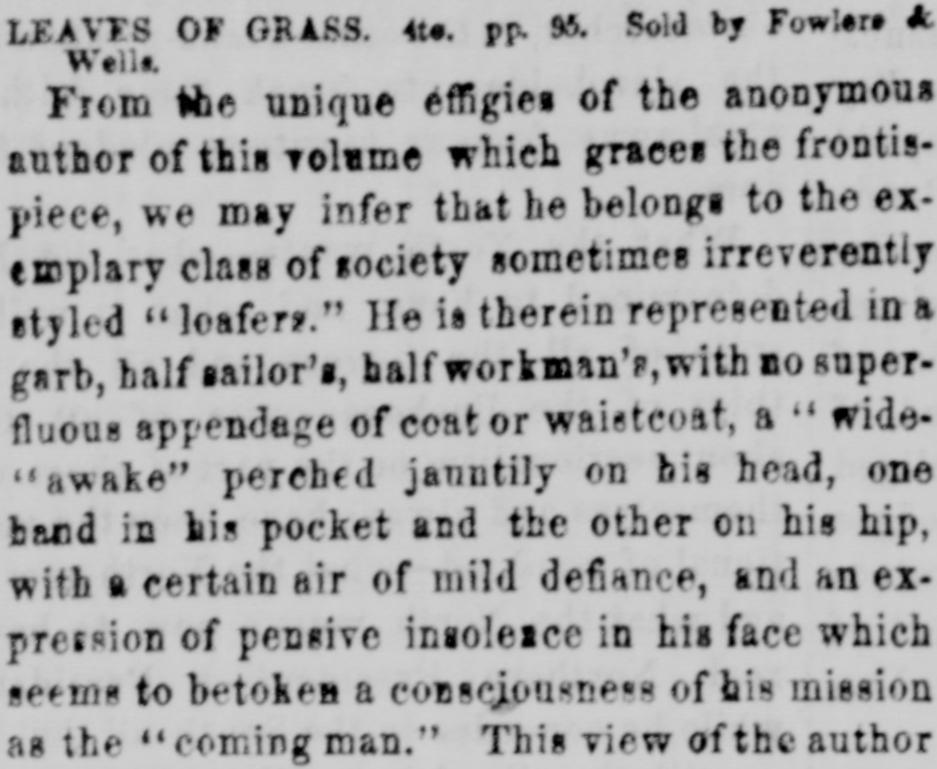
The start of the Tribune’s review of Leaves of Grass. New-York Daily Tribune, July 23, 1855, page 3. Library of Congress, Chronicling America. Click the clipping to read it full size.
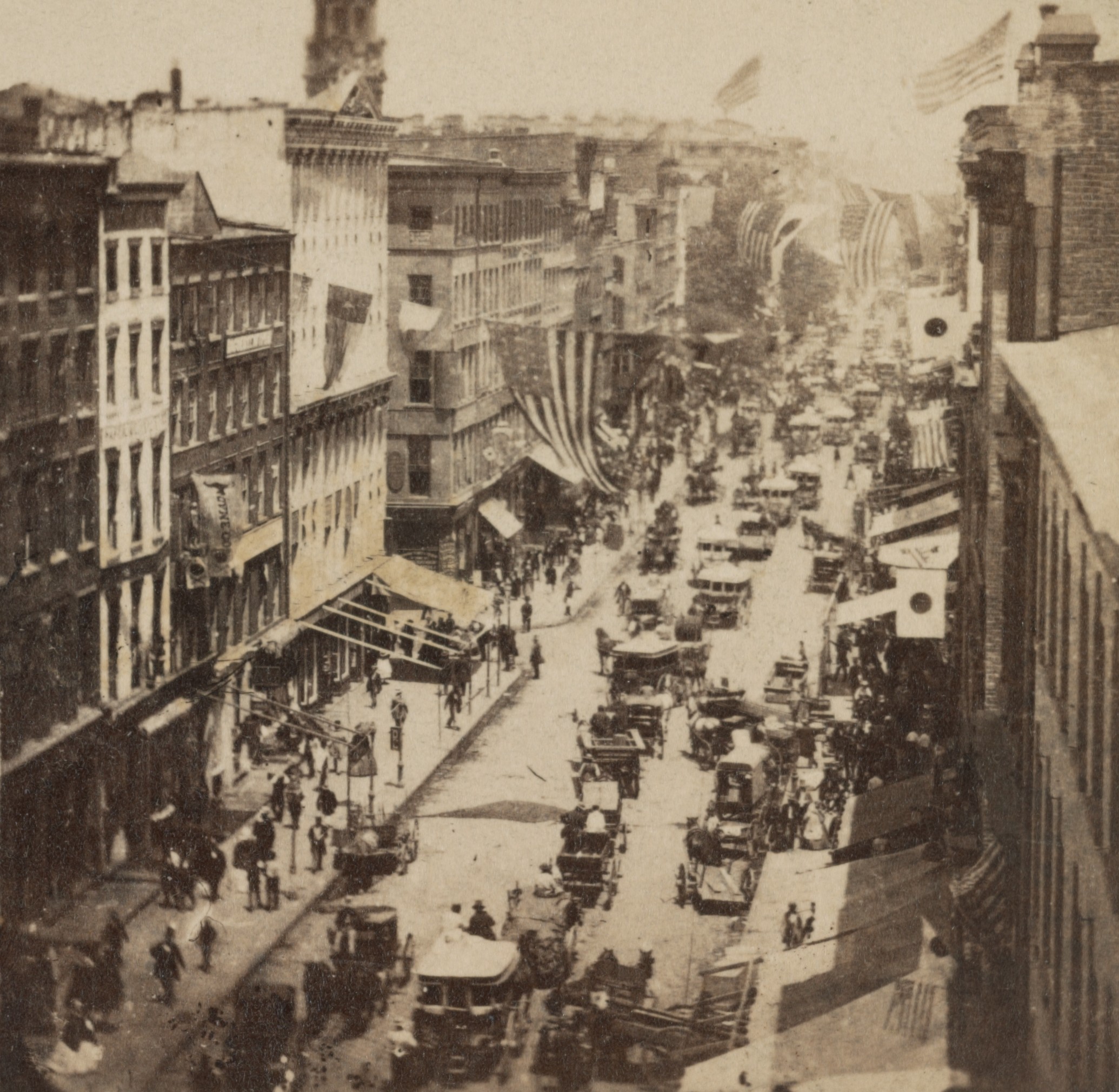
Broadway in New York City in June 1860, five years after Leaves of Grass went on sale at 308 Broadway. The flags are out for a visit by officials from Japan. Many of the boxy coaches in the street are omnibuses. This is a stand-in: the photo does not show the bookstore. Stereograph by George Stacy, Library of Congress. No known restrictions. Click the picture to see it full size.
A Letter From Concord
In Concord, Massachusetts, the writer Ralph Waldo Emerson read the book and wrote to its author. On October 10, 1855, the Tribune printed his letter on page 7. The paper’s short note called it an opinion “from a distinguished source.”
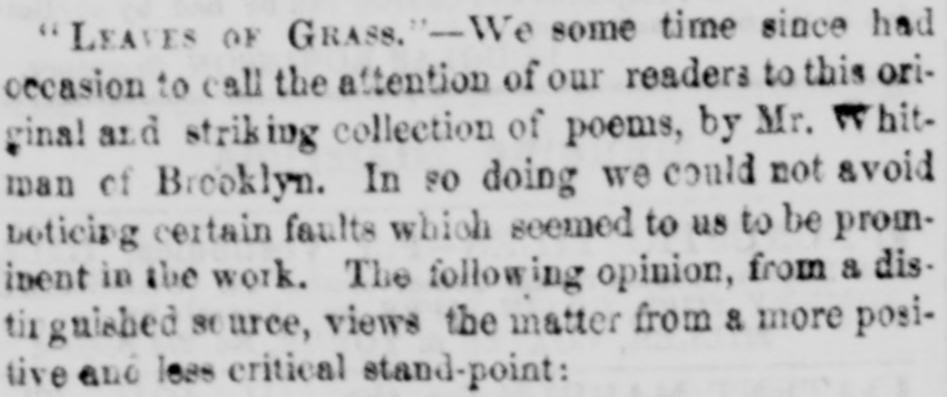
New-York Daily Tribune, October 10, 1855, page 7. Library of Congress, Chronicling America. Click the clipping to read it full size.
One line from that letter is still quoted often today:
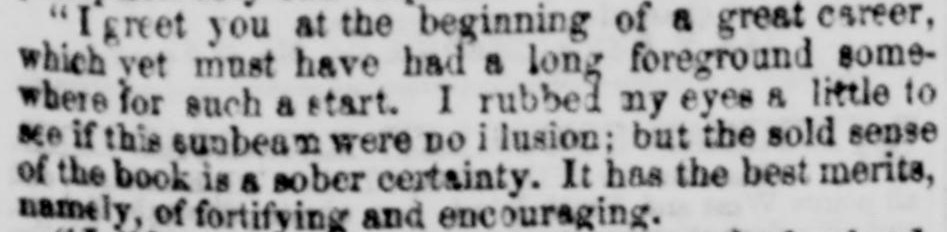
From Emerson’s letter. New-York Daily Tribune, October 10, 1855, page 7. Library of Congress, Chronicling America. Click the clipping to read it full size.
The foreground is the part of a picture closest to the person looking at it. Emerson meant that nobody writes a book like this on a first try, and that there had to be years of quiet work behind it.
He also explained why he had waited to write. Since the book had no name on its title page, he wasn’t sure the name he found inside was real, one he could address a letter to, until he saw the book in a newspaper ad.
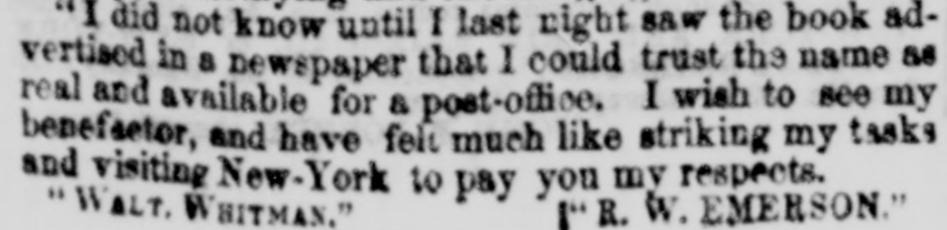
The end of Emerson’s letter, signed R. W. Emerson. New-York Daily Tribune, October 10, 1855, page 7. Library of Congress, Chronicling America. Click the clipping to read it full size.
The Long Foreground of Walt Whitman
Part of that long foreground had been sitting on page 3 of a New York newspaper since June 1850. Whitman kept changing the poem over the years. In the last edition he put together, printed in 1891 and 1892, its title was “EUROPE, The 72d and 73d Years of These States.” Whitman was counting the country’s years from 1776, so the 72d and 73d years take in 1848, the year Europe “le’pt forth.”

The poem’s title in Leaves of Grass (Philadelphia: David McKay, 1891-92), page 211. Internet Archive. Public domain. Click the clipping to read it full size.
Today, Leaves of Grass sits on library shelves all over the world. But the earliest of its poems known to have been printed before 1855 first reached readers in a daily paper, between the city news and a list of hay-rake teeth, signed by a man who still went by Walter.
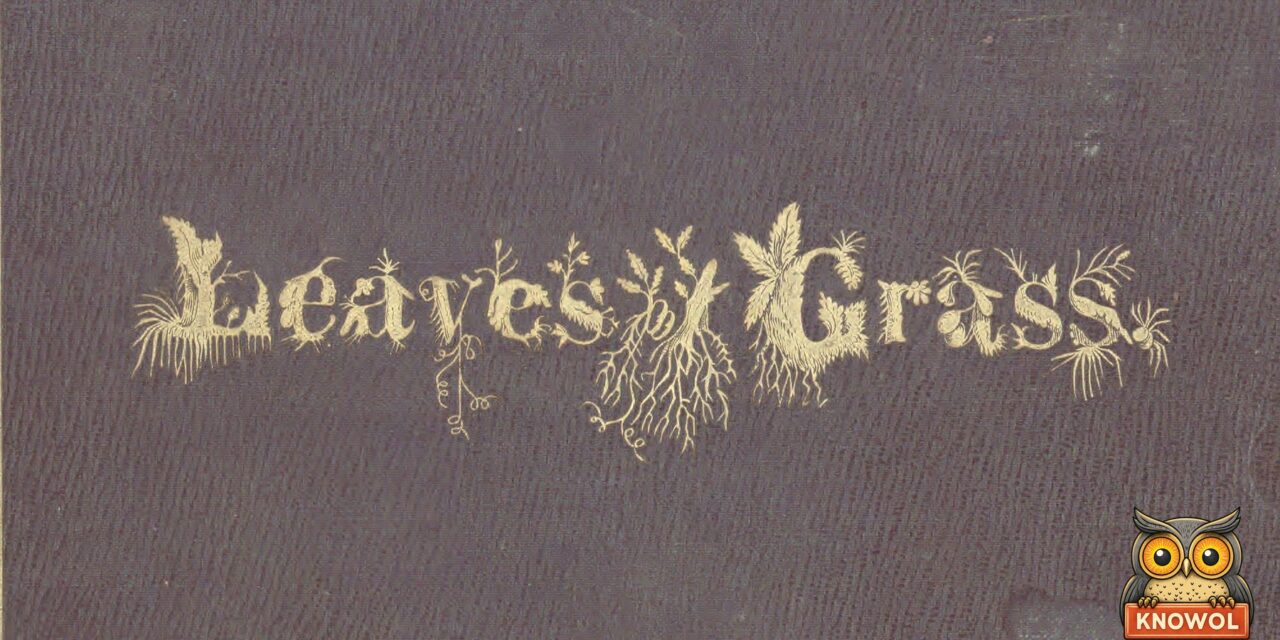
The picture at the top of this story is the cloth cover of the 1855 Leaves of Grass, from the copy at the Library of Congress. Its gold letters sprout roots and leaves.
Sources
- “Resurgemus,” by Walter Whitman, “List of Patents” and leech advertisement, New-York Daily Tribune (New York, New York), June 21, 1850, page 3. Library of Congress, Chronicling America.
- Leaves of Grass advertisement, New-York Daily Tribune, July 23, 1855, page 1. Library of Congress, Chronicling America.
- Review of Leaves of Grass, New-York Daily Tribune, July 23, 1855, page 3. Library of Congress, Chronicling America.
- Emerson’s letter to Walt Whitman, New-York Daily Tribune, October 10, 1855, page 7. Library of Congress, Chronicling America.
- Leaves of Grass (Brooklyn, New York, 1855), Library of Congress copy, Rare Book and Special Collections Division (the cover, the author’s picture, the title page, the copyright notice and pages 16, 29, 87 and 88). Published 1855, public domain.
- Walt Whitman: His Life and Work, by Bliss Perry (Houghton, Mifflin, 1906). Internet Archive.
- The Uncollected Poetry and Prose of Walt Whitman, edited by Emory Holloway (1921). Internet Archive.
- Leaves of Grass (Philadelphia: David McKay, 1891-92). Internet Archive.
- View on Broadway. Instantaneous, stereograph by George Stacy, photographed 1860. Library of Congress Prints and Photographs Division, Larry Gottheim Collection. No known restrictions on publication.
- The newspapers, books and photograph above were all published or made before 1931 and are in the public domain.