On June 15, 1829, a man named Walker sold off his fine horses at a public sale in London, England. One was a six-year-old dark bay named Young Truffle. He had been raised to be a racehorse, but he got hurt in his very first training. He never ran a race, not even once.
An American at the sale bought him anyway. He was James Barbour of Barboursville, Virginia, then the United States minister to Great Britain, America’s top diplomat in London. Barbour took the hurt horse home to Virginia. Within three seasons, between three and four hundred mares had been brought to him there.
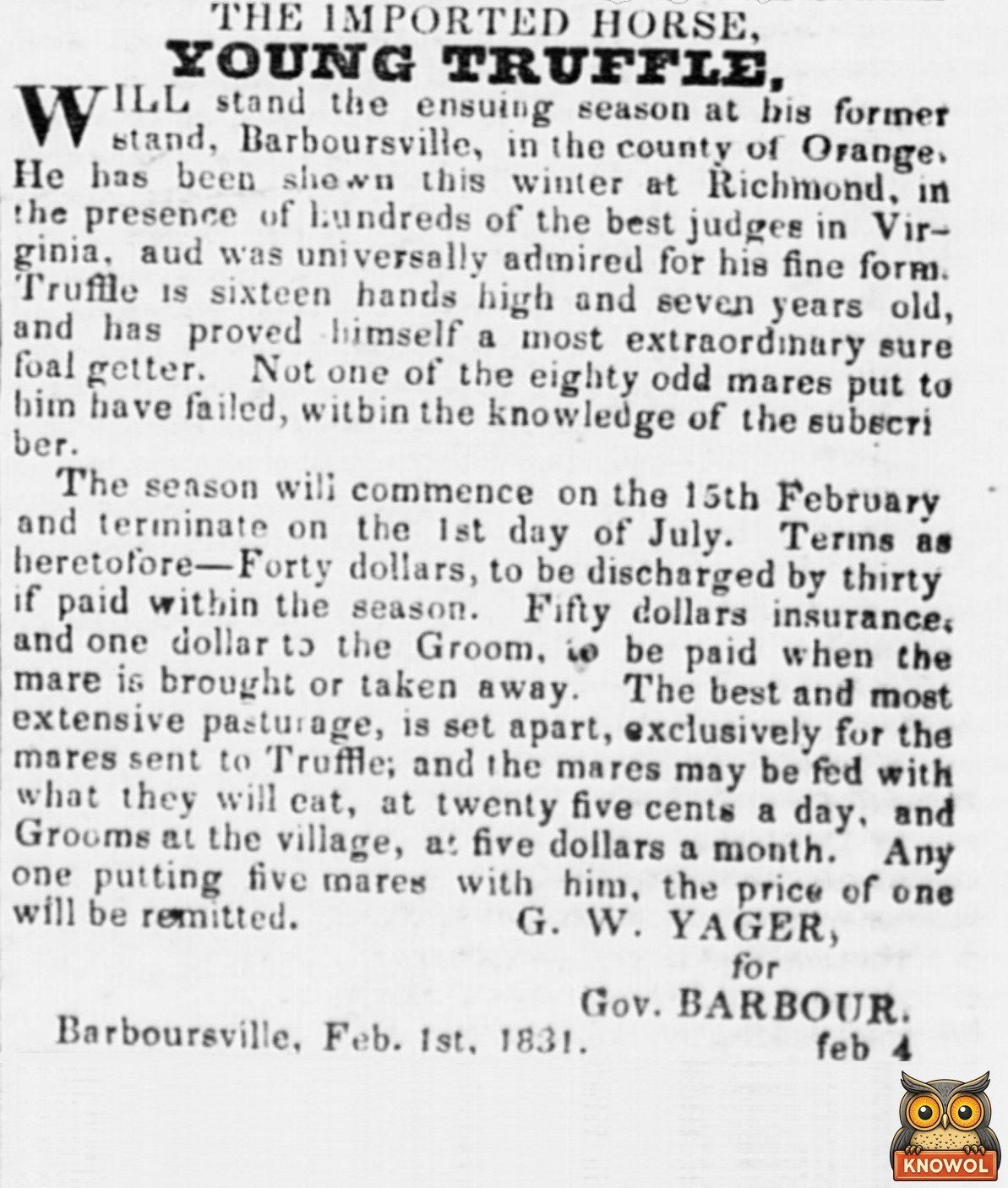
“The Imported Horse, Young Truffle.” Daily Richmond Whig, Richmond, Virginia, April 19, 1831, page 3. Library of Congress, Chronicling America. Click the clipping to read it full size.
A Bargain Horse From London for Barboursville, Virginia
James Barbour of Barboursville, Virginia, had been governor of Virginia during the War of 1812 and later the nation’s Secretary of War. He went to London in 1828 and left that job in the fall of 1829. Before he sailed home, he went horse shopping.
Young Truffle did not cost much. In 1836 a writer in the American Turf Register, a horse magazine printed in Baltimore, said Barbour “brought with him a cheap lot of horses.” He said Young Truffle “was bought for fifty-two guineas,” as an English horse magazine had reported. A guinea was an English gold coin worth a little more than a pound, so fifty-two guineas came to roughly $250 in American money then.

“A cheap lot of horses.” American Turf Register, Baltimore, April 1836. Internet Archive, public domain. Click the clipping to read it full size.
That was a bargain for a horse with his family tree. Richard Tattersall, whose family ran London’s best-known horse auction at Hyde Park Corner, signed a note about the “brown Horse sold by me to James Barbour.” It said the horse was “bred by the Duke de Guiche,” a French nobleman. His father was an English stallion named Truffle.
The note had two more numbers in it. In 1829, owners paid 15 guineas each to have their mares bred to Truffle. And Truffle himself “was sent to France, and bought back again at 1000 guineas.” So Barbour got the son for about the price of three and a half visits to the father.
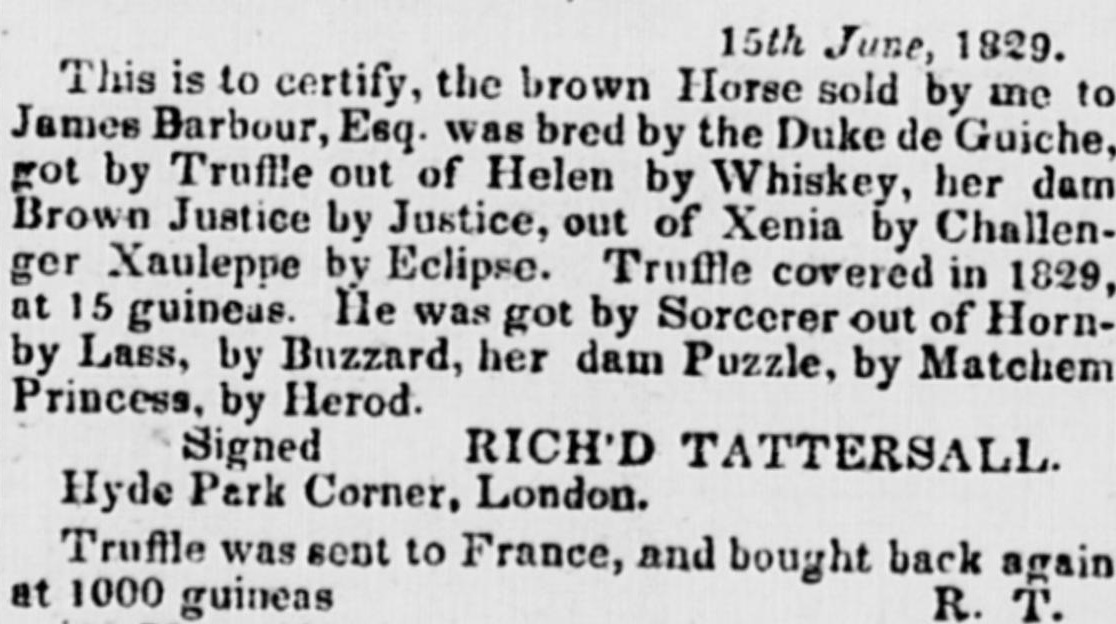
Richard Tattersall’s note of June 15, 1829. Daily Richmond Whig, January 25, 1830. Library of Congress. Click the clipping to read it full size.
Young Truffle Goes to Work in Barboursville, Virginia
Back home in Barboursville, Virginia, Young Truffle’s new job was to be a sire, or father horse. Farmers paid to bring their mares to him, hoping for foals with English racing blood. Barbour’s agent, a man named Yager, put an ad in the Richmond Whig in January 1830. It had a tiny woodcut of a horse at the top.
That ad called Young Truffle “a dark bay, sixteen hands high, of fine form and great activity.” A hand is 4 inches, so he stood 5 feet 4 inches tall at the shoulder. A bay horse has a reddish-brown body with a black mane, tail and legs.
The ad was honest about his past. It said he “was so injured in his first training, whilst he was the property of the Duke de Guiche, that he never ran.” Then it turned his age into a selling point. He was “only six years old last spring,” it said, and “Imported horses are generally too old” by the time they reach America.
Yager also showed the horse on court days, when people from all over a county came to town. Young Truffle would be “exhibited at the Court-houses of Albemarle, Louisa and Orange” on the first day of their March courts.
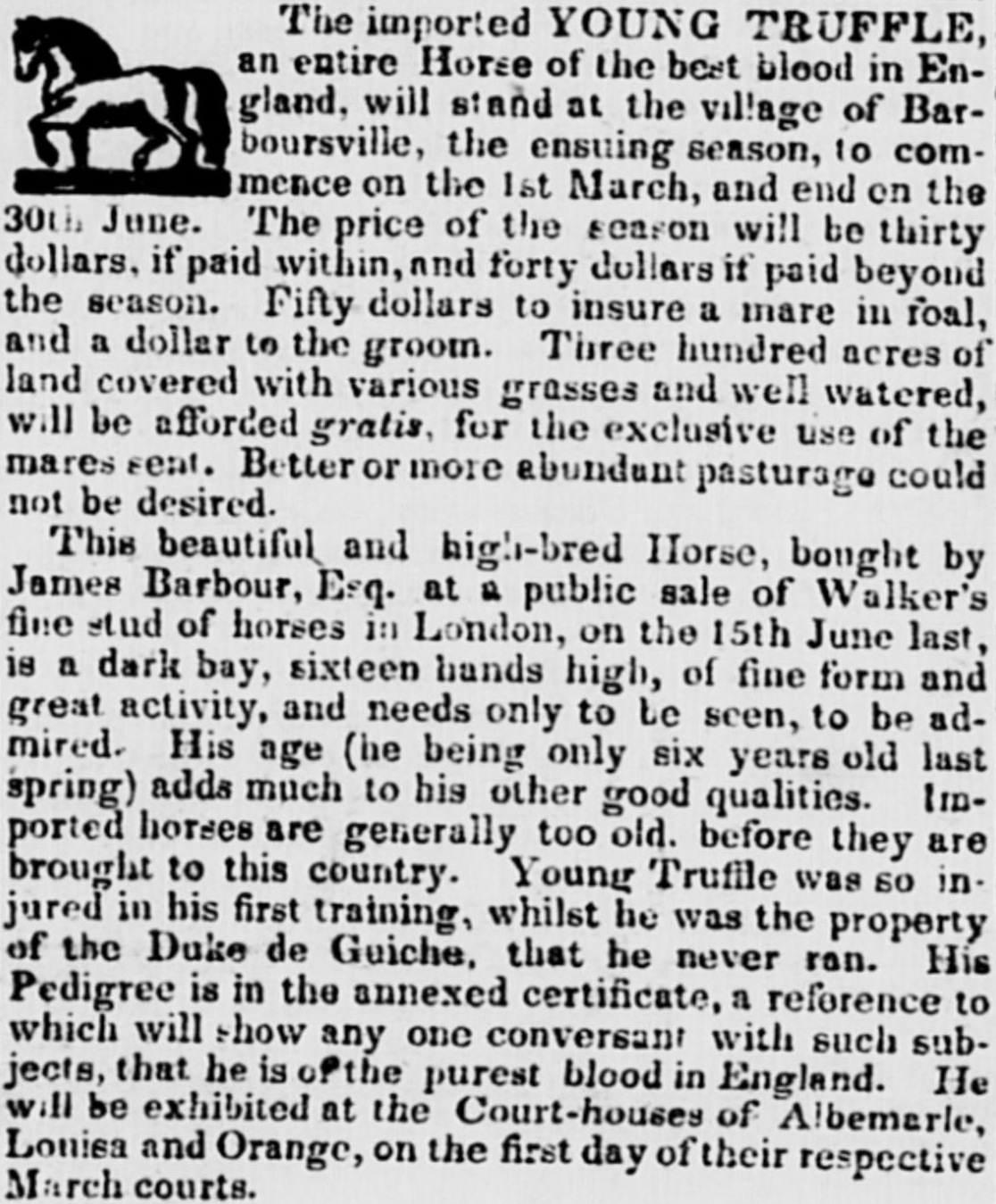
The 1830 ad and its little woodcut horse. Daily Richmond Whig, January 25, 1830. Library of Congress. Click the clipping to read it full size.
Young Truffle Wins Over Richmond, Virginia
In the winter of 1830 and 1831, Young Truffle was shown in Richmond, Virginia. A new ad, dated February 1, 1831, said he was shown there “in the presence of hundreds of the best judges in Virginia.” It said he “was universally admired for his fine form.” That ad was still running in the Richmond Whig on April 19, 1831.
It made a bold brag about his first season, too. Of the “eighty odd mares” brought to him, the ad said, not one had failed to have a foal on the way, as far as Yager knew.
What It Cost to Visit Young Truffle in Barboursville, Virginia
The ads for Young Truffle in Barboursville, Virginia, read like a price list. Here is what a farmer paid in 1830 and 1831:
- $40 for the season, or just $30 if you paid before the season was over.
- $50 to “insure a mare in foal.” That was paid once she was known to be expecting a foal.
- $1 for the groom, the worker who cared for the horses.
- 25 cents a day to have your mare fed “with what they will eat.”
- Five mares at once, and one of them came free.
- In 1830, 300 acres of grassy, “well watered” pasture, free, “for the exclusive use of the mares sent.” That is more land than 200 football fields.
- Also in 1830, the first two fillies to apply that had won a $300 race came free.
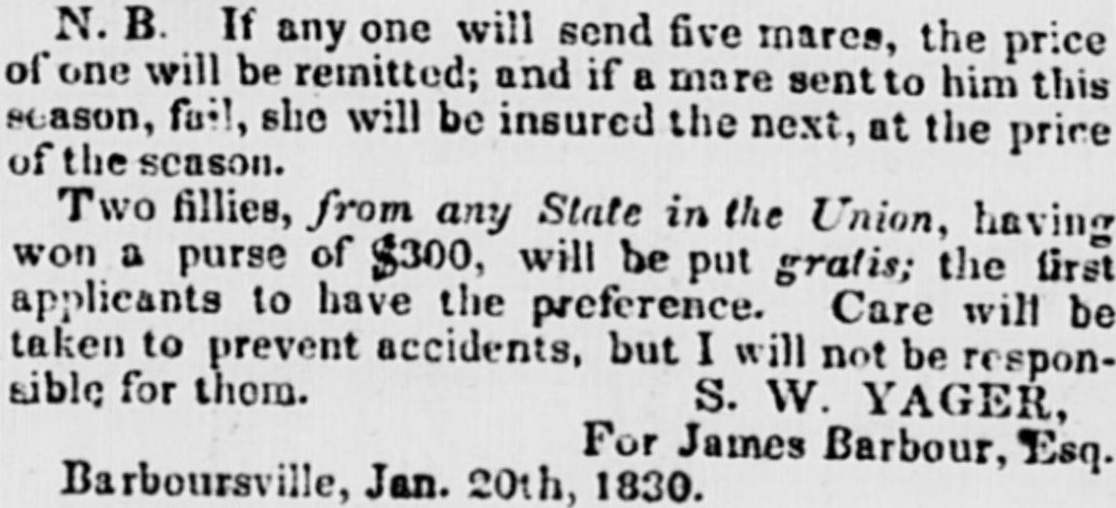
The five-mare deal. Daily Richmond Whig, January 25, 1830. Library of Congress. Click the clipping to read it full size.
“Pretty Good Business” for Barboursville, Virginia
By the summer of 1831, Young Truffle was making money for James Barbour of Barboursville, Virginia. In August 1831 the American Turf Register printed a letter adding up what five famous stallions had earned that season. The best one, Gohanna, made $7,050. “This, sir, you must allow, is pretty good business,” the writer said, “better than most farms, or lawyers’ or doctors’ shops.”
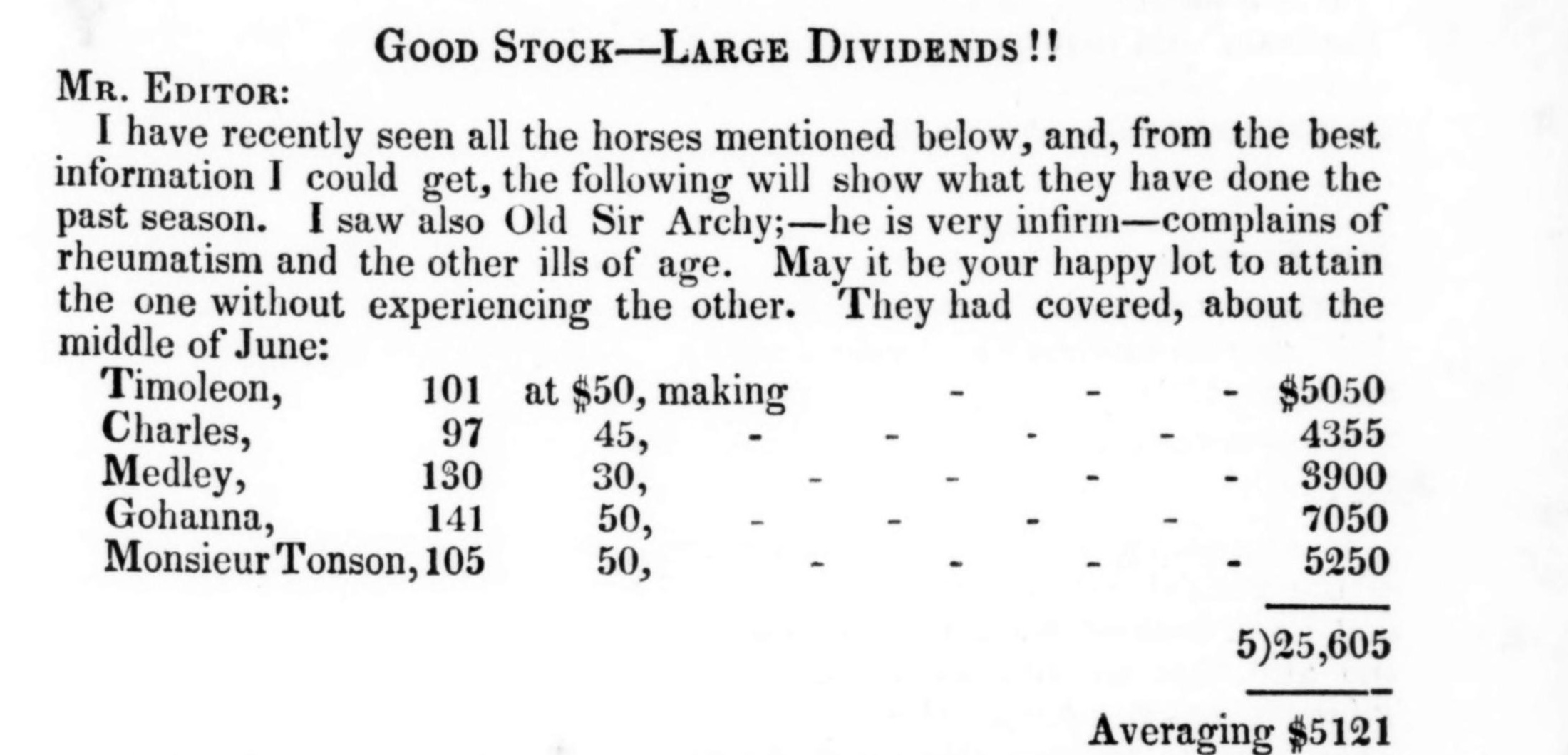
“Good Stock, Large Dividends!!” American Turf Register, August 1831. Internet Archive, public domain. Click the clipping to read it full size.
Then the writer, who signed himself “Observator,” added news about Barboursville: “I understand that Gov. Barbour’s Young Truffle had, some weeks since, earned his estimable owner $3500 this season.” It was secondhand news, but if it was true, the $250 bargain horse earned back his price about 14 times in one season.
Observator had one more piece of Barboursville news. A mare named Phantomia, bought by Barbour in England in July 1829, “produced a fine Young Truffle filly on the 8th of May last,” meaning May 8, 1831.
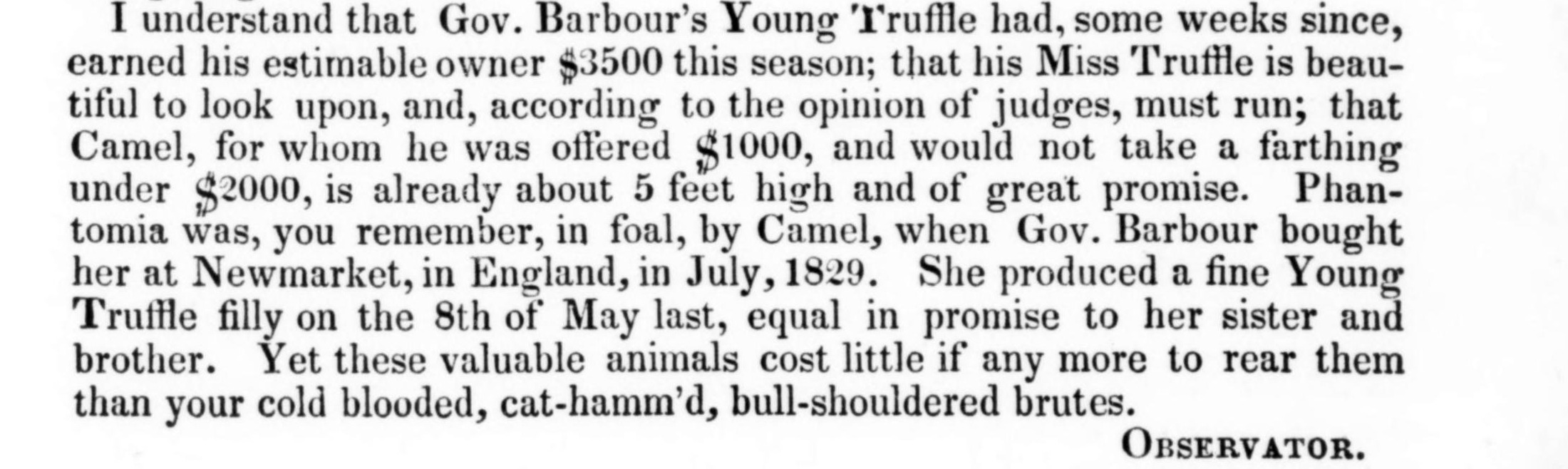
Observator’s news of Young Truffle. American Turf Register, August 1831. Internet Archive, public domain. Click the clipping to read it full size.
Young Truffle Leaves Barboursville, Virginia, for Alabama
In September 1832, a notice in the Daily National Intelligencer of Washington said Young Truffle was leaving Barboursville, Virginia. He would spend his next season “at some place in Alabama,” most likely Huntsville. People in the South and West had written to Barbour asking to rent the horse or buy him.
The notice gave one more reason. In “three successive seasons at Barbourville,” it said, the horse “has stocked the region round about with his blood.” Between three and four hundred mares had been brought to him. It described him one last time: nine years old, 16 hands, and “his color, beautiful brown bay, with jet black legs.”
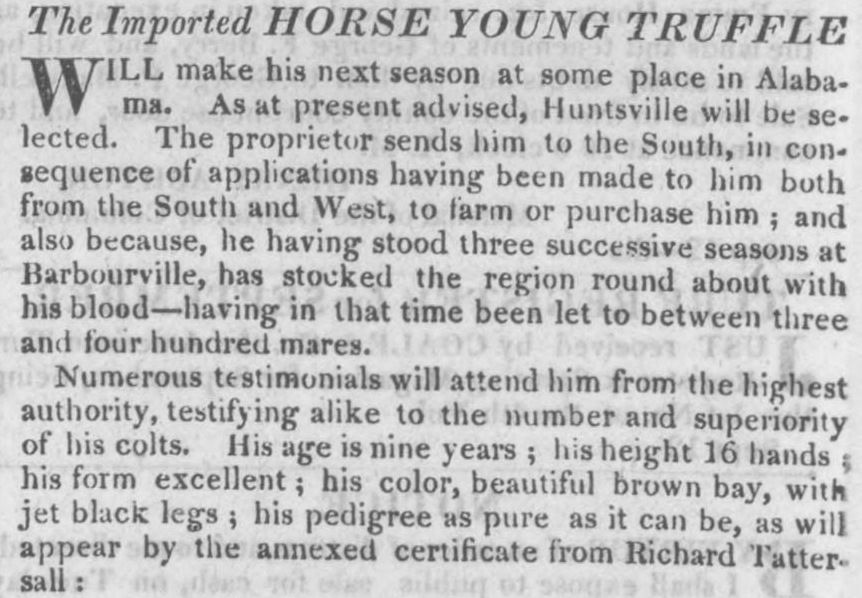
Off to Alabama. Daily National Intelligencer, Washington, D.C., September 15, 1832. Library of Congress. Click the clipping to read it full size.
What Is Left at Barboursville, Virginia
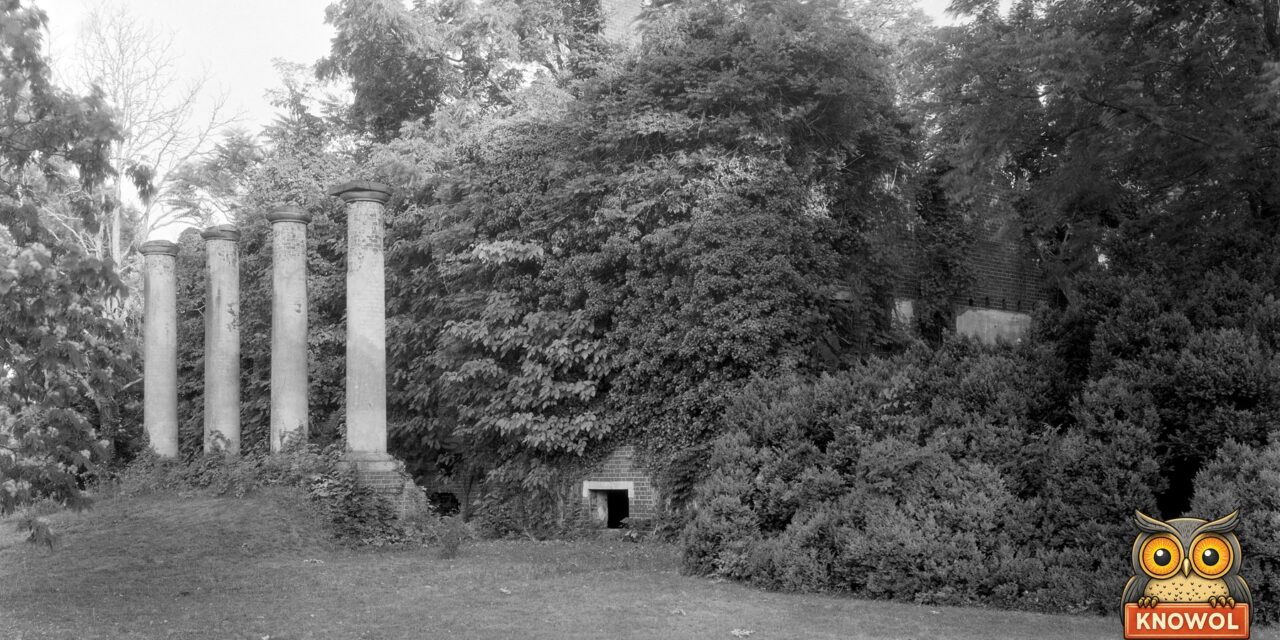
James Barbour’s big brick house in Barboursville, Virginia, was built about 1822, and Thomas Jefferson helped plan it. A 1923 book, Historic Gardens of Virginia, said rows of boxwood bushes “lead off to where the stables used to be.” The same book said “The house was burned on Christmas Day, 1884.” Its walls and tall white columns were still standing, and a walnut tree had grown up inside and spread its branches “in place of a roof.”
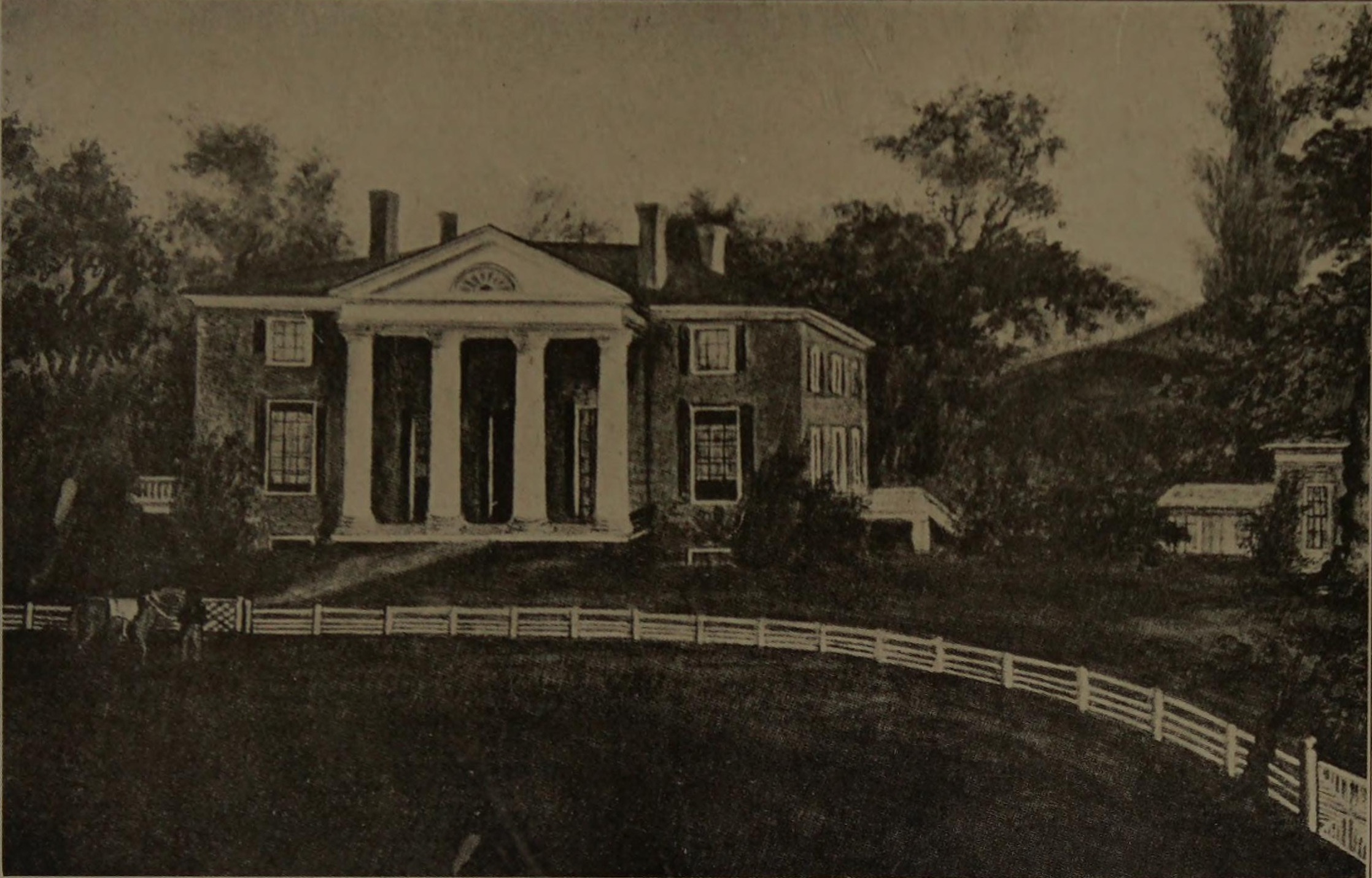
Barboursville in an old painting, printed in Historic Gardens of Virginia (1923). Its date is not known. Internet Archive, public domain. Click the picture to see it full size.
The photo at the top of this story shows those ruins at Barboursville, Virginia, in 1930, about a hundred years after Young Truffle lived there. Frances Benjamin Johnston took it for a survey of old Southern buildings, now kept at the Library of Congress. She also photographed four of the columns, with ivy and trees growing behind them.
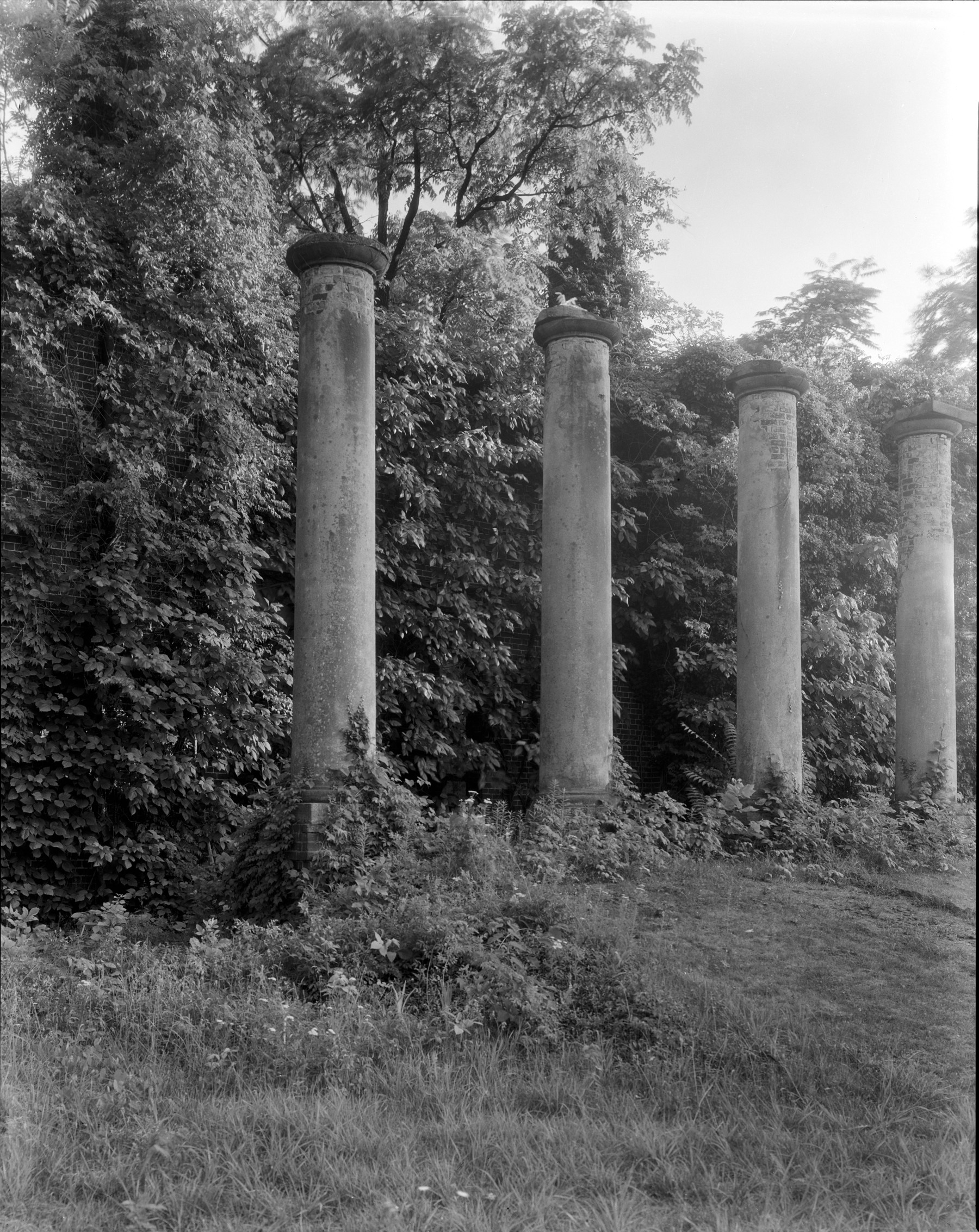
Four of Barboursville’s columns in 1930. Frances Benjamin Johnston, Library of Congress. Click the picture to see it full size.
Young Truffle never won a race, because he never ran one. In London he was the hurt horse in a cheap lot. In Virginia, farmers brought him hundreds of mares, and his foals grew up in the fields all around Barboursville.
Sources
- “The Imported Horse, Young Truffle,” Daily Richmond Whig (Richmond, Virginia), April 19, 1831, page 3, the ad dated February 1, 1831. Library of Congress, Chronicling America.
- “The imported Young Truffle,” Daily Richmond Whig (Richmond, Virginia), January 25, 1830, page 3, the first ad, with Richard Tattersall’s note of June 15, 1829. Library of Congress, Chronicling America.
- “The Imported Horse Young Truffle,” Daily National Intelligencer (Washington, D.C.), September 15, 1832, page 2. Library of Congress, Chronicling America.
- “Good Stock, Large Dividends!!,” letter signed Observator, American Turf Register and Sporting Magazine, August 1831, page 613. Internet Archive.
- Letter on imported horses, American Turf Register and Sporting Magazine, April 1836, page 352: “a cheap lot of horses” and “fifty-two guineas.” Internet Archive.
- James Barbour, Office of the Historian, U.S. Department of State: minister to Great Britain, appointed May 23, 1828, left his post about October 1, 1829.
- James Barbour, National Governors Association: governor of Virginia during the War of 1812, Secretary of War from 1825 to 1828.
- Historic Gardens of Virginia, compiled by the James River Garden Club (Richmond, 1923), pages 258 and 259: the stables, the fire on Christmas Day, 1884, and the old painting. Internet Archive.
- Barboursville, Orange County, Virginia, photographed by Frances Benjamin Johnston, 1930 (the cover). Carnegie Survey of the Architecture of the South, Library of Congress Prints and Photographs Division. No known restrictions on publication. The same record says Thomas Jefferson helped plan the house, built in 1822.
- Barboursville, Orange County, Virginia, the four columns, Frances Benjamin Johnston, 1930 (the Facebook and Instagram picture). Carnegie Survey of the Architecture of the South, Library of Congress Prints and Photographs Division. No known restrictions on publication.