On the afternoon of Wednesday, May 13, 1891, thousands of people stood in the hot sun and blowing dust at Churchill Downs in Louisville, Kentucky. They had waited for hours to see the Kentucky Derby, the biggest horse race of the year. When the favorite came out, his rider took off his cap to the crowd. He was Isaac Murphy, the jockey many people called the best in America.
What happened next was so slow that Louisville’s own paper said the horses “almost walked,” and it is still the slowest Kentucky Derby ever run. The man who trained the winner said the slow pace was part of his plan.
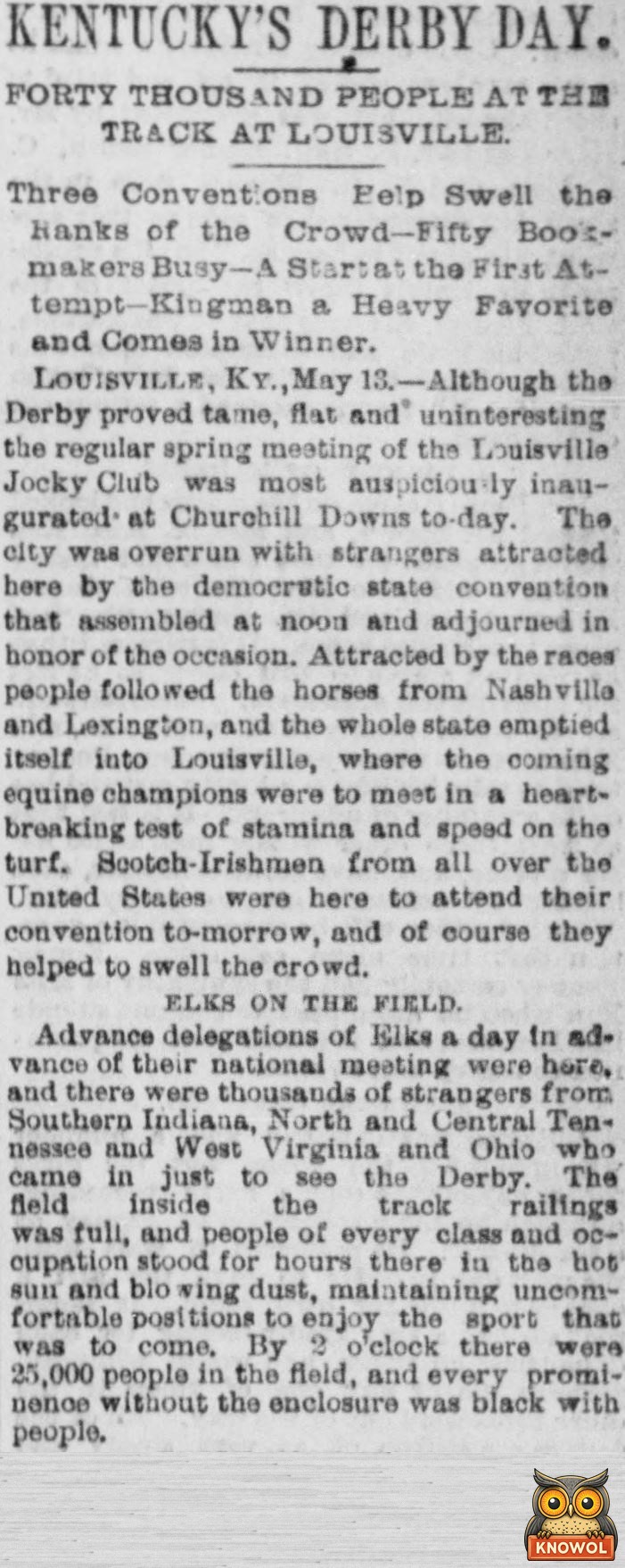
“Kentucky’s Derby Day.” The Morning News, Savannah, Georgia, May 14, 1891, page 1. Library of Congress, Chronicling America. Click the clipping to read it full size.
A Whole State Came to Louisville, Kentucky
On Derby Day in 1891, Louisville, Kentucky, was packed with visitors. The Democratic state convention met at noon and then stopped its work “in honor of the occasion.” The Morning News in Savannah, Georgia, said “the whole state emptied itself into Louisville.”
People rode out to the track in “coaches, carriages, buggies, traps, pony carts, express wagons,” and big horse-drawn buses called omnibuses, while others came on foot or by streetcar. The open field inside the track filled up, and people “stood for hours there in the hot sun and blowing dust.” So many people perched on top of the grandstands that some worried about “a collapse.”
Nobody agreed on the size of the crowd. The Evening Star in Washington said the “lowest estimate” was 15,000, the Weekly Courier-Journal of Louisville said 25,000, and the Savannah paper said 40,000. The news went out by wire that night, and the Savannah paper ran it on page 1 the next morning.
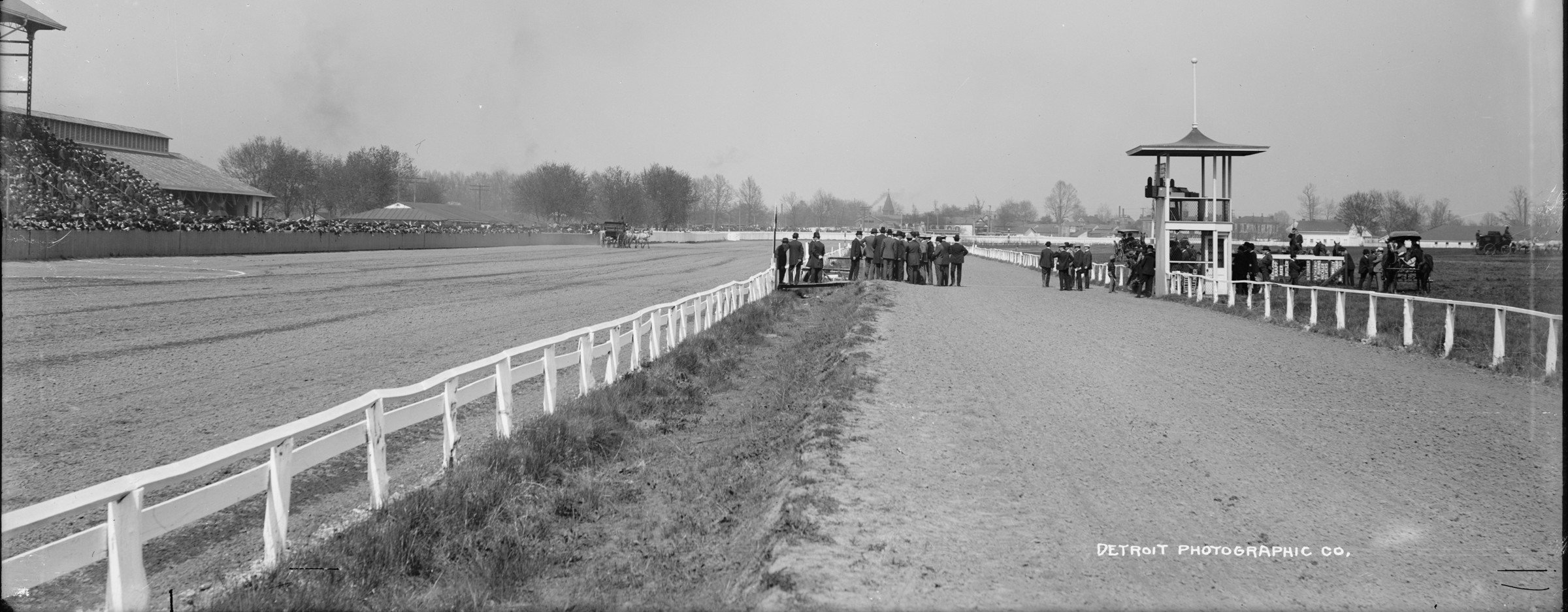
The track at Churchill Downs in Louisville, Kentucky, on Derby Day, April 29, 1901, ten years after Kingman’s race, with a crowd in the stands on the left. Detroit Publishing Co., Library of Congress. Click the picture to see it full size.
Isaac Murphy, the Jockey Who Knew When to Wait
The favorite in the 1891 Derby at Louisville, Kentucky, was a bay colt named Kingman. His rider, Isaac Murphy, was a Black jockey, and he was famous all over the country. The St. Paul Daily Globe said he had “the reputation of being the greatest jockey on the American turf,” which meant the world of horse racing.
The Globe said Murphy’s secret was his “ability to judge pace,” which means he could feel how fast his horse was going and how much run it had left. “He never punishes his animal,” the paper added. It also called him “the wealthiest jockey on the turf,” earning $10,000 to $15,000 a year for more than five years, and said he spent his free time at home on “study and reading.”
When Kingman cantered past the stands before the race, the cheers rang out so loud that an Indianapolis paper said “the surrounding knobs and hills-tops,” the rounded hills nearby, sent them echoing back. “Gracefully removing his cap, Murphy swept by.”
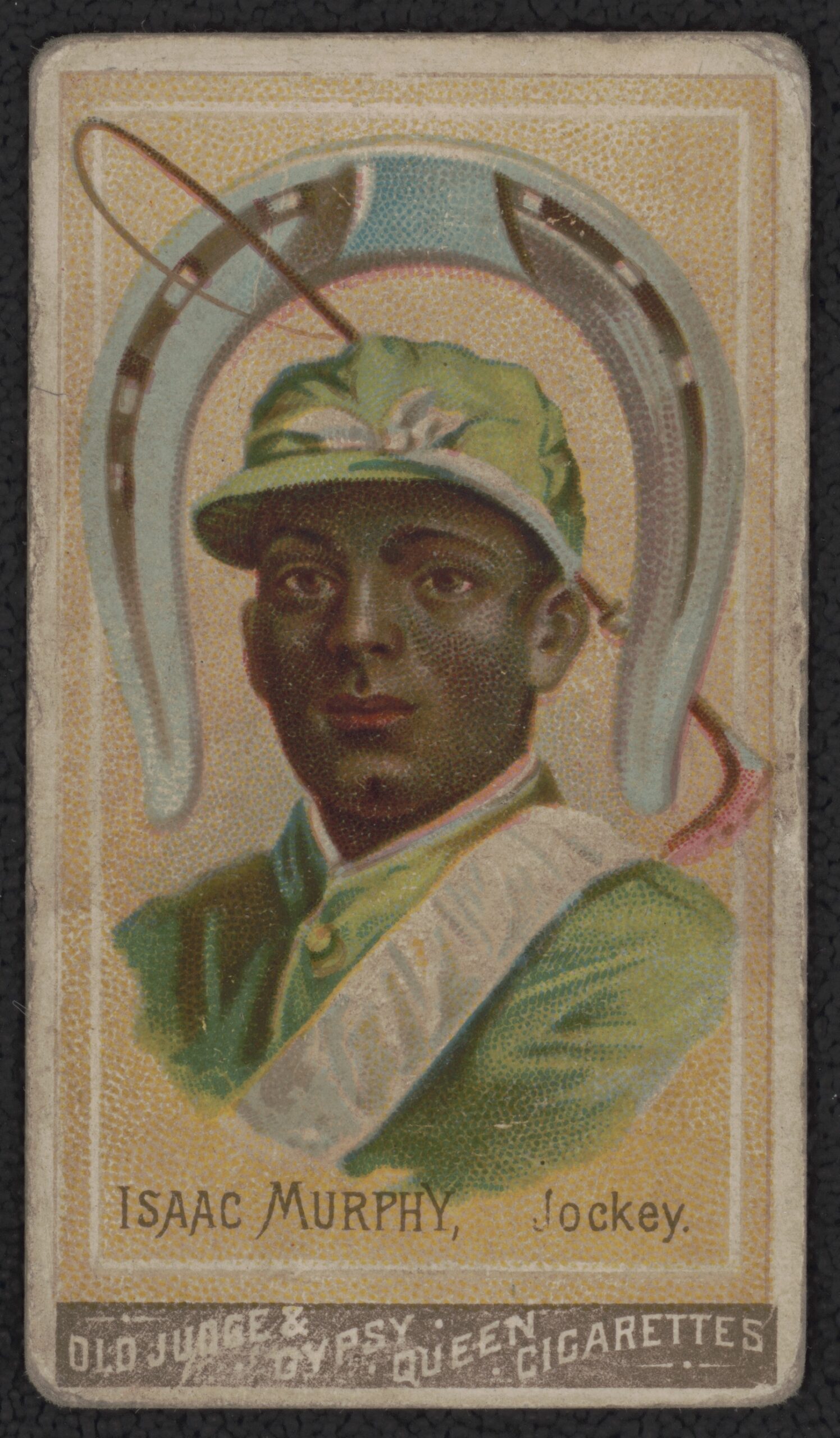
Isaac Murphy on a cigarette card, a small picture card that Goodwin & Co. gave out with its Old Judge and Gypsy Queen cigarettes, 1888, three years before the slow Derby. Library of Congress Prints and Photographs Division. Click the picture to see it full size.
A $265 Colt From Tennessee
Kingman, the favorite at Louisville, Kentucky, was born in Tennessee. A paper in Columbia, Tennessee, said that as a young colt he “sold at public auction for $265.” His trainer, Dudley Allen, said he “picked him out of a bunch of twenty” at a horse farm there.
Allen owned half of Kingman. The Globe called him “the half owner and trainer” and said he was a Black man “with a pleasant manner.” The other half belonged to Kinzea Stone, “a tobacco merchant of Georgetown, Ky.” Kingman raced for Stone’s Jacobin stable, so Murphy wore its colors: “wine, yellow and blue.” Allen had trained a Derby winner once before, a horse named Vagrant, in 1876.
Only Four Horses Lined Up in Louisville, Kentucky
Three horses were pulled out of the 1891 Derby in Louisville, Kentucky, before it started. That left four: Kingman, Balgowan, High Tariff and Hart Wallace. The Evening Star called it “the smallest field that ever started for the Kentucky derby.” Each horse carried the same weight, 122 pounds, and the race was a mile and a half long.
Most people thought Balgowan was the one horse that could beat Kingman, and his rider, a jockey named Overton, was also a Black man. The race started with a flag, not a gate. The horses lined up at the half-mile pole, where Starter James B. Ferguson waited, and they “were given the flag at the first attempt,” which means they got off cleanly on the first try. “‘They’re off!’ from thousands of throats came next.”
Why Nobody Wanted to Go First
In the 1891 Derby at Louisville, Kentucky, nobody wanted to be in front, because in a horse race the horse in front sets the pace, the speed for everyone. A horse that runs hard early can be tired at the end, while a horse that waits behind saves its strength for a fast finish. Both Kingman’s side and Balgowan’s side planned to wait.
Dudley Allen told the story after the race. “I knew that Balgowan’s jockey had been told to go around slow and beat my ‘hoss’ at the finish,” he said. So he gave Murphy orders of his own: “I told Murphy to let Balgowan set the pace and ‘lay’ for him.” To lay for a horse meant to stay close behind it and wait for the right moment to pass.
Then Allen smiled and said it even plainer: “I told Murphy to walk, if Balgawan walked, and he came near doing it.” (The paper spelled the horse’s name two ways.)
The Slow Race at Churchill Downs
At Churchill Downs in Louisville, Kentucky, the four horses jogged around close together. Kingman started last, and the Courier-Journal said “the race was exasperatingly slow.” At the half-mile mark nobody had changed places. When the leaders got two lengths ahead, Murphy loosened the reins a little, and Kingman slowly caught up.
On the last turn the horses finally sped up, and an eighth of a mile from the finish, Kingman and Balgowan ran side by side. Then Murphy let the reins out, and Kingman pulled away. “He had the others beat at any time,” the Savannah paper said. Kingman won by one length, about the length of one horse, with Balgowan second, High Tariff third and Hart Wallace last.
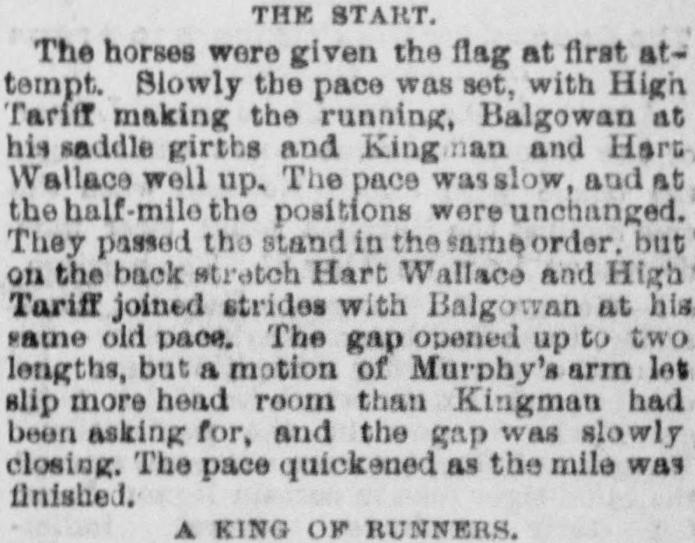
“Slowly the pace was set.” The Morning News, Savannah, Georgia, May 14, 1891, page 1. Library of Congress, Chronicling America. Click the clipping to read it full size.
Then came the clock. Captain Billy Williamson “hung out from the stand the figures 2:52¼.” That meant 2 minutes and 52 and a quarter seconds, and nobody had ever won the Derby that slowly. The Courier-Journal called the race “a farce,” a word for something so silly it seems like a joke, and the Evening Star said the same thing. The Star said many people thought Balgowan might have won if the pace had been fast from the start. By waiting, his side had turned the race into “a dash of a mile,” and in a short dash, Kingman was too quick for him.
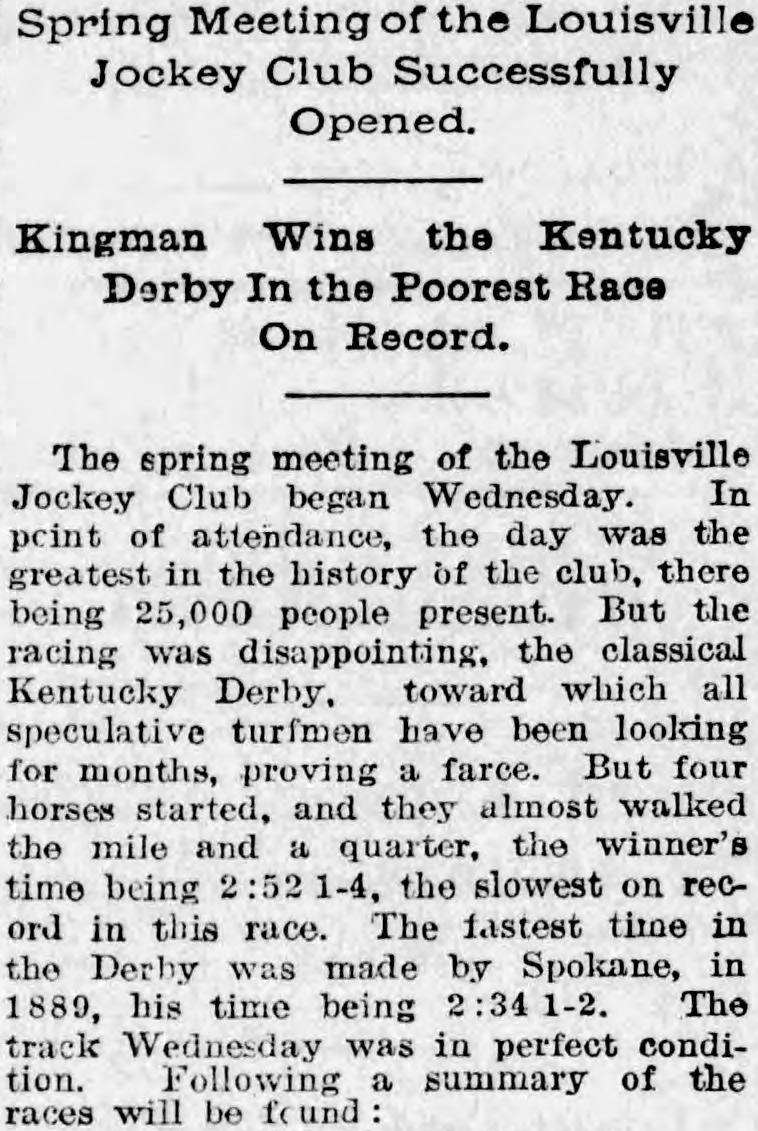
“They almost walked.” The Weekly Courier-Journal, Louisville, Kentucky, May 18, 1891, page 10. Library of Congress, Chronicling America. Click the clipping to read it full size.
Kingman Could Run Much Faster
Dudley Allen knew his colt could run much faster than he did in Louisville, Kentucky, that day. Early in Derby week, Allen said, “I got up before the break of day and sent Kingman the whole distance in 2:35½.” That practice run was almost 17 seconds faster than the Derby itself. “I knew none of the others could touch that,” he said.
After the race, Kingman stood in his stall “quietly munching some hay,” and Allen said the colt “finished the race sound and fresh.” Allen pointed at the stall and called it lucky, because fifteen years before, he had trained Vagrant for the Derby in that very spot.
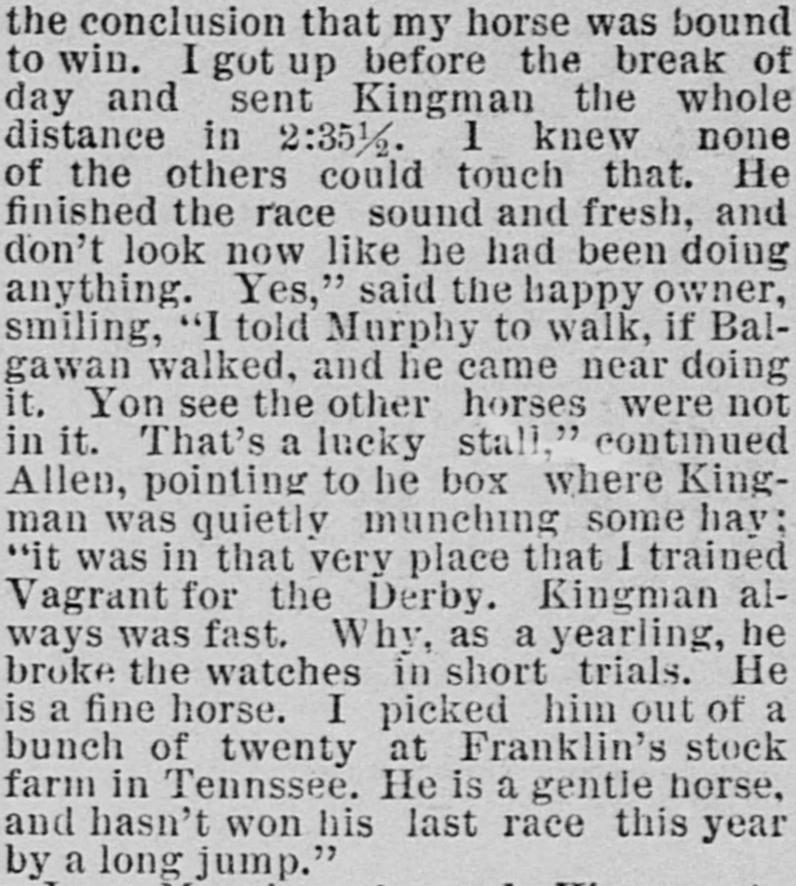
Dudley Allen tells how he won. St. Paul Daily Globe, Saint Paul, Minnesota, May 18, 1891, page 8. Library of Congress, Chronicling America. Click the clipping to read it full size.
By the Numbers: The Slow Derby of 1891
- 2:52¼: Kingman’s winning time, the slowest Kentucky Derby ever run.
- 2:45: the slowest Derby time before that, set by Riley in 1890 in deep mud.
- 2:34½: the fastest Derby up to then, run by Spokane in 1889.
- 4: horses in the race, the smallest Derby field up to then.
- $4,550: the value of the 1891 Derby, the Courier-Journal said.
Isaac Murphy Won Two Record-Slow Derbies in a Row
The 1891 race was not Isaac Murphy’s first slow Derby in Louisville, Kentucky. On May 14, 1890, he rode a colt named Riley to victory on a track “deep in soft, marshy mud.” The San Francisco Morning Call called it “the slowest Kentucky Derby ever run.” Riley’s time was 2:45.
So in 1890 the mud slowed every horse down. In 1891 the track was dry and dusty, yet Murphy’s Derby was even slower, because nobody wanted to go first. The Courier-Journal summed it up in one line: “Isaac Murphy has ridden the winner in three Derbies.”
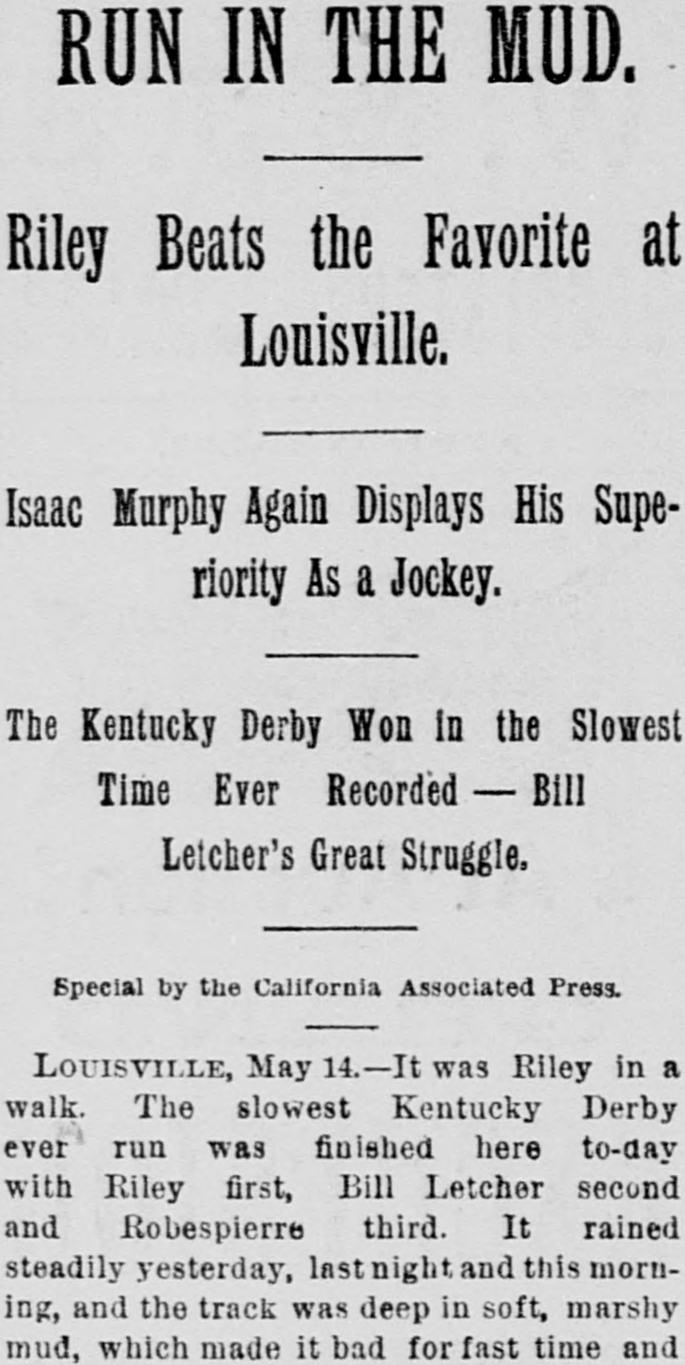
“Run in the Mud.” The Morning Call, San Francisco, California, May 15, 1890, page 1, on the 1890 Derby. Library of Congress, Chronicling America. Click the clipping to read it full size.
The Grandstand at the Top of This Page
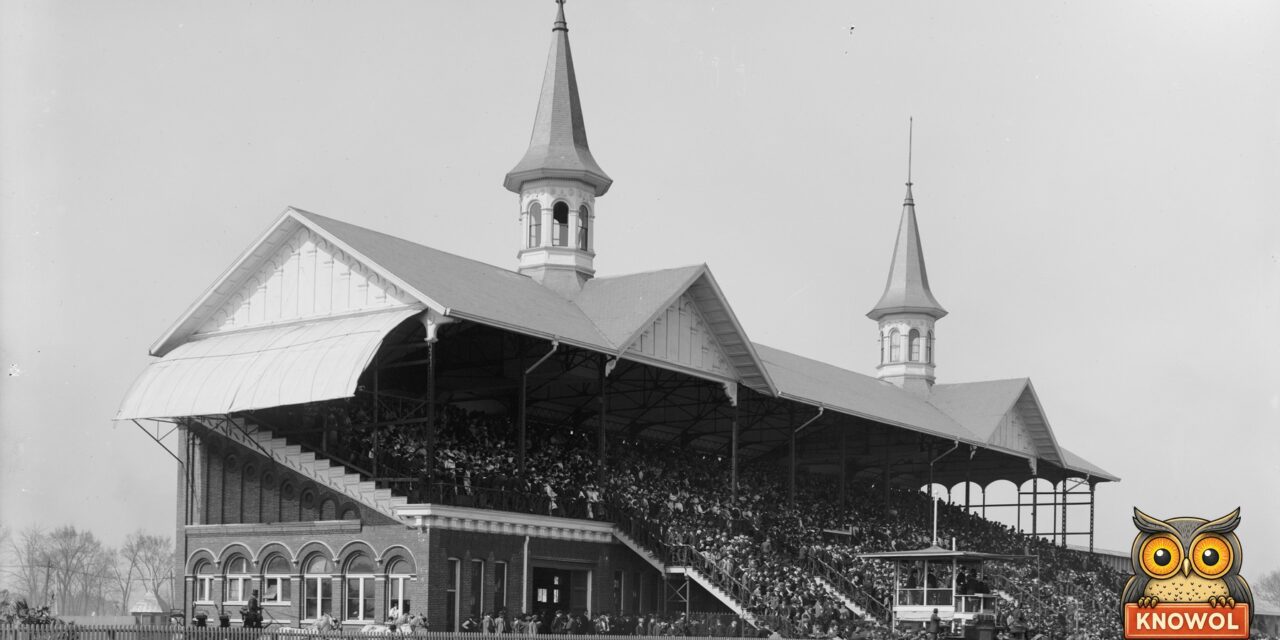
The photo at the top of this story shows Churchill Downs in Louisville, Kentucky, on Derby Day, April 29, 1901, ten years after Kingman’s slow race. It comes from a glass negative made by the Detroit Publishing Co., and nearly every seat under the long roof is full. It shows the same track a decade later, not the 1891 race.
Today the Kentucky Derby Museum in Louisville still names 1891 as the slowest Derby ever run. That May afternoon, thousands of people stood in the dust for hours to watch the fastest young horses in the country. What they saw was the slowest Kentucky Derby there has ever been, won by a jockey who knew exactly when to wait.
Sources
- “Kentucky’s Derby Day,” The Morning News (Savannah, Georgia), May 14, 1891, page 1: the crowd, the dust, the start and the slow time. Library of Congress, Chronicling America.
- “Kingman Wins the Kentucky Derby In the Poorest Race On Record,” The Weekly Courier-Journal (Louisville, Kentucky), May 18, 1891, page 10: 25,000 people, “they almost walked,” “exasperatingly slow,” the owners and Murphy’s three Derbies. Library of Congress, Chronicling America.
- “Kingman Wins the Derby,” Evening Star (Washington, D.C.), May 14, 1891, page 7: the smallest field, “a farce” and “a dash of a mile.” Library of Congress, Chronicling America.
- “Among the Horses,” St. Paul Daily Globe (Saint Paul, Minnesota), May 18, 1891, page 8: Dudley Allen’s own account of the race, and Isaac Murphy. Library of Congress, Chronicling America.
- “Kentucky’s Great Day,” The Indiana State Sentinel (Indianapolis, Indiana), May 20, 1891, page 9: the ride to the track, Murphy’s cap, the colors and the flag start. Library of Congress, Chronicling America.
- “The Kentucky Derby,” The Columbia Herald (Columbia, Tennessee), May 15, 1891, page 3: Kingman’s $265 auction price and his owners. Library of Congress, Chronicling America.
- St. Paul Daily Globe (Saint Paul, Minnesota), May 14, 1891, page 1: the slowest time before 1891 was Riley’s 2:45 in 1890. Library of Congress, Chronicling America.
- “Run in the Mud,” The Morning Call (San Francisco, California), May 15, 1890, page 1: Murphy and Riley win the 1890 Derby. Library of Congress, Chronicling America.
- Kentucky Derby Museum, “What Was the Slowest Derby Ever Run?”: Kingman’s 1891 time is still the slowest Derby on record.
- Detroit Publishing Co., “Churchill Downs, Louisville, Ky., Derby day,” April 29, 1901 (the cover and the track photo, two glass negatives). Library of Congress Prints and Photographs Division. No known restrictions on publication.
- “Isaac Murphy, jockey,” Old Judge & Gypsy Queen Cigarettes card, Goodwin & Co., 1888. Library of Congress Prints and Photographs Division. No known restrictions on publication.
- The newspapers, photographs and trading card above were all published or made before 1931 and are in the public domain.