On Sunday, July 12, 1885, about 100 people stepped onto a steamboat in Arkansas City, Kansas. That alone was a small miracle. Arkansas City sits out on the Kansas prairie, near today’s Oklahoma border, where the Arkansas and Walnut rivers meet. It is a long way from any ocean. The boat belonged to the town’s flour millers, and they had brought it all the way from St. Louis.
The townspeople had heard big river plans before. A letter to the Wichita Daily Eagle said so plainly: so many schemes for running boats on the Arkansas had been dropped that “the people were fully prepared for disappointment in this case.” This time, the boat came.
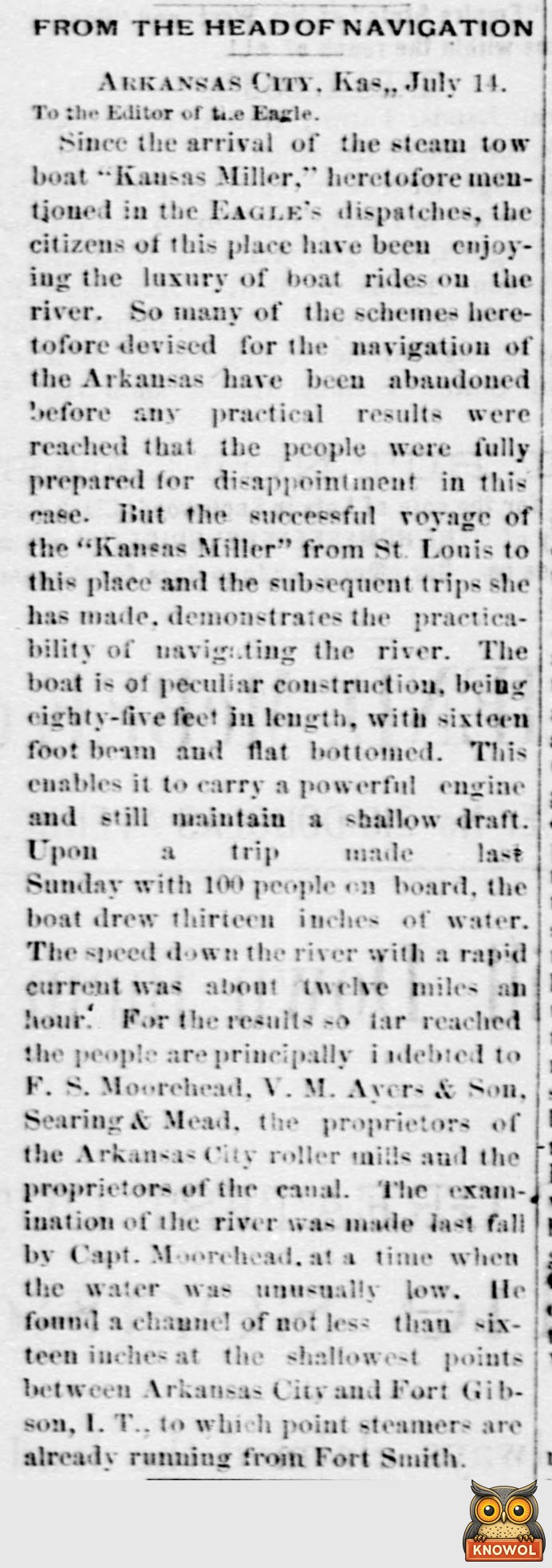
“From the Head of Navigation.” The Wichita Daily Eagle, Wichita, Kansas, July 15, 1885. Library of Congress, Chronicling America. Click the clipping to read it full size.
A ride for everybody on the Fourth
The plan was to have the boat home in time for the Fourth of July. On June 25, a letter from Arkansas City told Eagle readers what was coming. There would be speeches, parades, races “of all kinds,” and at night, fireworks and balloon ascensions (big balloons sent up into the sky). Then came the best part: “The steamboat is expected to be here by the third, so as to be ready to take everybody a ride on the Fourth.”
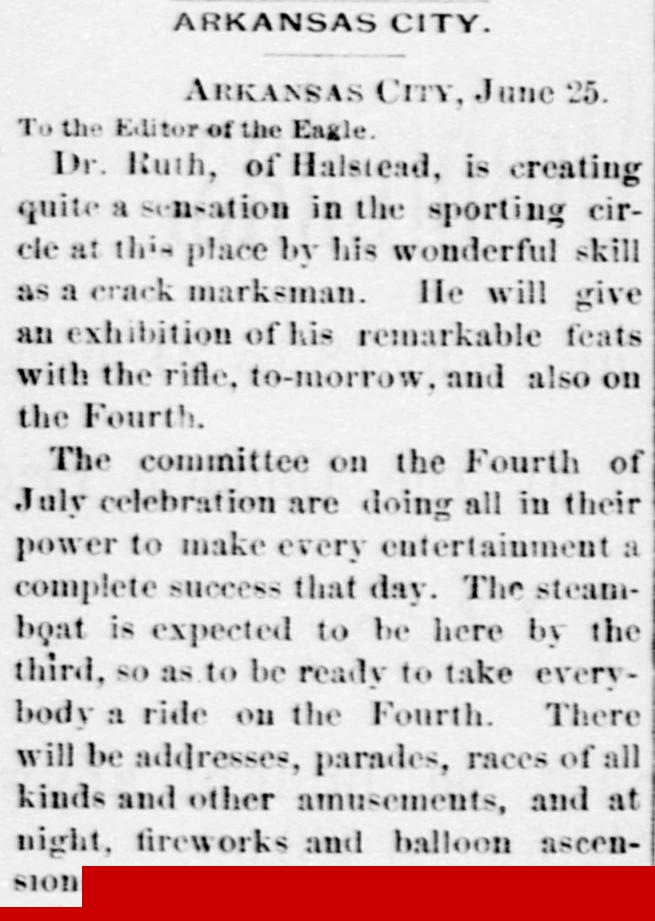
“Arkansas City.” A letter dated June 25, printed in the Wichita Daily Eagle, Wichita, Kansas, June 27, 1885. Library of Congress, Chronicling America. Click the clipping to read it full size.
Five days later, Henry T. Sumner, chairman of the celebration committee, wrote again. “The steamboat built by the millers of Arkansas City will positively be here,” he promised. It had passed Fort Smith, Arkansas, on June 22 “and was getting along finely.” The plan was to bring it up the Walnut River to a spot across from the railroad depot. Sumner signed off with a friendly poke at his readers, calling Arkansas City “the only city of Kansas that pretends to rival Wichita.”
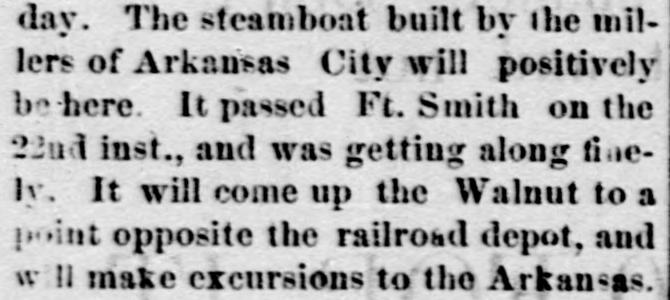
“Will positively be here.” The Wichita Daily Eagle, Wichita, Kansas, July 1, 1885. Library of Congress, Chronicling America. Click the clipping to read it full size.
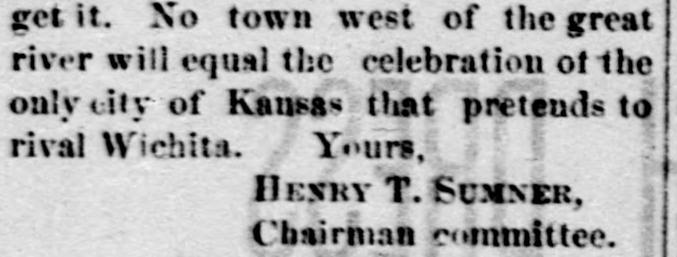
Henry T. Sumner signs off. The Wichita Daily Eagle, Wichita, Kansas, July 1, 1885. Library of Congress, Chronicling America. Click the clipping to read it full size.
Waiting for the water
A steamboat needs water under it, and the Arkansas River in Kansas can be wide, sandy and thin. So people watched the river. On July 3, the Eagle in Wichita, Kansas, upstream from Arkansas City, reported that the river had jumped six inches in two hours. “If it continues to rise,” the paper said, “the steamboat at our sister city will float on the fourth of July.”
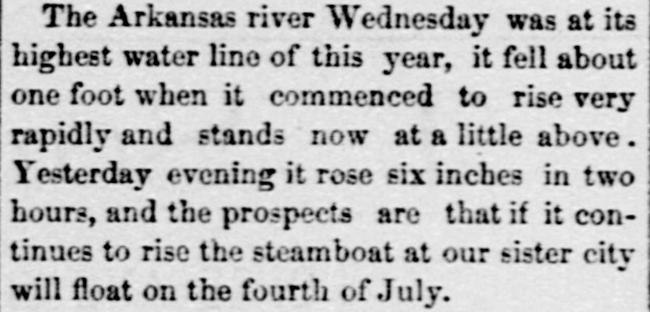
The river report. The Wichita Daily Eagle, Wichita, Kansas, July 3, 1885. Library of Congress, Chronicling America. Click the clipping to read it full size.
The Fourth came, and Arkansas City threw a big party. The Eagle’s reporter saw a parade led by two bands, a wagon showing off “a machine for making wire fence,” and “two chariots filled with gaily attired little girls.” Several thousand people picnicked in a grove, with swings for the young people and a dancing platform. His report never mentions a boat ride. To be fair, he had to leave at 3 o’clock and missed the fireworks.
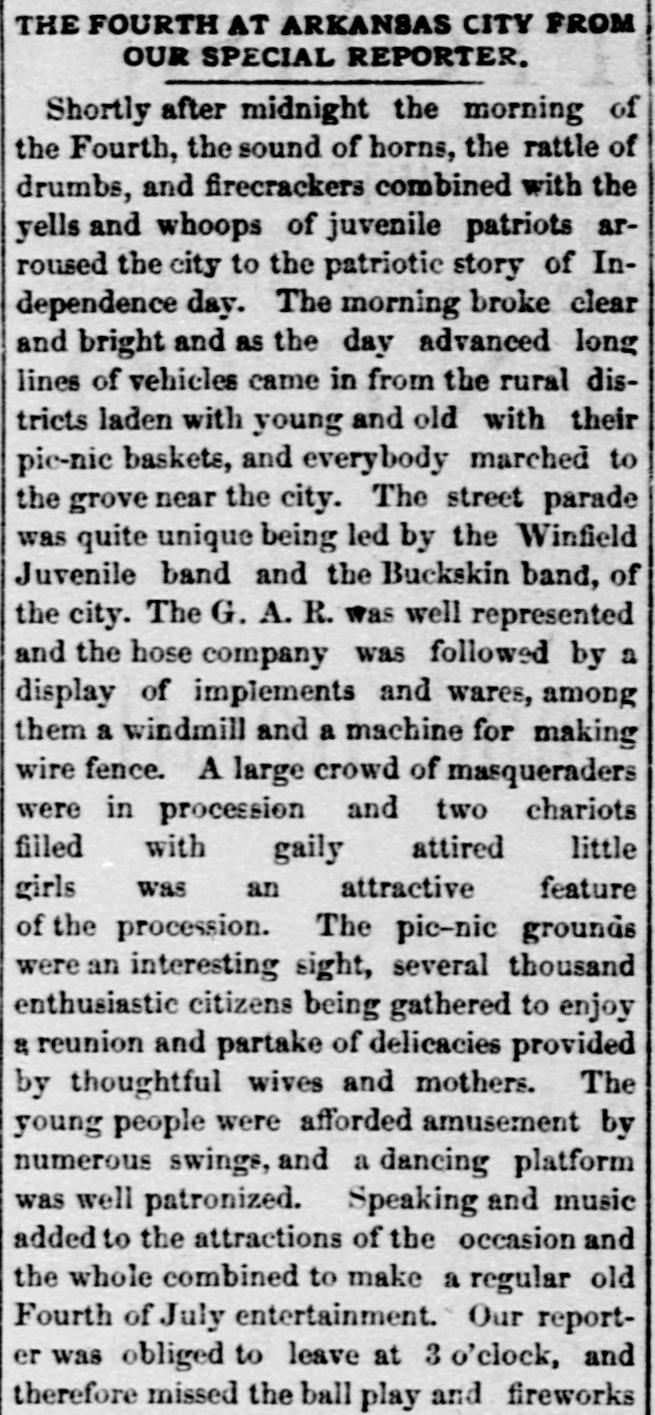
“The Fourth at Arkansas City.” The Wichita Daily Eagle, Wichita, Kansas, July 7, 1885. Library of Congress, Chronicling America. Click the clipping to read it full size.
A boat that floats in a foot of water
By July 14, the boat was in town. Its name was the Kansas Miller (some ads called it the Kansas Millers), and the letter from Arkansas City that day said people had been “enjoying the luxury of boat rides on the river.”
The boat was built for a shallow river. It was 85 feet long and 16 feet wide, with a flat bottom. A flat bottom spreads the weight out, so the boat sits high, a little like a wide sled riding on top of snow. The paper explained that this let it carry “a powerful engine and still maintain a shallow draft.” Draft means how deep a boat sinks into the water. With 100 people on board that Sunday, the Kansas Miller “drew thirteen inches of water.” That’s about the length of a school ruler, plus an inch. Going downstream with a fast current, it made about 12 miles an hour.
The letter named the men to thank: F. S. Moorehead, V. M. Ayers & Son, and Searing & Mead, owners of the Arkansas City roller mills (flour mills) and the canal that ran them. The fall before, when the river was “unusually low,” Captain Moorehead had gone down it and measured. He found a channel at least sixteen inches deep all the way to Fort Gibson, in Indian Territory, where steamboats from Fort Smith already came.
Two days later, on Thursday, a visitor named G. D. Root “had a splendid steamboat ride on the steamer Kansas Miller,” the Eagle said. That trip went twenty miles down the river.
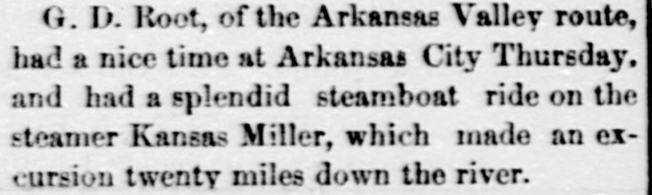
G. D. Root’s ride. The Wichita Daily Eagle, Wichita, Kansas, July 18, 1885. Library of Congress, Chronicling America. Click the clipping to read it full size.
What a day trip cost
Wichita wanted a turn. Organizers there planned a train trip to Arkansas City for Thursday, August 6, with a picnic in a shady grove and a ride on the boat. Their ad called it “the grandest, biggest, brightest and best excursion that ever left Wichita.” The round trip was “$2.00 for adults, children half fare,” so a kid went for a dollar. The ad made one more promise: “It will make you all younger and happier.”
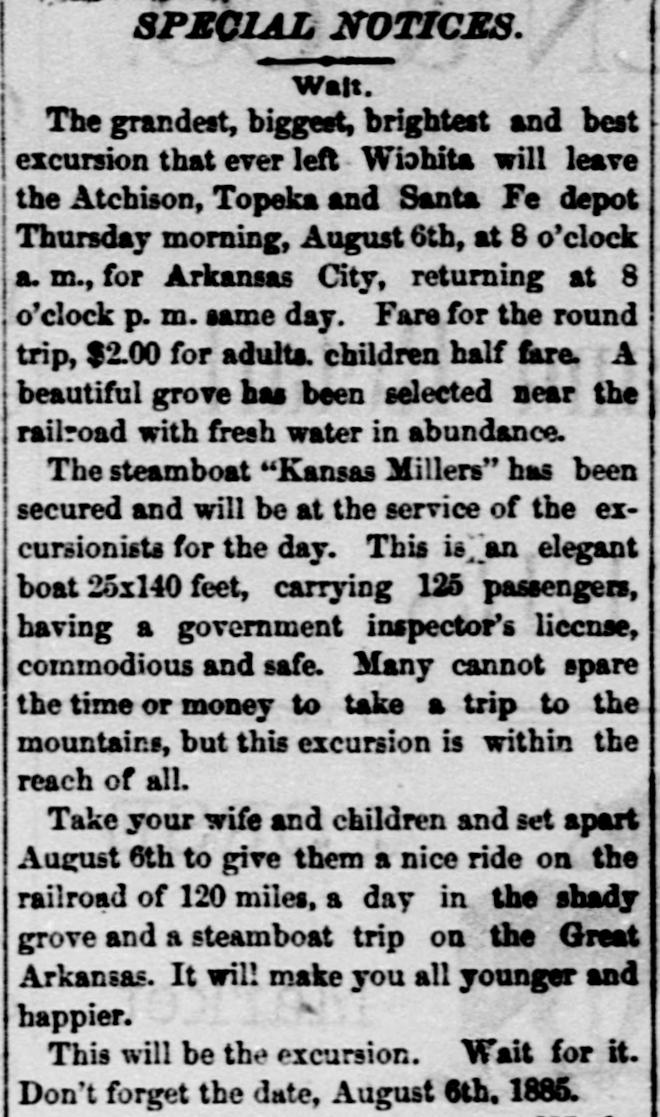
The excursion ad. The Wichita Daily Eagle, Wichita, Kansas, July 28, 1885. Library of Congress, Chronicling America. Click the clipping to read it full size.
On the morning of the trip, about 500 people crowded the Douglass Avenue depot in Wichita. The train had only four coaches and a baggage car. There was “a general rush” for the cars, and not more than half of the crowd found room. Many of the lucky ones rode standing up.
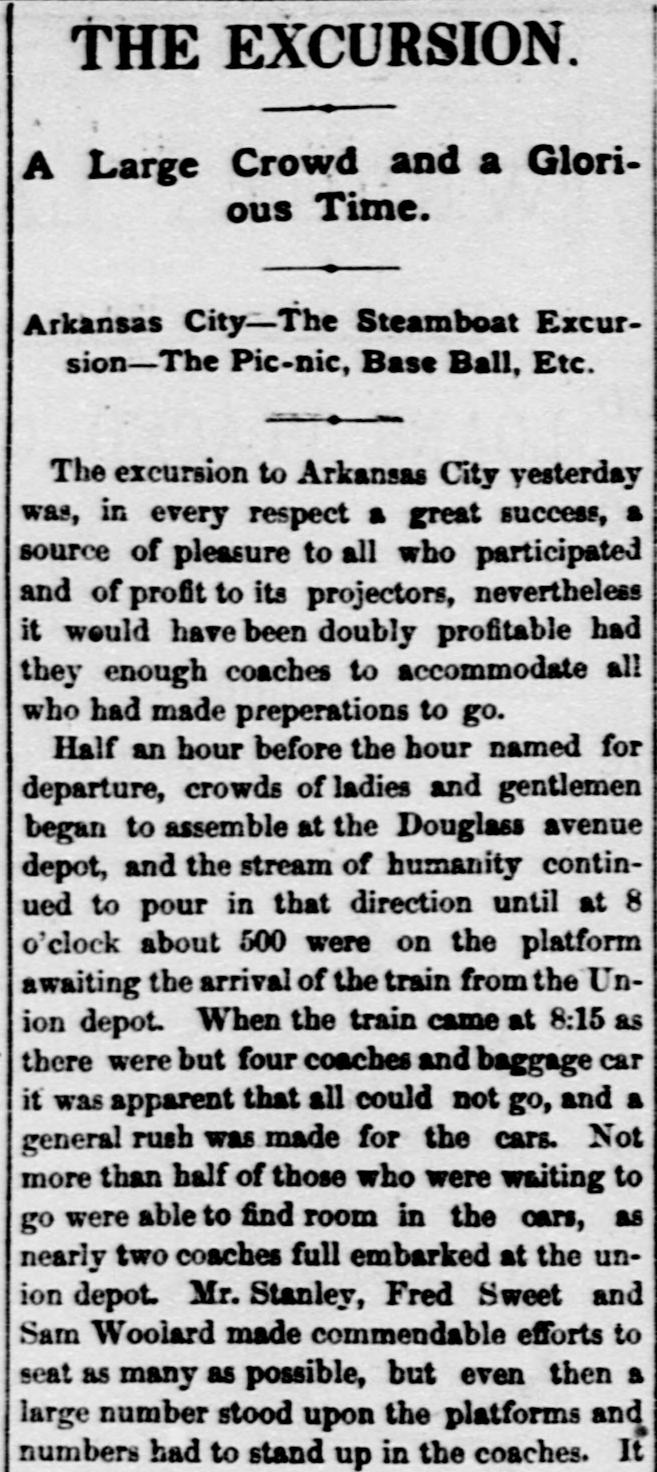
“The Excursion. A Large Crowd and a Glorious Time.” The Wichita Daily Eagle, Wichita, Kansas, August 7, 1885. Library of Congress, Chronicling America. Click the clipping to read it full size.
At Arkansas City, the riders followed a band down to the river, and “about fifty boarded the ‘Kansas Millers.'” The Eagle’s writer loved the trip. “Great waving willows line the edge of the stream,” he wrote, with leaves that “kiss the water.” The boat passed the big stone mills, “where the yellow waters of the Arkansas came tearing down from the mill race,” and herds of cattle drinking at the banks. The boat went about six miles and back, and the return trip took half an hour.
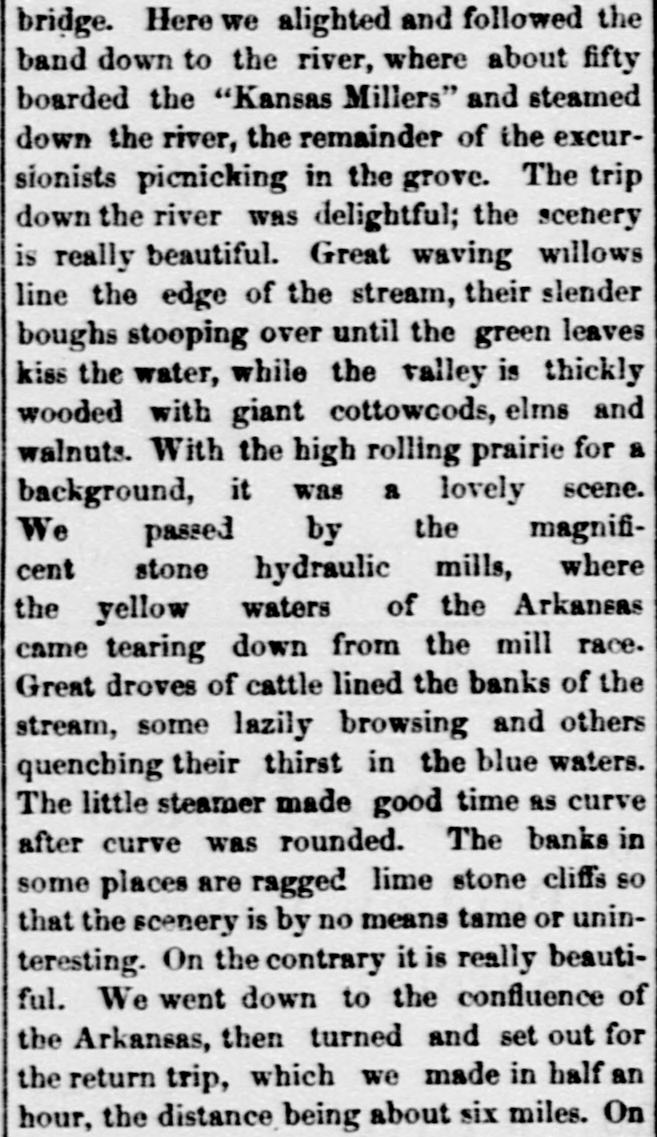
Down the river on the Kansas Millers. The Wichita Daily Eagle, Wichita, Kansas, August 7, 1885. Library of Congress, Chronicling America. Click the clipping to read it full size.
The same writer had ridden into Arkansas City on horseback in 1870, when it was a few shacks on a sandy hill. Now, he wrote, “there is one street of solid brick and stone blocks where the little board sheds then stood.”
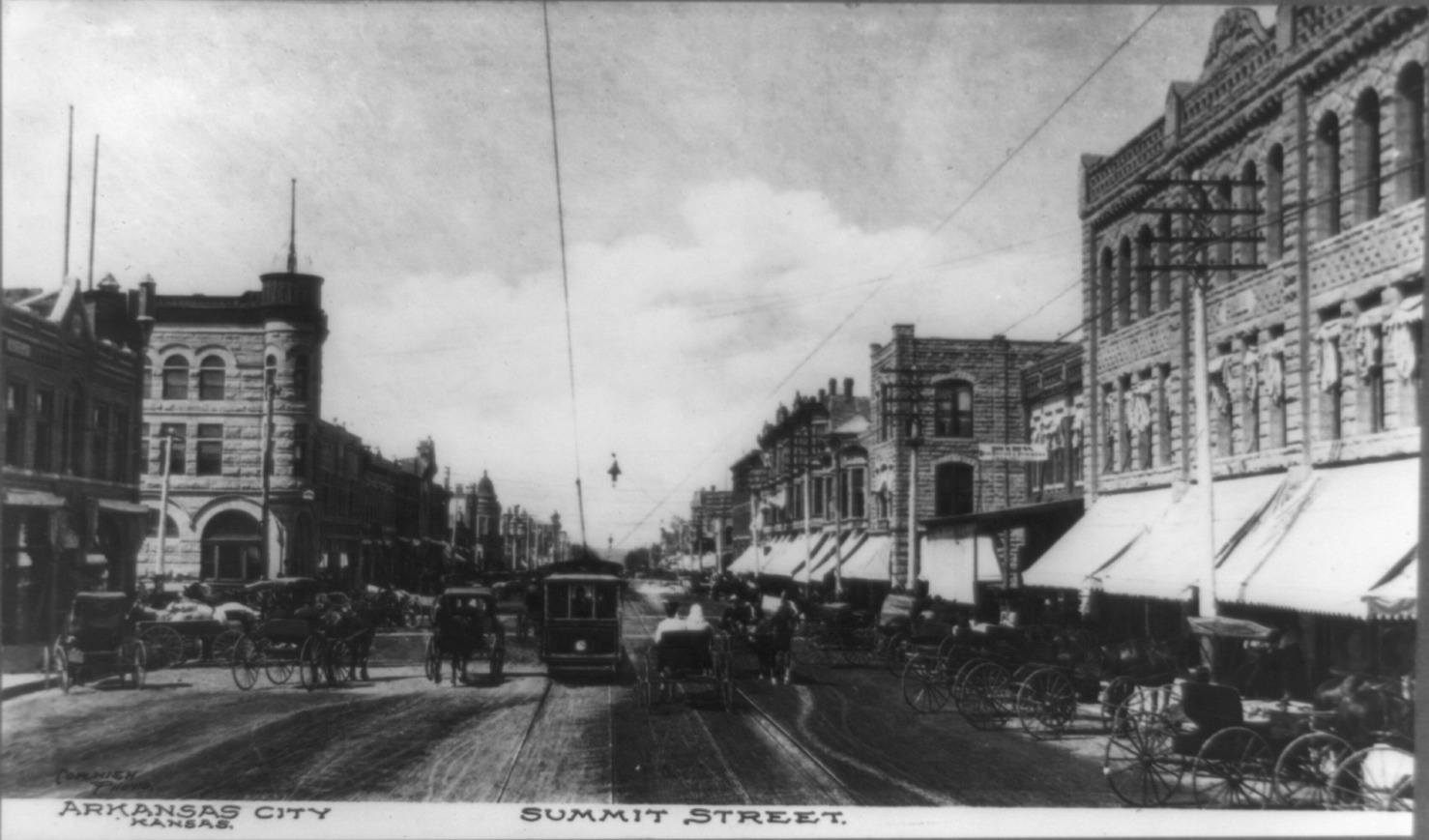
Summit Street, Arkansas City, Kansas, some years after the steamboat summer, with buggies and a streetcar. Cornish photo, Wittemann Collection, Library of Congress (dated between 1880 and 1910). Click the picture to see it full size.
The boat goes to work
Rides were fun, but the Kansas Miller was a millers’ boat, and a year later it did a millers’ job. On July 18, 1886, the Eagle reported that it had made the trip from Arkansas City to Fort Smith, Arkansas, with “200,000 pounds of Kansas flour.” Half of it, 100,000 pounds, was sold along the way in Indian Territory. Flour was packed in barrels of 196 pounds each back then, so that load was roughly a thousand barrels.
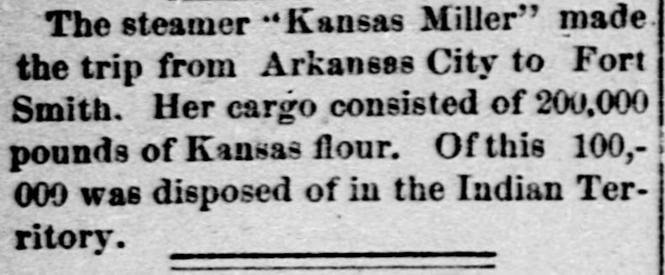
“200,000 pounds of Kansas flour.” The Wichita Daily Eagle, Wichita, Kansas, July 18, 1886. Library of Congress, Chronicling America. Click the clipping to read it full size.
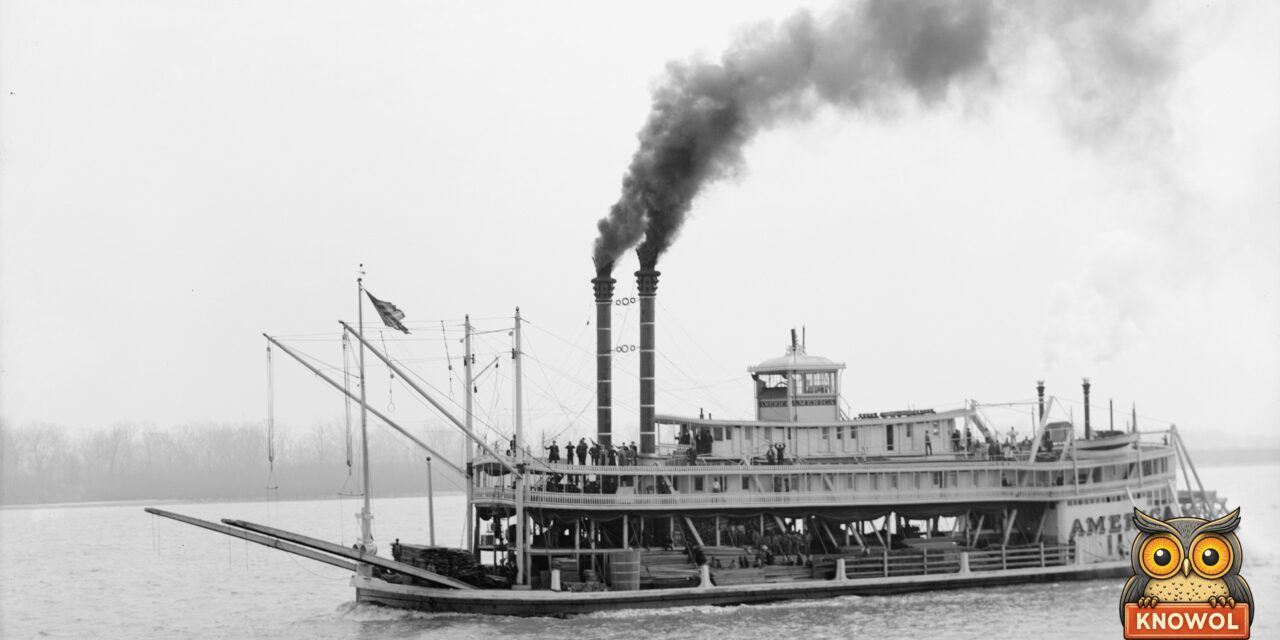
The Kansas Miller wasn’t the town’s first try. An 1883 history of Kansas says a carpenter named Cyrus Wilson built a steamboat called the Cherokee at Arkansas City in 1879. But the summer of 1885 was the one the papers cheered. The photo at the top of this story shows a much bigger sternwheel steamboat, the America, on the Mississippi River around 1900. We couldn’t find a free-to-use picture of the Kansas Miller itself.
By the numbers
- 85 feet: the length of the Kansas Miller.
- 13 inches: how deep it sat in the water with 100 people aboard.
- 12 miles an hour: its speed going downstream.
- $2.00: a grown-up’s round-trip ticket from Wichita, boat ride included.
- 200,000 pounds: the flour it carried to Fort Smith in 1886.
Arkansas City had good reason to doubt. Plenty of river dreams had sunk before this one started. But in July 1885, a flat-bottomed boat full of neighbors pushed off from the prairie, floating on just over a foot of water, and for a summer the little Kansas town had a steamboat of its own.
Sources
- The Wichita Daily Eagle (Wichita, Kansas), Library of Congress, Chronicling America page scans: “Arkansas City,” June 27, 1885; “Arkansas City,” July 1, 1885; the river report, July 3, 1885; “The Fourth at Arkansas City,” July 7, 1885; “From the Head of Navigation,” July 15, 1885; G. D. Root’s ride, July 18, 1885; the excursion ad, July 28, 1885; “The Excursion,” August 7, 1885; the flour trip, July 18, 1886.
- A. T. Andreas, History of the State of Kansas (Chicago, 1883), Cowley County, biography of Cyrus Wilson (the Cherokee, 1879).
- Pictures: “The America, Mississippi river boat” (the cover; Detroit Publishing Co., between 1900 and 1910), no known restrictions on publication; “Summit Street, Arkansas City, Kansas” (Cornish photo, Wittemann Collection, between 1880 and 1910), published view, before 1931. Library of Congress.