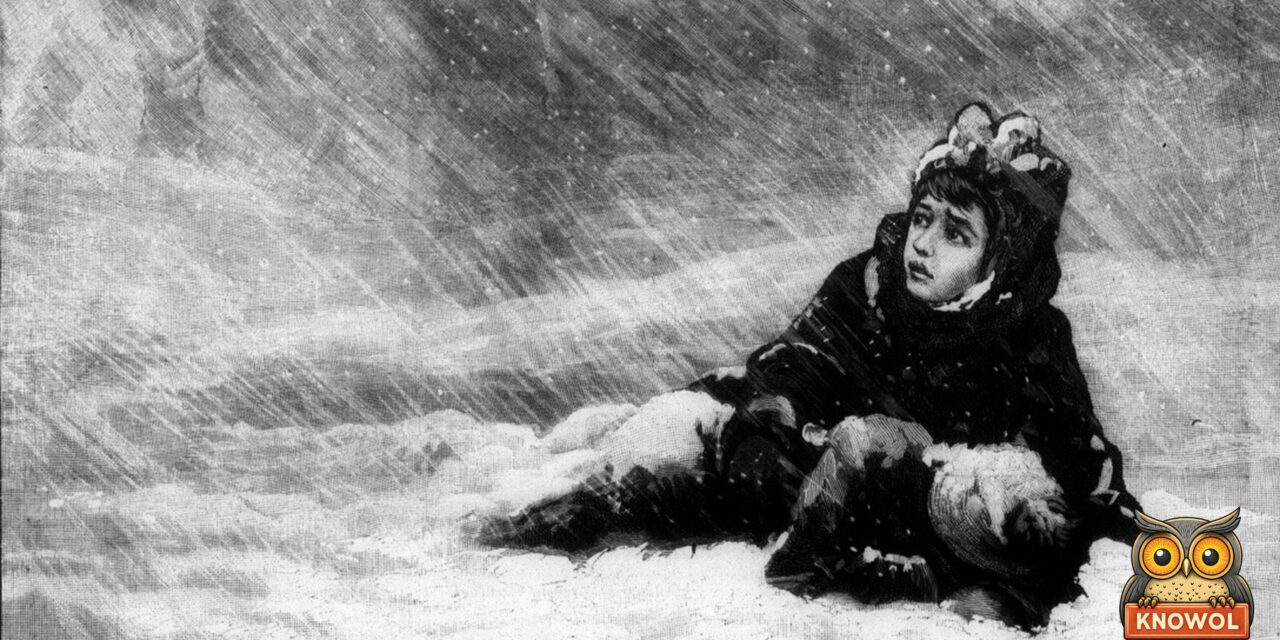
Just before school let out on Thursday, January 12, 1888, a blizzard slammed into the Mira Valley schoolhouse near Ord, Nebraska. That morning there had been “little evidence of the coming of the terrible storm,” the Omaha Daily Bee said later. Now the teacher, Minnie Freeman, 19 years old and in her first term, had thirteen pupils between six and fifteen, a small frame building shaking in the wind, and the nearest house at least half a mile away.
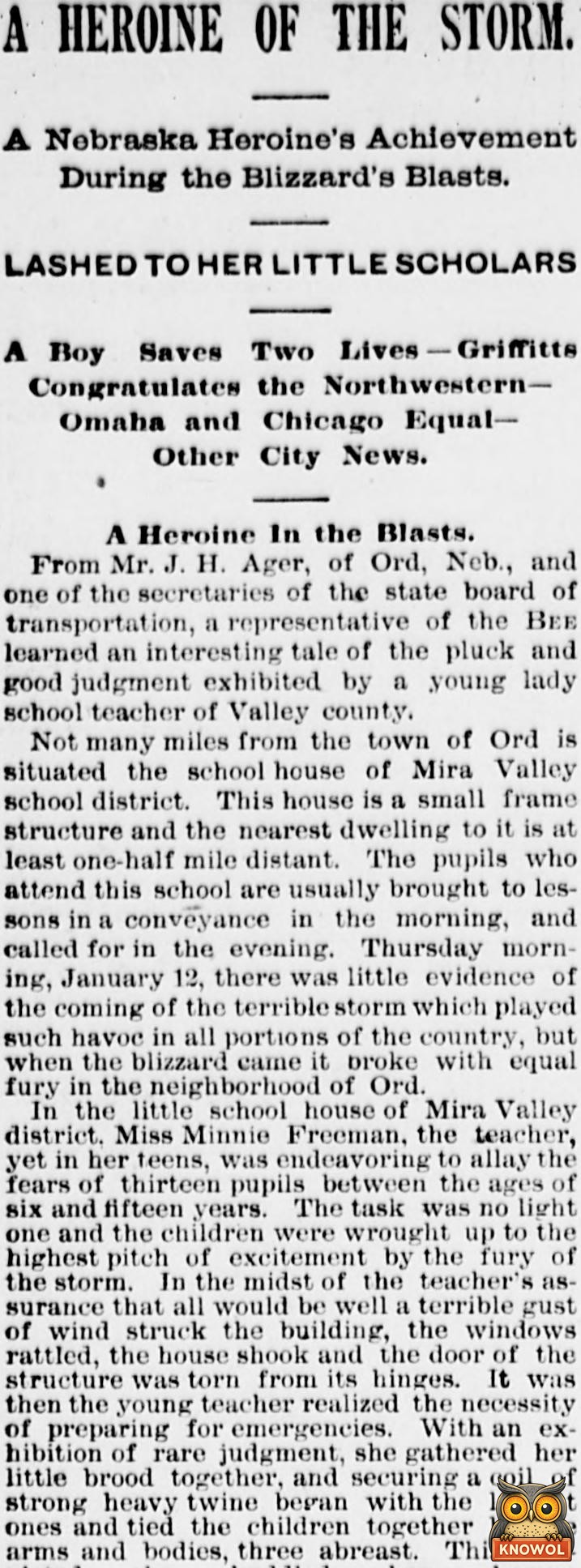
“A Heroine of the Storm,” Omaha Daily Bee, Omaha, Nebraska, January 18, 1888, page 8. Library of Congress, Chronicling America. Click the clipping to read it full size.
“Come on children”
The Omaha Daily Bee printed her story six days later, as told by J. H. Ager, a visitor from Ord. The wind hit the schoolhouse, “the windows rattled, the house shook and the door of the structure was torn from its hinges.” Freeman got the children ready. Then a gale “carried away, in the twinkling of an eye, the entire roof of the structure.”
Six days after that, she came to Omaha herself and told a reporter what happened in her own words. “Then I happened to think of a ball of twine I had taken away from a little fellow,” she said. She tied the children together and fastened the end to her arm. “Very soon the roof of the building blew off and I said, ‘Come on children,’ and we started.”
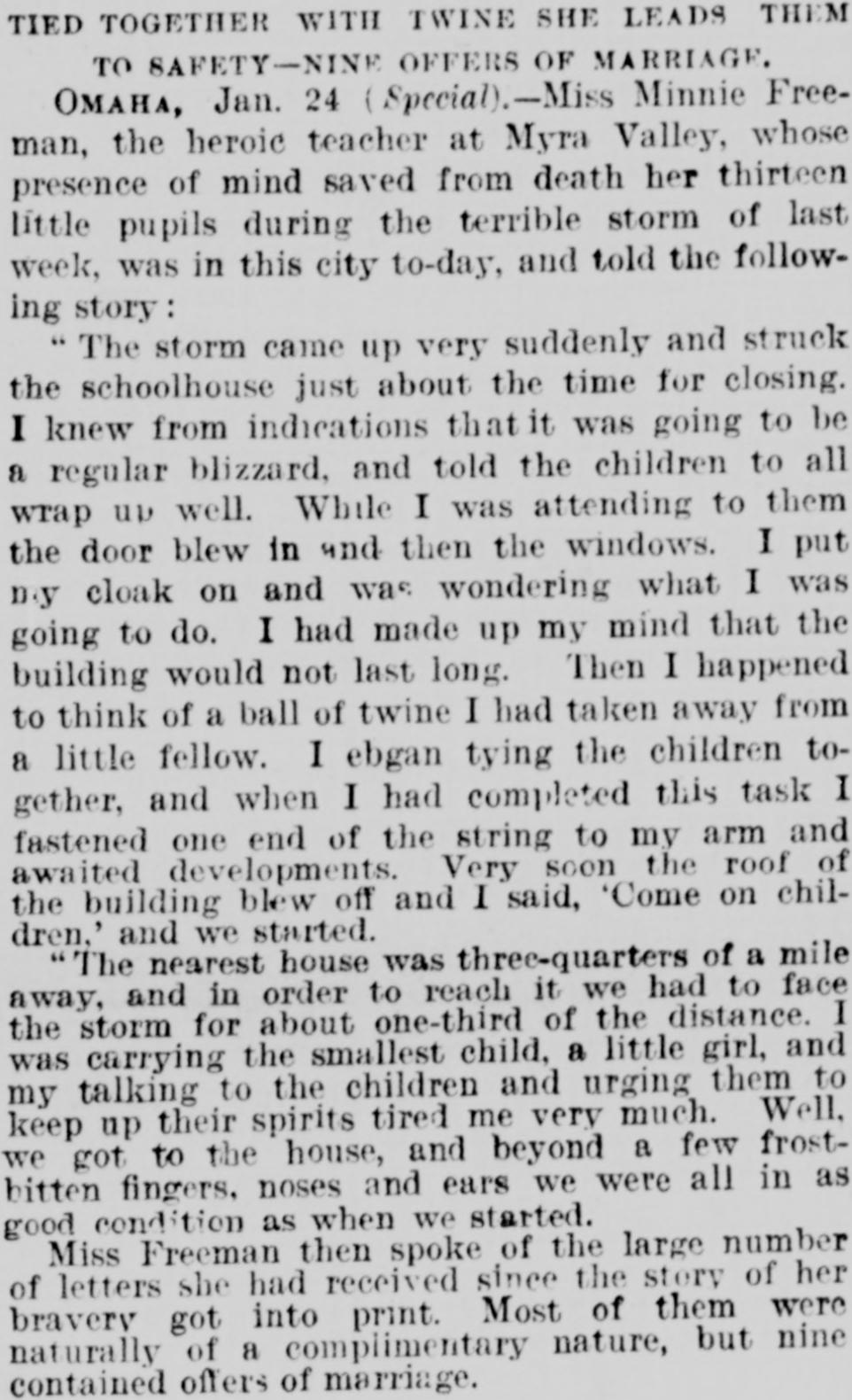
Minnie Freeman tells her own story, New-York Tribune, New York, January 25, 1888, page 1. Library of Congress, Chronicling America. Click the clipping to read it full size.
She carried the smallest child, a little girl, and kept talking the whole way to keep the others going. The nearest farmhouse was about three-quarters of a mile off, she said, and they had to walk straight into the storm for part of it. The Bee said the house they reached was the home of one of her pupils. Nobody was lost. “Beyond a few frost-bitten fingers, noses and ears,” she said, “we were all in as good condition as when we started.”
Not every school was so lucky
The storm struck with little warning across Nebraska and Dakota, and reports of the dead kept coming in for days. A Portland, Maine, paper ran a front-page headline on January 19: “One Hundred and Four Dead in Southern Dakota.” Right under it was Freeman’s story: “How a Plucky Teacher, with a Ball of Twine, Saved Her Pupils.”
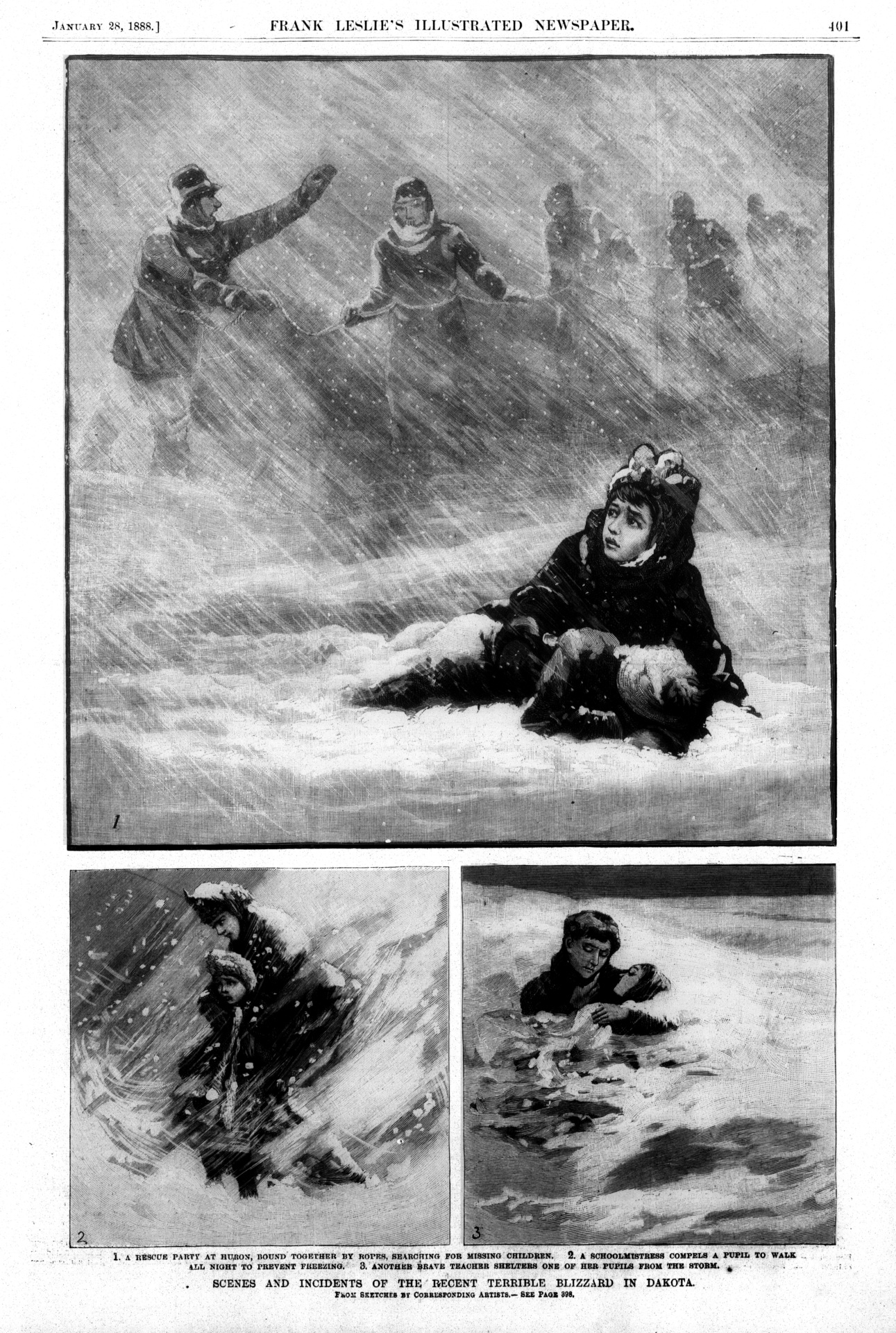
“Scenes and Incidents of the Recent Terrible Blizzard in Dakota,” Frank Leslie’s Illustrated Newspaper, January 28, 1888. Public domain, via Wikimedia Commons. Click the picture to see it full size.
Twine, a jump rope, or nothing at all
The papers never quite agreed on the details. By late February, a letter in the New-York Tribune called her “the Grace Darling of Nebraska,” after a famous English lighthouse keeper’s daughter, and said she had marched the children around the room singing to keep them warm before they left. It flatly denied the twine. “There was no tying of the children together, as the early reports stated, but all joined hands,” it said. That letter also put the walk at half a mile and the class at sixteen. Three years later, the Omaha Bee told the story again and said she had used a skipping rope. Every version ends the same way, with every child alive.
Nine proposals and a 40-cent song
The letters started almost at once. When she visited Omaha in January, she told the reporter that most of them were compliments. The paper added the rest: “nine contained offers of marriage.” A North Platte paper joked that one of those proposals came from a local man and that the clues “strongly point to I. A. F.”
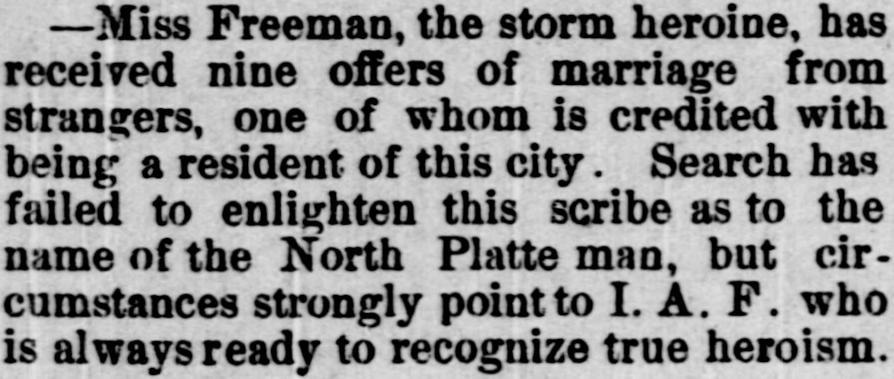
Lincoln County Tribune, North Platte, Nebraska, February 4, 1888. Library of Congress, Chronicling America. Click the clipping to read it full size.
Readers sent money, too. The Omaha Bee raised funds for several teachers caught in the storm, and by February 22 the one in Minnie Freeman’s name stood at $698.81. Her story even became a song. A store in Mitchell, Dakota, advertised it that same week: “Song of the Great Blizzard, Thirteen were Saved, just received at Crouse’s. Beautiful song only 40c.” The Census Bureau’s history office credits the song to William Vincent.
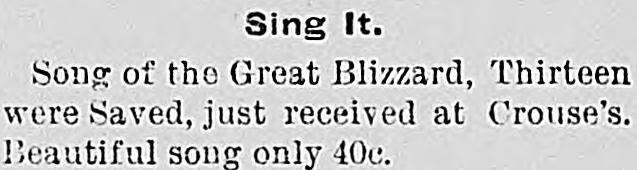
The Mitchell Capital, Mitchell, Dakota, February 24, 1888. Library of Congress, Chronicling America. Click the clipping to read it full size.
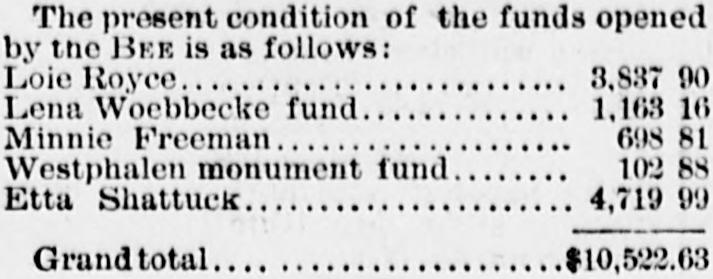
The Omaha Bee’s blizzard funds, February 22, 1888. Library of Congress, Chronicling America. Click the clipping to read it full size.
The wedding in Omaha
In April 1891, Minnie Freeman married E. B. Penney at the Hotel Dellone in Omaha. The Bee’s wedding notice spent most of its space on the blizzard. Since that day, it said, “her name is familiar to almost every school boy and girl in the country.” Its account of the blizzard ended like this: “Letters poured in upon her and the modest retiring woman found herself one morning famous.”
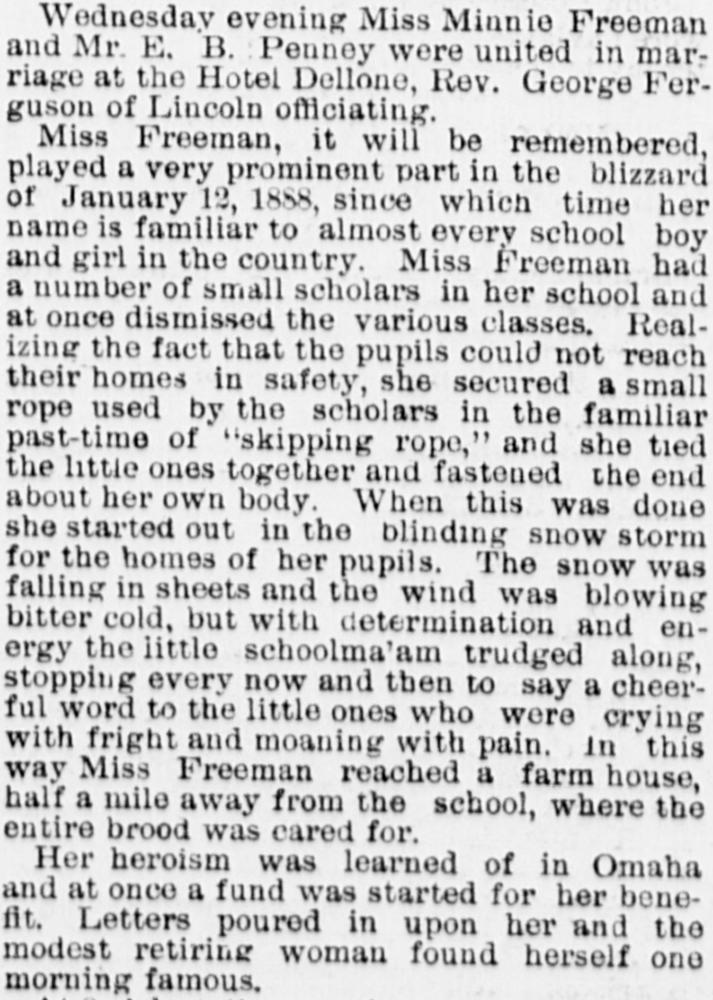
Omaha Daily Bee, Omaha, Nebraska, April 26, 1891. Library of Congress, Chronicling America. Click the clipping to read it full size.
Sources
- Omaha Daily Bee (Omaha, Neb.), January 18, 1888, page 8, February 22, 1888, page 4 and April 26, 1891, page 7.
- New-York Tribune (New York, N.Y.), January 25, 1888, page 1 and February 26, 1888, page 4.
- The Portland Daily Press (Portland, Me.), January 19, 1888, page 1.
- Lincoln County Tribune (North Platte, Neb.), February 4, 1888, page 3.
- The Mitchell Capital (Mitchell, Dak.), February 24, 1888, page 7.
- All newspaper images: Library of Congress, Chronicling America. No known copyright restrictions.
- U.S. Census Bureau, History and the Census: The 1888 Schoolchildren’s Blizzard, for the song’s author.
- Engraving: “Scenes and Incidents of the Recent Terrible Blizzard in Dakota,” Frank Leslie’s Illustrated Newspaper, January 28, 1888, via Wikimedia Commons.jpg). Public domain.
- Cover: “Scenes and Incidents of the Recent Terrible Blizzard in Dakota,” Frank Leslie’s Illustrated Newspaper, January 28, 1888, detail of the top panel. Public domain, via Wikimedia Commons.