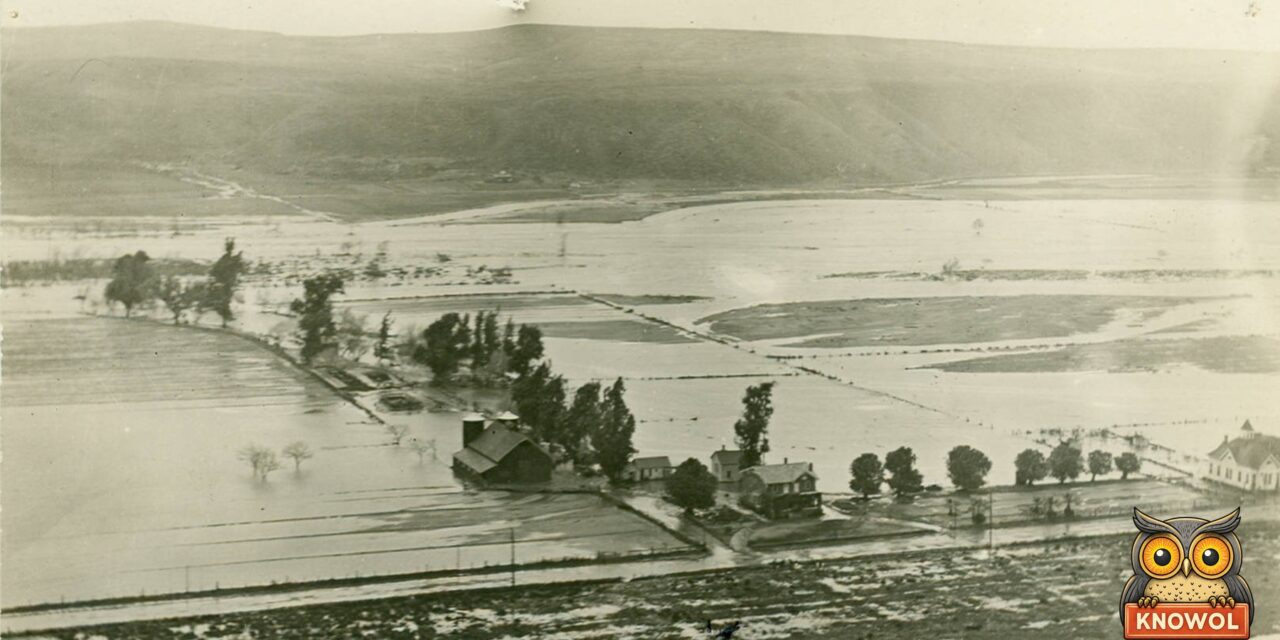
In the first days of January 1916, a man named Charles Hatfield was camped beside the Morena reservoir in the dry hills east of San Diego, California. He had a little tent, a tower and a set of secret chemicals, and he had a deal with the city. If he could fill the reservoir with rain, San Diego would pay him $10,000. Within a month, the reservoir was full, a dam downstream had burst, and the city council was trying to figure out how to get out of the bill.
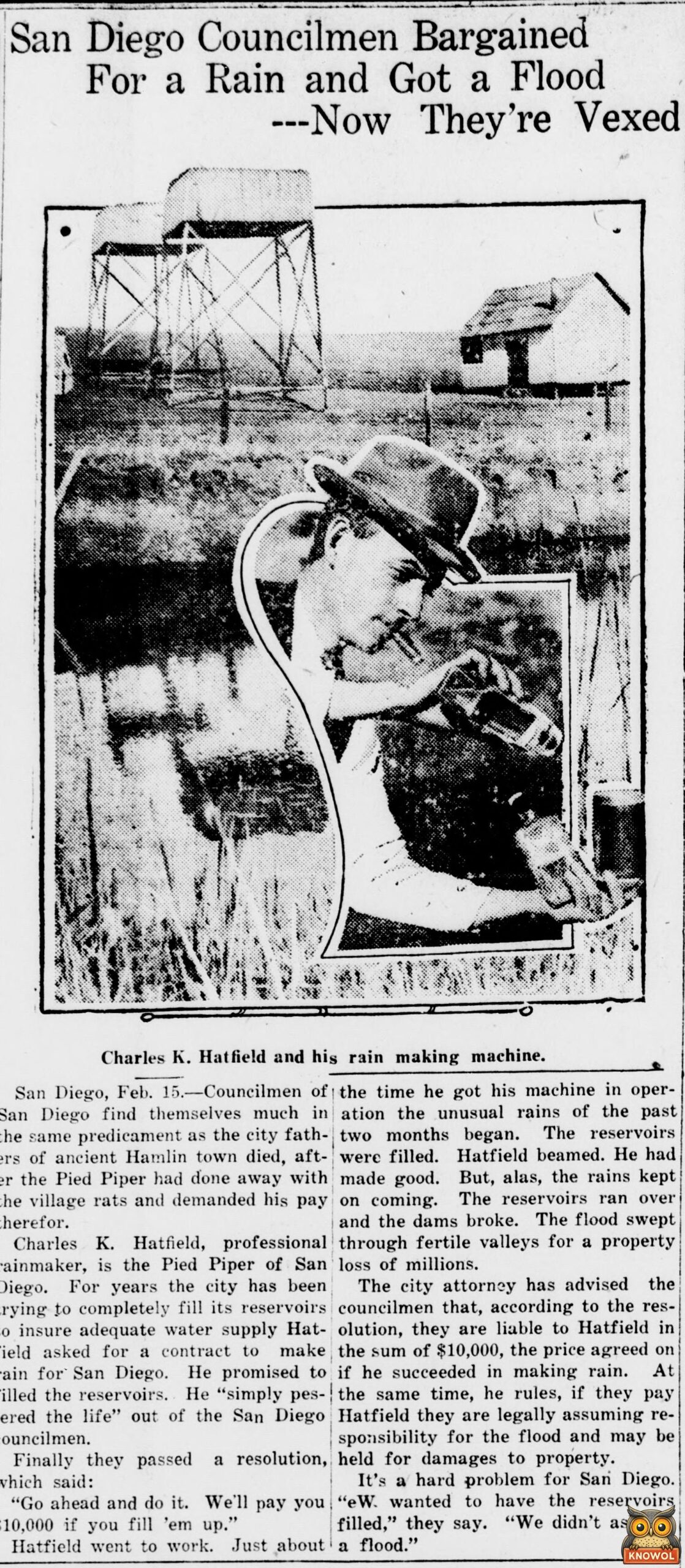
“San Diego Councilmen Bargained For a Rain and Got a Flood,” with a photo of Charles K. Hatfield, Imperial Valley Press, El Centro, California, February 15, 1916, page 4. Library of Congress, Chronicling America. Click the clipping to read it full size.
“We’ll pay you $10,000”
San Diego had worried about water for years. The Morena dam could hold 15 billion gallons, and the reservoir behind it had never come close to filling. On December 13, 1915, Hatfield, a professional rainmaker, went to the city council with his offer. He kept after the councilmen until they gave in and passed a resolution that, as one paper put it, came down to this: “Go ahead and do it. We’ll pay you $10,000 if you fill ’em up.” The Tacoma Times said the council only took the deal to get rid of him. “With many merry quips and jests at the rainmaker’s expense a contract was drawn.”
Then it rained
Hatfield set up at the dam and went to work, and within days it started to rain. It kept raining. By January 20, more than 16 inches had fallen at the Morena dam. When the worried councilmen sent word to his tent, the Tacoma Times reported, “Hatfield replied that he was busy but that it had just begun to rain.”
No milk, no trains, no news
The first storm cut San Diego off from the world. Rivers flooded the valleys south and east of the city, and four people died in the Tijuana River bottoms. The Tijuana race track was under water. Most of the dairies and vegetable gardens were flooded too, and with the Santa Fe trains stopped, nothing new could come in. Papers warned that the city might run out of milk and vegetables. For 48 hours, San Diego’s only news from outside came by wireless from Los Angeles.
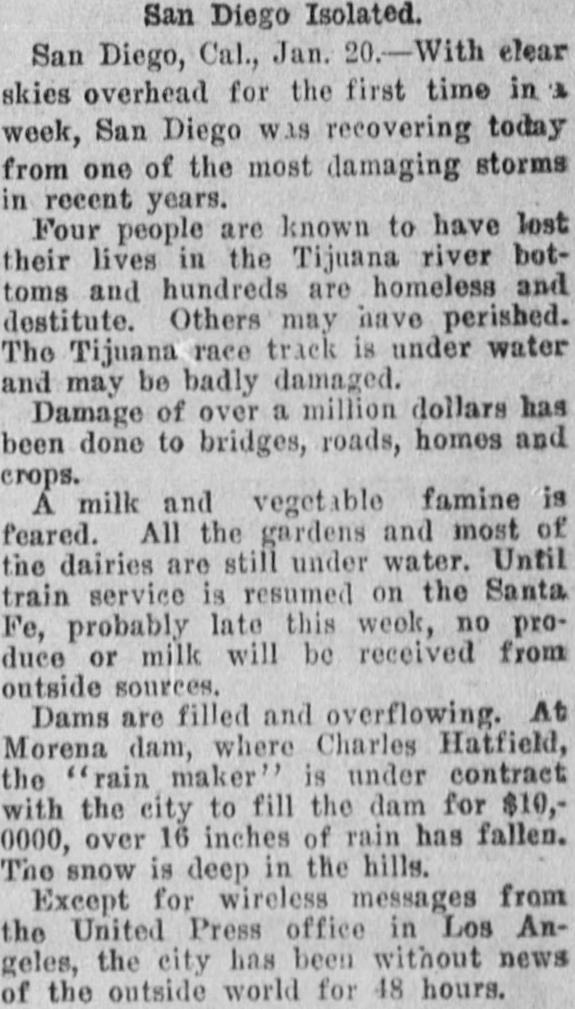
“San Diego Isolated,” Daily Capital Journal, Salem, Oregon, January 20, 1916, page 1. Library of Congress, Chronicling America. Click the clipping to read it full size.
The dam breaks
A second storm came in late January, and on January 27 the Lower Otay dam gave way. The city’s own history says it sent a 40-foot wall of water 12 miles down the valley to the sea, wrecking everything in its path. On January 31, the papers counted 34 bodies recovered and feared the dead would reach about 65, with 3,000 people homeless. The real toll was lower but never settled. A county historical marker put up in 1999 near the Morena dam says 14 people died.
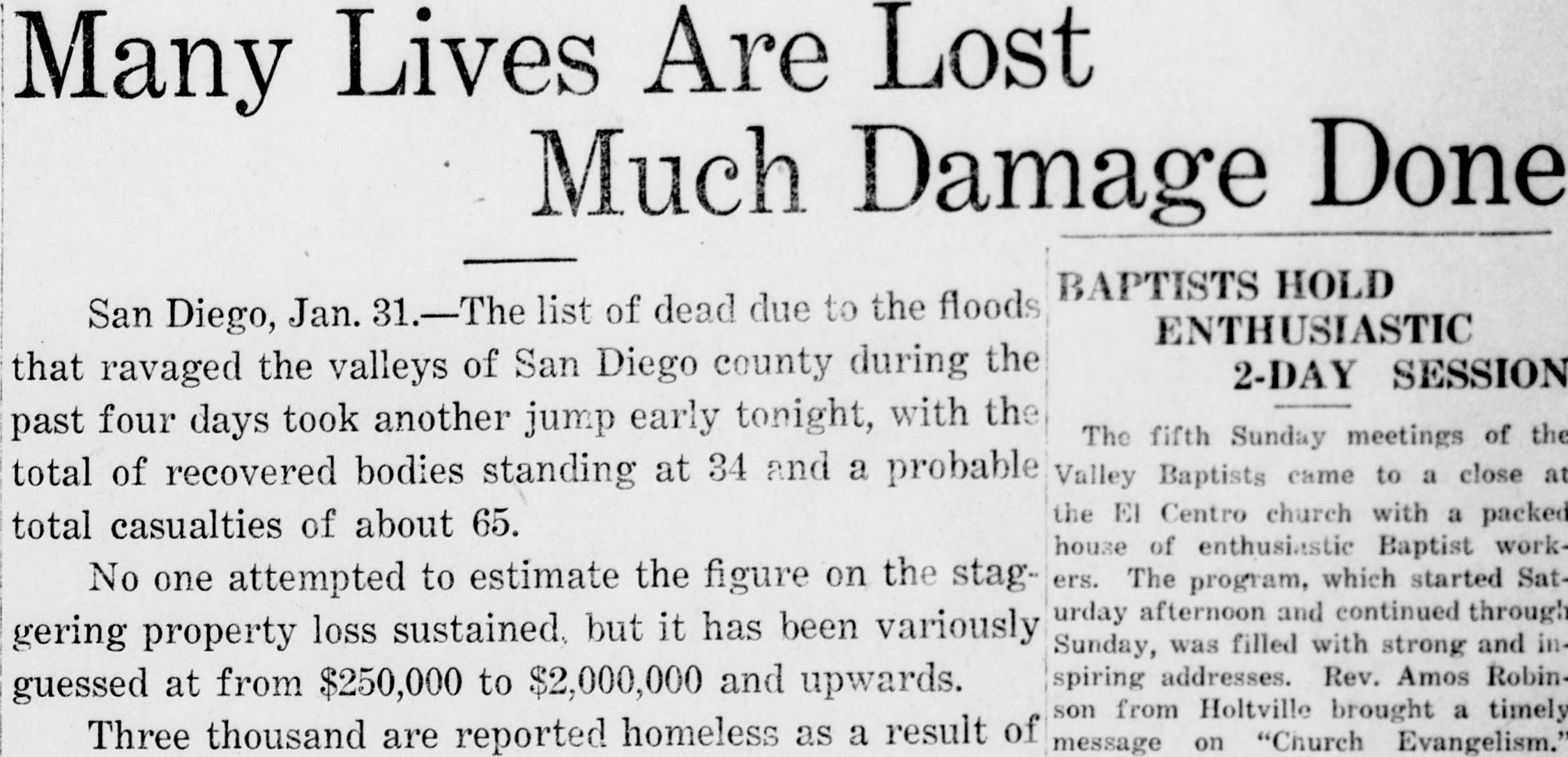
Imperial Valley Press, El Centro, California, January 31, 1916, page 1. Library of Congress, Chronicling America. Click the picture to see it full size.
“We didn’t ask for a flood”
Now the council had a problem. Its own lawyer said the city owed Hatfield the $10,000. But paying him would mean admitting he made the rain, and then San Diego could be sued for the flood. One paper compared the councilmen to the town fathers in the old tale of the Pied Piper, who got rid of the rats and then refused to pay the piper. “Hatfield beamed. He had made good. But, alas, the rains kept on coming,” it said. The councilmen had their own way of putting it: “We didn’t ask for a flood.”
By late February, a report from Los Angeles had the city attorney saying the opposite: since no formal contract had ever been drawn up, the city couldn’t be held for the debt. Hatfield hired a lawyer and sued. Some leading citizens even asked the city to sue him back for the flood damage. The Tacoma Times had already written the moral of the story: “Never tickle Mother Nature. You may throw the old lady into hysterics.”
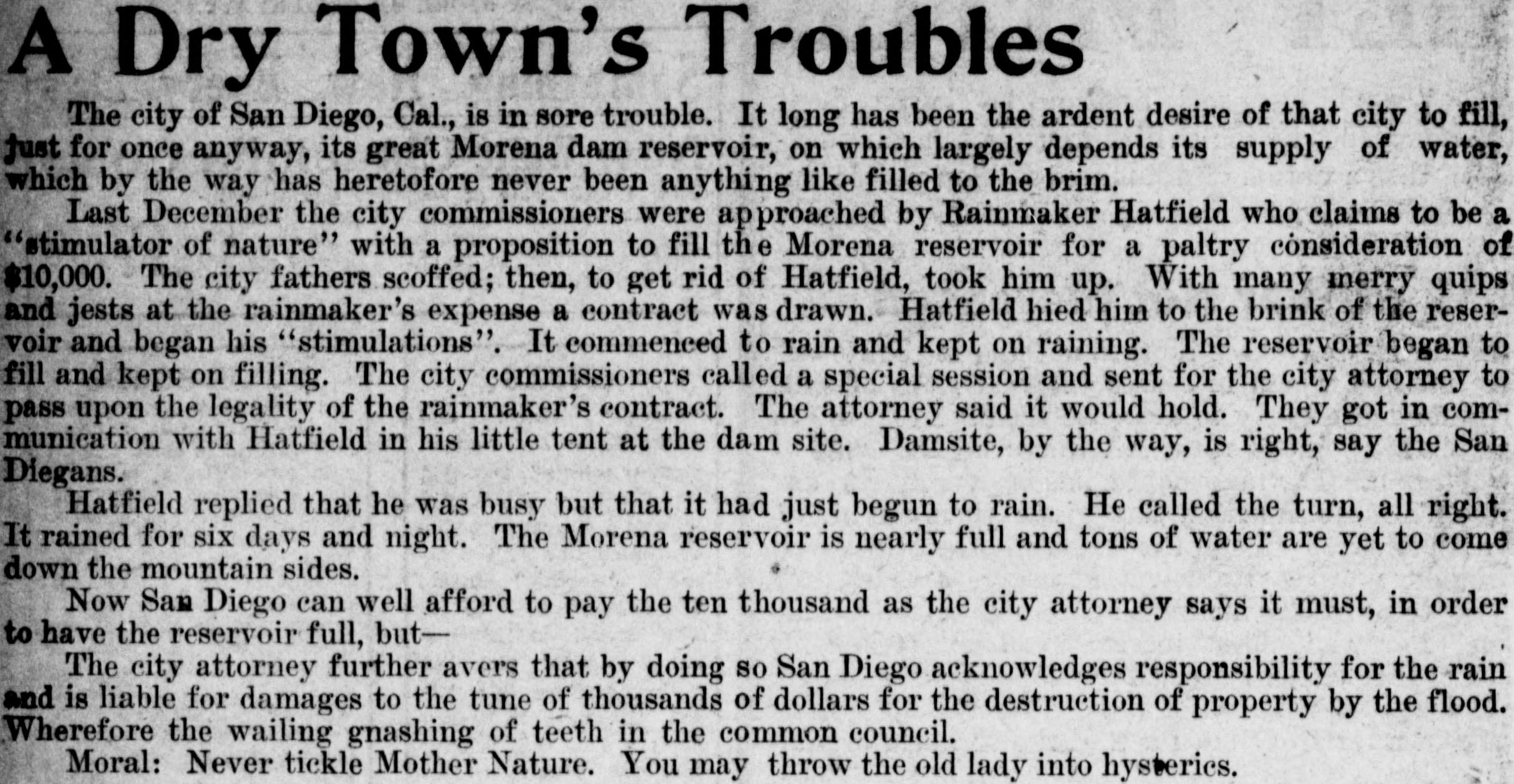
“A Dry Town’s Troubles,” the Tacoma Times, Tacoma, Washington, January 26, 1916, page 4. Library of Congress, Chronicling America. Click the picture to see it full size.
The bill that was never paid
The city offered to pay if Hatfield would take responsibility for the damage, and he refused. His lawsuit dragged on for more than 20 years until it was dismissed in 1938. Hatfield never got a cent from San Diego, and he left town and went on selling rain to other places. San Diego got what it asked for, though. The Morena reservoir was finally full.
Sources
- Imperial Valley Press (El Centro, Calif.), February 15, 1916, page 4 and January 31, 1916, page 1.
- The Tacoma Times (Tacoma, Wash.), January 26, 1916, page 4.
- Daily Capital Journal (Salem, Ore.), January 20, 1916, page 1.
- The Milwaukee Leader (Milwaukee, Wis.), February 24, 1916, page 1.
- City of San Diego Digital Archives, “Rainmaker Charles Hatfield”, for the December 1915 offer, his January 1 start and the 40-foot wall of water.
- “Hatfield the Rainmaker” historical marker, Campo, erected 1999 by the County of San Diego and the Squibob Chapter, E Clampus Vitus (marker text), for the death toll and that he was never paid.
- Christopher Klein, “When San Diego Hired a Rainmaker a Century Ago, It Poured,” JSTOR Daily, December 12, 2015, drawing on Barbara Tuthill, “Hatfield the Rainmaker,” Western Folklore (1954), for the December 13, 1915, council meeting, the date of the dam failure, the city’s offer to pay if he took the blame, and the 1938 dismissal.
- All newspaper images, including the 1916 photograph of Hatfield: Library of Congress, Chronicling America. No known copyright restrictions.
- Cover: “Flood in Mission Val San Diego Cal Jan 1916,” photograph, San Diego Public Library, via Wikimedia Commons (cropped). Public domain.