On Thursday, February 19, 1914, a five-year-old girl named May Pierstorff was taken to the train depot in Grangeville, Idaho along with the rest of the day’s mail. She was going to see her grandmother in Lewiston, about 73 miles away, and she wasn’t traveling on a passenger ticket. Her family had sent her by parcel post. That same day, the Idaho County Free Press put it on the front page: “Little Girl Sent By Mail As Parcel Post Package.”
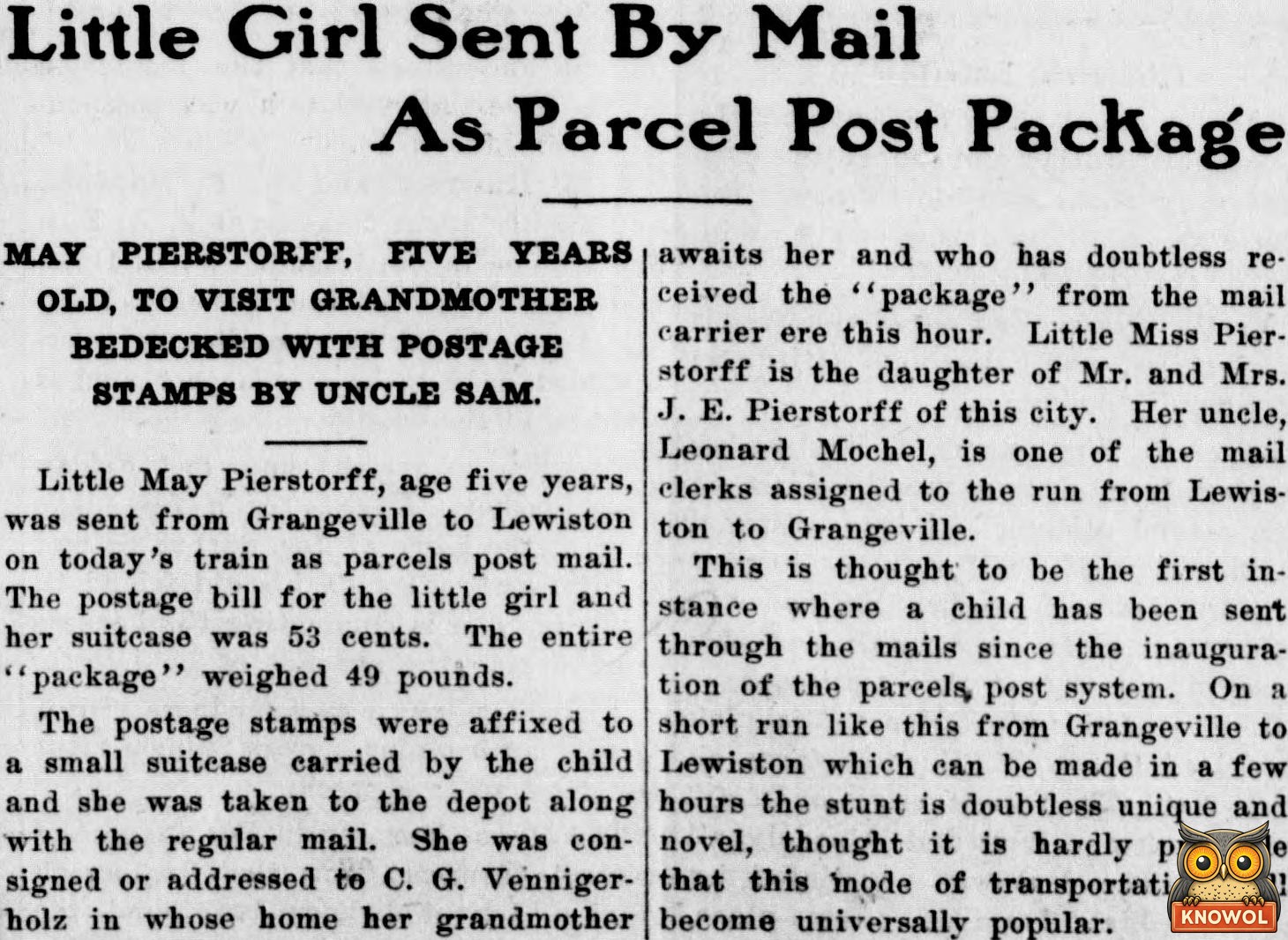
“Little Girl Sent By Mail As Parcel Post Package,” Idaho County Free Press, Grangeville, Idaho, February 19, 1914, page 1. Library of Congress, Chronicling America. Click the clipping to read it full size.
53 cents and 49 pounds
The paper gave the details like a shipping receipt. “The postage bill for the little girl and her suitcase was 53 cents,” it said. “The entire ‘package’ weighed 49 pounds.” That was just under the parcel post weight limit of 50 pounds. The stamps didn’t go on May herself. “The postage stamps were affixed to a small suitcase carried by the child and she was taken to the depot along with the regular mail.” She was addressed to C. G. Vennigerholz in Lewiston, whose home was where her grandmother was waiting.
Most retellings today, including the Smithsonian’s National Postal Museum, say the stamps were stuck to May’s coat. The hometown paper, written that same day, says the suitcase.
Her uncle in the mail car
May didn’t ride in a mail sack. She rode in the train’s mail compartment, and she had family aboard. Her uncle, Leonard Mochel, was one of the mail clerks on the Lewiston to Grangeville run, the Free Press explained. The Postal Museum says Mochel was the clerk on duty that day and delivered her to her grandmother’s house himself.
The paper thought it was the first time a child had been mailed since parcel post began, and it was sure the idea wouldn’t catch on. “It is hardly probable that this mode of transportation will become universally popular,” it said. It was wrong about being first. According to the Postal Museum, a baby boy in Ohio had already been mailed to his grandmother in January 1913, for 15 cents.
“Bees to Babies”
May’s trip had one more surprise in it. Six days earlier, the Post Office had already answered the question. A postmaster in Oklahoma had asked whether a man could mail a two-year-old from Twin Falls, Idaho. On February 13, 1914, the Washington Times ran the answer under the headline “Parcel Post Rules Now Prefer Bees to Babies.” The department ruled that “all human beings and live animals, except queen bees, are barred from the parcel post.”
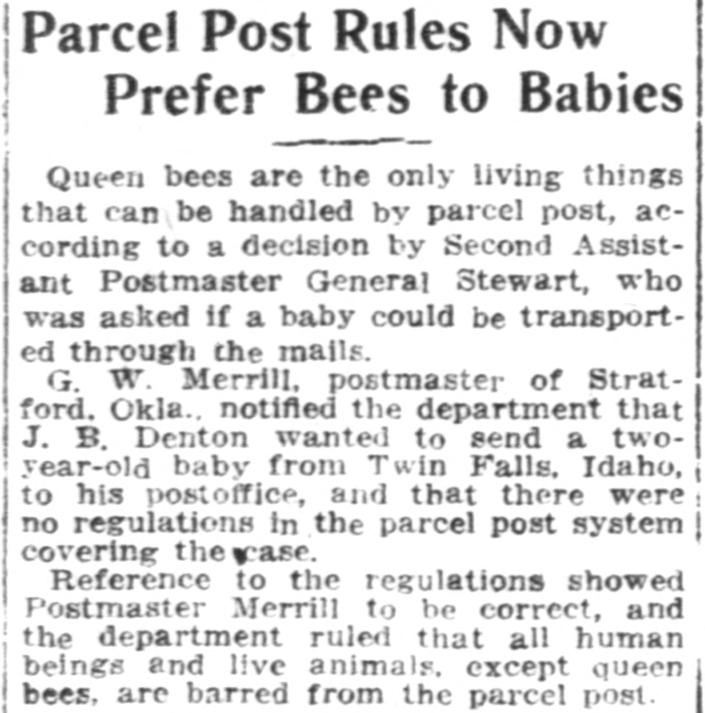
“Parcel Post Rules Now Prefer Bees to Babies,” the Washington Times, Washington, D.C., February 13, 1914, page 3. Library of Congress, Chronicling America. Click the picture to see it full size.
Word hadn’t reached Grangeville, or nobody there minded. The Postal Museum lists at least four more children sent by mail after May, into 1915.
Oats by mail
Parcel post was brand new, and people were testing what it could carry. It had started on January 1, 1913, with a weight limit of just 11 pounds. The limit went to 20 pounds and then to 50, and folks in rural Idaho put it to work. The same front page that told May’s story reported that a rancher in the Joseph country had about 2,000 pounds of oats sent to him by parcel post. The man who carried the mail on that route quit his contract the morning the oats came in, and the postmaster had to find two other men to haul the heavy mail the rest of the way.
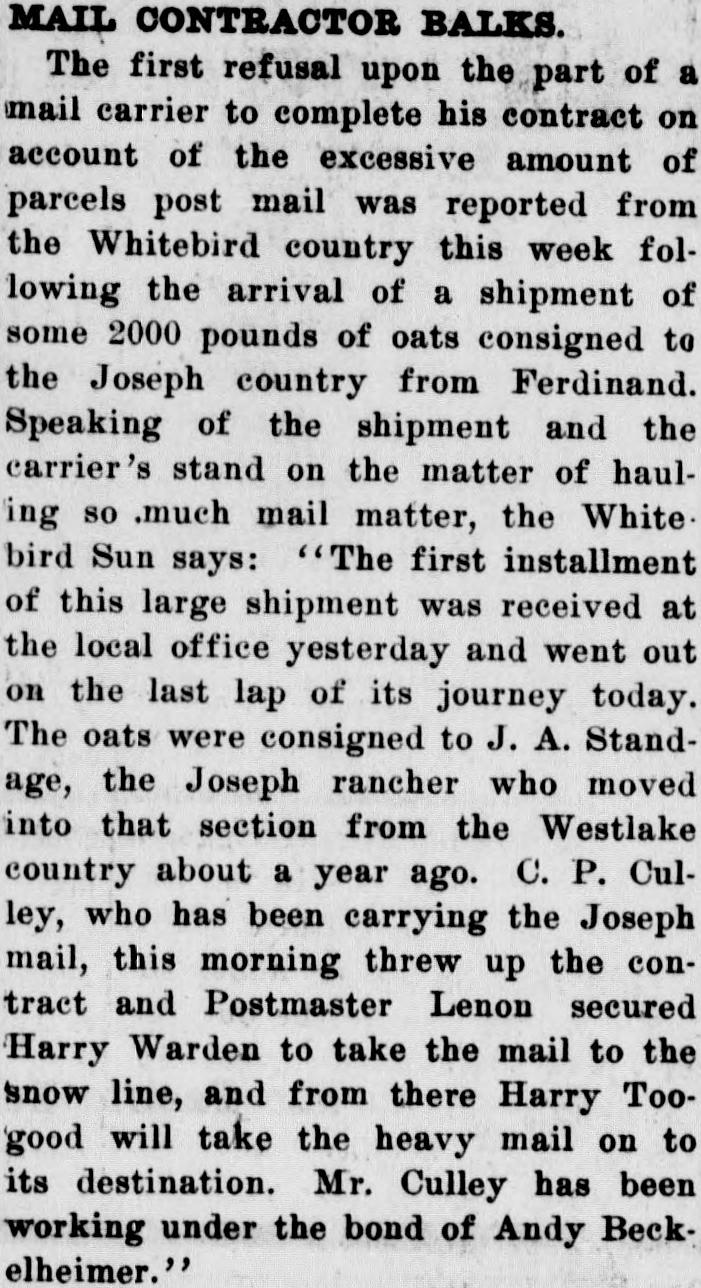
“Mail Contractor Balks,” Idaho County Free Press, Grangeville, Idaho, February 19, 1914, page 1. Library of Congress, Chronicling America. Click the clipping to read it full size.
The joke writers had fun with it too. Two days after May’s trip, a paper in Hattiesburg, Mississippi, printed a little joke borrowed from the Buffalo Express. “Is that a birthmark on that child’s face?” one person asks. “No. That’s where the cancelling machine hit him when he was travelling by parcel post.”
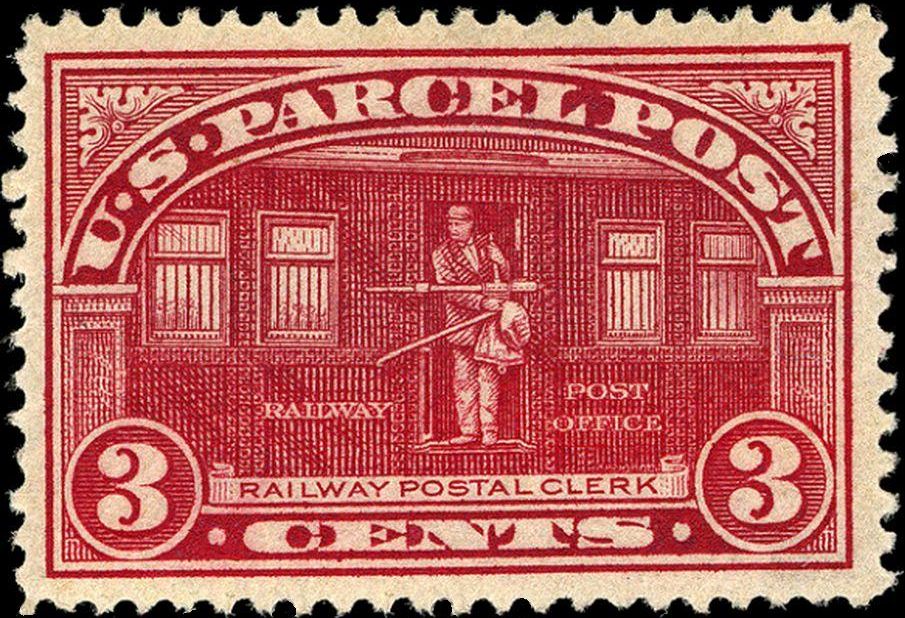
A 3-cent U.S. Parcel Post stamp from 1913 showing a railway postal clerk at the door of a mail car, the kind of clerk May rode with. Wikimedia Commons, public domain. Click the picture to see it full size.
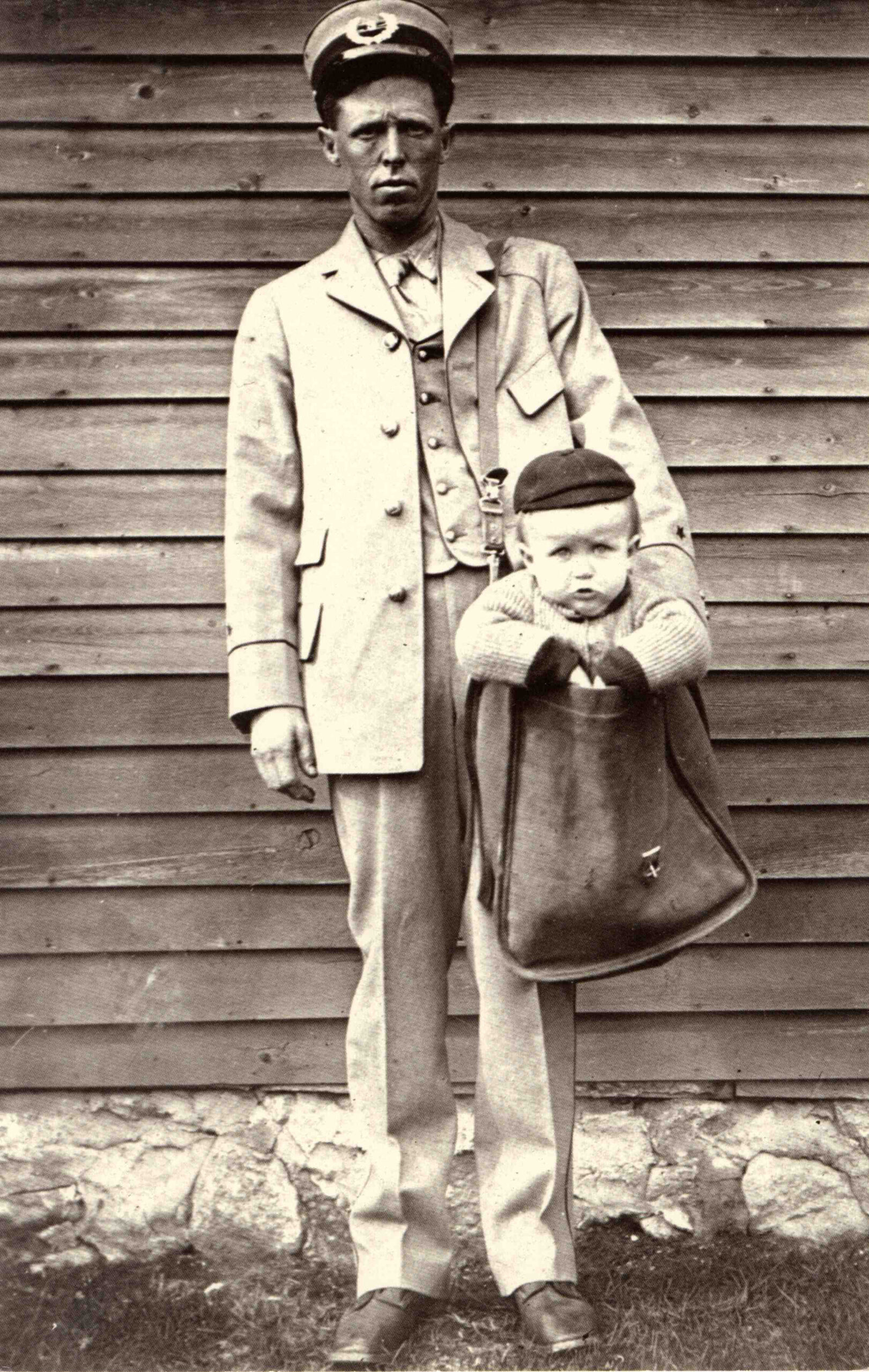
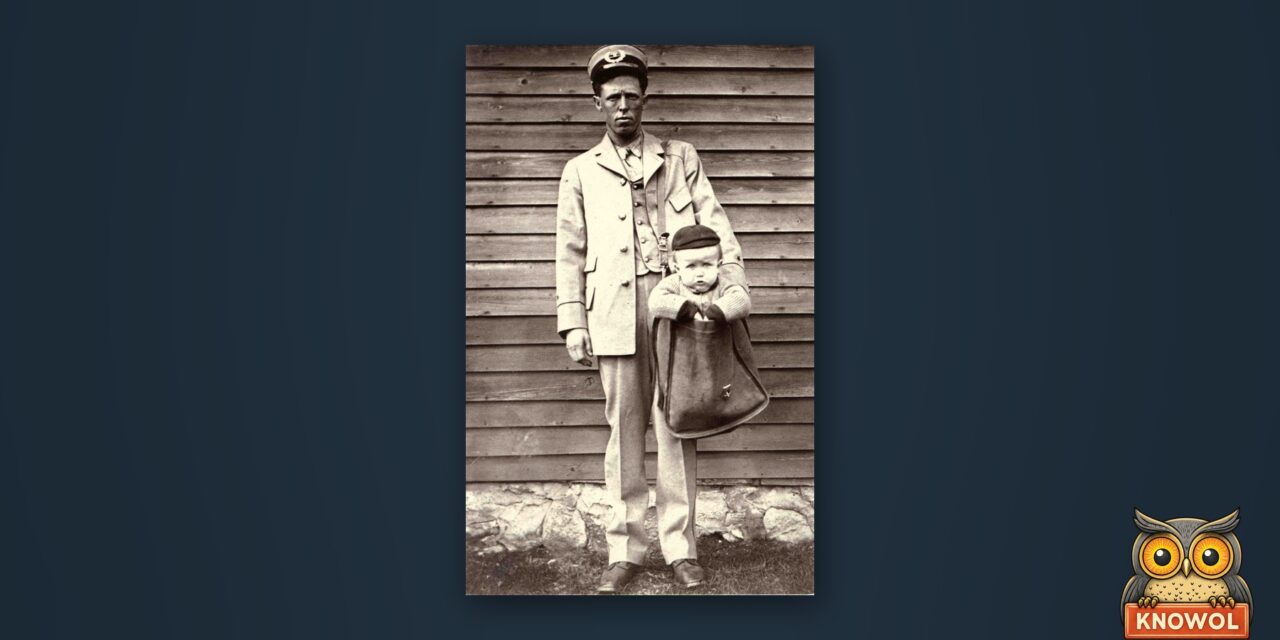
A city letter carrier poses with a little boy in his mailbag for a joke photograph in the early 1900s. Children who were “mailed” really rode with trusted postal workers, not in the bag. Smithsonian Institution, public domain. Click the picture to see it full size.
A short trip with a long life
May reached her grandmother in Lewiston safely, and her trip became the best known of all the parcel post children. The Smithsonian’s National Postal Museum still tells it, and so does a children’s book, “Mailing May.” The Free Press had guessed that mailing children would never become “universally popular,” and on that point the hometown paper was right.
Sources
- Idaho County Free Press (Grangeville, Idaho), February 19, 1914, page 1.
- The Washington Times (Washington, D.C.), February 13, 1914, page 3.
- The Hattiesburg News (Hattiesburg, Miss.), February 21, 1914, page 3.
- Smithsonian National Postal Museum: Nancy Pope, “Very Special Deliveries” (February 19, 2013); “Precious Packages: America’s Parcel Post Service”; “The Oddest Parcels”.
- All newspaper images: Library of Congress, Chronicling America. No known copyright restrictions.
- 1913 Parcel Post stamp: Wikimedia Commons, U.S. government work, public domain.
- Letter carrier photograph: Smithsonian Institution (A.2006-22), via Wikimedia Commons, public domain in the U.S.
- Cover: A letter carrier with a little boy in his mailbag, a joke photograph from the early 1900s. Smithsonian Institution, public domain.