About two o’clock on the afternoon of October 24, 1901, two boatmen rowed a wooden barrel out into the upper Niagara River near Port Day, above the rapids at Niagara Falls, New York. Inside it, with straps over her shoulders and a pillow over her head, was Anna Edson Taylor, a schoolteacher who had recently come to Niagara from Bay City, Michigan. She told the Evening World that she had been living in Bay City when she first got the idea. No one had ever gone over the falls in a barrel and lived.
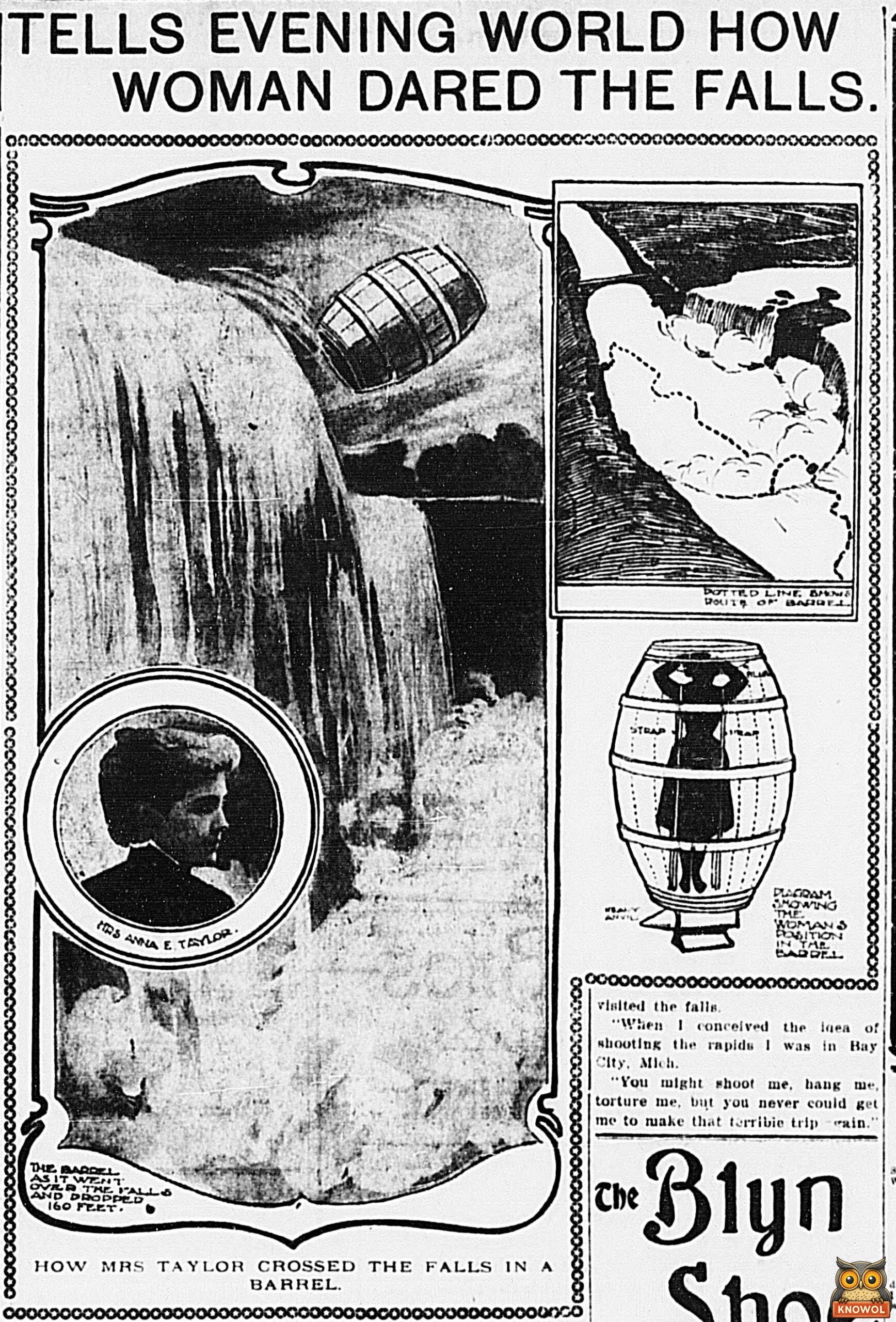
“Tells Evening World How Woman Dared the Falls,” the Evening World, New York, October 25, 1901. Library of Congress, Chronicling America. Click the clipping to read it full size.
What was in the barrel
The papers described the barrel closely. The New-York Tribune said it stood four and a half feet high and about three feet across, with a 200-pound anvil fastened to the bottom to keep it upright. A leather harness and cushions held her in place, and air came through a rubber tube connected to a small opening near the top. Before the lid went on, the St. Louis Republic said, she took off most of her clothing and dropped it in the bottom of the barrel, then put the pillow over her head and clasped her hands above it. The Evening World printed a diagram of her standing inside, arms up, the straps and the anvil marked.
Over the Horseshoe
The boatmen knew the currents, and they let the barrel go nearly a mile above the falls. For seventeen minutes it rode down through the rapids and over the reefs, bobbing along upright and keeping toward the Canadian side. At 4:23, the Tribune reported, it rounded the curve of the Horseshoe Fall and “dropped in fine style, bottom down, into the lower river, the plunge being 168 feet.”
At the crest it vanished in the spray. Thousands of people were watching from the banks, and the Republic said every one of them believed she was dead. Hardly a minute later the barrel bobbed up in the lower river, and men on the Canadian shore caught it at 4:40. No time was lost getting the lid off; they used a saw. Taylor raised her head and asked, “Have I really gone over the falls?”
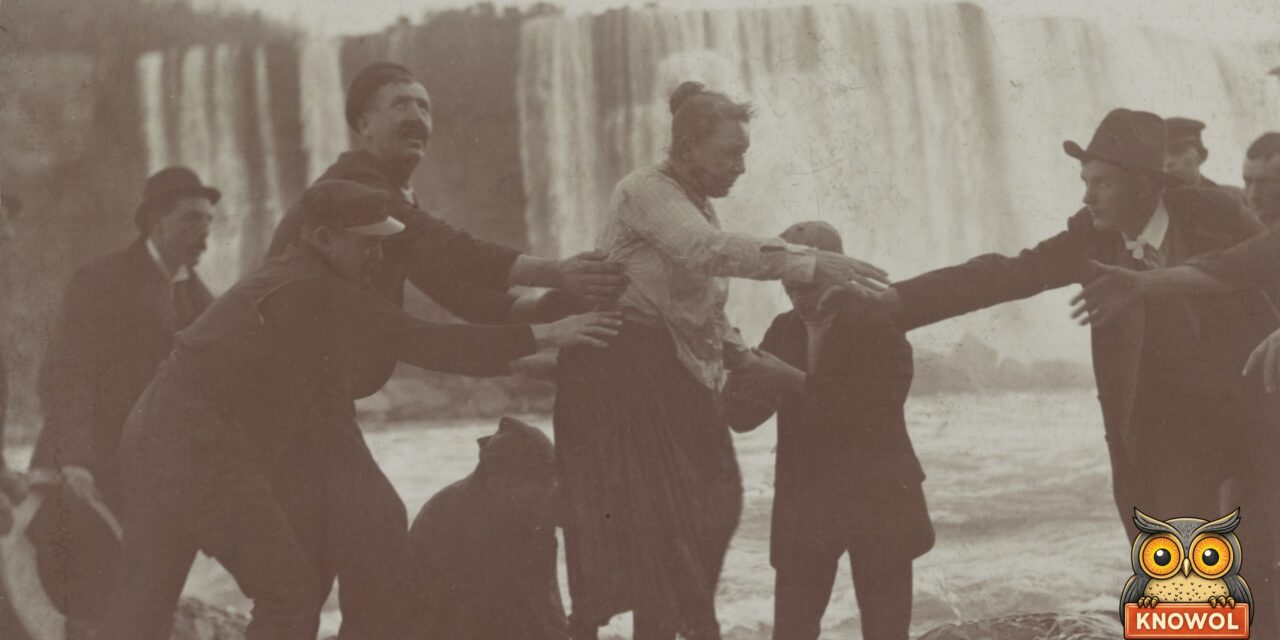
Men with megaphones shouted the news up to the crowd, and a great cheer came back. The barrel was a third full of water, and she had nearly drowned. She had a scalp wound, a slight concussion and bruises, but not one broken bone. Men laid planks across the slippery rocks so she could walk to dry land, and she went off to her hotel calling out, “They told me I could not do it, but I did!”
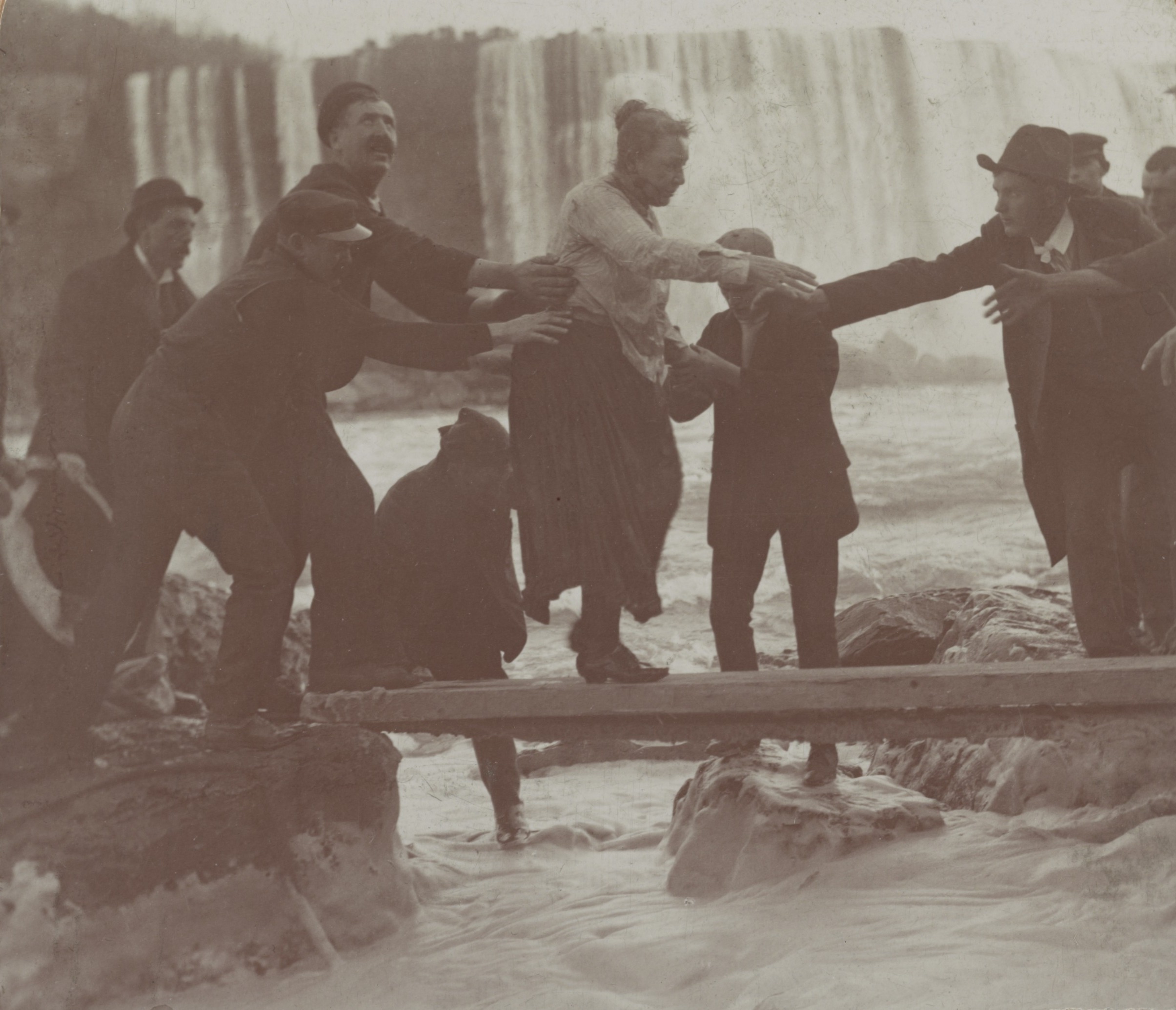
Anna Edson Taylor is helped across a plank below the falls, 1901. Stereograph by M. H. Zahner, Niagara Falls, New York. Library of Congress Prints and Photographs Division. Click the picture to see it full size.
“Not for a million dollars”
The next day she told the Evening World how it felt. “There’s such a ringing in my ears I can hardly hear,” she said. “It sounds like the Horseshoe Falls in full operation.” She would never try it again. “Not for a million dollars in cash would I go over again.”
She was honest about why she had done it. She needed money, she said, to pay off the mortgage on her ranch in Texas. The danger fascinated her too, and she wanted to be the first to prove that a person could go over the falls and live. She told the Tribune she wasn’t sorry, as long as it helped her with money.
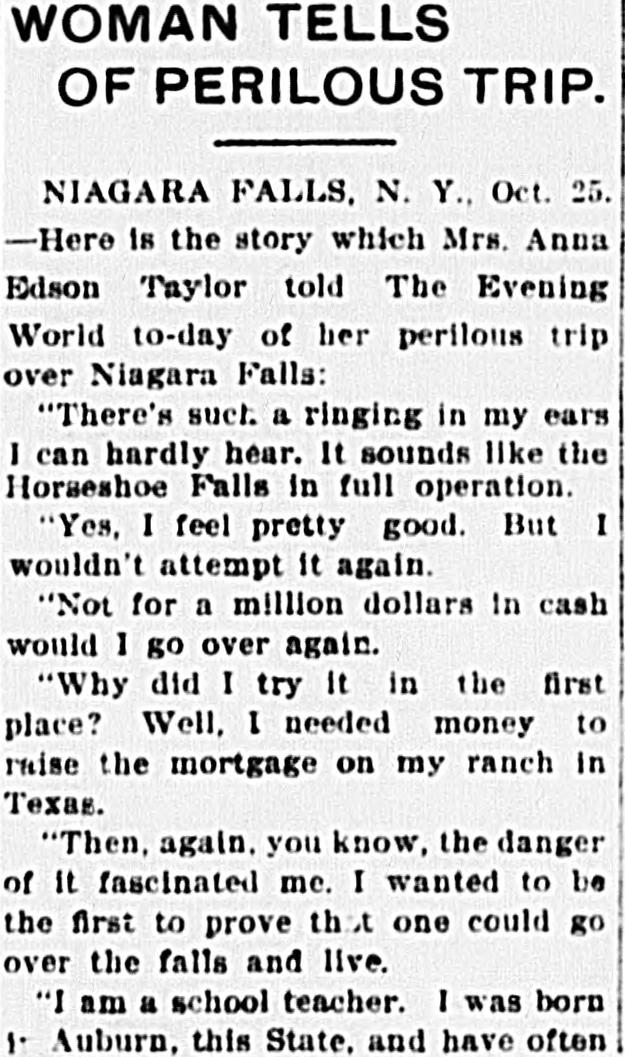
“Woman Tells of Perilous Trip,” the Evening World, New York, October 25, 1901. Library of Congress, Chronicling America. Click the clipping to read it full size.
How old she really was
The Tribune gave her age as forty-three. She was a good deal older than that. The Library of Congress record for her, filed under the name most people know today, Annie Edson Taylor, gives her birth date as October 24, 1838, in Auburn, New York, which means she went over Niagara Falls on her 63rd birthday.
The money she hoped for never really came. She died in April 1921 in the Niagara County infirmary at Lockport, and a paper as far away as Wyoming ran the headline “Woman Who Went Over Niagara for Luck Dies Poor.” It said bad luck had followed her from the day of her adventure to the day she died. It also added one last strange detail: while doctors were treating her after the plunge, somebody stole her barrel.
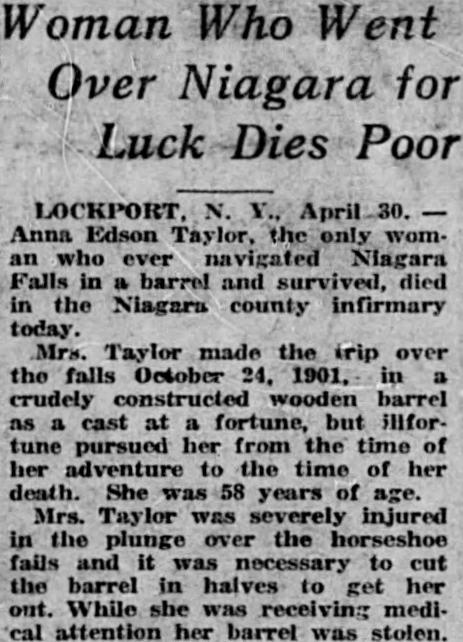
“Woman Who Went Over Niagara for Luck Dies Poor,” Casper Daily Tribune, Casper, Wyoming, May 1, 1921. Library of Congress, Chronicling America. Click the clipping to read it full size.
That same 1921 story called her the only woman who had ever gone over Niagara Falls in a barrel and survived. Back in 1901, the photographer who took her picture on the rocks put it more simply on his card: she was the first human being to go over the falls and live.
Sources
- New-York Tribune (New York, N.Y.), October 25, 1901, page 1.
- The Evening World (New York, N.Y.), October 25, 1901, page 11.
- The St. Louis Republic (St. Louis, Mo.), October 25, 1901, page 1.
- Casper Daily Tribune (Casper, Wyo.), May 1, 1921, page 1.
- “Niagara. Mrs. Taylor the first human being to go over falls and lives,” stereograph by M. H. Zahner, 1901: Library of Congress Prints and Photographs Division, LC-DIG-ds-06162. No known restrictions on publication.
- Birth date and place: Library of Congress Name Authority File, “Taylor, Annie Edson, 1838-1921”.
- All newspaper images: Library of Congress, Chronicling America. No known copyright restrictions.
- Cover: the same 1901 stereograph by M. H. Zahner (cropped), Anna Edson Taylor being helped across a plank below the falls. Library of Congress Prints and Photographs Division.