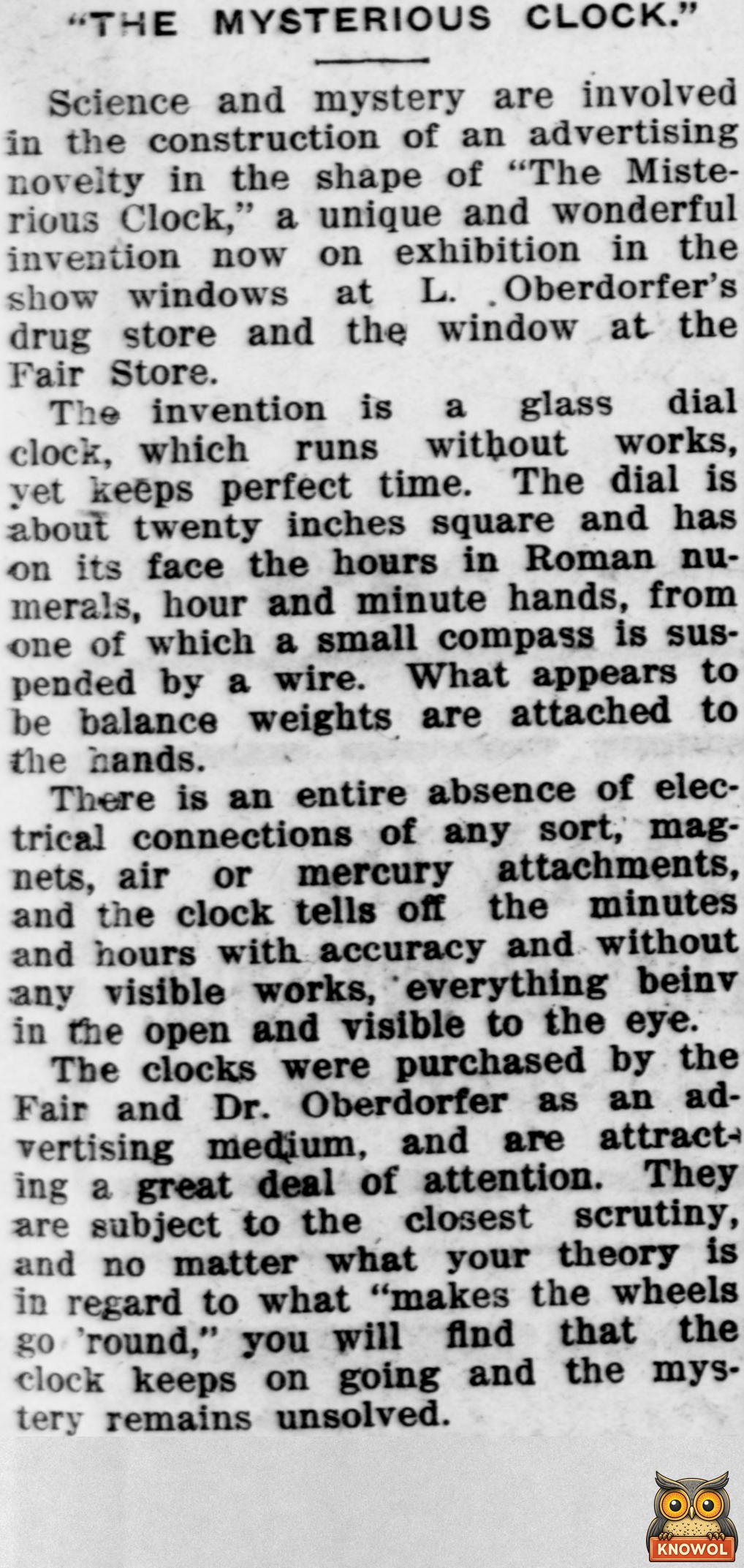
“The Mysterious Clock.” The Bourbon News, Paris, Kentucky, September 25, 1914, page 1. Library of Congress, Chronicling America. Click the clipping to read it full size.
In September 1914, people in Paris, Kentucky, kept stopping at the same two store windows. One was L. Oberdorfer’s drug store. The other was the Fair Store. In each window was a clock with a face made of glass. It had two hands, a tiny compass and a few little weights, and that seemed to be all. There was no box of gears behind it and no wheels. And it kept perfect time.
The Bourbon News, the town’s paper, came to look. “The invention is a glass dial clock, which runs without works, yet keeps perfect time,” it wrote on September 25. The face was “about twenty inches square,” with the hours in Roman numerals. A small compass hung from one hand on a wire. The paper checked for every trick it could think of. It found no electric wires, no magnets, nothing run by air and no mercury, a heavy liquid metal that some odd clocks used.
So it gave up, with a smile. “No matter what your theory is in regard to what ‘makes the wheels go ’round,'” the News told its readers, “you will find that the clock keeps on going and the mystery remains unsolved.”
A Puzzle Sold to Stores All Over America
The Paris clocks weren’t one of a kind. The News called them “an advertising novelty,” and Dr. Oberdorfer and the Fair had bought them “as an advertising medium.” In plain words, the clock was bait. A puzzle in the window pulls people up to the glass, and people at the glass might come inside.
Salesmen carried these clocks from town to town. In December 1914, a paper in Pine Bluff, Arkansas, said that A. J. Baum and C. L. Boyd, “representing the World-Wide Advertising company of Chicago,” had placed one with Seawell’s pharmacy. They promised a clock “that has mystified thousands.”
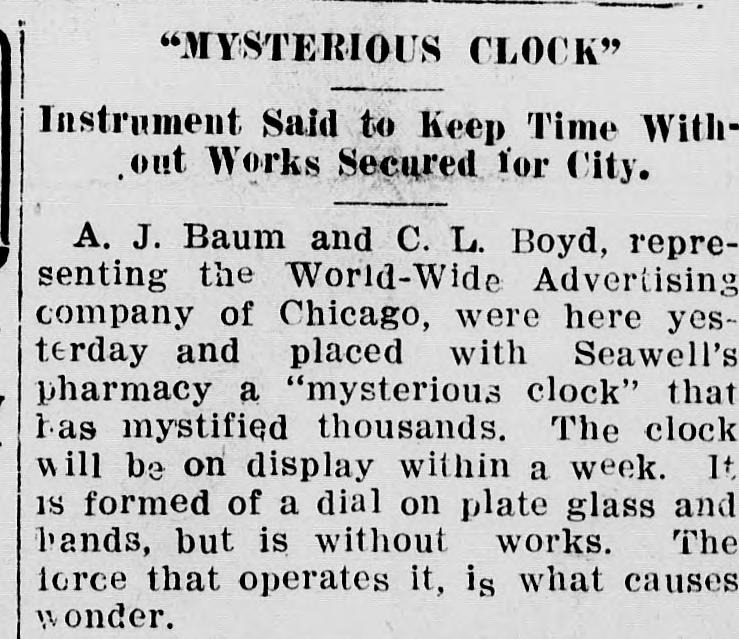
“Mysterious Clock.” Pine Bluff Daily Graphic, Pine Bluff, Arkansas, December 4, 1914, page 3. Library of Congress, Chronicling America. Click the clipping to read it full size.
Between 1912 and 1918, our search of old newspapers found the clock in more than 30 towns. It showed up in drug stores, jewelry stores, a hardware store, banks and even on the mirror of a bar in Tonopah, Nevada. Some were painted right onto a store’s front window. Others hung from the ceiling on brass chains, so people could walk all the way around them.
Hammond, Indiana: The Hands Came Back
The best eyewitness was a reporter in Hammond, Indiana. In October 1913, the Lake County Times sent someone to watch workers put the clock up at a furniture store at Sibley and Hohman streets. A big clock face was painted on the window glass. In the middle they glued “a rubber pivot, the size of a chocolate drop.” A pivot is the little post the hands turn on.
“There is nothing to wind, nothing concealed and nothing to investigate,” the paper said. Then the workers hung the hands on the pivot. The reporter was so surprised that the paper printed the next part in capital letters: “WHEN THE HANDS WERE ATTACHED THEY STARTED TO RUN ON CORRECT TIME WITHOUT SETTING.”
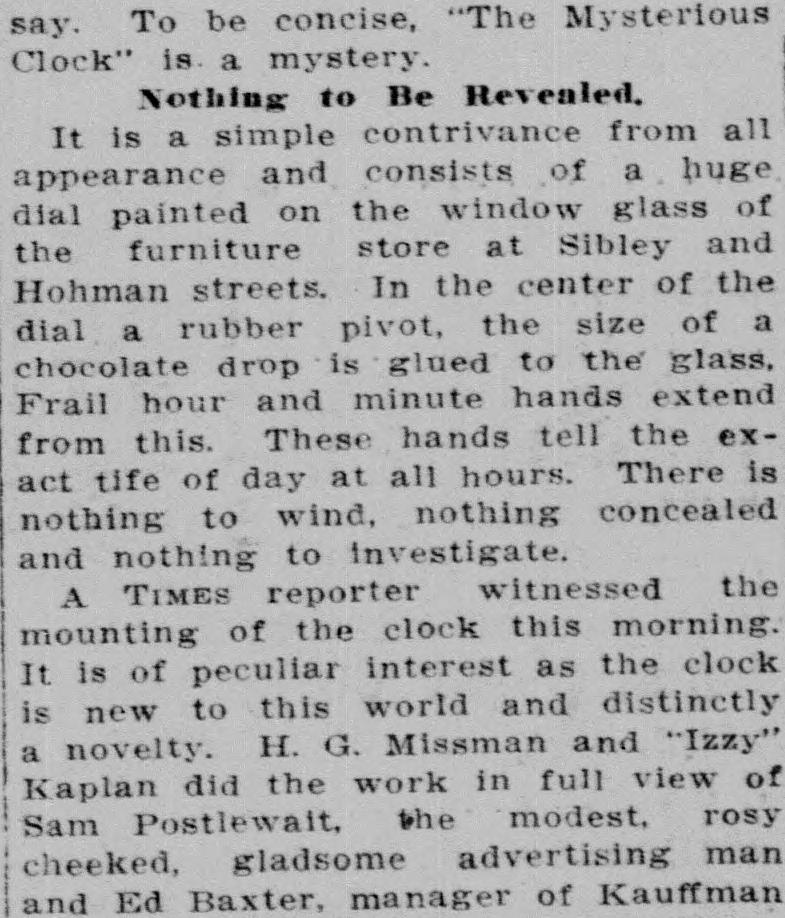
“Nothing to Be Revealed.” The Lake County Times, Hammond, Indiana, October 9, 1913, page 1. Library of Congress, Chronicling America. Click the clipping to read it full size.
One of the workers, H. G. Missman, had a trick to show. He whirled the hands around, out of time. “When he let go they flew back on time to the second.” The store’s advertising man, Sam Postlewait, was the most amazed of anyone. “He hasn’t gotten over it yet,” the Times said.
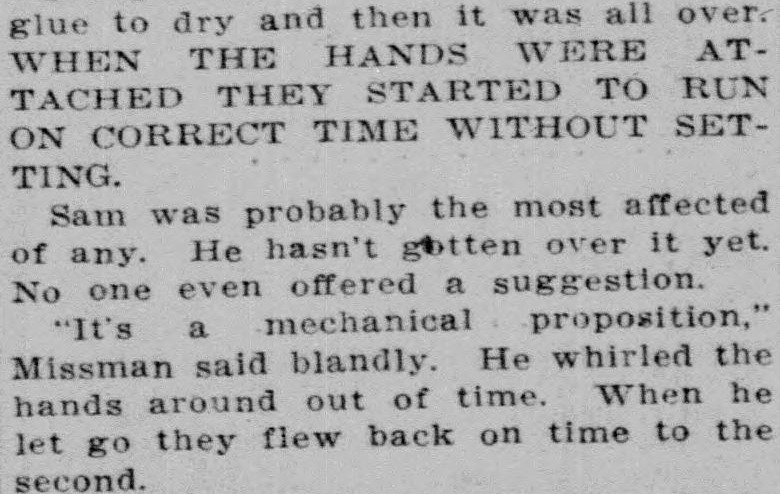
The Lake County Times, Hammond, Indiana, October 9, 1913, page 1. Library of Congress, Chronicling America. Click the clipping to read it full size.
Guess and Win
Store owners turned the clock into a contest. In Americus, Georgia, Howell’s Pharmacy said its clock had been set to stop sometime between March 25 and April 4, 1915. Guess the moment it stopped, and you won “$2.50 in gold.” The next closest guess got a box of Nunnally’s Candy. Every 25-cent purchase in the store earned one more guess.
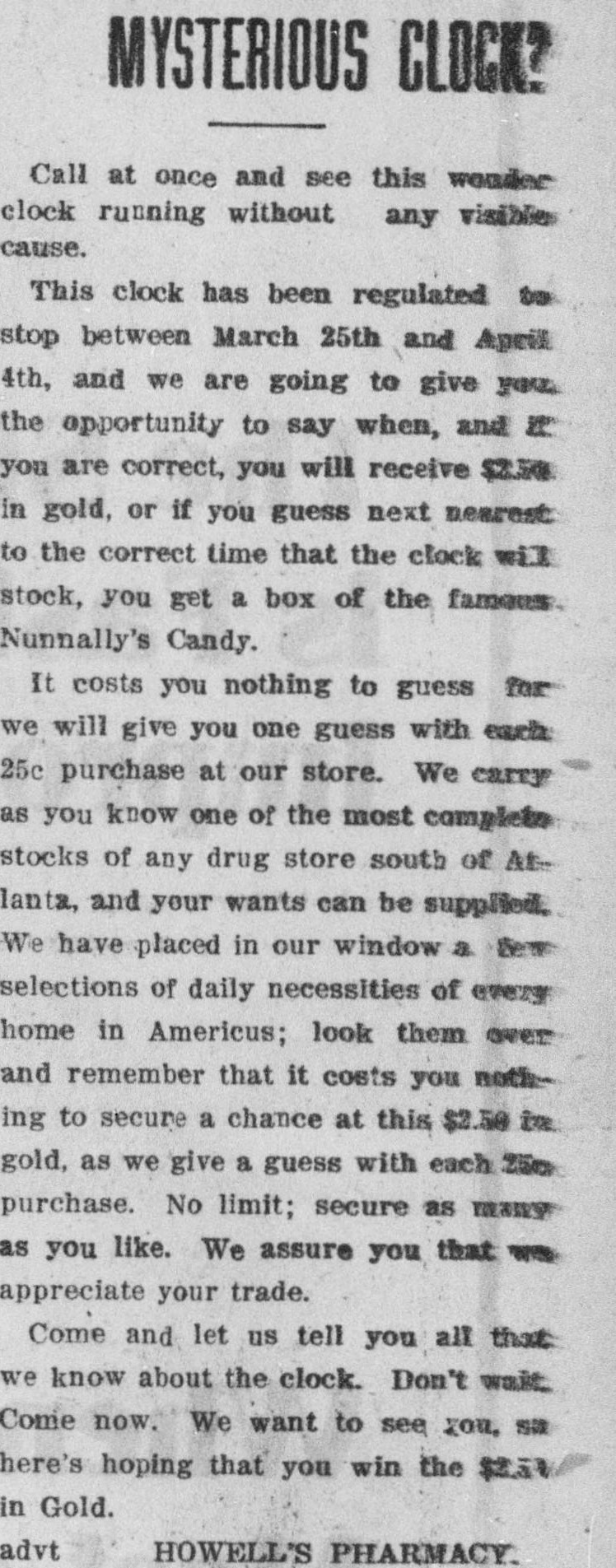
“Mysterious Clock?” An advertisement by Howell’s Pharmacy, Americus Times-Recorder, Americus, Georgia, March 24, 1915, page 5. Library of Congress, Chronicling America. Click the clipping to read it full size.
The same ad offered to “tell you all that we know about the clock.” That was a safe promise. The store wanted you inside and guessing, not walking away with the answer.
The Silly Answer
Some places printed an “explanation” that was really a joke. The same long, science-sounding answer turned up in banks in Lancaster, Wisconsin; Sauk Centre, Minnesota; and Alliance, Nebraska. It said the clock ran on the spinning of the earth, the pull of the moon and the little compass, all working together.
The Sauk Centre Herald printed the whole thing in May 1915, after its town’s First State Bank hung one of the clocks in its front window. The paper said some people had decided “there ain’t no such animile,” an old joke way of saying the thing couldn’t be real. At the end of the long explanation the Herald added three words: “Simple, isn’t it?”
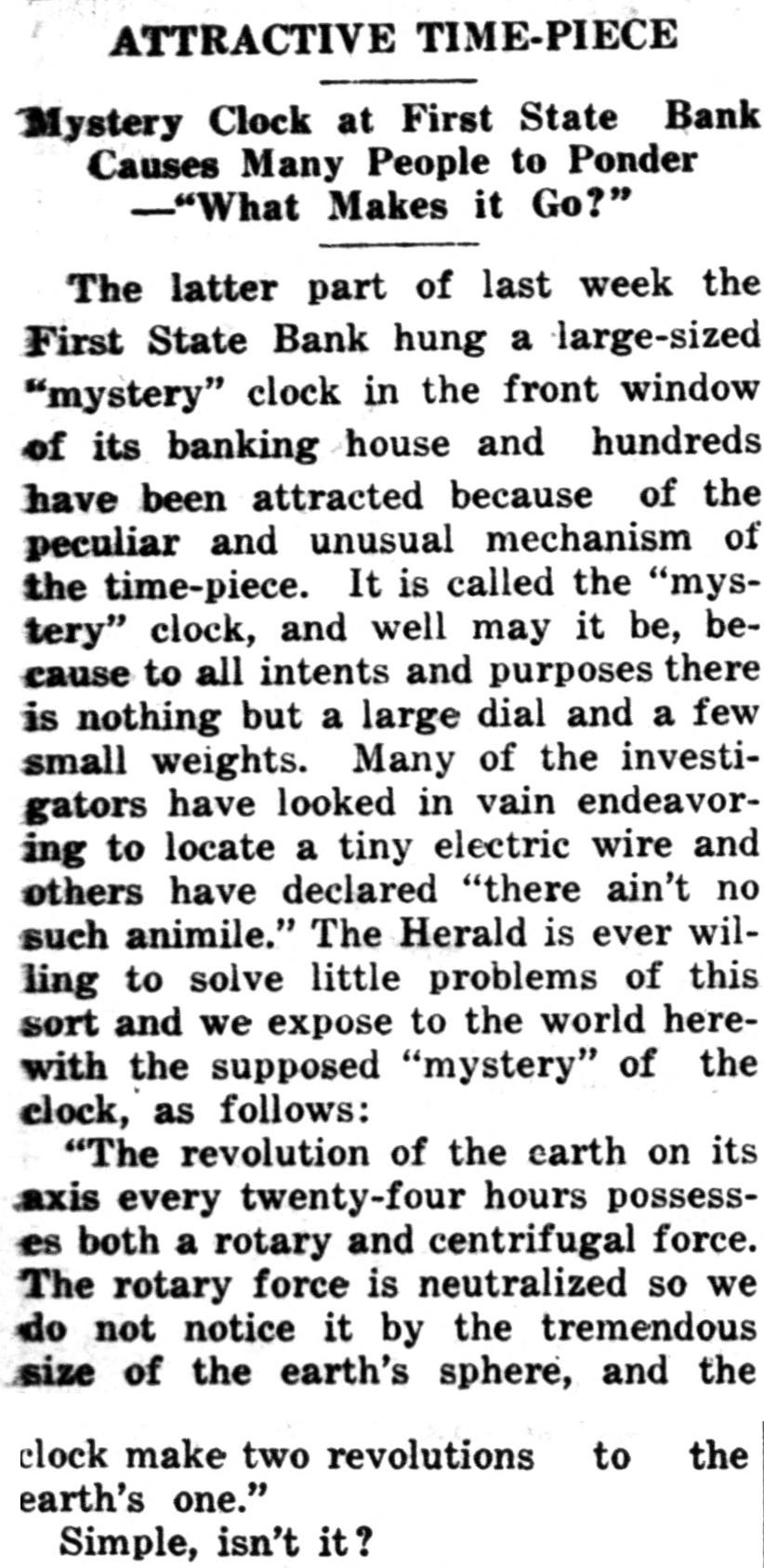
“Attractive Time-Piece.” The Sauk Centre Herald, Sauk Centre, Minnesota, May 13, 1915, page 10 (the top and the last lines of the article). Library of Congress, Chronicling America. Click the clipping to read it full size.
What Really Made It Go
Here is the real answer, and it was hiding in plain sight. Look again at what the Paris paper wrote: “What appears to be balance weights are attached to the hands.” The reporter saw the secret and wrote it down without knowing it.
In 1940, a jewelers’ magazine called The American Horologist explained how mystery clocks like these work. The fat end of each hand hid a tiny watch. Instead of turning little watch hands, that watch slowly turned a small weight inside the hand.
Think of a seesaw. If a weight slides along one side, the seesaw tips. The hand on the glass worked the same way. As the hidden watch moved its weight, the hand tipped a tiny bit to stay balanced, and it slowly turned around the face. Each hand was balanced to point at the right time. The clues in the 1910s papers fit this exactly. That’s why the Hammond worker could spin the hands and watch them swing right back.
The Ocala Evening Star in Florida came closest to guessing it. In January 1915, it said the clock was just two big hands on a piece of plate glass, “unless there is something in the ends or stubs of the hands, which are about as big as one’s thumb.” Then it gave away a big clue without seeing it: “The clock will run eight days when wound.” Something on that clock was getting wound.
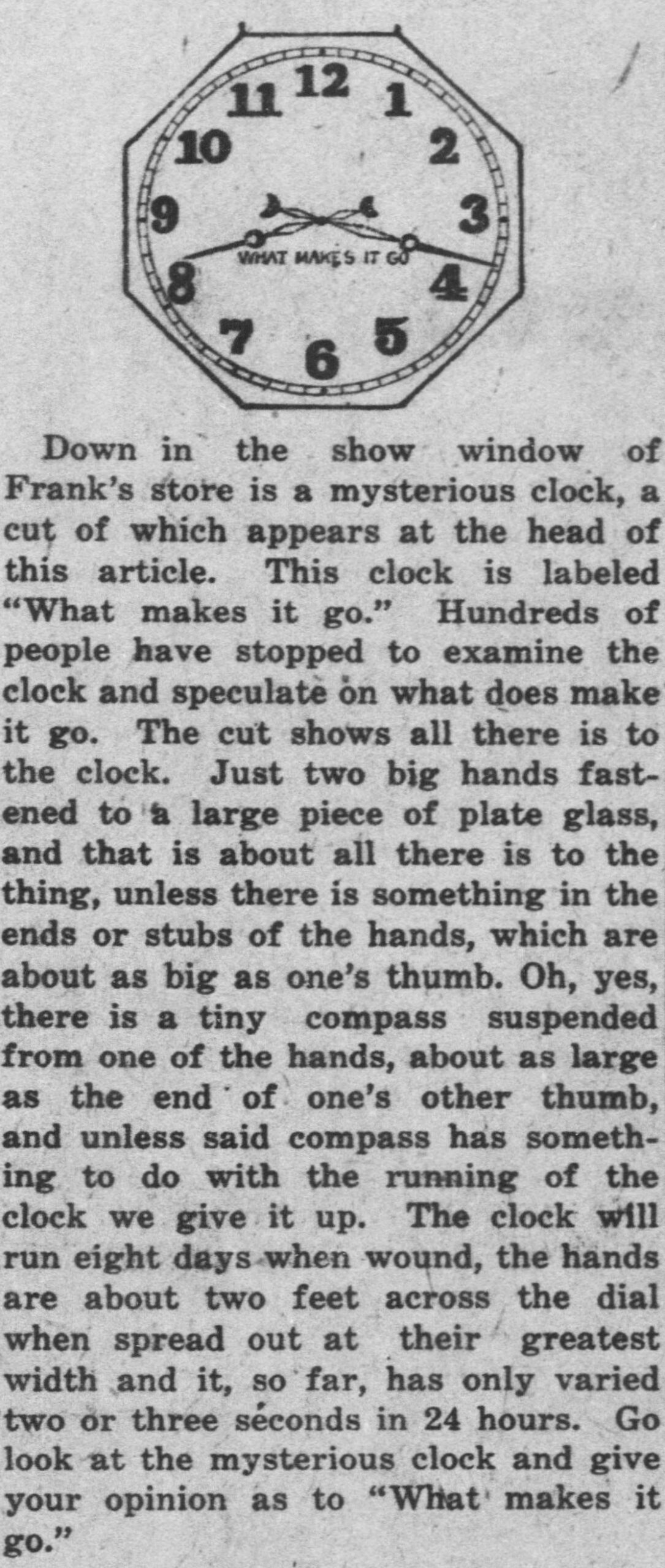
The Ocala Evening Star’s drawing of the mystery clock in Frank’s store, with “What makes it go” lettered on it. Ocala Evening Star, Ocala, Florida, January 29, 1915, page 8. Library of Congress, Chronicling America. Click the clipping to read it full size.
As for the little compass, the 1940 article never mentions one. It seems to have been there just to give people one more thing to puzzle over.
Back at the Window in Paris, Kentucky
The Paris clocks were still a mystery when the Bourbon News went to press. Nobody we found ever printed the answer in Paris. Somewhere in town, a druggist, a store clerk or a sharp-eyed kid may have figured out the balance weights. If they did, they kept it to themselves.
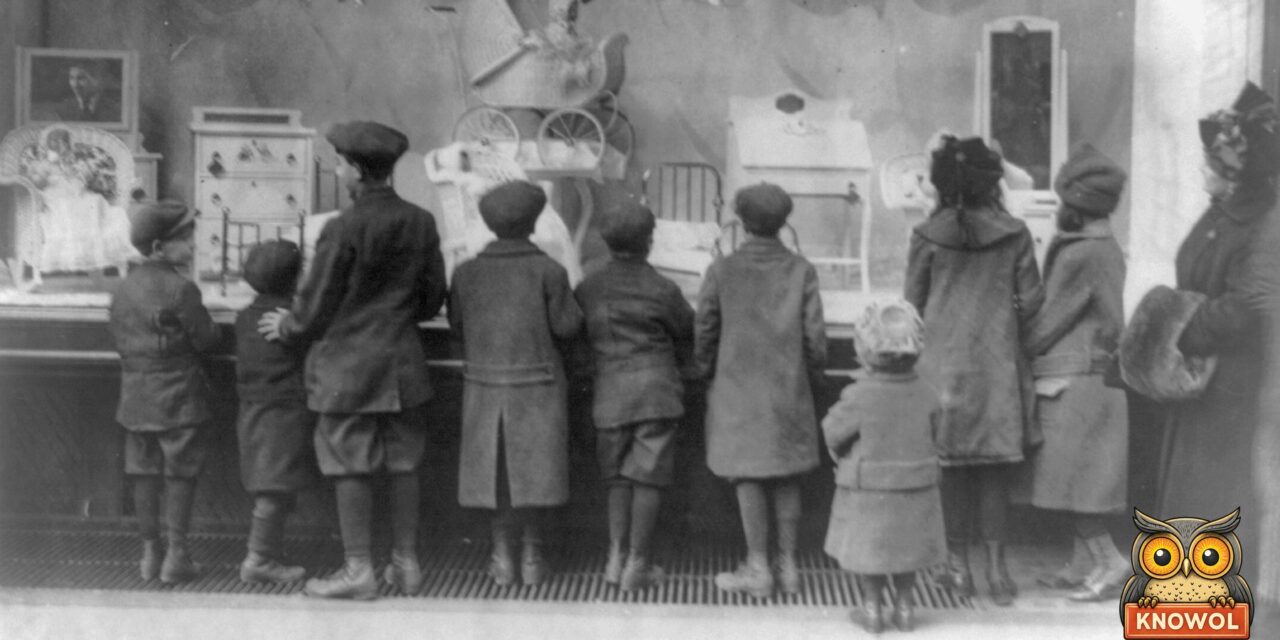
That was the whole point. A clock in the window that nobody could explain did what a sign never could. It made people stop, lean in and look. The cover photo shows that same look: children pressed up to a store window in New York City, taken by the Bain News Service sometime between 1908 and 1917.
A Drug Store of the Same Years
The Oberdorfer and Fair Store windows weren’t photographed that we know of. This 1913 photo shows what a busy drug store of the time looked like inside, with glass cases, cigars, candy boxes and a clock on the back wall. The record doesn’t say what town it was in.
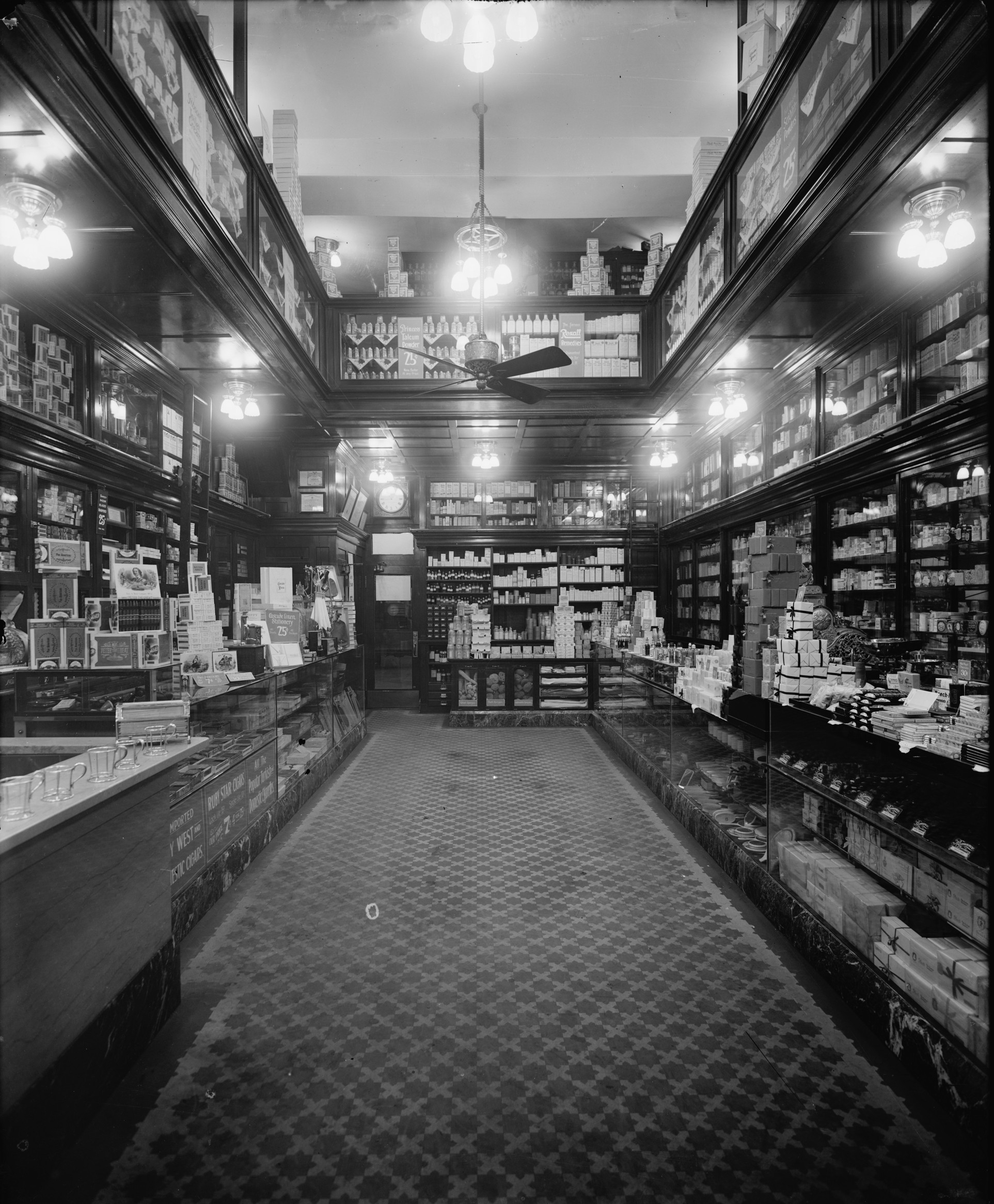
“G.W. Armstrong drug store,” Detroit Publishing Co., 1913 (place not named). Library of Congress. Click the picture to see it full size.
Paris, Kentucky, From the Air
Paris is the county seat of Bourbon County, in central Kentucky. This bird’s-eye map, drawn in 1870, shows the town about 44 years before the glass clocks came, with a creek curling past its streets.
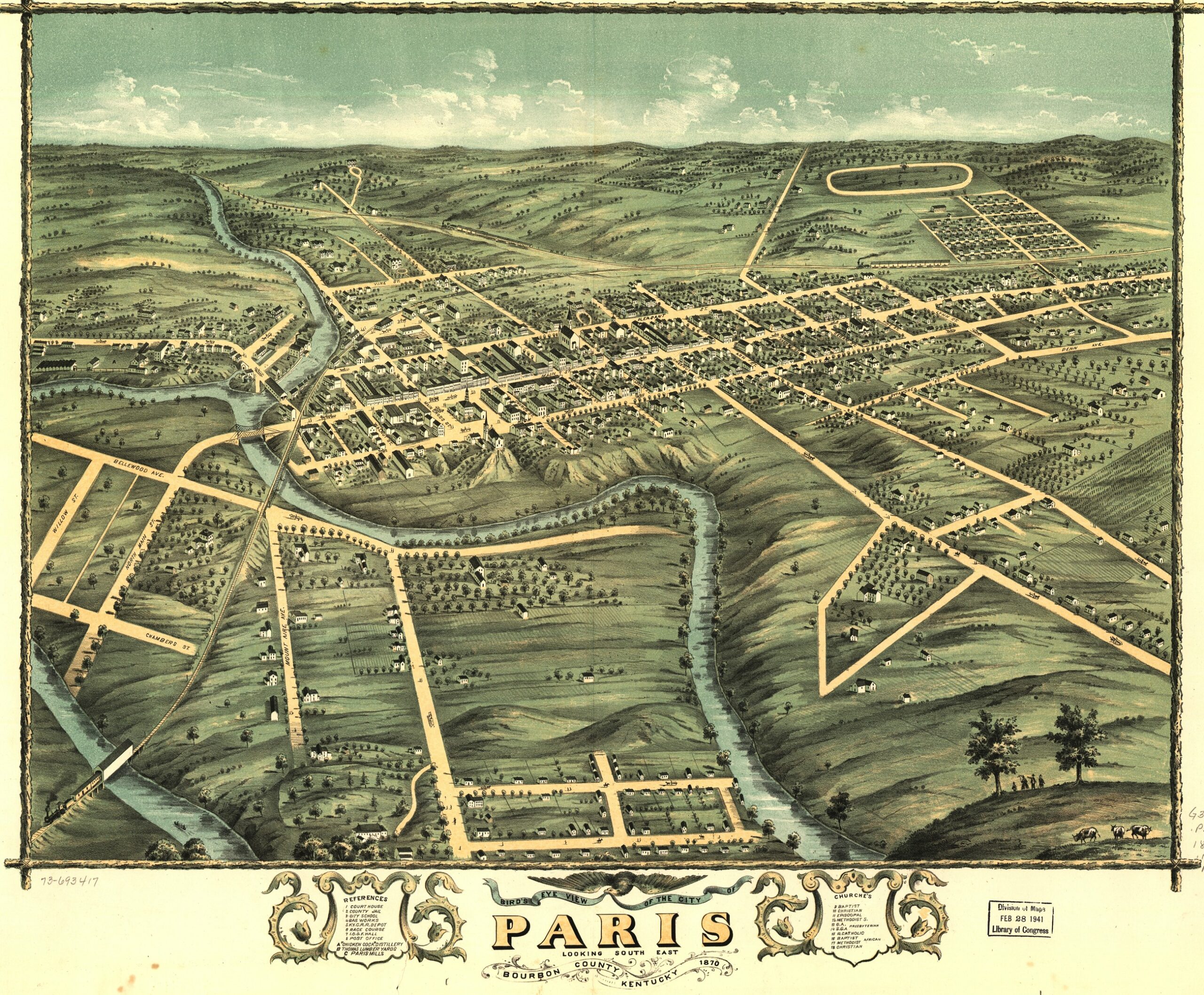
“Bird’s eye view of the city of Paris, Bourbon County, Kentucky 1870.” Library of Congress, Geography and Map Division. Click the picture to see it full size.
Sources
- “The Mysterious Clock,” The Bourbon News, Paris, Kentucky, September 25, 1914, page 1. Library of Congress, Chronicling America
- “Mysterious Clock,” Pine Bluff Daily Graphic, Pine Bluff, Arkansas, December 4, 1914, page 3. Library of Congress, Chronicling America
- “Can You Solve the Mystery?” The Lake County Times, Hammond, Indiana, October 9, 1913, page 1. Library of Congress, Chronicling America
- Howell’s Pharmacy advertisement, Americus Times-Recorder, Americus, Georgia, March 24, 1915, page 5. Library of Congress, Chronicling America
- “Attractive Time-Piece,” The Sauk Centre Herald, Sauk Centre, Minnesota, May 13, 1915, page 10. Library of Congress, Chronicling America
- Ocala Evening Star, Ocala, Florida, January 29, 1915, page 8. Library of Congress, Chronicling America
- Also seen in: Tonopah Daily Bonanza, Tonopah, Nevada, February 17, 1915, page 4 (Library of Congress); Grant County Herald, Lancaster, Wisconsin, November 25, 1914, page 1 (Library of Congress, Chronicling America); Alliance Herald, Alliance, Nebraska, November 23, 1916, page 13 (Library of Congress).
- How the clock works: W. H. Samelius, “Mystery Clock, Or, Balanced Hands,” The American Horologist, December 1940. Internet Archive
- Cover photo: “Small children gazing at Macy’s Christmas window display, New York City,” Bain News Service, between 1908 and 1917. Library of Congress
- Photo: “G.W. Armstrong drug store,” Detroit Publishing Co., 1913. Library of Congress
- Map: “Bird’s eye view of the city of Paris, Bourbon County, Kentucky 1870.” Library of Congress
- Newspapers printed before 1931 are in the public domain. Photos and map: Library of Congress, no known restrictions on publication.