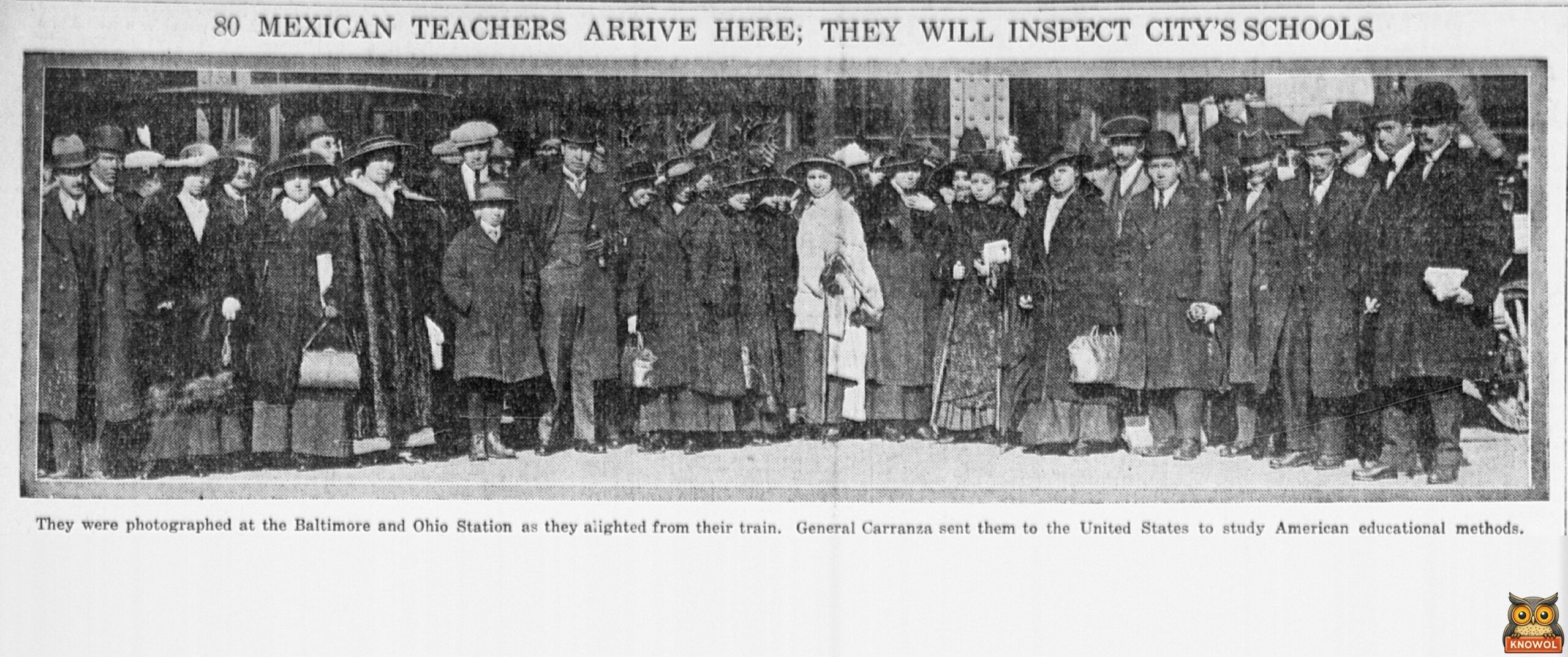
“80 Mexican Teachers Arrive Here; They Will Inspect City’s Schools.” The teachers at the Baltimore and Ohio Station in Philadelphia. Evening Ledger, Philadelphia, Pennsylvania, December 1, 1915, page 3. Library of Congress, Chronicling America. Click the clipping to read it full size.
On a December day in 1915, the halls of the Colonnade Hotel in Philadelphia, Pennsylvania, filled up with shouting and pounding. Bellboys ran from door to door. Guests poked their heads out to see what the fuss was. The noise was coming from a bedroom, and inside that bedroom, from a tall wooden wardrobe standing in the corner.
A wardrobe was a big cupboard for hanging clothes, the kind of closet you could move. Most hotel rooms had one. This one had a young woman locked inside it.
Her name was Dolores Sotomayor. She was 18 years old, and she was a teacher from Mexico. Her friends had locked her in as a joke.
Teachers From Mexico Come to Study
Dolores Sotomayor was part of a big group of teachers from Mexico who spent the fall of 1915 in the United States. Mexico was going through hard and violent years then. Its leader, General Venustiano Carranza, sent teachers north to see how American schools worked, so they could bring the best ideas home.
The Evening Star of Washington, D.C., said the group had “eighty-one Mexican school teachers and officials.” They had spent “several months studying educational methods and taking post-graduate work at Harvard University,” near Boston. Post-graduate work means classes for people who have already finished college. The Carranza government paid the bills, the paper said. The group’s leader, Eliseo Garcia, had once been the head of Mexico’s public schools.
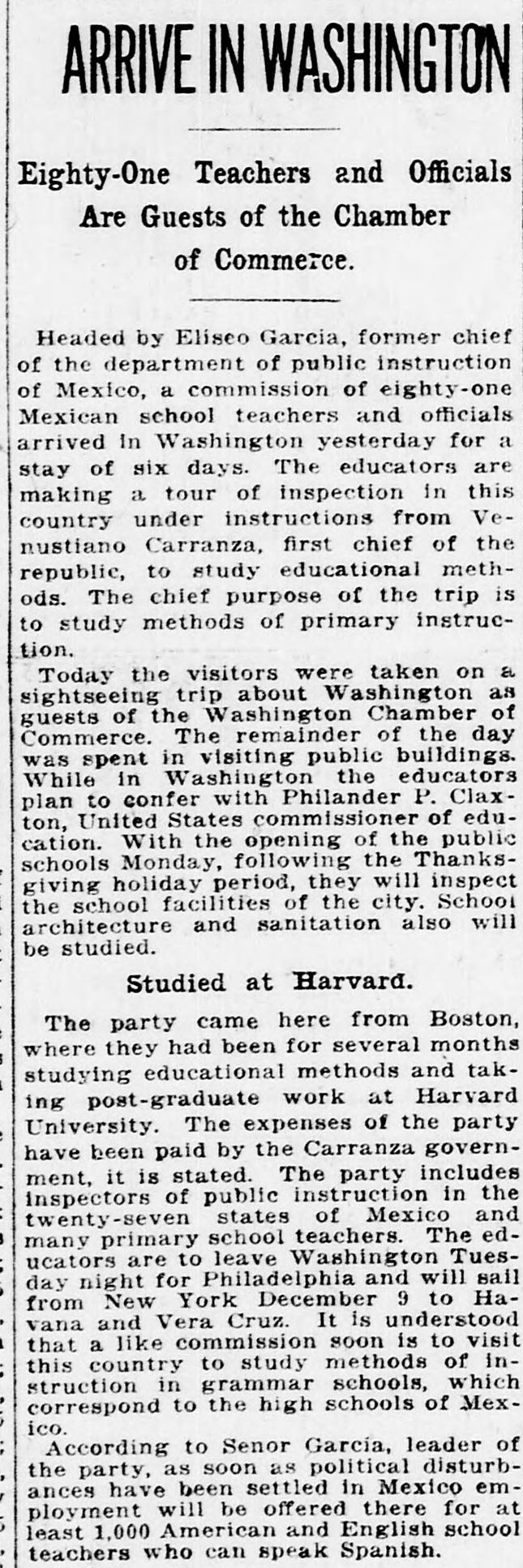
“Arrive in Washington: Eighty-One Teachers and Officials Are Guests of the Chamber of Commerce.” Evening Star, Washington, D.C., November 26, 1915, page 19. Library of Congress, Chronicling America. Click the clipping to read it full size.
The visitors had a busy trip. In Washington they toured the city and visited the schools after Thanksgiving. Then they met the president. “President Wilson today shook hands with a group of Mexican school teachers sent to the United States by General Carranza to study school systems,” a newspaper in Rock Island, Illinois, reported on November 30.
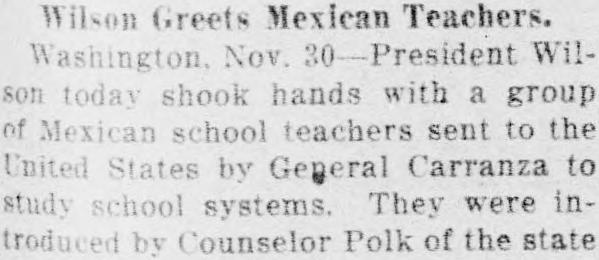
“Wilson Greets Mexican Teachers.” Rock Island Argus, Rock Island, Illinois, November 30, 1915, page 5. Library of Congress, Chronicling America. Click the clipping to read it full size.
The Teachers Reach Philadelphia
On their last day in Washington, the Evening Star said, the teachers toured the McKinley Manual Training School, a high school where students learned to work with tools and machines, and they made plans to keep in touch with the United States Bureau of Education. The next morning, December 1, they came into Philadelphia by train.
A photographer for the Evening Ledger caught them at the Baltimore and Ohio Station, standing in a long row in winter coats and wide hats. The paper’s headline said “80 Mexican Teachers Arrive Here; They Will Inspect City’s Schools.” Many of the faces in the row are young women. The paper didn’t name anyone in the picture, so nobody can say which one was Dolores.
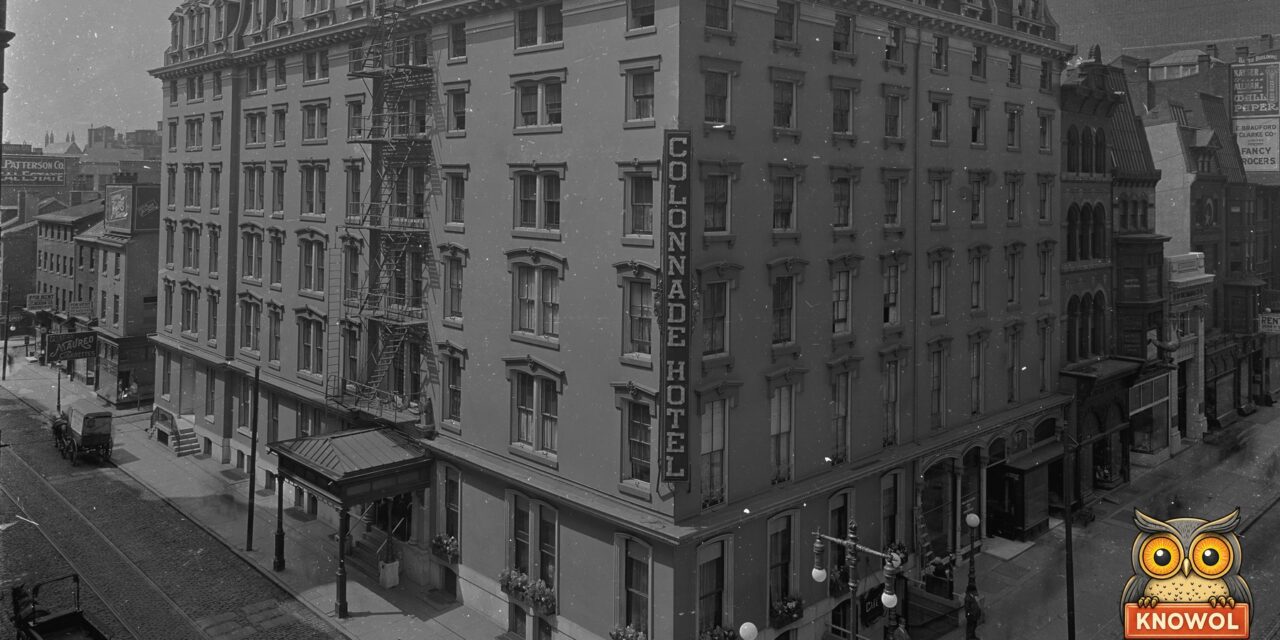
The group stayed at the Colonnade Hotel. It was a tall hotel with fire escapes up its side and a long sign running down its corner that spelled out its name. The cover photo shows it, taken by the Detroit Publishing Company sometime between 1910 and 1920.
Locked in the Wardrobe
Three days later, on December 4, the Evening Ledger told what happened in one of those hotel rooms. Four of Dolores’s friends “decided that an excellent practical joke would be to lock her in the wardrobe.” A practical joke is a trick you play on someone, not one you just tell.
The paper named the four jokers as Conception Morfla, Conception Chavez Coronol, Tomasa Zuniga and Maria Tellez Escalante, “all young women.” Those are the spellings the paper printed.
The wardrobe was not roomy. “The wardrobe has a shelf, making the height for standing room less than five feet,” the Ledger said. So Dolores had to stand bent over in the dark, with coats around her ears. “She was in there about half an hour.”
Then came the problem. When the bellboys found the right room, the door of the wardrobe was locked, “and the key was not in sight.”
The Hunt for the Key
Dolores helped the best way she could, by yelling. “Urged on by frantic cries from the wardrobe, the bellboys searched every corner of the room and peered into every crevice for the all-important key,” the Ledger said. A crevice is a narrow crack. The bellboys were looking in every little gap where a key could hide.
“After what seemed a long time the key was found in a corner under a bed.”
By then a crowd had gathered to watch. The door swung open, “and, in sight of a crowd attracted by the cries, 18-year-old Dolores Sotomayor tumbled out.”
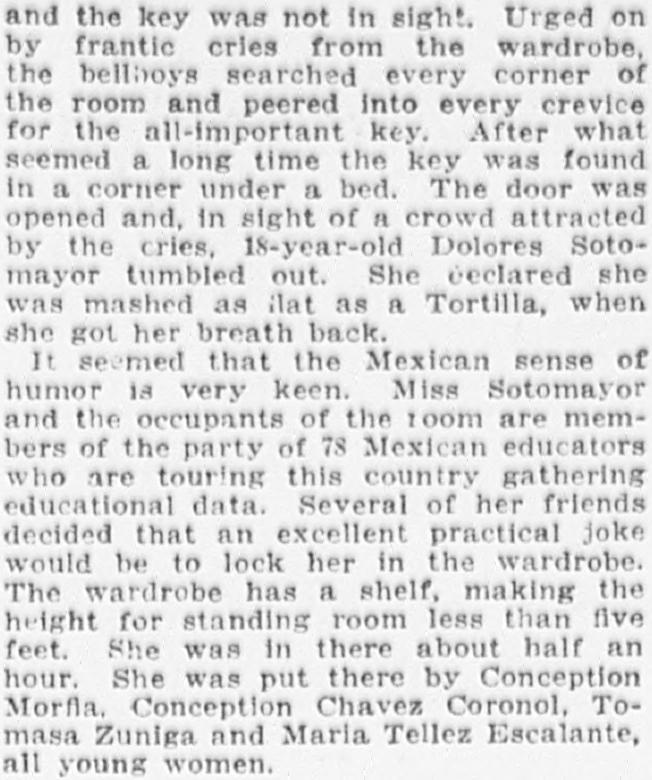
The end of the wardrobe story. Evening Ledger, Philadelphia, Pennsylvania, December 4, 1915, page 3. Library of Congress, Chronicling America. Click the clipping to read it full size.
Dolores was not angry, or at least she didn’t sound it. When she got her breath back, the paper said, she announced that she “was mashed as flat as a Tortilla.” A tortilla is the thin, flat, round bread eaten every day in Mexico. It was a joke of her own, made right after being the butt of one. The Ledger seemed to like that. “It seemed that the Mexican sense of humor is very keen,” it said.
Serious Work, and a Little Fun
Most of what the papers wrote about the trip was serious: 80 teachers who came to study the city’s schools. The wardrobe story in Philadelphia showed the other side of it. These were mostly young people, a long way from home, after months of classes and tours and handshakes. Four friends saw a big wardrobe with a key in the lock, and they couldn’t help themselves.
Teachers spend their days telling kids to settle down. It’s nice to know that in 1915, a few of them couldn’t settle down either.
Going Home
The trip ended a few days later. “Eighty-one prominent educators of Mexico, who have been visiting several American cities studying the educational system of this country, sailed for their homes yesterday,” the Associated Press reported from New York on December 10. The Evening Star had said they would sail to Havana, Cuba, and then on to Veracruz, Mexico.
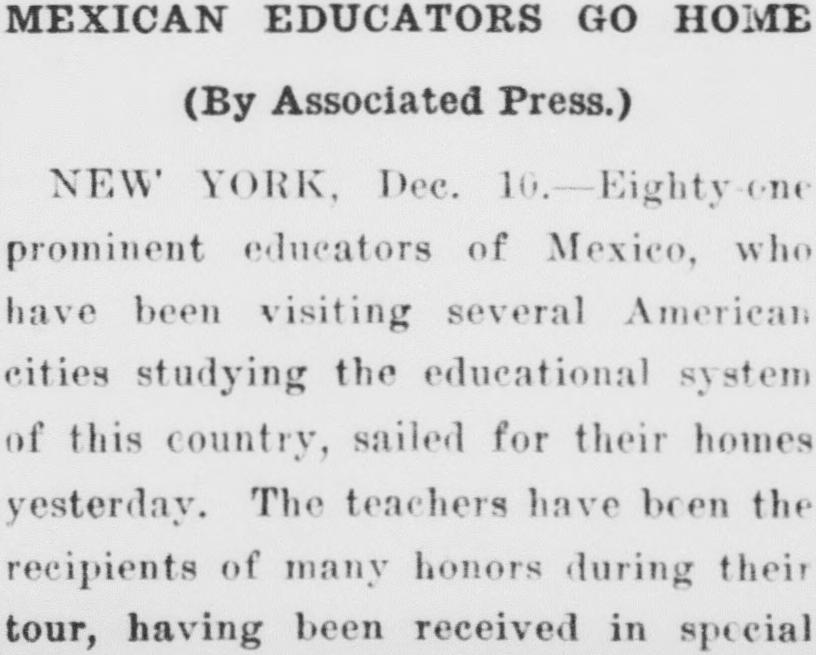
“Mexican Educators Go Home.” Nogales Daily Herald, Nogales, Arizona, December 10, 1915, page 1. Library of Congress, Chronicling America. Click the clipping to read it full size.
They took home notebooks full of ideas about classrooms, school buildings and how to teach small children. Dolores Sotomayor took home one more thing: the story of the half hour she spent in a Philadelphia wardrobe, and the key that was under the bed the whole time.
The Colonnade Hotel’s Palm Room
The Colonnade Hotel wasn’t only bedrooms and wardrobes. Its palm room was a bright dining room with white tablecloths, potted palms, flowers and tall windows. This Detroit Publishing Company photo of it was made sometime between 1900 and 1915.
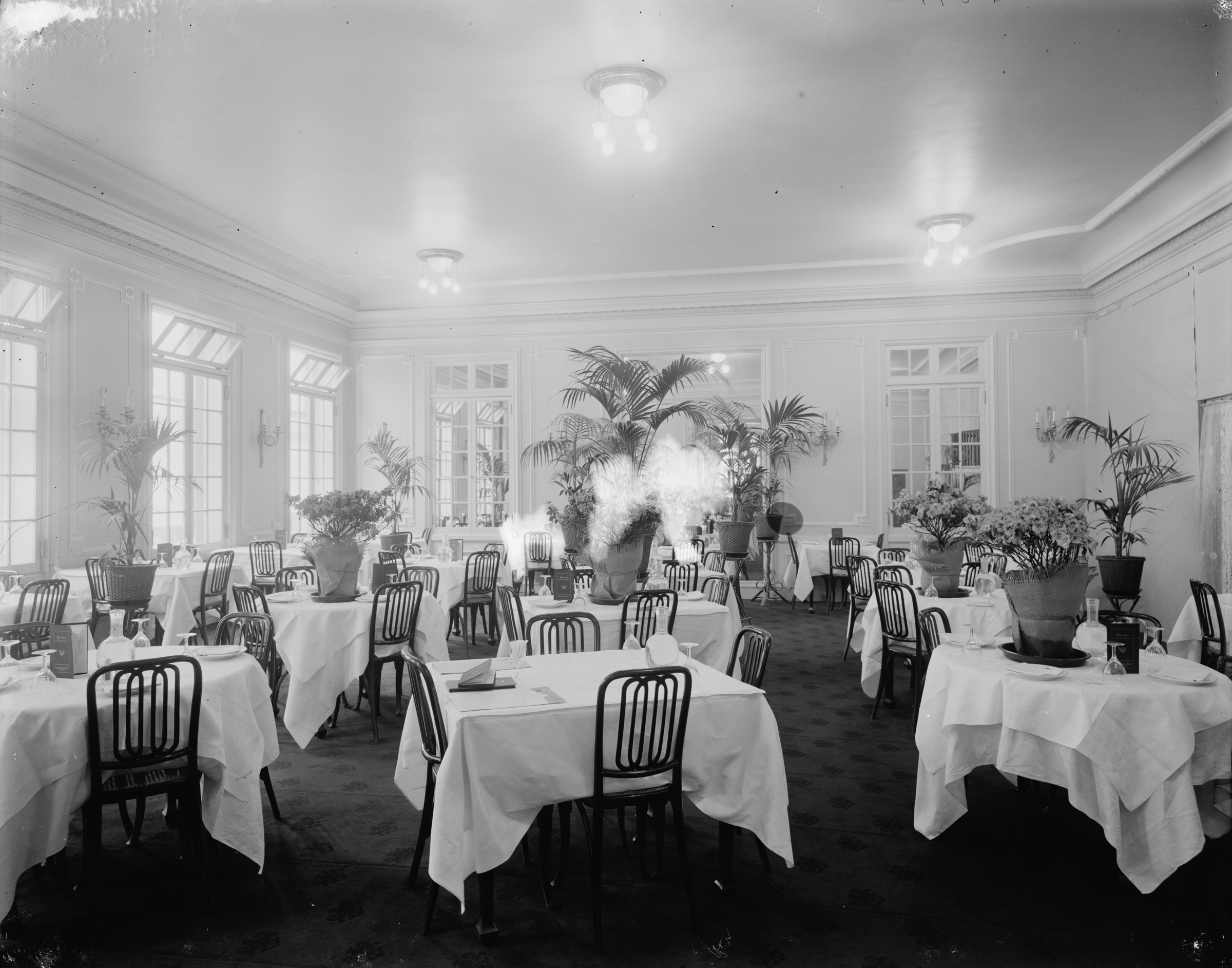
“Colonnade Hotel, the palm room, Philadelphia, Pa.” Detroit Publishing Co., between 1900 and 1915. Library of Congress. Click the picture to see it full size.
Sources
- “Mexican Maiden’s Cries Excite Crowds in Hotel,” Evening Ledger (Evening Public Ledger), Philadelphia, Pennsylvania, December 4, 1915, page 3. Library of Congress, Chronicling America
- “80 Mexican Teachers Arrive Here; They Will Inspect City’s Schools,” Evening Ledger, Philadelphia, Pennsylvania, December 1, 1915, page 3. Library of Congress, Chronicling America
- “Educators of Mexico Arrive in Washington,” Evening Star, Washington, D.C., November 26, 1915, page 19. Library of Congress, Chronicling America
- “Teachers Go to Quaker City,” Evening Star, Washington, D.C., December 1, 1915, page 22. Library of Congress, Chronicling America
- “Wilson Greets Mexican Teachers,” Rock Island Argus, Rock Island, Illinois, November 30, 1915, page 5. Library of Congress, Chronicling America
- “Mexican Educators Go Home,” Nogales Daily Herald, Nogales, Arizona, December 10, 1915, page 1. Library of Congress, Chronicling America
- Cover photo: “Colonnade Hotel, Philadelphia, Pa.,” Detroit Publishing Co., between 1910 and 1920. Library of Congress
- Photo: “Colonnade Hotel, the palm room, Philadelphia, Pa.,” Detroit Publishing Co., between 1900 and 1915. Library of Congress
- Newspapers printed before 1931 are in the public domain. Both photos: Library of Congress, no known restrictions on publication.