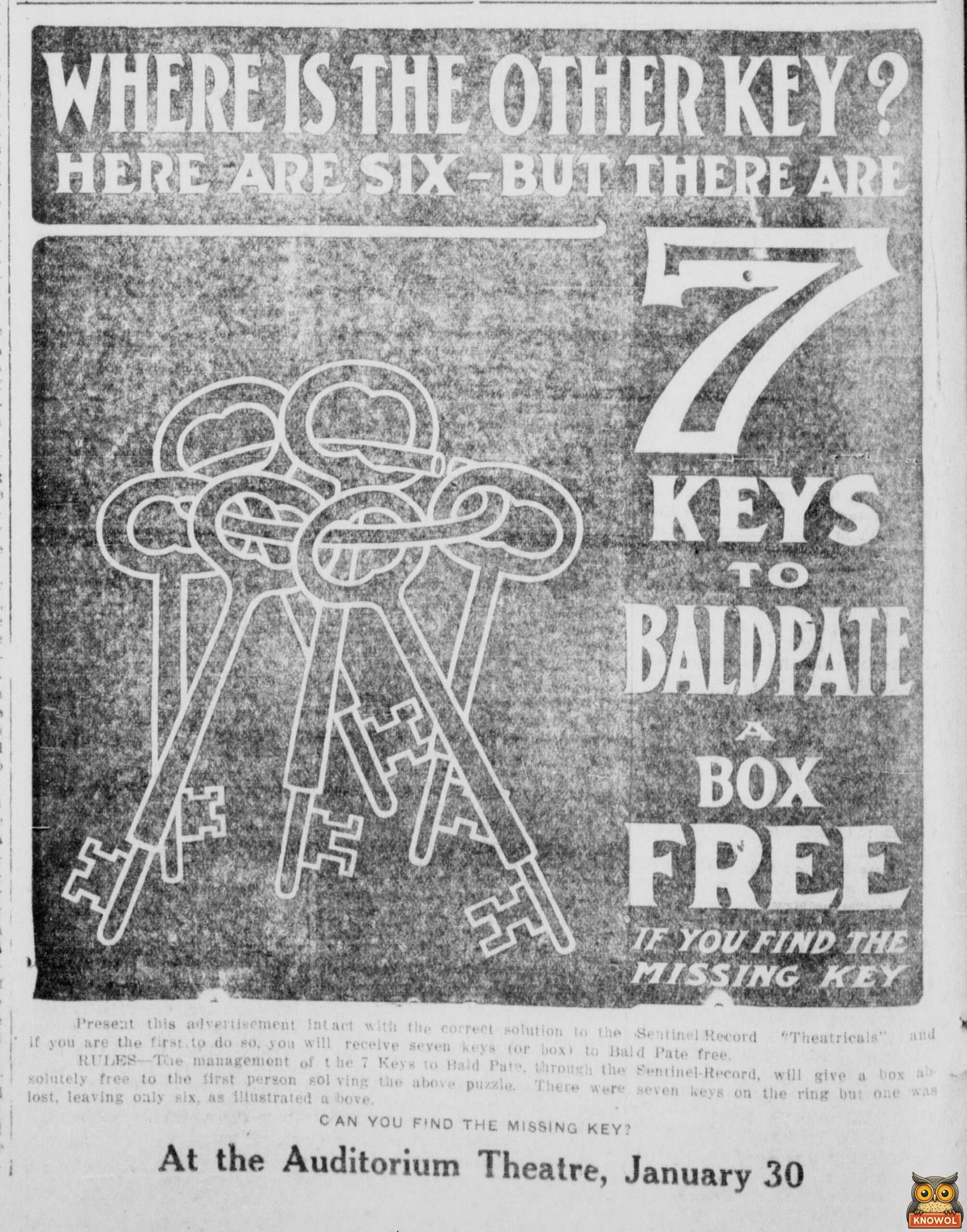
“Where Is the Other Key?” An advertisement for “7 Keys to Baldpate,” The Sentinel-Record, Hot Springs, Arkansas, January 26, 1915, page 6. Library of Congress, Chronicling America. Click the clipping to read it full size.
On Tuesday, January 26, 1915, people in Hot Springs, Arkansas, opened The Sentinel-Record and found a puzzle staring back at them. A big dark box filled the lower corner of page six. In it hung a ring of old-fashioned keys, the long kind with a loop at one end and little teeth at the other. Across the top, white letters asked, “WHERE IS THE OTHER KEY?” The ad said there were six keys on the ring, but there are seven keys to Baldpate.
Count them. There are six. The small print under the picture explained the trouble: “There were seven keys on the ring but one was lost, leaving only six, as illustrated above.” Then came the prize. The first person to find the missing key would get a box at the theater, free.
A Mystery Play Was Coming to Hot Springs
The keys came from a play. “Seven Keys to Baldpate” was a new mystery comedy by George M. Cohan, the famous Broadway song-and-dance man. He made it from a 1913 novel by Earl Derr Biggers. On Sunday, January 24, the paper told the story. A writer goes to Baldpate Inn, a summer hotel shut tight for the winter, to write a whole novel on a bet with the hotel’s owner. He thinks he has the only key. Then, one by one, the people holding the other six keys come creeping in.
The play was booked for one Saturday, January 30, at the Auditorium, a theater in Hot Springs. The puzzle ad was its way of getting the whole town talking first. A theater box was a little private balcony at the side of the hall, the fanciest seats in the house.
Hot Springs, Arkansas, Mailed in Its Answers
People in Hot Springs went at it with pencils and scissors. On Saturday morning, the day of the show, the paper printed the winner. “MRS. CLAUDE MARSH WINS THEATER BOX,” the headline said. “SHE WAS FIRST TO FIND EXTRA KEY IN POPULAR ‘BALDPATE’ PUZZLE.”
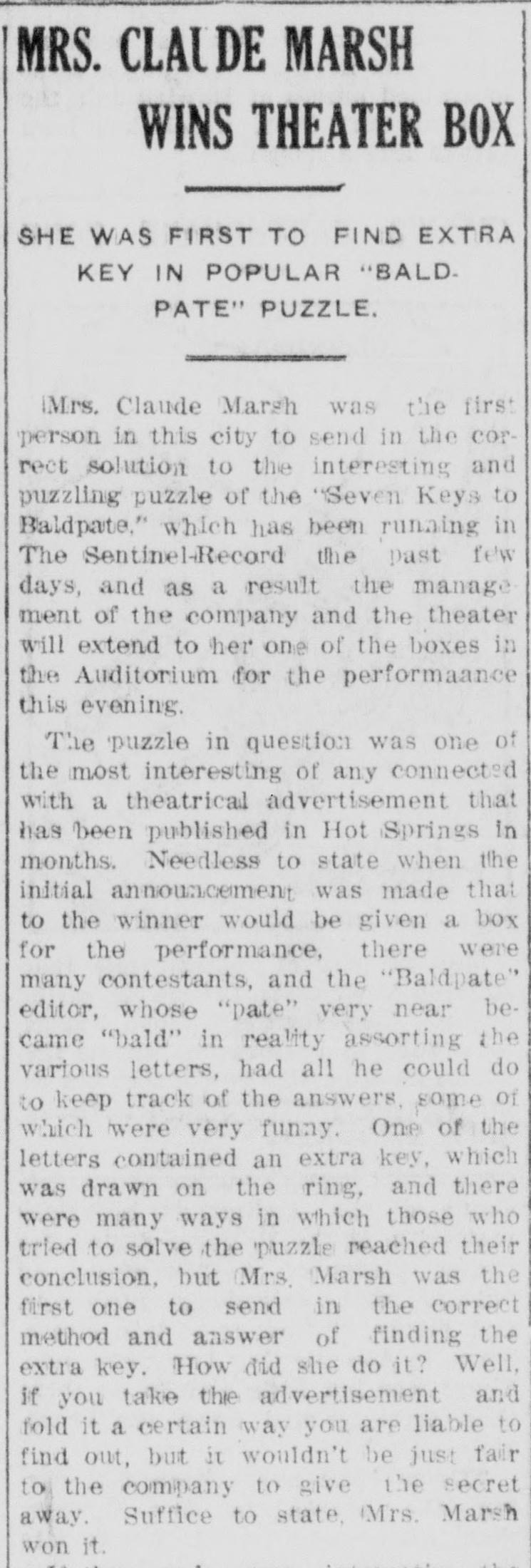
“Mrs. Claude Marsh Wins Theater Box.” The Sentinel-Record, Hot Springs, Arkansas, January 30, 1915, page 4. Library of Congress, Chronicling America. Click the clipping to read it full size.
Mrs. Marsh was a Hot Springs woman whose husband, Claude Marsh, was the secretary of the town’s school board. The paper had a little fun with the man who opened the mail. It said “the ‘Baldpate’ editor, whose ‘pate’ very near became ‘bald'” (a pate is the top of your head) “had all he could do to keep track of the answers, some of which were very funny.”
One reader found a shortcut. “One of the letters contained an extra key, which was drawn on the ring,” the paper said. Somebody had simply taken a pen and drawn a seventh key! It didn’t win. Mrs. Marsh had found the real answer, and she found it first.
So how did she do it? The paper wouldn’t say. “If you take the advertisement and fold it a certain way you are liable to find out,” it wrote, “but it wouldn’t be just fair to the company to give the secret away.” The show was still traveling to other towns, and those towns were going to get the same puzzle.
Seattle, Washington, Gave Away the Secret
Hot Springs wasn’t the only place hunting for the key. The same ring of keys ran in newspapers wherever the play went. In October 1914, the Harrisburg Telegraph in Pennsylvania said only two of its readers “used a folding method, which gives the correct solution.” The winner was “Miss Anna Woltz, 509 North street,” and she won five box seats.
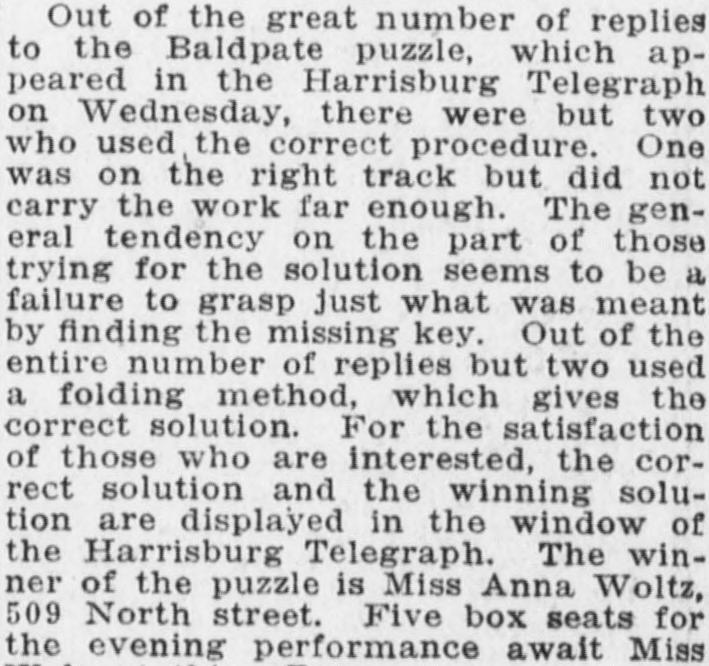
Harrisburg Telegraph, Harrisburg, Pennsylvania, October 16, 1914, page 15. Library of Congress, Chronicling America. Click the clipping to read it full size.
In Detroit, Michigan, in November, Miss Stella Gramer won six box seats from The Detroit Times. She said she read the whole paper first, then came back to the puzzle. “Then I cut out the illustrations and started to see if I could find the seventh key,” she said. “You can see that it did not take me long to find it.”
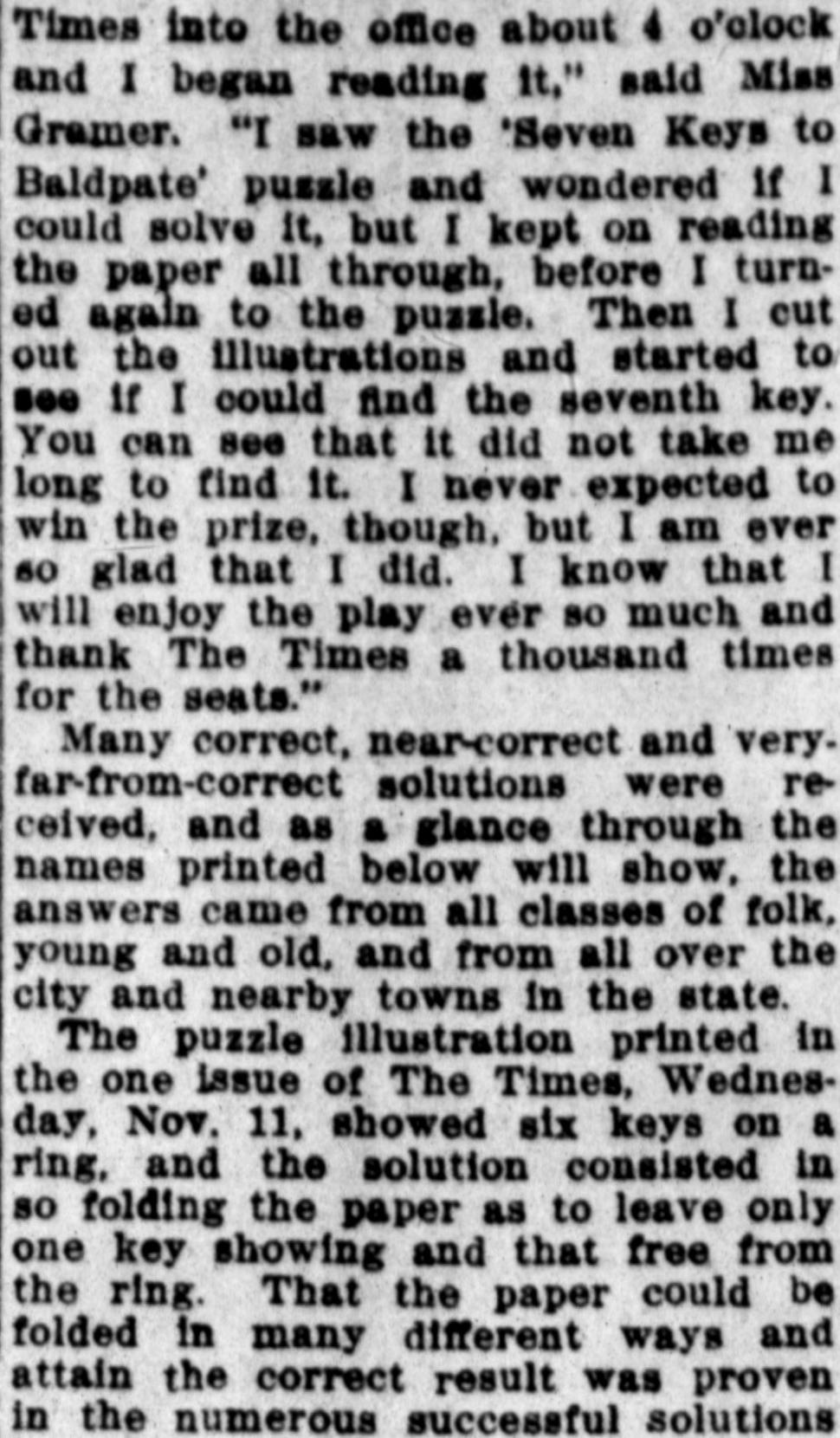
The Detroit Times, Detroit, Michigan, November 16, 1914, page 4. Library of Congress, Chronicling America. Click the clipping to read it full size.
The biggest hunt of all came in Seattle, Washington, in April 1915. The Seattle Star’s puzzle editor “received more than 15,000 answers to the puzzle,” the paper said, “and most of them were wrong.” Near the end, the letters came in so fast that they had to be hauled from the post office in automobile loads. The Star admitted, “It was a silly contest. Yet the town went stark crazy over it.”
Some readers thought the seventh key was the word “key” printed in the ad. One music lover worked out that the missing key had to be a musical key, “G sharp!” About 2,500 people got it right. Only the first 50 got free seats.
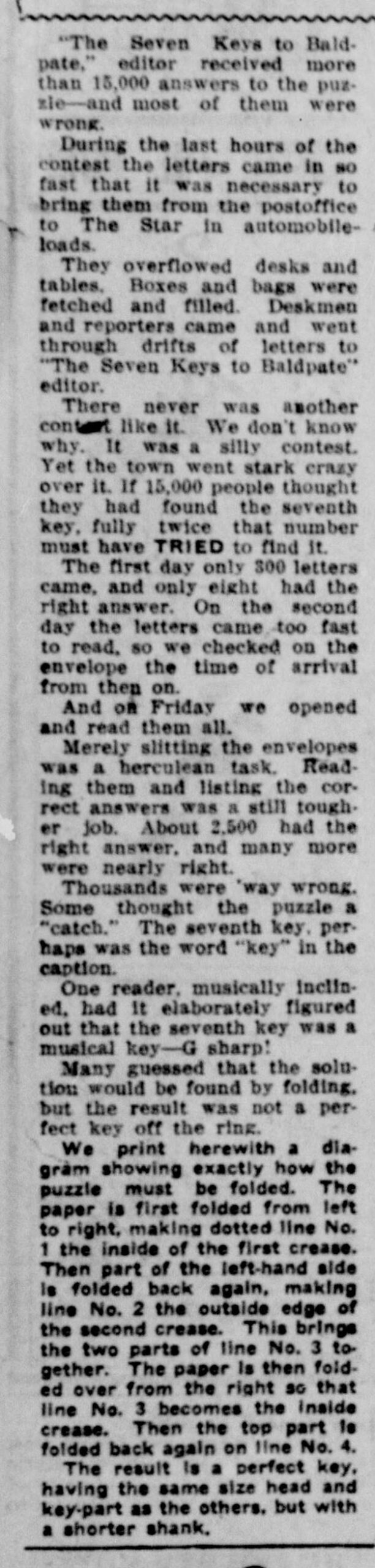
The Seattle Star, Seattle, Washington, April 17, 1915, page 5. Library of Congress, Chronicling America. Click the clipping to read it full size.
Then The Star did what the Hot Springs paper wouldn’t. It printed a drawing called “THE WAY IT’S DONE,” with four dotted lines across the keys.
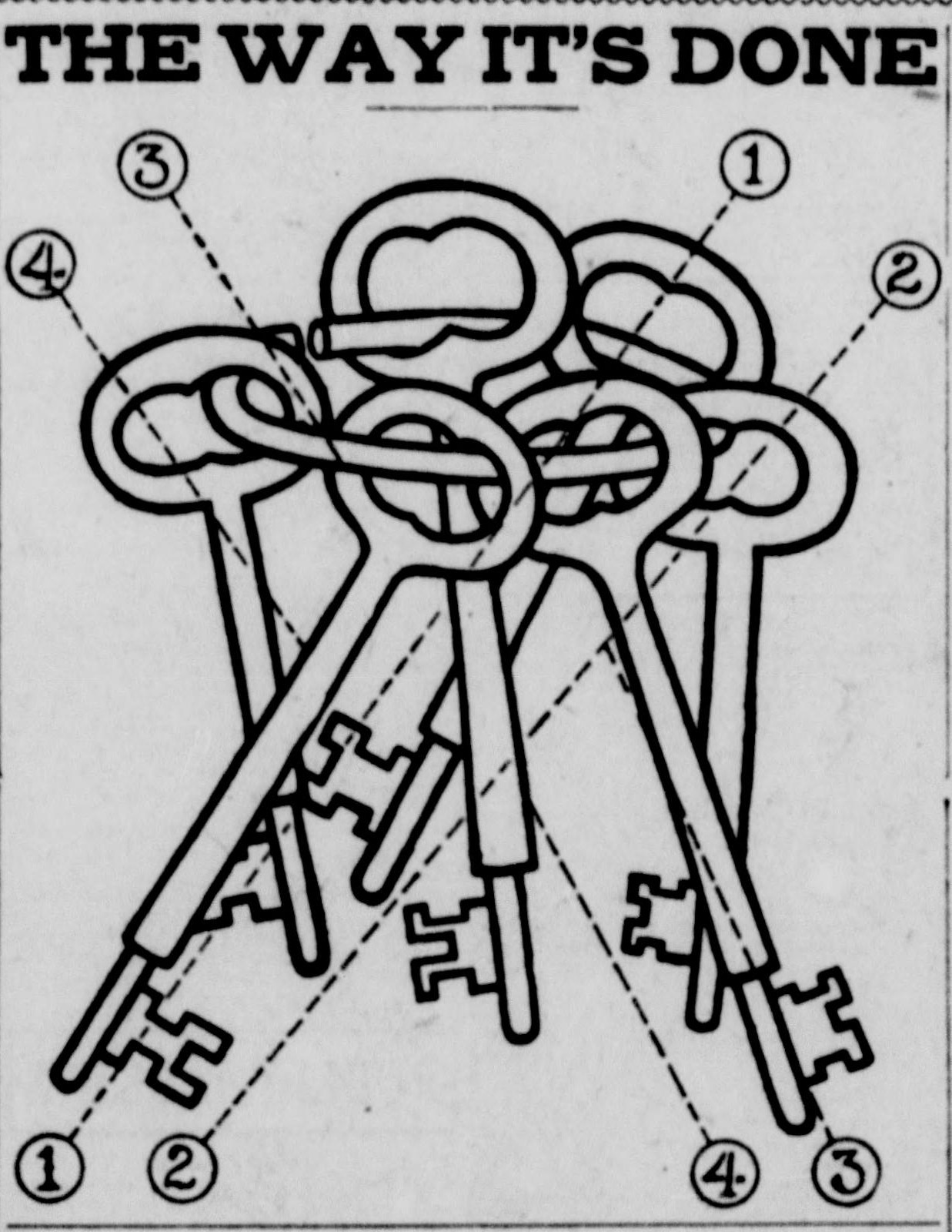
“The Way It’s Done.” The Seattle Star, Seattle, Washington, April 17, 1915, page 5. Library of Congress, Chronicling America. Click the clipping to read it full size.
How Four Folds Make a Seventh Key
Here is how the fold worked, from The Star’s own steps. You fold the paper along line 1, then fold part of it back along line 2. Next you fold from the other side along line 3, and fold the top back on line 4. Each fold hides most of the picture and slides one piece of a key right up against a piece of another key.
When you’re done, pieces of different keys line up into one whole key, all by itself, off the ring. “The result is a perfect key,” The Star said, “having the same size head and key-part as the others, but with a shorter shank.” The shank is the long stick in the middle of a key. So the lost key had been hiding inside the other six the whole time.
That fits the play, too. The Star’s 50 winners went to see “Seven Keys to Baldpate” together, and the paper said they all agreed the play’s surprise ending was much harder to guess than the puzzle.
What It Cost in Hot Springs
On the day Mrs. Marsh won, the Auditorium’s ad on the same page gave the ticket prices. “Prices, Night, $1.50, $1.00, 75c, 50c. 25c; Matinee, $1.00, 75c, 50c.” A matinee is an afternoon show. You bought seats at Schneck’s, a drug store in town.
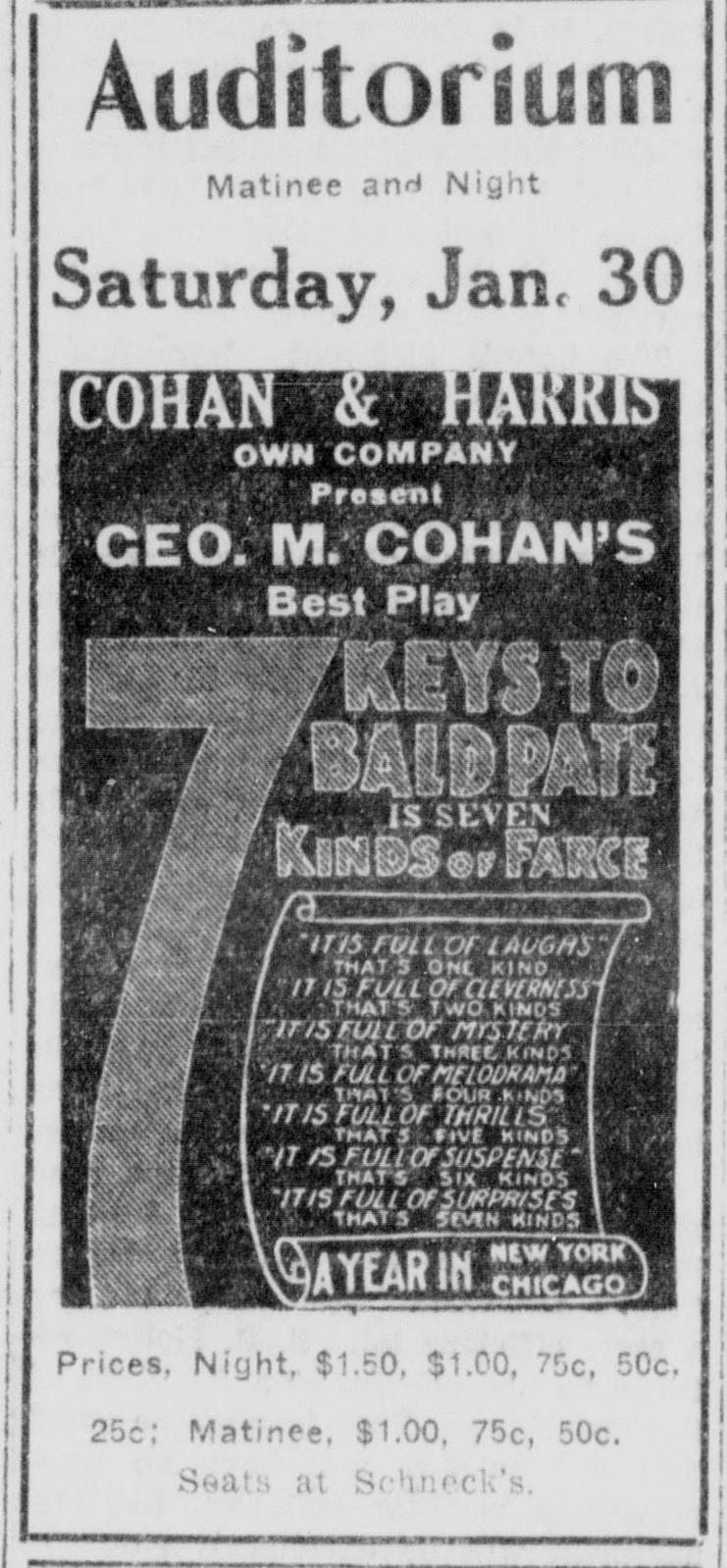
The Auditorium’s ad for “7 Keys to Baldpate,” The Sentinel-Record, Hot Springs, Arkansas, January 30, 1915, page 4. Library of Congress, Chronicling America. Click the clipping to read it full size.
At the top of that same page, R. T. Cotham’s store at 834 Central Avenue was starting a clearance sale. Men’s shoes worth up to $3.00 were “95c.” Children’s shoes were “$1.45.” So the best seat in the house cost more than a pair of shoes on sale. Mrs. Marsh’s whole box was free.
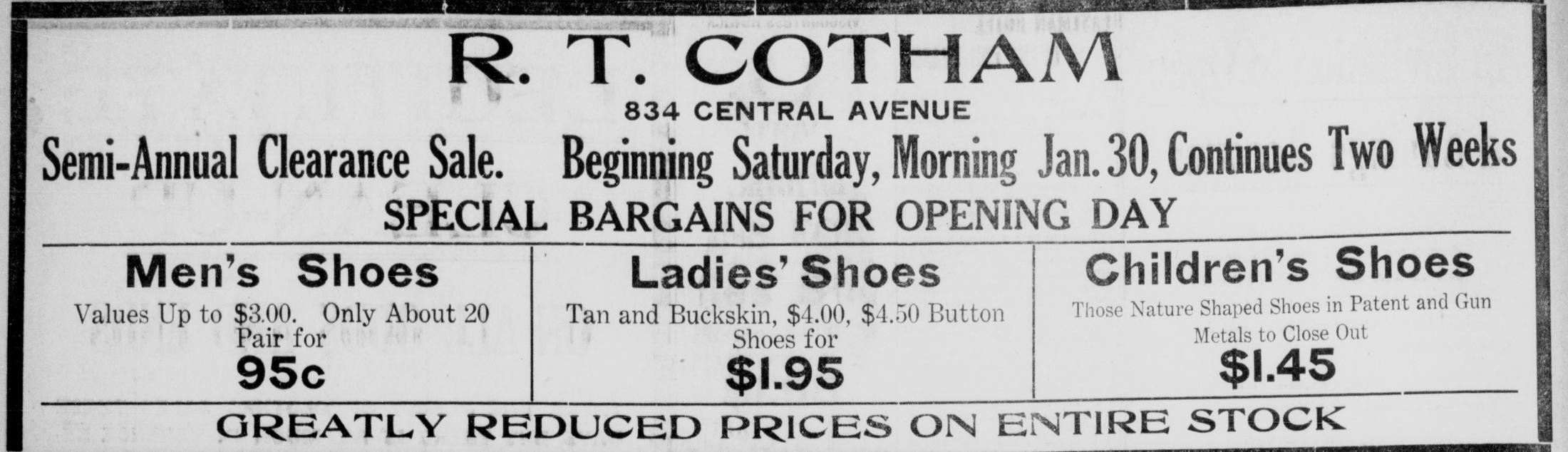
R. T. Cotham’s clearance sale ad, The Sentinel-Record, Hot Springs, Arkansas, January 30, 1915, page 4. Library of Congress, Chronicling America. Click the clipping to read it full size.
A Big Night in Hot Springs
Saturday, January 30, was a busy night in Hot Springs. The Eastman, one of the big hotels, was holding a ball. So the theater manager, Frank Head, moved the curtain up to 7:45, half an hour early, so people could see the play and still get to the dance.
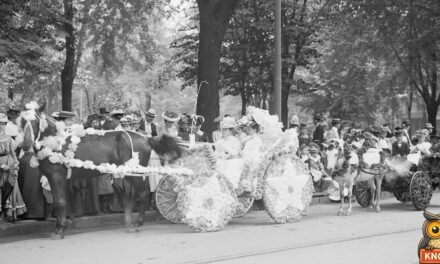
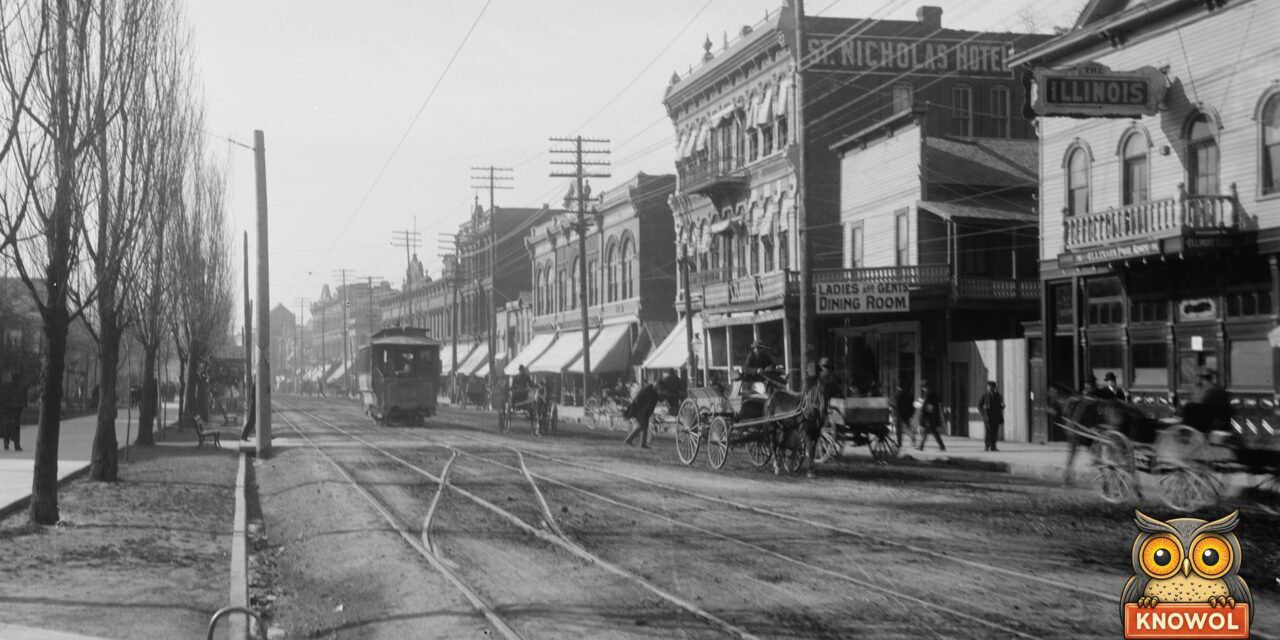
The cover photo shows Central Avenue, the main street of Hot Springs, sometime between 1895 and 1910, with a streetcar and horse wagons on the dirt road. This 1910 panorama shows more of the town, with the giant Eastman Hotel on the right.

“Panorama #1, Hot Springs, Ark.,” Haines Photo Co., 1910. Library of Congress, Prints and Photographs Division. Click the picture to see it full size.
Nobody wrote down what Mrs. Marsh thought of the play. But somewhere in a Hot Springs house that week was a folded-up newspaper ad with seven keys on it, and she was the first one in town to see the seventh.
Sources
- “Auditorium,” The Sentinel-Record, Hot Springs, Arkansas, January 24, 1915, page 7. Library of Congress, Chronicling America
- “Where Is the Other Key?” advertisement, The Sentinel-Record, Hot Springs, Arkansas, January 26, 1915, page 6. Library of Congress, Chronicling America
- “Mrs. Claude Marsh Wins Theater Box,” The Auditorium’s ad and R. T. Cotham’s ad, The Sentinel-Record, Hot Springs, Arkansas, January 30, 1915, page 4. Library of Congress, Chronicling America
- Claude Marsh, secretary of the school board: The Sentinel-Record, Hot Springs, Arkansas, May 17, 1914, page 2. Library of Congress, Chronicling America
- Harrisburg Telegraph, Harrisburg, Pennsylvania, October 16, 1914, page 15. Library of Congress, Chronicling America
- The Detroit Times, Detroit, Michigan, November 16, 1914, page 4. Library of Congress, Chronicling America
- “Here Are Fifty Who Found Hidden Key” and “The Way It’s Done,” The Seattle Star, Seattle, Washington, April 17, 1915, page 5. Library of Congress
- “50 Winners of Puzzle Laugh at ‘Seven Keys’,” The Seattle Star, Seattle, Washington, April 20, 1915, page 5. Library of Congress
- Cover photo: “[Central Avenue, Hot Springs, Arkansas],” Detroit Publishing Co., between 1895 and 1910. Library of Congress
- Photo: “Panorama #1, Hot Springs, Ark.,” Haines Photo Co., 1910. Library of Congress
- Newspapers printed before 1931 are in the public domain. Photos: Library of Congress, no known restrictions on publication.