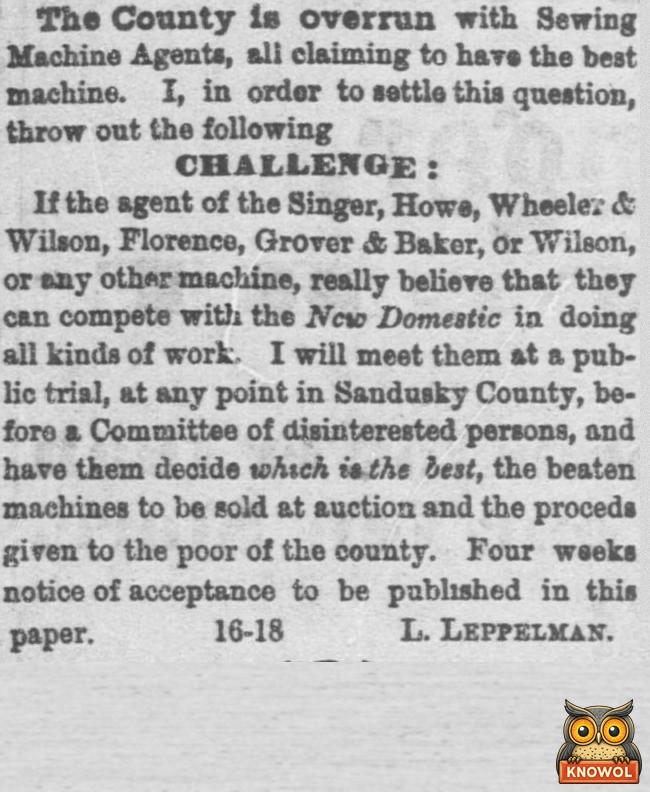
“Challenge.” L. Leppelman’s notice in The Fremont Weekly Journal, Fremont, Ohio, April 21, 1871, page 3. Library of Congress, Chronicling America. Click the clipping to read it full size.
In the spring of 1871, the people of Fremont, Ohio, could follow a fight every Friday without leaving their chairs. It was fought in the town’s weekly paper, one small notice at a time. The two men in it sold sewing machines. Before it was over, they were daring each other to put up $1,000.
It started on April 21. L. Leppelman ran a store in Fremont that sold jewelry, silver, pianos and organs. He was also the agent for the New Domestic sewing machine. An agent was a salesman for one brand. He showed the machine in town, carried it out to farms, and often left it in a family’s home “on trial” for a few days to try.
Leppelman was tired of the competition. “The County is overrun with Sewing Machine Agents, all claiming to have the best machine,” he wrote in The Fremont Weekly Journal. So he threw out a “CHALLENGE” to the agent of any other brand: Singer, Howe, Wheeler & Wilson, Florence, Grover & Baker or Wilson. He would meet them “at a public trial,” with a committee to decide which machine was best. Then came the twist. The losing machines would be “sold at auction and the proceds given to the poor of the county.”
Fremont, Ohio: The Wilson Man Answers
The answer came a week later from Perry Close, who sold the New Wilson sewing machine. He also ran a store that sold china, silverware and groceries. Close said he would not bother with a contest over one machine. His company could build “a dozen in less time than would be required to test one.”
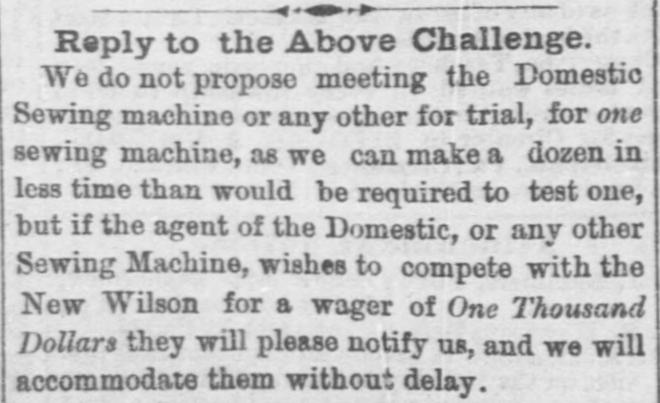
“Reply to the Above Challenge.” Perry Close’s notice, The Fremont Weekly Journal, Fremont, Ohio, April 28, 1871, page 3. Library of Congress, Chronicling America. Click the clipping to read it full size.
Then he raised the stakes. If any agent wanted to take on the New Wilson “for a wager of One Thousand Dollars,” Close wrote, “we will accommodate them without delay.” A New Wilson sold for $45, so $1,000 was the price of about 22 sewing machines.
In the same paper, Close printed a second notice, called “Notice to Everybody.” It said that Leppelman, “by some hook or crook,” had gotten hold of a few New Wilson machines. Close believed Leppelman meant to put them “in bad order” and sell them cheap, to make the Wilson look bad. So Close made an offer. Buy those machines anyway, he said, even if “they do not work at all,” and bring them to him. He would fix them for free and give the company’s five-year warranty. The company, he added, was “worth a million of dollars, which will make their warrant rather better than mine.”
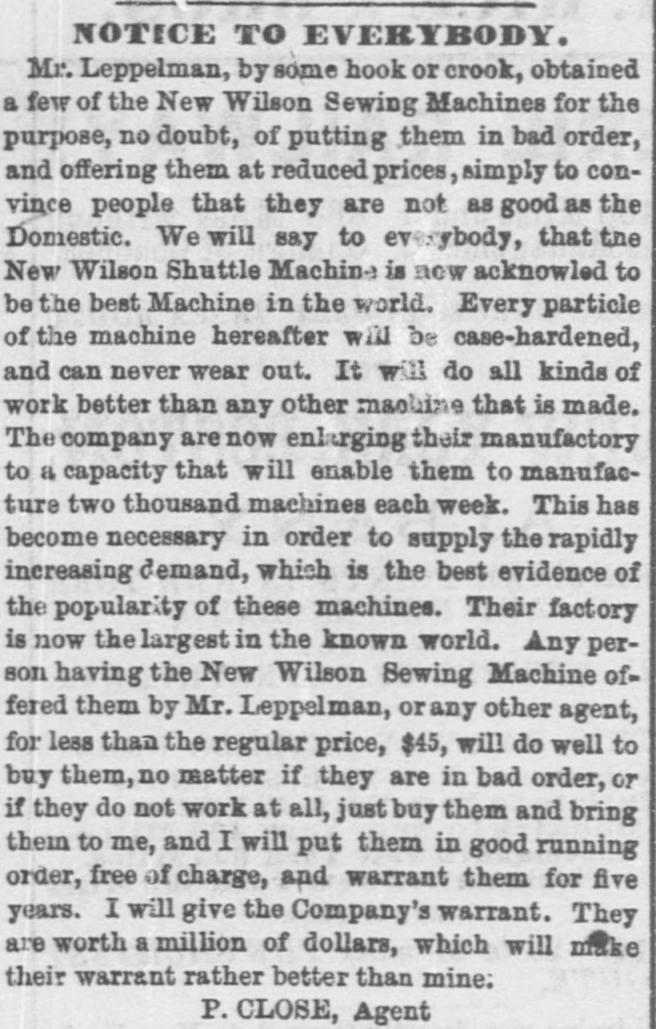
“Notice to Everybody.” Perry Close’s notice, The Fremont Weekly Journal, Fremont, Ohio, April 28, 1871, page 3. Library of Congress, Chronicling America. Click the clipping to read it full size.
Leppelman Takes the Bet, for the Poor of Fremont
On May 5, Leppelman wrote back. He called Close’s notice “the above tirade of meanness.” He said his own agents could put a machine in good order better than Close could.
Then he took the bet, with a change. He would accept the $1,000 wager, but the money would go “to the Ladies Aid Society, for the benefit of the poor of Fremont.” The trial would be held in one of the town’s public halls. He even picked the judges: “three of our best Mechanics and three Ladies.” A mechanic was a person who built and fixed machines. The ladies were the people who used them every day. Between the two, nothing about a sewing machine would get past the judges.
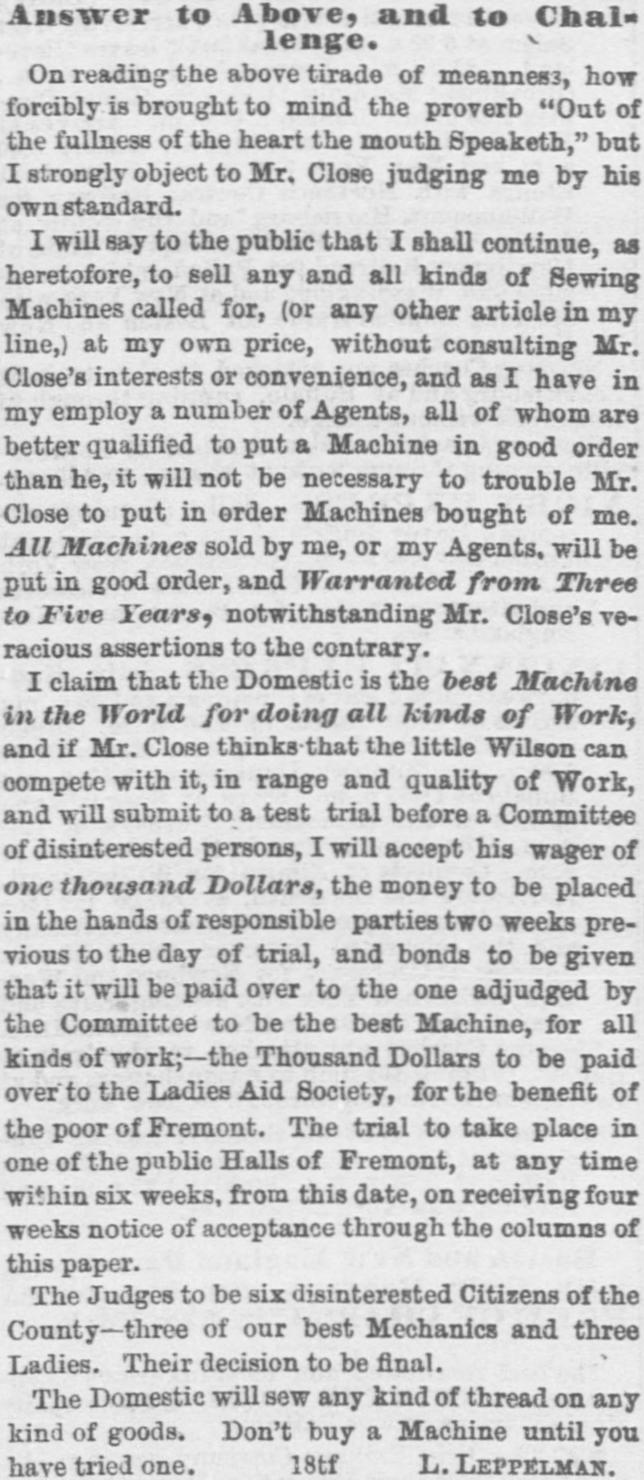
“Answer to Above, and to Challenge.” L. Leppelman’s notice, The Fremont Weekly Journal, Fremont, Ohio, May 5, 1871, page 3. Library of Congress, Chronicling America. Click the clipping to read it full size.
“Mr. Leppelman Says He Is Tired of Meanness”
Close’s reply in the May 12 paper had a grin in it. Leppelman, he wrote, said he was tired of meanness. “We are very glad to hear it.” But Close said Leppelman “is always throwing out challenges which he knows no person will take.”
Leppelman had called the Wilson “the little Wilson.” Close threw the word right back. Come compete with the “(little) Wilson, (as you call it),” he wrote, and “just put up your little thousand dollars.” The winner, he said, could “do as he pleases with the money.” That was the real sticking point now. One man wanted the money to go to the poor. The other wanted the winner to keep it.
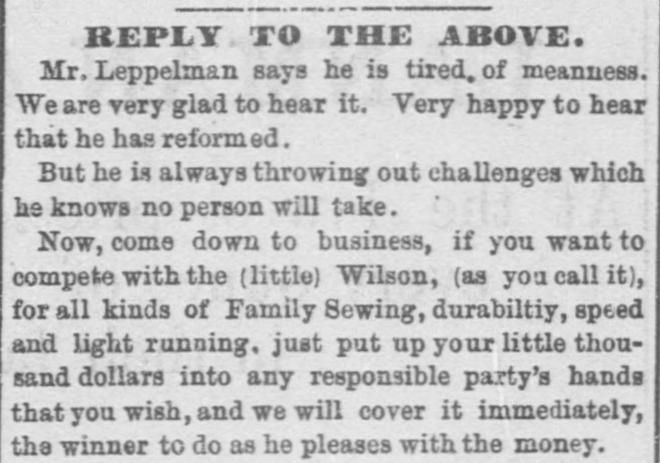
“Reply to the Above.” Perry Close’s notice, The Fremont Weekly Journal, Fremont, Ohio, May 12, 1871, page 3. Library of Congress, Chronicling America. Click the clipping to read it full size.
A Third Agent in Fremont Jumps In
By May 19, the editor of the Journal was enjoying the show. “The Sewing Machine contest grows warmer, and approaches a focus,” the paper said in its local news.
That same week, a third seller joined in. The Singer machines were sold at E. L. Cross’ Jewelry Store. Its notice ran under the big headline “SEWING MACHINE CONTEST.” The line under it read: “Now to Business, Quit Your Quarreling and Come to the Point.” Cross offered his own $1,000 for any machine that could beat “the Improved Family Singer Sewing Machine.”
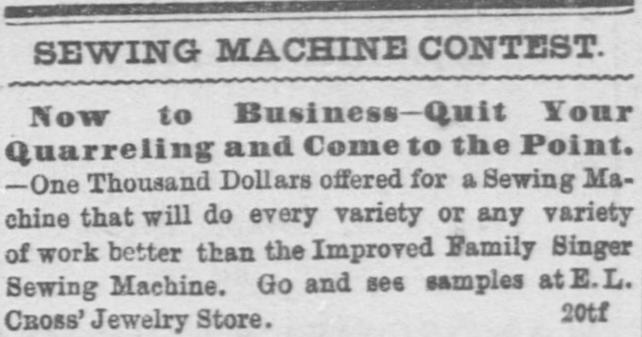
“Sewing Machine Contest.” The Singer notice for E. L. Cross’ Jewelry Store, The Fremont Weekly Journal, Fremont, Ohio, May 19, 1871, page 3. Library of Congress, Chronicling America. Click the clipping to read it full size.
The Money Goes on the Table
Leppelman made the next move. In a notice dated May 18, he said he had left $1,000 with Mr. F. I. Norton to hold. If Close did the same, they would meet on “Wednesday, May 31st, 1871,” and test the two machines.
He added one smart rule. The machines in the contest had to be ones already sold to customers around Fremont. That way, nobody could bring a machine “fixed up expressly for this occason.” In other words, no secret tune-ups. The test would use the kind of machine a family really had at home.
His last line was a joke at Close’s expense. “If Mr. Close wishes to make a permanent investment of One Thousand Dollars, now is his tme.” A permanent investment is money you put away and never see again. Leppelman meant that Close would lose.
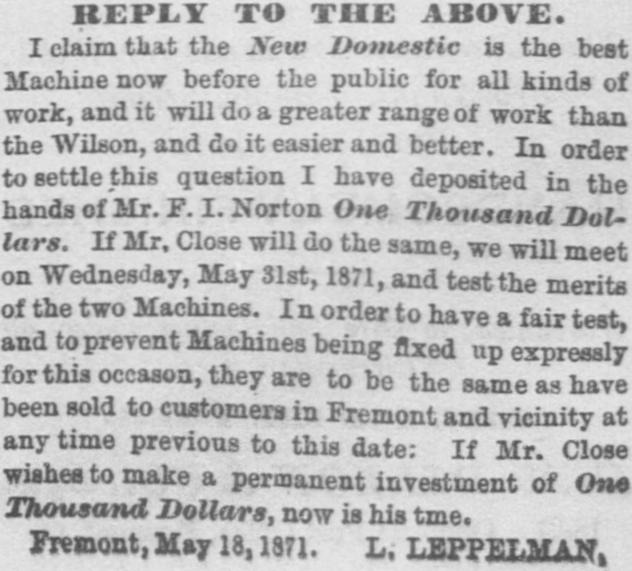
“Reply to the Above.” L. Leppelman’s notice, dated May 18, as it was still running in The Fremont Weekly Journal, Fremont, Ohio, June 16, 1871, page 3. Library of Congress, Chronicling America. Click the clipping to read it full size.
What Happened on May 31 in Fremont
Here is the strange part. We read the Fremont Weekly Journal for the weeks after May 31, and we found no report of a contest. No hall, no judges, no winner. Instead, the notices just kept running. Leppelman’s notice naming May 31 was still in the paper on June 16, two weeks after the day it named. Close’s “Notice to Everybody” ran right beside it. The Singer notice was still running in October. If the great trial ever happened, the Journal didn’t say so.
The two rivals did end up under one roof. At the Sandusky County Fair that October, the Journal walked its readers through the fair’s Floral Hall. Perry Close had a display of china, silver ware and sewing machines near the east entrance. Elsewhere in the same hall stood Leppelman’s large show case of silver, an Arion piano, organs and sewing machines.
A Year Later, the Same Two Stores
By April 1872, the shouting had turned into plain selling. Leppelman now had “second-hand Sewing Machines, as good as new,” of five other brands, including Singer and Wheeler & Wilson, “which he will sell for half price.” He also offered “one dollar” to anyone who could tell him where a Howe, Singer or Weed machine was “left on trial.” That was a reward for a tip, so he could get to that family before the other agent made the sale.
And Perry Close? His notice that week sat right above Leppelman’s. It was about something else entirely: “Raisins only 18c, at P. Close’s.”
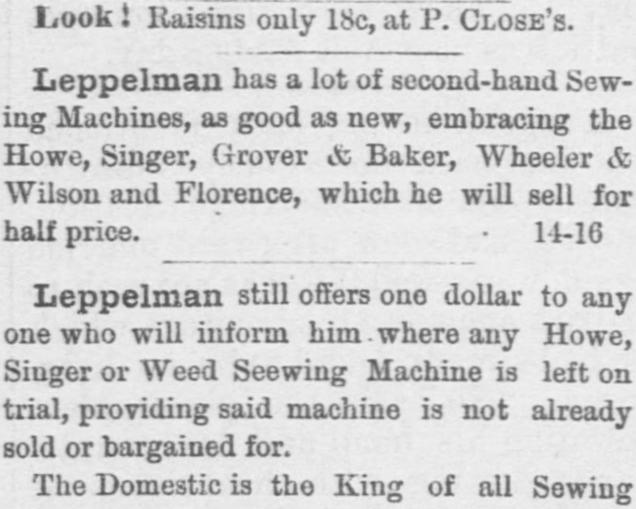
Perry Close’s raisins and L. Leppelman’s sewing machine notices, The Fremont Weekly Journal, Fremont, Ohio, April 19, 1872, page 3. Library of Congress, Chronicling America. Click the clipping to read it full size.
Nobody ever settled which machine was best, at least not in print. But for a few weeks in 1871, two shopkeepers in a small Ohio town turned a sewing machine sale into a duel. And the best idea in the whole fight was Leppelman’s first one. The loser’s money was going to the poor.
A Sewing Machine at Home
Sewing machines were still fairly new in American homes then, and printmakers liked to show them off in pretty pictures. This 1872 print shows a girl with a ribbon in her hair, guiding a ruffle under the needle of a black and gold machine. Leppelman would have liked the idea in it. A machine so easy to use that a child could do it was the best sales talk there was.
[IMAGE: photos/child-at-sewing-machine-1872-loc.jpg | “[Child at sewing machine],” print by J. S. Dawley, 1872. Library of Congress, Prints and Photographs Division.]
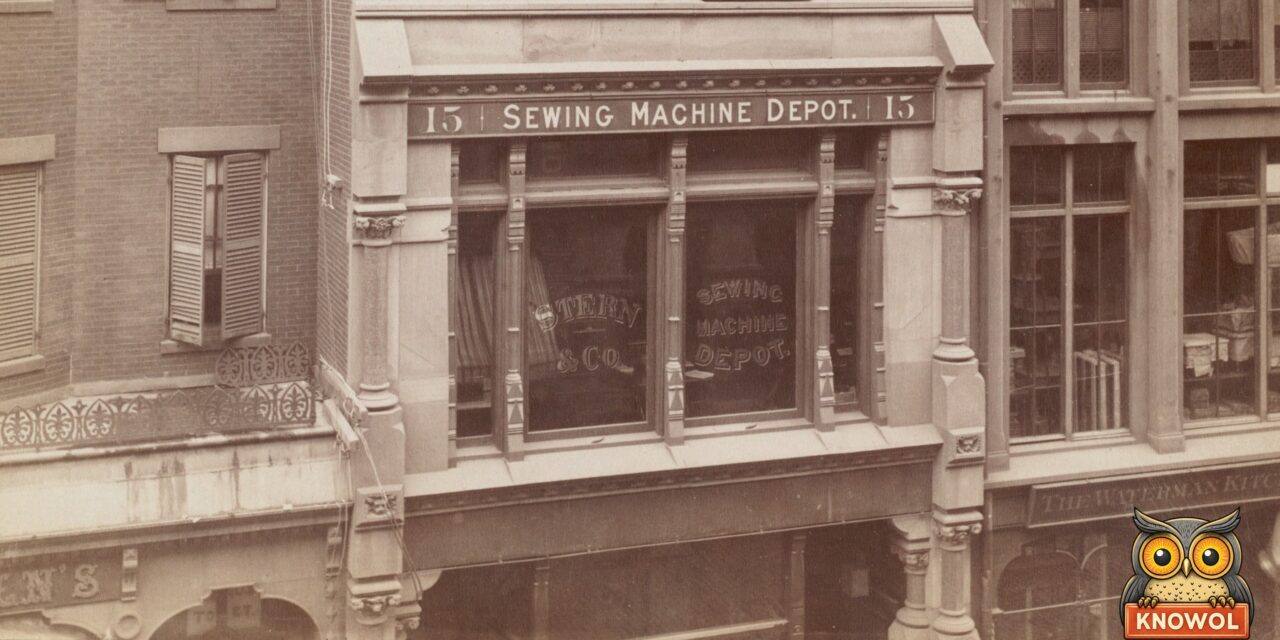
The Fremont stores of Close and Leppelman weren’t photographed that we know of. The cover photo shows a sewing machine shop of the same years in another city: Stern & Co.’s “Sewing Machine Depot” at 15 Essex Street in Boston, Massachusetts, about 1880.
Sources
- L. Leppelman, “Challenge,” The Fremont Weekly Journal, Fremont, Ohio, April 21, 1871, page 3. Library of Congress, Chronicling America
- Perry Close, “Reply to the Above Challenge” and “Notice to Everybody,” The Fremont Weekly Journal, April 28, 1871, page 3. Library of Congress, Chronicling America
- L. Leppelman, “Answer to Above, and to Challenge,” The Fremont Weekly Journal, May 5, 1871, page 3. Library of Congress, Chronicling America
- Perry Close, “Reply to the Above,” The Fremont Weekly Journal, May 12, 1871, page 3. Library of Congress, Chronicling America
- Local news and the Singer “Sewing Machine Contest” notice, The Fremont Weekly Journal, May 19, 1871, page 3. Library of Congress, Chronicling America
- L. Leppelman, “Reply to the Above” (dated May 18), The Fremont Weekly Journal, June 16, 1871, page 3. Library of Congress, Chronicling America
- Sandusky County Fair, Floral Hall, The Fremont Weekly Journal, October 6, 1871, page 3. Library of Congress, Chronicling America
- Local notices, The Fremont Weekly Journal, April 19, 1872, page 3. Library of Congress, Chronicling America
- Print: “[Child at sewing machine],” J. S. Dawley, 1872. Library of Congress
- Cover photo: “Sewing Machine Depot: Essex St.,” Boston, about 1880. Boston Public Library, Digital Commonwealth
- Newspapers printed before 1931 are in the public domain. Print: Library of Congress, no known restrictions on publication. Cover photo: Boston Public Library, no known copyright restrictions.