There’s a fact about numbers you can check yourself in about a minute, with nothing but a pencil.
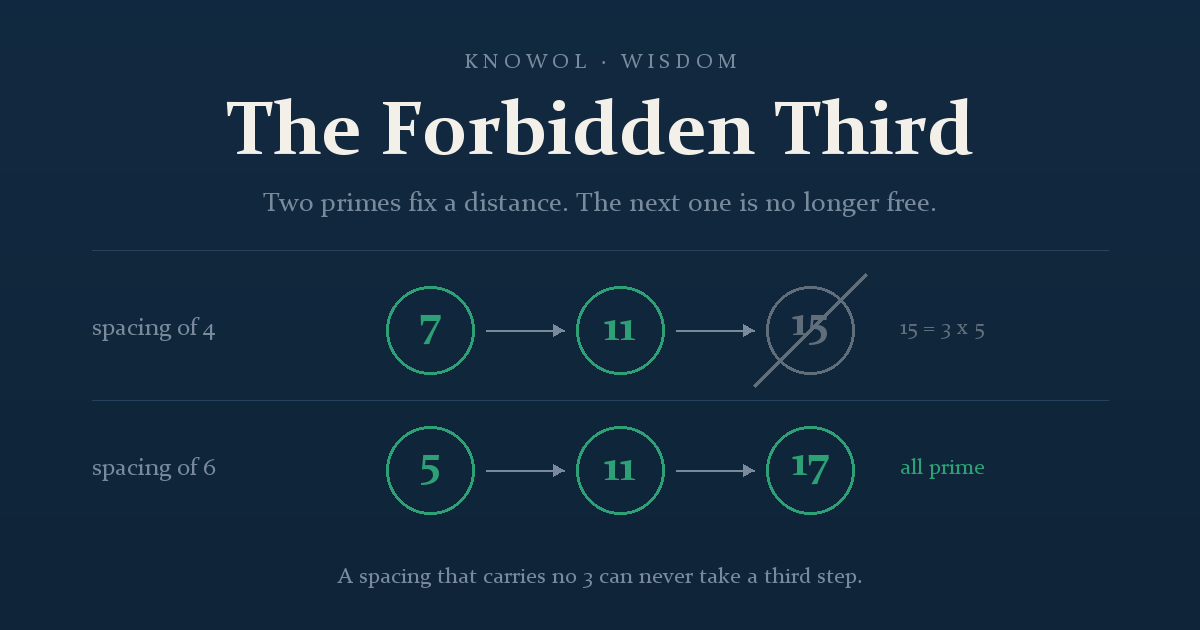
Pick two prime numbers the same distance apart. Say 7 and 11, four apart. Now ask whether a third prime sits four past the second. That would be 15. It isn’t prime. 15 is 3 times 5.
Try again. 13 and 17, four apart. The next would be 21. That’s 3 times 7.
Try 19 and 23. The next is 27. That’s 3 times 9.
It’s never going to work. Not once, not ever, no matter how far up the number line you walk. And the reason isn’t luck.
Take any three numbers spaced evenly apart, where the spacing isn’t divisible by 3. Divide each of them by 3 and look at the remainders. One lands on a remainder of zero, one on a remainder of one, one on a remainder of two. They cover every slot there is. And the one that landed on zero is divisible by 3, so it isn’t prime.
The door is closed. Not mostly closed. Closed.
Now try a spacing of 6. 5, 11, 17. All prime. 7, 13, 19. All prime. 47, 53, 59. All prime.
Six carries a 3 inside it. The wall isn’t there.
That’s the whole thing. A pattern that doesn’t carry a 3 in its spacing can’t take a third step. Everything below comes out of that one sentence.
This was true before anyone looked
It’s worth sitting still with that for a second before we take it anywhere useful.
That wall isn’t a law of nature. Laws of nature could’ve come out differently. Gravity could’ve had another strength. Light could’ve moved at another speed. You can picture a universe where those numbers changed and the whole thing still hangs together.
You can’t picture a universe where three evenly spaced numbers, spaced by something not divisible by three, somehow dodge the multiple of three. There’s no version of anything where that’s false.
So this is a floor underneath the floor. It was true before there were stars. It’ll be true after they’re gone. Nobody voted on it, nobody can revise it, and no amount of effort or belief or money moves it a single inch.
Hold onto that, because by the end it turns out to be the good news and not the bad news.
One prime is free. Two aren’t.
Here’s the piece that actually matters.
A single prime sitting by itself is completely unconstrained. It tells you nothing about what comes next. It has no direction. It’s just there.
Two primes are almost as free.
But two primes a fixed distance apart are a different object entirely. The moment that distance is fixed, the next number in the sequence stops being free. Its options collapse. Certain slots are now forbidden to it. It never agreed to that and it never had a say.
Read that again slowly, because the transfer to your own life is exact.
You aren’t constrained by the things you’ve done. You’re constrained by the spacing between them.
A man does one thing. It means nothing yet. He does it again at some interval. Now the third one isn’t fully his to decide. The interval already decided part of it for him.
This is the piece almost nobody has right. People think a life is made of events, so they agonize over events. Which job. Which move. Which decision. The arithmetic says the events aren’t where the structure lives. The structure lives in the gaps.
Purpose isn’t something you find
Which gives a real answer to a question people spend decades on.
“I don’t know what my purpose is.”
That question treats purpose as a point. Something out there, hidden, waiting to be located. Something you’d recognize on sight.
It isn’t a point. It’s what’s left over.
Take two things you’ve actually done and look at the distance between them. Not what they were. How far apart they were. That spacing generates a set of things the next move is allowed to be, and it forbids everything else. The surviving set is your purpose. It isn’t hiding. It’s a remainder.
So you don’t get to it by thinking harder. You can’t introspect your way there, because there’s nothing to introspect until two points are down. You get to it by laying two marks at a deliberate distance and reading off what’s now impossible.
And here’s the part that’s uncomfortable first and freeing second. After two committed repetitions, most of the space is already gone. Not by fate. By arithmetic. The field narrows fast, and the narrowing is the thing. A man with every option still open has no purpose, in exactly the way a single prime has no direction.
Money, part one. What a market actually does.
Now the money.
A prime is a number that can’t be built out of smaller pieces. That’s the entire definition. Everything else, every composite, gets assembled from parts, and the parts are available to anybody.
That isn’t a metaphor for business. It’s a description of one.
A market is a factoring machine. Given enough time that’s all it does. It looks at what you sell, finds the parts, prices the parts, and pays you the cost of the parts. Not a dollar more. The process is slow, it takes years, and it feels like bad luck the whole way down, but it’s just long division running in public.
So the question was never “how do I make money.” The question is:
What do I have that can’t be factored?
And it’s testable, which is the useful part. Take what you sell and break it into pieces. Name every one. Then ask whether a stranger could buy those pieces on the open market and put them back together.
If he could, you’re composite. Your price is heading toward the cost of the parts on a schedule you don’t control, and working harder doesn’t touch it, because the market isn’t grading your effort. It’s grading your factorization.
Most of what people sell is composite and somewhere they know it. That’s where the low background dread comes from.
Take a printed map. Paper, ink, a printer, a data file, a shipping label. Every one of those is purchasable by anyone. The map is composite and it’ll be commoditized. That isn’t pessimism, it’s arithmetic.
But the judgment about which twelve places belong on a map of a town of four thousand people, and which forty don’t, and why the pond matters and the strip mall doesn’t: there’s no supplier for that. You can’t order it. It has no parts. It’s prime.
The lesson isn’t to work harder on the map. It’s that the money was never in the map.
Primes thin out. They never run out.
One more thing about primes worth knowing, because it explains something that feels like personal failure and isn’t.
Primes get rarer the higher you go. Below 100 there are 25 of them. Up around a million you’ll typically find six or seven in a stretch of a hundred. They keep thinning forever.
But they never stop. There’s no last prime. Euclid settled that about 2,300 years ago and it’s held up.
What changes is the search. The higher you are, the longer you walk between them, and the rate is predictable. Around a number x, expect to cover roughly log(x) steps to reach the next one.
Read that as a business fact. The bigger you get, the longer the stretch between irreducible ideas. That isn’t decline and it isn’t you losing your edge. It’s the density function. A man who made something great at a small scale and now can’t find the next one hasn’t gone dry. He’s further up the number line where the gaps are longer, and he’s budgeting search time as though he were still down at the bottom.
Budget for the gap. It’s computable. It isn’t a verdict on you.
The veto, and why spreading out kills you
Now the part that runs against every instinct a struggling man has.
The formula that predicts how often these prime patterns turn up isn’t a sum. It’s a product. You multiply a factor for 2, times a factor for 3, times a factor for 5, and on through every prime forever.
A product has a property a sum doesn’t. One zero anywhere kills the whole thing. You can be solid at 5, magnificent at 7, unmatched at 11, and if 3 hands you a zero then the answer is zero. Not reduced. Zero.
People do additive thinking about their businesses. “The product’s excellent, so that makes up for the weak traffic.” It doesn’t. Traffic times conversion times margin times whether you can stand to keep going. A zero in any one of them and the rest is decoration.
That’s the easy version, though, and it isn’t the interesting part.
Here’s the interesting part. When does a prime hand you a zero?
It hands you a zero when your positions cover every slot. Go back to the opening: three evenly spaced numbers get killed by 3 precisely when they land in all three remainder slots. Cover everything, and one of the things you’re covering is necessarily the bad one.
You get vetoed by being everywhere. Not by being too small.
Sit with that, because it’s the exact opposite of what a man does when revenue falls. Revenue drops, so he adds. Another channel. Another price point. Another product line. Another platform, another audience, another offer. Every addition walks him closer to covering every slot. And the moment he covers them all, one of his positions is guaranteed to be the divisible one, and the product goes to zero.
The configurations that survive the sieve are the ones that leave a slot deliberately empty.
Focus isn’t a virtue here. Nobody’s asking you to be disciplined about it. It’s an admissibility condition. Leave something uncovered on purpose, or the arithmetic removes you.
The ladder: what a long chain costs
Now the most useful thing in this piece.
We asked whether three primes could sit evenly spaced. Ask for more. Four in a row. Five. Eleven.
Same argument, run further. For a run of n primes evenly spaced by h, every prime up to n has to divide h. Otherwise that prime kills one of the terms, the same way 3 did at the start.
So the spacing that supports a chain of a given length isn’t a matter of taste. It’s forced, and the price climbs fast.
| Links in the chain | The spacing must carry | Which is |
|---|---|---|
| 2 | 2 | 2 |
| 3 or 4 | 6 | 2 x 3 |
| 5 or 6 | 30 | 2 x 3 x 5 |
| 7 through 10 | 210 | 2 x 3 x 5 x 7 |
| 11 or 12 | 2,310 | 2 x 3 x 5 x 7 x 11 |
| 13 through 16 | 30,030 | 2 x 3 x 5 x 7 x 11 x 13 |
Now apply it.
Financial freedom isn’t an amount of money. Anyone who’s had a good year followed by a bad one already knows that. Freedom is a chain that doesn’t break.
One good month is a single prime. Free, isolated, and meaningless. It tells you nothing about the next one.
Two good months is a coincidence.
Three is the first real structure, and look what it costs. Six. The spacing has to carry a 2 and a 3 both.
You can’t buy chain length with intensity. You buy it with the divisibility of your interval.
A man working sixteen hour days, pushing every single day, is running at a spacing of 1. One fails the very first gate. There’s nothing inside it. No factor of 2, no factor of 3, no structure at all. He’ll get individual results and none of them will chain.
A man on a thirty day cycle has a spacing carrying 2, 3, and 5. He’s arithmetically capable of a six link chain. He isn’t working harder than the first man. He’s spaced correctly.
And notice which numbers fell out of that table without anyone arranging them. Thirty is the lunar month. Two hundred and ten is about seven of them. Every tradition that lasted, in every part of the world, runs on those numbers. Nobody derived them. They found them by attrition, by watching everything on other spacings come apart.
This also explains a specific and very common kind of pain.
Most efforts die on the third repetition. Third month, third launch, third attempt. The man blames his discipline. He decides something’s wrong with him.
Nothing was wrong with him. The third seat was forbidden. His spacing couldn’t carry a third term, so the third term wasn’t unlikely, it was impossible, and no amount of wanting moves a wall.
Change the spacing, not the effort. That’s the entire correction.
Two forces make nothing
Now set the old teaching next to it, because they’re saying the same thing and one of them has been saying it for a very long time.
The oldest idea in the Western esoteric line, and the one Gurdjieff built his whole system around, is the Law of Three. Two forces in opposition produce nothing. They push against each other and oscillate, and nothing new ever appears. Something new only happens when a third, reconciling force comes in.
That’s what we just proved with a pencil.
Two terms at a spacing. If the spacing carries no 3, there’s no third term. Not a difficult third term. An impossible one. Two forces, no third, nothing happens, forever.
Every tradition that lasted put three at the center. Three pillars. Three prayers. Salt, sulphur, mercury. Thesis, antithesis, synthesis. They all noticed the same behavior, described it in whatever vocabulary they had, and were right. Here’s the arithmetic underneath it.
The business version is exact, and it’s a diagnosis:
Wanting it, plus your effort, is two forces. Two forces oscillate. Good month, bad month, good month, bad month, and then force two gets tired and it stops. It always stops. It has to.
Wanting it, plus your effort, plus a mechanism that runs while you’re asleep, is three forces. That mechanism is your factor of 3. It’s the only thing that lets the pattern take a third step.
Any business that went from a large number down to a small one over several years, with the owner working just as hard the whole way, is a two force system that ran out of force two. It isn’t a market problem and it isn’t a talent problem. There’s no 3 in the spacing.
The gates
That gives you something you can actually run.
Take any plan you’re carrying and put it through the primes in order. Each one asks a question. Each one can hand back a zero. A zero anywhere is a zero everywhere.
2. Parity. Does this touch the actual world, or only your idea of the world? Is there a real person who’d hand over real money, someone whose name you could write down right now? Most plans die here and their owners never notice, because the plan keeps on feeling good.
3. The third force. Is there something reconciling in this, or is it two forces pretending to be a process? Name the thing that operates without you. If you can’t name it, you’ve got a two force system and it will stop.
5. Body. Does it have a physical instance? Something that exists at three in the morning while you’re asleep, that a stranger could stumble onto. An idea isn’t a body. Neither is a plan.
7. Period. Does it have a full cycle, a beginning and a close, or does it just run on indefinitely? Things that never close never compound. They only consume.
11. The long chain. Could it repeat eleven times without you present? If the honest answer’s no, you own a job. There’s nothing wrong with owning a job, but you should know which one you’ve got.
The discipline is the hard part and it isn’t intellectual. It’s this: a single zero isn’t outweighed by enthusiasm at the other primes. A driven man is very good at feeling his strength at 7 and 11 and letting it drown out the zero sitting at 3. The product doesn’t care how he feels about 7.
The technique: bind and loose
Here’s the practice, and its whole signature is that you never touch the thing itself. You only touch the spacing.
Find the interval, not the event. Take any pattern in yourself. A mood that returns. A habit. A slump. An argument you keep having. Don’t name it. Find the last two times it happened and measure the gap. Days, weeks, months, whatever unit it actually runs on.
In this system the true name of a pattern is a number, and that number is a distance. Naming the behavior is the amateur move. Naming the interval is the operative one.
To make something last: move its spacing up the ladder to the chain length you want, then hold that spacing exactly. Not roughly. Exactly. This is why every ritual tradition on earth insists on the specific hour and the specific day of the moon. They’re enforcing the divisibility of the interval. They couldn’t have told you why. It works anyway.
To kill something: move its spacing by one unit so it loses its 3. That’s all. You don’t fight the behavior, you don’t white knuckle it, you don’t confront it at any point. You make its third occurrence inadmissible and let the arithmetic do the removing.
That’s the difference between this and every willpower method ever sold. Willpower attacks the event, which is where the pattern is strongest and where you’re weakest. This attacks the interval, which costs nothing to move and where the pattern has no defense at all.
Allowed isn’t the same as delivered
Now the honest part, and it’s the one that decides where your effort should go.
Getting through all the gates makes a thing admissible. That’s the technical word and it’s precise. Admissible means allowed. No prime vetoes it, no wall forbids it, nothing in the structure of arithmetic rules it out.
Admissible doesn’t mean it happens.
Hardy and Littlewood conjectured that admissible patterns do occur, infinitely often, at a computable rate. That rate is a density. A density isn’t a schedule. It won’t tell you when, and it won’t tell you that this particular candidate is the one.
So every bit of the structural work above buys exactly one move. It takes you from impossible to allowed, at a rate. That’s it, and it’s enormous, because most people spend an entire life on inadmissible configurations and call the failure bad luck. They were never going to get there. Not for lack of wanting. Because 3 was in the way and nobody ever told them.
Once you’re admissible, though, only one thing works, and there’s no shortcut hidden in it.
You test candidates.
You can’t tell whether a number is prime by looking at it. There’s no appearance of primeness. 91 looks prime. It’s 7 times 13. The only way to know is to divide.
So here’s where effort and skill actually sit, and they’re two different things:
Effort is the trial division. It’s running the tests. Actually dividing, one candidate after another, most of which fail. There’s no version of this where you skip that.
Skill is a better sieve. It’s knowing which small primes to try first so you kill a bad candidate in four seconds instead of four months. It’s seeing at a glance that the digits sum to nine, and moving on.
A man with skill and no effort has a beautiful sieve and nothing running through it. He can tell you precisely why every idea won’t work, he’s usually right, and he has nothing.
A man with effort and no skill spends a month on a number that was visibly divisible by 3 from the first day. He works constantly. He’s exhausted, correct that he’s working hard, and wrong about what he’s working on.
Neither one substitutes for the other, and the arithmetic doesn’t offer a discount.
The groundwork
Which brings it back to the floor underneath the floor.
The set of what’s allowed was there before you. You didn’t build it. You can’t negotiate with it, you can’t outwork it, and it won’t move for you or for anybody else.
That sounds like a limit. It’s the opposite. It’s the only stable surface there is.
Every other surface a man builds a skill on is contingent. A platform’s algorithm gets rewritten. A channel saturates. A format goes out of style. A tax rule changes, a supplier closes, a trend turns. Someone who spent ten years mastering one platform’s ranking system mastered something that’s already been deleted.
Skill compounds on invariants. It evaporates on contingencies.
So the deepest question about your work isn’t what you’re good at. It’s this: is the thing I’m getting better at the kind of thing that can be revised?
Knowing which twelve places belong on a map of a small town, and why, was true in 1600 and it’ll be true in 3000, because it’s about how people hold a place in their minds, and that’s closer to arithmetic than it is to fashion. Knowing this quarter’s ad platform isn’t.
Both of them feel like skill while you’re building them. Only one is still there in ten years.
What freedom turned out to be
We should say plainly what freedom turned out to be, because it isn’t what it sounded like at the start.
We tend to think freedom means having every option available. Nothing closed off. Every door open.
The arithmetic says that’s the exact configuration that gets vetoed. Covering every slot is what kills you. A pattern with all its options open is inadmissible, and it isn’t free. It’s dead.
Freedom is holding an interval that can carry the next term.
A man who can repeat something eleven times is free. A man who could do anything at all today, and did something different yesterday, and something different again the day before, isn’t free. He’s undetermined. Undetermined isn’t a starting position. Nothing gets built on it, because there’s no interval, so there’s no third term, so there’s no chain.
The primes never run out. They only get rarer, and the gaps get longer, at a rate you can work out in advance. Nobody’s running out of irreducible things to be or to make.
The search just takes longer than it used to. That’s a density, not a verdict.
Go measure your interval. It’s the only number in your life you actually chose, and it’s deciding a great deal more than you think.
A note on the mathematics. The wall at 3, and the rule that a chain of n evenly spaced primes forces every prime up to n into the spacing, are classical results in number theory and you can verify both with a pencil. The predictive work on how often consecutive primes fall into lockstep, using Hardy and Littlewood’s densities with no fitted constants, is set out in The Lockstep Law: A Parameter-Free Hardy-Littlewood Predictor for Consecutive Prime Correlations and in The Prime Lattice Coherence Framework. There’s a shorter walkthrough at ctftheory.com. The readings drawn here about work, money and purpose are correspondences, not theorems. The arithmetic is exact. What a man does with it is his own.