
A hill town in the eastern Berkshire foothills, first called Huntstown, whose Baptists won their tax fight before the King in 1771 and whose peppermint stills sent essence peddlers walking across the young country.
Ashfield on the map
Click the map to look closer.
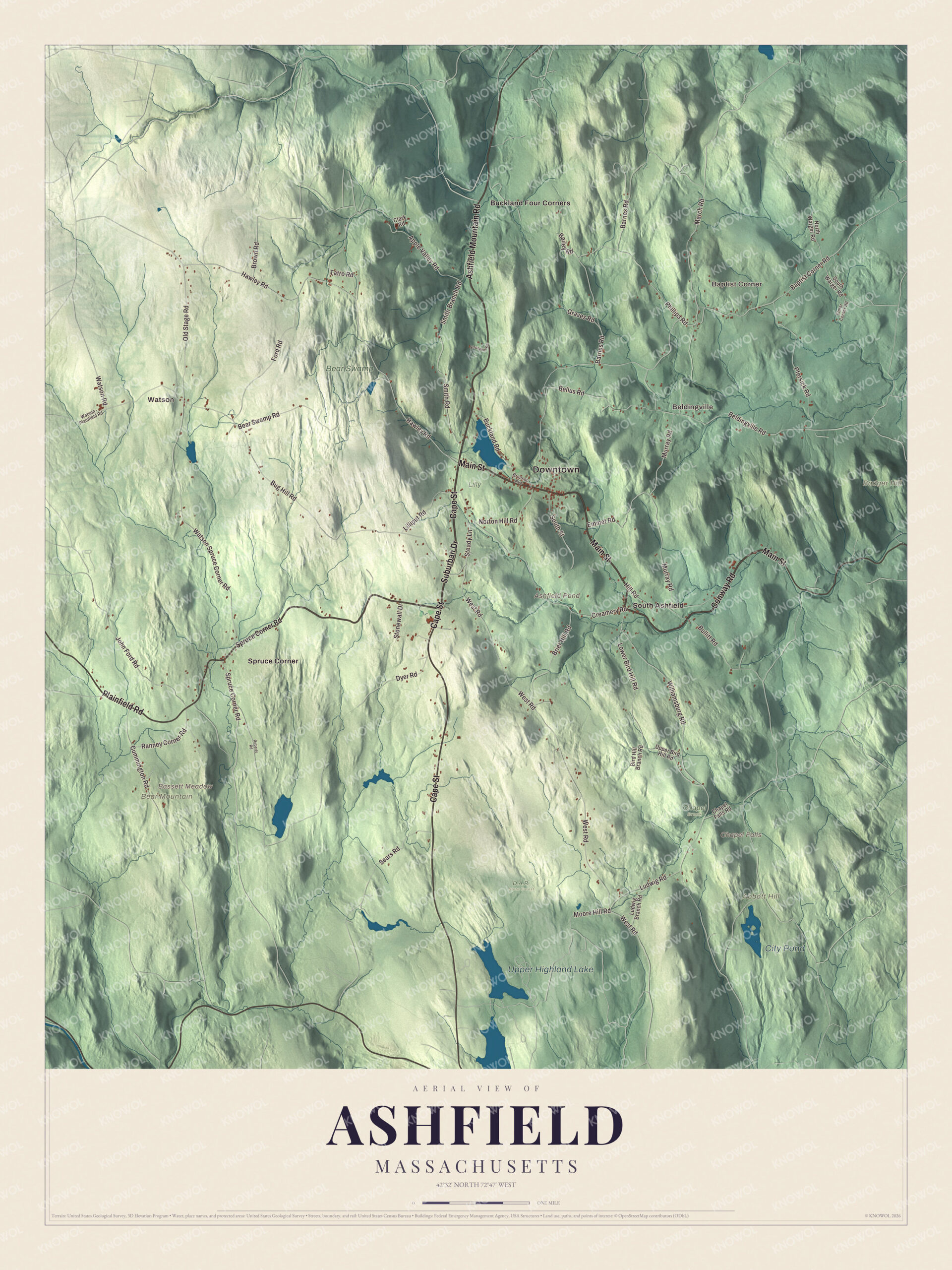
Ashfield today
By KNOWOL
Shaded hills from Bear Mountain, Abbott Hill and Badger Hill down to Ashfield Pond and Bassett Meadow, with Main Street, Cape Street, Conway Road, Plainfield Road and Ashfield Mountain Road across town.5
The story of Ashfield
Peppermint and the essence peddlers
About 1812 Samuel Ranney, who had come from Chatham, Connecticut, began raising peppermint and soon had a small still to turn it into oil. His neighbors followed. By 1821 there were five distilleries in town and by 1830 ten, cooking down spearmint, hemlock, spruce, tansy and wintergreen too. A letter of 1824 put the peppermint oil at over $40,000 a year. The oils became essences, and young men carried them off on a neck yoke, a basket of essences on one side and a tin trunk of Yankee notions on the other. The town's 1910 history says few young men here hadn't tried it. Then word came back that peppermint grew better around Phelps, New York, and many leading families moved there.26
The Baptists who went to the King
When Huntstown became Ashfield in 1765, the grant said settlers had to support a Congregational minister. Twelve of the seventeen families were Baptists with their own church at Baptist Corner, and they refused to pay. A 1768 law tied the tax to the land itself, and their goods were seized. The Baptists petitioned the General Court and lost. Then Samuel Stennett, a Baptist minister in London, carried their case to the King. On July 31, 1771, George III and his Privy Council disallowed the Ashfield act. Elder Ebenezer Smith said only three people in America knew the appeal had been made. The Baptist church records put it plainly: they were set at liberty and their lands restored.7
A small academy with famous friends
Rev. Alvan Sanderson left the pulpit in poor health and opened Sanderson Academy in 1816. He died a year later and left about $1,500 to keep it going. In 1817 the school hired Elihu Burritt to teach and took in Mary Lyon as a pupil; she came back to teach and was principal for terms in 1827 and 1828. By the 1870s the school had faded, and two summer residents, Charles Eliot Norton and George William Curtis, set out to revive it. They started the Academy dinners in 1879, with speakers like William Dean Howells. Townspeople gave the food and paid a dollar a plate. Twenty-five dinners and the fairs raised about $7,400.89
Through the years
25 moments from 1690 to today.
- 1690Captain Ephraim Hunt's men serve on the expedition to Canada; sixty of them later get this land for it.1
- 1739Heber, a freed man, draws lot number one, and later settles on it as the first settler.1
- 1743The first grist mill goes up on Pond Brook to grind meal for the first settlers.10
- 1745Richard Ellis, an Irish immigrant from Easton, makes the first permanent settlement.1
- 1763Heber Honestman joins the church in Ashfield.11
- 1765Huntstown is incorporated as the town of Ashfield.1
- 1768A new law confirms the tax for the Congregational minister, and Baptists who refuse to pay have their goods seized.7
- 1771King George III and his Privy Council disallow the Ashfield act, and the Baptists' lands are restored.7
- 1812About this year Samuel Ranney starts raising peppermint and soon builds a small distillery.2
- 1816Rev. Alvan Sanderson founds Sanderson Academy.8
- 1817Mary Lyon enters Sanderson Academy as a pupil; she later teaches there.8
- 1824A letter puts the town's yearly peppermint oil at over $40,000.6
- 1830Ten distilleries are running in town, making peppermint, spearmint, tansy and wintergreen oils.2
- 1845Women in town make $12,000 worth of linen shirt bosoms and collars in a year.6
- 1849Hosea Blake of the Free Soil party wins the seat in the legislature by one vote, and the Old Swivel cannon is fired in celebration.12
- 1865Ashfield marks its hundredth year with a dinner for six hundred in a tent on the Plain.13
- 1866The Ashfield Library Association is formed with help from summer residents Charles Eliot Norton and George William Curtis.1
- 1870The town buys the Congregational meetinghouse and makes it the town hall.14
- 1878A freshet sweeps away mills on the town's streams, including the Williams sawmill at Spruce Corner.15
- 1879The first Ashfield Academy dinner is held on September 11 to raise money for the school.9
- 1880The Ashfield Cooperative Creamery Association is formed.16
- 1881Cecil B. DeMille is born in Ashfield while his parents are vacationing here.1
- 1903The twenty-fifth and last Academy dinner is held.9
- 1913M. M. Belding gives the town the Belding Memorial Library building.1
- 1991The Ashfield Plain Historic District is listed on the National Register.14
Places to see
Places worth a visit in Ashfield today.
- Ashfield LakeNear the town center. Feeds the South River.
- Belding Memorial LibraryTown center. M. M. Belding's gift of 1913.Visit their website
- Town HallMain Street. The old meetinghouse, a town hall since 1870.
- Baptist CornerNorth of the Plain. Home of the Baptists who appealed to the King.
- BeldingvilleNorthern Ashfield. Historic neighborhood in the north.
- South AshfieldSouth of the center. Mill village, rival keeper of the Old Swivel.
- Spruce CornerRoad to Watson. Where a sawmill stood until 1878.
- Bear MountainAshfield hills. One of the town's high hills.
- Daughters of the American Revolution State ForestSouthwest corner. State forest reaching in from Goshen.Visit their website
- Poland Brook Wildlife Management AreaSouthwest corner. State wildlife land along the town line.
On the National Register
All 1 places in Ashfield on the National Register of Historic Places that still stand today, oldest first, and why each one matters.4
-
Ashfield Plain Historic District
The village center on the Plain, the town's civic and commercial heart since the late 1700s, mostly wood-frame houses and stores of the late 1800s and early 1900s. It takes in the Town Hall, built in the 1810s for the First Congregational Church, moved half a mile down a steep hill and sold to the town in 1870.14
In their words
“In Oct. 1771, We were set at liberty by the King of Great Britain and our lands restored.”
The records of Ashfield's Baptist Church, quoted in History of the town of Ashfield, 19107
“Money flowed into the town in many and large currents”
Dr. William P. Paine on the essence trade, in History of the town of Ashfield, 19102
“I do not believe there ever was another schoolhouse like it in this world.”
Architect Eugene C. Gardner on Ashfield's Round School, in History of the town of Ashfield, 191017
Nearby towns
Sources
- Ashfield, Massachusetts, Wikipedia
- History of the town of Ashfield, Franklin County, Massachusetts (1910), on peppermint and the essence trade, Internet Archive
- History of the town of Ashfield, Franklin County, Massachusetts (1910), on population, Internet Archive
- National Register of Historic Places listings in Franklin County, Massachusetts, Wikipedia
- Map of Ashfield, Massachusetts in 2026, KNOWOL (USGS elevation, Census Bureau roads)
- History of the town of Ashfield, Franklin County, Massachusetts (1910), on the town's products, Internet Archive
- History of the town of Ashfield, Franklin County, Massachusetts (1910), on the Baptist troubles, Internet Archive
- History of the town of Ashfield, Franklin County, Massachusetts (1910), on Sanderson Academy, Internet Archive
- History of the town of Ashfield, Franklin County, Massachusetts (1910), on the Academy dinners, Internet Archive
- History of the town of Ashfield, Franklin County, Massachusetts (1910), on early roads and the first mill, Internet Archive
- History of the town of Ashfield, Franklin County, Massachusetts (1910), on the first settlers, Internet Archive
- History of the town of Ashfield, Franklin County, Massachusetts (1910), on the 1849 election, Internet Archive
- History of the town of Ashfield, Franklin County, Massachusetts (1910), on the 1865 centennial, Internet Archive
- Ashfield Plain Historic District, Wikipedia
- History of the town of Ashfield, Franklin County, Massachusetts (1910), on mills and the freshet of 1878, Internet Archive
- History of the town of Ashfield, Franklin County, Massachusetts (1910), on the creamery, Internet Archive
- History of the town of Ashfield, Franklin County, Massachusetts (1910), on the Round School, Internet Archive