
A hill town in Windham County, incorporated in 1714, where Washington spent a Sunday at a tavern, Thomas Knowlton raised the men who held the rail fence at Bunker Hill, and Westford once made amber glass bottles.
Ashford on the map
Click the map to look closer.
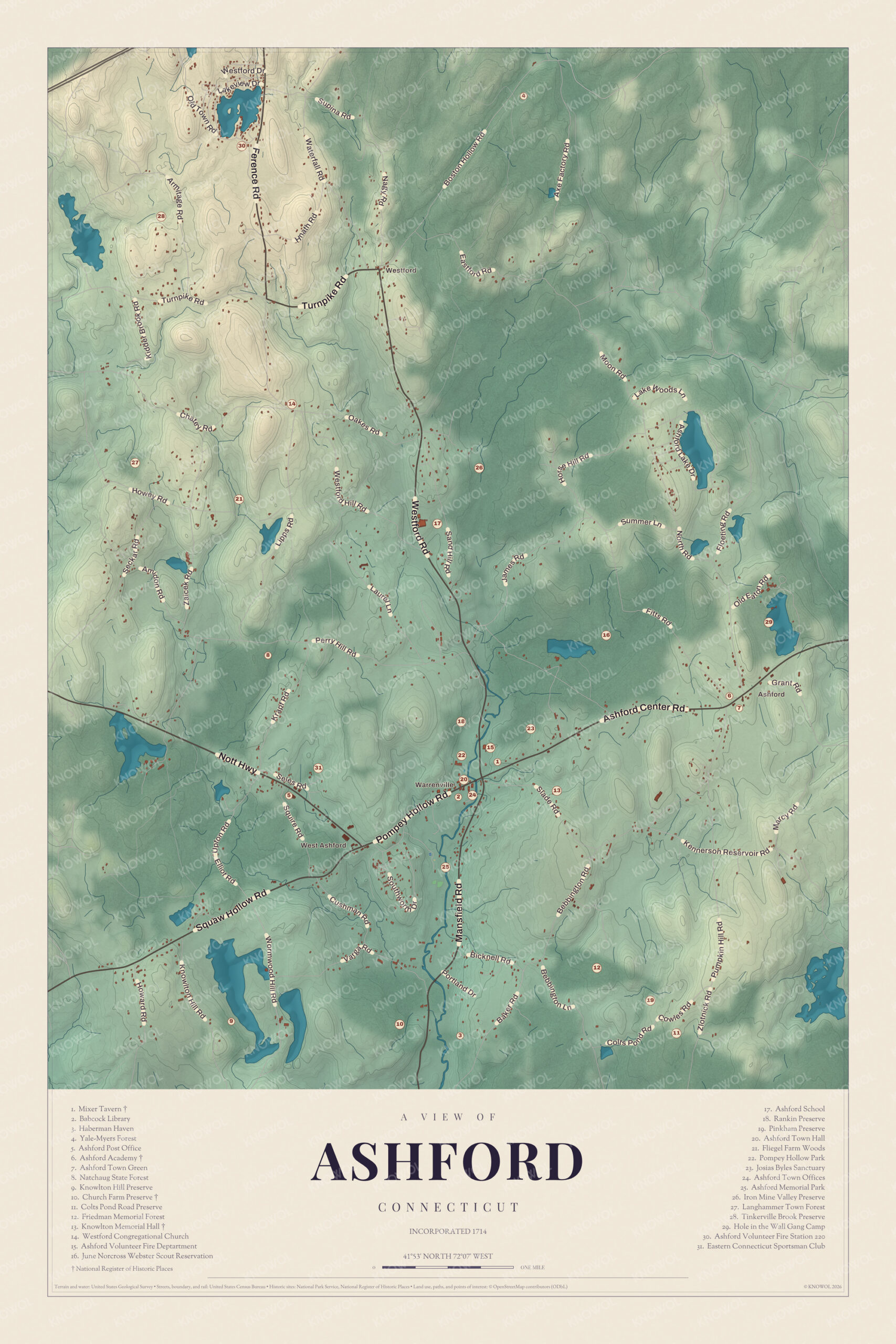
Ashford today
By KNOWOL
Shaded hills from elevation data, Lake Chaffee drawn to its true shape, the villages of Warrenville, Westford, West Ashford and Ashford, and a guide of 31 numbered landmarks with the National Register sites marked.4
The story of Ashford
Amber bottles from Westford
Westford, up in the north of town, was called Richmondville for years, after Michael Richmond, a saddler everyone knew as Squire Richmond. He made gun caps, shipped shoes to New York City, turned out wooden dishes at the Smith mill, and made axes at a shop at the end of Boston Hollow that was still called the axe factory in 1920. In 1854 he and others organized the Westford Glass Works. Edwin A. Buck, born in Ashford in 1832, bought the glass company at a bankrupt sale in 1865, and it gave work to about 150 men. Its quart bottles were called amber wines. Nathan Mathews, who mixed the glass, never wrote his formula down, and when he died the secret died with him.526
A brewer's gift of books and music
Archibald Babcock grew up in Ashford, moved to Charlestown, Massachusetts, and became a wealthy brewer. In 1863 he left the town $6,000. Half the income was for a library and half for band music, and if Ashford ever went without a band, the money was to hire one from outside town to come and play where people could hear it. The library opened about 1866 in the Warrenville store with about a hundred books. By 1889 it held 2,200 volumes, and the librarian had built a room onto his own house to hold them. The Babcock Cornet Band was still a popular institution in 1920. When Knowlton Memorial Hall opened in 1924, the library upstairs carried the Babcock name, and Ashford's own Babcock Band played the dedication concert.7894
Washington's Sunday in Ashford
On Saturday, November 7, 1789, President Washington came west through Pomfret on his presidential tour. No one in Ashford knew he was coming, so only people who happened to be along the road got a look at him. He stopped at Perkins' tavern and stayed over the Sabbath, since the law didn't allow hiring a carriage on Sunday. In his diary he called the tavern not a good one. Ashford knew a thing or two about taverns. John Mixer, who bought land here in 1710, was the first tavern keeper chosen by town vote, and town meetings often adjourned to his place to finish their business. By about 1751 Theophilus Clark had opened what was long known as the Clark Tavern on Ashford Green.10111412
Through the years
21 moments from 1706 to today.
- 1706The colony lays out Ashford as a township six miles square, west of Pomfret and north of Mansfield.13
- 1710John Mixer buys 100 acres and applies for a license to keep a tavern.14
- 1714Ashford is incorporated as a town.1
- 1718The town votes to build its meetinghouse on Pine Hill, and every man who skips the raising owes a five shilling fine.15
- 1739Elijah Whiton is paid thirteen pounds for two months of keeping school.16
- 1751About now Theophilus Clark opens what was long known as the Clark Tavern on Ashford Green.12
- 1767Westford raises its first meetinghouse, and the society votes a barrel of rum and 100 pounds of sugar for the raising.17
- 1775Captain Thomas Knowlton and his Ashford company help hold the rail fence at Bunker Hill.18
- 1776Knowlton is killed leading his men at Harlem Heights, and Washington says he would have been an honor to any country.18
- 1789President Washington spends a Sunday at Perkins' tavern in Ashford and calls it not a good one.10
- 1818Ashford counts eight stores, six grain mills, nine sawmills and five tanneries.19
- 1821Zalmon Aspinwall builds the Federal farmhouse now known as Church Farm.20
- 1825Ashford Academy is built, a school until 1949.21
- 1847Eastford splits off to become a town of its own.1
- 1854Michael Richmond and others organize the Westford Glass Works.5
- 1863Archibald Babcock leaves Ashford $6,000 for a library and a band.7
- 1865Edwin A. Buck buys the Westford Glass Company at a bankrupt sale and goes on making glass.2
- 1866The Babcock Library opens in the Warrenville store with about a hundred books.8
- 1924Knowlton Memorial Hall opens as the town hall and library.22
- 1951Ashford School is built to replace the old Ashford Academy schoolhouse.1
- 1988Paul Newman's Hole in the Wall Gang Camp opens in Ashford.1
Places to see
The numbers match the landmark guide printed on the 2026 map.
- 1Mixer TavernWarrenville. John Mixer's tavern site from 1710.
- 2Babcock LibraryAshford. Named for Archibald Babcock's gift.Visit their website
- 4Yale-Myers ForestNortheast. Yale's research forest.
- 6Ashford AcademyAshford village. Schoolhouse of 1825 by the green.
- 7Ashford Town GreenAshford village. The old center beside the Academy.
- 10Church Farm PreserveMansfield Road. Named for the Church family farm.
- 13Knowlton Memorial HallTown Hall Road. Fieldstone town hall of 1924.
- 14Westford Congregational ChurchWestford. Church of the northern village.
- 16June Norcross Webster Scout ReservationAshford. Connecticut's largest Boy Scout camp.
- 29Hole in the Wall Gang CampEast of town. Paul Newman's camp for sick children.
On the National Register
All 4 places in Ashford on the National Register of Historic Places that still stand today, oldest first, and why each one matters.3
-
Mixer Tavern
John Mixer bought the land in 1710 and applied for a tavern license. It served travelers into the early 20th century and keeps rare tavern features, including a walk-in storage vault built into the chimney.14
-
Church Farm
A remarkably elegant Federal farmhouse for so rural a spot, built by Zalmon Aspinwall. His son-in-law John Church raised sheep and made cheese on 135 acres, and later generations kept the place as a country retreat.20
-
Ashford Academy
Believed to be the town's oldest public building, it was a school until 1949. Its fine Federal detailing is unusual for a schoolhouse of its day.21
-
Knowlton Memorial Hall
Charles Knowlton, an Ashford native who made his fortune in textiles, gave this fieldstone hall to the town in honor of his father and his ancestor Thomas Knowlton. It gave Ashford a well-defined town center again, with town offices, a library and an auditorium for town meetings.22
In their words
“He was an intrepid soldier, an ardent whig, a true patriot and a worthy citizen.”
A gazetteer of the states of Connecticut and Rhode-Island, 1819, on Col. Thomas Knowlton23
“When its head is in the clouds, the storm is not over yet.”
A modern history of Windham County, 1920, on Old Storm Mountain, seen from Westford Hill24
“Its character is that of a quiet, moral town, mostly interested in farming.”
Historic gleanings in Windham County, 189913
Nearby towns
Sources
- Ashford, Connecticut, Wikipedia
- Representative men of Connecticut, 1861-1894 (1894), on Edwin A. Buck, Internet Archive
- National Register of Historic Places listings in Windham County, Connecticut, Wikipedia
- Map of Ashford, Connecticut in 2026, KNOWOL (USGS elevation, Census Bureau roads)
- A modern history of Windham County, Connecticut (1920), on Michael Richmond of Westford, Internet Archive
- A modern history of Windham County, Connecticut (1920), on Nathan Mathews of the Westford glass works, Internet Archive
- A modern history of Windham County, Connecticut (1920), on Westford home industries and the Babcock gift, Internet Archive
- History of Windham County, Connecticut (1889), on the Babcock Library and band, Internet Archive
- A modern history of Windham County, Connecticut (1920), on the Babcock Library, Internet Archive
- History of Windham County, Connecticut (1889), on Washington's visit, Internet Archive
- History of Windham County, Connecticut (1874), on early Ashford and John Mixer, Internet Archive
- History of Windham County, Connecticut (1874), on Timothy Allen and the Clark Tavern, Internet Archive
- Historic gleanings in Windham County, Connecticut (1899), Internet Archive
- Mixer Tavern, Wikipedia
- History of Windham County, Connecticut (1874), on the first meetinghouse, Internet Archive
- Genealogical and biographical record of New London County, Connecticut (1905), on Elijah Whiton, Internet Archive
- A modern history of Windham County, Connecticut (1920), on the Westford meetinghouse, Internet Archive
- Connecticut as a colony and as a state (1904), on Thomas Knowlton, Internet Archive
- A modern history of Windham County, Connecticut (1920), on Ashford's turnpikes and trades, Internet Archive
- Church Farm, Wikipedia
- Ashford Academy, Wikipedia
- Knowlton Memorial Hall, Wikipedia
- A gazetteer of the states of Connecticut and Rhode-Island (1819), Internet Archive
- A modern history of Windham County, Connecticut (1920), on Westford Hill, Internet Archive