
A Nashua River mill town that split from Lancaster in 1850, where Erastus Bigelow's power looms wove coach lace, gingham, Brussels carpet and wire cloth, and where the Wachusett Dam holds back greater Boston's great reservoir.
Clinton then and now
The same town 150 years apart. Click either map to look closer.
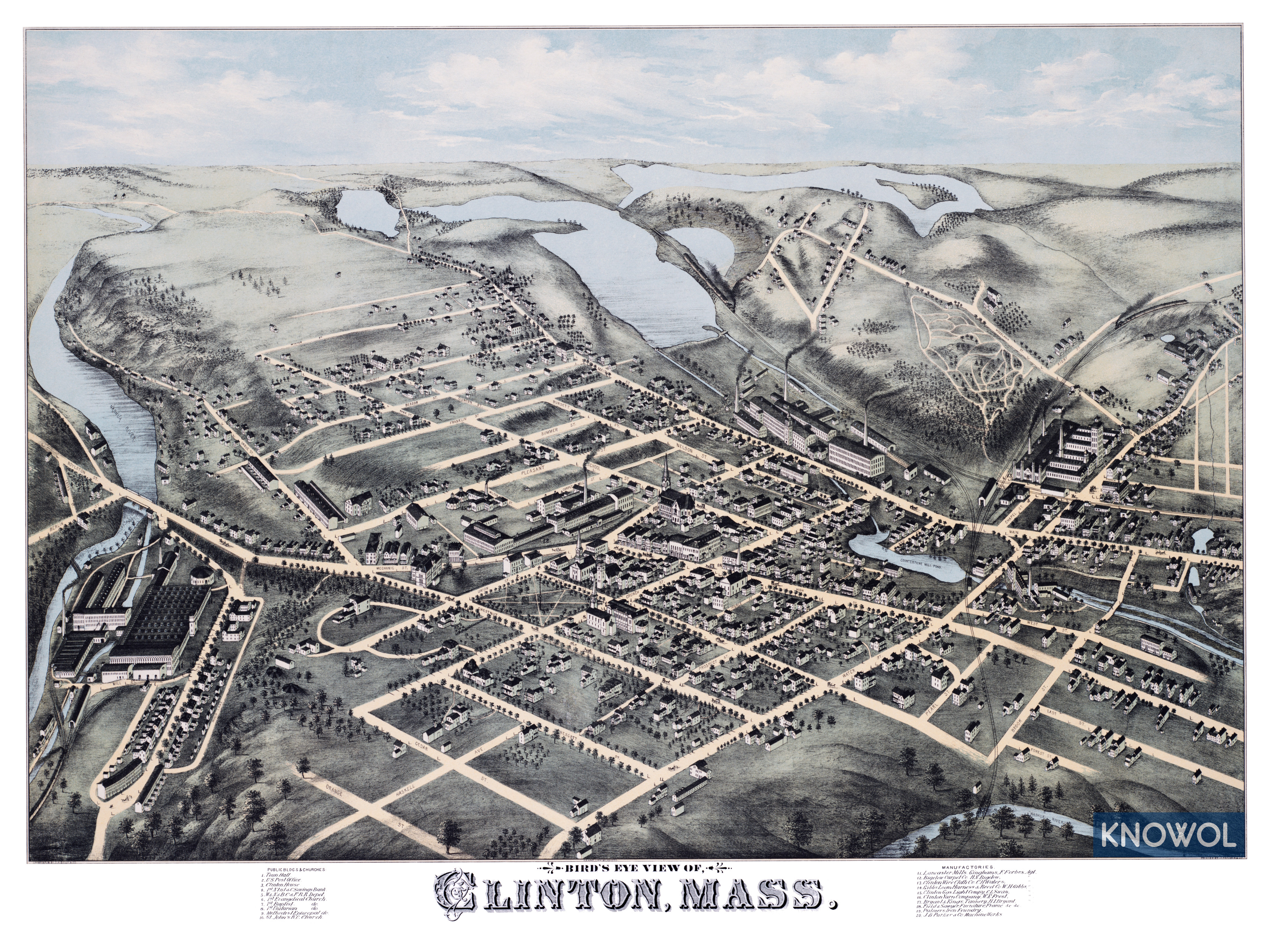
The bird's-eye view
By O. H. Bailey
Clinton drawn as if from the sky in 1876, with street names and old landmarks: the Town Hall, the Clinton House, the Lancaster Mills, the Bigelow Carpet Company, the Clinton Wire Cloth Company, the Gibbs Loom, Harness and Reed Company, the Clinton Gas Light Company, the Clinton Yarn Company, Bryant and King's tannery, Field and Sawyer's furniture works and Palmer's iron foundry.5
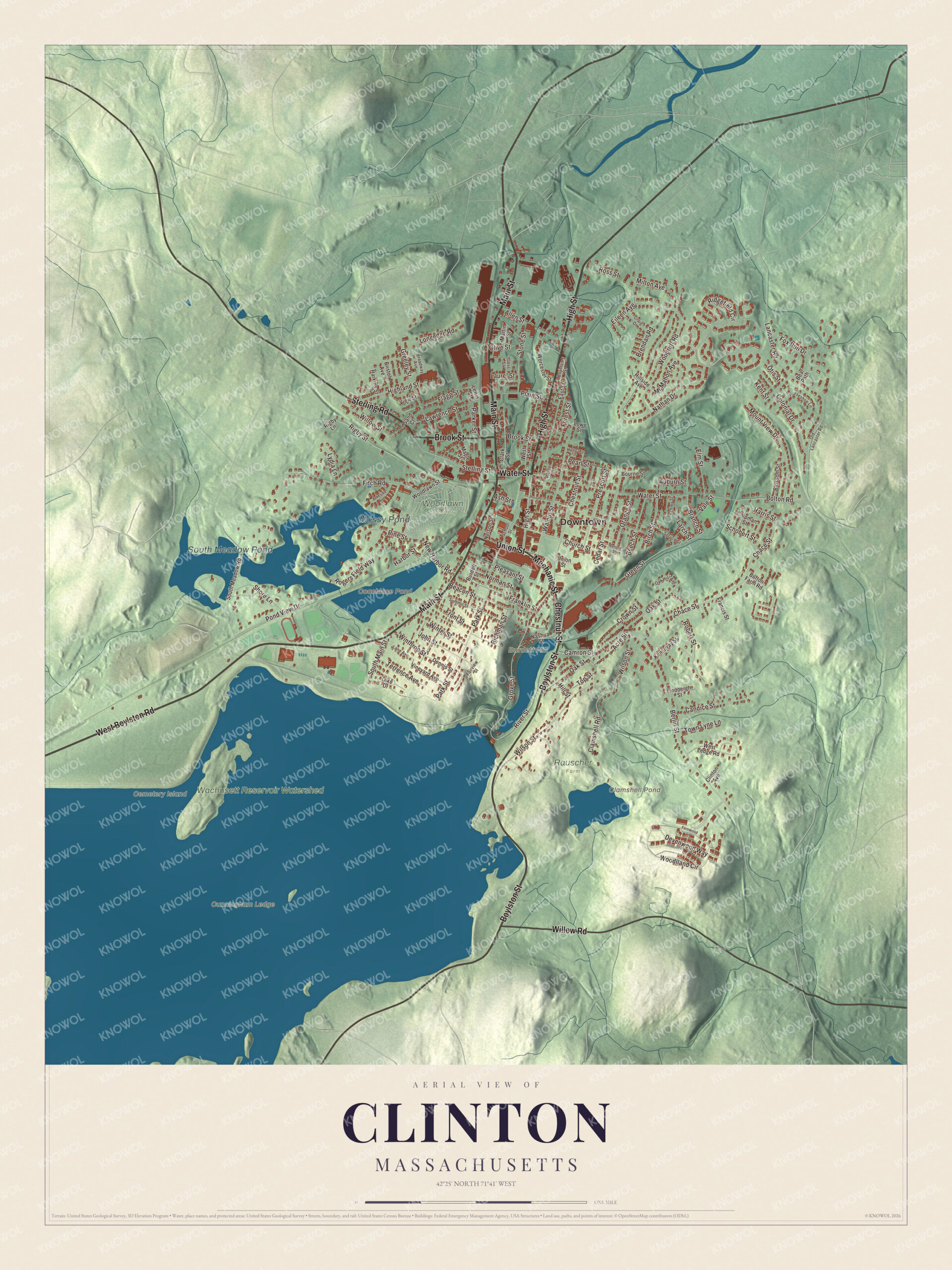
Clinton today
By KNOWOL
The compact mill town on the Nashua River, with Main Street, High Street, Water Street, Sterling Road, Boylston Street and West Boylston Road, the Wachusett Reservoir to the south, and South Meadow Pond, Mossy Pond, Clamshell Pond, Coachlace Pond, Burdett Hill and Cemetery Island.6
The history of Clinton, Massachusetts
From Prescott's mill to a town of its own
In 1654 John Prescott, Lancaster's blacksmith, finished a log corn mill on the brook near today's Water Street. Clinton's 1896 history calls it the first grist mill within the present limits of Worcester County, and says the industrial history of Clinton began with its first kernel of corn. For almost two centuries this was just the south end of Lancaster. Horn combs were pressed in little shops and farm sheds, and in 1809 Poignand and Plant bought the old Prescott mills and began making cotton goods, until people called the place the Factory Village. Then the Bigelow brothers came, and the village grew faster than the old town wanted to spend. In October 1849 its people voted to go their own way, with only one vote against. Clinton became a town on March 14, 1850.27891
The Bigelow looms
Erastus B. Bigelow built a power loom for coach lace and set it up here in the late 1830s. He wrote that it cut the cost of weaving coach lace from twenty-two cents a yard to three. The company took its name from New York's Clinton House hotel, and the village took the company's. His gingham looms filled the Lancaster Mills, whose six-hundred-loom weaving room was the largest in the United States. With Brussels carpet, one woman at his power loom could weave as much as ten men and ten boys by hand. In 1856 his wire loom started the Clinton Wire Cloth Company, the first to weave wire by power with success, for window screens, corn poppers and sieve bottoms. By 1889 it claimed to be the largest maker of woven wire goods in the world.10111213143
The day Mossy Pond broke loose
In March 1876 a heavy snow and then a hard rain swelled the Bigelow Carpet Company's reservoir higher than anyone had seen it. On Sunday, March 26, water began to slip over a sand embankment on the north side of Mossy Pond, and in moments it cut a deep channel. The flood burst a railroad bank forty feet high and tore through Bryant and King's tannery, which had employed 125 men, carrying off buildings and thousands of hides. It crossed Sterling Street and Main Street and smashed the old comb shops. The Boyce brothers' three-story braid factory was lifted off its dam and carried upright into the Nashua. The tannery never came back, and the comb and braid works were never rebuilt. KNOWOL's restored 1876 view of Clinton still shows Bryant and King's tannery.15165
Clinton, Massachusetts through the years
24 moments from 1643 to today.
- 1643Sachem Sholan of the Nashaway deeds the land that becomes Lancaster, and later Clinton.1
- 1654John Prescott's corn mill, the first grist mill in today's Worcester County, begins grinding.2
- 1808Nathaniel Lowe starts making horn combs in his little shop near High and Water Streets.7
- 1809Poignand and Plant buy the old Prescott mills, and the place becomes known as the Factory Village.8
- 1838The Clinton Company is chartered to weave coach lace, named by E. B. Bigelow for New York's Clinton House.10
- 1844A group led by the Bigelow brothers founds the Lancaster Mills, the first major gingham mill.17
- 1846The Lancaster Courant, the village weekly, prints its first number on July 4.18
- 1848Emerson, Greeley and Thoreau are among the lecturers of the Bigelow Mechanics' Institute.19
- 1849On October 29 the village votes, with one person against, to split from Lancaster.9
- 1850Clinton is incorporated as a town on March 14.1
- 1853Joshua Thissell lays out Woodlawn Cemetery, one of the new town's first projects.20
- 1854The first business message comes over Clinton's new telegraph wires on September 23.21
- 1856The Clinton Wire Cloth Company becomes the first to weave wire cloth by power with success.14
- 1861On March 4 the town votes $1,000 for the Clinton Light Guard, the first Massachusetts town to fund troops before a call.22
- 1873The public library opens.1
- 1876On March 26 the Mossy Pond embankment washes out, and the flood wrecks a tannery, comb shops and a braid mill.15
- 1878Fuller Field is laid out; Clinton claims it as the oldest baseball field in continuous use in the world.1
- 1889The wire cloth company claims to be the largest maker of woven wire goods in the world.3
- 1893The Clinton Daily Item, the town's first daily paper, comes out on July 17.23
- 1896The state takes the Nashua's south branch for Boston's water, and about a square mile of Clinton is expected to go under.24
- 1897Work begins on the Wachusett Dam.25
- 1902Visitors to the works see where a trestle 130 feet high, the highest railway in New England, will cross the gorge.26
- 1905The Wachusett Dam is finished.25
- 1908The Wachusett Reservoir fills, covering a large part of Clinton and its neighbors.1
Places to see in Clinton, Massachusetts
Places worth a visit in Clinton today.
- Downtown ClintonHigh and Church Streets. Business blocks from 1840 to the 1920s.
- Central ParkDowntown, facing the library. Green park at the center of town.
- Bigelow Free Public Library54 Walnut Street. Began as the 1846 Mechanics' Institute.Visit their website
- Bigelow Carpet MillUnion and High Streets. Carpet looms from 1849, now Nypro.
- Fuller FieldThe town ball field. Baseball played here since 1878.
- Wachusett DamSouth of the town center. Built 1897 to 1905 for Boston's water.
- Wachusett ReservoirSouth of the town center. Second largest body of water in Massachusetts.
- Cemetery IslandOut in the reservoir. Its old graves were moved to Lancaster.
- Clamshell PondEast of the Nashua. Named for its shape, or its mussels.
- Coachlace PondWest of Burdett Hill. The old Clinton Mill Pond.
Clinton on the National Register of Historic Places
All 11 places in Clinton on the National Register of Historic Places that still stand today, oldest first, and why each one matters.4
-
Downtown Clinton Historic District
Clinton's downtown along High Street, with buildings on Church Street, grew up between about 1840 and the 1920s, Italianate at first and Colonial Revival later. The Brimhall Building at 92-116 High Street, from 1857, is one of its oldest.27
-
Lancaster Mills
Founded in 1844 by a group led by Erastus and Horatio Bigelow, the Lancaster Mills were the first major mill to make gingham, and their success led to Clinton's split from Lancaster. William T. Merrifield of Worcester built the mills and the tenements beside them from 1844 to 1848.17
-
Woodlawn Cemetery
Laid out in 1853 by Joshua Thissell in the rural cemetery style, it was one of the new town's first public projects, and it now covers more than 33 hilly acres. Erastus and Horatio Bigelow are buried here.20
-
Bigelow Carpet Mill
Erastus and Horatio Bigelow began weaving Brussels carpet in an older building here in 1849, and the oldest surviving building dates to 1855. Enlarged again and again until 1922, it grew into one of the world's major early automated carpet mills, and it's now Nypro's headquarters.28
-
Clinton Wire Cloth Company Historic District
The Clinton Wire Cloth Company, incorporated in 1856 to work E. B. Bigelow's power loom for wire, was the first to make wire cloth by power with success, the town's 1896 history says. By 1889 it claimed to be the largest maker of woven wire goods in the world. The district takes in its works on Sterling and Parker Streets.14
-
Bigelow Carpet Company Woolen Mills
Erastus and Horatio Bigelow began work here in 1837 in a wood-frame mill that may date to about 1810, which was still part of the complex at its listing in 1983, beside eight brick mills built from 1858 to 1898, one with an ornate five-story tower. The Bigelow Carpet Company ran the plant until a 1929 merger closed it a few years later; it now holds apartments and small businesses.29
-
Bowers School
A school stood on this lot from 1847, when it was still part of Lancaster. This two-story brick schoolhouse was built in 1892 to a design by the local architect Joshua Thissell, became a model for the town's other schools, and was named for Rev. Charles Manning Bowers of the school committee. It now holds homes.30
-
Wachusett Dam Historic District
Built from 1897 to 1905 to hold back the Nashua River for greater Boston's water, it made the Wachusett Reservoir, then the largest public water supply reservoir in the world, and was then the largest gravity dam in the world. It's still called the largest hand-dug dam in the world.25
-
Corcoran School
Built in 1900 to a design by the Boston architect Charles J. Bateman, it was the largest of Clinton's primary schools, with eight classrooms and an assembly hall on the third floor. It was named in 1918 for John Corcoran of the school committee, taught children until 1980, and now holds homes.31
-
First Methodist Church
Begun in 1927 to a design by Woodbury and Stuart of Boston, for a congregation founded in 1830, the stone church was never finished for lack of money. The congregation worshipped in its community center until the 1980s, and the building now holds homes and offices.32
-
Wachusett Aqueduct Linear District
A 9-mile aqueduct, mostly underground, that carries water from the Wachusett Reservoir in Clinton through Berlin and Northborough to the treatment plant at Walnut Hill in Marlborough. It was the main line from the reservoir until the Cosgrove Tunnel replaced it in 1965, and it's now a backup.33
Clinton in their words
“The town may well glory in the fact that it was the foremost town in the foremost state to take financial measures to support the government.”
History of the origin of the town of Clinton, 1896, on the town's vote for its Light Guard in March 186134
“Clinton, the youngest daughter of old [Lancaster,] her teeming industries, led by millions of flying spindles, have enabled her to far outstrip the mother towns and all the family circle in population, wealth and resources.”
A toast to Clinton at Boylston's centennial, 188635
“The growth in wealth, in culture, and in influence among our citizens of Irish descent during the last thirty years, is the most remarkable fact in the history of our town”
History of the origin of the town of Clinton, 189636
Towns near Clinton, Massachusetts
Sources for the history of Clinton
- Clinton, Massachusetts, Wikipedia
- History of the origin of the town of Clinton, Massachusetts, 1653-1865 (1896), on John Prescott's corn mill, Internet Archive
- History of Worcester County, Massachusetts (1889), on the Clinton Wire Cloth Company, Internet Archive
- National Register of Historic Places listings in Worcester County, Massachusetts, Wikipedia
- Beautifully restored map of Clinton, MA from 1876, restored by KNOWOL
- Map of Clinton, Massachusetts in 2026, KNOWOL
- History of the origin of the town of Clinton, Massachusetts, 1653-1865 (1896), on the early comb makers, Internet Archive
- History of the origin of the town of Clinton, Massachusetts, 1653-1865 (1896), on the first cotton mill, Internet Archive
- History of the origin of the town of Clinton, Massachusetts, 1653-1865 (1896), on the incorporation of Clinton, Internet Archive
- History of the origin of the town of Clinton, Massachusetts, 1653-1865 (1896), on the Clinton Company and its name, Internet Archive
- History of the origin of the town of Clinton, Massachusetts, 1653-1865 (1896), on the founding of the Lancaster Mills, Internet Archive
- History of Worcester County, Massachusetts (1889), on the Lancaster Mills, Internet Archive
- History of the origin of the town of Clinton, Massachusetts, 1653-1865 (1896), on E. B. Bigelow's carpet looms, Internet Archive
- History of the origin of the town of Clinton, Massachusetts, 1653-1865 (1896), on the Clinton Wire Cloth Company, Internet Archive
- History of Worcester County, Massachusetts (1879), on the Mossy Pond disaster of 1876, Internet Archive
- History of Worcester County, Massachusetts (1889), on the flood of 1876, Internet Archive
- Lancaster Mills, Wikipedia
- History of Worcester County, Massachusetts (1889), on the Lancaster Courant, Internet Archive
- History of the origin of the town of Clinton, Massachusetts, 1653-1865 (1896), on the Bigelow Mechanics' Institute, Internet Archive
- Woodlawn Cemetery, Wikipedia
- History of Worcester County, Massachusetts (1889), on the telegraph in Clinton, Internet Archive
- The story of the Fifteenth regiment Massachusetts volunteer infantry in the civil war, 1861-1864 (1898), on the Clinton Light Guard, Internet Archive
- Biographical review, containing life sketches of leading citizens of Worcester County, Massachusetts (1899), on the Clinton Daily Item, Internet Archive
- History of the origin of the town of Clinton, Massachusetts, 1653-1865 (1896), on the planned Metropolitan reservoir, Internet Archive
- Wachusett Dam Historic District, Wikipedia
- Proceedings of the Worcester Society of Antiquity for the year 1902, on the excursion to the Metropolitan Water Basin, Internet Archive
- Downtown Clinton Historic District, Wikipedia
- Bigelow Carpet Mill, Wikipedia
- Bigelow Carpet Company Woolen Mills, Wikipedia
- Bowers School, Wikipedia
- Corcoran School, Wikipedia
- First Methodist Church, Wikipedia
- Wachusett Aqueduct Linear District, Wikipedia
- History of the origin of the town of Clinton, Massachusetts, 1653-1865 (1896), on the Clinton Light Guard, Internet Archive
- Centennial celebration of the incorporation of the town of Boylston, Massachusetts, August 18, 1886 (1887), Internet Archive
- History of the origin of the town of Clinton, Massachusetts, 1653-1865 (1896), on the Catholic Church, Internet Archive