
A farming town that began as Lebanon Crank, the parish where Eleazar Wheelock's school on the green grew into Dartmouth College, with a cotton mill at Hop River and a lake made for the mills of Willimantic.
Columbia on the map
Click the map to look closer.
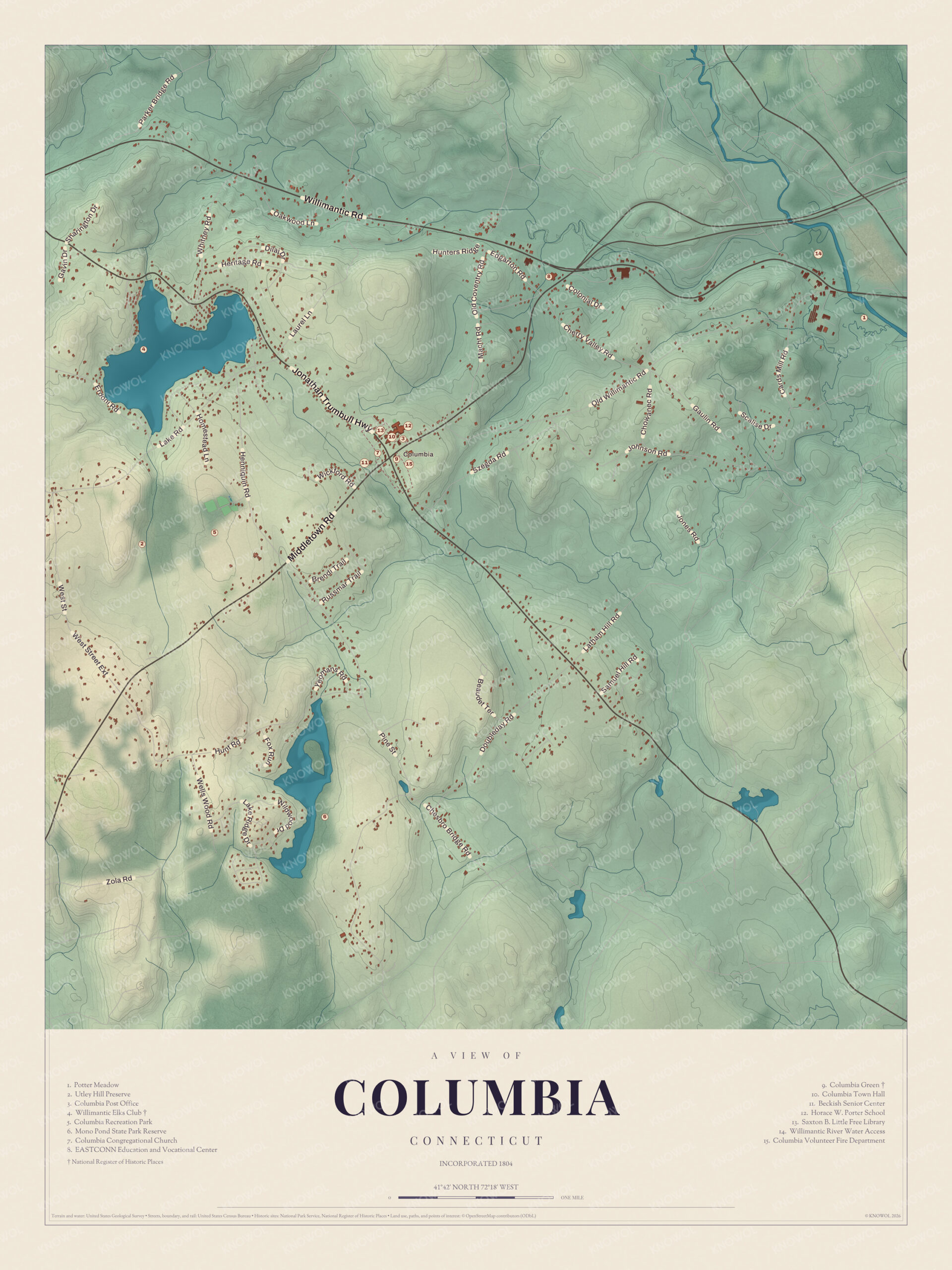
Columbia today
By KNOWOL
Shaded hills out to Chestnut Hill, every street, Columbia Lake and Mono Pond, and a guide of 15 numbered landmarks with the National Register sites marked.5
The story of Columbia
The school on the green
Eleazar Wheelock became pastor of Lebanon Crank in 1735, and in December 1743 he took a young Mohegan scholar, Samson Occom, into his family school. Occom's success gave him a bigger idea. Joshua Moor of Mansfield gave a lot near the center of the parish, and a schoolhouse went up on the corner east of the Hartford road and south of the Willimantic road, with Wheelock's house just across to the north. The first two students, Lenape boys, came in 1754. Money came from two colonial legislatures and from England, two hundred pounds of it from the King. When David McClure rode in late one afternoon in 1764, he found about 30 students, half Native and half English, playing on the green. Wheelock later moved the school to Hanover, New Hampshire, where it grew into Dartmouth College.56789
A meetinghouse the color of the sky
The parish that became Columbia took real care with its meetinghouse. In 1748 it voted to clapboard the south side and the ends in cedar and the back in chestnut, and those boards were still on the building when it came down in 1832, 84 years later. In December 1753 the parish voted to paint the house "sky collour," as the clerk spelled it, and to pave around it with stone. This was a parish of only 170 taxpayers. In 1792 subscribers added a steeple and a bell for $150. David Huntington rang that bell at noon and at nine every night for 36 years, until he died in 1828. Even so, a man who remembered 1816 said the meetinghouse had no heat at all, and families rode to church on horseback.1011
Hop River, hats and a reservoir
Columbia was mostly a farming town, but its streams kept a few trades going. In earlier years the town made cheap woolen hats in good numbers, and some fur hats too. A cotton mill ran at Hop River for more than forty years, and by 1883 it was the Hop River Warp Manufacturing Company, the town's chief industry. A dam went in at Hop River in 1861 and 1862 for Joshua Lord. In 1865 the American Linen Company of Willimantic flooded meadowland to make the reservoir that's now Columbia Lake, and a sketch from 1900 places an old red schoolhouse near its west shore. By 1907 Columbia had 655 people, a paper mill at Hop River, three post offices and a mail wagon that came twice a day.121351415
Through the years
23 moments from 1716 to today.
- 1716A second church society is formed in Lebanon, known as Lebanon North Parish or Lebanon Crank.2
- 1720The Congregational Church is organized and Samuel Smith is ordained its pastor the same day.3
- 1735Eleazar Wheelock becomes pastor of the church at Lebanon Crank.5
- 1743In December Wheelock takes the young Mohegan scholar Samson Occom into his family school.6
- 1748The parish votes to clapboard its new meetinghouse in cedar and chestnut.10
- 1753The parish votes to paint the meetinghouse "sky collour" and pave around it with stone.10
- 1754Wheelock's school opens with two Lenape boys as its first students.7
- 1764Student David McClure arrives and finds about 30 students on the green, half Native and half English.8
- 1772Thomas Brockway becomes pastor and serves until 1807.16
- 1775The Revolution begins; at least 64 men of the parish will serve and 14 will die.3
- 1792A steeple and bell are added to the meetinghouse for $150.10
- 1804Lebanon Crank is set off from Lebanon and incorporated as the town of Columbia.1
- 1816Most houses are unpainted, only two are white, and no house or church in town has a stove.11
- 1821Dwight Loomis, later a congressman and Connecticut Supreme Court judge, is born in Columbia.17
- 1828David Huntington dies after ringing the meetinghouse bell for 36 years.10
- 1832The old meetinghouse comes down, its cedar and chestnut clapboards still on it.10
- 1861A dam is built at Hop River for Joshua Lord.13
- 1865The American Linen Company of Willimantic floods meadowland to make what is now Columbia Lake.5
- 1866The church celebrates the 150th anniversary of the parish on October 24.2
- 1883The Hop River Warp Manufacturing Company is the town's chief industry, and about 800 people live here.12
- 1907Columbia has a paper mill at Hop River, three post offices and a mail wagon twice a day.15
- 1990The Columbia Green Historic District is listed on the National Register.18
- 2008Mono Pond becomes a state park reserve.5
Places to see
The numbers match the landmark guide printed on the 2026 map.
- 2Utley Hill PreserveWest of the green. Open land west of the center.
- 5Columbia Recreation ParkWest of the green. The town's recreation park.
- 6Mono Pond State Park ReserveSouth of town. 218 acres around a shallow pond.
- 7Columbia Congregational ChurchColumbia Green. The church of old Lebanon Crank.Visit their website
- 8EASTCONN Education and Vocational CenterNortheast. Regional education and vocational center.
- 9Columbia GreenCenter of town. The historic green, listed in 1990.
- 10Columbia Town HallColumbia Green. Town offices beside the green.
- 12Horace W. Porter SchoolNear the green. Pre kindergarten through eighth grade.
- 13Saxton B. Little Free LibraryNear the green. The town's free library.Visit their website
- 14Willimantic River Water AccessWillimantic River. A way down to the river.
On the National Register
All 1 places in Columbia on the National Register of Historic Places that still stand today, oldest first, and why each one matters.4
-
Columbia Green Historic District
The town green and 43 historic buildings around it and northwest along Route 87, among them the Congregational Church, the Town Hall and Eleazar Wheelock's house of about 1736. General Rochambeau's officers stayed at the Landmark Inn while they scouted the French army's route from Newport to Yorktown.18
In their words
“The events of which Dr. Wheelock was the central figure and moving spirit, have given to Columbia an eminent name among the towns of Tolland County.”
The historical, statistical and industrial review of the state of Connecticut, 188419
“Mr. Brockway, the pastor of the church, started off with his long gun and deacons and parishioners to assist in doing battle with the enemy.”
The historical, statistical and industrial review of the state of Connecticut, 1884, on hearing that New London was burning3
“The people riding to church on horseback, very often the man with his wife or daughter on a pillion behind him.”
A Columbia man remembering 1816, at the church's 150th anniversary, 186611
Nearby towns
Sources
- Columbia, Connecticut, Wikipedia
- The 150th anniversary of the organization of the Congregational Church in Columbia, Conn., October 24th, 1866 (1867), on the founding of the parish, Internet Archive
- The historical, statistical and industrial review of the state of Connecticut (1884), on Columbia's soldiers and church, Internet Archive
- National Register of Historic Places listings in Tolland County, Connecticut, Wikipedia
- Map of Columbia, Connecticut in 2026, KNOWOL (USGS elevation, Census Bureau roads)
- The 150th anniversary of the organization of the Congregational Church in Columbia, Conn., October 24th, 1866 (1867), on Moor's Charity School, Internet Archive
- A history of Connecticut: its people and institutions (1914), on the Moor Charity School, Internet Archive
- History of Connecticut in monographic form (1925), on David McClure's arrival at Lebanon Crank, Internet Archive
- History of Connecticut in monographic form (1925), on the school's move to Hanover, Internet Archive
- The 150th anniversary of the organization of the Congregational Church in Columbia, Conn., October 24th, 1866 (1867), on the meetinghouse, Internet Archive
- The 150th anniversary of the organization of the Congregational Church in Columbia, Conn., October 24th, 1866 (1867), on Columbia in 1816, Internet Archive
- The historical, statistical and industrial review of the state of Connecticut (1883), on Columbia's industries, Internet Archive
- A modern history of Windham County, Connecticut (1920), on the Hop River dam, Internet Archive
- Year-book of the Connecticut Society of the Sons of the American Revolution (1900), on Mr. Loomer of Hop River, Internet Archive
- Register and manual of the State of Connecticut (1907), on Columbia, Internet Archive
- History of New London County, Connecticut (1882), on the church in Columbia, Internet Archive
- Representative men of Connecticut, 1861-1894 (1894), on Dwight Loomis, Internet Archive
- Columbia Green Historic District, Wikipedia
- The historical, statistical and industrial review of the state of Connecticut (1884), on Lebanon Crank and Dr. Wheelock, Internet Archive