
A hill town on the Housatonic where Ethan Allen spent his boyhood, the Foreign Mission School drew students from Hawaii, Asia and Native nations, and the red covered bridge at the old Hart's Bridge still carries the road across the river.
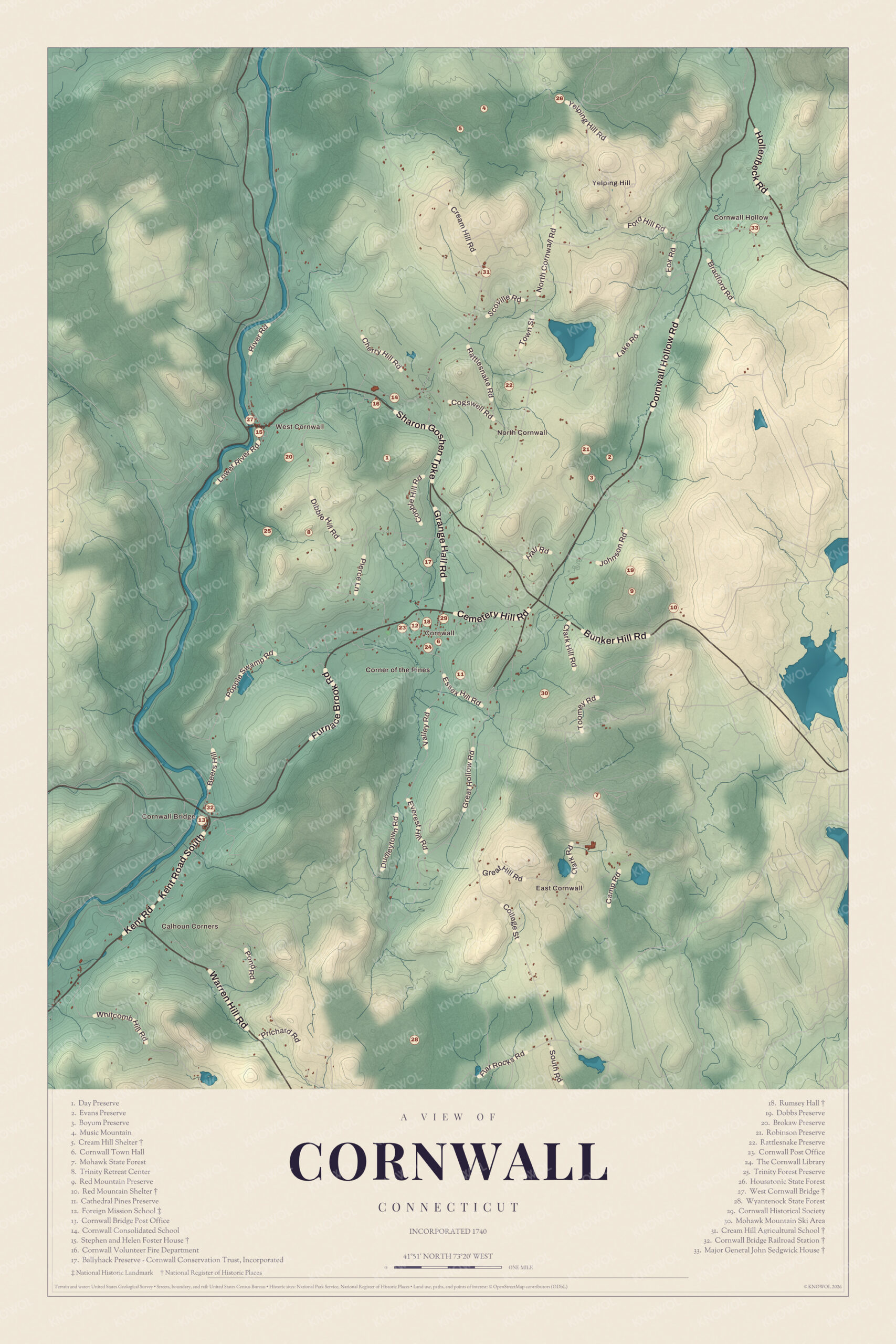
Cornwall on the map
Click the map to look closer.
Cornwall today
By KNOWOL
Shaded hills from Yelping Hill down to Calhoun Corners, every road from Cream Hill Road to Popple Swamp Road, all nine villages and hamlets by name, and a guide of 33 numbered landmarks with the National Historic Landmark and the National Register sites marked.5
The story of Cornwall
Thunder over the Sedgwick farm
The Sedgwicks put down deep roots in Cornwall. During the Revolution, the night after John Sedgwick marched off with a company of men, his house burned, and neighbors cut the timber and built him a new one in three days. His grandson John, born here in 1813, went to West Point and rose to command the Sixth Corps. When the old homestead burned in 1859, he came home on leave to rebuild it, and that Italianate house still stands on Hautboy Hill Road. He was killed at Spotsylvania in May 1864. The family wanted a quiet funeral from the home he loved. Thousands came anyway, his pallbearers were neighbors who'd known him from a boy, and as his body was lowered a peal of thunder rolled like distant artillery.6789
The school by the church
In May 1817 a school opened in Cornwall village to train young men from around the world as missionaries, teachers and translators for their own people. It grew out of the hopes of Henry Opukahaia, a young Hawaiian who had come to New Haven on a ship. He died in Cornwall in February 1818, aged 26, and his stone in the village burying ground says he died with a heavenly smile on his face. By 1820 the school had 29 pupils, 19 of them from Native nations and 6 from the Pacific islands. Support in town cooled, especially after two Cherokee students, John Ridge and Elias Boudinot, married young women from Cornwall, and the school closed in 1826. Its Steward's House still stands and became a National Historic Landmark in 2016.1011124
Hart's Bridge and the shear shop
West Cornwall used to be called Hart's Bridge. Deacon Solomon Hart came in 1764, bought land along the river and built a big white house known as Hart's Tavern. As late as 1820 there was only one house at the bridge. By 1837 a state geologist counted two iron furnaces in the western part of town, run by the Cornwall Iron Company and the Cornwall Bridge Iron Company. In 1856 Joseph Mallinson came over from Yorkshire, made shears on Cream Hill, then moved down to West Cornwall to make nickel-plated and japanned shears and scissors. By 1901 shears and scissors led the town's products. Floods and ice took the bridge more than once, and the red covered bridge there today dates to about 1864.1314151632
Through the years
25 moments from 1738 to today.
- 1738The township is laid out in fifty-three rights, or homesteads, of nearly a square mile each.17
- 1740Cornwall is incorporated, and thirteen families make the first permanent settlements.17
- 1740Joseph Allen buys land in Cornwall and moves here with his small son Ethan, the future hero of Ticonderoga.18
- 1741Rev. Solomon Palmer becomes Cornwall's first minister.17
- 1753Palmer stuns his congregation one Sunday by announcing he has become an Episcopalian, then sails to England for ordination.19
- 1759Ebenezer Dibble marches from Cornwall to the French war and keeps a diary that the village library later preserves.20
- 1764Deacon Solomon Hart settles by the river, and the place that becomes West Cornwall is called Hart's Bridge.13
- 1765About this year Ethan Allen, who spent his youth in Cornwall and Salisbury, leaves for the New Hampshire Grants.21
- 1813John Sedgwick, the future Union general, is born in Cornwall.7
- 1817The Foreign Mission School opens in Cornwall village in May.10
- 1818Henry Opukahaia, the young Hawaiian whose hopes started the school, dies in Cornwall at 26.11
- 1818Cornwall counts twenty sawmills, two forges, and grain, fulling, oil and carding mills.3
- 1820The mission school has 29 pupils, 19 from Native nations and 6 from the Pacific islands.12
- 1826The Foreign Mission School closes.10
- 1837A state geological report lists two iron furnaces in western Cornwall.15
- 1845T. S. Gold and his father found the Cream Hill Agricultural School on their farm.22
- 1847Ambrose S. Rogers opens a boys' school at North Cornwall.23
- 1856Joseph Mallinson arrives from Yorkshire and starts making shears, first on Cream Hill, then in West Cornwall.16
- 1864General Sedgwick is killed at Spotsylvania, and thousands come to his funeral in Cornwall.9
- 1864The present covered bridge at West Cornwall is finished about this year.2
- 1869The Cornwall Library is organized.1
- 1875Swift's Bridge, in the southwest corner of town, is rebuilt in iron for $2,500.24
- 1930The concrete arch bridge at Cornwall Bridge is built over the Housatonic.25
- 1947Walt Schoenknecht opens the Mohawk Mountain Ski Area.5
- 2016The Steward's House of the Foreign Mission School is named a National Historic Landmark.10
Places to see
The numbers match the landmark guide printed on the 2026 map.
- 6Cornwall Town HallCornwall Village. Town business in the village center.
- 10Red Mountain ShelterMohawk State Forest. Log shelter built by CCC crews, 1934.
- 11Cathedral Pines PreserveSouth of the village. Old pines saved by the Calhouns in 1883.Visit their website
- 12Foreign Mission SchoolCornwall Village. National Historic Landmark, opened 1817.
- 24The Cornwall LibraryCornwall Village. Organized in 1869.Visit their website
- 27West Cornwall BridgeWest Cornwall. Red covered bridge of about 1864.
- 30Mohawk Mountain Ski AreaMohawk Mountain. Opened in 1947.
- 31Cream Hill Agricultural SchoolCream Hill Road. Early farm school, 1845 to 1869.
- 32Cornwall Bridge Railroad StationCornwall Bridge. Housatonic Railroad depot of the 1880s.
- 33Major General John Sedgwick HouseHautboy Hill Road. The general's rebuilt family home.
On the National Register
All 8 places in Cornwall on the National Register of Historic Places that still stand today, oldest first, and why each one matters.4
-
Cream Hill Agricultural School
Believed to be the first school in the United States devoted to teaching farming, founded in 1845 by T. S. Gold and his father on their own farm. The farmhouse of about 1770 and the classroom wings of 1845 and 1850 survive, and the land is still farmed.22
-
Steward's House, Foreign Mission School
National Historic Landmark
The remaining building of the Foreign Mission School, which from 1817 to 1826 trained young men from Hawaii, Asia and Native nations as missionaries, teachers and translators. Its students included Henry Opukahaia, John Ridge and Elias Boudinot.10
-
Maj. Gen. John Sedgwick House
General Sedgwick was born in an earlier house on this site, built by his grandfather, a Revolutionary veteran. After that homestead burned in 1859 he took leave to oversee the new house, and the local builder Cyrus Marsh may have designed its rich Italianate trim.8
-
Stephen and Helen Foster House
An Italianate and Italian Villa style house in West Cornwall village, credited to the builder Cyrus William Marsh.26
-
West Cornwall Covered Bridge
A Town lattice truss of red spruce on a site where a bridge may have stood since 1762. Saved by a local committee when the state considered replacing it in 1968, it's one of only three covered bridges left in Connecticut.2
-
Cornwall Bridge Railroad Station
A Stick style depot built by the Housatonic Railroad to replace an earlier station. Passenger service ended in 1971 and the building was listed the next year.27
-
Bridge No. 560 (Cornwall Bridge)
Six open-spandrel concrete arches carry the highway over the river and the railroad; it's the largest of six such bridges in the state. After it opened, the village of Cornwall Bridge slowly moved up the hill from the river.25
-
Red Mountain Shelter
A log trail shelter built by a Civilian Conservation Corps crew on what was then the Appalachian Trail. It's one of three CCC log shelters that survive in Connecticut.28
In their words
“I know of no rural community which, in the evidence of the industry of its inhabitants, and in the external proof of thrift, taste, intellectual culture, and social enjoyment, can bear any comparison with this.”
An address on the North Cornwall parish, in Historical records of the town of Cornwall, 190429
“The mountains and lofty hills which rise immediately on almost every side, shutting out in a sense the rest of the world from this apparently retired spot, present a bold and most striking feature in the landscape.”
John Warner Barber, Connecticut historical collections, 1837, on Cornwall village30
“No military salute was fired above his grave; but, as the body was lowered to its last resting-place, a peal of thunder like the roar of distant artillery reverberated along the heavens, sounding the requiem.”
The military and civil history of Connecticut during the war of 1861-65, 1868, on General Sedgwick's funeral in Cornwall9
Nearby towns
Sources
- Cornwall, Connecticut, Wikipedia
- West Cornwall Covered Bridge, Wikipedia
- Annual report of the Bureau of Labor Statistics of the State of Connecticut, on the industries of Cornwall, Internet Archive
- National Register of Historic Places listings in Litchfield County, Connecticut, Wikipedia
- Map of Cornwall, Connecticut in 2026, KNOWOL (USGS elevation, Census Bureau roads)
- Encyclopedia of Connecticut biography (1917), on the Sedgwick family, Internet Archive
- The historical, statistical and industrial review of the state of Connecticut (1884), on the two John Sedgwicks, Internet Archive
- Maj. Gen. John Sedgwick House, Wikipedia
- The military and civil history of Connecticut during the war of 1861-65 (1868), on General Sedgwick's funeral, Internet Archive
- Foreign Mission School, Wikipedia
- Connecticut historical collections, John Warner Barber (1836), on Henry Opukahaia, Internet Archive
- Connecticut historical collections (1837), on Cornwall village, Internet Archive
- Historical records of the town of Cornwall, Litchfield County, Connecticut (1904), on the Hart family, Internet Archive
- Historical records of the town of Cornwall, Litchfield County, Connecticut (1904), on the Marsh family, Internet Archive
- The Connecticut magazine (1899), on the iron furnaces of Litchfield County, Internet Archive
- Historical records of the town of Cornwall, Litchfield County, Connecticut (1904), on Joseph Mallinson, Internet Archive
- Genealogy of the descendants of Thomas Tanner, sr., of Cornwall, Connecticut (1893), on the founding of Cornwall, Internet Archive
- History of ancient Woodbury, Connecticut (1871), on the Allen family, Internet Archive
- Sketches and chronicles of the town of Litchfield, Connecticut (1859), on Rev. Solomon Palmer, Internet Archive
- Papers and addresses of the Society of colonial wars in the state of Connecticut (1903), on Ebenezer Dibble's diary, Internet Archive
- Sketches and chronicles of the town of Litchfield, Connecticut (1859), on Ethan Allen, Internet Archive
- Cream Hill Agricultural School, Wikipedia
- History of the towns of New Milford and Bridgewater, Connecticut, 1703-1882 (1882), on the Rogers school, Internet Archive
- Historical records of the town of Cornwall, Litchfield County, Connecticut (1904), on bridges and Captain Holmes, Internet Archive
- Cornwall Bridge, Wikipedia
- Foster, Stephen and Helen, House, National Park Service NPGallery
- Cornwall Bridge station, Wikipedia
- Red Mountain Shelter, Wikipedia
- Historical records of the town of Cornwall, Litchfield County, Connecticut (1904), on the North Cornwall parish, Internet Archive
- Connecticut historical collections (1837), on Cornwall village, Internet Archive