
The old Upper Houses of Middletown, a river port that traded hay and mules for West Indies rum and mahogany, then became home to the J. & E. Stevens iron toy works and A. N. Pierson's acres of roses under glass.
Cromwell on the map
Click the map to look closer.
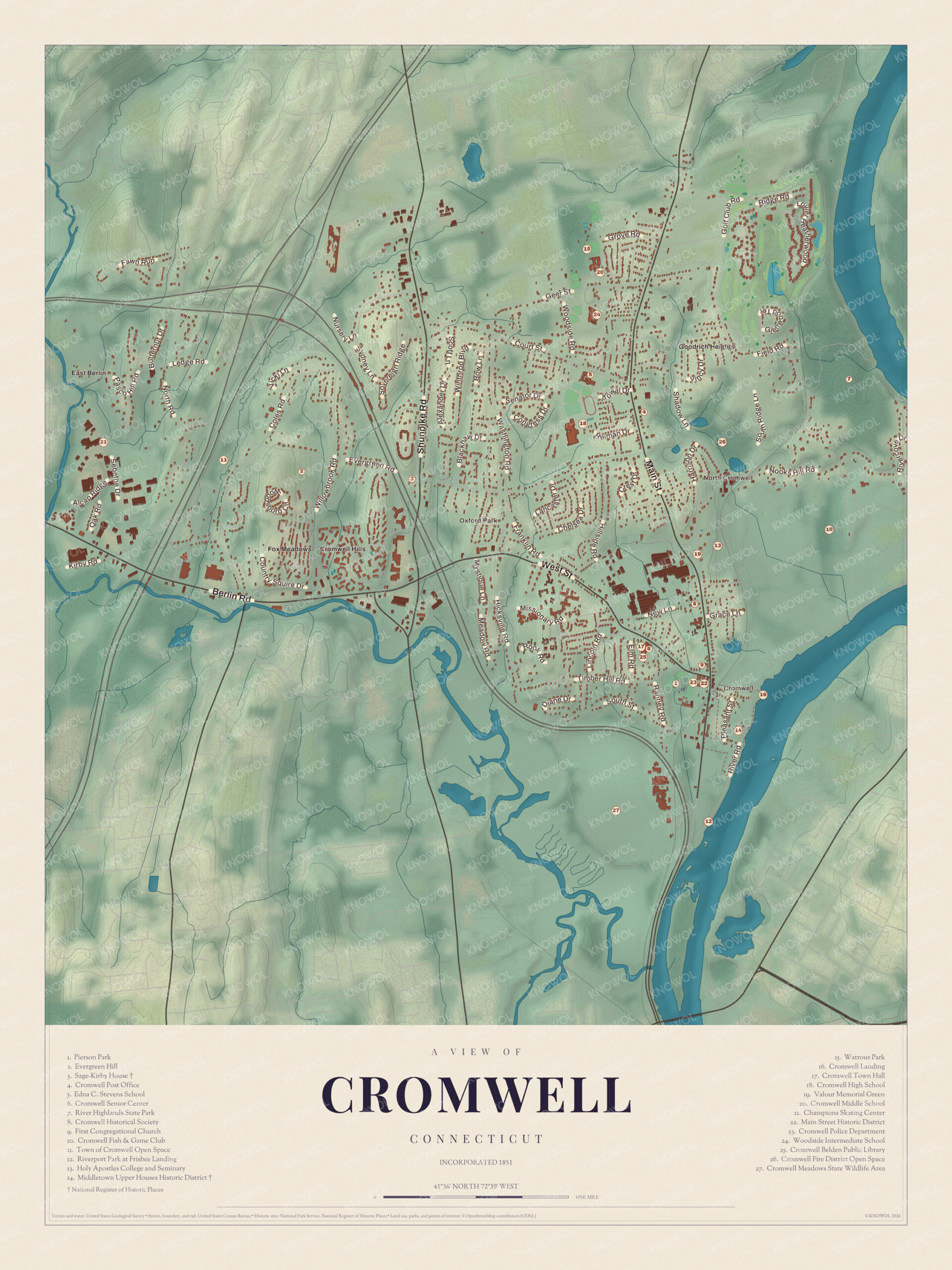
Cromwell today
By KNOWOL
Shaded hills from Nooks Hill down to the riverbank, every street from Shunpike Road to River Road, and a guide of 27 numbered landmarks with the National Register sites marked.4
The story of Cromwell
Iron toys from the Nooks
Cromwell's streams were busy long before the toy works made the town known. About 1814 the Nooks Manufacturing Company spun the area's first wick yarn and wove a coarse, strong cotton called Hum Hum that sold for 50 cents a yard. John and Elisha Stevens started their business in 1843 making cast iron hardware, and by 1850 they made about seventy different articles with forty hands, including half a ton of iron wheels for children's toy wagons every week. Russel Frisbie, a pattern maker, took charge of the works in 1866 and turned out an almost endless variety of toys. By 1884 the company had eight buildings and about 100 workers, and a 1917 biography called it the oldest iron toy factory in the world.516789
Roses in a cow pasture
Andrew N. Pierson came from Sweden with his family in 1869 and reached Cromwell in 1871 as a private gardener. The next year he bought about eight acres of old cow pasture with money borrowed at seven percent, agreeing to give it all up if he failed within three years. He plowed it for vegetables, then grew flowers and carried them to Hartford in a basket. By 1888 he had some eighteen hothouses, and that March, while he was in Florida getting over pneumonia, the great blizzard crushed every one. Friends helped him rebuild, and he turned to roses. By 1917 the Cromwell Gardens covered 500 acres, 22 of them under glass, with 350 people at work all year, and Pierson was known as the Rose King of America.21
When the wharves were lively
For more than a century the Upper Houses lived by the river. Around 1800 three shipyards lined the bank, sometimes with a vessel on the stocks in each, and a rope walk behind them made the rigging. Ships carried hay and mules to the West Indies and came home with rum, molasses, sugar, fruit and mahogany, and when one tied up, boys and girls ran down to the wharves for tropical fruit and trinkets. Old families kept decorated china brought home from Chinese ports. Timothy Dwight, passing through in 1796, counted about 80 well-built houses and found the place full of sprightliness and prosperity. As New York drew the trade away, the yards closed, and by 1884 not a single vessel was owned wholly in Cromwell.1011
Through the years
24 moments from 1650 to today.
- 1650The Upper Houses is laid out on the west bank of the Connecticut, north of the mouth of the Little River.12
- 1703The Upper Houses becomes its own parish, the North Society of Middletown, with about 250 people.13
- 1713The village opens its own burying ground; Martha Gipson is the first burial.1
- 1715The parish hires Sam Stowe to beat the drum that calls people to worship and to sweep the meetinghouse.14
- 1759A ferry starts running between the Upper Houses and Chatham.15
- 1775William Stow writes home from the siege of Boston that the army has fresh beef, milk and chocolate.16
- 1796Timothy Dwight counts about 80 well-built houses and a brisk West Indies trade.11
- 1803The Hartford Turnpike opens through town, and the mail coaches announce themselves with the stage horn.17
- 1809The Upper Houses gets its own post office.18
- 1810The Friendly Association, a debating society with a library, holds its first meeting.19
- 1814About this year the Nooks Manufacturing Company begins making wick yarn and Hum Hum cloth.5
- 1821William C. Redfield studies the great storm of September 3 and finds that storms whirl.20
- 1834The brick Academy is built for $1,700.19
- 1840Volunteers haul stone across the river from Portland for a new Congregational church.21
- 1843John and Elisha Stevens found the J. & E. Stevens Company.1
- 1850The Stevens shop makes half a ton of iron wheels for toy wagons every week.6
- 1851The General Assembly makes the Upper Houses the town of Cromwell, with 1,259 people.1
- 1872Andrew N. Pierson buys about eight acres of cow pasture and starts his nursery.2
- 1877The new village improvement society plants about 370 trees in one autumn.22
- 1883St. John's Catholic Church is dedicated.23
- 1888The March blizzard crushes every one of Pierson's hothouses.2
- 1888Josiah Belden, born in the Upper Houses, sends a large gift for a new public library.1
- 1917Pierson's Cromwell Gardens covers 500 acres, 22 under glass, with 350 workers.2
- 1979The Middletown Upper Houses Historic District is listed on the National Register.12
Places to see
The numbers match the landmark guide printed on the 2026 map.
- 1Pierson ParkCromwell. Named for the Rose King of America.
- 3Sage-Kirby HouseShunpike Road at Evergreen Road. Brick Federal house of about 1811 to 1815.
- 7River Highlands State ParkNortheast, on the river. 177 acres at the old blow hole.Visit their website
- 8Cromwell Historical SocietyMain Street. In John Stevens's house of 1853.Visit their website
- 9First Congregational ChurchNear the river port. The church gathered in 1715.Visit their website
- 12Riverport Park at Frisbee LandingThe riverfront. A park on the river landing.
- 13Holy Apostles College and SeminaryTown center. Founded in 1956 on 40 acres.Visit their website
- 14Middletown Upper Houses Historic DistrictBetween Main Street and the river. The old river port, laid out about 1650.
- 22Main Street Historic DistrictMain Street. Two greens and 66 historic buildings.
- 25Cromwell Belden Public LibraryTown center. Named for Josiah Belden of California.Visit their website
On the National Register
All 3 places in Cromwell on the National Register of Historic Places that still stand today, oldest first, and why each one matters.3
-
Middletown Upper Houses Historic District
The first village of what became Cromwell, laid out about 1650 and a busy seaport trading with the West Indies by the middle of the 1700s. Its 72 houses, almost half of them older than 1820, stand on a small grid of streets by the river, with the remains of a dock where brownstone was loaded.12
-
Main Street Historic District
Along the old turnpike between Hartford and Old Saybrook, it takes in Valour Green, Memorial Green, the Cromwell Historical Society and 66 contributing buildings. It shows a rural village center becoming a 20th-century town, with every major building style from 1750 to 1935.24
-
Sage-Kirby House
Built for Ebenezer Sage, from one of Cromwell's early families, it is one of four brick Federal houses left in town and the only one with a central chimney. It was made into a duplex in 1944 and restored beginning in 1953.25
In their words
“the whole place wears an air of sprightliness and prosperity.”
Timothy Dwight on the Upper Houses in 1796, quoted in History of Middlesex County, 188411
“On land and sea the sons of this parish endured hard service, and won for themselves imperishable honor.”
History of Middlesex County, 1884, on the Upper Houses in the Revolution16
“The business was established in 1843, and is the oldest iron toy factory in the world.”
Encyclopedia of Connecticut biography, 1917, on J. & E. Stevens9
Nearby towns
Sources
- Cromwell, Connecticut, Wikipedia
- Encyclopedia of Connecticut biography (1917), on Andrew N. Pierson, Internet Archive
- National Register of Historic Places listings in Middlesex County, Connecticut, Wikipedia
- Map of Cromwell, Connecticut in 2026, KNOWOL (USGS elevation, Census Bureau roads)
- History of Middlesex County, Connecticut (1884), on the Nooks Manufacturing Company, Internet Archive
- History of Middlesex County, Connecticut (1884), quoting the New York Journal of Commerce of 1850 on J. & E. Stevens, Internet Archive
- History of Middlesex County, Connecticut (1884), on Russel Frisbie, Internet Archive
- History of Middlesex County, Connecticut (1884), on the J. E. Stevens Company, Internet Archive
- Encyclopedia of Connecticut biography (1917), on Charles B. Frisbie and the J. & E. Stevens Company, Internet Archive
- History of Middlesex County, Connecticut (1884), on Cromwell's shipyards, Internet Archive
- History of Middlesex County, Connecticut (1884), on Cromwell's West Indies trade, Internet Archive
- Middletown Upper Houses Historic District, Wikipedia
- History of Middlesex County, Connecticut (1884), on the parish of Upper Houses, Internet Archive
- History of Middlesex County, Connecticut (1884), on the drum that called people to worship, Internet Archive
- Historic towns of the Connecticut River valley (1906), on the river ferries, Internet Archive
- History of Middlesex County, Connecticut (1884), on the Upper Houses in the Revolution, Internet Archive
- History of Middlesex County, Connecticut (1884), on the Cromwell roads and the Hartford Turnpike, Internet Archive
- Historic towns of the Connecticut River valley (1906), on the first post offices, Internet Archive
- History of Middlesex County, Connecticut (1884), on the Friendly Association and Academy, Internet Archive
- Historic towns of the Connecticut River valley (1906), on William C. Redfield, Internet Archive
- History of the First church in Cromwell, 1715-1915 (1915), on the church of 1840, Internet Archive
- History of Middlesex County, Connecticut (1884), on village improvements, Internet Archive
- History of Middlesex County, Connecticut (1884), on St. John's Catholic Church, Internet Archive
- Main Street Historic District (Cromwell, Connecticut), Wikipedia
- Sage-Kirby House, Wikipedia