
The Hat City of western Connecticut, a Revolutionary supply depot burned by the British in 1777 that came back to make more hats than anywhere else in the country, along the Still River below Candlewood Lake.
Then and now
The same town 142 years apart. Click either map to look closer.
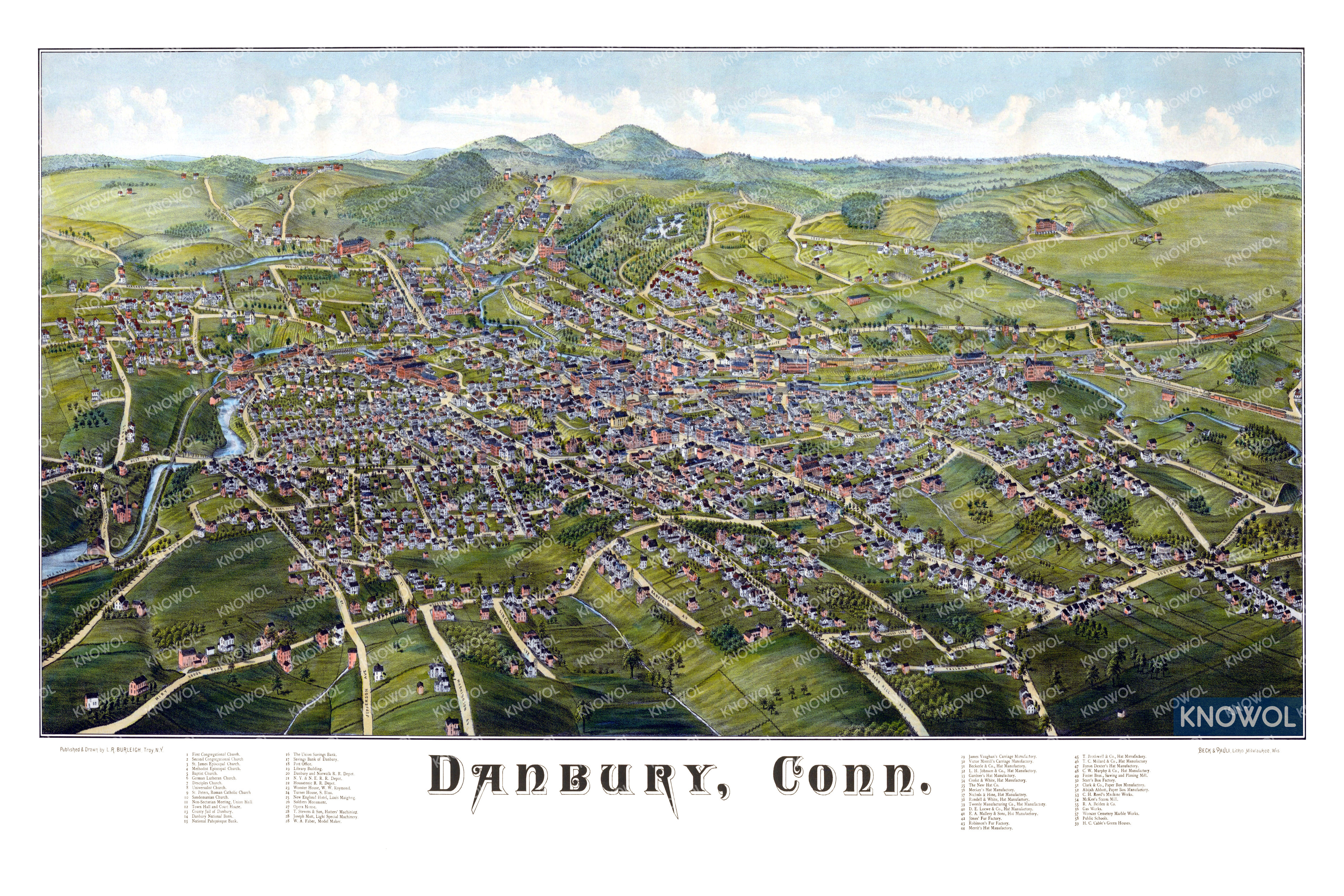
The bird's-eye view
By Lucien Burleigh
Danbury drawn as if from the sky, with its street names and landmarks, from the Danbury and Norwalk Railroad depot, the New England Hotel and the Danbury Opera House to the Beckerle and Meeker hat factories, Jones' and Robinson's fur factories and Starr's box factory.4
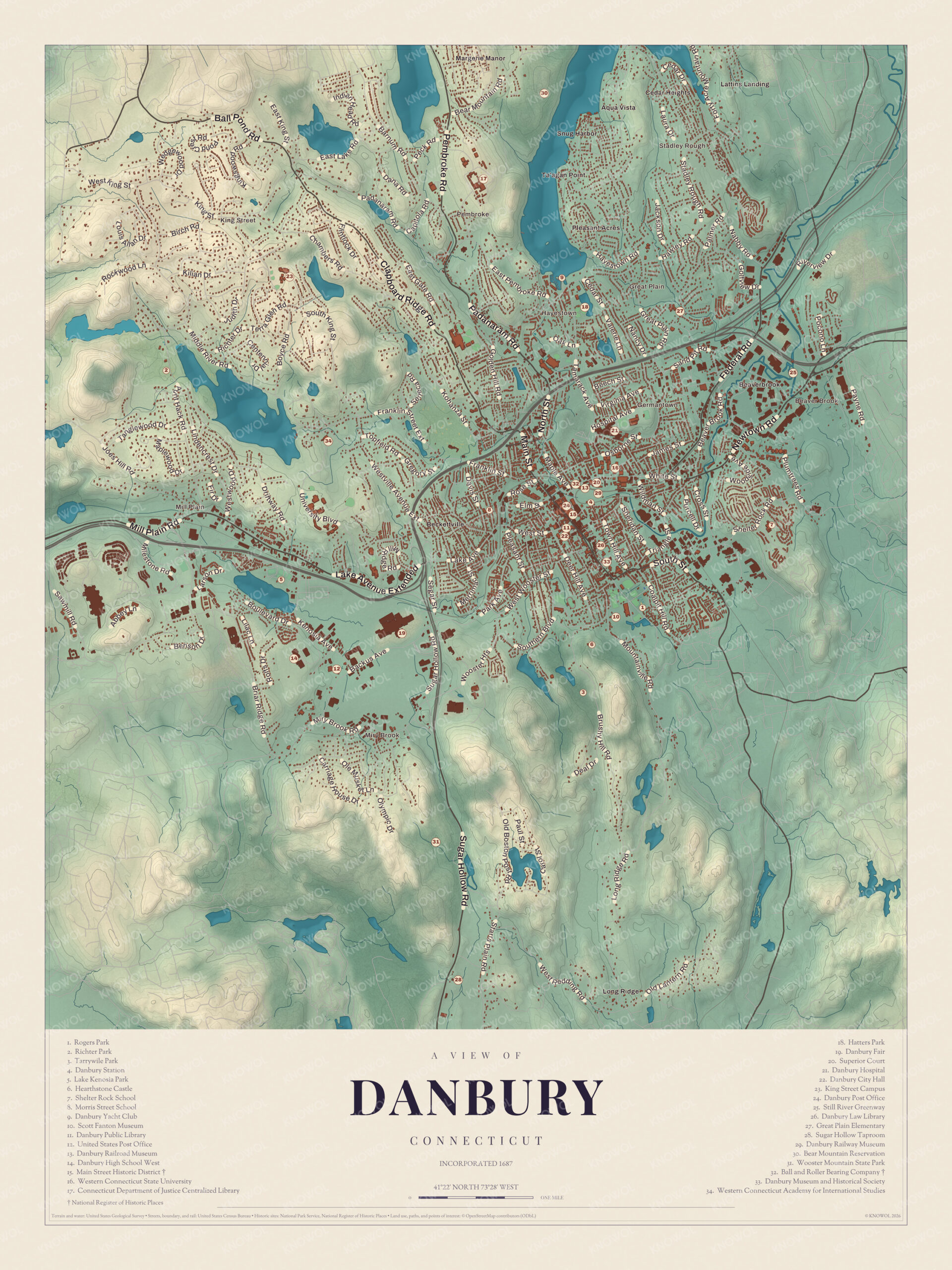
Danbury today
By KNOWOL
Shaded hills from downtown out to Hawthorne Terrace, every street down to White Turkey Road Extension, Main Street, Tarrywile Park and Lake Kenosia, and a guide of 34 numbered landmarks with the National Register sites marked.5
The story of Danbury
The night the British came
On the afternoon of April 26, 1777, the British column reached the south end of Main Street. Silas Hamilton, a farmer from the north part of town, had just picked up a bolt of wool cloth from the clothier and tied it behind his saddle. Three troopers chased him, but each time they got close, the loose end of the cloth flapped in the wind and spooked the nearest horse, and he got away. Four men fired on the troops from Major Daniel Starr's house and were shot down, and the house was burned. The pork and flour stores were rolled into the street and set on fire, and afterward the pork fat lay deep in the road. The town records burned too, left behind in the town clerk's house.67
Fifty-six hat shops
Zadoc Benedict's little red shop at the north edge of the village made three hats a day in 1780. By 1810 there were fifty-six hat shops in the township, none with more than five hands. Men stood around a kettle in small plank rooms heated by wood fires, forming the coarse fur bodies by hand, and the rough hats went to New York to be finished. In 1823 Joel Taylor of Danbury invented the hatter's circular dye kettle and wheel, which came into use across America and Europe. By 1887, thirty factories were turning out 5 million hats a year, and Danbury had become the Hat City.891
The bullet in the grave
General David Wooster was shot near Ridgefield on April 27, 1777, chasing the British after they burned Danbury. He was carried back to Danbury, and the surgeon probed for the ball but never found it. Wooster died a few days later and was buried in the old burying ground, about twenty feet from the grave of Robert Sandeman. Seventy-seven years later, in 1854, the town set out to move him to a new monument, but nobody was sure where he lay. Diggers found a skull, then two bunches of matted wire that had been his epaulets, and finally a lump of clay with a large English bullet inside. The Masons, the state and the people of Danbury raised the monument together.101112
Through the years
25 moments from 1685 to today.
- 1685Eight families from Norwalk and Stamford buy land from the Pahquioque and settle along the Still River.1
- 1680sThe settlers raise a little church, forty feet by thirty, and every person in town sits together on its sills.13
- 1687The General Court names the town Danbury, after Danbury in Essex, England.1
- 1708With war on the frontier, the colony orders a garrison built at Danbury at the colony's charge.14
- 1771Robert Sandeman, the Scottish preacher whose followers worshipped in a small church set back from Main Street, dies at Danbury and is buried in the old burying ground.11
- 1777On April 26 and 27, British troops under William Tryon burn Danbury and the Continental Army's stores.1
- 1777The town records burn in the town clerk's house, and the Assembly orders every road and piece of land in Danbury surveyed again.615
- 1780Zadoc Benedict opens what's traditionally called Danbury's first hat shop, with three workers making 18 hats a week.1
- 1784Danbury becomes a half-shire town, sharing the county courts with Fairfield.5
- 1802Thomas Jefferson writes to the Danbury Baptist Association about a "separation of church and state."1
- 1810Danbury has fifty-six hat shops, none with more than five hands, sending rough hats to New York to be finished.8
- 1813Ezra Mallory opens a small hat shop at Great Plain, the start of E. A. Mallory and Sons.16
- 1823Joel Taylor of Danbury invents the hatter's circular dye kettle and wheel, soon used in America and Europe.9
- 1824Danbury's first bank opens in a room rented in Dr. Comstock's house.17
- 1852The Danbury and Norwalk Railroad opens, the first rail line in Danbury.1
- 1854General Wooster's remains are moved to his new monument, and the British bullet that killed him turns up in the grave.1012
- 1861Danbury votes to pay the wife of each volunteer three dollars a week and each child one dollar while he's away.18
- 1869The Kohanza Reservoir dam breaks, and the flood kills 11 people within 30 minutes.1
- 1870The Danbury News is founded, and its centennial issue on the 1777 burning is printed in blue ink.19
- 1884Lucien Burleigh draws his bird's-eye view of Danbury.4
- 1889The borough is reincorporated as the City of Danbury.1
- 190263,202 people come to the Danbury Fair, more than any six other Connecticut fairs together.2
- 1903The New Haven Railroad builds Union Station on White Street.20
- 1908The U.S. Supreme Court decides the Danbury Hatters' Case.1
- 1981The last Danbury Fair is held. The Danbury Fair Mall opens on the grounds in 1986.1
Places to see
The numbers match the landmark guide printed on the 2026 map.
- 3Tarrywile ParkSoutheast of downtown. 722 acres with 21 miles of trails.Visit their website
- 5Lake Kenosia ParkWest of downtown. A lakeside city park.
- 6Hearthstone CastleTarrywile Park. Built of stone quarried on the site.
- 15Main Street Historic DistrictDowntown. 132 buildings from the 1780s on.
- 16Western Connecticut State UniversitySouth of Danbury Hospital. Began as a teachers' school in 1903.Visit their website
- 19Danbury FairOld fairgrounds. Held from 1821 to 1981.
- 29Danbury Railway MuseumWhite Street. The 1903 Union Station, restored.Visit their website
- 31Wooster Mountain State ParkSouth Danbury. Named for General David Wooster.
- 32Ball and Roller Bearing CompanyMaple Avenue. Where the centerless grinder was developed.
- 33Danbury Museum and Historical SocietyMain Street. The Rider House and Dodd Hat Shop.Visit their website
On the National Register
All 12 places in Danbury on the National Register of Historic Places that still stand today, oldest first, and why each one matters.3
-
Charles Ives House
The birthplace of the composer Charles Ives, born here in 1874 when the house stood on Main Street. It was moved three times within Danbury to make way for banks and a school, and it's the only house left that's tied to his musical career. The historical society runs it.21
-
John Rider House
Built by John Rider, a carpenter and Revolutionary militia captain. In 1941 it was about to be torn down for a gas station, and saving it started historic preservation in Danbury. It's the oldest house in the city still on its first site, and the home of the Danbury Museum and Historical Society.22
-
Main Street Historic District
The oldest part of the city, once called Town Street, running three quarters of a mile from the Rider House to White Street. Some buildings have been lost since, but its 132 buildings still hold churches, government buildings and Italianate business blocks from the hat era. A marker shows where the first shot was fired at the British in 1777.23
-
Octagon House
Daniel Starr built it with one-foot-thick concrete walls, following Orson Squire Fowler's book on octagon houses. It's considered the best surviving octagon house in Connecticut, and it was listed to save it from urban renewal.24
-
Meeker's Hardware
Known as the Red Block, it opened as a hardware store in 1885 and stayed in the Meeker family until 2013. It was the only hardware store on the National Register, famous for its old interior and its wall sign for cheap fountain drinks near the train station.25
-
P. Robinson Fur Cutting Company
A tall brick factory on the banks of the Still River, built in stages over the last twenty years of the 1800s. It's the last surviving building of the fur cutting side of the hat industry, which prepared the fur that became felt.26
-
Ball and Roller Bearing Company
Joseph Nutt opened a machine shop here for the hat industry in 1886. Lewis Heim, a former hat worker, bought it in 1904 and developed the centerless grinding machine here, which changed how machine parts were made. It now houses a church and social service agencies.27
-
Tarrywile
The Tarrywile Mansion, probably the finest Shingle Style house in the city, with its gatehouse, carriage house and greenhouse. Charles Darling Parks bought it in 1910, and it's now the heart of the 722-acre Tarrywile Park.2829
-
Hearthstone
A stone castle built as a honeymoon cottage for the photographer E. Starr Sanford, from granite quarried on the hill and hauled by a little railroad built just for the job. Its roof has fallen in, but the stone walls still stand in Tarrywile Park, and the city has stabilized them.2930
-
Locust Avenue School
A brick Romanesque Revival school designed by Warren R. Briggs in 1896, where new teachers from the state normal school practiced on real classes. It's the last 19th-century school building left in Danbury and is still a school today.31
-
Union Station
Built by the New Haven Railroad after the three lines into Danbury merged, with 125 trains a day at its peak. Alfred Hitchcock filmed Strangers on a Train on its curved platform. After it closed in 1993, rail fans formed the Danbury Railway Museum and restored it.20
-
New Haven Railroad Danbury Turntable
The roundhouse and shops around it burned in the 1980s, leaving the only intact railroad turntable in Connecticut. It sits in the railway museum's yard, a few hundred yards east of the station.20
In their words
“During the week of the fair, Danbury suddenly expands into a city twice its usual size.”
The Connecticut Magazine, 19032
“Norwalk expands the blaze; o'er Redding hills High flaming Danbury the welkin fills.”
Joel Barlow's poem on the towns burned in the Revolution, quoted in The Connecticut Wits, 192032
Nearby towns
Sources
- Danbury, Connecticut, Wikipedia
- The Connecticut Magazine (1903), Financial History of Danbury, on the fair, Internet Archive
- National Register of Historic Places listings in Fairfield County, Connecticut, Wikipedia
- Bird's-eye view of Danbury, 1884, restored by KNOWOL
- Map of Danbury, Connecticut in 2026, KNOWOL (USGS elevation, Census Bureau roads)
- A Historical Collection of the Part Sustained by Connecticut during the War of the Revolution (1842), Internet Archive
- 1708 Ridgefield, Connecticut 1908, Bi-centennial Celebration (1908), Internet Archive
- Connecticut as a Colony and as a State (1904), Internet Archive
- John Warner Barber, Connecticut Historical Collections (1837 edition), Internet Archive
- Genealogy of the Woosters in America (1885), Internet Archive
- John Warner Barber, Connecticut Historical Collections (1836), Internet Archive
- Chapter Sketches, Connecticut Daughters of the American Revolution: Patron Saints (1901), Internet Archive
- The Ancient Historical Records of Norwalk, Connecticut (1847), Internet Archive
- History of Ancient Woodbury, Connecticut (1854), Internet Archive
- The Public Records of the State of Connecticut, 1776 to 1778 (1894), Internet Archive
- Connecticut as a Colony and as a State (1904), on Ezra Mallory, Internet Archive
- The Connecticut Magazine (1903), Financial History of Danbury, on the banks, Internet Archive
- The Military and Civil History of Connecticut during the War of 1861-65 (1868), Internet Archive
- The Historical, Statistical and Industrial Review of the State of Connecticut (1884), Internet Archive
- Danbury Railway Museum, Wikipedia
- Charles Ives House, Wikipedia
- John Rider House, Wikipedia
- Main Street Historic District (Danbury, Connecticut), Wikipedia
- Octagon House (Danbury, Connecticut), Wikipedia
- Meeker's Hardware, Wikipedia
- P. Robinson Fur Cutting Company, Wikipedia
- Ball and Roller Bearing Company, Wikipedia
- Tarrywile Park, Wikipedia
- Hearthstone Castle, Wikipedia
- Seeking the abandoned ruins of Hearthstone Castle (updated May 2024), Seconds to Go
- Joseph W. Pepin Memorial Building (Locust Avenue School), Wikipedia
- The Connecticut Wits and Other Essays (1920), Internet Archive