
The old East Parish of Bridgewater, bought at Sachem Rock in 1649, where a stone herring weir sat in the Satucket River and the mill streams turned out cannon, machine-made nails, tacks and cotton gins.
Then and now
The same town 139 years apart. Click either map to look closer.
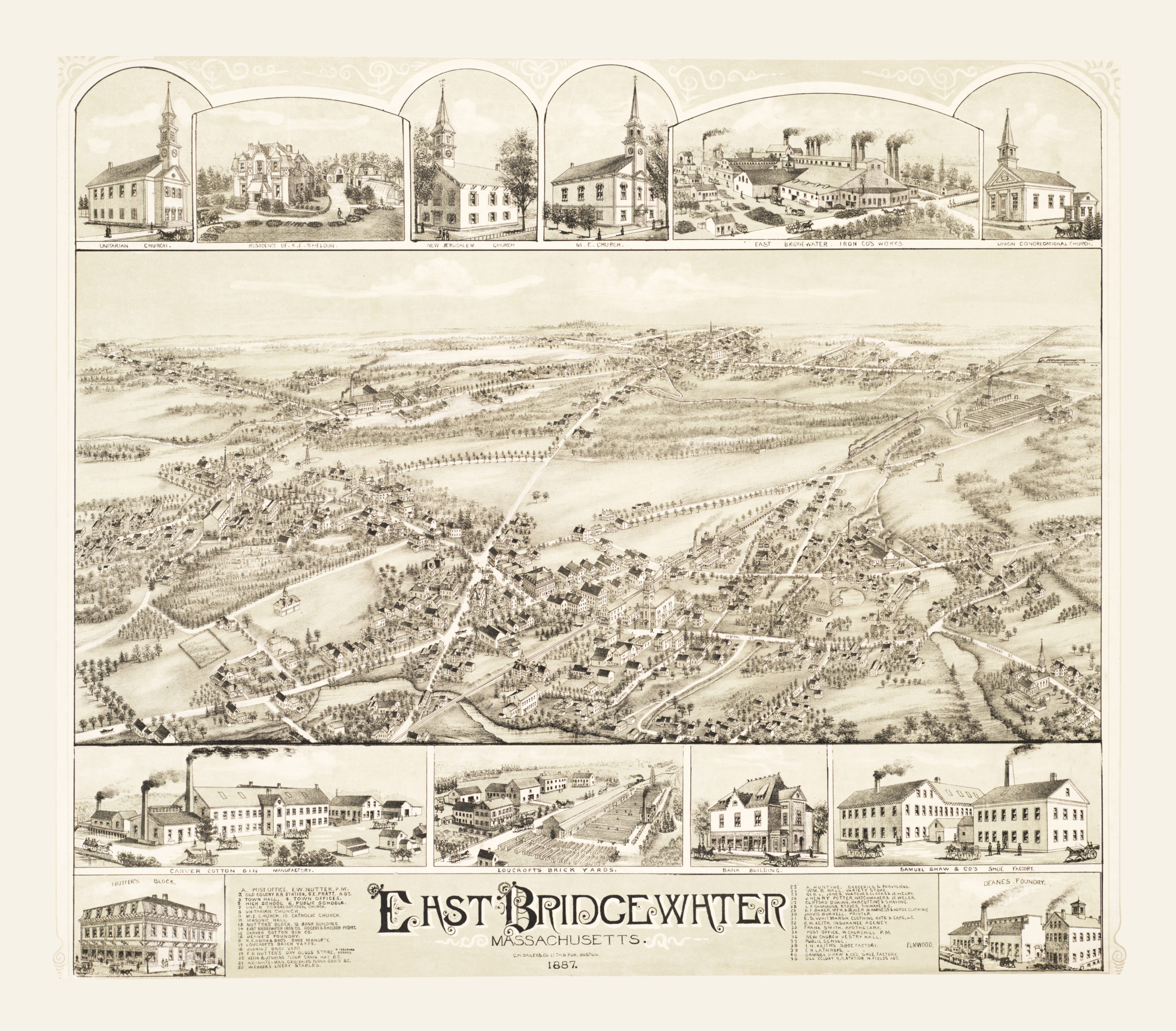
East Bridgewater in 1887
By Unknown
A detailed map of East Bridgewater in 1887, with the Old Colony Railroad station, Judkins Brick Yard, the town hall, the Masonic Hall and J. Henry Potter's watchmaker's shop.4
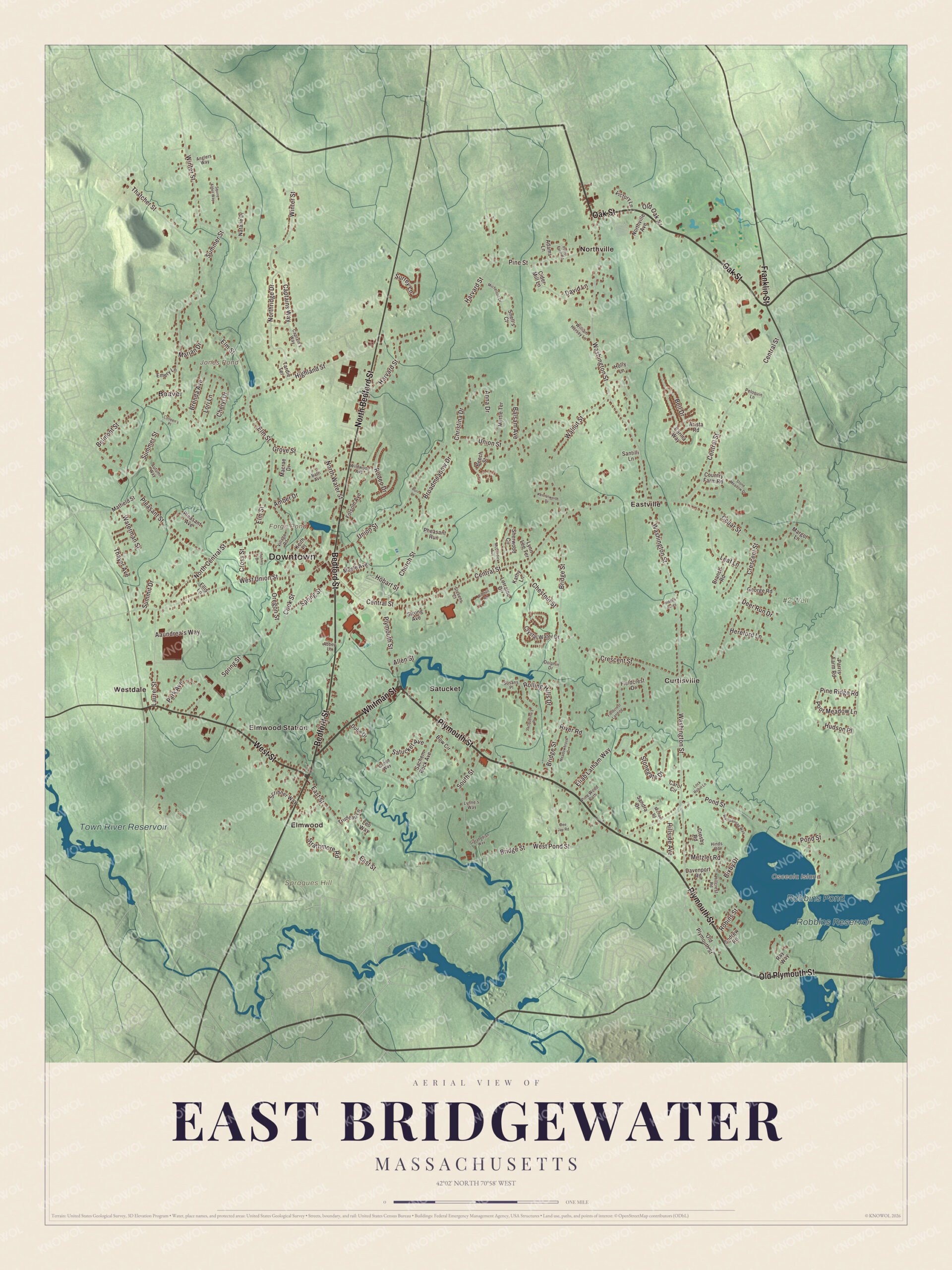
East Bridgewater today
By KNOWOL
Shaded relief with Plymouth Street, Bedford Street, Oak Street, West Street and Whitman Street, and Forge Pond, Jones Pond, Robbins Reservoir, Osceola Island and Spragues Hill.5
The story of East Bridgewater
The herring weir on the Satucket
Long before the mills, people here caught herring at a stone weir on the Satucket River, where the fish ran up to spawn in Robbins Pond. An 1884 county history says the weir still looked much as it did when the last Native fisherman set his net in its stony sluice. About 1663 Robert Latham built a house just south of it and soon put up a saw-mill a few rods below, the first in East Bridgewater. Around 1724 the mill moved near today's Satucket bridge, and a grist-mill joined it. Nail machines came in 1815, and Zebina Keith began making tacks there in 1827, a business his sons ran until fire destroyed the mills in 1872. After 1819 the mills no longer stopped for the fish, and the herring nearly quit coming.678
Nails, cannon and cotton gins
East Bridgewater was a town of clever machines. Around 1740 Hugh Orr, a Scottish gunsmith, set up a trip-hammer on the Matfield River, and a 1907 history says he built it with timbers from the parish's first meeting house. He made firearms there, and an 1874 gazetteer says he cast cannon for the Revolutionary army and built the first machines in the country for carding, roping and spinning cotton. Samuel Rogers built a small machine that cut and headed a nail in one step, and its nails went into the shingles of the 1794 meeting house. Later Eleazer Carver, who had started making cotton gins at Natchez in 1807, brought the trade here, and the Carver Cotton Gin Company was still at work in town in 1914.910111213
Seven coats and nine hatchets
In March 1649 the sachem Massasoit deeded a great tract to Myles Standish and two other Plymouth commissioners. A 1928 county history lists the price: seven coats, nine hatchets, eight hoes, twenty knives, four moose skins and ten and a half yards of cotton. The deal was made on a small hill in East Bridgewater, Sachem Rock, a granite outcrop the Wampanoag called Wonnocoote. Samuel Allen Jr. built the first house here in 1660, near the Matfield River. In King Philip's War in 1676 every house but Nicholas Byram's was burned. The settlement grew back into Bridgewater's East Parish and became its own town in 1823. The town bought Sachem Rock Farm in 1998, and it's open to the public today.2141
Through the years
23 moments from 1649 to today.
- 1649Massasoit deeds the land of the Bridgewaters to Plymouth's commissioners on a small hill in what's now East Bridgewater.2
- 1660Samuel Allen Jr. builds the first house, a few rods from the Matfield River.2
- 1662Thomas Whitman comes from Weymouth and settles between the Satucket and Matfield rivers.15
- 1663About this year Robert Latham settles by the Satucket River and builds a saw-mill just below the herring weir.7
- 1676In King Philip's War every house in the settlement but Nicholas Byram's is burned.2
- 1700About this year a tannery starts at the village then called Joppa.16
- 1721The town common is laid out.17
- 1723The area becomes Bridgewater's East Parish.1
- 1724Rev. John Angier is ordained as the parish's first minister, and Latham's saw-mill is moved near Satucket bridge.10
- 1740About this year Hugh Orr, a Scottish gunsmith, sets up a trip-hammer on the Matfield River.9
- 1794The meeting house on the common is built, its shingles laid with Samuel Rogers' machine-made nails.11
- 1815Nail machines are set up in a new factory at the Satucket mills.8
- 1819The mills stop shutting down for the herring run, and the herring nearly stop coming.6
- 1823East Bridgewater is incorporated as a town on June 14.1
- 1827Zebina Keith starts making tacks at Satucket, and cotton goods replace nails there.8
- 1836The legislature charters the East Bridgewater Bank on April 1.18
- 1861Thirty-eight men sign up at a mass meeting on April 24, the start of Company C of the 29th Massachusetts.19
- 1866Eleazer Carver, who had made cotton gins since 1807, dies in East Bridgewater.12
- 1872Joppa takes the name Elmwood, and fire destroys the Satucket mills.16
- 1887A detailed map of the town is published, now restored by KNOWOL.4
- 1998The town buys Sachem Rock Farm and opens it to the public.14
- 1999The East Bridgewater Common Historic District joins the National Register.17
- 2006Sachem Rock Farm joins the National Register.14
Places to see
Places worth a visit in East Bridgewater today.
- Matfield RiverWest side, through Elmwood. Called the Elmwood River near Route 18.
- Satucket RiverSouth of the center. Tea-colored stream from Robbins Pond.
- Robbins PondSoutheast corner. Largest body of water in town.
- ElmwoodSouthwest of the center. The old village of Joppa.
- BeaverNorthwest of the center. Named for the brook's beavers.
- NorthvilleNortheast part of town. Once the Northeast School District.
- Catholic Church of Saint John the EvangelistCentral Street. The town's Catholic parish church.
- Forge PondEast Bridgewater. One of the town's ponds.
- Beaver Brook Beagle ClubNorthwest corner. A large stretch of woods.
On the National Register
All 2 places in East Bridgewater on the National Register of Historic Places that still stand today, oldest first, and why each one matters.3
-
East Bridgewater Common Historic District
The historic town center, built around a common laid out in 1721, with houses as old as 1703 and the Old Graveyard. The First Parish Church of 1794 faces the common, and town offices are in Aaron Hobart's Italianate house of the 1850s.17
-
Sachem Rock Farm
Sachem Rock, the granite high point the Wampanoag called Wonnocoote, is where Massasoit sold the land of the Bridgewaters to Plymouth settlers in 1649. The barns date from about 1870, and the town bought the farm in 1998 and opened it to the public.14
In their words
“probably the first nail completely cut and headed by machinery at one operation in the world, was made in East Bridgewater, by the late Mr. Samuel Rogers.”
Nahum Mitchell, History of the early settlement of Bridgewater, 184011
“still remains much the same as when the last Indian placed his net to catch the nimble fish as they darted along through the stony sluice”
History of Plymouth County, 1884, on the herring weir in the Satucket River6
“Beaver Village, in the northwest part of the town, derives its name from the fact that the stream running through it once abounded in beavers”
History of Plymouth County, 188420
Nearby towns
Sources
- East Bridgewater, Massachusetts, Wikipedia
- History of Plymouth, Norfolk and Barnstable counties, Massachusetts (1928), on the 1649 deed and first settlers, Internet Archive
- National Register of Historic Places listings in Plymouth County, Massachusetts, Wikipedia
- Map of East Bridgewater, Massachusetts from 1887, restored by KNOWOL
- Map of East Bridgewater, Massachusetts in 2026, KNOWOL (USGS elevation, Census Bureau roads)
- History of Plymouth County, Massachusetts (1884), on the Satucket herring weir, Internet Archive
- History of Plymouth County, Massachusetts (1884), on Robert Latham's saw-mill, Internet Archive
- History of Plymouth County, Massachusetts (1884), on the Satucket mills, Internet Archive
- Proceedings of the 250th anniversary of Old Bridgewater, Mass. (1907), Internet Archive
- A gazetteer of the state of Massachusetts (1874), Internet Archive
- History of the early settlement of Bridgewater, in Plymouth County, Massachusetts (1840), Internet Archive
- History of Plymouth County, Massachusetts (1884), on Eleazer Carver, Internet Archive
- History of Plymouth, Norfolk and Barnstable counties, Massachusetts (1928), on Charles L. Nutter and the Carver Cotton Gin Company, Internet Archive
- Sachem Rock Farm, Wikipedia
- History of Plymouth County, Massachusetts (1884), on Thomas Whitman, Internet Archive
- History of Plymouth County, Massachusetts (1884), on Joppa and its tannery, Internet Archive
- East Bridgewater Common Historic District, Wikipedia
- History of Plymouth County, Massachusetts (1884), on the East Bridgewater Bank, Internet Archive
- History of Plymouth County, Massachusetts (1884), on Company C of the 29th Regiment, Internet Archive
- History of Plymouth County, Massachusetts (1884), on the villages of East Bridgewater, Internet Archive