
A paper and railroad city on the north branch of the Nashua River, once the Turkey Hill end of Lunenburg, where Alvah Crocker's mills and railroad built a busy Victorian downtown below the granite of Rollstone Hill.
Then and now
The same town 151 years apart. Click either map to look closer.
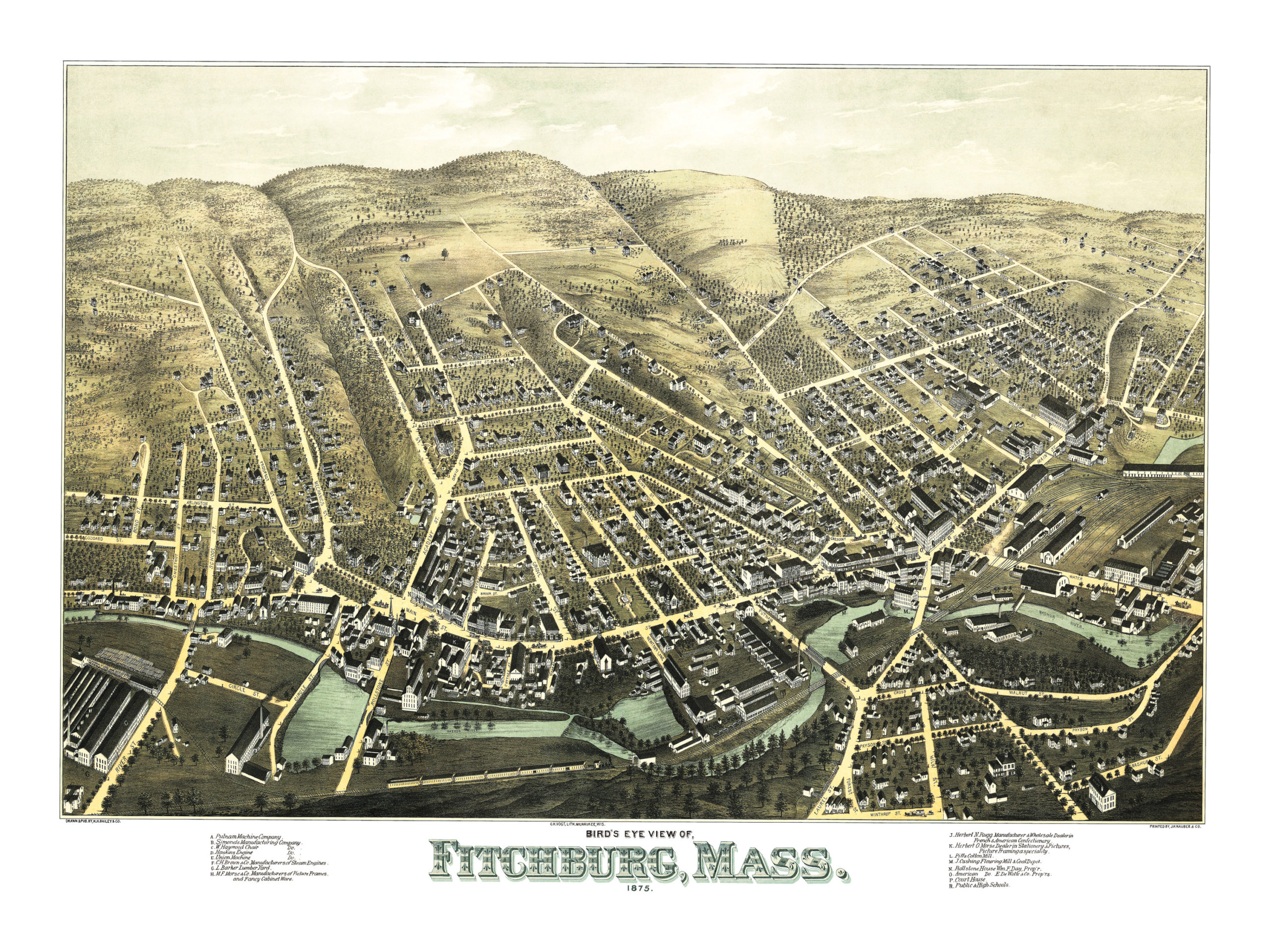
The bird's-eye view
By H.H. Bailey
Fitchburg drawn as if from the sky in 1875, with street names and landmarks including the Putnam Machine Company, Simonds Manufacturing, the Heywood Chair Company, Hoskins Engine Company, Union Machine Company, Brown Steam Engines, Barker Lumber Yard, Pitts Cotton Mill and the public schools.4
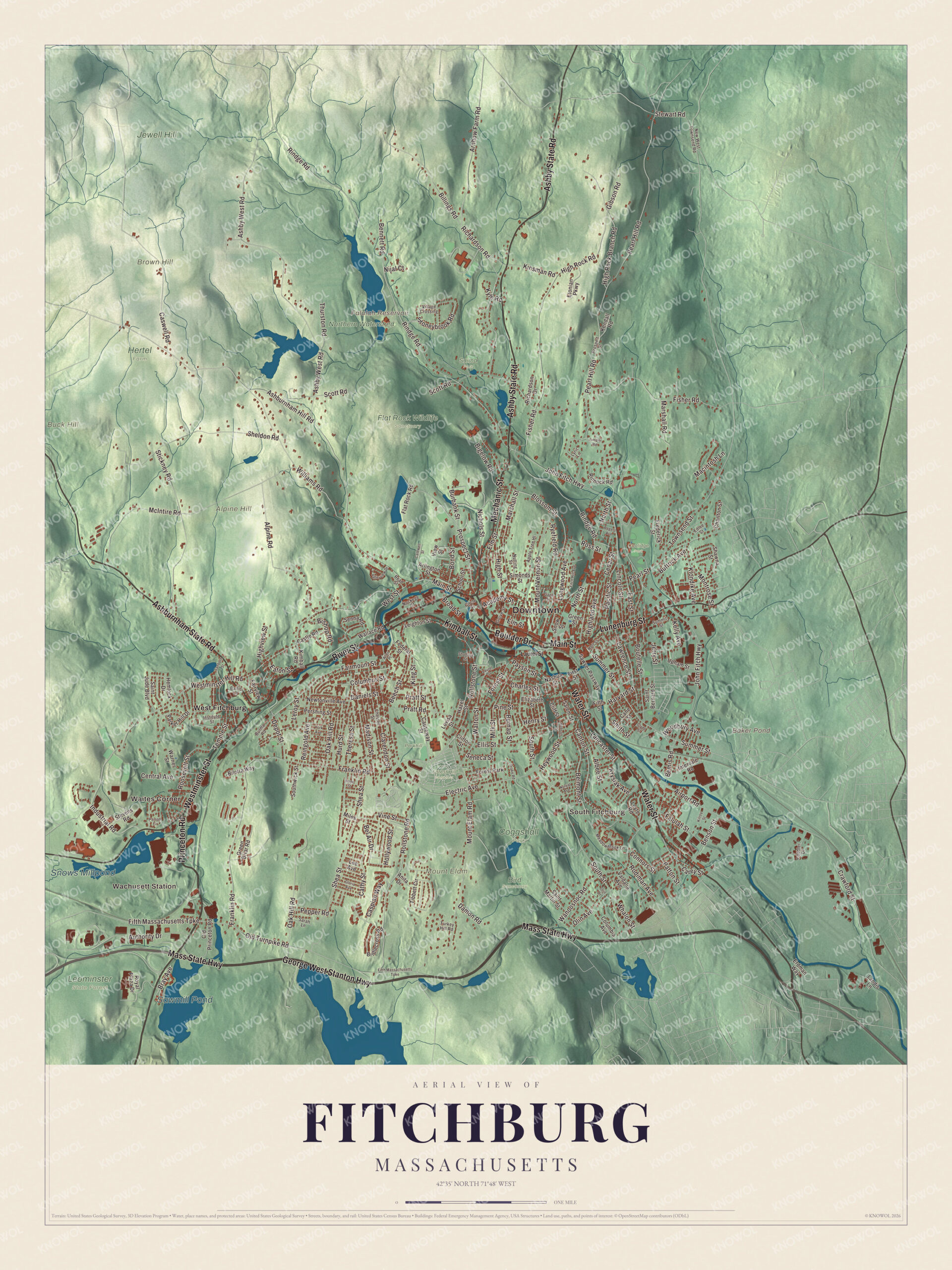
Fitchburg today
By KNOWOL
Shaded relief from Brown Hill, the city's highest point, down to the Nashua River, with Main Street, River Street, Boulder Drive and the George West Stanton Highway, and Baker Pond, Sawmill Pond and the Falulah Reservoir.5
The story of Fitchburg
Ninety-nine town meetings
Fitchburg's first meetinghouse went up in 1766 on an acre given by Thomas Cowdin, the tavern keeper, in the part of town called the Old City. The 1879 county history says a man fined there for skipping church cursed the place and named it Sodom, and the name stuck for years. By 1786 the little church was too small, and the town voted to build a new one at "the nearest convenientest place" to the centre. Nobody could agree where that was. It took ten years and ninety-nine town meetings to settle it. Meanwhile the Dean Hill families in the west built a plain meetinghouse of their own, later nicknamed the Lord's Barn, and asked to become a separate town. Fitchburg called their petition a work of fancy, and it failed.26
Crocker's railroad
Alvah Crocker made paper in Fitchburg and built a mill of his own in 1826. George Boutwell, later governor, remembered him driving a one-horse wagon to a Groton bindery for paper shavings, a lean and awkward man whose voice carried over most of the village. When Crocker pushed for a railroad straight to Boston, the 1889 county history says, the idea met great opposition and ridicule. Even at home people fought over the depot. When the directors chose Water Street, 310 voters asked the legislature for a separate railroad just to connect the village with it. The line opened to Fitchburg on March 5, 1845. Crocker went on to champion the Hoosac Tunnel, bored with the rock drill Charles Burleigh invented here in 1866.789105
The boulder on Rollstone Hill
Rollstone Hill, just southwest of downtown, is solid granite, and in 1885 quarries were cutting it every warm season. The Fitchburg Railroad's depot in Boston was built of its stone. On the bare summit sat the Boulder, forty-five feet around and at least a hundred tons, a rock unlike anything within thirty miles that the writer guessed had come on the ice. From beside it you could see the whole city, with Wachusett to the south and Watatic to the northwest. In 1896 a member of the Fitchburg Historical Society warned that the quarries were getting close enough to destroy it, and the society named a committee to talk with the owners. It held on until 1929, when the mayor stopped the quarrying and the boulder was taken apart and rebuilt near the Upper Common.7115
Through the years
25 moments from 1730 to today.
- 1730European settlement begins here, on land that is still the western end of Lunenburg.1
- 1748A raiding party attacks John Fitch's garrison, in a corner of town later given to Ashby, and carries his family to Montreal. They're ransomed the next year.12
- 1759Families in the west end of Lunenburg first ask to be set off as a town of their own.2
- 1764On February 3 the governor signs the act that makes Fitchburg a town.2
- 1764The first town meeting is held on March 5 in Captain Samuel Hunt's tavern.2
- 1766The first meetinghouse, on land given by the tavern keeper Thomas Cowdin, is ready for use.2
- 1775On April 19 about fifty minute men march for Concord and arrive that evening, too late for the fight.2
- 1786During the unrest that became Shays' Rebellion, the town sends Elijah Willard to a convention at Worcester.2
- 1786A vote to build a new meetinghouse near the centre starts a quarrel that takes ten years and ninety-nine town meetings.2
- 1790The Dean Hill families in the west ask the General Court to make them a separate town. Fitchburg objects, and the request fails.6
- 1805Thomas French starts the town's first paper mill.9
- 1807About thirty investors build Fitchburg's first cotton factory, the third in the state by the 1889 county history's count.9
- 1826Alvah Crocker builds a paper mill of his own.7
- 1830Fitchburg counts 235 houses, four cotton mills, two paper mills and one chair factory.2
- 1839With no police force, citizens run a Society for the Detection of Thieves, complete with a pursuing committee.6
- 1845The Fitchburg Railroad opens to Fitchburg on March 5.10
- 1860The first report of the American Anti-Tobacco Society, George Trask's crusade, is dated at Fitchburg.13
- 1861The Civil War begins. Fitchburg will organize nine companies and send 750 men.2
- 1866Charles Burleigh of Fitchburg invents the rock drill later used on the Hoosac Tunnel.7
- 1870Fire destroys the Heywood chair works on Water Street, and the company rebuilds on nine acres on River Street.7
- 1872Fitchburg becomes a city on March 8, with about 12,000 people.2
- 1874The soldiers' monument in Monument Park is dedicated on June 26.7
- 1875H.H. Bailey publishes his bird's-eye view of Fitchburg.4
- 1896A member of the Historical Society warns that the Rollstone quarries threaten the boulder on the summit.11
- 1929The Rollstone Boulder is blasted apart and rebuilt near the Upper Common, work finished in 1930.5
Places to see
Places worth a visit in Fitchburg today.
- Rollstone BoulderNear the Upper Common. Moved down from Rollstone Hill, 1929 to 1930.
- Upper CommonMain Street. The common at Main Street's western end.
- Fitchburg Art MuseumElm Street. Eleanor Norcross's museum, opened 1929.Visit their website
- Fitchburg Public LibraryMain Street. Founded 1859, children's room from 1899.Visit their website
- Fay Club658 Main Street. George Fay's 1884 house, a club since 1910.
- Old North Worcester County CourthouseMonument Park. High Victorian Gothic courthouse of 1871.
- Crocker FieldRiver Street. A 1916 gift, landscaped by the Olmsteds.
- Coggshall ParkMirror Lake. 300 wooded acres, set aside in 1894.
- West Fitchburg Steam Line TrailWaites Corner. Path along the Nashua and Flag Brook.
- Brown HillNorthwest corner. The city's highest point, 1,210 feet.
On the National Register
All 12 places in Fitchburg on the National Register of Historic Places that still stand today, oldest first, and why each one matters.3
-
Duck Mill
George Blackburn rebuilt his cotton mill here in 1844 after a fire. It was the only Fitchburg mill to weave heavy cotton duck, used by the Union Army in the Civil War, and it's now apartments.14
-
Moran Square Historic District
The junction of East Main, Lunenburg and Summer Streets grew up just east of Union Station as a second commercial and factory center. Its oldest factory, at 64 Main Street, was built in 1860 by Sylvanus Sawyer, whose company made arms during the Civil War.15
-
Fitchburg Paper Company Historic District
The West Fitchburg mills of the Fitchburg Paper Company, begun at the end of 1864 in the old Lyon paper mill and Kimball scythe shops. Rodney Wallace, sole owner from 1869, added a stone dam, a brick mill in 1878 and houses for his workers, and a small village grew up around the mills.12
-
Monument Park Historic District
The city laid out the park in 1874 around Martin Milmore's Civil War monument, a winged figure of Victory. Around it stand the 1871 courthouse, the 1891 armory and the 1903 old post office, one of the city's finest groups of buildings.16
-
Fay Club
Richard M. Upjohn designed this Late Victorian Gothic house for businessman George Fay in 1883. His daughter Lucy gave it to his club in 1910, and the club took the Fay name. It closed in 2015 and reopened in 2016 after members raised the money.17
-
Parkhill Mill
Scottish immigrant Andrew Cleghorn built the first part in 1885 and sold it in 1889 to his brother-in-law John Parkhill, whose company wove gingham and at its peak employed more than 1,000 people. The complex grew until 1915 and is now offices, businesses and homes.18
-
Safety Fund National Bank
Completed in 1895 to a design by local architect H. M. Francis, it's the only one of his three Fitchburg bank buildings still standing, and it has housed a bank ever since.19
-
Calvinistic Congregational Church
Built in 1896 to a design by Henry M. Francis, it's one of the city's finest Richardsonian Romanesque buildings, with a tower over 158 feet tall and five Tiffany windows. Its congregation was founded in 1802 as a traditional alternative to the town's first church.20
-
Fitchburg Yarn Mill
Built in 1907 and enlarged several times, it was one of the city's largest textile operations for over 60 years. The building is an important local work of Frank P. Sheldon, a noted industrial architect of the period.21
-
Fitchburg Historical Society
Built in 1912 to a design by H. M. Francis as the first home of the Fitchburg Historical Society, founded in 1892, it's one of the city's finest Georgian Revival buildings. The society now works from the Phoenix Building at 781 Main Street.22
-
Crocker Field Historic District
Paper maker Alvah Crocker II gave the field to the city's children in 1916, hired the Olmsted Brothers to design it, and left $38,000 for its upkeep. Most of it was built in 1918, of stone, brick and concrete meant to last.23
-
Academy Street Educational Historic District
Listed in September 2025 as an educational historic district, it takes in the buildings at 62, 82 and 98 Academy Street, near Elm Street and Wallace Way.3
In their words
“We of the present day, proud of our heritage, are striving to improve it by all means within our power.”
Atherton P. Mason, Fitchburg in 1885, The Bay State Monthly7
“Fitchburg is pre-eminently a busy and thriving city, and probably no other place of its size can boast of a greater diversity of industries.”
History of Worcester County, Massachusetts, 18899
“To such we offer, not the gilded fancies of a boom town, but the steady, balanced prosperity of a community whose foundations have been laid deep.”
Fitchburg: a quality city, 1912, inviting manufacturers, merchants and skilled workmen10
Nearby towns
Sources
- Fitchburg, Massachusetts, Wikipedia
- Historical sketch of Fitchburg, by Ebenezer Bailey, The Bay State Monthly (January 1885), Internet Archive
- National Register of Historic Places list, Wikipedia
- Beautifully restored map of Fitchburg, MA from 1875, restored by KNOWOL
- Map of Fitchburg, Massachusetts in 2026, KNOWOL
- History of Worcester County, Massachusetts (1879), on Fitchburg, Internet Archive
- Fitchburg in 1885, by Atherton P. Mason, The Bay State Monthly (March 1885), Internet Archive
- Reminiscences of sixty years in public affairs, by George S. Boutwell (1902), Internet Archive
- History of Worcester County, Massachusetts (1889), on Fitchburg, Internet Archive
- Fitchburg: a quality city, a manufacturing and mercantile review (1912), Internet Archive
- Proceedings of the Fitchburg Historical Society, volume 2 (1897), Internet Archive
- Fitchburg, Massachusetts, past and present, by William A. Emerson (1887), Internet Archive
- Proceedings of the Fitchburg Historical Society, volume 3 (1902), on Rev. George Trask, Internet Archive
- Duck Mill, Wikipedia
- Moran Square Historic District, Wikipedia
- Monument Park Historic District, Wikipedia
- Fay Club, Wikipedia
- Parkhill Mill, Wikipedia
- Safety Fund National Bank, Wikipedia
- Calvinistic Congregational Church, Wikipedia
- Fitchburg Yarn Mill, Wikipedia
- Fitchburg Historical Society, Wikipedia
- Crocker Field Historic District, Wikipedia