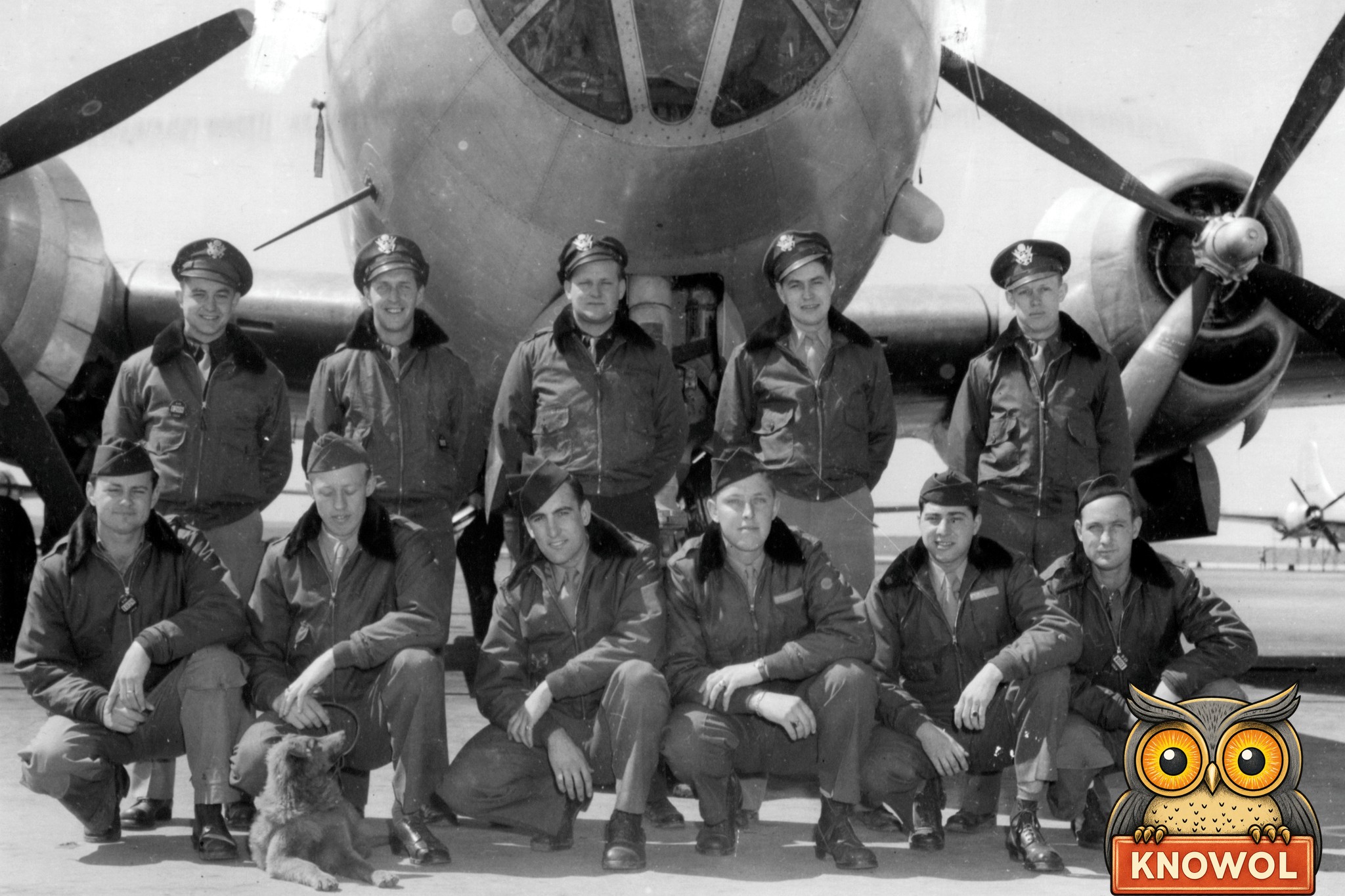
The Pilchard crew of the 793rd Bomb Squadron, 468th Bomb Group, at an air base in India in 1944. U.S. Army Air Forces, National Archives. Click the photo to see it larger. The KNOWOL logo doesn’t appear on prints.
Eleven airmen of the 793rd Bomb Squadron, 468th Bomb Group, pose in front of a Boeing B-29 Superfortress at an air base in India in 1944. The back of the print names their pilot as Capt. R. M. Pilchard. The Army Air Forces didn’t date the photo, but it was taken before June 15, 1944. That night, Pilchard’s crew flew on the first B-29 raid on Japan, and their bomber never came back.
What to Look For
The men pose in two rows. The five standing in back wear officers’ caps with the eagle badge, and the back of the print names five officers. The six crouching in front wear soft garrison caps. Every man has on a zip-up flight jacket with a dark fur collar, and some have round badges clipped to the front. A fluffy dog lies on the pavement in front, and one of the crouching men reaches down to pet it.
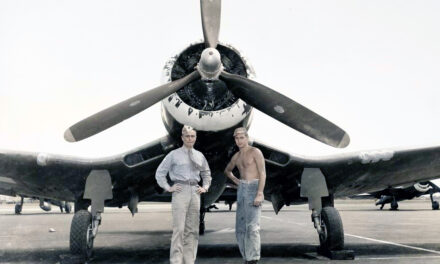
Behind them is the rounded glass nose of the B-29, where the bombardier and the two pilots sat. The big propellers of the two inner engines stand on either side of it. Behind the middle officer, you can see up into the well where the nose wheel folds away. Another bomber sits far off at the right edge of the picture.
The Long Way to Japan
The B-29 was the newest and biggest bomber the Army Air Forces had in 1944. The 468th Bomb Group belonged to XX Bomber Command, which kept its B-29s at bases around Kharagpur, in eastern India. To reach Japan, the bombers had to stop at airfields near Chengtu, China, now called Chengdu, and take on fuel there. For weeks, the B-29s hauled that fuel and other supplies to China themselves, flying over the Himalayas on the air route fliers called the Hump. The command flew its first combat mission against Bangkok, Thailand, on June 5, 1944.
The First Raid on Japan
The first target in Japan was the Imperial Iron and Steel Works at Yawata, on the island of Kyushu. Army planners rated it the most important single target in Japan’s steel industry, and their target files estimated it made about 24 percent of the country’s rolled steel. The bombers began flying from India to the China bases on June 13, and the 468th Group’s base was Pengshan. Each plane carried two tons of 500-pound bombs. The round trip to Yawata was about 3,200 miles. Army leaders in Washington didn’t think the B-29s had the range to fly that far in formation, so they ordered a night raid, with each plane bombing on its own.
Takeoff began at 4:16 p.m. on June 15, 1944. Of the 75 B-29s sent, 68 got into the air. The first one reached Yawata at 11:38 p.m. China time. The city was blacked out and hidden by haze or smoke, so of the 47 planes that bombed it, 32 aimed by radar and only 15 by sight. It was the first time American planes had flown over Japan since the Doolittle raid in April 1942. Photos taken on June 18 showed only one hit on the steel works, on a power house 3,700 feet from the coke ovens.
The Bomber That Didn’t Come Back
Pilchard’s B-29, Army serial number 42-93826, took off from Pengshan with 11 crewmen and one passenger. It never returned. The Missing Air Crew Report on it, number 6601, gives the place it was last known as “Unknown.” The report says the plane was lost to “other circumstances,” not to enemy fighters or antiaircraft guns. Only three Japanese fighters fired at the bombers that night, and they hit nothing.
The 468th Group listed two bombers as missing after the raid, and Pilchard’s was one of them. Search parties led by Capt. H. M. Berry tracked both planes down “with great difficulty.” Both had crashed, and everyone aboard was killed, including Robert Schenkel, a reporter for Newsweek magazine. In all, the mission cost XX Bomber Command seven planes and 55 men, though the enemy did little fighting. The Army recorded the deaths of Pilchard’s crew as June 16, 1944. On February 1, 1950, all twelve men were buried together in one group grave, Section R, Site 43, at Fort McPherson National Cemetery near Maxwell, Nebraska.
The Twelve Men Aboard
The report lists each man’s job on the plane and his next of kin, the family member the Army would notify.
- Pilot: 1st Lt. Robert Marvin Pilchard; his wife, Mildred, Salina, Kansas
- Copilot: 2nd Lt. Ray P. Sturges; his wife, Phyllis, Chicago, Illinois
- Navigator: 2nd Lt. John T. Roberts; his father, Herbert, Oklahoma City, Oklahoma
- Bombardier: 2nd Lt. Donald R. R. Mortimer; his wife, Mildred, Los Angeles, California
- Flight engineer: Lt. Jack Robins Bevan; his father, Hurus, Platteville, Wisconsin
- Senior gunner: Cpl. Lambert A. Pfeiffer; his father, Lambert Sr., Ecorse, Michigan
- Radio operator and gunner: S/Sgt. Delbert Grimes; his mother, Ethel, Chowchilla, California
- Radar officer: 2nd Lt. Harold Belle Myers; his father, Clyde, Melrose, New Mexico
- Left gunner: Sgt. Ralph V. Ferracane; his mother, Mary, Cambridge, Massachusetts
- Right gunner: Sgt. Robert P. Sharples; his father, William, Warsaw, Ohio
- Tail gunner: S/Sgt. William F. Quirke Jr.; his father, William, Lowell, Massachusetts
- Passenger: 1st Lt. Henry Escher; his wife, Alison, Schenectady, New York
The back of the print names ten of the eleven men in the photo, and nine of them were aboard that night. The typed caption spells Bevan as “Beran,” and it calls Pilchard a captain, while the report lists him as a first lieutenant. The tenth man it names, E. C. Wrigley, isn’t on the report, so he wasn’t on the plane. The caption doesn’t say which man is which.
About This Photo
- Archive title: “Capt. Pilchard and crew of the 793rd Bomb Squadron, 468th Bomb Group, pose in front of their Boeing B-29 at an air base somewhere in India.”
- Original caption: “They are: Capt. R. M. Pilchard, 2nd Lt. R. P. Sturges, 2nd Lt. J. T. Roberts, 2nd Lt. D. R. Mortimer, 2nd Lt. J. R. Beran, E. C. Wrigley, L. A. Pfeiffer, R. P. Sharples, R. V. Ferracane, W. F. Quirke and one unidentified.”
- Date: 1944, before June 15 (the photo isn’t dated)
- Place: An air base in India. The caption doesn’t name it; the crew’s report gives the squadron’s home base as Kharagpur.
- Photographer: U.S. Army Air Forces (the record doesn’t give a name)
- Collection: Photographs of Activities, Facilities and Personnel, Records of U.S. Air Force Commands, Activities, and Organizations (Record Group 342), National Archives at College Park, Maryland
- Photo number: U.S. Air Force photo 75594AC, Archives number 342-FH-3A34889-75594AC, National Archives Identifier 633471241. The print card says the original 4×5-inch negative came in on March 20, 1950, from the Adjutant General’s Office in St. Louis.
- Rights: Public domain, a work of the U.S. government
- Restoration: KNOWOL, 2026, from the Archives’ scan of the print
KNOWOL prints this restored photo on luster photo paper in the 12 x 18 inch size, plain or in a black or white wood frame. Click here to get your copy of the Pilchard B-29 crew photo.

Sources
- National Archives catalog, “Capt. Pilchard and crew of the 793rd Bomb Squadron, 468th Bomb Group,” with the back of the print
- National Archives, Missing Air Crew Report number 6601 (B-29 42-93826), Records of the Office of the Quartermaster General
- Wesley Frank Craven and James Lea Cate, eds., The Army Air Forces in World War II, Vol. V, Chapter 4, “XX Bomber Command Against Japan” (HyperWar)
- Fort McPherson National Cemetery burial records, Maxwell, Nebraska (Interment.net, from U.S. Department of Veterans Affairs records)