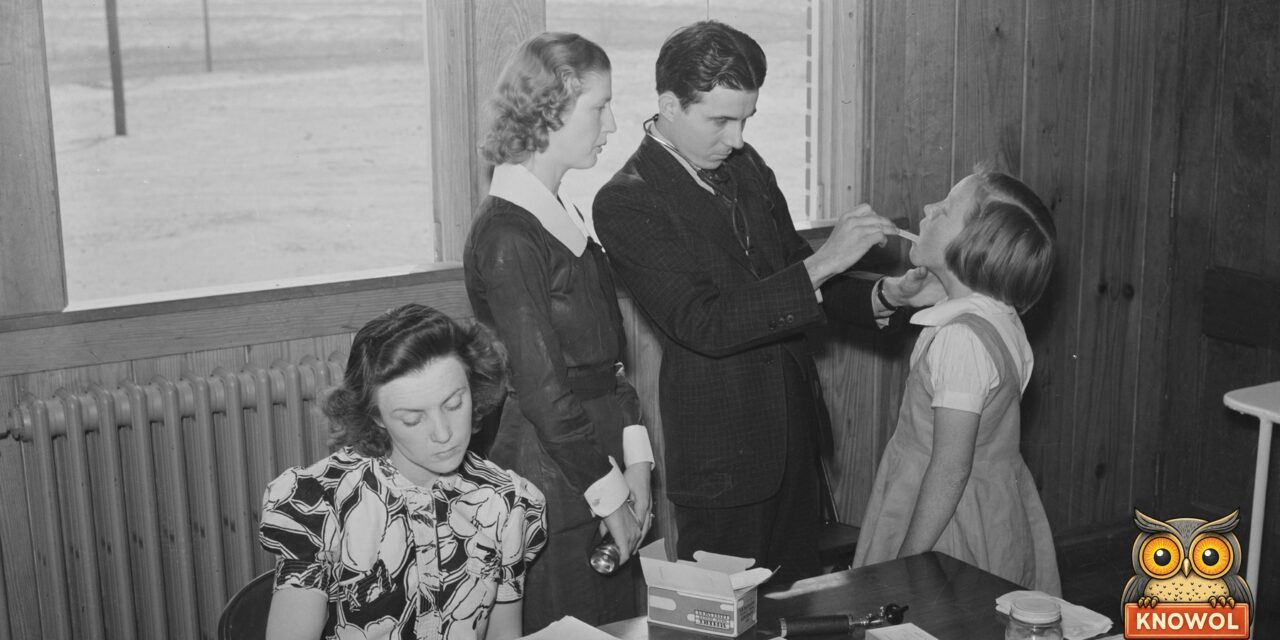
A little girl in a cotton jumper tips her head back and opens wide. A young doctor in a dark suit holds a wooden tongue depressor in one hand and her chin in the other. A nurse in a white collar watches closely, holding what looks like a flashlight. At the table, a first grade teacher writes it all down. It’s April 1939, in the brand-new health room of Goodman School, out in the farm country of Coffee County, Alabama, about eight and a half miles from Enterprise, Alabama.
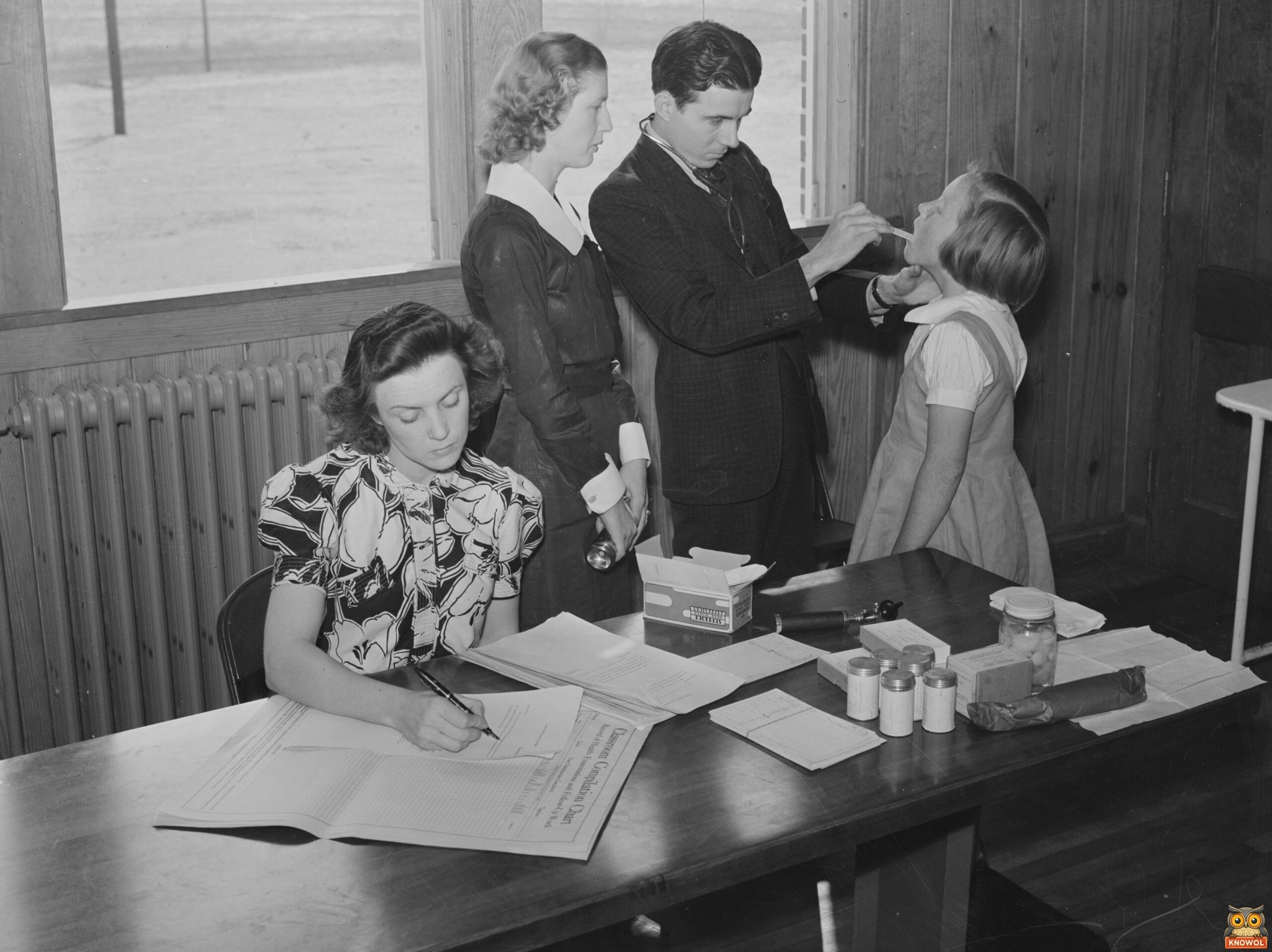
“Nurse and doctor examining throat and teeth of child in health room of Goodman School with first grade teacher keeping records. Coffee County.” Photo by Marion Post Wolcott, April 1939. Library of Congress, Prints and Photographs Division, FSA/OWI Collection. No known restrictions. Click the picture to see it full size.
The photographer’s caption card tells us exactly what’s going on: “Nurse and doctor examining throat and teeth of child in health room of Goodman School with first grade teacher keeping records.” It doesn’t give anyone’s name. But the room, the school, and the reason a government photographer came to take its picture make a good story.
What’s on the Table in the Goodman School Health Room
The table in the Goodman School health room is a little museum of a 1939 checkup. Near the middle sits an open box of wooden tongue depressors, the flat sticks a doctor presses on your tongue to see your throat. Next to it lies what looks like a lighted tool for peeking into ears. There’s a glass jar packed with cotton balls, a row of small round tins, and stacks of white cards, probably one for each child.
The big sheet under the teacher’s pen has its title printed right across it: “Classroom Compilation Chart.” Under that, in smaller letters, it says “Record of Health Examinations and Follow-Up Work.” So this wasn’t a one-time look. Every child’s checkup went onto one chart for the whole class, and the “follow-up work” meant coming back later to help anyone who needed it.
Look at the room, too. The walls are smooth wooden boards. A radiator runs under the window, which meant heat on cold mornings. Outside the glass is a wide, sandy schoolyard with a couple of bare poles.
Miss Teal, the Nurse at Goodman School
The nurse in the Goodman School photo is almost surely Miss Teal. Wolcott took more pictures in the same health room that April, and two of the caption cards name her. One says, “Nurse, Miss Teal, weighing child in health room of Goodman School.” In that picture she wears the same dark dress, with the same white collar and white cuffs.
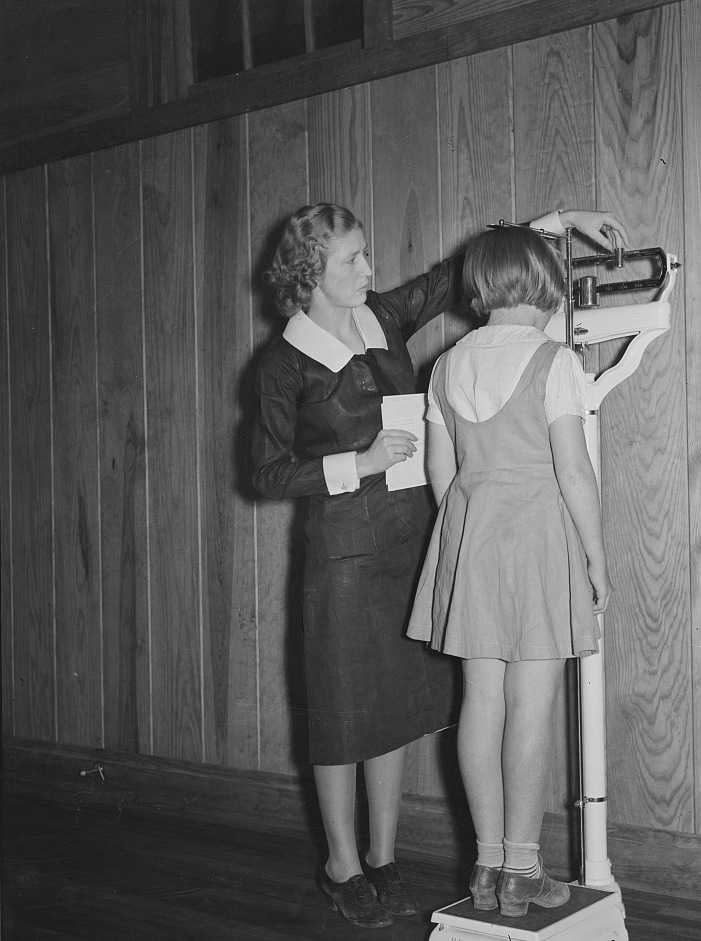
“Nurse, Miss Teal, weighing child in health room of Goodman School. Coffee County, Alabama.” Photo by Marion Post Wolcott, April 1939. Library of Congress, FSA/OWI Collection. No known restrictions. Click the picture to see it full size.
Miss Teal didn’t stay in one room. Other Coffee County cards by Wolcott show her bringing medicine to a farm family’s home and helping doctors at clinics in Enterprise. The cards give only her last name, and we couldn’t find her first one.
Another card from the same Goodman School room says the doctor and Miss Teal were “giving examination and treatment for hookworm to one of children.” That one word, hookworm, explains a lot about why a country school needed a health room at all.
Why Alabama Schools Checked Kids for Hookworm
Hookworm is a tiny worm that lived in the soil of the rural South. Its tiny young could dig right through the skin of a bare foot. Once inside, the worms fed on a person’s blood. Children with hookworm got pale and tired, and many were too worn out to keep up in school, the Encyclopedia of Alabama says.
Alabama had been fighting it for 30 years. From 1909 to 1914, a group paid for by John D. Rockefeller, the Rockefeller Sanitary Commission, examined more than 12,500 Alabama children in 12 counties. On average, 57 out of every 100 had hookworm. Things got better, but a 1930 survey still found that in the southern part of Alabama, where Coffee County is, about 75 out of every 100 schoolchildren had it.
The cure was a few doses of worm medicine. The way to stay cured was shoes, which kept the worms out of bare feet, and toilets or good outhouses, which kept the worms’ eggs out of the soil. That was hard in 1940, when 80 out of every 100 Alabama homes still didn’t have full indoor plumbing. So a nurse who knew every family, and a chart that remembered every child, mattered.
A Report Asked for a Building in Goodman, Alabama
Goodman, Alabama, had been in a government report two years before. In December 1937, the Farm Security Administration printed a study called A Basis for Social Planning in Coffee County, Alabama, by Karl Shafer. One of its jobs was to say where new community buildings should go.
The study mostly pointed at two communities up north. Then it added Goodman: “Consideration should, however, also be given to the Goodman community in the southern part, due to the fact that it is an established trade center and therefore a natural community center, that it is approximately nine miles from the nearest standard high school.”
Nine miles was a long way for a farm kid to get to high school in 1937. The records we found don’t say who paid for the new school or whether the study helped. But by April 1939, Goodman had its new building. Wolcott photographed kids running across the sandy yard at noon in front of a long brick school with white columns. The words over the front door say “COMMUNITY BUILDING.”
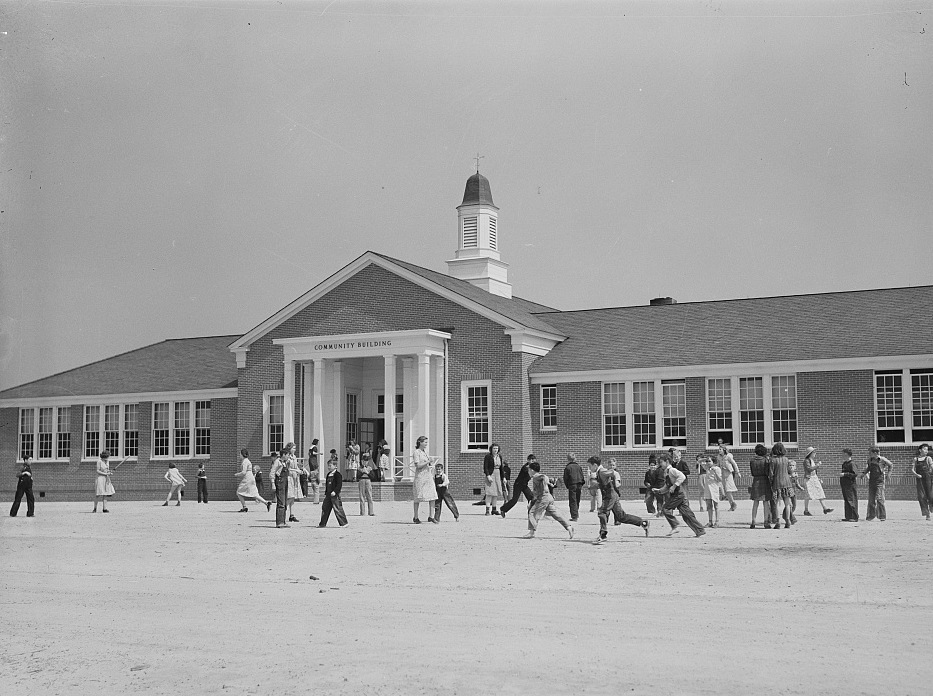
“New school and community building. Goodman School at noon hour. Coffee County, Alabama.” Photo by Marion Post Wolcott, April 1939. Library of Congress, FSA/OWI Collection. No known restrictions. Click the picture to see it full size.
Her caption cards say the new Goodman School replaced three smaller schools. She photographed them too. A May 1939 picture shows an empty classroom in the old Goodman school with bare board walls and long, rough wooden benches. Then picture the health room again, with its smooth wooden walls, its radiator and its window full of light.
Why the Government Cared About Coffee County, Alabama
Coffee County, Alabama, had been through a lot by 1939. Shafer’s study tells how the boll weevil, a beetle that eats cotton, wrecked the county’s cotton crop around 1917 and 1918. Farmers switched to peanuts, and the money came back. The people of Enterprise even put up a monument to the boll weevil in the middle of town, in 1919. A boll weevil monument still stands in downtown Enterprise today.
Then the Great Depression hit. In 1935, Shafer wrote, about 60,000 acres of farms that lenders had taken back were handed to a state relief group. Two years later those farms belonged to the brand-new Farm Security Administration. The FSA lent money to struggling farm families and sent workers to help with farming, homemaking and health. One of Wolcott’s April cards shows Miss Teal bringing hookworm medicine to a farm family in the FSA’s program. The Library of Congress files all these pictures under one subject: “Coffee Farms.”
Who Took the Picture in Coffee County, Alabama
The woman behind the camera at Goodman School was Marion Post Wolcott. She was born in 1910, so she was 28 that spring. Back then she was still Marion Post. She married Leon Oliver Wolcott in 1941 and left the job in 1942.
She worked for the FSA’s photo office, which sent photographers all over the country to show how Americans lived and worked, and how the government’s farm programs were going. That spring in Coffee County she photographed farms, schools and clinics, and her caption cards name families, teachers and nurses. In 1944 the pictures went to the Library of Congress, where anyone can see them free today.
She could have made the Goodman health room look like a hospital. Instead she caught a regular school day: a teacher with her pen, a nurse watching close, a doctor bent over his work, and one little girl with her mouth open as wide as it would go.
Sources
- Marion Post Wolcott, “Nurse and doctor examining throat and teeth of child in health room of Goodman School with first grade teacher keeping records. Coffee County,” April 1939: Library of Congress, item 2017800653 (LC-USF34-051442-D). Caption card quoted from the record; chart words read off the full-size scan.
- Same shoot, April 1939: Miss Teal weighing a child, item 2017800654; hookworm examination in the health room, item 2017800652; Goodman School at noon hour, item 2017800594; Miss Teal brings hookworm medicine to a family, item 2017800587. May 1939: classroom in the old Goodman school, item 2017800962.
- Karl Shafer, A Basis for Social Planning in Coffee County, Alabama (U.S. Department of Agriculture, Farm Security Administration and Bureau of Agricultural Economics, Social Research Report No. VI, December 1937), printed pages 2 and 38: Internet Archive. Quote read off the page scan.
- Encyclopedia of Alabama, Hookworm Disease in Alabama and Coffee County.
- Goodman, Alabama and Marion Post Wolcott on Wikipedia.
- About the FSA/OWI photographs and their rights: Library of Congress, FSA/OWI Black-and-White Negatives and rights and restrictions.