
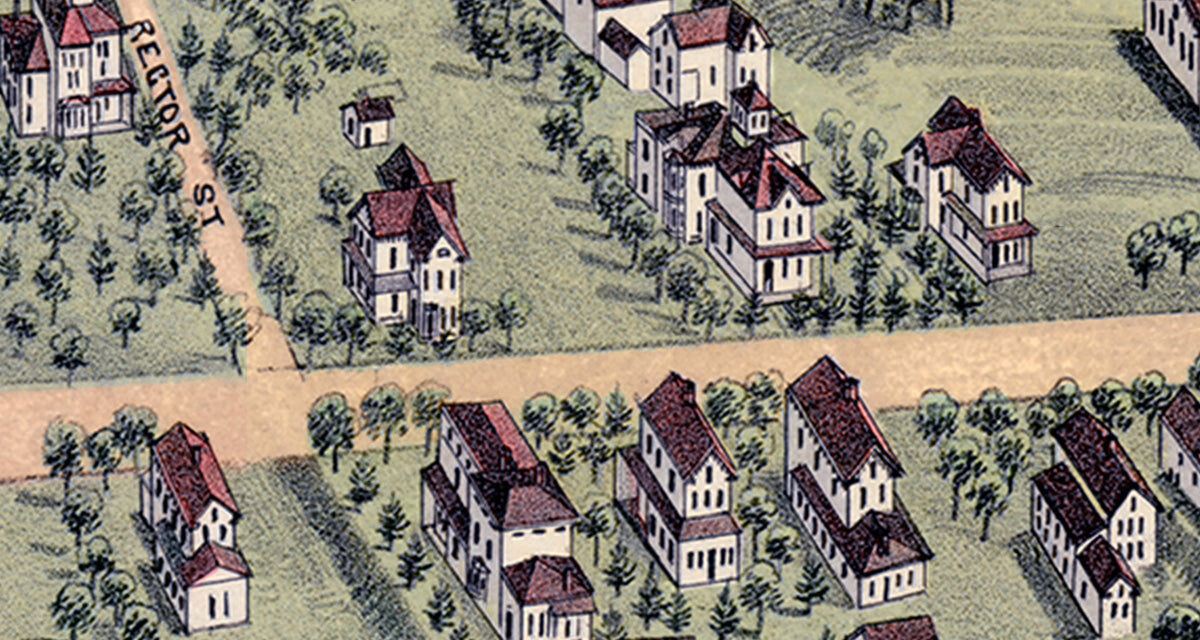
Oakley Hoopes Bailey, who signed his work O. H. Bailey, was an Ohio-born artist who drew and published bird’s-eye views of American towns from about 1871 to 1926. From his home in Cambridge, Massachusetts, and his offices in Boston and New York, he pictured hundreds of places in New England, New York, New Jersey and Pennsylvania as if seen from a few thousand feet up, long before anyone could take a picture from an airplane. He was born in Beloit, Ohio, on June 14, 1843, served in the Union Army in 1864 and died in Alliance, Ohio, on August 13, 1947, at the age of 104.

O. H. Bailey at a Glance
- Full name: Oakley Hoopes Bailey (his family spelled it Baily)
- Born: June 14, 1843, Beloit, Mahoning County, Ohio
- Died: August 13, 1947, Alliance, Ohio, age 104
- Civil War: Private, Company F, 143rd Ohio, May to September 1864
- Home: 83 Inman Street, Cambridge, Massachusetts, from 1875 into the 1910s
- Firms: O. H. Bailey & Co., Bailey & Hazen, Bailey & Moyer, Fowler & Bailey, Hughes & Bailey
- Years at work: about 1871 to 1926
- Views: 226 known views (below); he put his own total at nearly 600 places
A Quaker Boy From Beloit, Ohio
Bailey grew up in Beloit, a village in Mahoning County, Ohio, the fifth of six children of Hoopes and Ann Paxson Baily. The family were Quakers, and most of them spelled the name without the second e. Oakley added it, and every print he ever made says Bailey. His middle name was his father’s first name. He studied at Mount Union College in nearby Alliance in the early 1860s and taught in the Fairmount and Mount Pleasant schools around Alliance before the war. Eighty years later he still remembered one class: “I still remember that geometry was tough.”
A Hundred Days in the Union Army
In May 1864 Bailey joined Company F of the 143rd Ohio, a National Guard regiment called up for 100 days. Company F came from Fairfield Township in Columbiana County, under Captain Benjamin S. Wright. The regiment formed at Camp Chase near Columbus on May 13 and went first to Washington, D.C., where it manned Forts Slemmer, Totten, Slocum and Stevens on the north side of the city. In June it was sent to Virginia, to Bermuda Hundred and the trenches near City Point, and then to Fort Pocahontas on the James River. The men came home and mustered out at Camp Chase in September 1864.
He stayed proud of those hundred days for the rest of his life. In 1909 he was Senior Vice Commander of John A. Logan Post 186 of the Grand Army of the Republic, the Union veterans’ society, in Cambridgeport, Massachusetts. In 1946 a Boston newspaper column called him the oldest Grand Army man in Ohio.
Teacher, Traveler, Then Viewmaker
After the war Bailey went back to Mount Union in 1866. He taught school in St. Louis, St. Paul and St. Anthony, the town that became part of Minneapolis, and he worked with his older brother, Howard Heston Bailey, on a business directory that took him as far as Chicago, Indianapolis and Minneapolis. Howard had taught penmanship and worked as a photographer before he took up bird’s-eye views, and Oakley followed him into the trade around 1871. The two brothers’ names appear together on an 1872 view of Columbus, Ohio. Howard died in Alliance in February 1878, at 41, and Oakley carried the family business on.
Married in Indiana, Settled in Cambridge
On August 21, 1872, Bailey married Sarah Frances Kelly in Dublin, Indiana, where her sister lived. Sarah was born in Bradford, Vermont, and had taught school in Chicago and Indianapolis. By 1874 Bailey had set up his business in Boston, and in 1875 the couple settled across the Charles River in Cambridge. Their house at 83 Inman Street was the address of O. H. Bailey & Co., map publishers, in the Cambridge city directory year after year for more than thirty years. In the early 1880s the firm also kept a Boston office at 13 Franklin Street. Their daughter, Iovel, was born in 1875 and their son, Eric, in 1879. A family history printed in 1913 called Sarah “an active business manager.”
How a Bailey View Was Made
There was no airplane and no balloon. Bailey first laid out the town’s street plan as if it were tilted up toward the viewer, the way it would look from 2,000 or 3,000 feet. Then he walked the streets, sketching the houses, churches, mills, stores, bridges and trees one by one. Back in the workroom he set each sketch into its place on the street plan. The finished drawing went to a lithographer, who copied it onto stone and printed it. In the 1870s his views were printed by shops in Milwaukee, Cincinnati and Cambridge. By 1890 his own firm was printing them in Boston.
It was slow, careful work, and he knew it. Looking back in 1932, he said the business had “been practically without competition as so few could give it the patience, care and skill essential to success.” The company that printed his later views told the Library of Congress that 100 to 250 copies of each one were usually printed, which is why so few survive today.
The views were sold before they were printed. In June 1881 the Guilford column of a New Haven paper reported that Bailey had just sketched the borough’s streets and buildings, and that “an agent is canvassing the borough for subscribers, and is meeting with good success thus far.” A month later he was in Branford, carrying his pencil drawing around town to show people what their view would look like. In 1885 a Mr. Fowler of O. H. Bailey & Co. showed a pencil sketch of Milford, Delaware, with a plain promise: if enough people subscribed, it would be printed. A town got its view only when enough of its people had ordered one.

The Men He Worked With
Bailey rarely worked alone. From 1876 to 1880 he drew and published with James C. Hazen of Boston, and their names are on views of Boston, New Haven, Fall River, Lawrence, Lynn, Brattleboro and many smaller towns. In 1898 he worked with a partner named Moyer on a run of Pennsylvania towns around Reading. From 1904 to 1926 his New York firm, Hughes & Bailey, published views of towns in Connecticut, Massachusetts, New York, New Jersey and Pennsylvania.
His closest friend in the trade was the viewmaker Thaddeus Mortimer Fowler (1842-1922). Fowler drew many of the views that carry Bailey’s firm names, from Lewisburg, Pennsylvania, in 1884 to Waterbury, Meriden and Derby, Connecticut, from 1917 to 1920. The two men spent more than four years on a pen-and-ink panorama of Allentown, Pennsylvania, 28 by 71 inches, that was never printed. In 1918 Fowler was arrested in Allentown as a suspected German spy, because his drawing showed airplanes over the city. Bailey took over the Allentown job, and in a 1920 letter Fowler wrote that Bailey got a much warmer welcome than he did. The drawing is in the Library of Congress today.
The Aero Views
From 1909 on, Hughes & Bailey called their prints aero views, and the artists drew biplanes and airships into the sky to suggest the pictures had been made from the air. They hadn’t. They were drawn the same way as the 1870s views, street by street, by hand. One of Bailey’s drawings of Atlantic City, New Jersey, is more than seven feet long and shows five or six miles of the boardwalk, the hotels and the ocean front.
He saw the end coming. In 1932 he said airplane cameras could “put more towns on paper in a day than was possible in months by hand work.” The last dated Hughes & Bailey view is Hammonton, New Jersey, in 1926, and Bailey retired about then, as his eyesight failed.
His Last Years in Ohio
Bailey went home to Ohio and lived in Alliance with his niece Anna Lamborn until she died in 1938, and later with family and friends in the same town. He kept traveling into his late eighties. In 1931 he visited Boston and other eastern cities, and in 1932 he went to New York with his niece. By about then his sight was gone, and he was blind for the last 15 years of his life. In 1937, at 94, he wrote a history of Quaker Hill, the old Quaker settlement near Alliance. In 1946 Mount Union College, in its 100th year, claimed him as the oldest living college graduate in the United States.
In August 1946 he was one of only eight members of the Grand Army still living in Ohio. A year later, when the national encampment of the Grand Army of the Republic met in Cleveland, Ohio’s welcome named its six surviving veterans, and Bailey’s name was first: “Oakley H. Bailey, age 104, Alliance.” He died there that same week, on Wednesday, August 13, 1947. The Associated Press called it unexpected. He and the national commander of the Grand Army had been the last two members of Alliance’s John C. Fremont Post, and the wire reports from Cleveland noted that his death left only 67 members of the Grand Army alive.
How Many Towns Did O. H. Bailey Draw?
Nobody knows the exact number. In 1932 Bailey said he had sketched nearly 600 places in about 20 states and Canada, and that more than a million copies of his views had been printed. His numbers may have been generous. The Library of Congress holds 158 prints of about 150 different places under his name and his firms’ names. The Boston Public Library once counted 242 views he drew or published between 1874 and 1891. KNOWOL has restored Bailey views of 60 towns that aren’t in the Library of Congress at all, from New Canaan and Westport, Connecticut, to Lambertville, New Jersey, and Clayton, Delaware. The list below has all 226 Bailey views we’ve found so far, and we’ll keep adding to it.
Every O. H. Bailey View We Know Of
Here are all 226 views, by state and town. Click a town name to see the town on a KNOWOL map today. “Library of Congress” opens the library’s free scan of the original. “Restored print” is our restored copy of the view, and “The story” is our article on the town at the time it was drawn.
Connecticut (73)
Massachusetts (78)
Rhode Island (10)
| Town | Year | Original | KNOWOL |
|---|---|---|---|
| Bristol | 1891 | Library of Congress | Restored print · The story |
| Lonsdale | 1888 | Library of Congress | |
| Pascoag and vicinity | 1895 | Library of Congress | Restored print · The story |
| Pawtucket & Central Falls | 1877 | Library of Congress | The story |
| Warren | 1877 | The story | |
| Washington | 1888 | Restored print | |
| Washington Village | 1888 | The story | |
| Westerly | 1877 | Library of Congress | The story |
| Westerly | 1911 | Library of Congress | |
| Wickford | 1888 | Library of Congress |
New Hampshire (1)
| Town | Year | Original | KNOWOL |
|---|---|---|---|
| Concord | 1875 | Library of Congress |
New York (11)
| Town | Year | Original | KNOWOL |
|---|---|---|---|
| borough of Larchmont | 1904 | Library of Congress | |
| Despatch, N.Y., Rochester's great industrial suburb | 1890 | Library of Congress | |
| Freeport, Long Island | 1909 | Library of Congress | |
| Gloversville | 1875 | Library of Congress | |
| Monroe | 1923 | Library of Congress | |
| National Prohibition Park, Westerleigh, borough of Richmond, Staten Island, New York City | 1898 | Library of Congress | |
| Oneida | 1874 | Library of Congress | |
| Patchogue, Long Island | 1906 | Library of Congress | |
| Pearl River | 1924 | Library of Congress | |
| Peekskill | 1911 | Library of Congress | |
| Silver Lake Park, on St Mary's Lake, White Plains | 1880 | Library of Congress |
New Jersey (19)
| Town | Year | Original | KNOWOL |
|---|---|---|---|
| Atlantic City | 1909 | Library of Congress | |
| Atlantic City | 1910 | Library of Congress | |
| Atlantic Highlands | 1894 | Library of Congress | |
| Belvidere | 1883 | The story | |
| Blairstown | 1883 | Restored print · The story | |
| Bridgeton | 1886 | Library of Congress | |
| Dover | 1903 | Library of Congress | |
| Hackensack | 1896 | Library of Congress | The story |
| Hackettstown | 1883 | The story | |
| Hammonton | 1926 | Library of Congress | |
| Hoboken | 1881 | Library of Congress | Restored print |
| Hoboken | 1904 | Library of Congress | |
| Lambertville | 1883 | Restored print · The story | |
| New-Brunswick | 1910 | Library of Congress | |
| Newton | 1883 | Restored print · The story | |
| Properties of the Delaware River Improvement Company on Morrisville Island, Pa. opposite Trenton | 1900 | Library of Congress | |
| Rockaway | 1902 | Library of Congress | |
| Vineland | 1885 | Library of Congress | |
| Woodbury | 1886 | Library of Congress |
Pennsylvania (23)
| Town | Year | Original | KNOWOL |
|---|---|---|---|
| Allentown | 1879 | Library of Congress | |
| Bangor | 1885 | The story | |
| Bangor | 1918 | Library of Congress | |
| Bath | 1885 | The story | |
| Bernville | 1898 | Library of Congress | |
| Berwick | 1884 | Library of Congress | |
| Bethlehems | 1878 | Library of Congress | |
| Catasauqua | 1873 | Library of Congress | |
| Chester | 1885 | Library of Congress | |
| East Stroudsburg | 1884 | The story | |
| Hazleton | 1884 | The story | |
| Lehighton | 1883 | The story | |
| Lewisburgh | 1884 | Library of Congress | |
| Mifflinburg | 1884 | Restored print · The story | |
| Mohnsville | 1898 | Library of Congress | |
| Mount Carmel | 1884 | The story | |
| Nazareth | 1885 | Restored print · The story | |
| Newmanstown and Sheridan | 1898 | Library of Congress | |
| Ogontz Park, Ogontz, Montgomery Co., Penna. : Wm. T.B. Roberts, 410 Land Title Bldg., Philadelphia | 1880 | Library of Congress | |
| Pen Argyl | 1916 | Library of Congress | |
| Reading | 1898 | Library of Congress | |
| Slatington | 1883 | The story | |
| Womelsdorf | 1898 | Library of Congress |
Delaware (2)
| Town | Year | Original | KNOWOL |
|---|---|---|---|
| Clayton | 1885 | Restored print · The story | |
| Wilmington | 1874 | Library of Congress |
Ohio (2)
| Town | Year | Original | KNOWOL |
|---|---|---|---|
| Columbus | 1872 | Library of Congress | |
| Lancaster | 1885 | The story |
Indiana (2)
| Town | Year | Original | KNOWOL |
|---|---|---|---|
| Muncie | 1884 | The story | |
| Richmond | 1884 | Library of Congress |
Michigan (5)
| Town | Year | Original | KNOWOL |
|---|---|---|---|
| Alma | 1885 | The story | |
| Clare | 1884 | Restored print · The story | |
| Coleman | 1884 | Restored print · The story | |
| Midland | 1884 | Restored print · The story | |
| Mt. Pleasant | 1884 | Restored print · The story |
O. H. Bailey in the Newspapers
These are the words of the newspapers that saw Bailey at work, and saw him off. Click a town to see it on a KNOWOL map today.
Guilford, Connecticut, 1881
From the Guilford news column, about "O. H. Bailey, of Cambridgeport, Mass.":
“has recently sketched our borough, streets, buildings, etc. The sketch is to be lithographed, giving what is termed a bird's-eye view of the place, and an agent is canvassing the borough for subscribers, and is meeting with good success thus far.”
Morning Journal and Courier, New Haven, Connecticut, June 30, 1881. See the original page. See the finished view: Guilford, 1881.
Branford, Connecticut, 1881
From the Branford news column:
“O. H. Bailey, of Boston, has penciled a map of this town, wherein he illustrates most lucidly the business interests of the town. He is exhibiting the penciled copy at present, from which other copies are to be lithographed.”
Morning Journal and Courier, New Haven, Connecticut, July 23, 1881. See the original page.
Milford, Delaware, 1885
From the Milford news column, dated August 13:
“Mr. Fowler, of O. H. Bailey & Co., Boston, is in town exhibiting a pencil sketch of Milford drawn by O. H. Bailey. If enough subscriptions [are] obtained the sketch will be lithographed.”
Delaware Gazette and State Journal, Wilmington, Delaware, August 20, 1885. See the original page.
Alliance, Ohio and Beloit, Ohio, 1946
Bailey at 102, looking back on his college days at Mount Union in Alliance, in a story that also told of his birth in Beloit:
“I still remember that geometry was tough.”
Salem News, Salem, Ohio, June 4, 1946. See the original page.
Alliance, Ohio and Cambridge, Massachusetts, 1947
From Alliance, the wire story that also noted he had once been in business in Cambridge, Massachusetts:
“Oakley Bailey, 104-year-old Civil War veteran, died unexpectedly Wednesday.”
Associated Press, in the Marion Star, Marion, Ohio, August 14, 1947. See the original page.
Did Bailey Draw Your Town’s View, or Did Fowler?
Look at the small print along the bottom edge. Many views from 1877 to 1880 read “Drawn & Pub. by O. H. Bailey & J. C. Hazen,” and many others read “O. H. Bailey & Co.” Some views from the 1880s, and many from 1910 to 1920, that carry Bailey’s firm names were drawn by T. M. Fowler. A view signed “Fowler & Bailey” was a joint job. If your print says Hughes & Bailey, it was published by Bailey’s New York firm, and the artist may have been Bailey, Fowler or another artist.
Questions People Ask About O. H. Bailey
What does O. H. stand for?
Oakley Hoopes. Hoopes was his father’s first name.
Were Bailey’s views drawn from an airplane or a balloon?
No. He drew the street plan in perspective and then walked the town sketching every building. Even his later “aero views,” with airplanes drawn in the sky, were made by hand on the ground.
Was O. H. Bailey related to H. H. Bailey?
Yes. Howard Heston Bailey (1836-1878) was his older brother, and Oakley learned the trade from him.
Did O. H. Bailey fight in the Civil War?
Yes. He served as a private in Company F of the 143rd Ohio from May to September 1864, guarding the forts around Washington, D.C., and serving in Virginia near City Point and Bermuda Hundred.
Where did O. H. Bailey live?
He was born in Beloit, Ohio, lived at 83 Inman Street in Cambridge, Massachusetts, from 1875 into the 1910s, and spent his last years in Alliance, Ohio.
How many copies of a Bailey view were printed?
Usually 100 to 250, according to the company that printed his later views. That’s why an original is hard to find today.
How old was O. H. Bailey when he died?
He was 104. He died in Alliance, Ohio, on August 13, 1947, as one of the last Union veterans of the Civil War living in Ohio.
Where This Comes From
This life of O. H. Bailey was put together from the records of his own time: the Kirk family genealogy (1913) and the Kelly family genealogy (1886), the Official Roster of the Soldiers of the State of Ohio and the History of Columbiana County, Ohio (1879), the Cambridge city directories from 1877 to 1918 and the 1904 Cambridge poll list, the journals of the Grand Army of the Republic for 1909 and 1947, the reports of the State Library of Massachusetts, the 1912 Catalog of Copyright Entries, the Salem (Ohio) News from 1931 to 1947, other Ohio and Boston newspapers of 1946 and 1947, and the catalog records and published research of the Library of Congress.
















