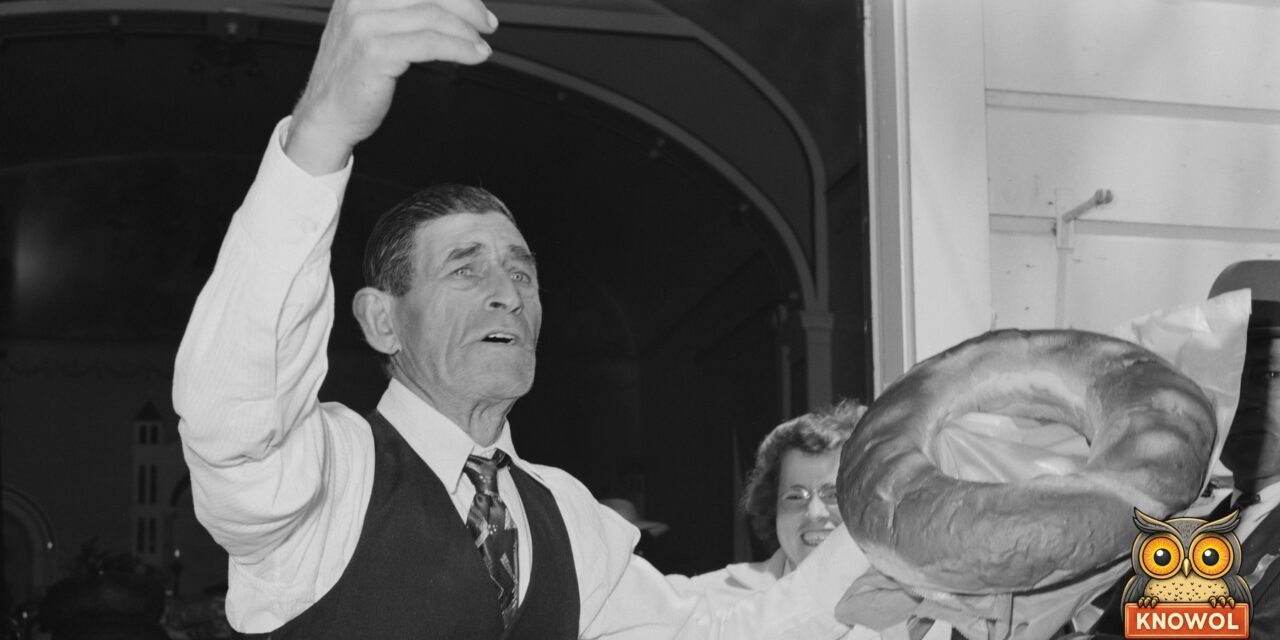
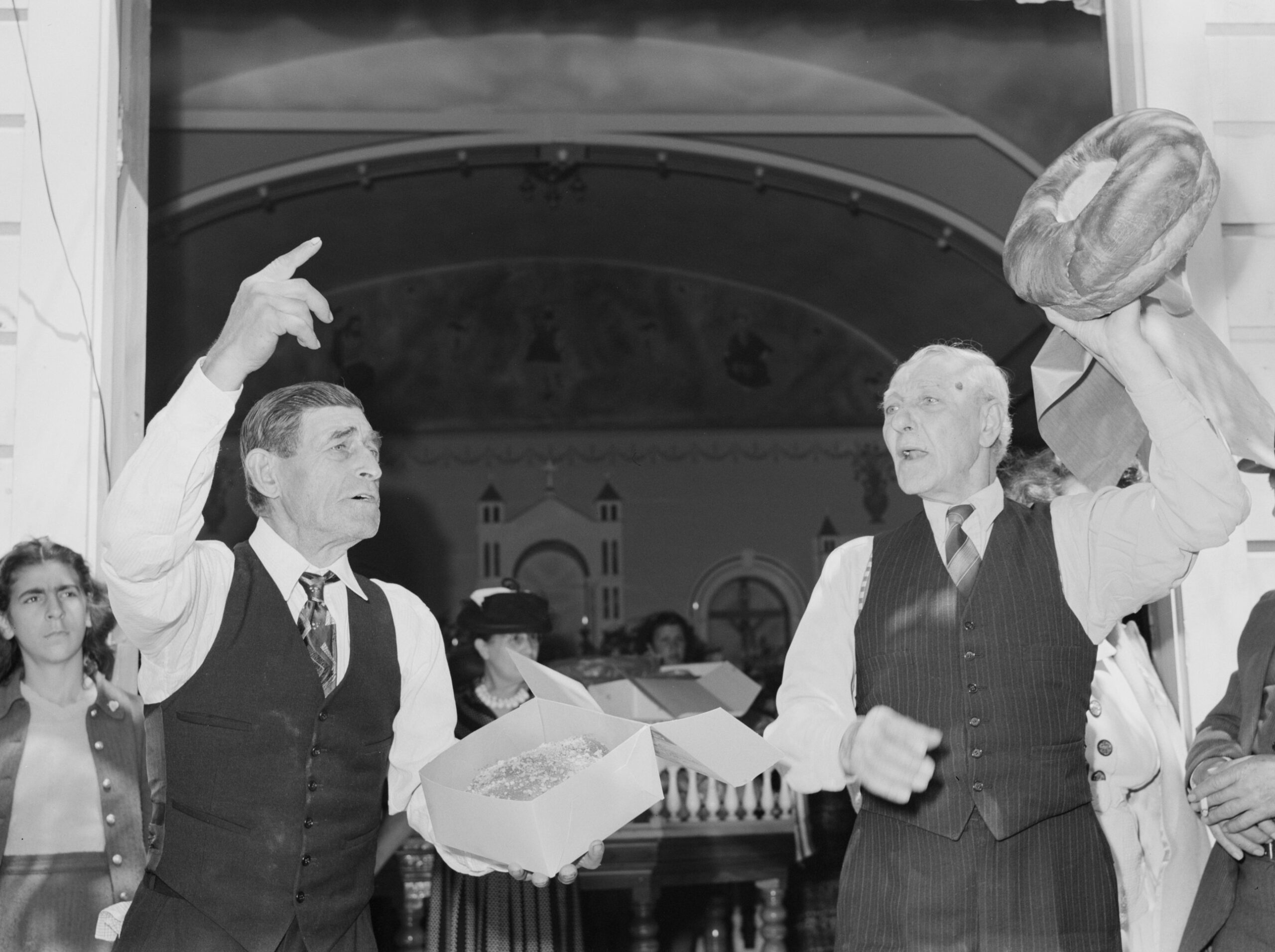
A man in a dark vest throws his arm high and calls out over the crowd. In his other hand he holds up a big round loaf of bread, shaped like a ring and wrapped in paper, so everyone in the back can see it. A woman in a white coat is smiling behind him. It’s May 1942 in Santa Clara, California, and this man is running an auction. The photographer, Russell Lee, wrote down the most surprising part on his caption card: “It is not unusual for a single egg or lemon to sell at auction for one dollar.”
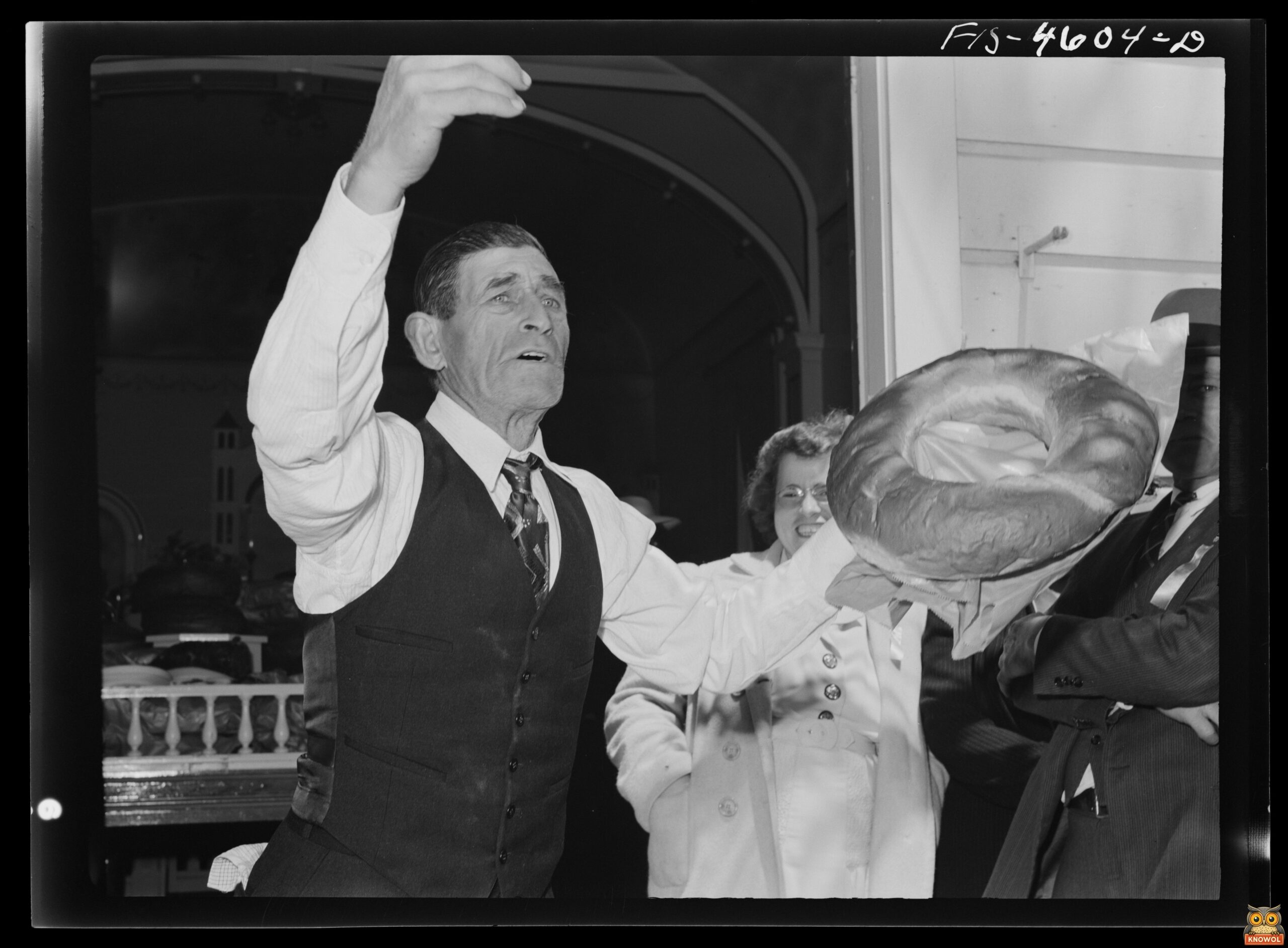
“Auction followed the dinner at the fiesta of the Holy Ghost. Santa Clara, California.” Photo by Russell Lee, May 1942. Library of Congress, Prints and Photographs Division, FSA/OWI Collection. No known restrictions. Click the picture to see it full size.
Why One Egg Cost a Dollar in Santa Clara, California
Nobody at the auction in Santa Clara needed a dollar egg. A whole dozen eggs cost well under a dollar at the store in 1942, and a dollar then was worth about $20 in today’s money. People paid it anyway, because the money wasn’t really for the egg. Lee’s card explains: “Rather than distributing food to the needy of the community during the fiesta of the Holy Ghost, proceeds from the auction are used for this work.”
In plain words, the auction was a way to help the poor. Instead of handing out food on the day of the party, the neighbors bid on eggs, lemons and loaves, and the money went to people who needed it. So the man waving the bread was not just a salesman. He was turning a lemon into a meal for a family down the road, one dollar at a time.
Santa Clara, California, and Its Portuguese Neighbors
The people at this party in Santa Clara were Portuguese Americans. Many of their families had come from the Azores, a chain of islands in the middle of the Atlantic Ocean that belongs to Portugal. In the 1800s, Azorean farmers and sailors moved to California, and lots of them settled in the farm valleys around San Francisco Bay. Santa Clara, then a small town of orchards, had a big Portuguese community.
Those families started a club called the Sociedade do Espirito Santo, Portuguese for “Society of the Holy Spirit.” Everyone called it the S.E.S. It was officially formed on January 2, 1896, and it built a hall on Lafayette Street. Its biggest day of the year was the fiesta of the Holy Ghost (an old name for the Holy Spirit). One of Lee’s cards calls the S.E.S. the society “under whose sponsorship the fiesta of the Holy Ghost was held.”
The Queen and Her Crown in Santa Clara, California
The fiesta in Santa Clara goes back to a real queen. Isabel of Portugal lived about 700 years ago, from 1271 to 1336, and she was famous for feeding hungry people. The story Portuguese families tell is that during a hard time, she prayed to the Holy Spirit for help and promised to give away her crown. Later, people remembered her by holding a feast for everyone, with a crown carried in a parade. The custom faded in most of Portugal, but on the Azores it stayed strong, and the islanders brought it to America.
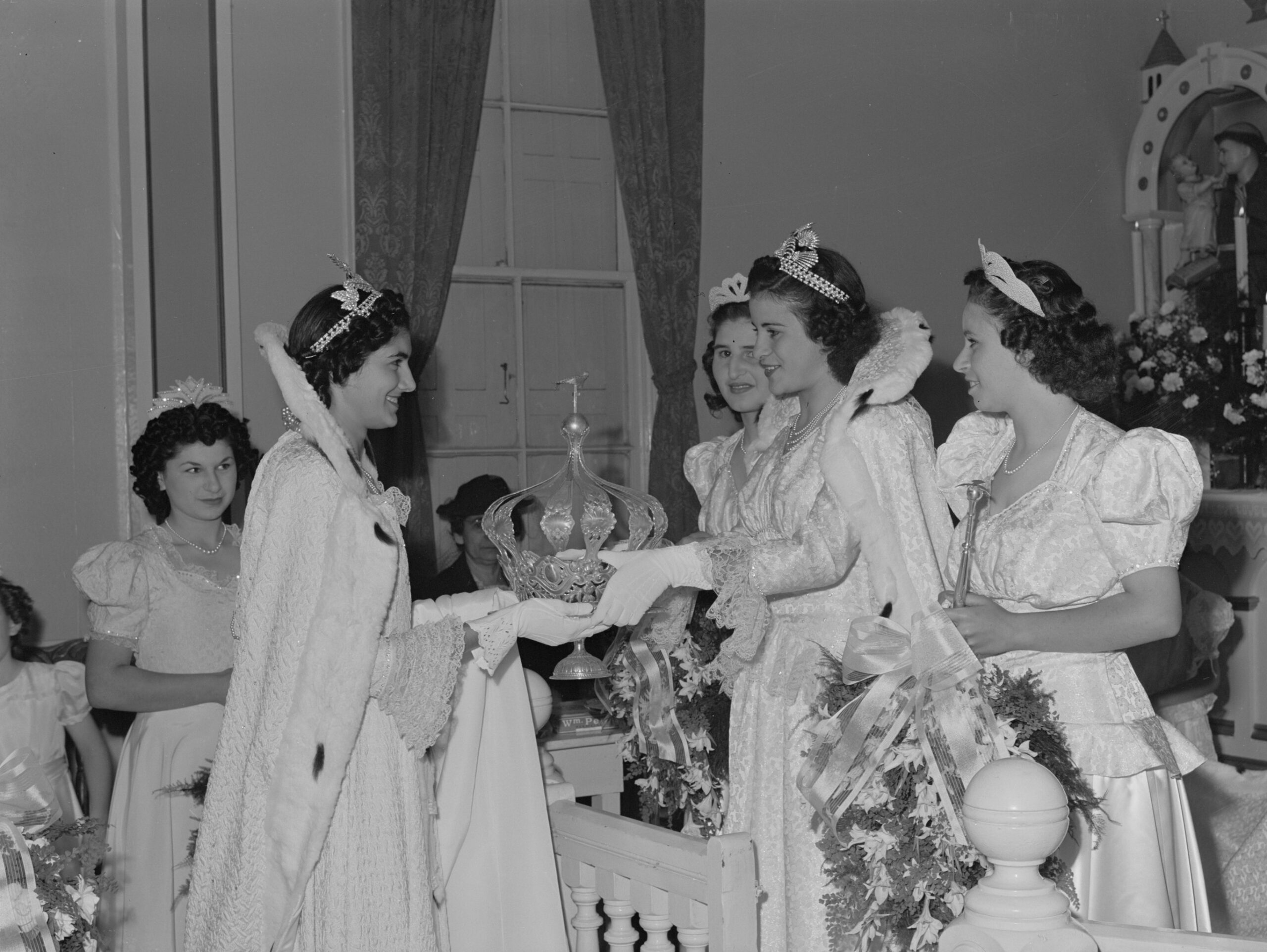
“Last year’s Queen of the fiesta of the Holy Ghost presents the crown to the new Queen of the fiesta. The new Queen will carry the crown in a parade to the church where she will be crowned. Santa Clara, California.” Photo by Russell Lee, May 1942. Library of Congress, FSA/OWI Collection. No known restrictions. Click the picture to see it full size.
Lee photographed that part of the day too. In one picture, young women in long white gowns and sparkling tiaras stand inside the hall. Last year’s queen, in a long cape, holds out a tall silver crown to the new queen. Lee’s card says, “The new Queen will carry the crown in a parade to the church where she will be crowned.” Other pictures show the parade through Santa Clara, with the queens, men carrying big embroidered banners, and flags.
Dinner for Everyone in Santa Clara, California
The Holy Ghost dinner in Santa Clara came before the auction. At the festa today, the dinner is free for anyone who comes, rich or poor, neighbor or stranger, the way Queen Isabel’s feast was meant to be. In 1942, men cooked beef over a long barbecue pit, and Lee took pictures of them slicing it. Then there was the soupa.
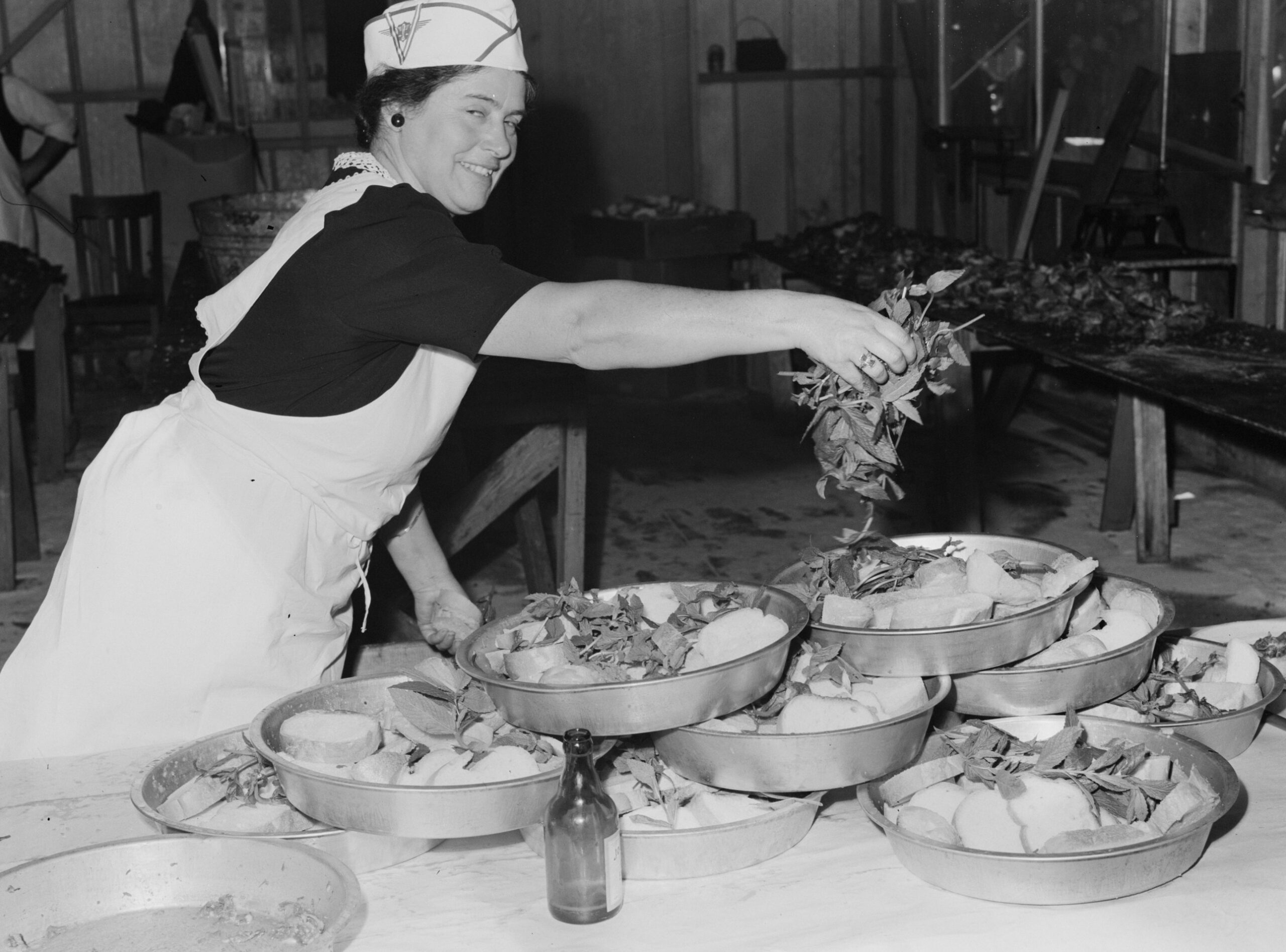
“Mint is used for the soupa to be served at dinner at the fiesta of the Holy Ghost. Santa Clara, California.” Photo by Russell Lee, May 1942. Library of Congress, FSA/OWI Collection. No known restrictions. Click the picture to see it full size.
In this picture, a smiling woman in a white apron and a paper cap reaches across a table covered with metal pans. Each pan is full of thick slices of bread, and she is tucking fresh mint leaves on top. Lee’s card explains what came next: “Soupa is a Portuguese-American dish and consists of highly spiced gravy poured over sliced bread and fresh mint.” Today the dish is usually called sopas, and it is still served free at the festa.
The Auction in Santa Clara, California
Then came the auction in Santa Clara. Look behind the man with the bread in the first picture. Through the doorway you can see a white wooden railing and a painted altar with two little towers. It looks like the altar inside the S.E.S. hall, where Lee photographed the new queen and her maids in their gowns.
“Santa Clara, California. Portuguese-Americans selling cakes at the fiesta of the Holy Ghost.” Photo by Russell Lee, May 1942. Library of Congress, FSA/OWI Collection. No known restrictions. Click the picture to see it full size.
The same man shows up in another picture. This time he points to the sky with one hand and holds an open box in the other. Next to him, an older man in a striped vest swings one of the ring-shaped loaves over his head. Lee’s card calls them “Portuguese-Americans selling cakes.” The record doesn’t give the men’s names, and it doesn’t say how much each loaf brought. It only says that one egg or one lemon could go for a dollar. With these two calling out the bids, that’s easy to believe.
Why a Government Photographer Came to Santa Clara, California
Russell Lee grew up in Illinois and studied to be a chemical engineer, but he loved taking pictures more. In 1936 he went to work for the Farm Security Administration, or FSA, a government office that helped struggling farm families. The FSA sent photographers all over the country with one big job: show how Americans really lived and worked.
By May 1942, the United States had been at war for five months. Lee’s Santa Clara pictures went to the Office of War Information, the government office that told Americans, and the rest of the world, about life in the United States during World War II. Lee spent that spring traveling around California, and he photographed Holy Ghost festivals in other Portuguese towns too, like Novato. His cards from Santa Clara catch the little things: the mint, the crown, even a snake charmer from a traveling carnival “which came to Santa Clara, California, for the Holy Ghost fiesta.”
Santa Clara, California, Still Holds the Festa
The S.E.S. never stopped. Its hall still stands on Lafayette Street in Santa Clara, and every spring the society still holds its Festa do Espirito Santo. Queens in long, hand-sewn capes walk in a parade to church. The kitchen cooks thousands of pounds of beef for sopas, free to all, and after lunch comes an auction, with big loaves of Portuguese sweet bread for sale.
The man in the dark vest never got his name on Lee’s card. But on one spring afternoon in 1942, with a war going on, he stood in a doorway holding up a loaf of bread and asking his neighbors to pay far too much for it. And they did, because they knew where the money was going.
Sources
- Russell Lee, “Auction followed the dinner at the fiesta of the Holy Ghost. Santa Clara, California. Rather than distributing food to the needy of the community during the fiesta of the Holy Ghost, proceeds from the auction are used for this work. It is not unusual for a single egg or lemon to sell at auction for one dollar,” May 1942. Caption card title, record and full-size scan: Library of Congress, item 2017833124 (LC-USW3-004604-D). FSA/OWI photographs: no known restrictions.
- Russell Lee, Santa Clara, May 1942, same shoot: “Portuguese-Americans selling cakes,” item 2017833127; auctioneer, item 2017833133; last year’s queen presents the crown, item 2017833113; mint for the soupa, item 2017833130; slicing barbecue, item 2017833106; officers of the S.E.S., “under whose sponsorship the fiesta of the Holy Ghost was held,” item 2017833108; parade, item 2017833120; religious banner, item 2017833099; the carnival snake charmer, item 2017833084; the queen and her maids at the altar in the S.E.S. hall, item 2017833116.
- Russell Lee, Holy Ghost Festival at Novato, California, May 1942: item 2017831800.
- Carolyn Schuk, “Sociedade do Espirito Santo Celebrates 120 Years in Santa Clara,” Silicon Valley Voice, May 25, 2016: svvoice.com (the S.E.S. incorporated January 2, 1896, the hall on Lafayette Street, Queen Isabel, the festa surviving in the Azores).
- Carolyn Schuk, “Portuguese Keep Festival Tradition Alive,” Silicon Valley Voice, June 25, 2014: svvoice.com (today’s parade, capes, sopas free to all, the auction and sweet bread).
- “Festa: A Medieval Portuguese Tradition Thrives (and Evolves) in the California Delta,” Delta Stewardship Council: delta.ca.gov (Queen Isabel feeding the poor, the festa in the Azores, Azorean immigrants bringing it to California).
- Queen Isabel: Wikipedia, Elizabeth of Portugal and Cult of the Holy Spirit. Russell Lee: Wikipedia.
- What a 1942 dollar is worth today: U.S. Bureau of Labor Statistics, CPI Inflation Calculator.
- About the FSA/OWI photographs and their rights: Library of Congress, FSA/OWI Black-and-White Negatives and rights and restrictions.