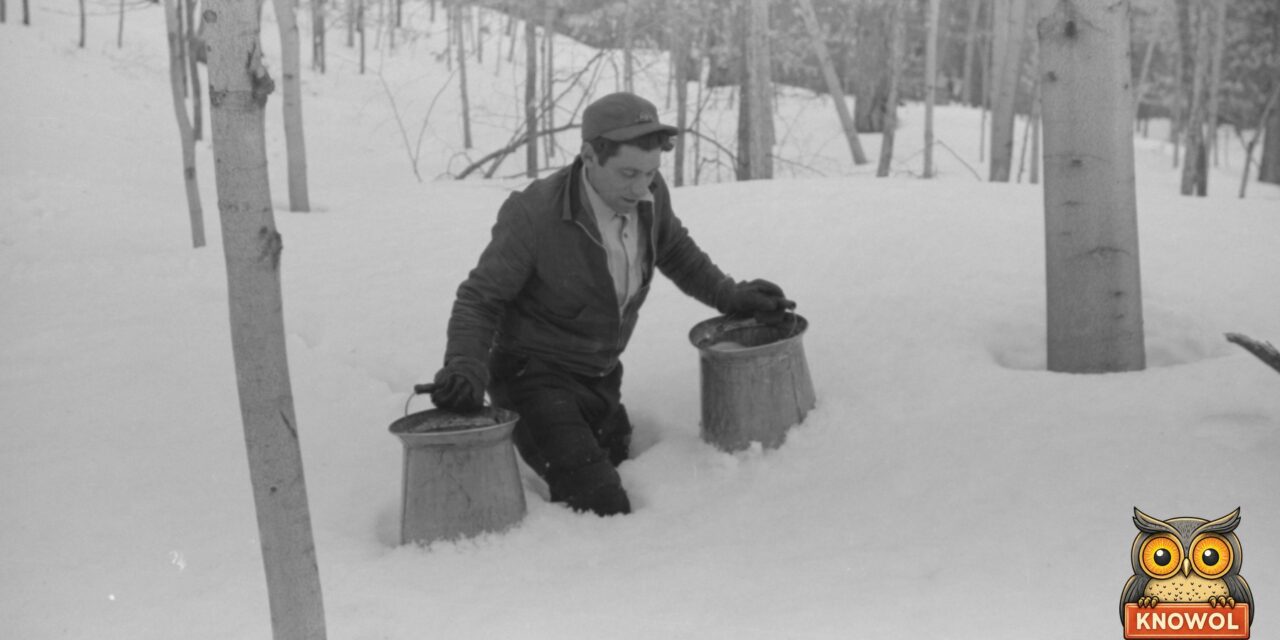
A young man in a wool cap wades through snow almost up to his hips. He’s hauling two big metal buckets of maple sap, one by the handle and one with a hand pressed on its rim. All around him stand bare trees, with deep wells melted in the snow around their trunks. It’s the spring of 1940 on Frank H. Shurtleff’s farm in North Bridgewater, a village in the town of Bridgewater, Vermont, and the snow is the whole story of this picture.
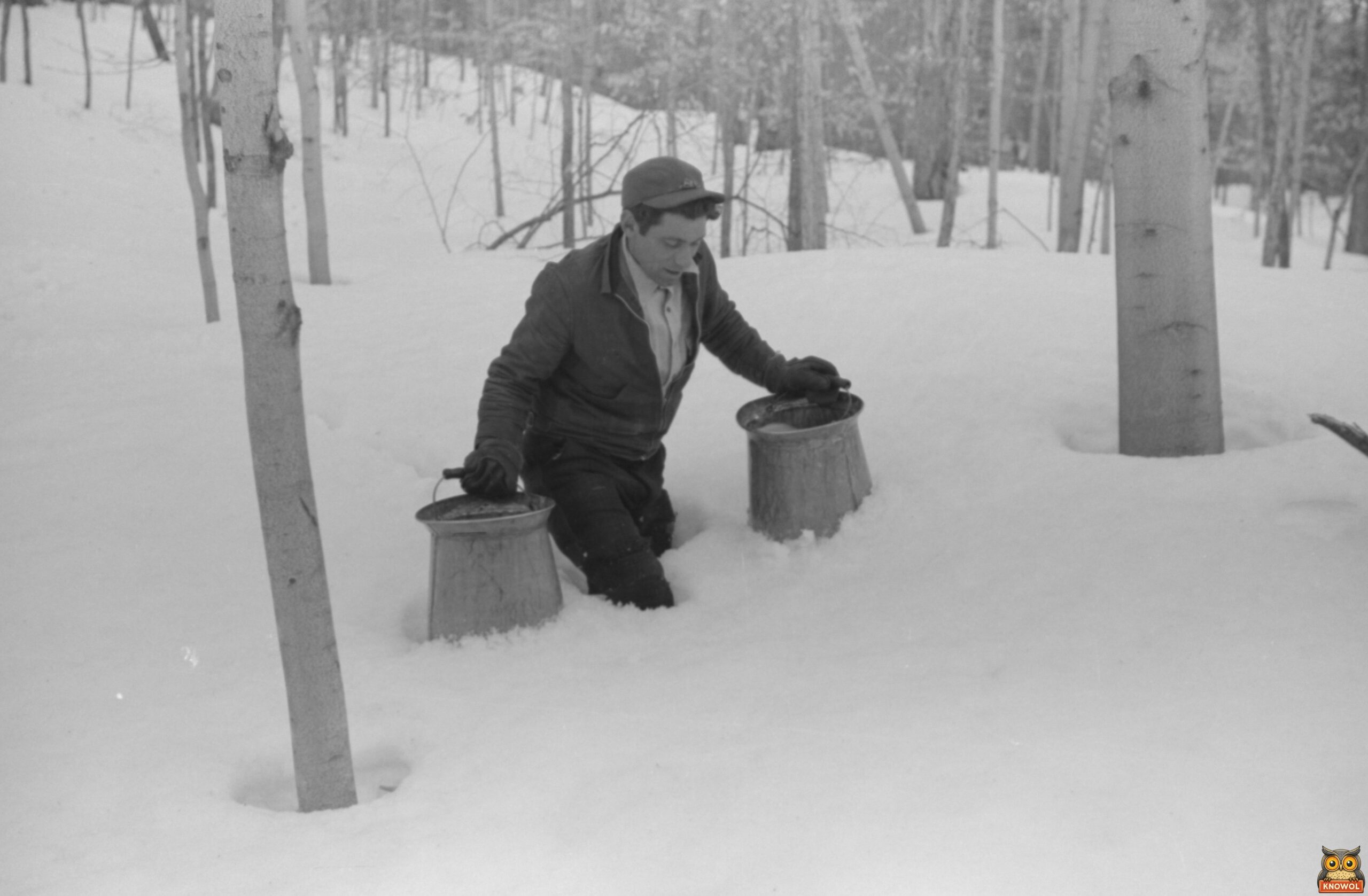
“Hired man of Frank H. Shurtleff gathering sap from sugar trees for making maple syrup.” North Bridgewater, Vermont. Photo by Marion Post Wolcott for the U.S. Farm Security Administration, probably April 1940. Library of Congress, Prints and Photographs Division, FSA/OWI Collection. No known restrictions. Click the picture to see it full size.
The photographer, Marion Post Wolcott, wrote down what the farmer told her. Her caption card says: “Because of the deep snow this year he only tapped 1000 of his 2000 trees. He expects to make about 300 to 500 gallons this year.” So the snow kept half of Frank Shurtleff’s maple trees from ever getting a bucket that spring. The young man in the photo is his hired man, though the card never gives his name.
How Sugaring Worked in North Bridgewater, Vermont
Making maple syrup on the Shurtleff farm in North Bridgewater started with a drill. Wolcott photographed Frank Shurtleff tapping a tree step by step. First he drilled a small hole in the trunk, then he pushed in a metal spout and hung a bucket on it, and last he slid a cover over the bucket to keep out rain and bits of bark.
Sap runs best in early spring, when nights freeze and days warm up above freezing. On a good day it drips from the spout into the bucket, clear and thin like water, and only a little sweet. That’s why sugaring takes so much work: it takes about 40 gallons of sap, boiled for hours, to make one gallon of syrup.
Now do the math on Frank Shurtleff’s plan. At about 40 gallons of sap for each gallon of syrup, 300 to 500 gallons of syrup meant somewhere around 12,000 to 20,000 gallons of sap. Every drop of it had to be poured out of the tree buckets and carried through the snow. In 1940 there was no plastic tubing running from tree to tree, so it all moved by hand, by bucket and by horse.
The Sap Crew in North Bridgewater, Vermont
That’s where the hired man in the picture comes in. In North Bridgewater, the crew emptied the tree buckets into carrying buckets and lugged them to a big metal vat that rode on a wooden sled. A team of two horses pulled the sled from tree to tree. Look closely at the vat in the next picture and you can read its maker’s name, Leader Evaporator, a Vermont company that made sugaring tools. When the vat was full, they hauled it down to the sugar house.
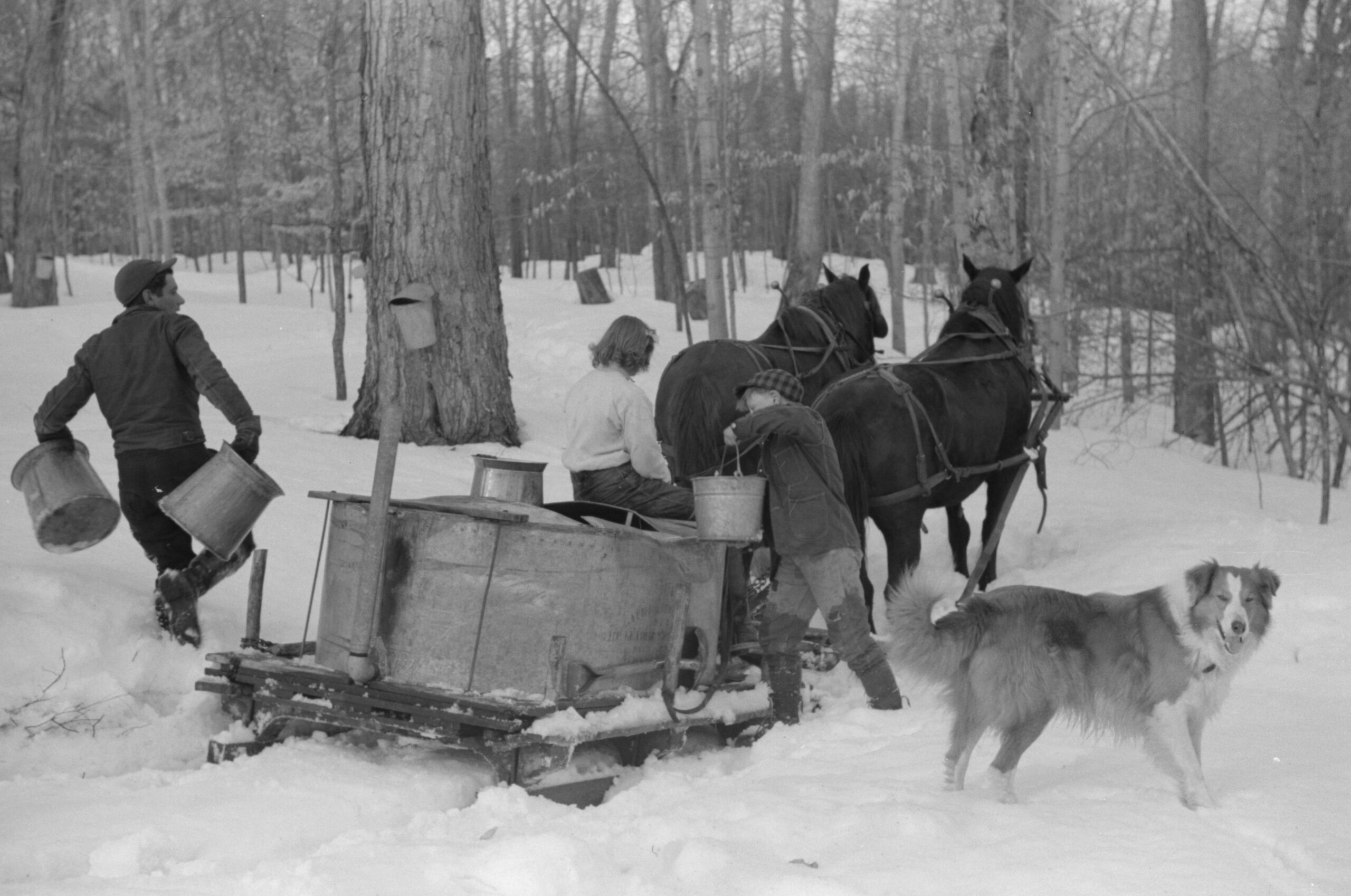
“Hired man, young neighbor (Julia Fletcher), collie dog, and Frank H. Shurtleff’s son gathering sap from sugar trees for making syrup.” North Bridgewater, Vermont. Photo by Marion Post Wolcott, probably April 1940. Library of Congress, FSA/OWI Collection. No known restrictions. Click the picture to see it full size.
The deep snow on the Shurtleff farm made every trip harder. One of Wolcott’s cards says the hired man and Frank Shurtleff had to shovel out the sled itself. In her picture, one man digs while the other holds the horses’ reins. Another card says Frank’s young son drove the sled with the vat of sap. The farm’s collie trotted along with the crew.
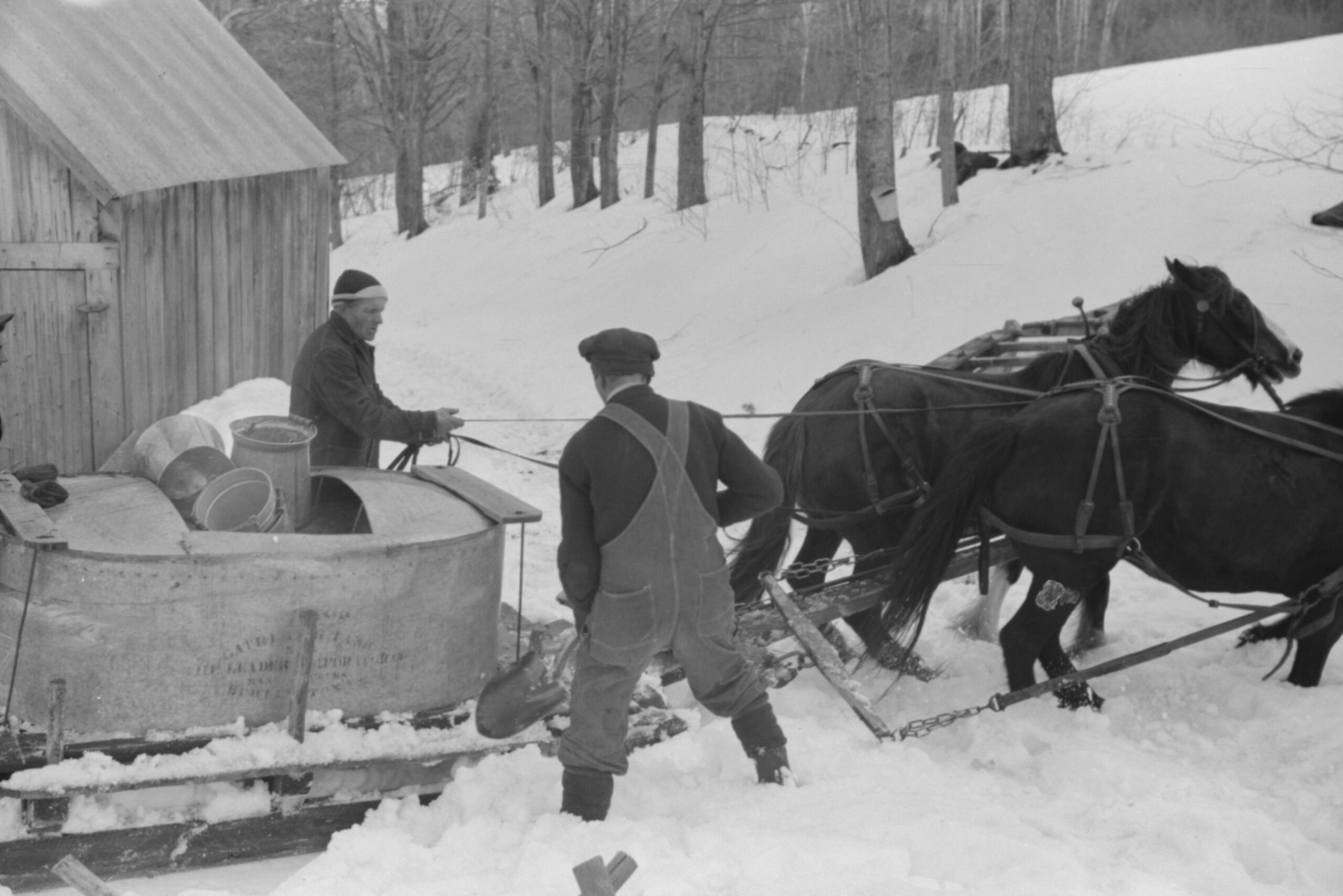
“Hired man and Frank H. Shurtleff shovelling out sled with vat for gathering maple sap for making maple syrup.” North Bridgewater, Vermont. Photo by Marion Post Wolcott, probably April 1940. Library of Congress, FSA/OWI Collection. No known restrictions. Click the picture to see it full size.
Why Sugaring Was a Party in North Bridgewater, Vermont
Hard work or not, sugaring on the Shurtleff farm was fun, and Wolcott’s cards say it again and again: “Sugaring is a social event and is enjoyed by all the young people and children in the neighborhood.” Her pictures back that up. A young neighbor named Julia Fletcher carried buckets with the crew. In one shot the hired man and a young neighbor are “rough housing” in the snow, wrestling in a drift. In another, the hired man and a neighbor lean on the sled, resting and chatting. Frank’s young daughter sat outside the sugar house and watched.
At noon the work stopped for a meal. One card shows “Mr. Shurtleff and his children going home to dinner after making maple syrup all morning.” Back then, many farm families called the big noon meal dinner.
Inside the Sugar House in North Bridgewater, Vermont
At the Shurtleff sugar house, the crew piped the sap out of the vat and into the building. Inside, it was boiled down in an evaporator, a long, flat pan set over a hot fire. As the water boiled away in clouds of steam, the sap got thicker and sweeter until it turned into syrup.
That fire ate a lot of wood. Wolcott photographed tall woodpiles stacked outside the sugar house and wrote, “Large supply of wood is needed for fuel in boiling the maple sap.”
An Old Family Farm in Bridgewater, Vermont
The Shurtleff farm in North Bridgewater was big and old. The cards say it covered about 400 acres and was “originally purchased by grandfather in 1840.” Frank raised sheep and cows, cut lumber, and had been making maple syrup for about 35 years, since around 1905. Sugaring brought in “about one thousand dollars annually,” a big help to a farm in those years.
An old family history adds a clue about that grandfather. A book about the Montague family, printed in 1886, says Harriet Montague married Alden Shurtleff at Bridgewater, Vermont, on January 28, 1840. It calls him a farmer who lived in Bridgewater. That’s the same year the farm was bought. He was probably Frank’s grandfather, but no record we found says so for sure.
Why a Government Photographer Came to North Bridgewater, Vermont
Marion Post Wolcott worked for the Farm Security Administration, or FSA, a government office that helped struggling farm families during the Great Depression. The FSA also sent photographers all over the country with one big job: show how Americans really lived and worked. Wolcott was born in New Jersey in 1910 and had worked as a newspaper photographer in Philadelphia. The FSA hired her in 1938, and she spent the next few years traveling the country with her cameras.
In the spring of 1940 she came to Woodstock, the town just east of Bridgewater, to show how country people there were getting by. She photographed snowy streets in Woodstock, farmers at work and the Shurtleff sugaring crew. Today the Library of Congress keeps her negatives with more than 170,000 others from the FSA, and anyone can use them for free. She married Lee Wolcott in 1941 and left the FSA in February 1942.
Sweet Endings in North Bridgewater, Vermont
Nobody wrote down how much syrup Frank Shurtleff made in the end that spring of 1940. Wolcott’s pictures end the way a sugaring day did, with the farmer and his children walking home to dinner and snow still banked high along the road. Maple syrup is still a big deal in Vermont, which makes more of it than any other state. Every spring, when the nights freeze and the days thaw, the sap starts running again, and somebody has to go out and get it.
Sources
- Marion Post Wolcott, “Hired man of Frank H. Shurtleff gathering sap from sugar trees for making maple syrup…,” North Bridgewater, Vermont, 1940 Apr.? Caption card title, record and full-size scan: Library of Congress, item 2017756264 (LC-USF33-030892-M4). FSA/OWI photographs: no known restrictions.
- Same shoot, Marion Post Wolcott, North Bridgewater, March and April 1940: the crew with Julia Fletcher and the collie, item 2017756261; shoveling out the sled, item 2017756250; “rough housing,” item 2017756251; resting and chatting, item 2017756252; drilling the hole, item 2017756181; hanging the bucket, item 2017756179; putting on the cover, item 2017756178; the son driving the sled, item 2017756279; the daughter outside the sugar house, item 2017756276; going home to dinner, item 2017756291; piping sap into the sugar house, item 2017802880; woodpiles, item 2017802793.
- George William Montague, History and Genealogy of the Montague Family of America (1886), Harriet Montague’s marriage to Alden Shurtleff at Bridgewater, Vt., January 28, 1840: archive.org.
- Matthew Powers, “A Photo Essay: Sugaring the 1940s,” Woodstock History Center, February 2026 (the Shurtleff farm, hand gathering before pipelines, the deep snow of spring 1940): woodstockhistorycenter.org.
- Leader Evaporator Co., a sugaring-tool maker in Burlington, Vermont, from 1904: maplesyruphistory.com.
- Sap runs on freezing nights and thawing days: University of New Hampshire Extension. About 40 to 43 gallons of sap make a gallon of syrup: Penn State Extension.
- Marion Post Wolcott’s life: Wikipedia. Vermont as the top maple state: Wikipedia, Maple syrup.
- About the FSA/OWI photographs and their rights: Library of Congress, FSA/OWI Black-and-White Negatives and rights and restrictions.