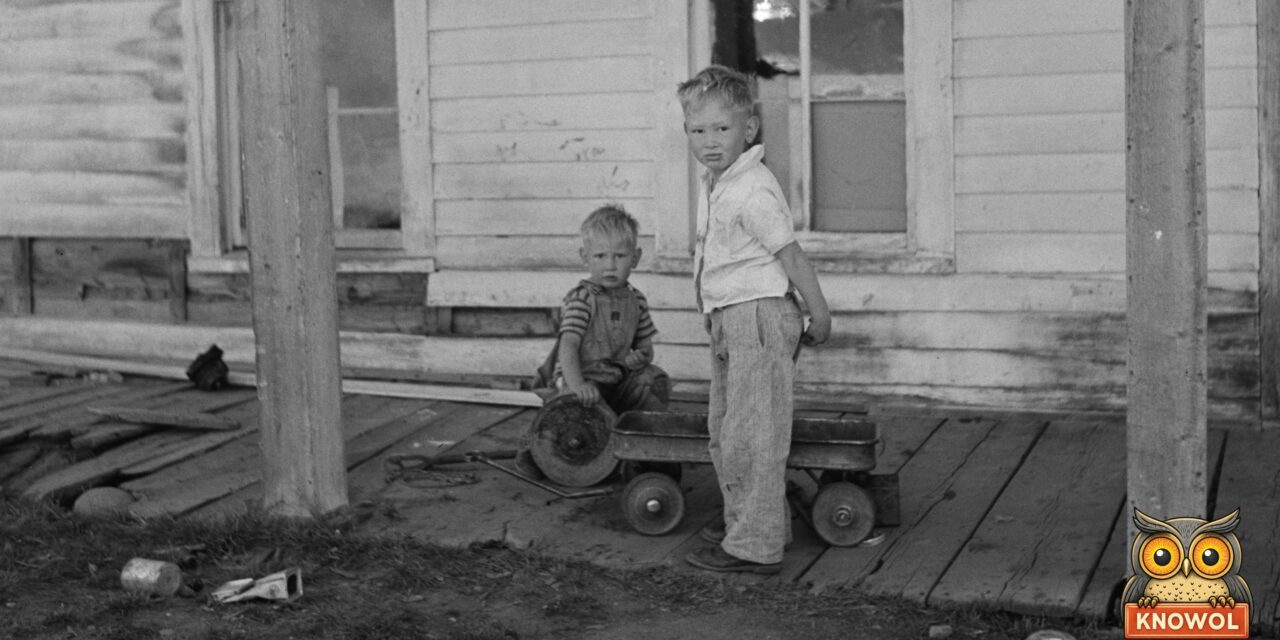
Two little boys and a toy wagon on the front porch of an old hotel. It’s September 1941 in Montezuma, Colorado, a mining town high in the Rocky Mountains. The smaller boy, in overalls and a striped shirt, sits on the porch boards with one hand on a big, round wheel. The bigger boy, in a white shirt and striped pants, stands by the wagon and looks back over his shoulder at the camera. Behind them, the paint is peeling and a few of the porch boards are loose. The photographer’s caption card tells us who they are: “Children of family now living in old hotel in ghost mining town now coming to life because of defense needs.”
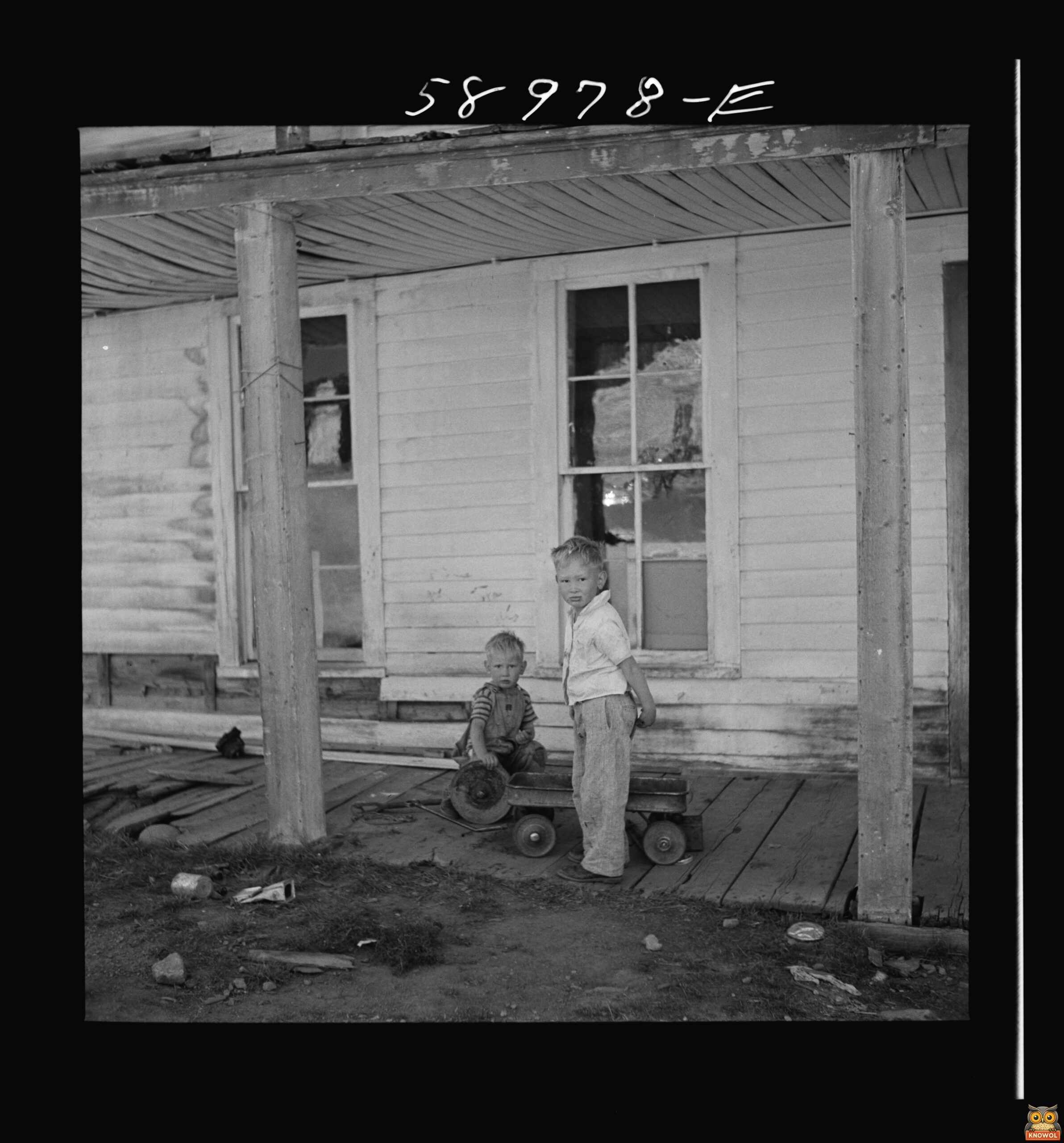
“Children of family now living in old hotel in ghost mining town now coming to life because of defense needs. Montezuma, Colorado.” Photo by Marion Post Wolcott for the U.S. Farm Security Administration, September 1941. Library of Congress, Prints and Photographs Division, FSA/OWI Collection. No known restrictions. Click the picture to see it full size.
That one caption holds a whole story. A town that had been nearly empty for years was filling up again. A family had moved into an old hotel from the mining days. And the reason was something far bigger than one little mountain town: the United States was getting ready for war.
How Montezuma, Colorado, Became a Ghost Town
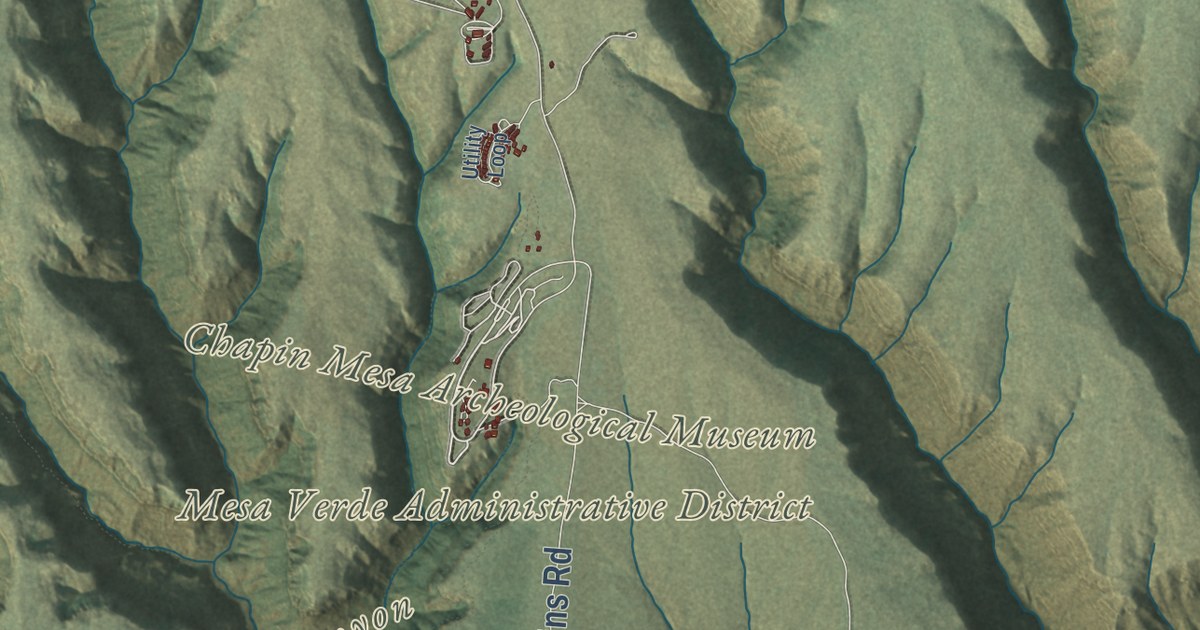
Montezuma sits at about 10,300 feet, near the top of the Snake River valley in Summit County. That is almost two miles above the sea. Miners founded it in 1865, after silver was found near Argentine Pass, a high pass on the way to Georgetown. They named it for Montezuma, the Aztec emperor of Mexico.
In the 1880s, Montezuma was a busy silver camp. By 1890 it had stores, a post office, a sawmill and two hotels, the Summit House and the Rocky Mountain House. Nobody agrees on how many people lived there at the top of the boom. Some old guesses say thousands. One modern mining history thinks those guesses are much too big and says a little more than a thousand is likelier.
Then came 1893. The price of silver crashed, and silver mines all over Colorado shut down. Montezuma never emptied out completely, but it got very small. The census counted just 38 people there in 1930, and 59 in 1940. Many of the old wooden buildings stood empty. In the 1941 pictures, their siding is warped and some windows are broken.
Why the Mines Around Montezuma, Colorado, Woke Up in 1941
In the fall of 1941, the United States was not at war yet. Pearl Harbor was still three months away. But the country was building an army, a navy and thousands of planes, and it was sending supplies to Britain. All of that took metal, and lots of it.
The mountains around Montezuma hold more than silver. Mining records for the district list lead, zinc, copper, gold and bismuth too. Lead goes into bullets and batteries. Zinc goes into brass, the metal of cartridge shells. Suddenly, old mines that weren’t worth working a few years before were worth opening again. One history of the town says the hunger for metals in World War II brought the mines around Montezuma back to life for a while.
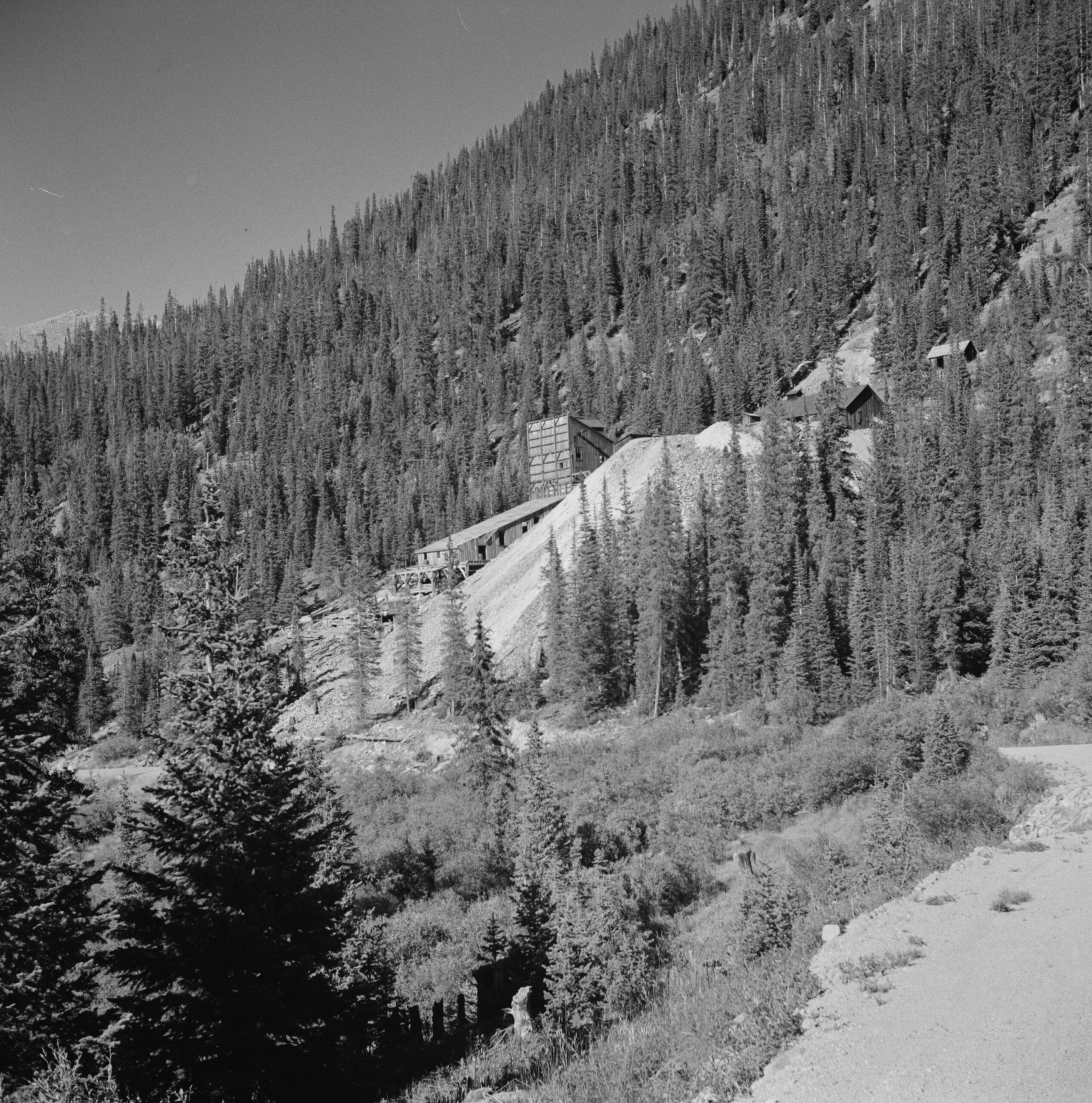
“Mine recently opened up because of defense needs. In ghost mining town of Montezuma, Colorado.” Photo by Marion Post Wolcott, September 1941. Library of Congress, FSA/OWI Collection. No known restrictions. Click the picture to see it full size.
The photographer took a picture of one of them. It shows a tall wooden mine building on a steep, piney mountainside, with a long gray pile of waste rock spilling down the slope below it. Her card reads, “Mine recently opened up because of defense needs.” It doesn’t say which mine it was or what it dug, and no other card in the set does either.
A Hotel, a Post Office and a Family in Montezuma, Colorado
When a mine opens, workers come, and workers need somewhere to live. In a town full of empty buildings, the old hotels made sense. The caption on the boys’ picture says their family was “now living in old hotel.” It doesn’t give the family’s name, where they came from, or which old hotel it was.
The town also had a hotel that was still open. The photographer made several pictures of a big two-story building with rows of windows, a sign over the door that reads JOHNNY’S, a HOTEL sign hanging from the wall and a second sign that says MONTEZUMA POST OFFICE. So in 1941, one building was the place to sleep, eat and pick up the mail. In one picture, a shiny 1930s car is parked out front, and a man stands on the wooden sidewalk with his hands in his pockets. Her card calls it “Hotel and post office in ghost town now coming to life because of defense minining boom.” (The extra “ni” in “minining” is the card’s own typo.)
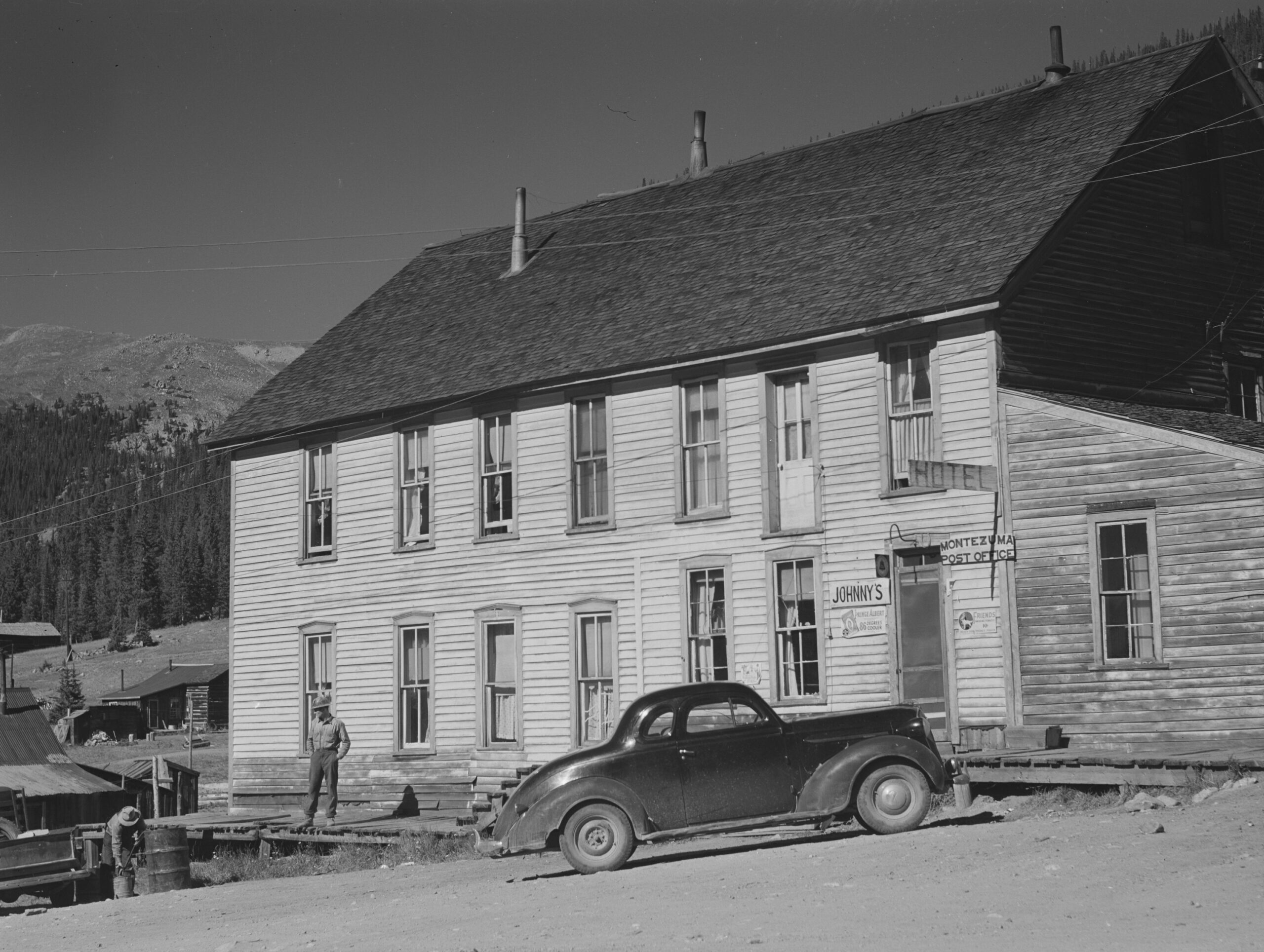
“Hotel and post office in ghost town now coming to life because of defense minining boom. Montezuma, Colorado.” Photo by Marion Post Wolcott, September 1941. Library of Congress, FSA/OWI Collection. No known restrictions. Click the picture to see it full size.
None of the cards say who Johnny was, and none say whether the boys’ family lived there or in another old hotel. Look closely at the porch in the boys’ picture: plain white boards, tall windows, and a thick wooden post with wire wrapped around it. The boys had a whole hotel porch for a playground, and a dirt yard out front.
The Photographer Who Came to Montezuma, Colorado
The woman behind the camera was Marion Post Wolcott. She was born in 1910 in Montclair, New Jersey, and in July 1938 she went to work as a photographer for the Farm Security Administration, or FSA. The FSA was a government office that helped struggling farm families. It also sent photographers across the country with one big job: show how Americans really lived and worked. Today the Library of Congress keeps their negatives, and anyone can use them for free.
Wolcott traveled thousands of miles through the South, New England and the West. In June 1941 she married Lee Wolcott, who worked for the Department of Agriculture. That fall she set out on her last big trip for the FSA, through Colorado, Nebraska, Montana and Idaho.
In Colorado that September, she went looking for mining towns. Her cards from the trip tell a story of booms and busts. She photographed the “old mining town” of Leadville, empty buildings in the “ghost mining town” of Ashcroft, and the main street of Craig, “A new and thriving boom town.” Montezuma was the one in between: a ghost town in the middle of waking up. She used the same words on card after card: “now coming to life.”
Wolcott left the FSA soon after this trip and spent the next years raising four children. She died in 1990. Her pictures, including these two boys on the porch, are still kept and shown by the Library of Congress.
What Happened to Montezuma, Colorado
The boom didn’t last. After the war, the mines around Montezuma went quiet again. Fires hurt the town over and over. In 1949, three buildings burned, including an old general store and bar. On Christmas 1958, a fire burned the historic Summit House hotel, the town hall and two homes. Fifteen guests at the hotel got out safely. The post office finally closed in 1972.
But Montezuma never disappeared. It’s still there today at the end of a paved road above the Keystone ski area, with dirt streets, old wooden houses and its 1880s schoolhouse. About 70 people live there all year. Skiers, hikers and summer families have taken the place of the miners.
We don’t know the names of the two boys, or what became of the wagon. What we do know is that for a few months in 1941, an old hotel in an almost-empty mountain town was a home again, and two little boys had the whole front porch to themselves.
Sources
- Marion Post Wolcott, “Children of family now living in old hotel in ghost mining town now coming to life because of defense needs. Montezuma, Colorado,” September 1941. Caption card title, record and full-size scan: Library of Congress, item 2017808456 (LC-USF34-058978-E). FSA/OWI photographs: no known restrictions.
- Marion Post Wolcott, Montezuma, September 1941, same shoot: “Mine recently opened up because of defense needs,” item 2017808459; “Hotel and post office in ghost town now coming to life because of defense minining boom,” item 2017808634; “Johnny’s Hotel and the post office,” item 2017808453; “Old hotel in ghost mining town,” item 2017808452; “Ghost mining town coming to life because of defense mining boom,” item 2017808622.
- Marion Post Wolcott, Colorado, 1941, the same trip: Leadville, “Main street of old mining town,” item 2017808440; “Buildings in ghost mining town. Ashcroft, Colorado,” item 2017808428; “Main street of Craig, Colorado. A new and thriving boom town,” item 2017808333.
- Marion Post Wolcott’s life and her fall 1941 trip: Encyclopedia of the Great Plains, University of Nebraska-Lincoln.
- Montezuma’s history (founding, the 1893 crash, the World War II revival, the 1949 and 1958 fires): Western Mining History, Montezuma and Summit Historical Society, Montezuma (the post office closing in 1972).
- Elevation, the 1890 hotels, census counts and the town today: Wikipedia, Montezuma, Colorado.
- The metals of the Montezuma district: Western Mining History, Montezuma, Snake River, and Peru Districts.
- About the FSA/OWI photographs and their rights: Library of Congress, FSA/OWI Black-and-White Negatives and rights and restrictions.