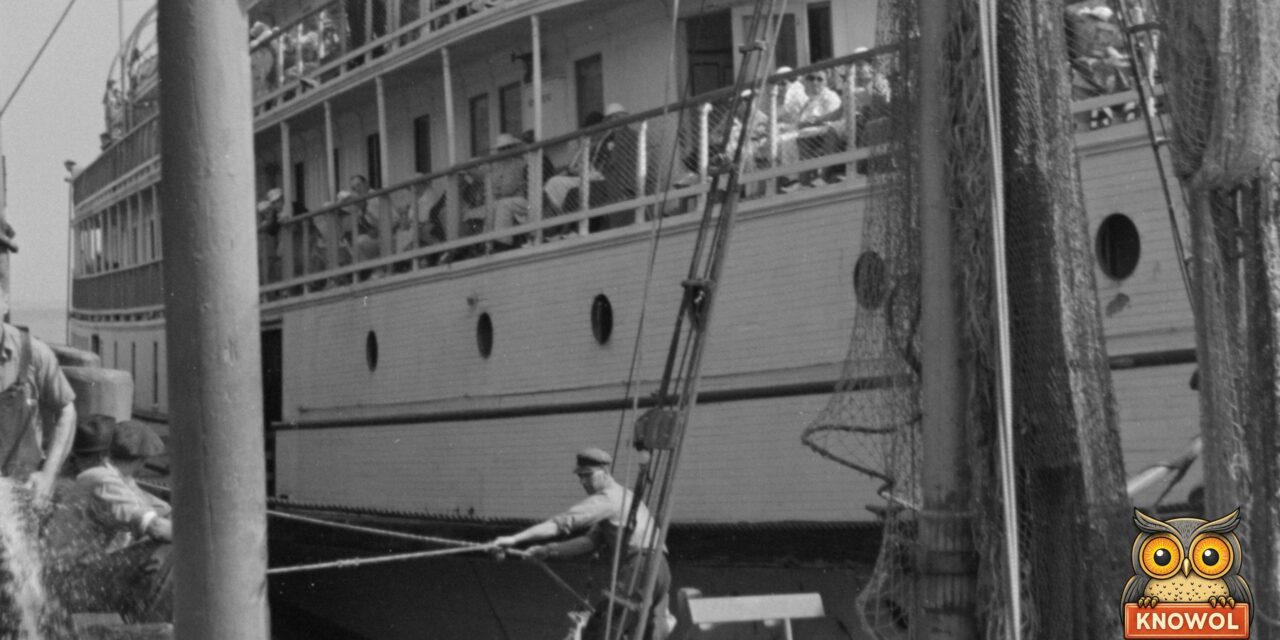
Down in a small fishing boat at the wharf in Provincetown, Massachusetts, a man in a cap leans hard on a long rope. Another man, in tall rubber boots, stands on the deck coiling more rope. Nets hang from the mast to dry. And right behind them, so close it fills the sky, sits a big white steamship with two smokestacks, smoke rolling out the top, and every deck crowded with people in summer hats. The photographer, Edwin Rosskam, wrote what it meant on his caption card: “The economy of a town: fishing and the tourist trade.”
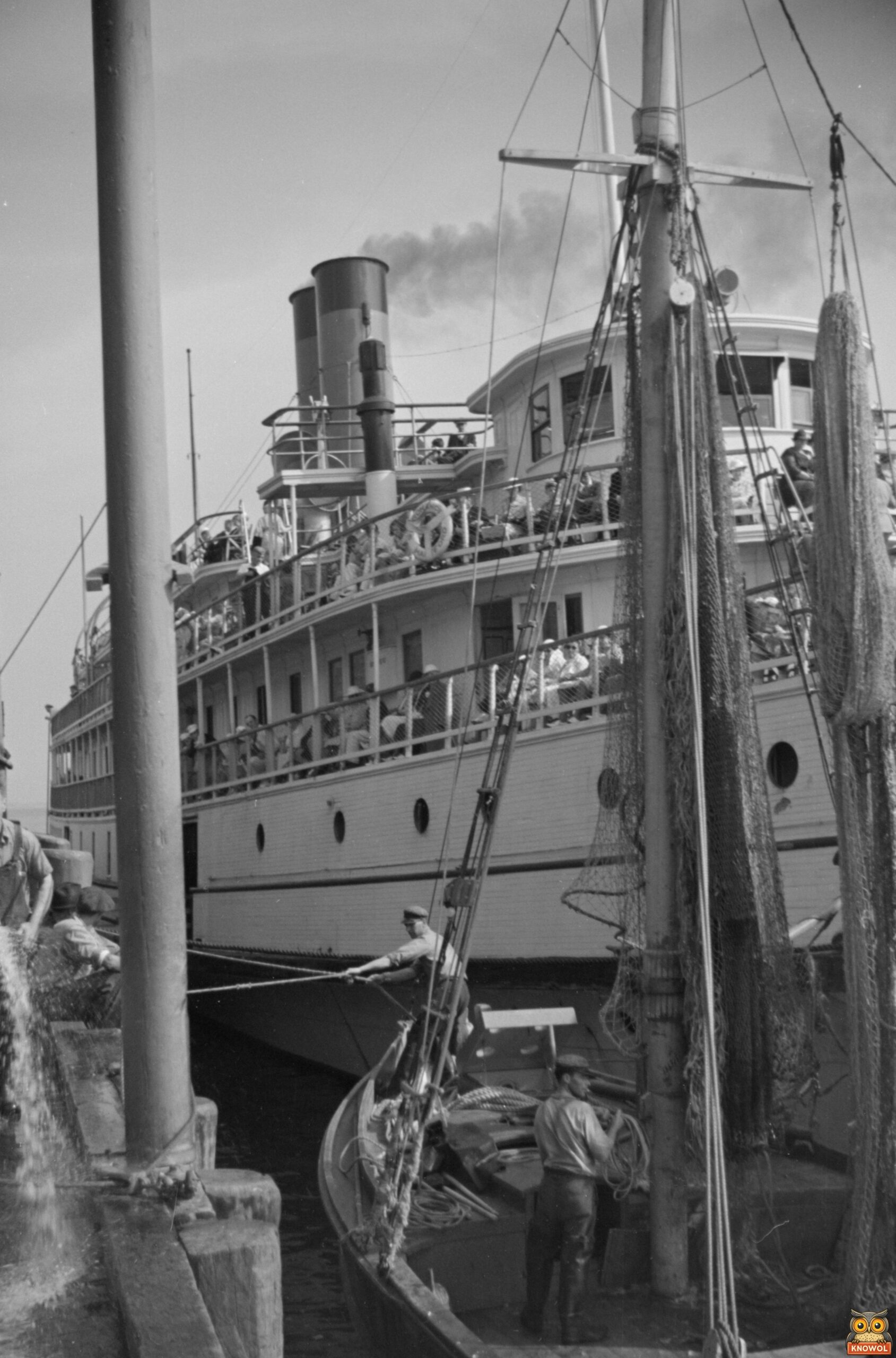
A fishing boat in front of the steamer Romance at Provincetown, Massachusetts. Photo by Edwin Rosskam. The Library of Congress dates it summer 1937, but the Romance’s only summer on the Provincetown run was 1936. FSA/OWI Collection, Library of Congress. No known restrictions. Click the picture to see it full size.
Two Ways to Make a Living in Provincetown, Massachusetts
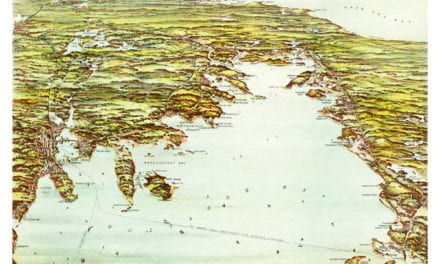
Provincetown sits at the very tip of Cape Cod, curled around a deep, quiet harbor. It’s where the Pilgrims’ ship, the Mayflower, first dropped anchor in 1620. By the 1930s the town had two ways to make a living, and Rosskam’s picture shows both of them in one frame.
The first was fish. Provincetown boats went out before sunrise to their “traps,” giant nets held up on poles along the shore. Rosskam rode along on one trip. His card says the boat came up to the trap “at five o’clock in the morning.” Fish swam into the net through a long funnel and couldn’t find their way back out. The men hauled the net into the boat on one side and let it back over the other, again and again, until the fish were crowded into a small pocket, “where fish mill around by the thousands,” the card says. They scooped out whiting, mackerel and squid with a hand net. Sometimes a tuna was in there too, and that was a fight, because a tuna, the card says, can weigh “between 300 and 800 pounds.” The biggest ones weighed more than a piano.
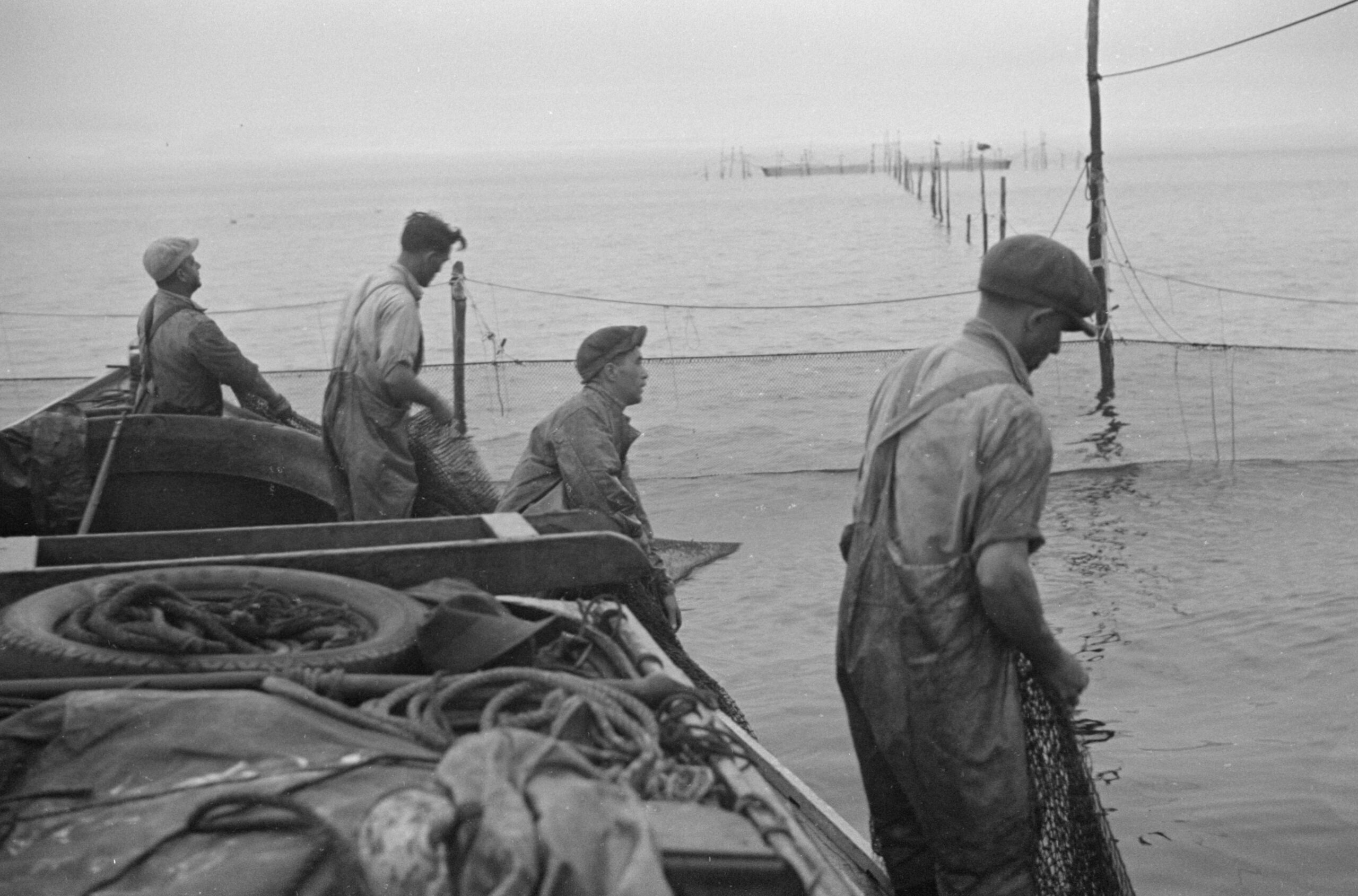
Provincetown fishermen pull in a fish trap, with the trap’s long line of poles behind them. Photo by Edwin Rosskam, Provincetown, Massachusetts, catalog date summer 1937. FSA/OWI Collection, Library of Congress. No known restrictions. Click the picture to see it full size.
The second way was visitors. Every summer day, steamers brought crowds down from Boston for a day in Provincetown and a cool ride on the water. The fishermen and the tourists shared the same wharf. In the photo, the fishing boat looks like a toy next to the steamer.
The Steamer Romance Came to Provincetown, Massachusetts
The big white ship in the picture was the Romance. You can read her name in big letters on her side in another picture Rosskam took on the same roll of film. She was not new. She had been built in 1898 as the Tennessee, and she was about 245 feet long, about as long as six school buses parked end to end. In 1935 the Bay State Steamship Company bought her, gave her the new name and put her on the run between Boston and Provincetown.
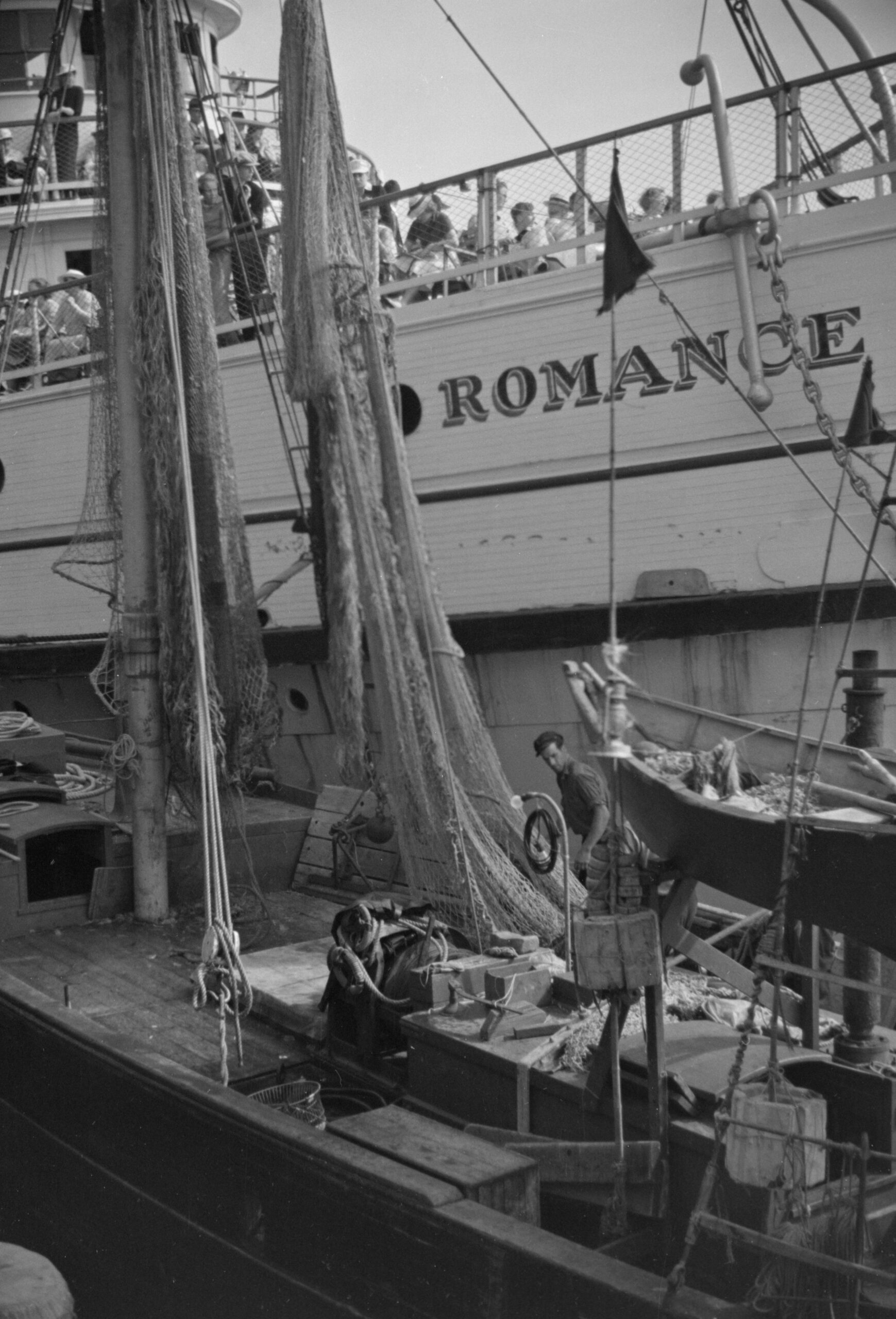
Passengers lean on the rail of the Romance, her name painted on her side, above a Provincetown fishing boat. Photo by Edwin Rosskam, Provincetown, Massachusetts. FSA/OWI Collection, Library of Congress. No known restrictions. Click the picture to see it full size.
The Romance had an orchestra and a music room, plus open decks where people could sit outside and watch the water go by. Look at the photo again and you can see them up there, rows of them along every rail, dressed for a day at the shore.
Fog Over Boston Harbor
The Romance’s summer of 1936 was almost over when the fog came. On the morning of September 9, Captain Adelbert C. Wickens was at a hearing in Boston before United States steamboat inspectors, about a complaint from a rival steamship line. The hearing was put off because Wickens said he had to take the Romance out on her daily trip. A wire story the next day printed what one inspector asked him: “Captain Wickens, you are not going out in weather like this, are you?” And it printed his answer: “Oh, yes.”
That evening the Romance was coming home from Provincetown with 159 passengers and 53 crew members. Near the entrance to Boston’s outer harbor, the fog was so thick the paper called it “pea-soup.” Out of it came the steamer New York, a ship about four times as heavy, heading out of Boston with 300 passengers of her own. Her steel bow hit the Romance in the middle.
Down in the music room, the orchestra had just finished a tune. A young woman from Lynn, Vivian Simonds, told reporters: “The orchestra had just finished playing the ‘Poet and Peasant’ overture when there was quite an impact.” People were knocked over chairs. A young Boston mother, Mrs. Alice V. Feeney, was sitting in the music room with her five-year-old daughter. Through the window across from her, she said, “I saw a big white something moving toward us.”
Everyone Off the Romance
What happened next is why this isn’t a sad story. The New York stayed pressed into the side of the Romance, and her crew let ladders down between the two ships. A crew member opened a cabinet of life belts. Mrs. Feeney and her little girl put them on and hurried up a deck, and someone lifted the girl up a ladder onto the New York, with her mother climbing right behind. More than 100 passengers crossed that way. The rest went over in lifeboats.
About 20 minutes after the crash, the Romance sank into deep water. By then every passenger and every crew member was safe on the New York. Twelve people were hurt, none badly, the wire story said. The New York was able to steam back to Boston under her own power and let everyone off. The Romance never finished her first season. It would have ended that coming Sunday.
The Man With the Camera in Provincetown, Massachusetts
Edwin Rosskam was born in Germany in 1903 to American parents and came to the United States in 1919, as a teenager. He studied painting in Philadelphia and lived in Paris for a while before he picked up a camera. In 1938 he went to work in Washington for Roy Stryker at the Farm Security Administration, the government office that sent photographers all over the country to show how Americans lived and worked. Rosskam laid out their pictures and took photos of his own.
His Provincetown pictures ended up in that same huge government collection, now at the Library of Congress, where anyone can use them for free. The card on the Romance pictures was written after she was gone. It calls her a tourist boat that “used to ply between Boston and Provincetown and has since sunk in Boston Harbor.” The library files the pictures under summer 1937. But the Romance only sailed to Provincetown in 1936, so Rosskam most likely took them that summer, a few weeks or months before the fog.
Where the Romance Is Now
The Romance still lies on the bottom of Massachusetts Bay, in about 80 feet of water, roughly a mile north of Graves Light at the edge of Boston Harbor. Her bow and her boilers are still partly in one piece, and divers go down to see them.
Rosskam’s picture shows the Romance on an ordinary sunny day, with her smoke going up, her decks full and a fisherman at work beneath her. Nobody on that wharf knew this would be her only summer. And nobody yet knew the happy part either: when the fog came, every single person aboard got home.
Sources
- Edwin Rosskam, “[Untitled photo, possibly related to: The economy of a town: fishing and the tourist trade. A fishing boat in front of the S.S. “Romance,” a tourist boat which used to ply between Boston and Provincetown and has since sunk in Boston Harbor. Provincetown, Massachusetts],” catalog date summer 1937. Record and full-size scan: Library of Congress, item 2017729109 (LC-USF33-005069-M3). FSA/OWI photographs: no known restrictions.
- Edwin Rosskam, same roll, the captioned negative with the Romance’s name on her side: item 2017729107 (LC-USF33-005069-M1); and item 2017729106.
- Edwin Rosskam, trap fishing in Provincetown (the five o’clock trip, the fish “by the thousands,” tuna of 300 to 800 pounds): item 2017729097 and item 2017729084.
- Homer Jenks, United Press, “Excursion Ship Sunk off Boston In A Collision,” The Daily Independent (Elizabeth City, North Carolina), September 10, 1936, page 1: Library of Congress, Chronicling America (the inspector’s question and the captain’s answer, the orchestra, the music room, the ladders and lifeboats, the first season).
- United Press, “Fast Work After Collision Off Boston Avoids Major Disaster,” The Times-News (Hendersonville, North Carolina), September 10, 1936, page 1: Library of Congress, Chronicling America (“pea-soup” fog, the New York’s size and passengers, twelve hurt, the return to Boston).
- The Romance’s history (built 1898 as the Tennessee, 245 feet, bought by the Bay State Steamship Company in 1935) and the wreck today: Graves Light Station, Romance (1936) and Northern Atlantic Dive Expeditions, Romance.
- Edwin Rosskam’s life: The Jewish Museum, Edwin Rosskam.
- Provincetown and the Mayflower: Wikipedia, Provincetown, Massachusetts.
- About the FSA/OWI photographs and their rights: Library of Congress, FSA/OWI Black-and-White Negatives and rights and restrictions.