On Friday night, September 8, 1922, two children named Dan and Virginia Taggart walked into Mount Vernon, George Washington’s famous home. They enjoyed the visit and turned to go. Then Virginia asked where George was. Little Dan had the answer ready. “He’s not here,” he told her. “He’s been dead 12 years.”
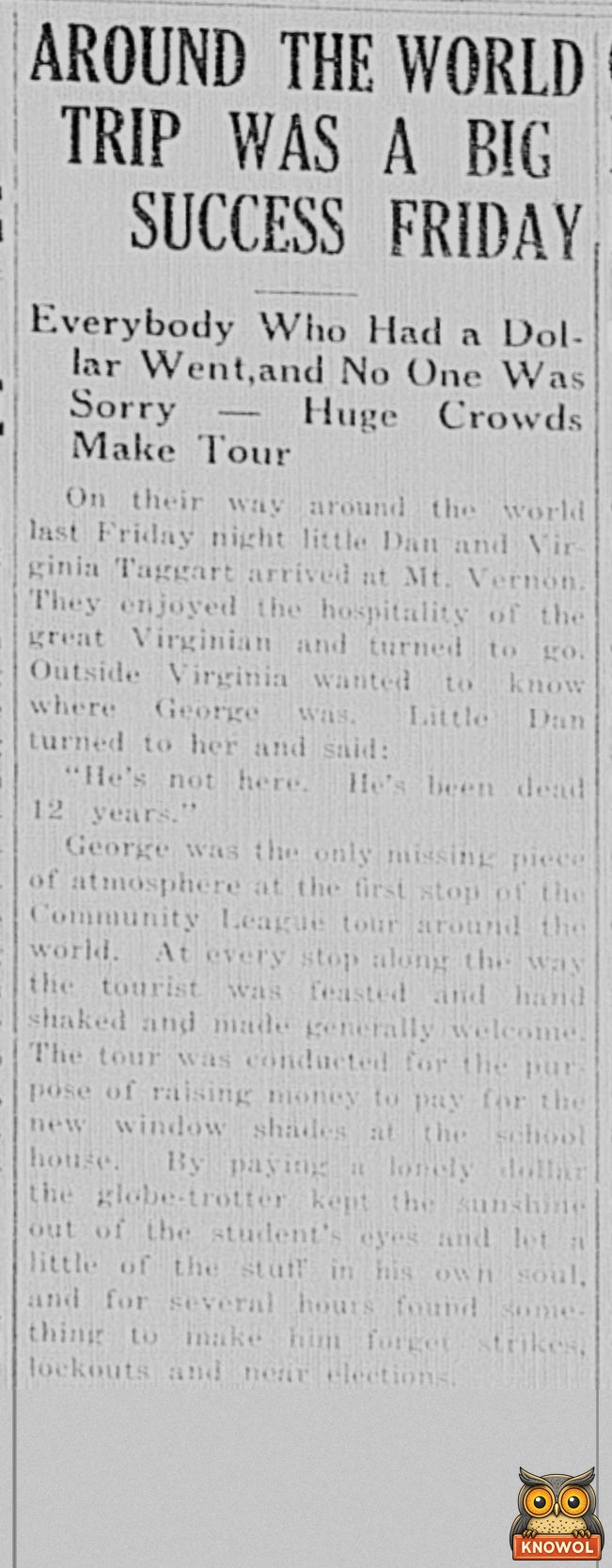
“Around the World Trip Was a Big Success Friday.” The Big Stone Gap Post, Big Stone Gap, Virginia, September 13, 1922, page 1. Library of Congress, Chronicling America. Published 1922, public domain. Click the clipping to read it full size.
Dan was off by more than a hundred years. Washington died in 1799. But Dan was right about one thing: George wasn’t home. That’s because this Mount Vernon wasn’t the real one. It was a house in Big Stone Gap, Virginia, a mountain town in Wise County, in the far southwest corner of the state. And Dan was on a trip around the whole world that started at 8 o’clock at night and ended back home the same night.
The Community League of Big Stone Gap Sells Tickets
The trip was the idea of the Community League, a club of Big Stone Gap women who raised money for the town. On August 30, 1922, the Big Stone Gap Post told readers what the “public spirited laidies” (that’s how the paper spelled it) had planned. They called it “A Trip Around the World.”
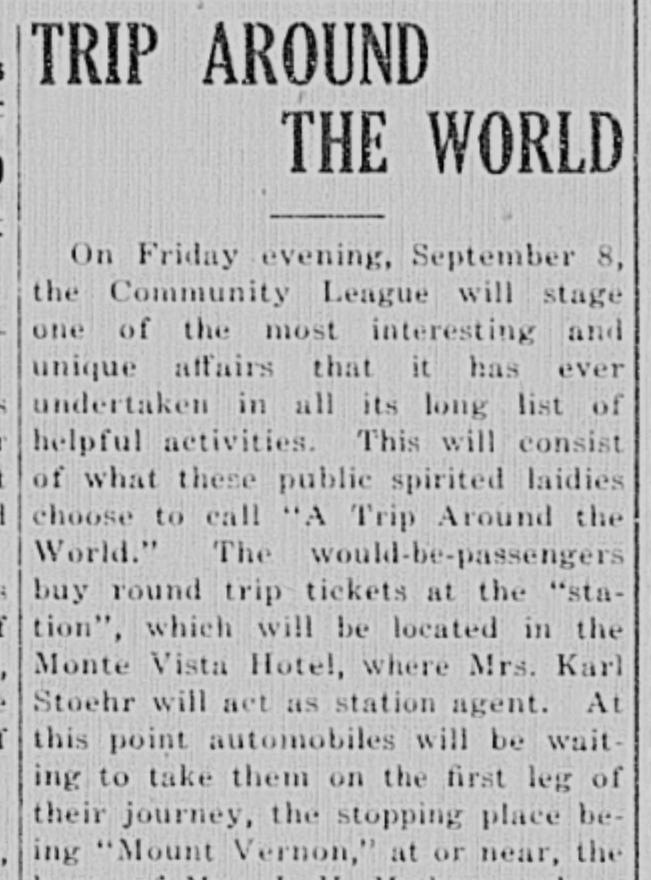
The plan. The Big Stone Gap Post, Big Stone Gap, Virginia, August 30, 1922, page 1. Library of Congress, Chronicling America. Published 1922, public domain. Click the clipping to read it full size.
Here’s how it worked. You bought a round trip ticket at the “station,” just like at a real railroad depot. The station was the Monte Vista Hotel, and Mrs. Karl Stoehr played the “station agent,” the person who sells tickets. Outside, automobiles waited to carry the passengers. Every “country” on the trip was somebody’s house in town, dressed up to look like a faraway place, with a hostess and something good to eat.
A ticket cost $1.00. Children rode for 50 cents. A week later, the Post ran a little reminder, set up like a real train notice.

The Big Stone Gap Post, Big Stone Gap, Virginia, September 6, 1922, page 1. Library of Congress, Chronicling America. Published 1922, public domain. Click the clipping to read it full size.
What the Dollar Bought in Big Stone Gap
The money in Big Stone Gap had a job. After the trip, the Post explained it was all “for the purpose of raising money to pay for the new window shades at the school house.” Window shades were cloth rolls that pulled down over the glass, so the hot sun wouldn’t shine right in a student’s face.
The paper put it in a funny, warm way. “By paying a lonely dollar the globe-trotter kept the sunshine out of the student’s eyes and let a little of the stuff in his own soul.” A “globe-trotter” is a person who travels all over the world. So one dollar made shade for the kids and sunshine for the grown-ups.
The Post said the trip let people “forget strikes, lockouts and near elections” for a few hours. Those were the grown-up worries of 1922, and for one night they stayed home.
The Stops on the Big Stone Gap Trip Around the World
After Mount Vernon came West Point, the famous Army school in New York. In Big Stone Gap, West Point was Mrs. J. L. McCormick’s home. The Post said “the humble bean was served on china plates while boys in uniforms, doing sentinel duty, kept off the mosquitos.” Sentinel duty means standing guard. So the town’s boys played soldiers, and their enemy was the bugs.
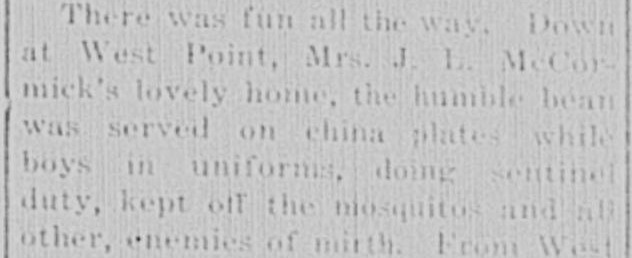
West Point, Big Stone Gap style. The Big Stone Gap Post, September 13, 1922, page 1. Library of Congress, Chronicling America. Published 1922, public domain. Click the clipping to read it full size.
The travelers drank tea in “Japan” at Mrs. J. W. Chalkley’s house, with fans all around. In “Ireland,” at Mrs. D. B. Pierson’s, a guest the paper called Pickles Cantrel got to kiss the Blarney stone. The real Blarney Stone is a rock in an Irish castle. People say kissing it gives you the gift of smooth talk.
The last stop was “Paris.” Mrs. R. E. Taggart was the “boss of Paris,” the Post said. Her house had bright lights and an orchestra, and young people could skip the rest of the world, buy a dollar ticket, and go “straight to ‘Paris’ where they may dance from nine till twelve.”
Ice Cream Under the Stars in “Paris,” Virginia
The Post’s report on Paris is the best part. “If you didn’t want to eat ice cream under the stars you could step right up to the table and gamble for candy.” Gambling for candy meant playing a game where the prize was sweets, not money.
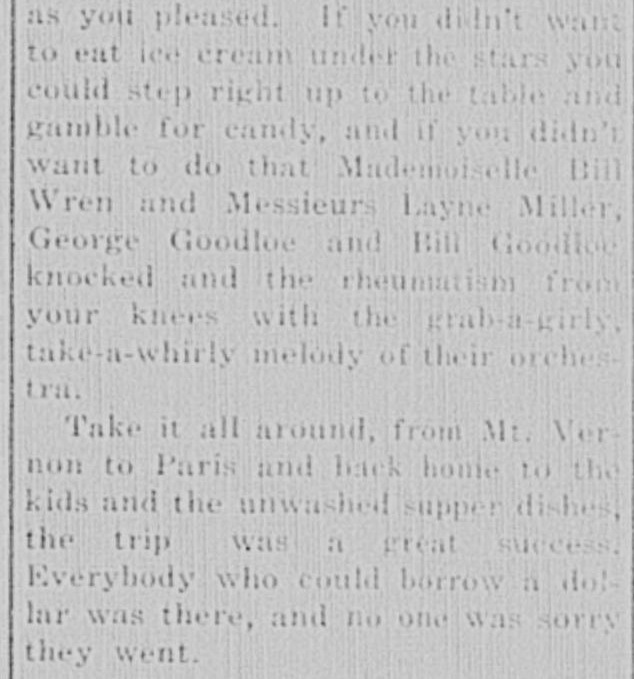
Paris, and the trip home. The Big Stone Gap Post, Big Stone Gap, Virginia, September 13, 1922, page 1. Library of Congress, Chronicling America. Published 1922, public domain. Click the clipping to read it full size.
The band was four local men: Bill Wren, Layne Miller, George Goodloe and Bill Goodloe. The paper said their music took “the rheumatism from your knees.” Rheumatism is stiff, achy joints, the kind grandparents complain about. The Post called it a “grab-a-girly, take-a-whirly melody.” In other words, nobody could sit still.
Big Stone Gap Wasn’t the Only Town Going Around the World
Big Stone Gap’s trip was part of a fad. In the early 1920s, church groups and clubs all over the country took “trips around the world” without leaving town. Cars stood in for ships and trains, and neighbors’ parlors stood in for whole countries.
In Silver Run, Maryland, on August 2, 1920, a ladies’ Bible class at a local church ran one for “the modest sum of 35 cents, including meals and Pullman fare.” A Pullman was a fancy railroad sleeping car, so that was a joke. Their world had Spain, Holland, Ireland, Japan, Florida and Iceland. It started in “Atlantic City,” a house where signs warned the ladies “not to flirt with the chauffeurs” and told the men that “no shoes larger than number tens were permitted on the boardwalk.”
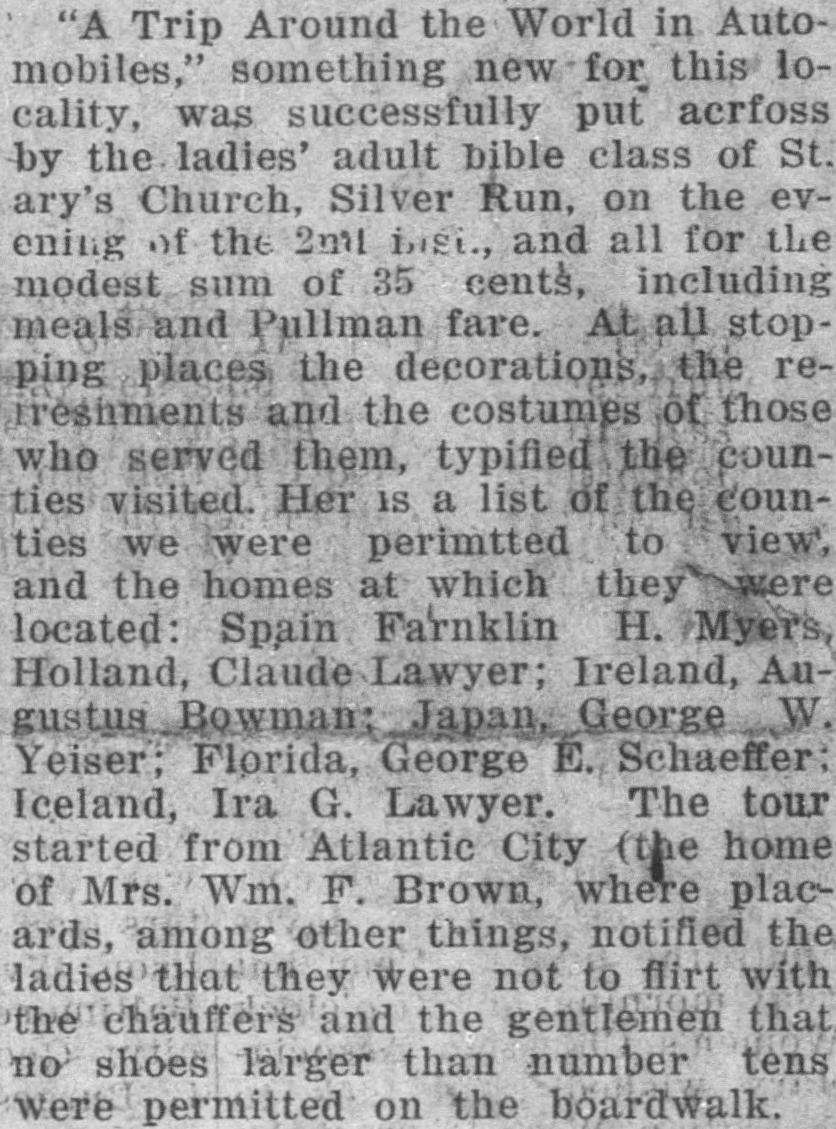
Silver Run, Maryland, goes around the world. The Democratic Advocate, Westminster, Maryland, August 6, 1920, page 1. Library of Congress, Chronicling America. Published 1920, public domain. Click the clipping to read it full size.
In Hammond, Indiana, in September 1922, the Ladies’ Aid Society of the Pine Street Presbyterian Church sent out “cars representing ocean liners” every fifteen minutes. Its church stood for America, and members’ homes stood for Scotland, Japan, the Hawaiian Islands, Ireland and Alaska.
And in Charleston, South Carolina, on August 21, 1925, the young people of Bethel Senior League rode by car to “Japan” at Miss Vera Davis’s home for tea and cakes, then to “Holland” at Miss Genevieve Tiller’s. The last stop was “America,” at Miss Lizzie Easterby’s. The refreshment there was the “all familiar” ice cream cone. The Southern Christian Advocate, a church paper in Charleston, South Carolina, printed the report on September 10, 1925.
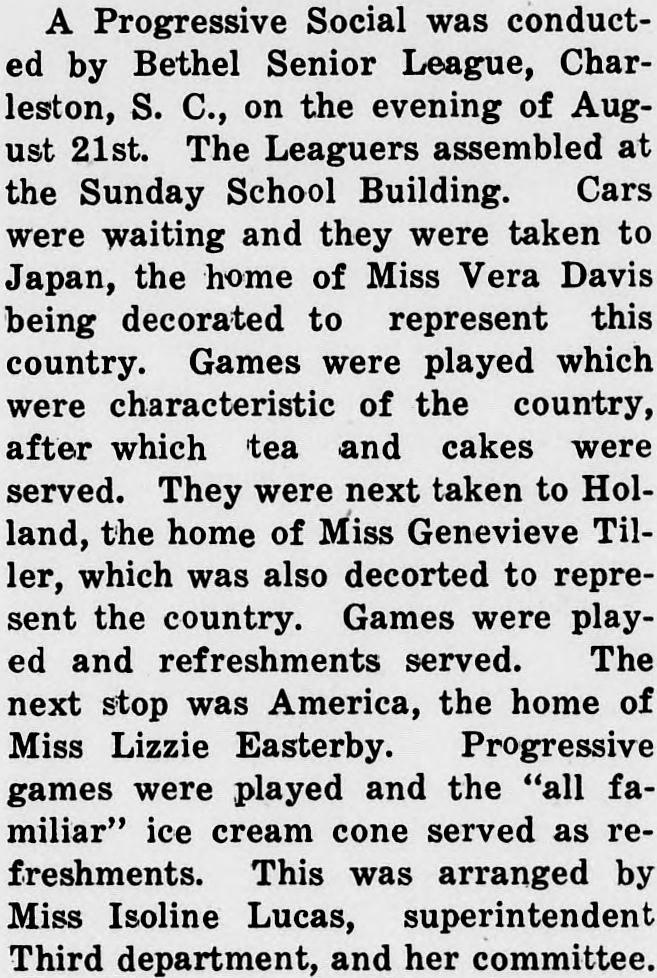
Charleston, South Carolina, goes around the world. Southern Christian Advocate, Charleston, South Carolina, September 10, 1925, page 10. Library of Congress, Chronicling America. Published 1925, public domain. Click the clipping to read it full size.
Home From Paris to Big Stone Gap
A real trip around the world took months and cost a fortune. For a dollar, or 35 cents, these towns got a little taste of it in one evening, and the money went to something the town needed.
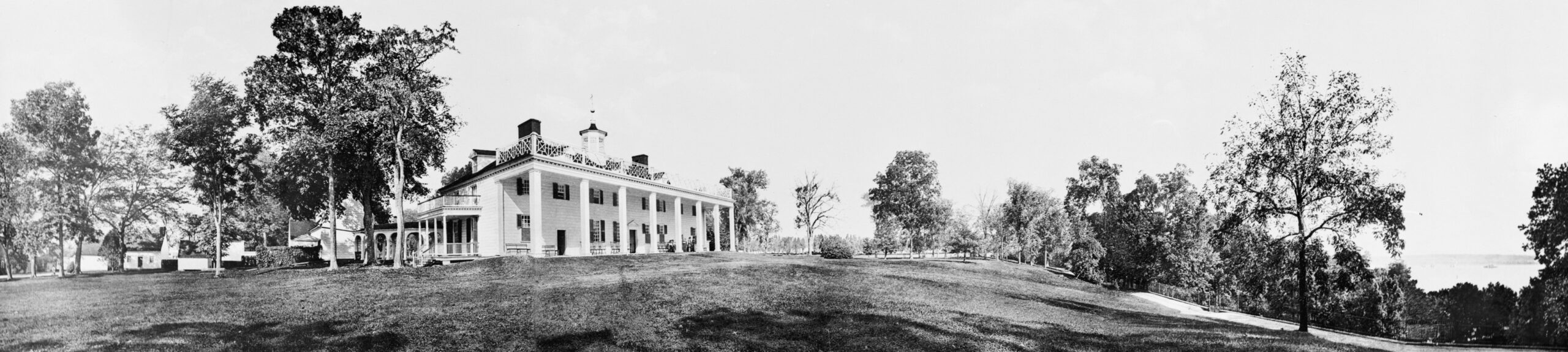
The real Mount Vernon, George Washington’s home on the Potomac River in Virginia, about 1900 to 1910. Detroit Publishing Co., Library of Congress. Click the picture to see it full size.
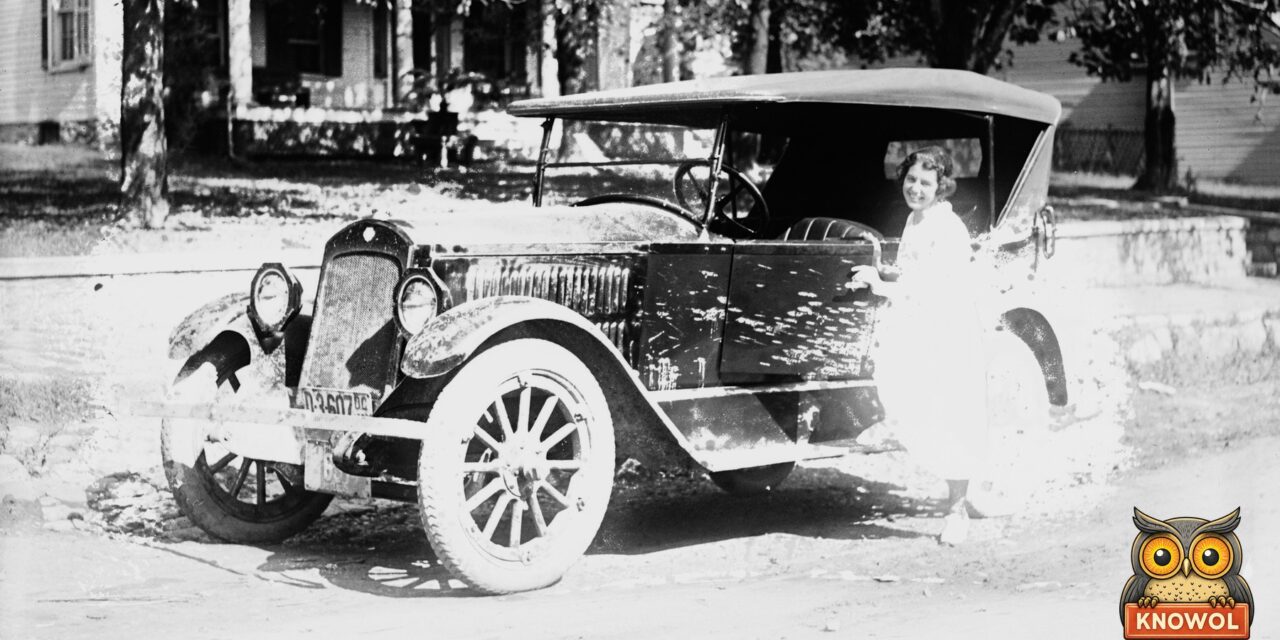
The picture at the top of this story isn’t Big Stone Gap. It’s a 1920 photo by the National Photo Company of a smiling woman beside an open touring car outside a house, filed by the company as “Herald Tour, Staunton, Mitchell cars,” from a Washington Herald auto tour to Staunton, Virginia. It shows the kind of car that waited at the Monte Vista Hotel. No old photo of the Big Stone Gap trip has turned up.
The Big Stone Gap Post summed up the night on its front page. “Take it all around, from Mt. Vernon to Paris and back home to the kids and the unwashed supper dishes, the trip was a great success.” Then it added the line that tells you how the town felt. “Everybody who could borrow a dollar was there, and no one was sorry they went.” The dollars went to the schoolhouse window shades. And little Dan Taggart got the best line in the paper.
Sources
- “Trip Around the World.” The Big Stone Gap Post, Big Stone Gap, Virginia, August 30, 1922, page 1. Library of Congress, Chronicling America
- “Buy your tickets for ‘The Trip Around the World.'” The Big Stone Gap Post, September 6, 1922, page 1. Library of Congress, Chronicling America
- “Around the World Trip Was a Big Success Friday.” The Big Stone Gap Post, September 13, 1922, page 1. Library of Congress, Chronicling America
- Union Mills column (Silver Run trip). The Democratic Advocate, Westminster, Maryland, August 6, 1920, page 1. Library of Congress, Chronicling America
- Pine Street Presbyterian church item. The Lake County Times, Hammond, Indiana, September 27, 1922, page 8. Library of Congress, Chronicling America
- Epworth League page (Bethel Senior League social). Southern Christian Advocate, Charleston, South Carolina, September 10, 1925, page 10. Library of Congress, Chronicling America
- Cover: “Herald Tour, Staunton, Mitchell cars,” National Photo Company, 1920. Library of Congress Prints and Photographs. No known restrictions on publication.
- “Mount Vernon, Virginia, the home of Washington,” Detroit Publishing Co., between 1900 and 1910. Library of Congress Prints and Photographs. No known restrictions on publication.
- Newspaper pages printed in 1920, 1922 and 1925 are in the public domain.