In the summer of 1857, a newspaper in Boston got a close look at something small enough to hide in a coat. It came from a man in Hartland, Vermont. It was a little box with keys. Benjamin Livermore could slip it into his pocket, reach in, press the keys, and print words on a strip of paper without ever taking it out. That was sixteen years before the first typewriters were built for sale.
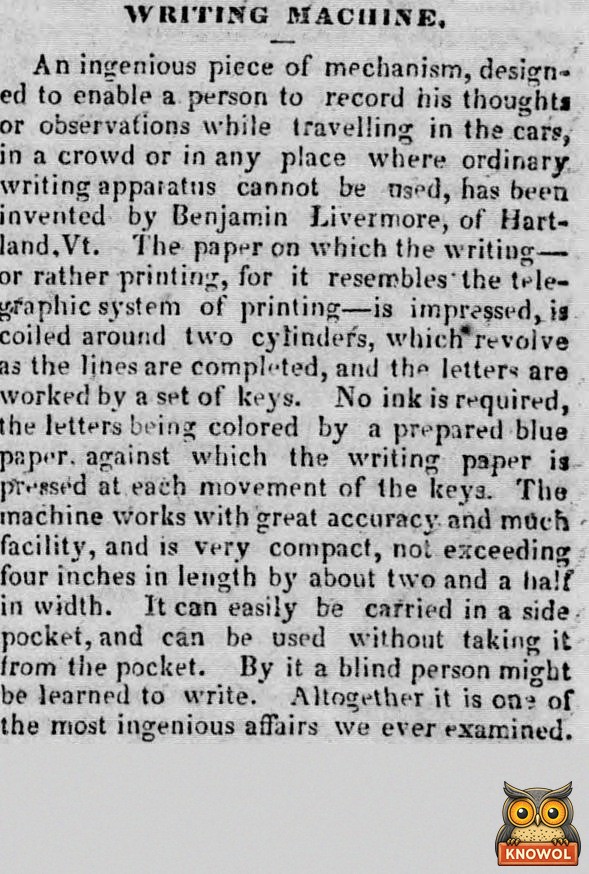
“Writing Machine.” Winchester Republican, Winchester, Virginia, July 31, 1857, page 1. Library of Congress, Chronicling America. Published 1857, public domain. Click the clipping to read it full size.
The Boston Journal wrote about it, and other papers copied the story all over the country. The Winchester Republican, a weekly paper in Winchester, Virginia, printed it on July 31, 1857. It called the machine “one of the most ingenious affairs we ever examined.”
What the Hartland, Vermont, Machine Could Do
Livermore built his machine so a person could write “while travelling in the cars, in a crowd or in any place where ordinary writing apparatus cannot be used.” The cars were railroad cars. In 1857, writing on a bumpy train meant a pen, a bottle of ink, and a good chance of a big blot on your shirt.
Livermore’s box needed no ink at all. The paper said “the letters being colored by a prepared blue paper.” Each time you pressed a key, the writing paper got pushed against that blue sheet, and the color came off in the shape of a letter. It worked a lot like carbon paper, the dark sheets office workers later slipped into typewriters to make copies. The paper rolled around two little cylinders, which turned as each line was finished.
The best part was the size. The paper said it was “not exceeding four inches in length by about two and a half in width.” That’s about as big as a deck of cards. “It can easily be carried in a side pocket, and can be used without taking it from the pocket.” The writer added one more idea: “By it a blind person might be learned to write.”
Benjamin Livermore, the Tinkerer of Hartland
Benjamin Livermore was born in Hartland, Vermont, on August 6, 1818. He was a tinkerer all his life. Before the writing machine, he and a partner, Nathan F. English, got a patent in 1847 for a machine that helped shoemakers shape boots. He got more patents for boot tools in 1849 and 1852.
A family history printed in 1902 tells how the writing machine began. “While studying shorthand about 1850, he invented a type-writer.” Shorthand is a fast way of writing with quick squiggles instead of letters, so reporters can keep up with a speaker. Livermore wanted to write fast, too.
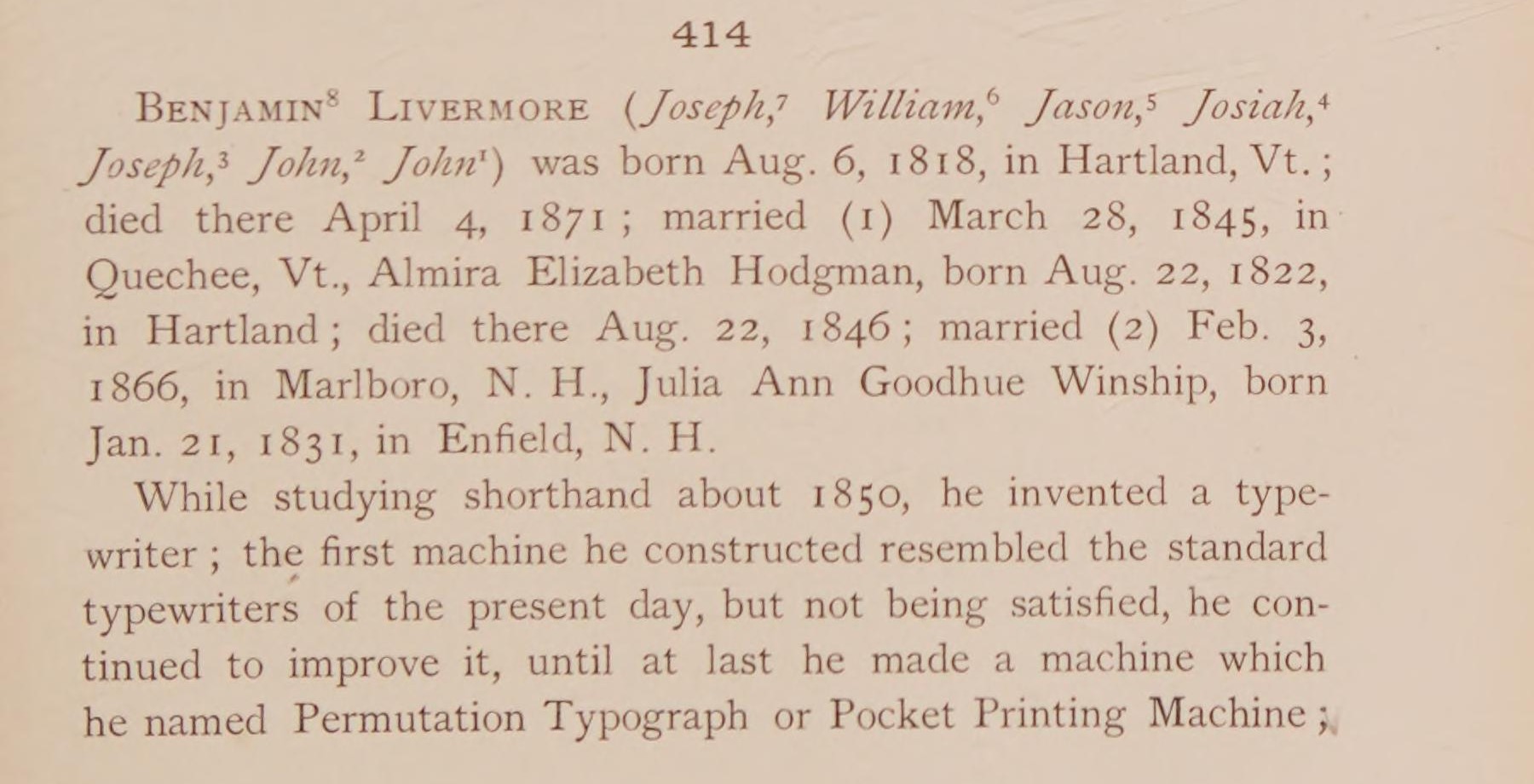
Benjamin Livermore’s entry. The Livermore Family of America, by Walter Eliot Thwing, Boston, 1902, page 269. Internet Archive. Published 1902, public domain. Click the clipping to read it full size.
His first machine looked like the big typewriters of later years, the book says. He wasn’t happy with it. So he kept changing it, “until at last he made a machine which he named Permutation Typograph or Pocket Printing Machine.” A permutation is a new way of arranging the same pieces. That name was the whole secret of how it worked.
How Six Keys Made Every Letter
Most typewriters have one key for every letter. Livermore’s finished pocket machine had only six keys. On July 21, 1863, he got a United States patent for it, No. 39,296, called a “Hand-Printing Device or Mechanical Typographer.”
The patent drawing shows the trick. His machine had just one piece of type, cut into six parts. Four straight bars made the sides of a little square. Two small V shapes sat inside it, one pointing up and one pointing down. Each key pushed one of those parts against the paper.
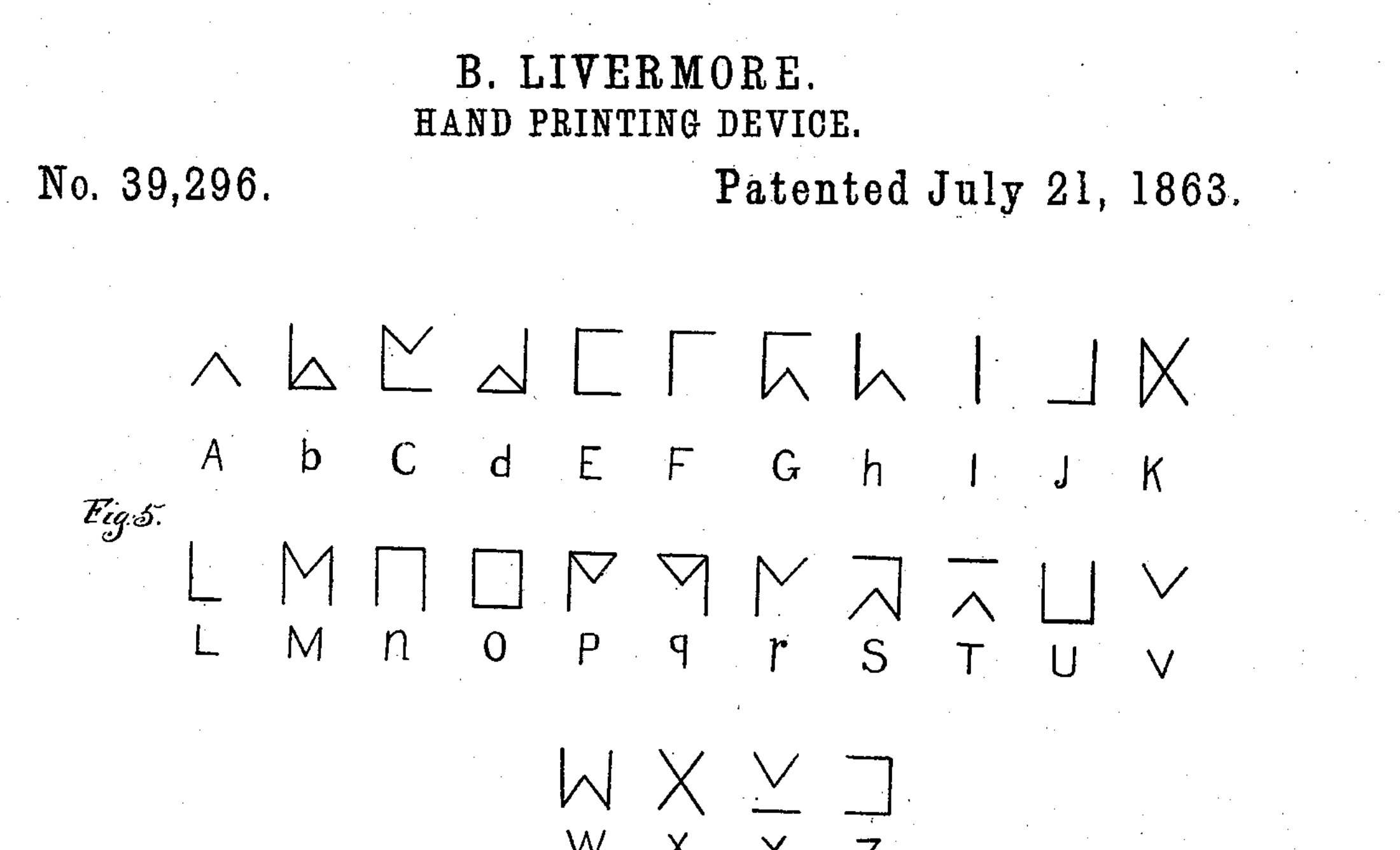
Livermore’s whole alphabet, made from six little bars and V shapes. Benjamin Livermore, Hand Printing Device, U.S. Patent No. 39,296, July 21, 1863, Figure 5. U.S. Patent Office, public domain. Click the picture to see it full size.
Press one key and you got a single V, which stood for A. Press the four keys for the four sides and you got a box, which stood for O. Press two sides and you got an L. Most other letters were a mix of two or three parts, pressed at the same time, like a chord on a piano. The letters came out blocky and a little strange. His S looks like a little tent tucked under a 7. But anyone who learned the shapes could read them.
The patent says the lines came out curved, because the type swung along an arc as it moved across the paper. The ink pad was simple, too: a piece of paper rubbed with coloring and grease. Scientific American, a big weekly magazine about inventions, listed his machine among the most important patents of that week.
If the idea sounds familiar, look at a digital clock. Its numbers are built from a few straight bars that light up in different mixes. Livermore was doing the same thing with letters, with his fingers, about a hundred years earlier. Patents from the 1970s for a character generator and a keyboard even list his 1863 patent among the earlier ideas.
The Steel Box From Hartland, Vermont
The 1902 family book gives the sizes of the finished machine. “The box itself was of steel, four and one-half inches long, two and one-half inches wide, and one and a quarter inches deep.” Inside was “a roll of paper twenty feet long.” Each line held twenty letters, and “about sixty lines could be printed upon one foot.”
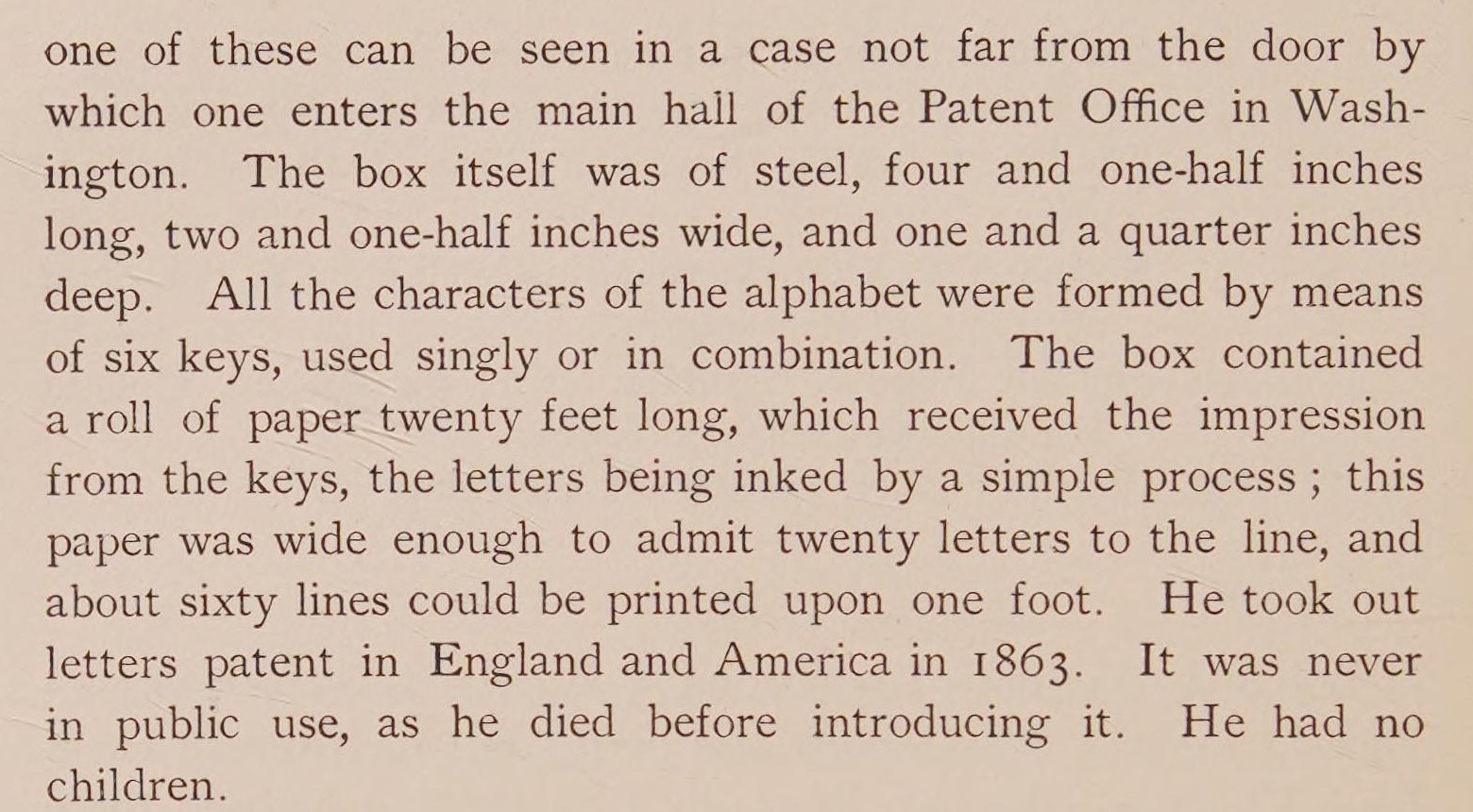
The pocket machine, with its six keys and its twenty feet of paper. The Livermore Family of America, 1902, page 270. Internet Archive. Published 1902, public domain. Click the clipping to read it full size.
If you do the math, one roll of paper had room for about 24,000 letters. That’s enough for a long letter home, or a whole notebook of train-ride thoughts.
The book says one of these machines sat “in a case not far from the door by which one enters the main hall of the Patent Office in Washington.” We could not find where the little steel box is today.
The Big Machines With Piano Keys
Livermore was not the only inventor chasing a writing machine. In New York, a doctor named Samuel W. Francis got a patent on October 27, 1857, the same year the papers wrote about Livermore. Francis’s machine had piano keys and sat in a wooden frame about a foot wide. The Smithsonian still has the model he sent to the Patent Office.
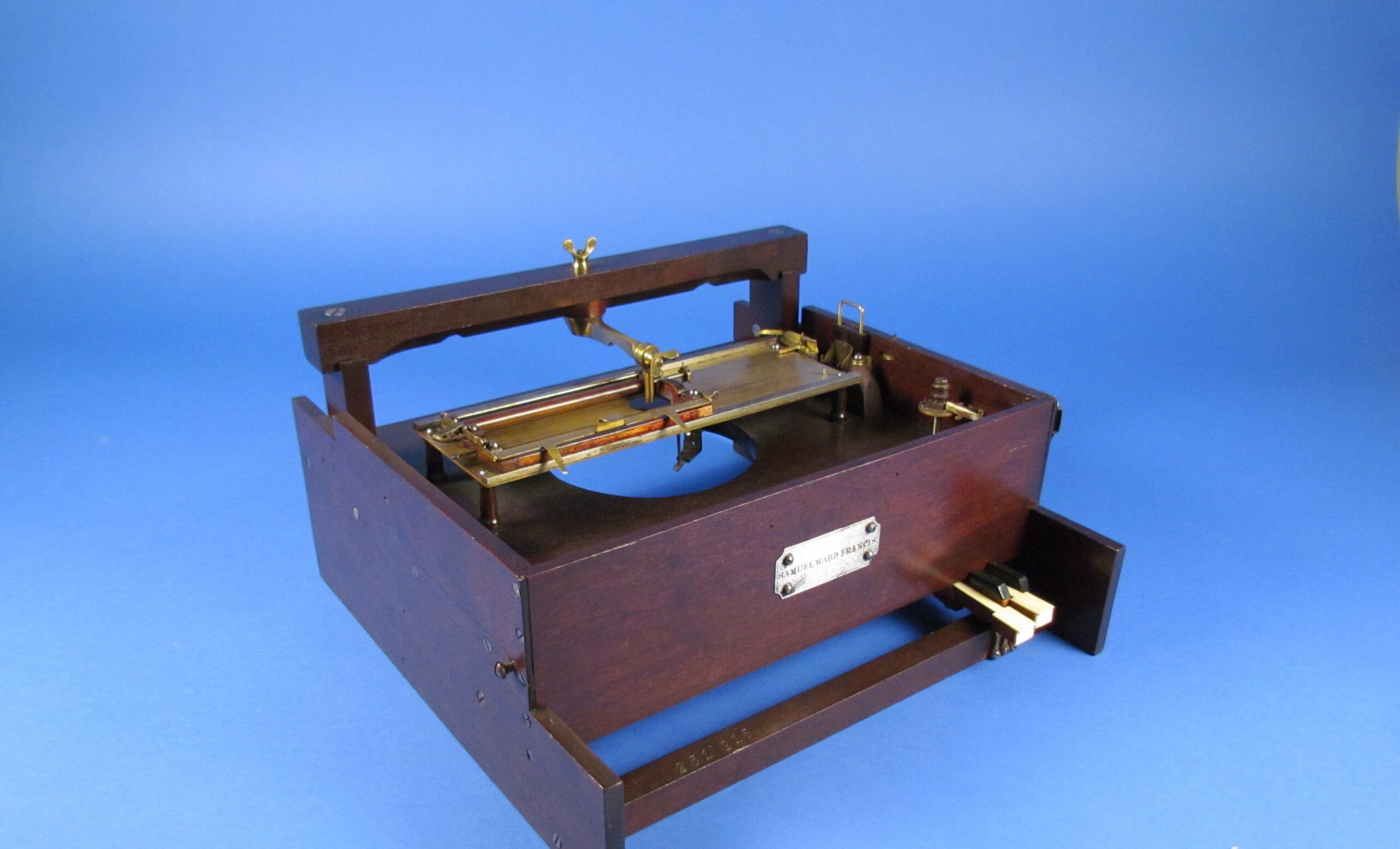
The Samuel W. Francis printing machine patent model, patented October 27, 1857, the same year newspapers wrote about Livermore’s pocket machine. National Museum of American History, Smithsonian Institution. CC0. Click the picture to see it full size.
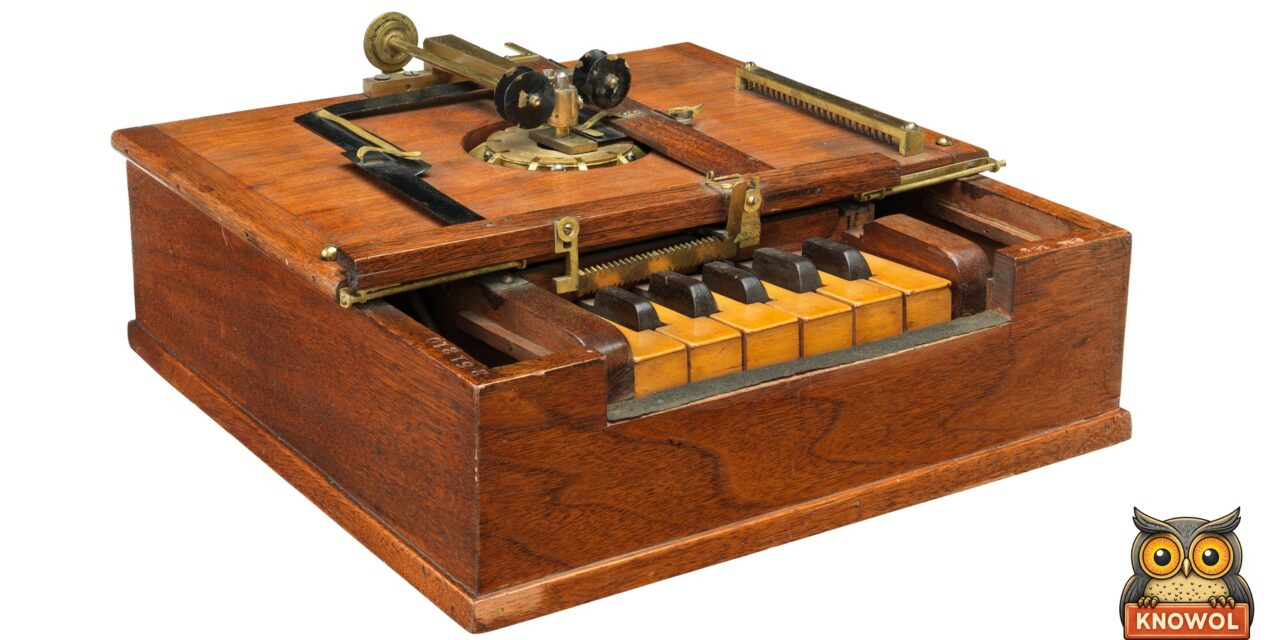
The cover photo at the top of this story shows another one. It’s the patent model of the typewriter by C. Latham Sholes, Carlos Glidden and Samuel Soule of Milwaukee, Wisconsin, patented in 1868. It’s a wooden box with piano keys, and it’s the family of machines that finally won. A history book printed in 1923 for the typewriter’s 50th birthday says the first practical writing machines began to be made in Ilion, New York, in the fall of 1873. The same book lists “Benjamin Livermore of Hartland, Vermont, in 1863” among the inventors who tried before.
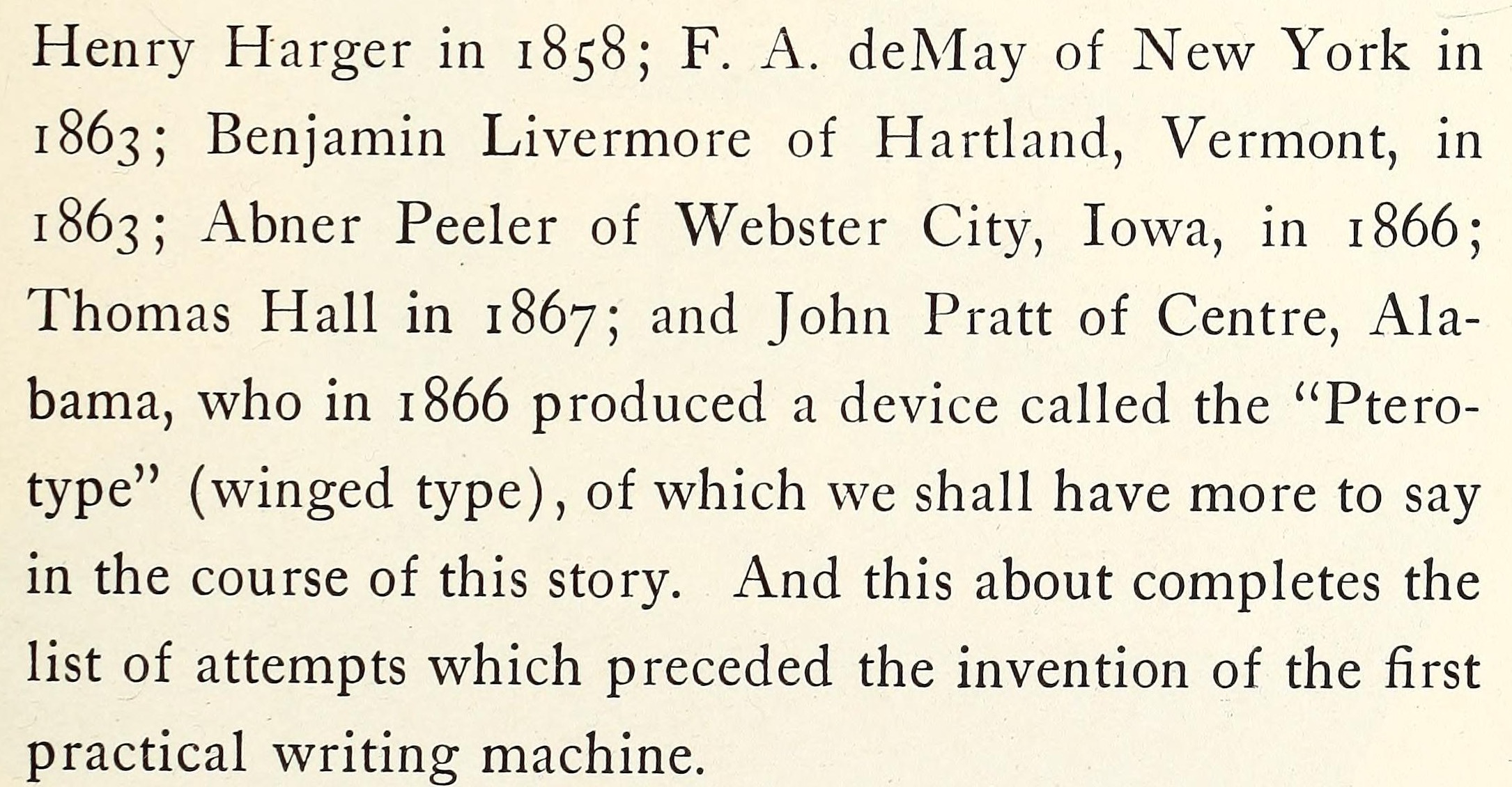
Livermore on the list of early tries. The Story of the Typewriter, 1873-1923, Herkimer County Historical Society, 1923, page 27. Internet Archive. Published 1923, public domain. Click the clipping to read it full size.
A Pocket Machine That Came Too Early
Livermore had other ideas going, too. In 1860 a Vermont paper, the Orleans Independent Standard, said he was laying water pipe made of cement, which he had also patented. He said about one thousand rods of it were working, which is about three miles of pipe. Since he started doing it his new way, he said, “he has not had a single failure.”
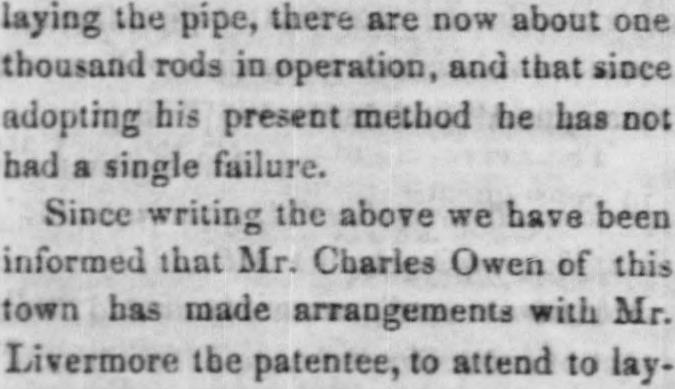
Livermore’s cement water pipe. Orleans Independent Standard, Irasburg, Vermont, August 3, 1860, page 2. Library of Congress, Chronicling America. Published 1860, public domain. Click the clipping to read it full size.
His pocket printer never got its chance. Benjamin Livermore died in Hartland on April 4, 1871, at 52. “It was never in public use, as he died before introducing it,” the family book says. Two and a half years later, the first typewriters for sale were being built in Ilion. They were desk machines, built to sit in an office. Livermore’s idea was a writer that rode in your pocket, worked on a train and needed no ink. People carry machines like that today. They just call them phones.
Sources
- “Writing Machine.” Winchester Republican, Winchester, Virginia, July 31, 1857, page 1. Library of Congress, Chronicling America
- Item from the Boston Journal. Yorkville Enquirer, Yorkville, South Carolina, July 16, 1857, page 2. Library of Congress, Chronicling America
- The same story also ran in the Evening Bulletin, Louisville, Kentucky, July 11, 1857 (Internet Archive), and the Western Standard, San Francisco, California, August 28, 1857 (Internet Archive).
- “Cement for Aqueducts.” Orleans Independent Standard, Irasburg, Vermont, August 3, 1860, page 2. Library of Congress, Chronicling America
- Benjamin Livermore, Device for Hand-Printing, U.S. Patent No. 39,296, July 21, 1863. Patent PDF. His cement drain patent is No. 28,091, May 1, 1860.
- “Recent American Patents.” Scientific American, August 8, 1863. Internet Archive
- Livermore’s boot-making patents: Scientific American, April 24, 1847 (Internet Archive), and Journal of the Franklin Institute, October 1852 (Internet Archive).
- Walter Eliot Thwing, The Livermore Family of America, Boston, 1902, pages 269-270. Internet Archive
- Herkimer County Historical Society, The Story of the Typewriter, 1873-1923, 1923, page 27. Internet Archive
- Cover: Sholes, Glidden, and Soule Typewriter Patent Model, 1868. National Museum of American History, Smithsonian Institution. Smithsonian. CC0.
- Samuel W. Francis Typewriter Patent Model, 1857. National Museum of American History, Smithsonian Institution. Smithsonian. CC0.
- Newspapers, books and patents printed before 1931 are in the public domain.