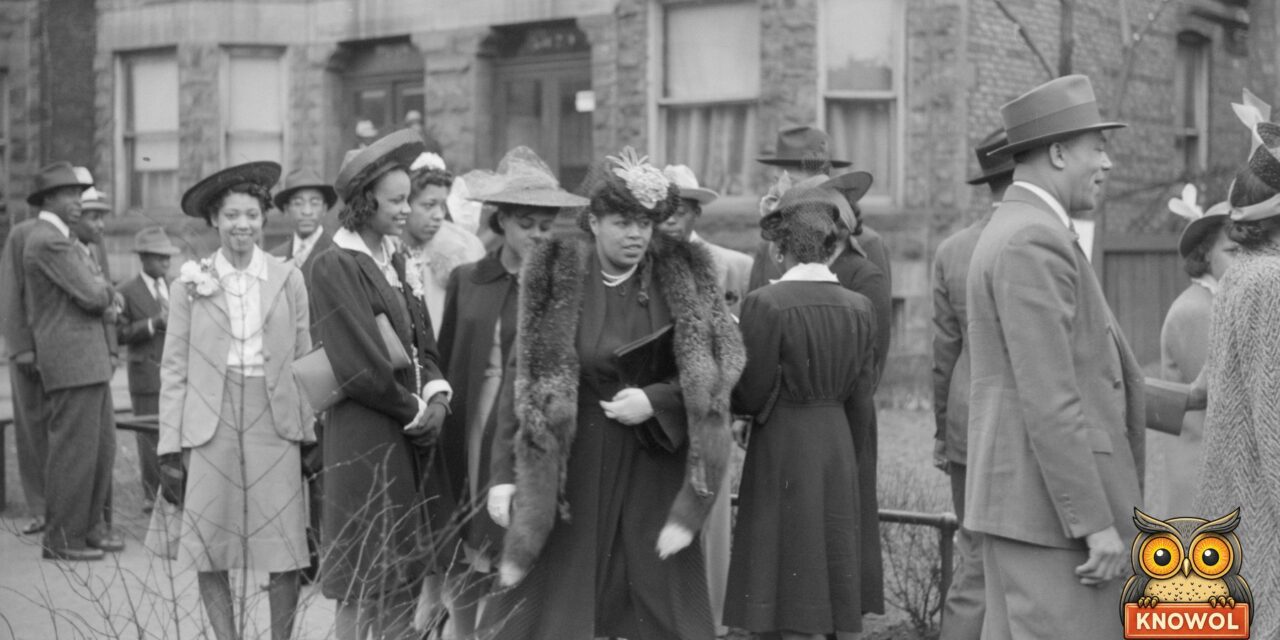
The church doors have just opened, and nobody is in a hurry to go home. It’s Easter Sunday, April 13, 1941, on the South Side of Chicago, Illinois. A young woman on the left grins at the camera, a white flower pinned to her jacket. In the middle, a woman walks straight toward us in a long fur stole that hangs nearly to her knees, with a spray of flowers on top of her hat. Off to the right, a man in a gray hat is laughing at something we’ll never hear. Everyone in this picture is wearing their very best, and almost all of them look glad about it.
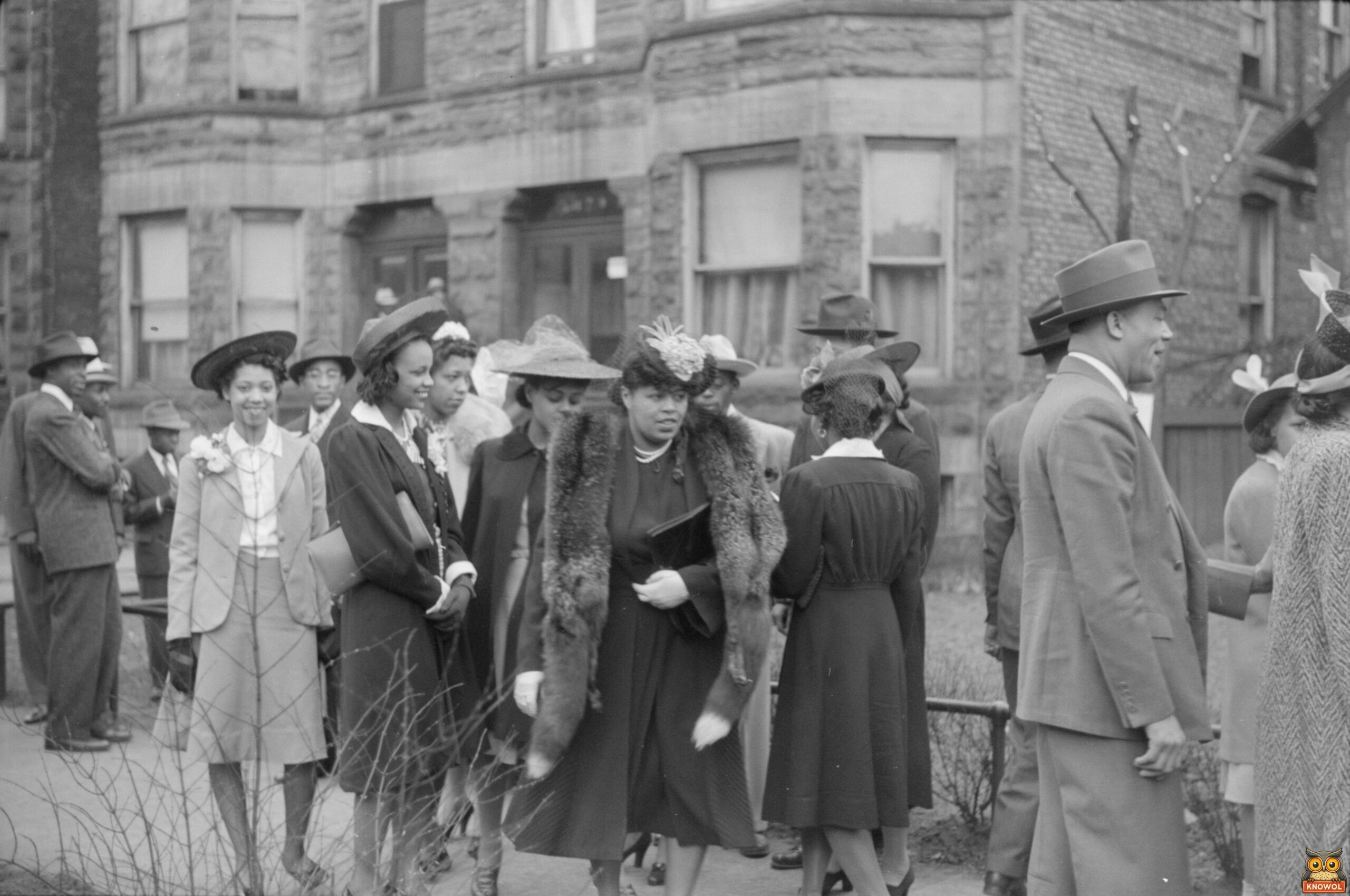
A crowd outside a church after Easter Sunday service, Chicago, Illinois, April 1941. Photo by Edwin Rosskam for the U.S. Farm Security Administration. Library of Congress, Prints and Photographs Division, FSA/OWI Collection. No known restrictions. Click the picture to see it full size.
The Man With the Camera in Chicago
The photographer was Edwin Rosskam, and the United States government was paying him to stand on that Chicago sidewalk. In the 1930s and early 1940s, a government office called the Farm Security Administration, or FSA, sent photographers all over the country. Their job sounds simple: show how Americans really lived and worked. They took pictures of farms, factories, kitchens, county fairs and city streets. Today the Library of Congress keeps more than 170,000 of their pictures, and anyone can use them for free.
That April, Rosskam worked in Chicago alongside another FSA photographer, Russell Lee. They spent their days on the South Side, the part of the city where most of Chicago’s Black families lived. Rosskam was also choosing the pictures for a book by the writer Richard Wright called 12 Million Black Voices. It came out from Viking Press that October, with Wright’s words and Rosskam’s choice of FSA photos.
Rosskam wrote a short caption card for this picture. It says the crowd is outside a “fashionable” church “after Easter Sunday service.” The card doesn’t name the church or anyone in the crowd. So we don’t know who the woman in the fur was, or the young woman with the flower. We only know the day, the city and the joy.
Why Easter Sunday Mattered on Chicago’s South Side
To see why this Chicago sidewalk was so full, it helps to know who lived around it. Starting in about 1910, millions of Black Americans left farms and small towns in the South and moved north for factory jobs and a fairer chance. Historians call it the Great Migration. In its first wave, up to 1940, about 1.6 million people moved. Chicago was one of the biggest places they went. By 1940 the city had about 278,000 Black residents, many of them packed into a long, narrow strip of the South Side that people called Bronzeville.
For many families, church was the heart of that neighborhood, the place where newcomers from the South found friends and help. Easter was the biggest church day of the year, and people dressed in their finest. After the service, people didn’t rush home. They walked up and down the avenues in their Easter best, to see and be seen. The Chicago Defender, the city’s famous Black newspaper, called this the Easter stroll.
What Easter Best Looked Like in 1941
Look closely at Rosskam’s Chicago photo, and you can read the fashions of spring 1941 like a catalog. Almost every woman wears a hat, and no two hats are alike: wide brims, little tilted saucers, one with a net veil, one with a big flower on top. Two women wear corsages, little bunches of flowers pinned to the coat. There are white gloves, strings of pearls and flat purses called clutches, carried under the arm instead of on a strap.
The men are dressed up too, in suits, ties and felt hats with a dent in the crown. The trees are still bare and the bushes are only twigs, because spring comes late to Chicago. That’s probably why so many people kept their coats on.
The Rest of Easter Day in Chicago
Rosskam didn’t take just one picture in Chicago. He spent the whole day on the South Side, and his other frames tell the rest of the story. He also photographed an Easter procession outside a church that his card again calls fashionable, probably this same one. In it, choir members in dark robes walk along the sidewalk, singing from their hymn books.
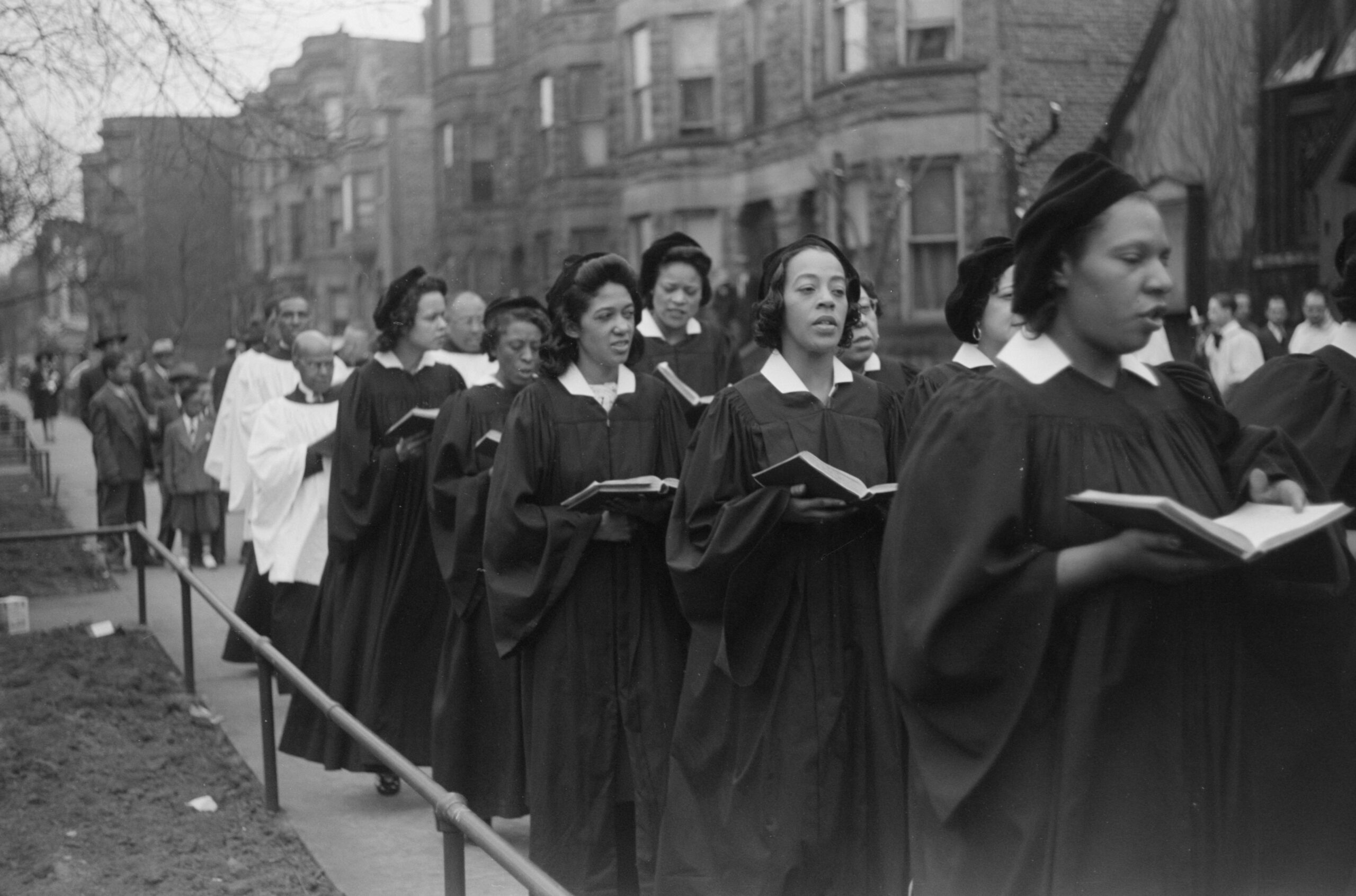
The choir in an Easter procession outside a church, Chicago, Illinois, April 1941. Photo by Edwin Rosskam, FSA/OWI Collection, Library of Congress. No known restrictions. Click the picture to see it full size.
On a street corner, men sold Easter lilies in clay pots from wooden crates. A lily is the flower of Easter, and lots of families bought one for the table or for church.
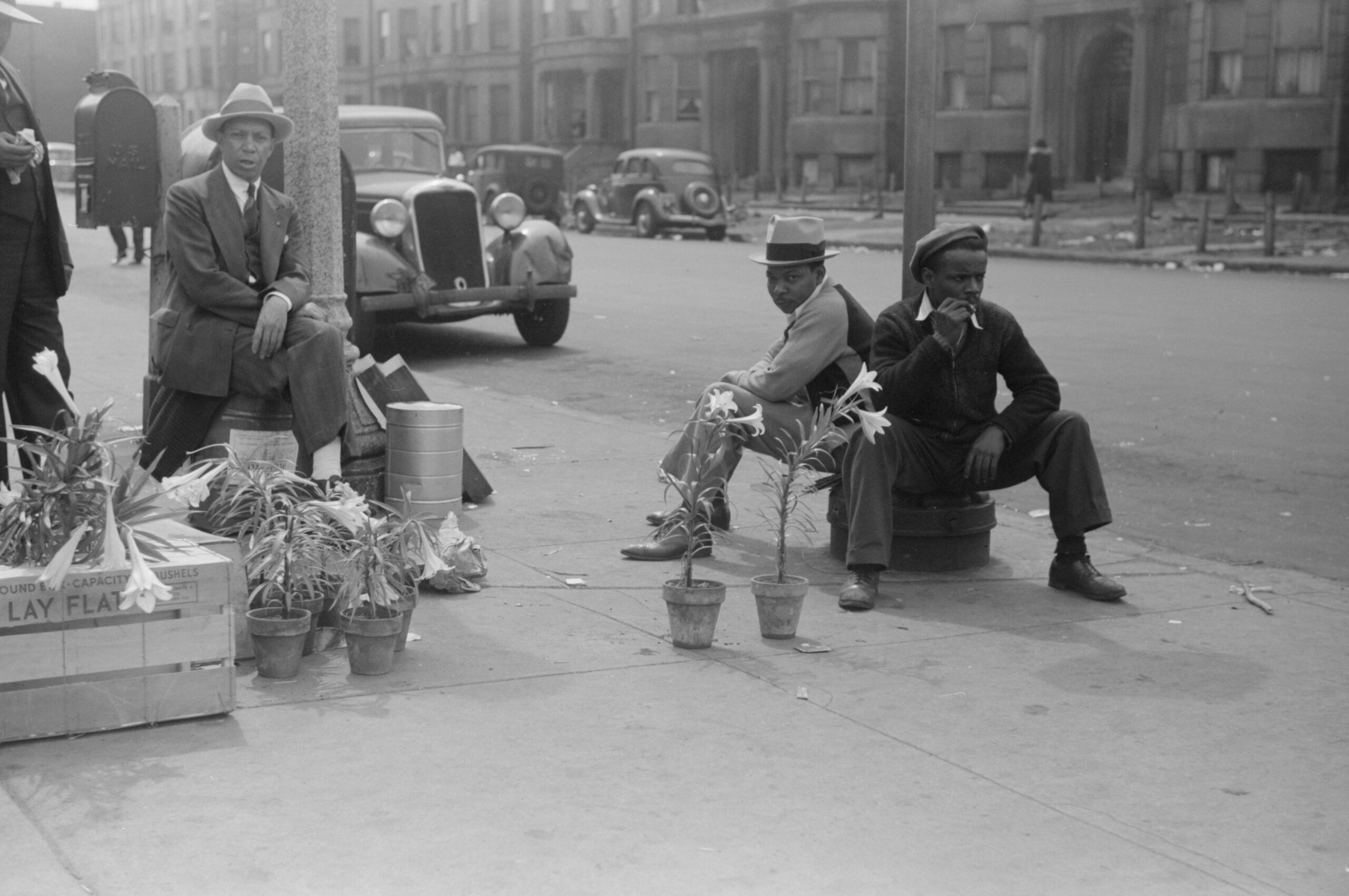
Lily sellers on Easter Sunday, Chicago, Illinois, April 1941. Photo by Edwin Rosskam, FSA/OWI Collection, Library of Congress. No known restrictions. Click the picture to see it full size.
Then came the best part for the kids. Rosskam found a long line of children outside a movie theater, waiting for the Easter Sunday matinee, an afternoon show. They’re still in their church clothes: the boys in suits and hats, the girls in coats and little purses. On the posters beside them you can read the names Cary Grant, Katharine Hepburn and James Stewart. Those are the stars of The Philadelphia Story, a hit movie that had just come out. The other poster is for The Aldrich Family in Life With Henry, a comedy about a teenager named Henry Aldrich who always seemed to land in trouble.
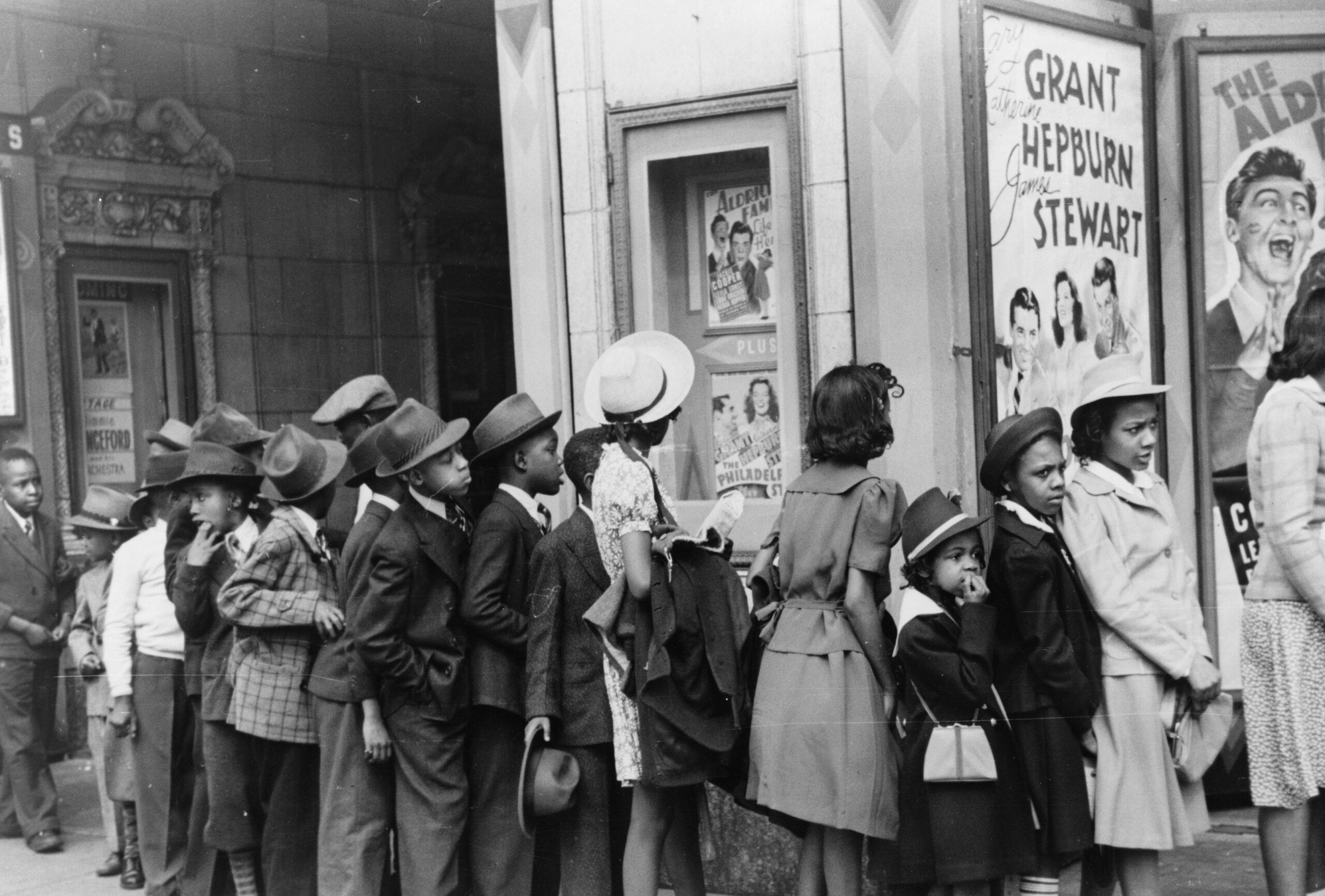
Children in line at a movie theater for the Easter Sunday matinee, Chicago, Illinois, April 1941. Photo by Edwin Rosskam, FSA/OWI Collection, Library of Congress. No known restrictions. Click the picture to see it full size.
Russell Lee was out with his camera that Easter too. He photographed people on the steps of Pilgrim Baptist Church, and he photographed an Episcopal church’s procession and the handshakes at its door afterward. Lee’s Episcopal church has the same wooden porch and the same white-painted tree trunks as the church in Rosskam’s procession pictures, so the two men were probably working the same doorway that Easter. Neither caption names it.
What Happened to the Pictures From Chicago
In 1942 the FSA photographers who made these Chicago pictures were moved into a new wartime office, the Office of War Information. In 1944 their pictures, this one included, went to the Library of Congress. Rosskam and Lee took hundreds of photos on the South Side that spring. Richard Wright’s book told the hard side of the migration: sharecropping in the South, then crowded apartments and low pay in the North.
This picture shows another side. It’s one cool spring morning when a busy neighborhood put on its best hats, walked out of church together, and smiled. Edwin Rosskam lived until 1985. The woman in the fur, the young woman with the flower, and the laughing man in the gray hat never got their names on the caption card. But their Easter Sunday made it into the nation’s library, and it’s still there for anyone to see.
Sources
- Edwin Rosskam, “Crowd outside of fashionable … church after Easter Sunday service, Chicago, Illinois,” April 1941. Caption card title, record and full-size scan: Library of Congress, item 2017729518. (The record’s old wording for race is left out here.) FSA/OWI photographs: no known restrictions.
- Edwin Rosskam, Easter procession outside a church, Chicago, April 1941: Library of Congress, item 2017729495. Lily vendors on Easter Sunday: item 2017729485. Children at the Easter Sunday matinee: item 2017729470.
- Russell Lee, “In front of Pilgrim Baptist Church on Easter Sunday, South Side of Chicago, Illinois,” April 1941: Library of Congress, item 2017743618. Russell Lee, “Church services are over on Easter Sunday an an Episcopal Church on the South Side of Chicago, Illinois,” April 1941: item 2017743695.
- About the FSA/OWI photographs and their rights: Library of Congress, FSA/OWI Black-and-White Negatives and rights and restrictions.
- 12 Million Black Voices (Viking Press, October 1941), text by Richard Wright, photos selected by Edwin Rosskam: Wikipedia.
- The Great Migration’s first wave: Wikipedia, Great Migration. Chicago’s Black population in 1940: Wikipedia, African Americans in Chicago.
- The Easter stroll in Bronzeville and the Chicago Defender: Ron Grossman, “The long tradition of Easter finery on parade,” Chicago Tribune, March 30, 2024, via Yahoo News.