On August 27, 1885, a lady from Austin, Texas, sat down by the sea and wrote a letter to her hometown paper. She was staying in Cottage City, a summer resort town on the island of Martha’s Vineyard, Massachusetts. Back home it was hot, and she guessed the summer news gave the editors “but little variety for your columns.” So she would “favor (?) your readers” with a report. That little question mark was her joke: she wasn’t sure it was a favor.
The Austin Weekly Statesman printed her letter on its front page on September 10, 1885. The headline said “By the Seaside,” and under it, “Interesting Delayed Letter from an Austin Lady.” She signed it with three letters, F. C. P. Today her seaside town is called Oak Bluffs, Massachusetts, and the big night she was waiting for still happens there every summer.
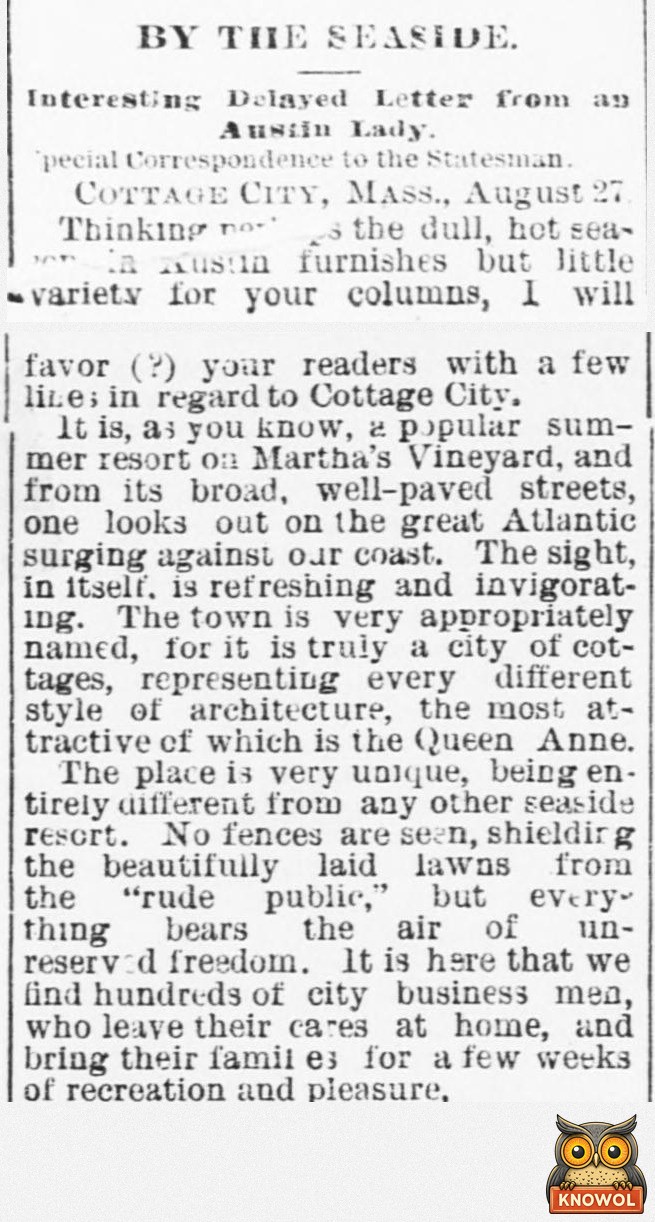
“By the Seaside. Interesting Delayed Letter from an Austin Lady.” The Austin Weekly Statesman, Austin, Texas, September 10, 1885, page 1. Library of Congress, Chronicling America. Click the clipping to read it full size.
A Town of Cottages With No Fences
F. C. P. told Austin that Cottage City had the right name, “for it is truly a city of cottages.” Every cottage had its own style. Her favorite was the Queen Anne, the kind of house with towers, porches and fancy trim.
What surprised her most was what the town didn’t have. “No fences are seen, shielding the beautifully laid lawns from the ‘rude public,'” she wrote. In Cottage City, anyone could walk right up to the lawns. Business men from the cities left “their cares at home” and brought their families for a few weeks by the ocean.
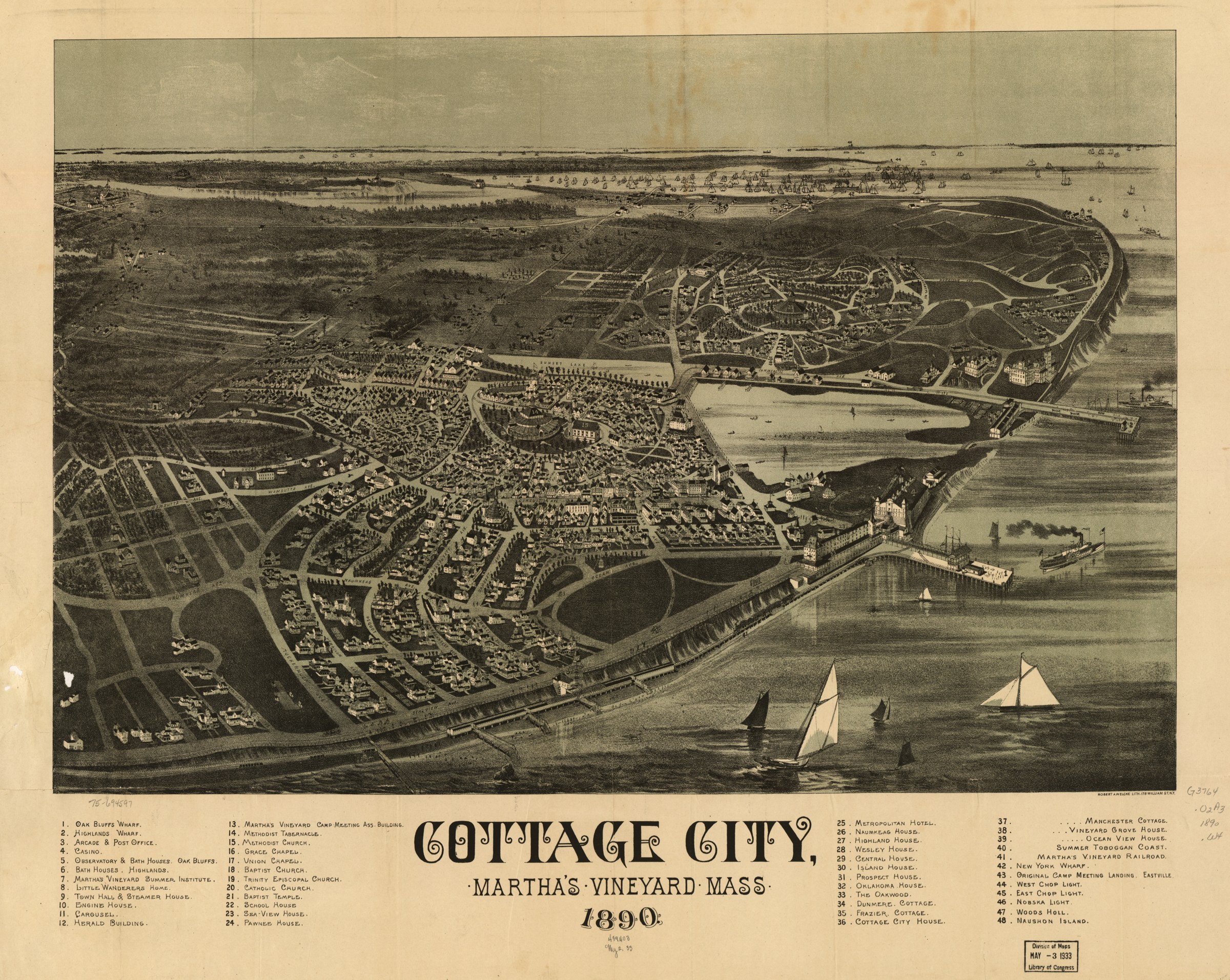
Cottage City, Martha’s Vineyard, Mass., 1890, a bird’s-eye view drawn five summers after the letter. The steamboat wharf is at the right. Library of Congress, Geography and Map Division. Click the picture to see it full size.
Bathing Hour in Cottage City
In Cottage City, swimming had a schedule. “Bathing is, of course, the principal amusement,” F. C. P. wrote, and every morning from eleven to twelve o’clock the beach was crowded with people watching the swimmers.
The swimsuits were part of the show. Bathing suits then were baggy and dark, made to cover up, not to show off. “Their costumes are simply ‘immense,'” she wrote, “and the wearers are almost beyond recognition.” Nobody minded, because everyone looked just as silly.
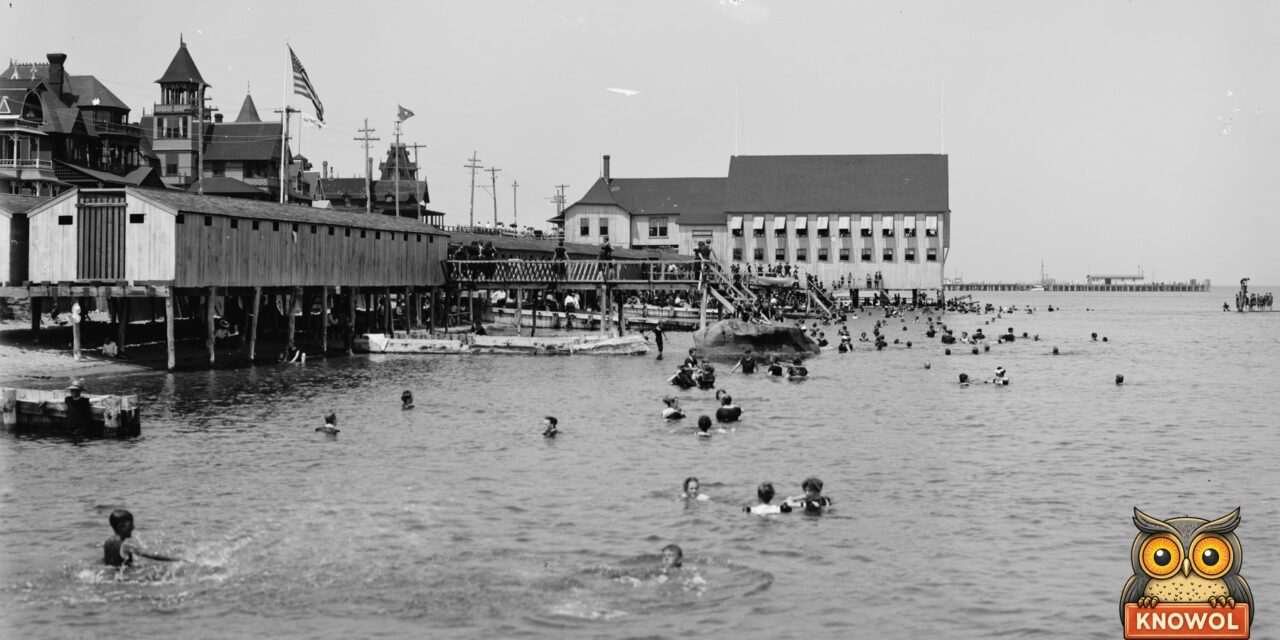
Her best line was about the beginners. “Some swim, dive and float, while others make awkward attempts to do the same; it is needless to say the latter class are the ones who attract most attention.” In other words, the splashers got the biggest crowd. Higgins’ band, from Boston, played on the beach every morning. The photograph at the top of this page shows bathers at Cottage City a few summers later: tall cottages, bathhouses on stilts and swimmers in the water.
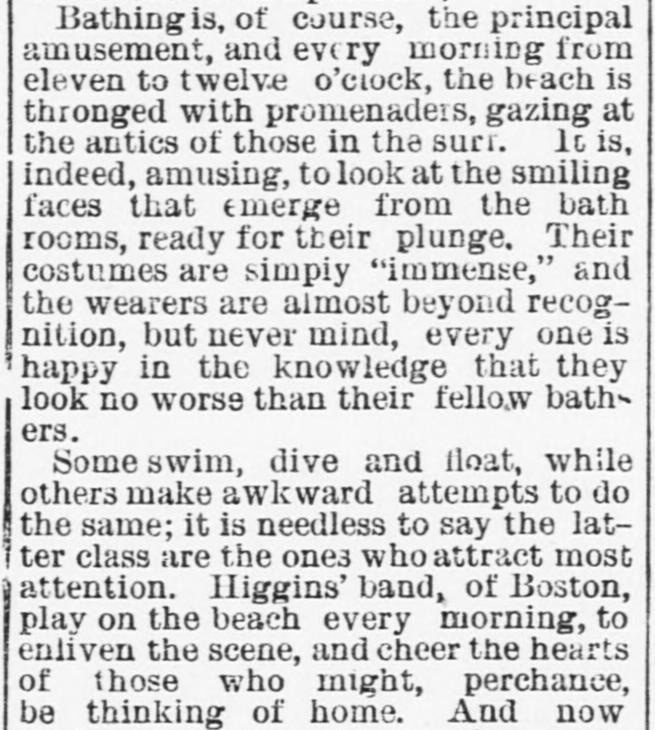
Bathing hour, “simply ‘immense'” costumes and Higgins’ band. The Austin Weekly Statesman, September 10, 1885, page 1. Library of Congress, Chronicling America. Click the clipping to read it full size.
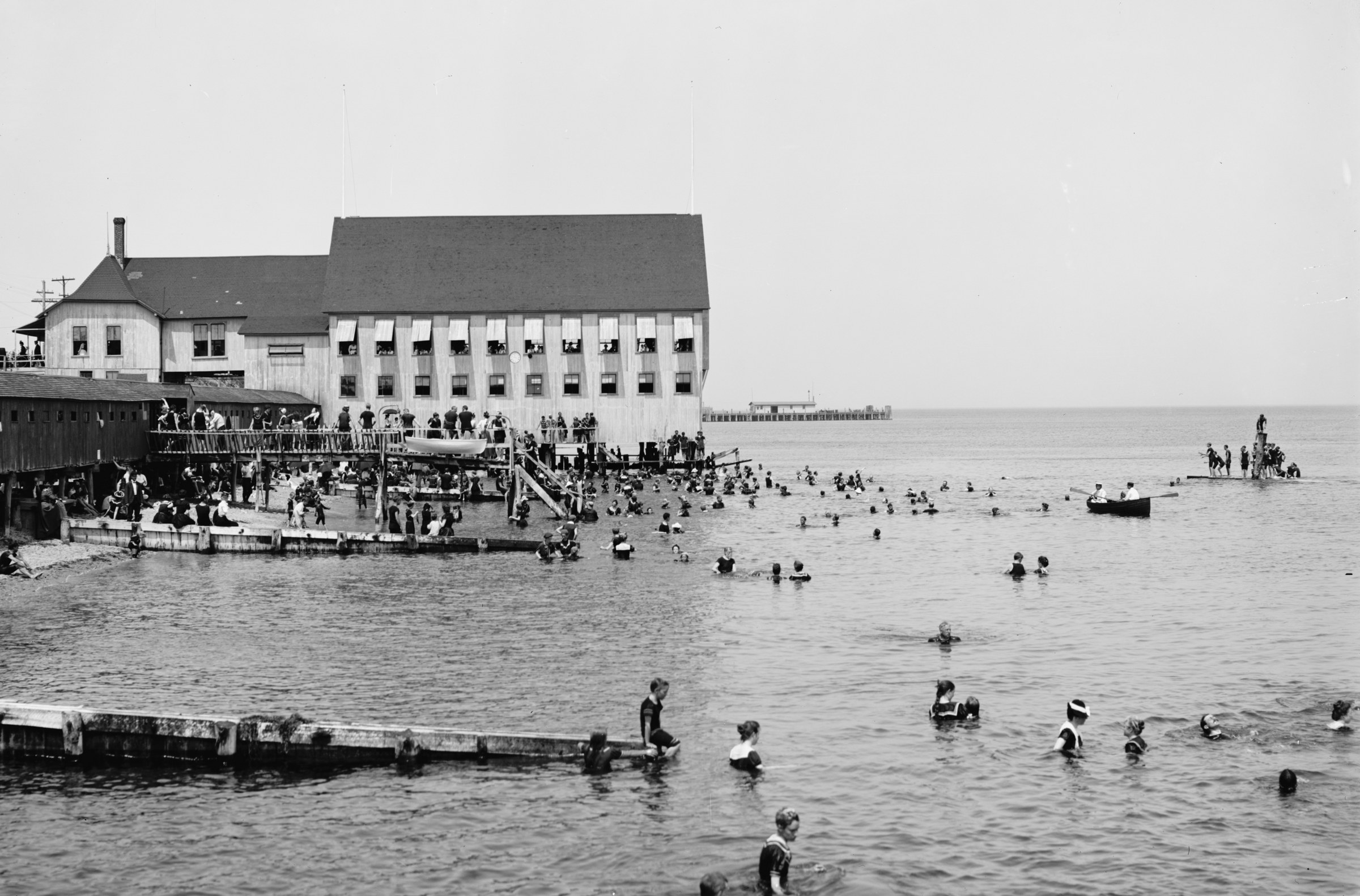
Bathers at Cottage City, Martha’s Vineyard. Detroit Publishing Co., between 1890 and 1901. Library of Congress. Click the picture to see it full size.
No Flirting Allowed in Cottage City (Officially)
F. C. P. had fun with Cottage City’s manners. The town, she wrote, took “every precaution” against the “heart-breaking scourge” found at every summer resort. “No flirting of any description is allowed, and when one sees two pairs of feet peeping from underneath a huge umbrella, in a snug corner, on the beach, they naturally wonder what is going on ‘behind the scenes.'”
Daytime was casual. Ladies stayed in relaxed clothes most of the day. The men paid quick visits, which she called “stop a moment calls,” in “blouse waists, knee trousers and red ‘sand slippers.'” At night, when there was a “German” (a fancy dance party) or a hop, everyone dressed up.
There was plenty to do between swims: baseball, lawn tennis and carriage drives. Bicycles and tricycles “reign supreme,” she wrote, for young men and maidens, old men and children. A New York Times reporter on the island that August added that “bicycling by moonlight” was “just now very fashionable.”
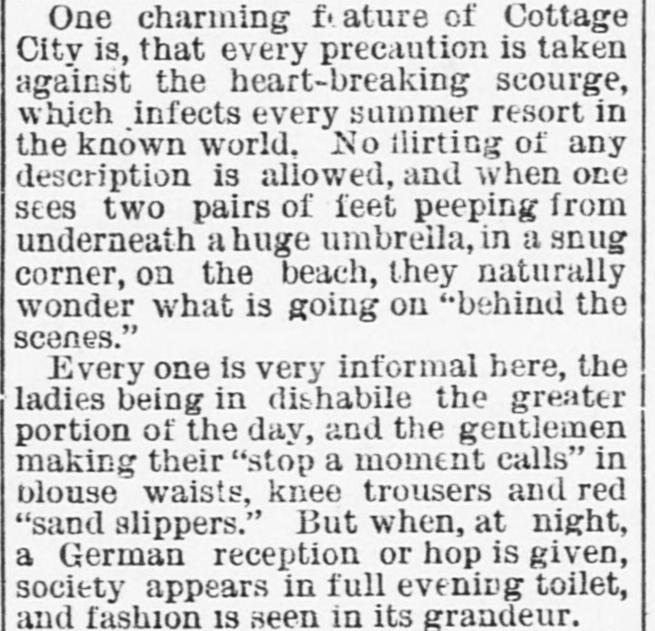
“No flirting of any description is allowed.” The Austin Weekly Statesman, September 10, 1885, page 1. Library of Congress, Chronicling America. Click the clipping to read it full size.
Texans by the Sea at Cottage City
F. C. P. wasn’t the only Texan in Cottage City. “Our Lone Star State has been well represented here this season,” she wrote, “Galveston, San Antonio, Marshall and Austin faces having been seen among the pleasure seekers.” Austin readers would have liked that line. It meant people they knew were on the beach, too.
Waiting for Illumination Night in Cottage City
The end of F. C. P.’s letter from Cottage City is about the night everyone was waiting for. “Everyone is looking forward to the grand illumination, which takes place on the 5th of September,” F. C. P. wrote. “Each cottage is to be illuminated, and friends will vie with one another, to see who can outrival their neighbors in the brilliancy and beauty of their fairy-like homes.”
To illuminate a cottage meant to hang it with paper lanterns and light them all. In plain words, every cottage in town would glow, and neighbors would try to outshine each other. There would be fireworks and bands, too. “Illumination night,” she wrote, was “the formal closing of the season.”
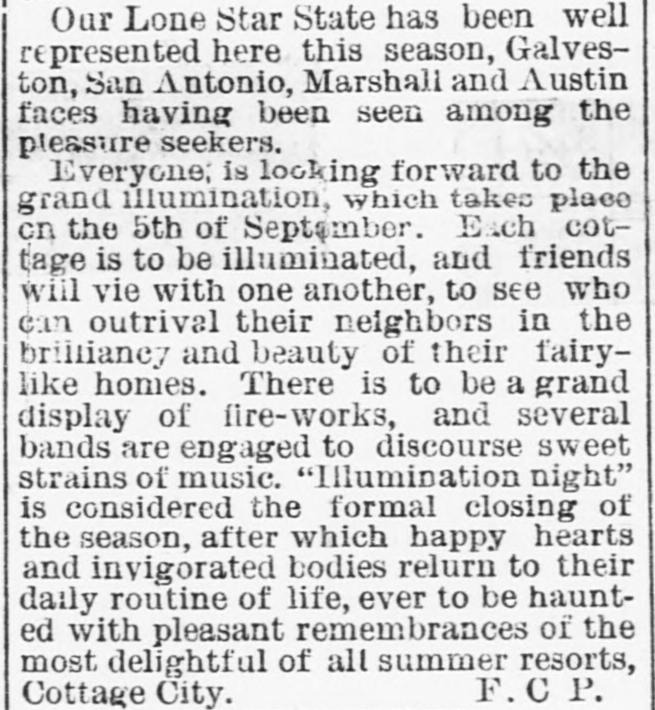
Texans at the seaside, and the grand illumination. The letter is signed F. C. P. The Austin Weekly Statesman, September 10, 1885, page 1. Library of Congress, Chronicling America. Click the clipping to read it full size.
The tradition was already old in 1885. The Martha’s Vineyard Camp Meeting Association says the first Illumination Night was held on August 14, 1869, with Chinese and Japanese lanterns hung from cottages and trees. In 1880, a Connecticut paper reported “the twelfth annual illumination,” and said, “There were thirty thousand people spectators.”
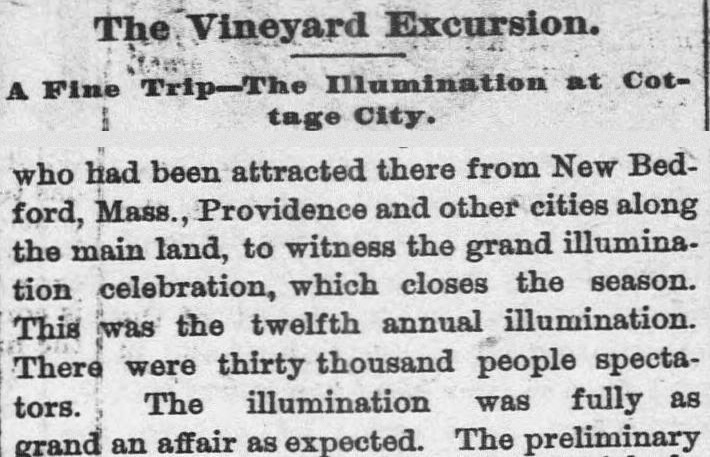
“The Illumination at Cottage City,” 1880. Morning Journal and Courier, New Haven, Connecticut, August 31, 1880, page 2. Library of Congress, Chronicling America. Click the clipping to read it full size.
Why Cottage City’s Lantern Night Waited a Week
The date F. C. P. gave for Cottage City’s big night, September 5, was later than usual, and that was on purpose. In July, The New York Times reported “a strong effort” to push the illumination back to the end of the first week in September. It would “prolong the season just one week,” and one more week of guests meant “hundreds of dollars” for “the always-willing-to-take-it hotel man.”
One hotel owner put money on it. He said “he would give $150 toward the illumination if it could be postponed until Sept. 5, otherwise he would subscribe but $50.” That is three times as much for one extra week.
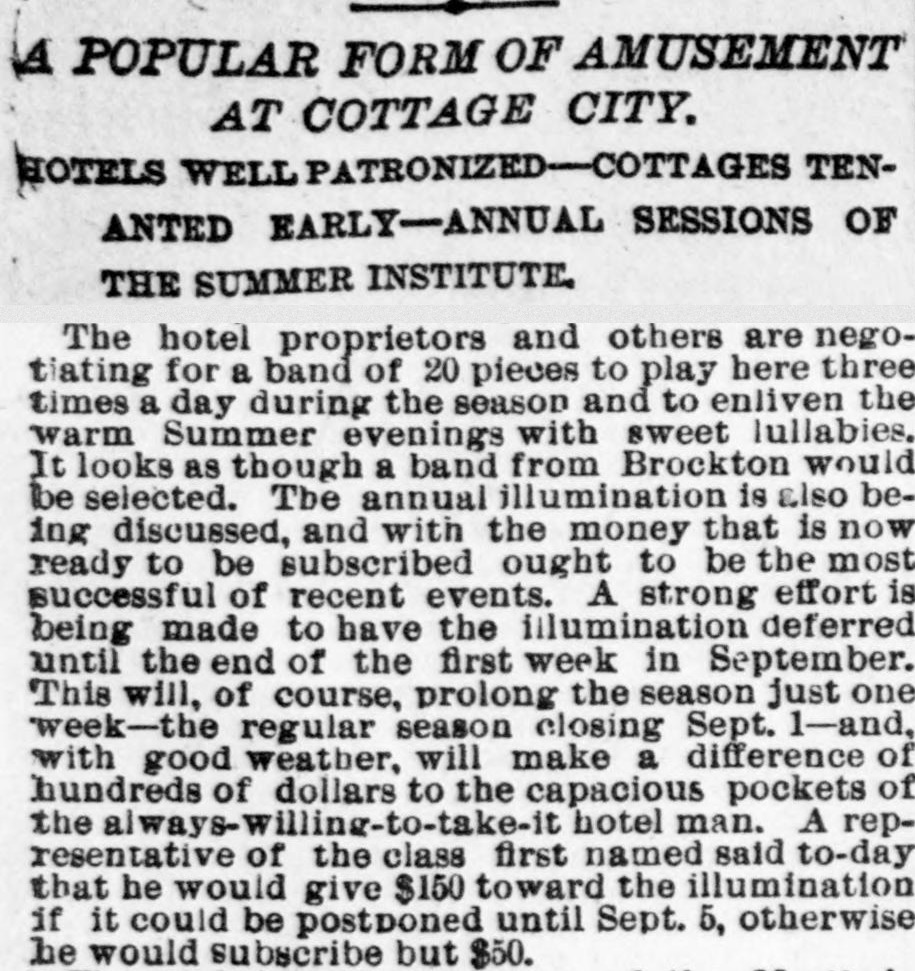
The hotel man’s offer. The New York Times, July 12, 1885, page 3. Internet Archive, public domain. Click the clipping to read it full size.
By late August, the date was set. On August 28, the Times wrote from Cottage City: “Nobody will go away now until the final celebration and illumination, which is to occur on Saturday evening, Sept. 5.” Three days of games were planned before it, including bicycle and tricycle races and “a tug-of-war between 50 men.”
The Night It Rained on Cottage City
The Austin paper called F. C. P.’s letter from Cottage City a “Delayed Letter.” By the time Austin read it on September 10, the big night was five days past. We could not find a report on how the lanterns did, but we did find one clue. The Sun of New York, in a story sent from Cottage City on September 6, wrote about “the heavy rain of last evening.” Rain is no friend to paper lanterns.
The tradition didn’t wash away, though. The next June, The New York Times said, “The annual illumination at the end of the season will this year be more brilliant than ever.”
Oak Bluffs, Massachusetts, Still Lights the Lanterns
In 1907, Massachusetts lawmakers changed the town’s name from Cottage City to Oak Bluffs. Over the years, Illumination Night moved to the old camp meeting grounds in the middle of town, where small cottages stand close together around a big open-air church called the Tabernacle. It is still held there every August. Thousands of people come, and after dark all the lanterns are lit at once. In 2026, the night fell on August 19.
F. C. P. ended her letter by saying visitors went home “ever to be haunted with pleasant remembrances of the most delightful of all summer resorts, Cottage City.” More than 140 years later, people still come back to see the cottages glow.
Sources
- “By the Seaside. Interesting Delayed Letter from an Austin Lady” (signed F. C. P., dated Cottage City, Mass., August 27). The Austin Weekly Statesman, Austin, Texas, September 10, 1885, page 1. Library of Congress, Chronicling America.
- “A Popular Form of Amusement at Cottage City.” The New York Times, July 12, 1885, page 3. Internet Archive.
- “Society at Cottage City. The Season to Be Closed With Feasting and Illuminations on Saturday.” The New York Times, August 29, 1885, page 3. Internet Archive.
- Cottage City dispatch of September 6 (“the heavy rain of last evening”). The Sun, New York, September 7, 1885, page 1. Library of Congress, Chronicling America.
- “Martha’s Vineyard. A Bright Outlook for a Very Successful Season.” The New York Times, June 6, 1886, page 14. Internet Archive.
- “The Vineyard Excursion. A Fine Trip, The Illumination at Cottage City.” Morning Journal and Courier, New Haven, Connecticut, August 31, 1880, page 2. Library of Congress, Chronicling America.
- The vote to rename Cottage City as Oak Bluffs: “New England Briefs,” The United Opinion, Bradford, Vermont, January 25, 1907, page 7; “Cottage City, now called Oak Bluffs”: The Evening Tribune, Providence, Rhode Island, August 18, 1907, page 24. Library of Congress, Chronicling America.
- The first Illumination Night (August 14, 1869) and Grand Illumination today: Martha’s Vineyard Camp Meeting Association, Grand Illumination.
- Cover and inside photographs: Bathers at Cottage City, Martha’s Vineyard (LC-D4-12481) and Bathers at Cottage City, Martha’s Vineyard (LC-D4-12482), Detroit Publishing Co., between 1890 and 1901. Library of Congress Prints and Photographs Division, no known restrictions on publication.
- Map: Cottage City, Martha’s Vineyard, Mass. 1890, bird’s-eye view. Library of Congress Geography and Map Division, published 1890, public domain.