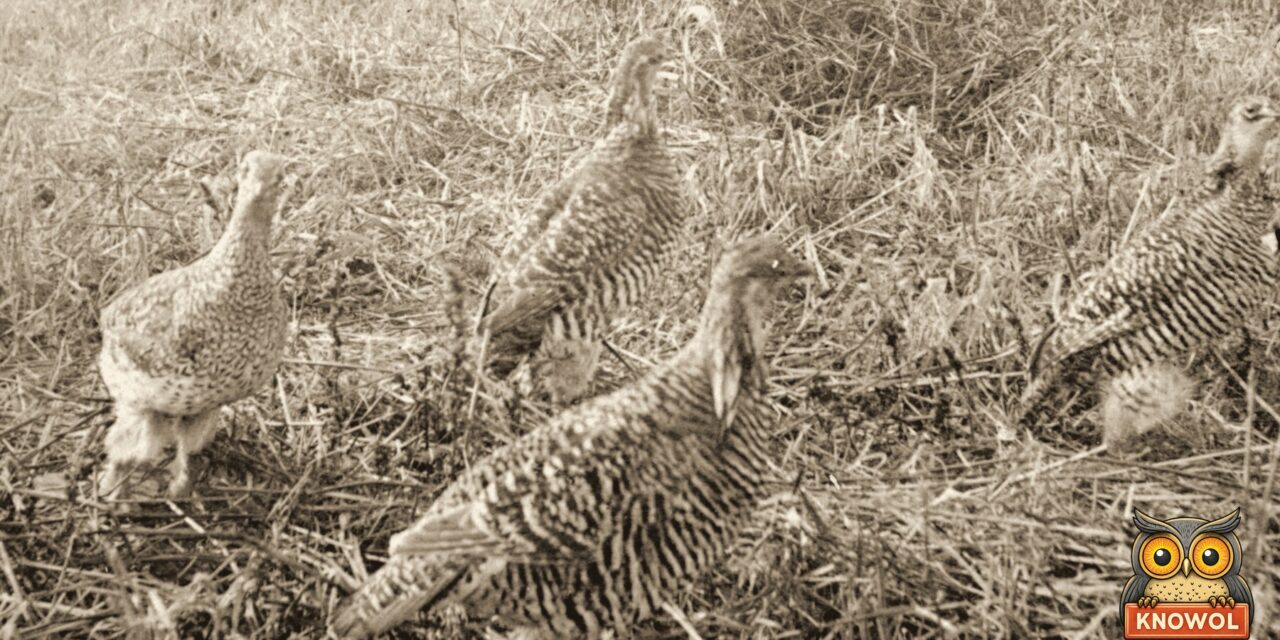
On Sunday, August 17, 1902, Fred Molander of Morris, Minnesota, went out to spend the day at his father’s farm, and he brought along a borrowed shotgun “in case of emergency,” the Morris Tribune said. Out there he learned that “several coveys of prairie chickens,” or little flocks of the wild birds, were “causing the farmers all kinds of trouble.” So Fred “decided to rid them of the pest.”
There was one problem: prairie chicken season in Minnesota didn’t open until September 1. And somebody else was out in the fields that Sunday. As the Tribune put it, “Fullerton happened to be out hunting as well, and bagged Molander.”
Fullerton was Sam Fullerton, the head game warden for the whole state. Fred was about to get a fine, and then help paying it, from the very man who caught him.
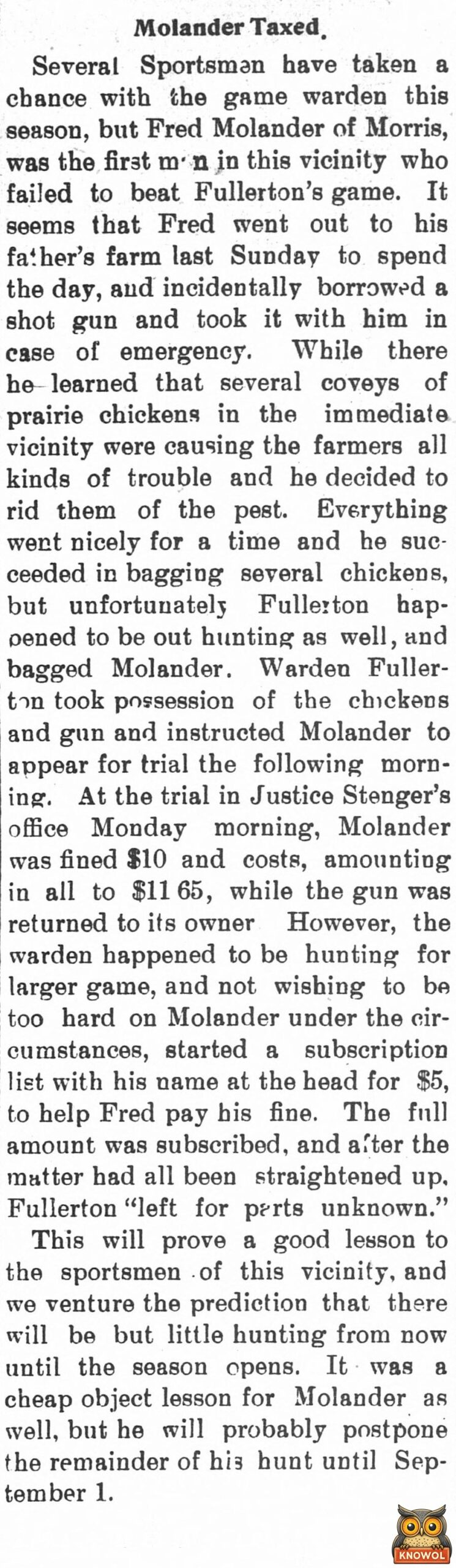
Morris Tribune, Morris, Minnesota, August 23, 1902, page 3. Library of Congress, Chronicling America. Click the clipping to read it full size.
How Sam Fullerton Caught Fred Molander Near Morris
The Minneapolis Journal told how the game warden caught Fred Molander near Morris in a few short lines on August 19, 1902. “State Game Warden Fullerton came upon Fred Molander with four prairie chickens in his buggy,” it said. “He handed Molander his card and relieved him of his gun.” In plain words, the warden showed who he was and took the shotgun and the four birds.
Prairie chickens were wild grouse of the open prairie, and hunters prized them. A list of 1902 hunting seasons in Field and Stream magazine gave Minnesota’s dates for them as “Sept. 1 to Nov. 1,” and the rest of the year, shooting one was against the law.

Minnesota’s 1902 hunting seasons, from the “Open Seasons for Game” list in Field and Stream, September 1902. Internet Archive, public domain. Click the clipping to read it full size.
The birds were getting scarce, too, and a 1902 U.S. Department of Agriculture booklet on game laws said, “Every State in which prairie chickens still exist now prohibits their export.” No state that still had them would let anyone ship them out.
Fred Molander’s Day in Court in Morris, Minnesota
Fred Molander’s trial was the next morning, Monday, in Justice Stenger’s office in Morris. A justice of the peace was a town judge who handled small cases. Fred “was fined $10 and costs, amounting in all to $11 65,” the Tribune said, “while the gun was returned to its owner.” It was borrowed, after all.
Then the game warden did something nobody expected: he “started a subscription list with his name at the head for $5, to help Fred pay his fine.” A subscription list was a sheet of paper passed around for people to sign, each writing down what they would give. Fullerton signed first.
The Minneapolis Journal gave his reason in his own words: “I wasn’t after Molander, but bigger fish.” It added, “Molander is a laboring man,” meaning he worked with his hands for his pay, and $11.65 was real money to him. In Morris, “The full amount was subscribed,” and then, the Tribune said, Fullerton “left for parts unknown.”
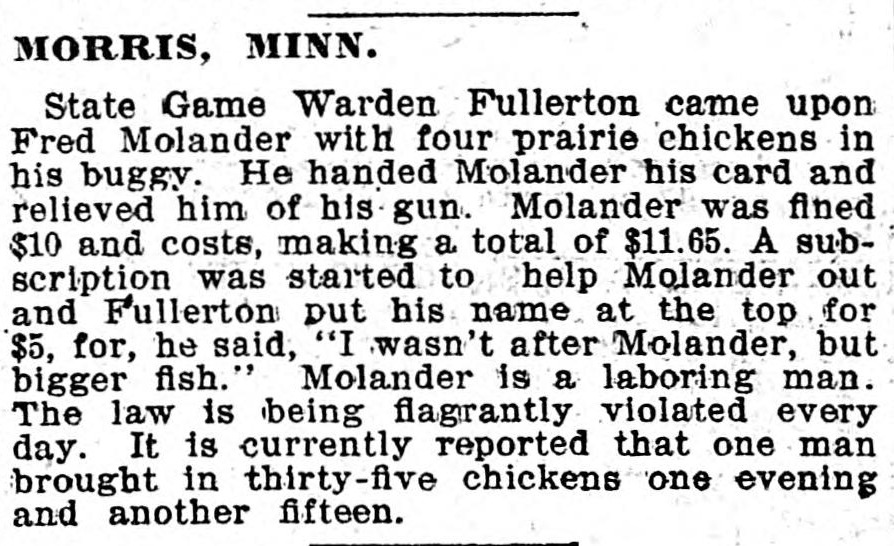
The Minneapolis Journal, Minneapolis, Minnesota, August 19, 1902, page 10. Library of Congress, Chronicling America. Click the clipping to read it full size.
The Tribune called the whole thing “a cheap object lesson for Molander,” meaning a lesson learned from something that really happened to him. The paper guessed Fred would “postpone the remainder of his hunt until September 1.”
What $11.65 Could Buy in Morris in 1902
Prices in Morris that summer show what Fred Molander’s fine meant. On August 30, 1902, the Tribune ran this notice: “First-class meals served at the Palace Cafe for 25 cents.” So $11.65 would have paid for more than 46 restaurant meals, and Fullerton’s $5 would have paid for 20.

Morris Tribune, Morris, Minnesota, August 30, 1902, page 5. Library of Congress, Chronicling America. Click the clipping to read it full size.
The Morris stores were ready for the real season. An ad from the E. J. Jones Lumber Co. shouted “GREAT GUNS!” and said, “The chicken season will soon be on.” Jones would sell you “any kind of gun you want, from a common single barrel to the best grades of Smith or Parkers.” Another Morris store, McDonald & Vaughn, bragged, “We carry over 50,000 loaded shells in stock all the time.”
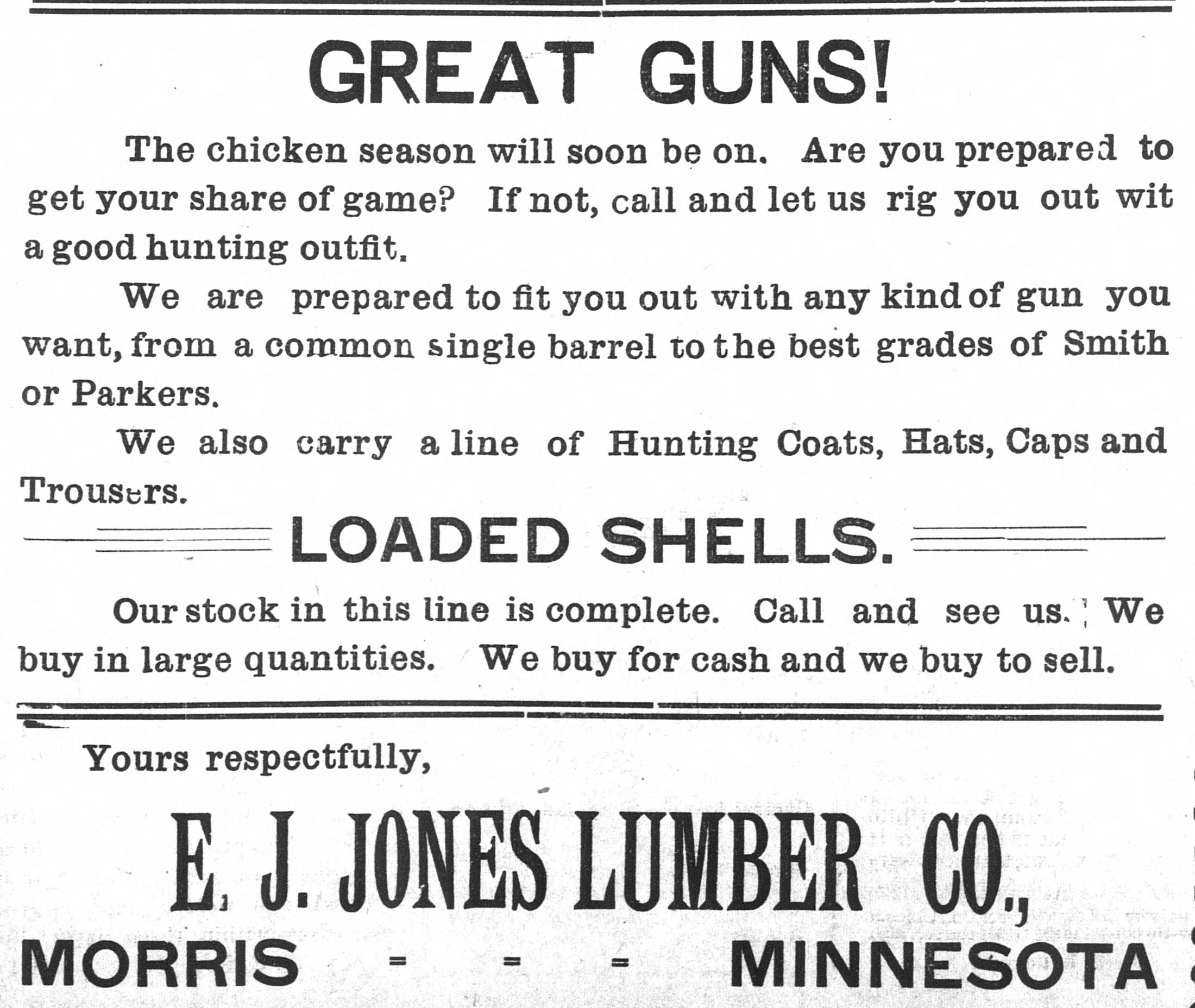
E. J. Jones Lumber Co. ad, Morris Tribune, Morris, Minnesota, September 6, 1902, page 5. Library of Congress, Chronicling America. Click the picture to see it full size.
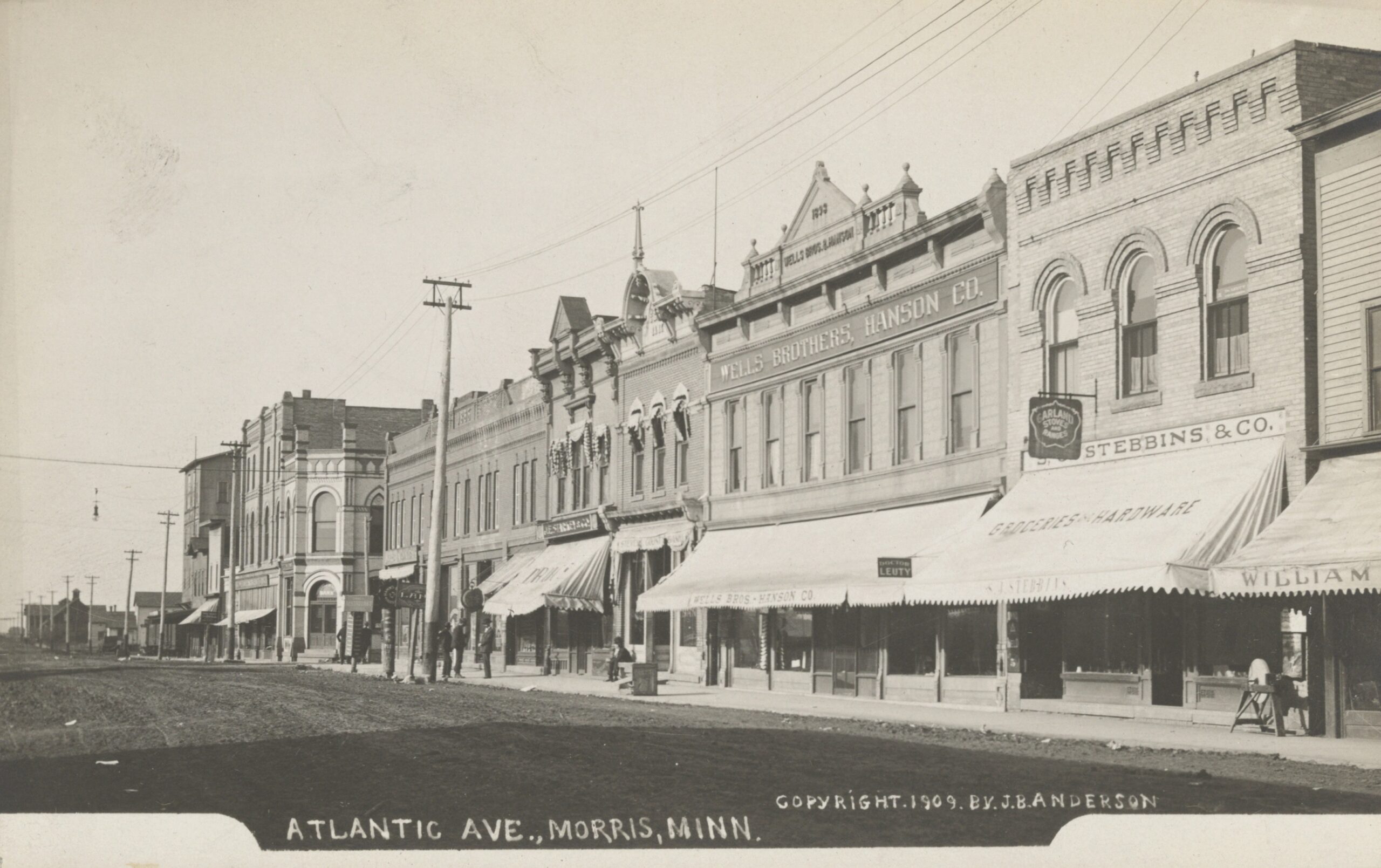
Stores along Atlantic Avenue in Morris, Minnesota, in 1909, seven years after Fred Molander’s fine. Real photo postcard by J. B. Anderson. Library of Congress. Click the picture to see it full size.
The Prank Behind the Hotel in Herman, Minnesota
That same week, Sam Fullerton turned up in Herman, Minnesota, a small town north of Morris. Some of “the boys up at Herman,” as the Tribune called them, were strolling near the hotel when they saw “a man sitting on a bench in the rear of the building dressing prairie chickens.” Dressing a bird means cleaning it to cook, and chicken season hadn’t opened yet.
The men in Herman thought it would be “quite a joke for one of the crowd to pose as Fullerton and arrest the transgressor,” or lawbreaker. So one of them played game warden, while the man on the bench was “busily engaged in preparing a delicious fry.”
The pretend warden stated his business, but the man with the chickens “positively refused to be arrested,” the Tribune said. He said “he himself was the only Game Warden Fullerton that he knew of, and that he himself had to arrest a fellow over in Stevens county in order to get the chickens.” Morris is the county seat of Stevens County.
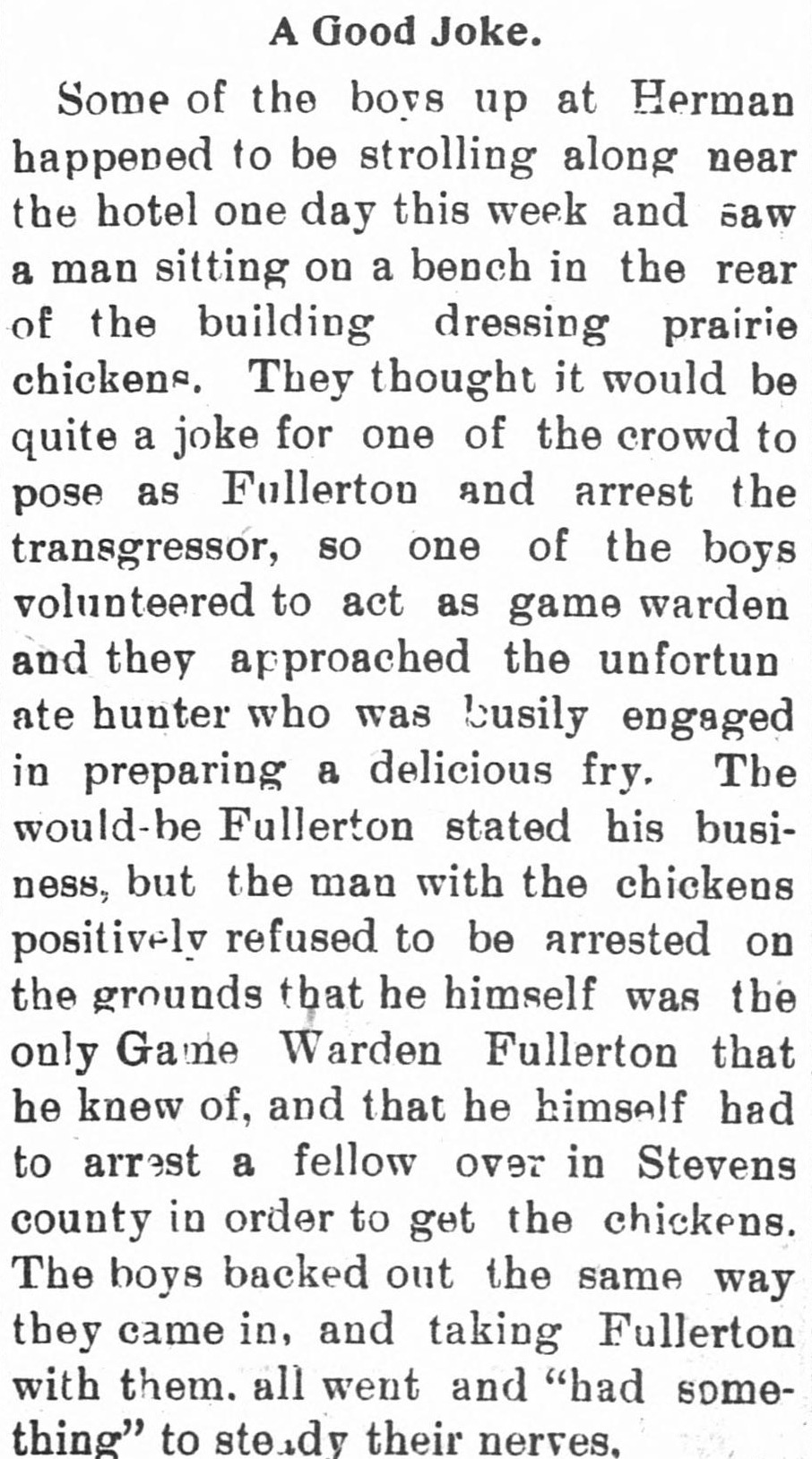
“A Good Joke,” Morris Tribune, Morris, Minnesota, August 23, 1902, page 3. Library of Congress, Chronicling America. Click the clipping to read it full size.
“The boys backed out the same way they came in,” the Tribune said. Then, “taking Fullerton with them,” they “all went and ‘had something’ to steady their nerves.”
The Minneapolis Journal told it a little differently: its report from Herman said some sportsmen were about to have the man cleaning chickens “back of the hotel” arrested for real. Then, “before papers for his arrest were issued it was discovered that the alleged violator of law and order was the game warden himself.” The Journal said the chickens had been “seized by him in Stevens county.” Neither paper named the hunter they came from, and while Fred Molander’s four birds fit the story, nobody wrote down that they were his.
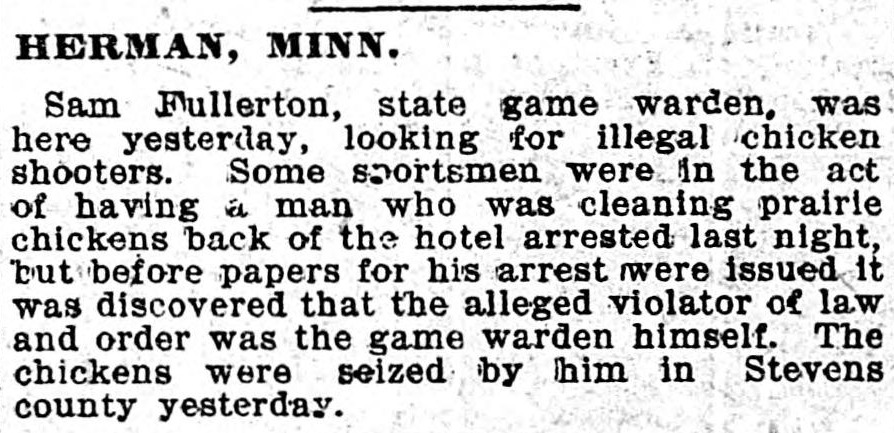
The Minneapolis Journal, Minneapolis, Minnesota, August 19, 1902, page 10. Library of Congress, Chronicling America. Click the clipping to read it full size.
Sam Fullerton’s “Bigger Fish”
Sam Fullerton worked out of St. Paul as the executive agent of Minnesota’s Board of Game and Fish Commissioners, which made him the state’s chief game warden. A 1902 U.S. government list of game officials names him there as “S. F. Fullerton, St. Paul.”
That summer, Fullerton read a paper at a meeting of state game wardens at Mammoth Hot Springs, Wyoming, in Yellowstone National Park. Field and Stream printed it in September 1902. The editor called him “a tireless, intelligent and determined worker.”
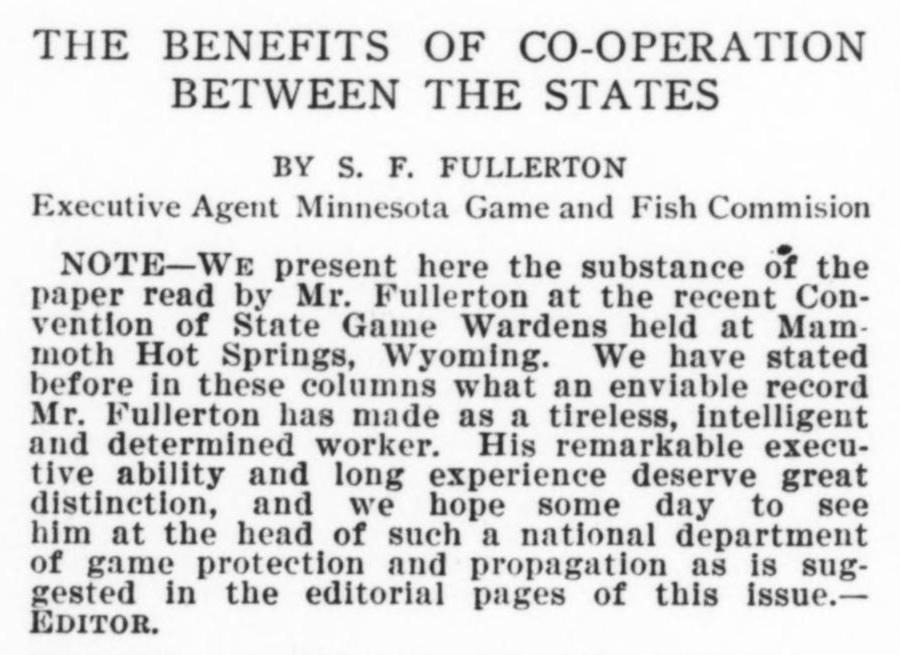
Field and Stream, September 1902, page 380. Internet Archive, public domain. Click the clipping to read it full size.
His talk showed what “bigger fish” meant. His real target was the game dealers who shipped wild birds and deer meat off to sell in big cities like Chicago. Fullerton wrote that a load of game “may be shipped as butter, household goods, dressed poultry,” or hidden by “a score of other devices known to the game dealer,” which means about 20 other tricks.
In February 1903, Sam Fullerton landed one of those bigger fish. A St. Paul report in the Morris Tribune said “About 900 partridges and 17 saddles of venison” had been taken “by Executive Agent S. F. Fullerton.” A saddle of venison is the meaty back of a deer. The game was hidden in “a back room” of a St. Paul merchant’s home, and it took two drays, or flat delivery wagons, to haul it to a cold storage warehouse. “The seizure is the largest ever made in the history of the Minnesota game and fish commission,” the paper said.
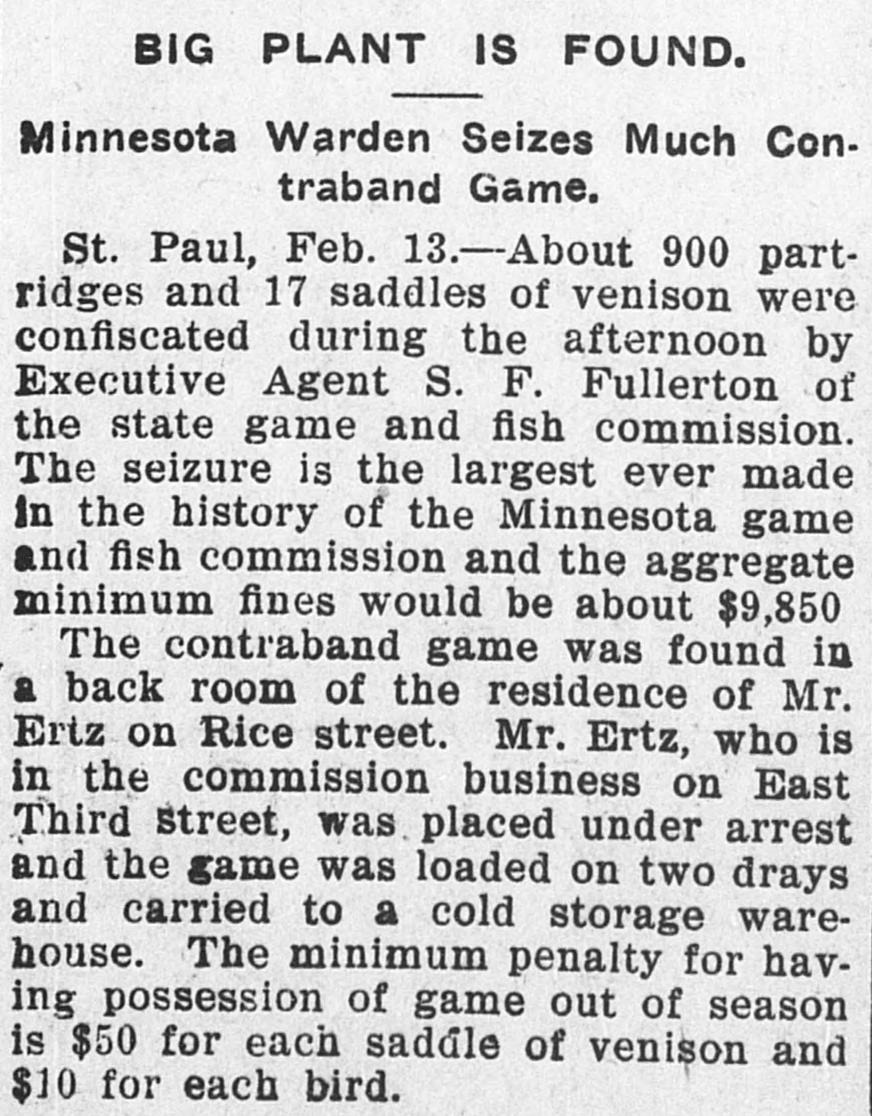
“Big Plant Is Found,” Morris Tribune, Morris, Minnesota, February 14, 1903, page 1. Library of Congress, Chronicling America. Click the clipping to read it full size.
Chicken Season in Morris and Herman, Minnesota
Prairie chicken season opened in Minnesota on September 1, 1902, and Field and Stream’s guide to Northwest hunting spots that same month said Herman had “plenty of vacant land, making it an excellent chicken section in season.”
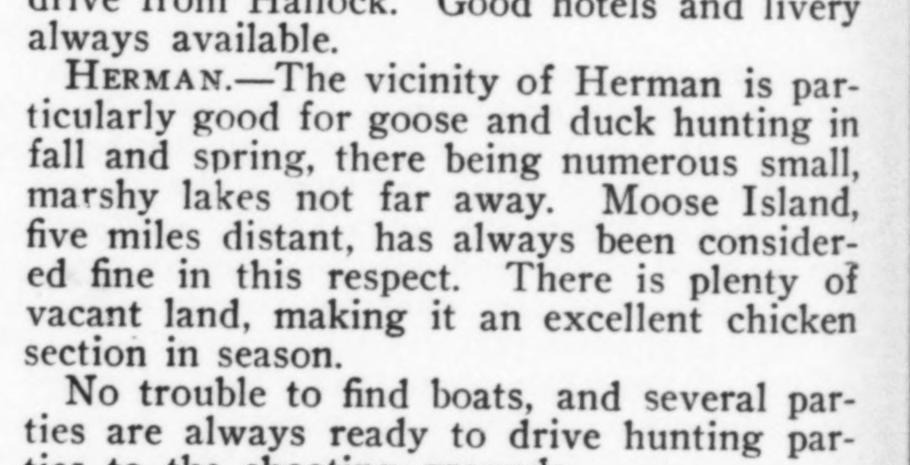
Field and Stream, September 1902, page 386, “Hunting Grounds of the Northwest.” Internet Archive, public domain. Click the clipping to read it full size.
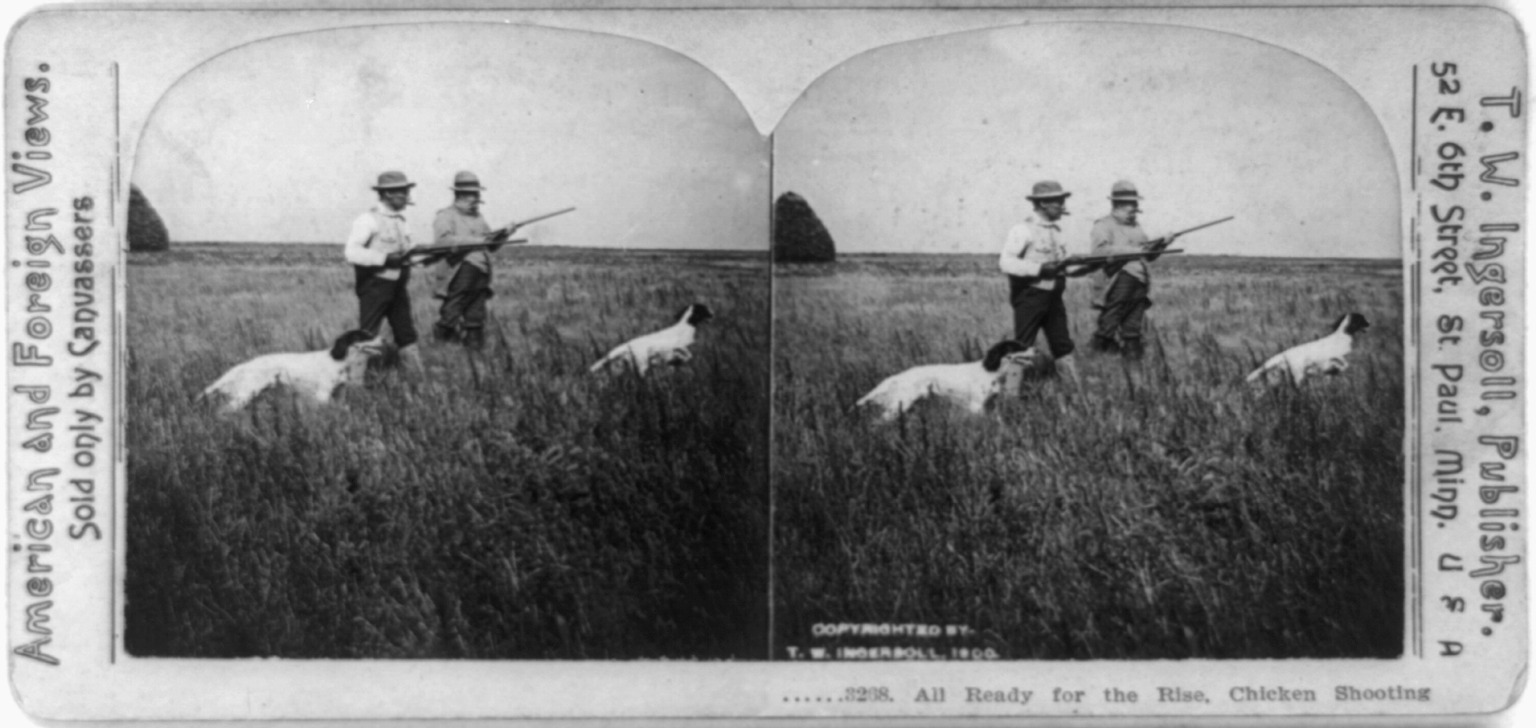
“All Ready for the Rise, Chicken Shooting,” a 1900 stereograph card by T. W. Ingersoll of St. Paul, Minnesota. The place is not named. Library of Congress. Click the picture to see it full size.
The next summer, the Morris Tribune had advice for every hunter in town. On August 22, 1903, almost a year after Fred Molander’s fine, it printed one short line: “Don’t shoot chickens out of season but read Jones’ new ad.”

Morris Tribune, Morris, Minnesota, August 22, 1903, page 5. Library of Congress, Chronicling America. Click the clipping to read it full size.
Fred Molander lost four prairie chickens and a Monday morning. The borrowed gun went home to its owner, and Fred didn’t have to pay his fine alone. The warden who caught him put his own $5 at the top of the list, because he was after “bigger fish.” The picture at the top of this page shows prairie chickens in a stubble field, from a stereograph card made by T. W. Ingersoll of St. Paul, Minnesota. Its date was not recorded.
Sources
- “Molander Taxed” and “A Good Joke,” Morris Tribune (Morris, Minnesota), August 23, 1902, page 3. Library of Congress, Chronicling America.
- “Morris, Minn.” and “Herman, Minn.,” The Minneapolis Journal (Minneapolis, Minnesota), August 19, 1902, page 10. Library of Congress, Chronicling America.
- Morris Tribune, August 30, 1902, page 5 (Palace Cafe). Library of Congress, Chronicling America.
- Morris Tribune, September 6, 1902, page 5 (E. J. Jones Lumber Co. and McDonald & Vaughn ads). Library of Congress, Chronicling America.
- “Big Plant Is Found,” Morris Tribune, February 14, 1903, page 1. Library of Congress, Chronicling America.
- Morris Tribune, August 22, 1903, page 5. Library of Congress, Chronicling America.
- S. F. Fullerton, “The Benefits of Co-operation Between the States,” Field and Stream, September 1902, page 380; “Hunting Grounds of the Northwest,” page 386; “Open Seasons for Game”. Internet Archive.
- T. S. Palmer and H. W. Olds, Game Laws for 1902, U.S. Department of Agriculture Farmers’ Bulletin 160, page 9. Internet Archive.
- Directory of State Officials and Organizations Concerned With the Protection of Birds and Game, 1902, U.S. Department of Agriculture, Biological Survey (Minnesota), page 3. Internet Archive.
- Prairie chickens in stubble, T. W. Ingersoll, St. Paul, Minnesota, stereograph (the cover). Library of Congress Prints and Photographs Division.
- All Ready for the Rise, Chicken Shooting, T. W. Ingersoll, 1900, stereograph. Library of Congress Prints and Photographs Division. No known restrictions on publication.
- Atlantic Ave., Morris, Minn., J. B. Anderson, 1909, real photo postcard. Library of Congress Prints and Photographs Division.
- The newspapers, magazines, government booklets, stereograph cards and postcard above were all published before 1931 and are in the public domain.