In August 1877, people in New York, New York, walked off the hot summer streets and into a long brick building near Madison Square. They came to hear a band. They got a surprise, too. “All who attended the garden last week were astonished to find the climate more agreeably cool, by many degrees, than in the open street,” the New York Dispatch reported. Nobody had an electric fan in 1877, and air conditioners hadn’t been invented. Yet this big hall stayed cooler than the sidewalk outside.
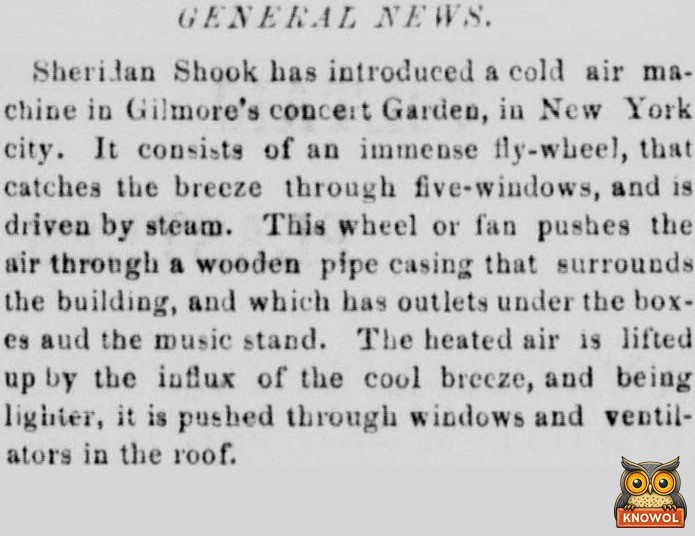
“Sheridan Shook has introduced a cold air machine in Gilmore’s concert Garden.” Daily Kennebec Journal, Augusta, Maine, June 23, 1877, page 2. Library of Congress, Chronicling America. Click the clipping to read it full size.
A giant wheel and a steam engine
The answer was a machine. Even a paper far away in Augusta, Maine, thought its readers would want to hear about it. It printed the news under “General News” in June. The New-York Tribune in New York had printed the same news three days before.
“Sheridan Shook has introduced a cold air machine in Gilmore’s Concert Garden,” the Tribune said. Shook was one of the men who ran the Garden. His machine “consists of an immense fly-wheel, that catches the breeze through five windows, and is driven by steam.”
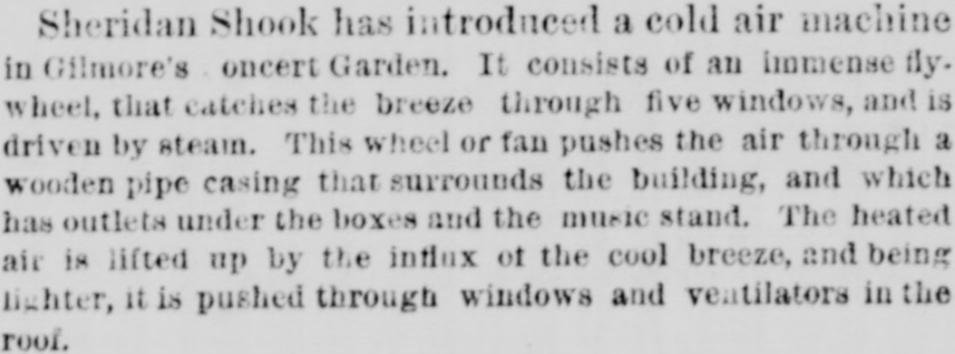
The cold air machine in the hometown paper. New-York Tribune, New York, New York, June 20, 1877, page 8. Library of Congress, Chronicling America. Click the clipping to read it full size.
How it worked
Picture a huge wheel with blades, like a giant fan, set beside five open windows. A steam engine turned it, the same kind of power that ran trains and riverboats. As the wheel spun, it pulled in the outside breeze.
Then the air had somewhere to go. “This wheel or fan pushes the air through a wooden pipe casing that surrounds the building,” the Tribune explained. That was a long wooden pipe, wrapped all the way around the hall. It had openings “under the boxes and the music stand.” The boxes were the little private balconies where people sat. So fresh air came up right under the crowd and the band.
The old, hot air had to get out, too. Warm air is lighter than cool air, so it rises. The cool breeze pushed in from below, and the warm air was pushed up and out “through windows and ventilators in the roof.” The machine didn’t make the air cold the way an air conditioner does. It kept moving outside air in and pushing stale, hot air out, over and over, all night long.
Sixty registers
The Garden had bragged about its new air before summer even started. In May, the New York Herald said the Garden was getting ready to open for the summer. “A special novelty of the season is the introduction of sixty registers through which 100,000 feet of cool air per minute can be forced into the building at various points.” A register is a metal grate where air blows out, like the vents in many homes today. The Herald meant cubic feet. That’s enough air to fill a room 100 feet long, 100 feet wide and 10 feet high, every single minute.
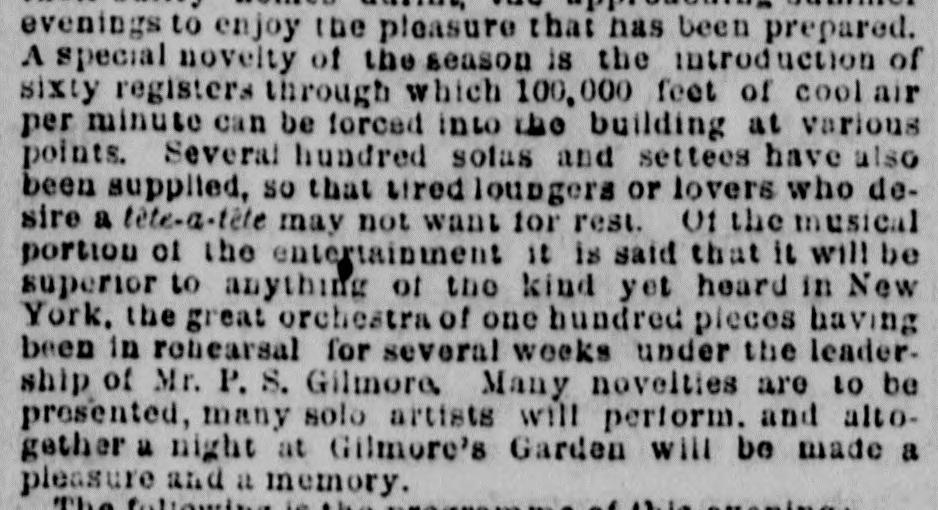
Sixty registers, a hundred-piece orchestra and sofas for “tired loungers.” The New York Herald, New York, New York, May 23, 1877, page 5. Library of Congress, Chronicling America. Click the clipping to read it full size.
The Herald promised sofas for “tired loungers,” too, and music from “the great orchestra of one hundred pieces” led by Patrick S. Gilmore, a famous bandleader of the day.
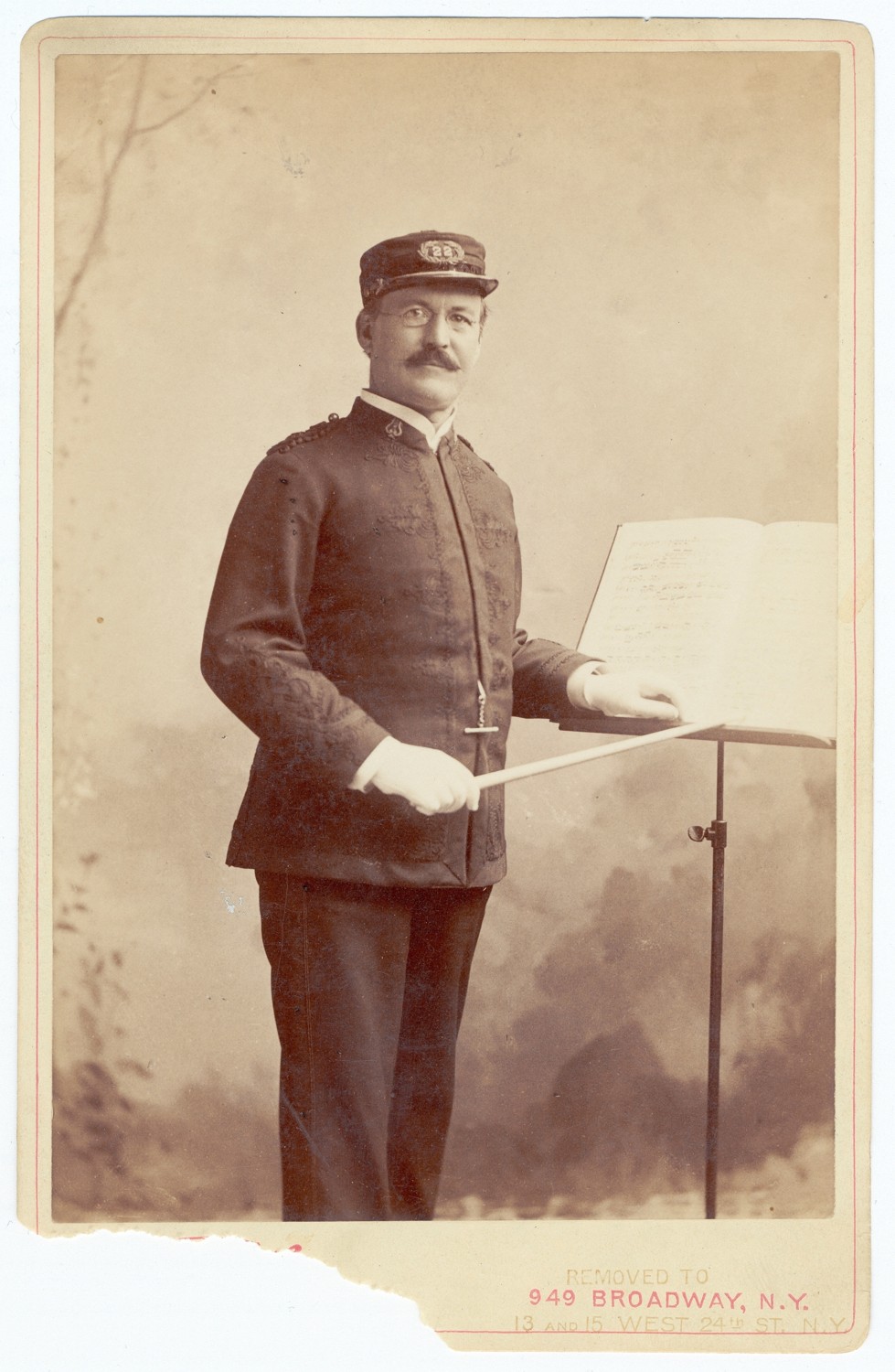
Bandleader Patrick S. Gilmore with his baton and music stand. Cabinet card photograph, George Grantham Bain Collection, Library of Congress. Click the clipping to read it full size.
What it cost
A New York letter writer for the Worcester Daily Press in Massachusetts passed the news along. At the Garden, the letter said, “a new contrivance for forcing in cool air has been purchased at an expense of $5000, and is now in full operation.” A contrivance is a clever machine. Five thousand dollars was a big pile of money in 1877, all spent to move air.
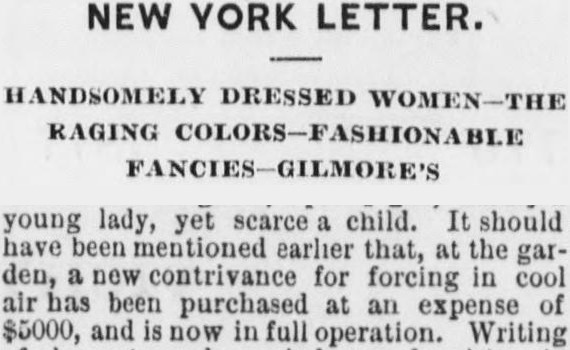
“A new contrivance for forcing in cool air.” Worcester Daily Press, Worcester, Massachusetts, June 28, 1877, page 1. Library of Congress, Chronicling America. Click the clipping to read it full size.
Better than the beach
Did it work? By August, the Dispatch said “the ventilating apparatus works famously.” That means it worked very well. A week later, the paper went even further. A busy businessman who couldn’t leave the city “can have as much real pleasure now by spending an evening at Gilmore’s Garden as he could by going to the mountains or the sea-shore.”
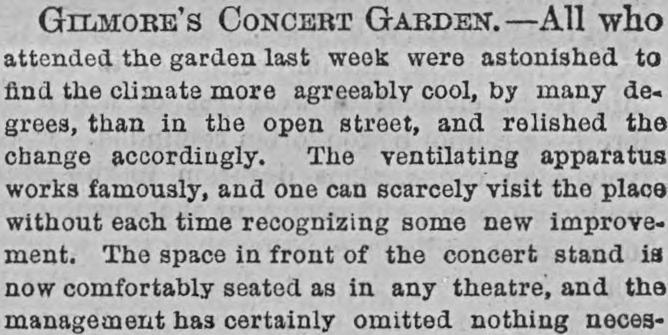
“Cool, by many degrees, than in the open street.” New York Dispatch, New York, New York, August 12, 1877, page 4. Library of Congress, Chronicling America. Click the clipping to read it full size.
The Garden had one more cool trick. It had a little waterfall inside. The Dispatch wrote about “the cooling murmur of the miniature falls of Niagara, and a temperature agreeably cool.” Picture it: palm trees, a splashing waterfall, a hundred musicians, and a steady breeze blowing in through the vents.
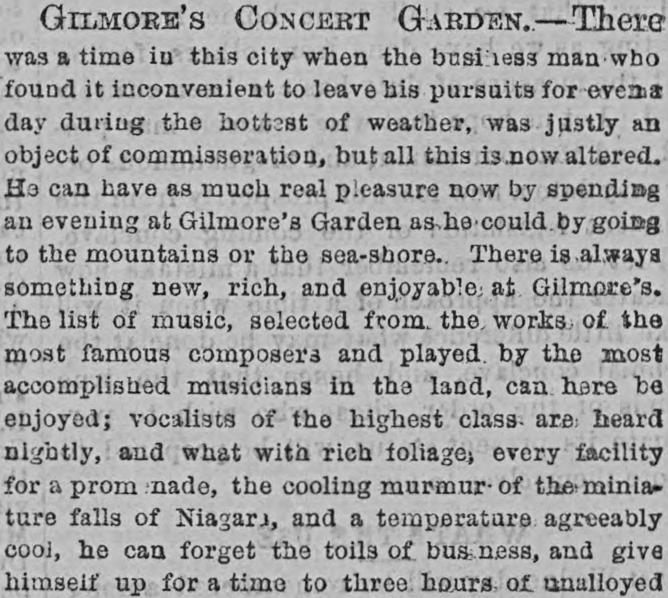
The Garden as a summer escape, with its “miniature falls of Niagara.” New York Dispatch, New York, New York, August 19, 1877, page 4. Library of Congress, Chronicling America. Click the clipping to read it full size.
The building that became a famous name
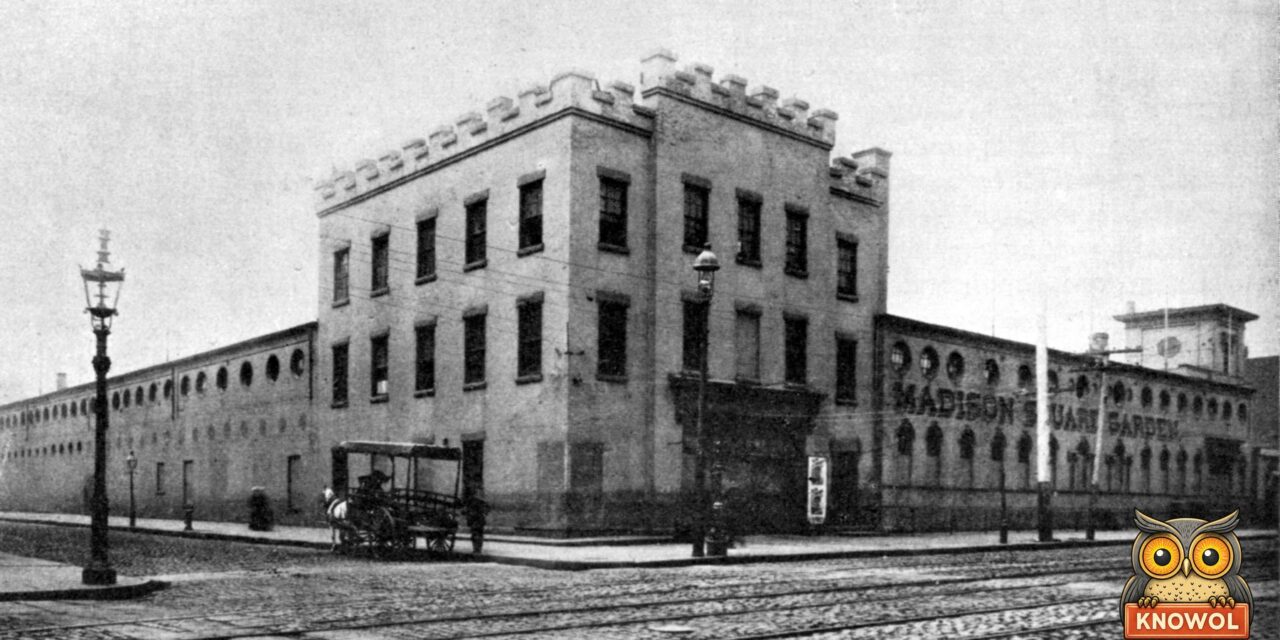
The Garden had a busy past. It began as a railroad depot. Then P. T. Barnum turned it into his Hippodrome, a giant hall for circus shows. Then it became Gilmore’s Garden. Later it got the name it is still famous for: Madison Square Garden. The photo at the top of this story shows that same building a few years after 1877, with its new name painted on the side. Here it is in the 1870s, with “Gilmore’s Concert Garden” painted on the wall.
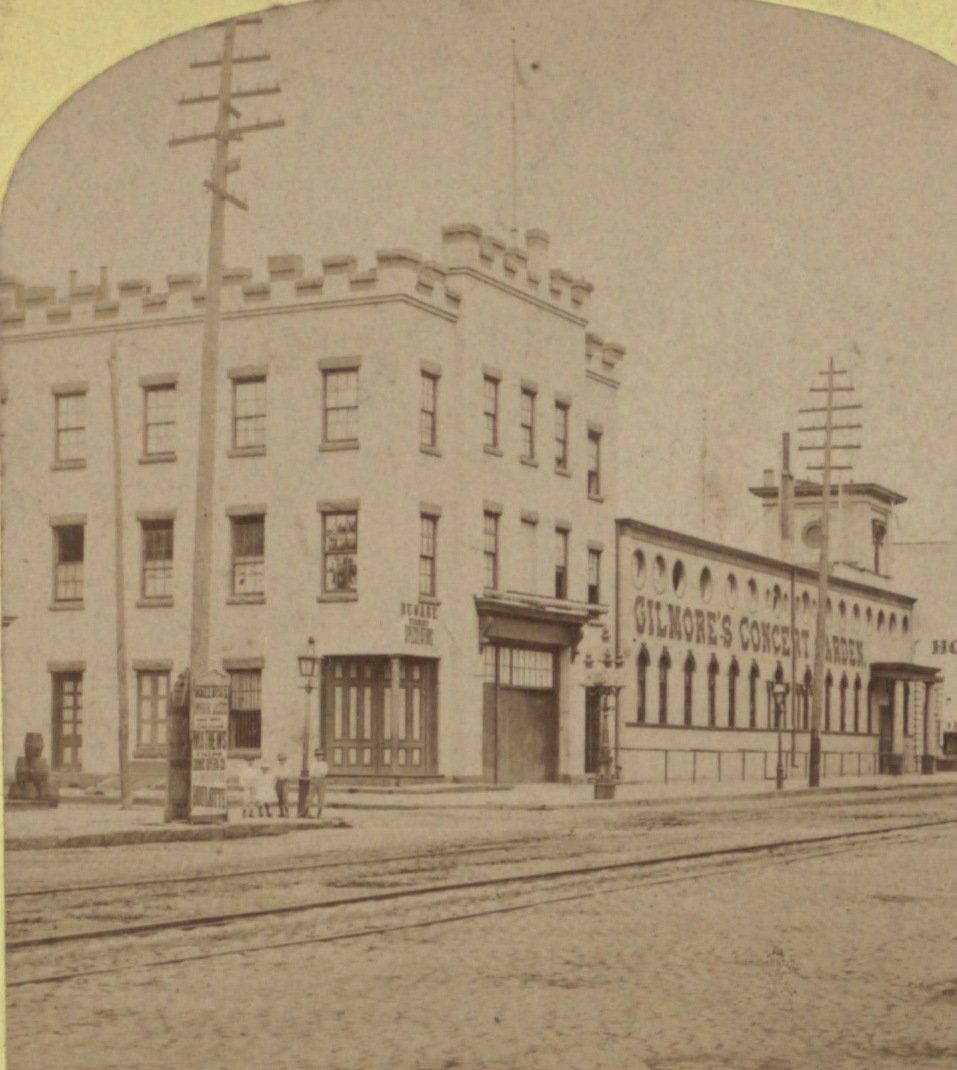
“Gilmore’s Garden, New York.” One half of a stereograph card from the 1870s; the sign on the long wall reads “Gilmore’s Concert Garden.” Robert N. Dennis collection of stereoscopic views, New York Public Library. Click the picture to see it full size.
Today, a summer night in New York means air conditioning almost everywhere. In 1877, it meant a steam engine, a giant wheel, five open windows and a long wooden pipe. It was enough to make a crowd of New Yorkers feel cooler inside than out on the street. People were “astonished.” They had good reason to be.
Sources
- “General News,” Daily Kennebec Journal (Augusta, Maine), June 23, 1877, page 2. Library of Congress, Chronicling America.
- New-York Tribune (New York, New York), June 20, 1877, page 8. Library of Congress, Chronicling America.
- “Gilmore’s Garden,” The New York Herald (New York, New York), May 23, 1877, page 5. Library of Congress, Chronicling America.
- “New York Letter,” Worcester Daily Press (Worcester, Massachusetts), June 28, 1877, page 1. Library of Congress, Chronicling America.
- “Gilmore’s Concert Garden,” New York Dispatch (New York, New York): August 12, 1877, page 4; August 19, 1877, page 4. Library of Congress, Chronicling America.
- Sheridan Shook and the Garden’s lease: New York Clipper, December 8, 1877. Internet Archive.
- The building’s history (railroad depot, Barnum’s Hippodrome, Gilmore’s Garden, Madison Square Garden): James Grant Wilson, editor, The Memorial History of the City of New-York, volume 4. Internet Archive.
- Photos: “Gilmore’s Garden, New York” stereograph, Robert N. Dennis collection of stereoscopic views, New York Public Library (digital ID G91F214_024F), public domain; the first Madison Square Garden (the cover), as printed in The Arts magazine, December 1928, public domain; Patrick S. Gilmore, George Grantham Bain Collection, Library of Congress, no known restrictions on publication.