On Thursday, November 23, 1939, President Franklin D. Roosevelt carved the Thanksgiving turkey in Warm Springs, Georgia. Tables were set for 350 people. The guest of honor was a 6-year-old girl. Across much of the country, though, nobody was eating turkey that day. In 23 states, Thanksgiving was still a week away. That year, America had two Thanksgivings.
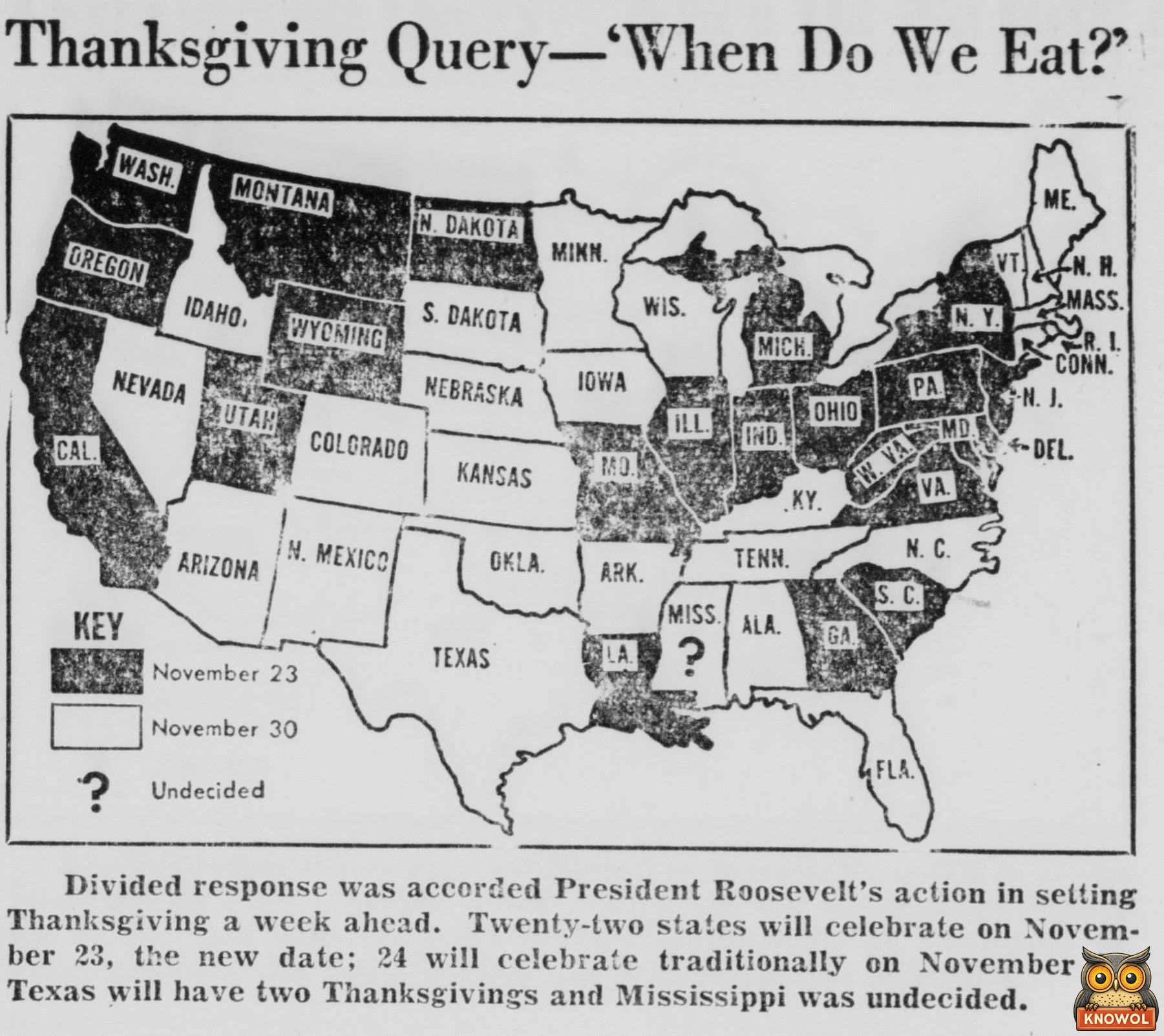
“Thanksgiving Query: ‘When Do We Eat?'” The Hagerstown Globe, Hagerstown, Maryland, October 27, 1939, page 2. Dark states planned to celebrate November 23 and white states November 30. A few states changed their plans later. Library of Congress, Chronicling America. Click the clipping to read it full size.
A dinner at Warm Springs
Warm Springs was the President’s second home. He had polio, a disease that often struck children and could leave people unable to walk. He swam in the town’s warm spring water and helped start the Warm Springs Foundation, a place where polio patients came to get stronger. Newspapers then called polio “infantile paralysis.”
The guest of honor was Ann Smithers of Frankfort, Kentucky. She had been at the foundation about five months, and “only recently has she been able to sit up in a wheel chair,” the United Press reported. How did she get the best seat in the house? She “won the honor by drawing straws with the 90 other infantile paralysis patients.” Nine other winners were “merely table guests.”
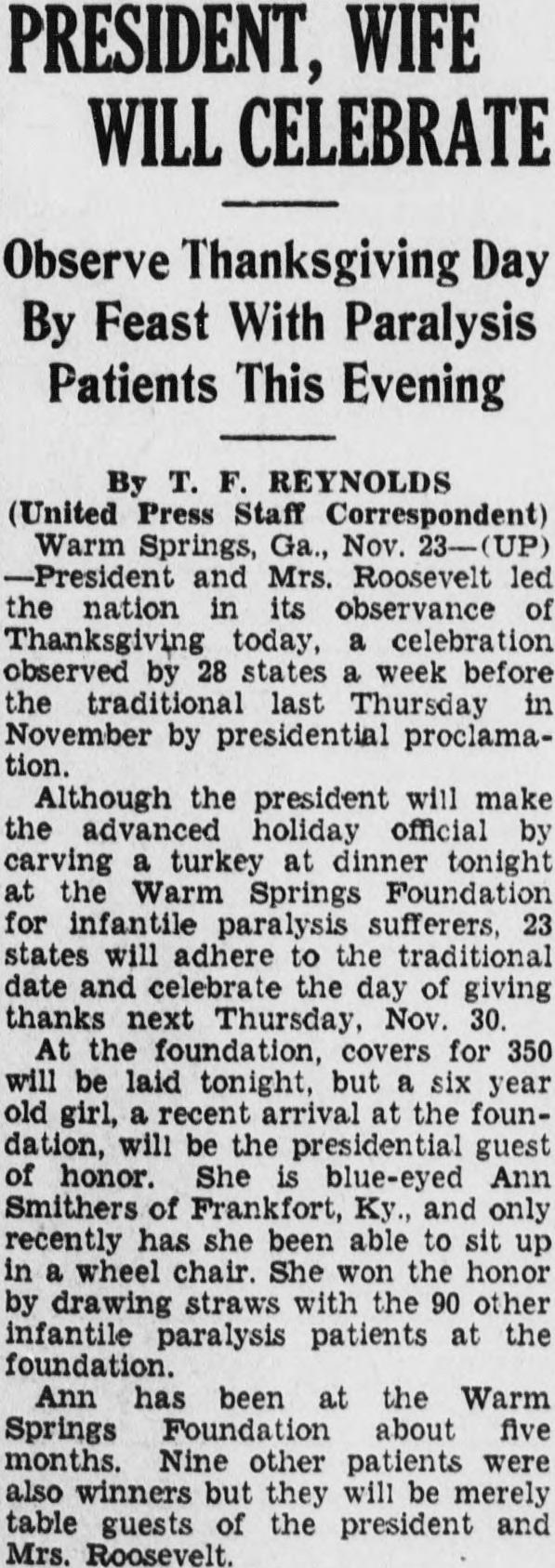
“President, Wife Will Celebrate,” a United Press story from Warm Springs, Georgia. The Waterbury Democrat, Waterbury, Connecticut, November 23, 1939, page 13. Library of Congress, Chronicling America. Click the clipping to read it full size.
At dinner the President told the crowd he hoped to keep coming back, “just to see how the Warm Springs family is getting on.”

The “Little White House,” Roosevelt’s cottage in Warm Springs, Georgia, now a state historic site. Photo by Carol M. Highsmith, 2017. Library of Congress. Click the picture to see it full size.
Why move Thanksgiving?
Since President Abraham Lincoln’s time, Thanksgiving had been the last Thursday in November. In 1939, November had five Thursdays, so the last one fell on the 30th. Store owners didn’t like that. They said it “threw the holiday too close to Christmas and cut down on Christmas shopping.” In those days, stores waited until after Thanksgiving to start selling for Christmas.
In August, Roosevelt moved Thanksgiving up a week, to November 23. “This sounds silly,” he admitted, but he was “willing to go along with merchants.” The change was “automatically making liars of all 1939 calendars,” the Associated Press said. Football coaches were upset because big games were already set for the 30th. One senator joked that the President should issue another order to “abolish winter.”
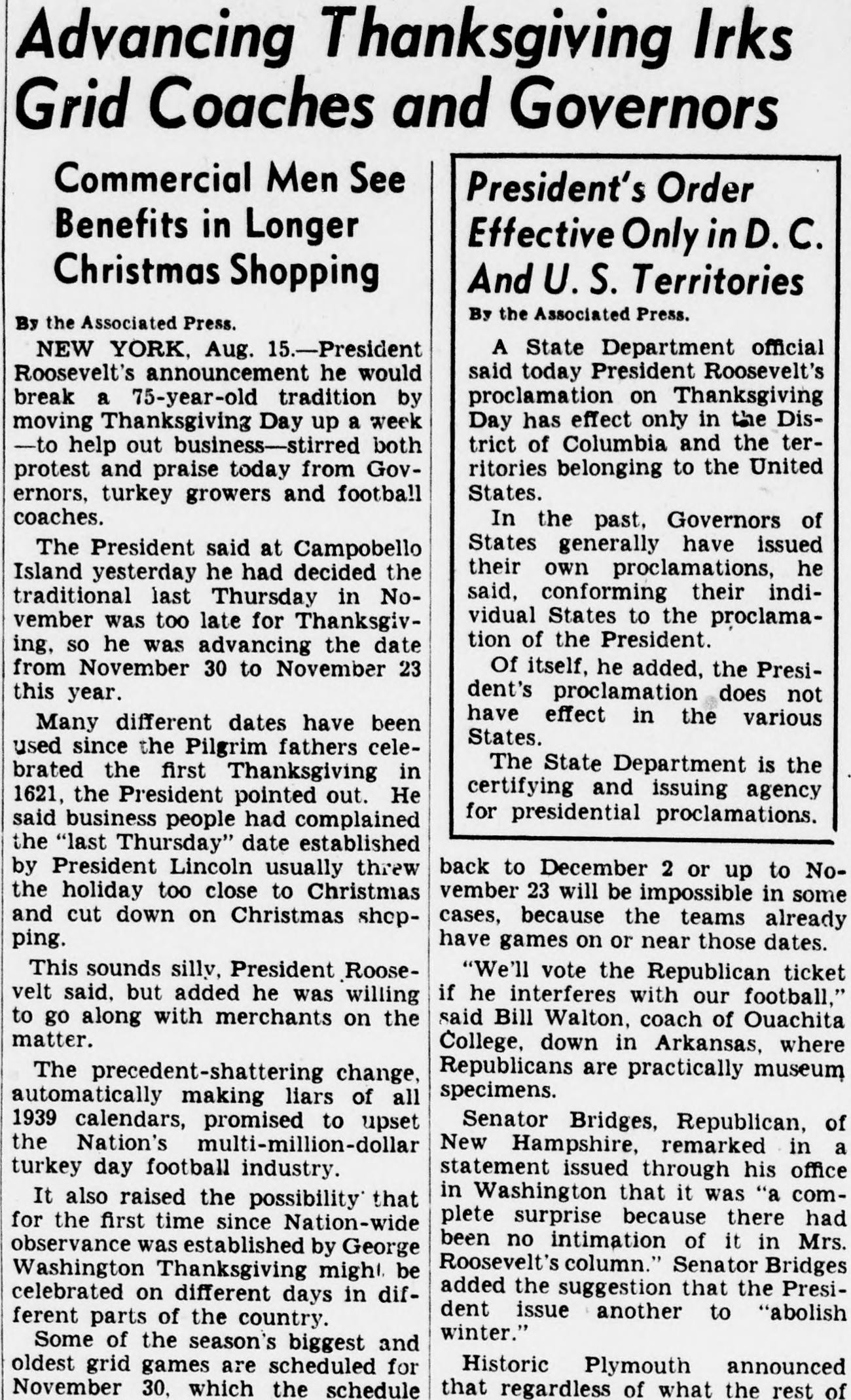
“Advancing Thanksgiving Irks Grid Coaches and Governors.” The Evening Star, Washington, D.C., August 15, 1939, page 1. Library of Congress, Chronicling America. Click the clipping to read it full size.
Why states could say no
Here’s the surprise. The President’s order counted “only in the District of Columbia and the territories,” a State Department official explained. Each state’s governor picked the day for that state. Most governors usually just copied the President. In 1939, about half of them didn’t.
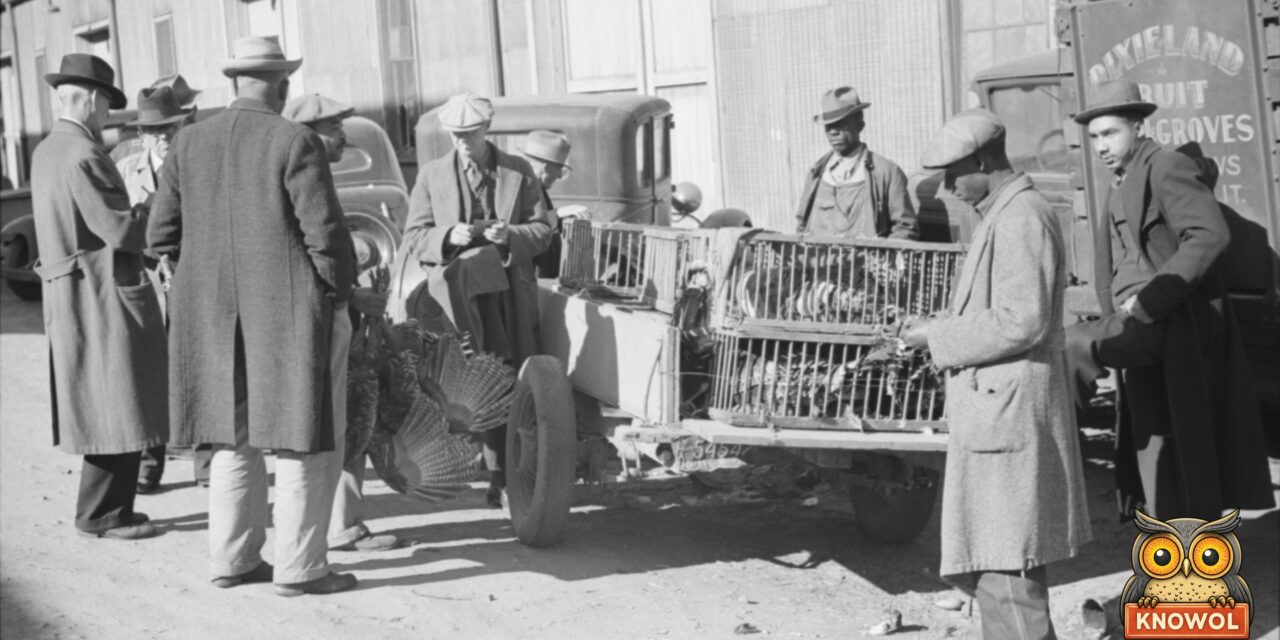
By mid-November, 22 states had picked the 23rd and 23 states had picked the 30th. A “lucky minority,” the Associated Press said, “centered in Texas, Colorado and Mississippi,” would “dine in style on both big days.” North Carolina was one of the states that kept the 30th. That November in Durham, North Carolina, farmers sold Thanksgiving turkeys from crates on their trucks, right outside the tobacco warehouses.
One country, two dinners
The split made some strange neighbors. One street divided Beloit, Wisconsin, from its Illinois twin, today called South Beloit. “The kids on the Wisconsin side are going to be awfully hungry on the 23d,” the AP wrote, “and the kids in Illinois will be jealous on the 30th.”
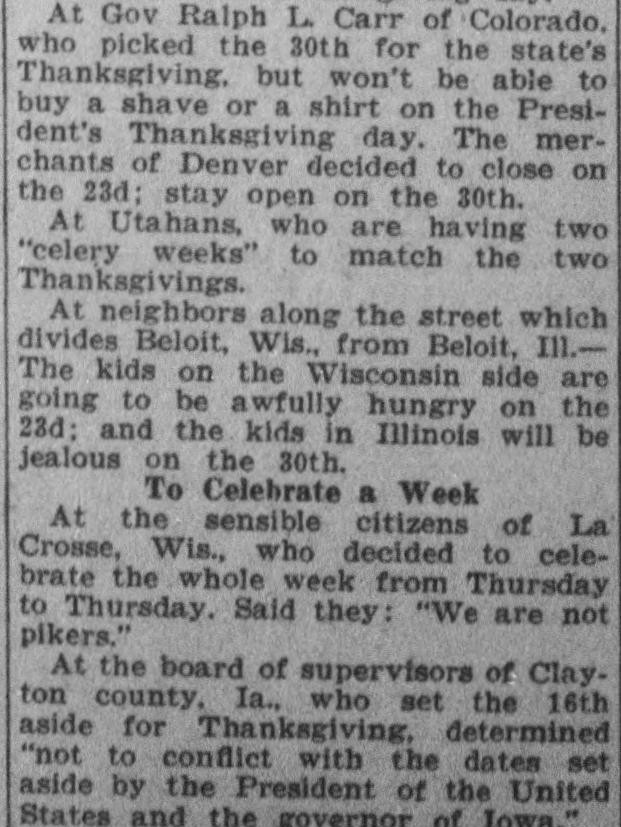
From “No Matter When the Turkey, That Hash Is Sure to Follow,” by William M. Pinkerton of the Associated Press. The Springfield Weekly Republican, Springfield, Massachusetts, November 16, 1939, page 12. Library of Congress, Chronicling America. Click the clipping to read it full size.
People in Kentucky who worked across the river in Ohio got the 23rd off, “with nothing to celebrate.” The next week, with a holiday back home, most had to work. Clarkston, Washington, sits across a river from Idaho. Its state picked the 23rd, but the town picked the 30th, like Idaho. In Denver, Colorado’s governor chose the 30th, but stores closed on the 23rd. That meant he “won’t be able to buy a shave or a shirt” on the President’s Thanksgiving.
The mayor of Torrington, Connecticut, wanted both days. “Where but in our own glorious democracy could this happen?” he asked.
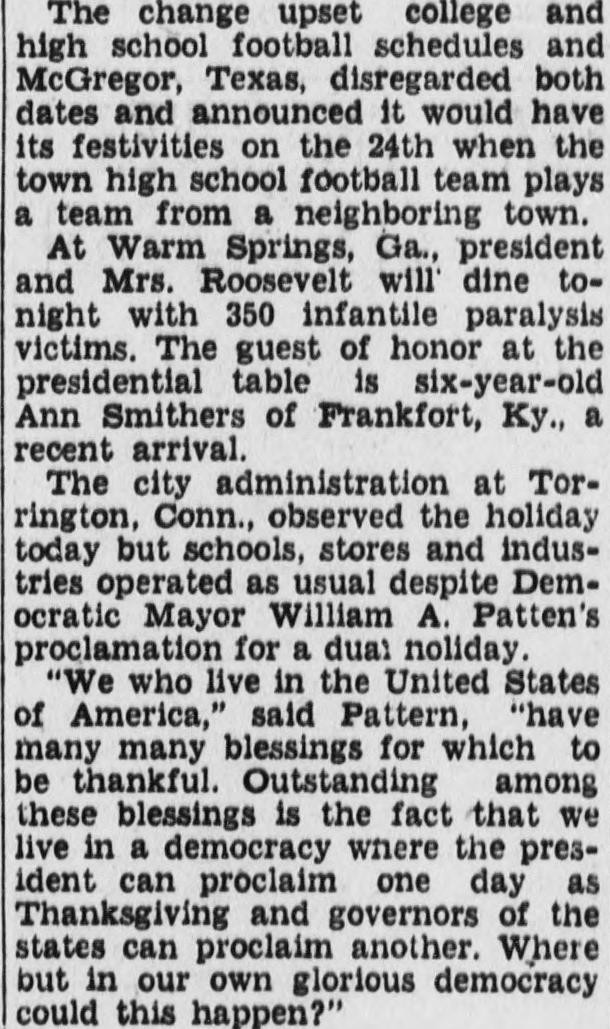
United Press roundup, November 23, 1939. The Waterbury Democrat, Waterbury, Connecticut, November 23, 1939, page 4. Library of Congress, Chronicling America. Click the clipping to read it full size.
How to survive two Thanksgivings, 1939 style
- **Celebrate all week.** La Crosse, Wisconsin, decided “to celebrate the whole week from Thursday to Thursday.” Their reason: “We are not pikers.” A piker is someone who does things halfway.
- **Pick a third day.** Leaders of Clayton County, Iowa, set aside November 16, so as “not to conflict” with the President or the governor.
- **Follow the football.** McGregor, Texas, “disregarded both dates.” It planned its party for the 24th, the day of the high school football game.
- **Pick just one.** A doctor named Logan Clendening wrote a newspaper column warning readers “not to try to celebrate two Thanksgivings. Your stomach will not stand it.”
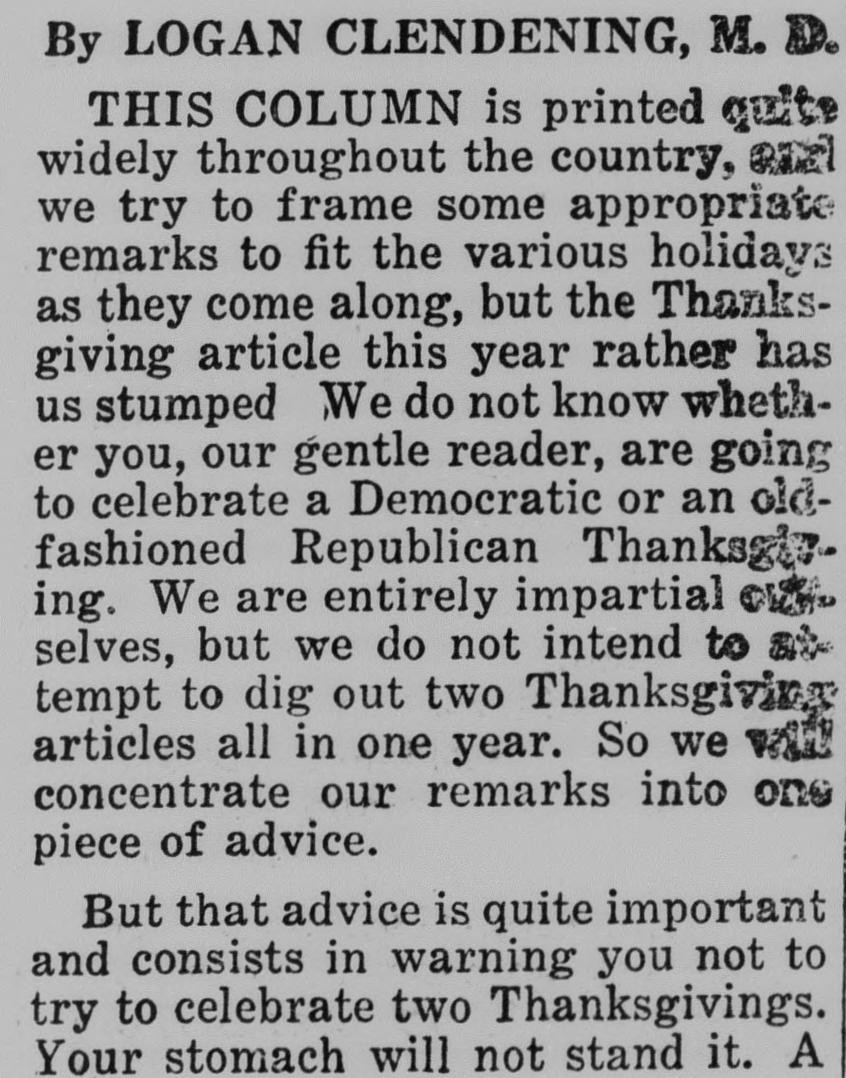
Dr. Logan Clendening’s health column. The Henderson Daily Dispatch, Henderson, North Carolina, November 27, 1939, page 7. Library of Congress, Chronicling America. Click the clipping to read it full size.
How it ended
The mix-up went on for two more years. In December 1941, Congress voted to make the “fourth Thursday” of November the national Thanksgiving. Congress’s number experts did the math. A Connecticut paper said they found that “only two out of every seven years” have a November with five Thursdays. So most years, the fourth Thursday is also the last one. In the other years, stores still get an extra week of Christmas shopping. That’s the rule we still follow today.
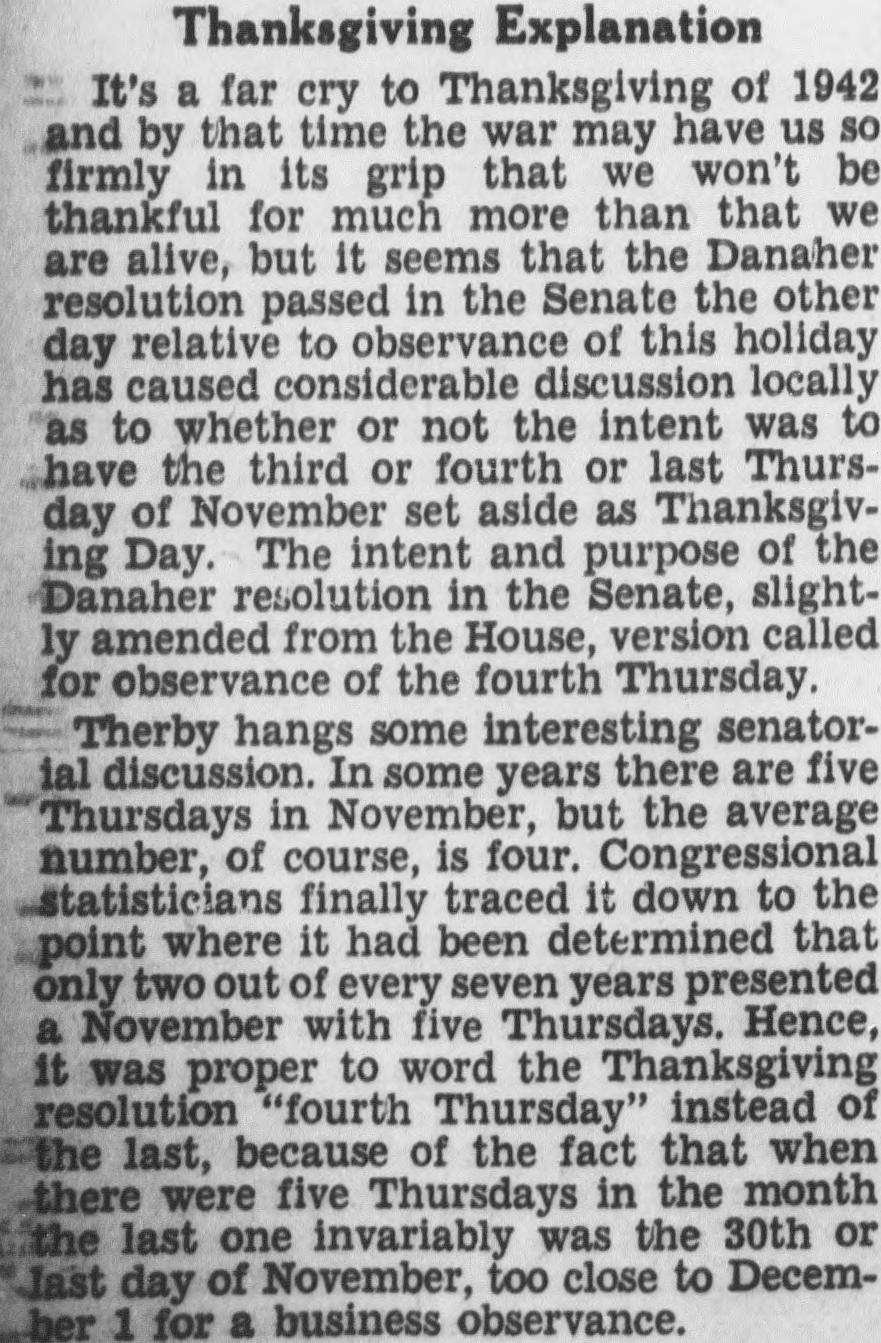
“Thanksgiving Explanation.” The Waterbury Democrat, Waterbury, Connecticut, December 13, 1941, page 6. Library of Congress, Chronicling America. Click the clipping to read it full size.
Sources
- The Waterbury Democrat (Waterbury, Connecticut): November 23, 1939, page 13 (“President, Wife Will Celebrate,” United Press), November 23, 1939, page 4 (United Press roundup), November 24, 1939, page 8 (the President’s dinner remarks) and December 13, 1941, page 6 (“Thanksgiving Explanation”).
- The Evening Star (Washington, D.C.): August 15, 1939, page 1 (“Advancing Thanksgiving Irks Grid Coaches and Governors,” Associated Press).
- The Hagerstown Globe (Hagerstown, Maryland): October 27, 1939, page 2 (the map).
- The Springfield Weekly Republican (Springfield, Massachusetts): November 16, 1939, page 12 (Associated Press roundup by William M. Pinkerton).
- The Henderson Daily Dispatch (Henderson, North Carolina): November 27, 1939, page 7 (Dr. Logan Clendening’s column).
- All newspaper images: Library of Congress, Chronicling America.
- Cover: “Farmer selling Thanksgiving turkey to farmer outside warehouse where tobacco auction sales are being held. Durham, North Carolina,” November 1939, photo by Marion Post Wolcott, Farm Security Administration, Library of Congress, no known restrictions on publication.
- The Little White House: photo by Carol M. Highsmith, 2017, Library of Congress.