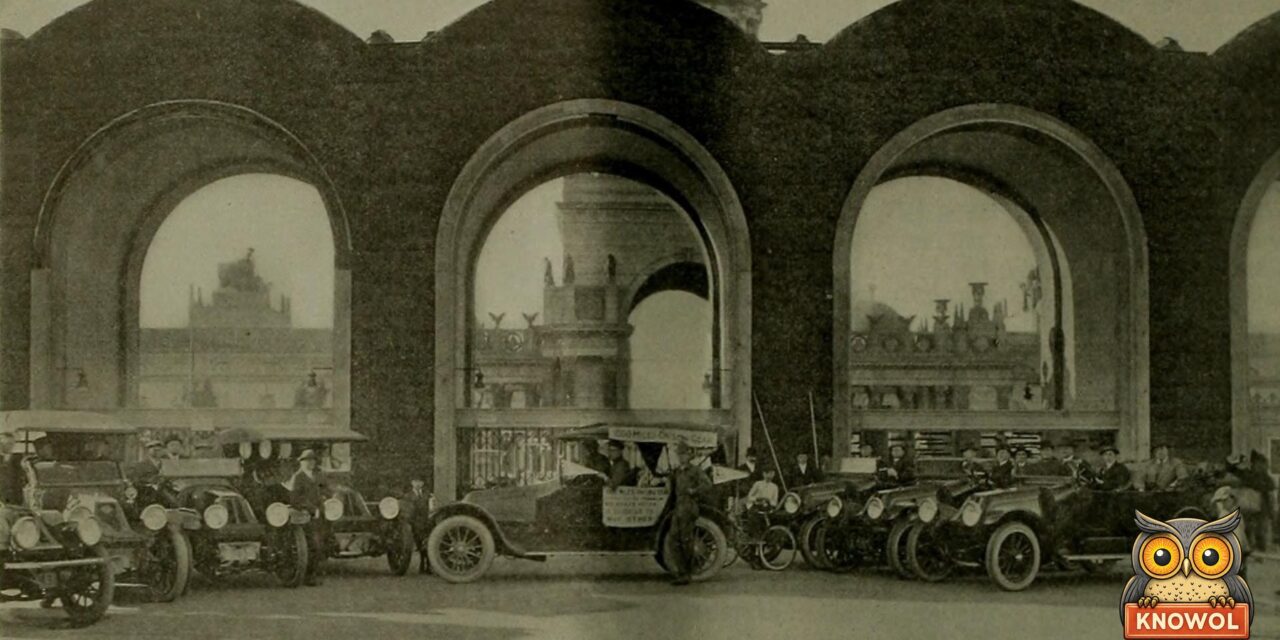
On a Sunday morning in August 1915, a crowd stood around a car outside the Pendleton Auto Co. garage in Pendleton, Oregon. Its engine was running, and it had not stopped since the car left Walla Walla, Washington, at 6:10 that morning. The plan was to keep it running all the way to San Francisco.
While the motor hummed, a garage owner named Kyle Long checked the gear box. Two of the car’s three gears were already out, so only low gear was left, the slowest one. A railroad agent sealed the box shut. Then the missing gears went to the express office, to be shipped to San Francisco ahead of the car. That started a race nobody had planned: three men in a Franklin automobile, crawling in low gear, against their own gears riding the railroad.
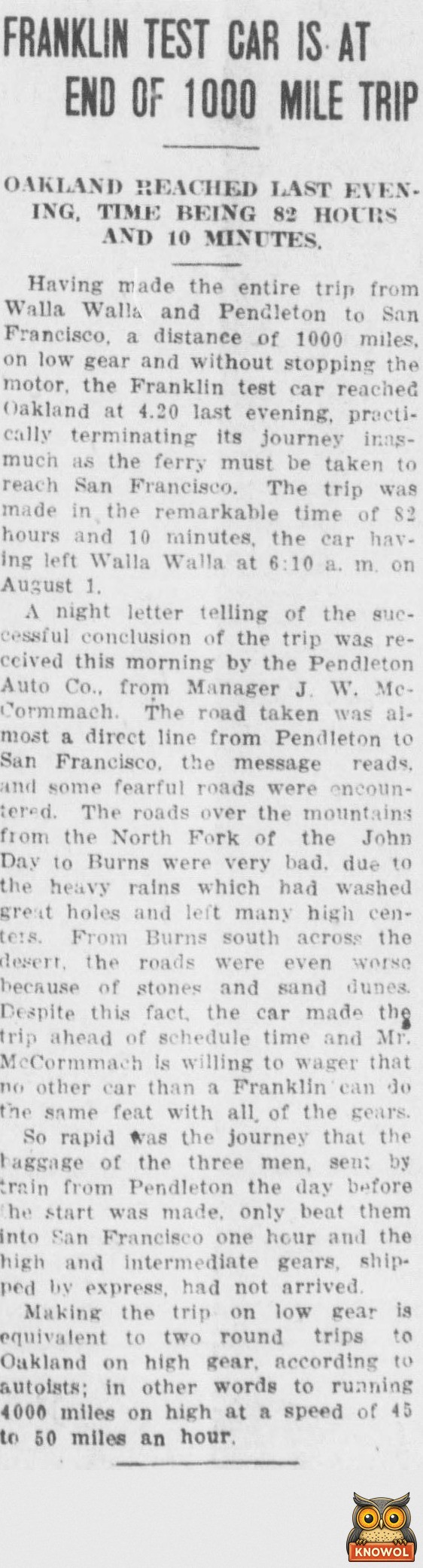
“Franklin Test Car Is at End of 1000 Mile Trip.” East Oregonian, Pendleton, Oregon, August 5, 1915, page 5. Library of Congress, Chronicling America. Click the clipping to read it full size.
Why Pendleton, Oregon, Wanted a Car in Low Gear
The man behind the plan was Walter McCormmach, who ran the Pendleton Auto Co. in Pendleton and sold Franklin cars. Six days before the start, the East Oregonian spelled it out. He and two other drivers would go “the entire distance on low gear and without once stopping their engine.”
Low gear is the gear a car starts in. Think of the easiest gear on a bicycle, where your feet spin fast but you don’t go far. In low gear, a car’s engine spins hard while the car creeps along, and an engine working that hard gets hot. “Traveling from here to San Francisco on low will be equivalent to running 4000 miles on high at 45 miles an hour without stopping,” McCormmach said.
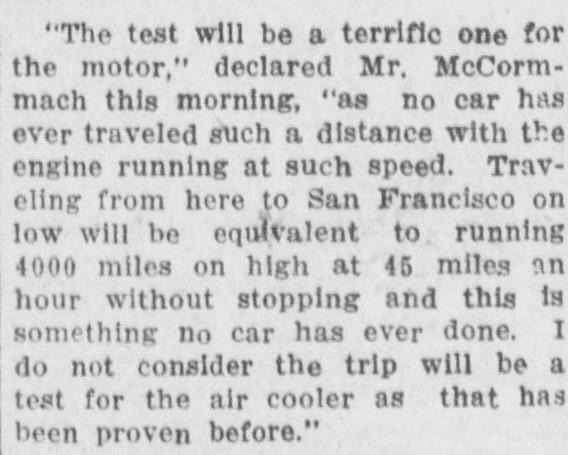
McCormmach’s plan. East Oregonian, July 26, 1915, page 1. Library of Congress, Chronicling America. Click the clipping to read it full size.
Heat was the whole point. Most cars of 1915 cooled their engines with water, pumped through a radiator up front. Drive slowly up a long hill and the water could boil over. A Franklin had no radiator at all. A big fan pulled air across the engine instead, and Franklin’s ads said it worked even when the car was barely moving. McCormmach wanted to prove it on the worst roads he could find.
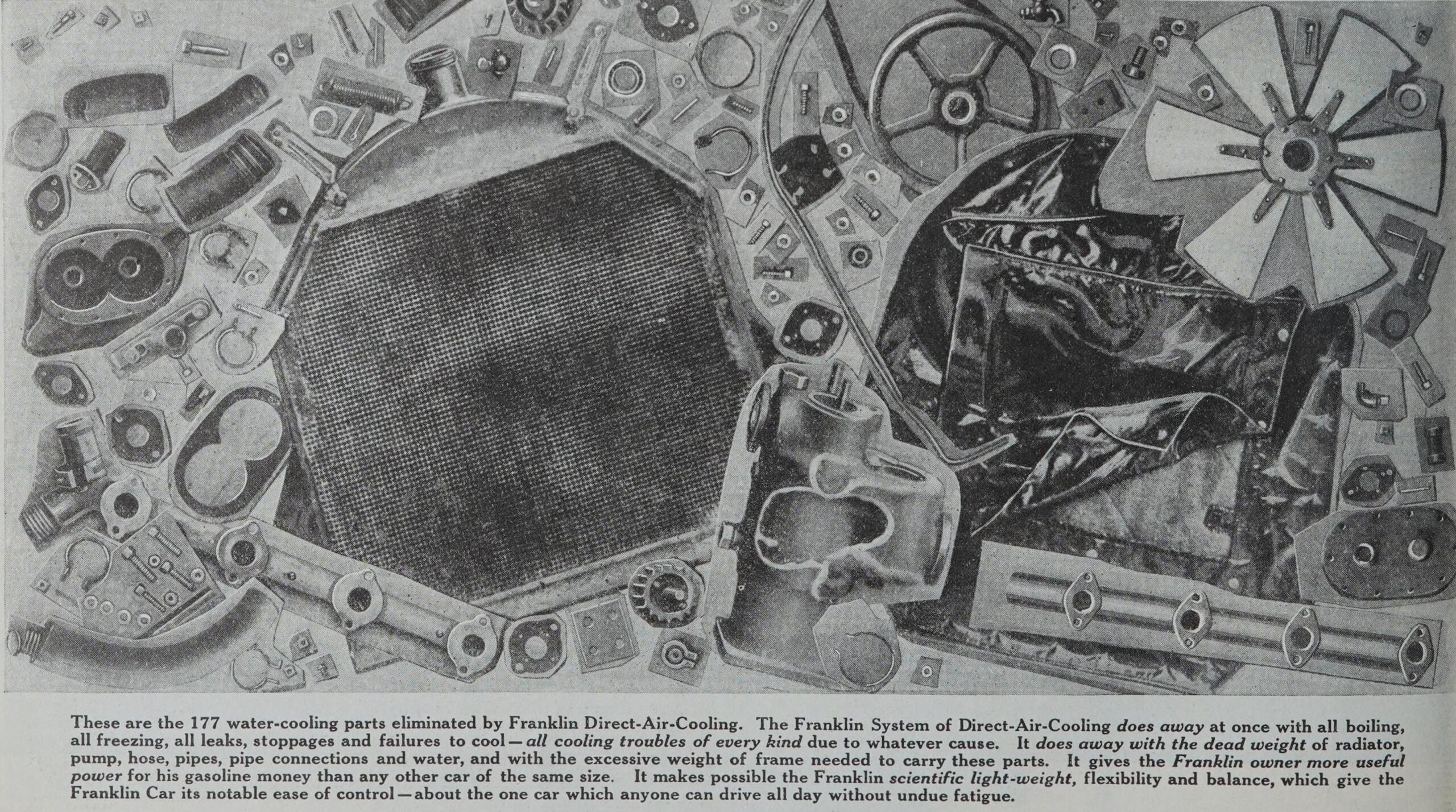
A Franklin ad showed “the 177 water-cooling parts” its cars did without, from the big radiator down to the smallest bolt. The Saturday Evening Post, March 18, 1916, page 72. Internet Archive, public domain. Click the picture to see it full size.
Cooking and Sleeping in the Car
McCormmach and his helpers got ready in Pendleton like sailors packing for a long voyage. “They will fit out so that cooking and sleeping can be done in the car and so that there will be no possible excuse for stopping,” the paper said. They would take turns at the wheel “so that they can travel night and day.”
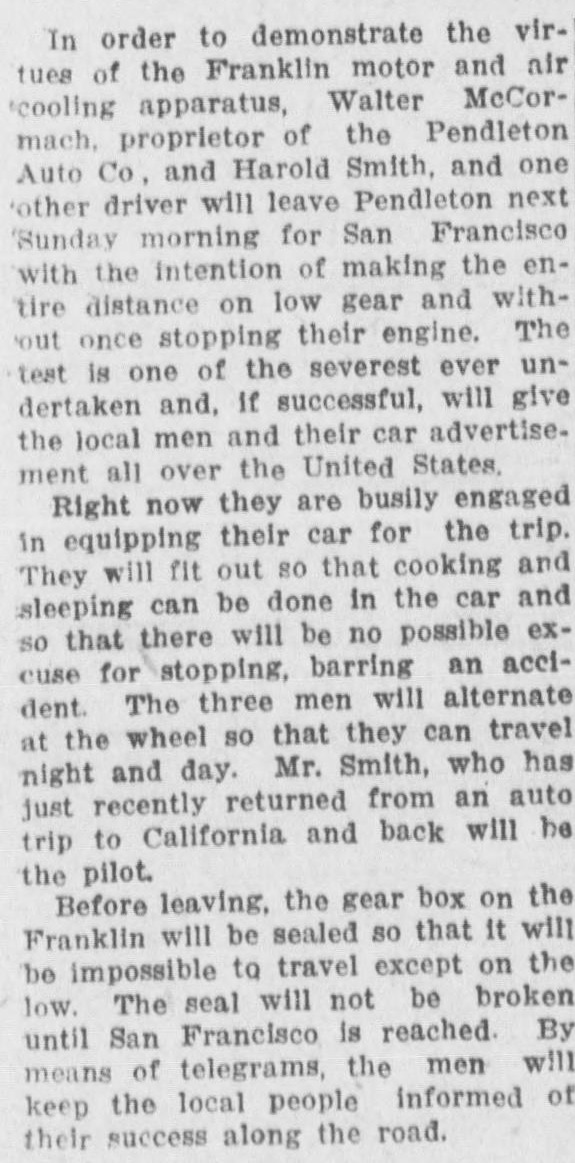
East Oregonian, July 26, 1915, page 1. Library of Congress, Chronicling America. Click the clipping to read it full size.
The Gears Go Ahead by Express
On Sunday, August 1, the Franklin left Walla Walla at 6:10 a.m. and rolled into Pendleton at 10:12. With the engine still running, Kyle Long of the Stone Garage made sure “the high and intermediate gears had been removed.” T. F. O’Brien, the agent for the O.-W. R. & N. railroad, sealed the transmission. A San Francisco magazine said the gear box was closed with “a regulation railroad freight car seal,” so nobody could sneak a gear back in.
The gears went to B. Parlett at the American Express office. He shipped them to San Francisco “for use on the return trip.” Express was the fast way to send a package in 1915, and it rode the trains. The men’s baggage had already left by train the day before. So the car had two things to chase, and it couldn’t even shift.
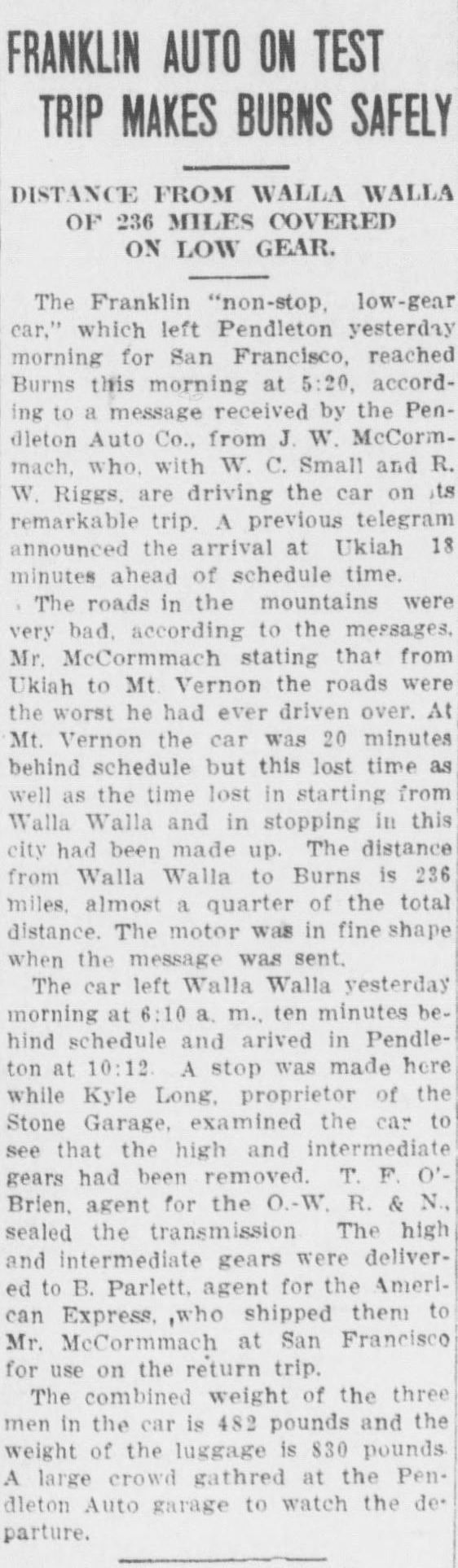
“Franklin Auto on Test Trip Makes Burns Safely.” East Oregonian, August 2, 1915, page 5. Library of Congress, Chronicling America. Click the clipping to read it full size.
Telegrams From the Oregon Desert
McCormmach sent telegrams home to the Pendleton Auto Co. whenever he found a telegraph office, and the company printed them in a big ad. From Burns, Oregon, 236 miles out, the news was “MOTOR RUNNING PERFECT.” The road from Ukiah, Oregon, to Mount Vernon was the “WORSE I EVER DROVE.”
Heavy rains had torn up the roads and “left many high centers,” the East Oregonian said. A high center is a hump of dirt between two deep ruts, tall enough to scrape the bottom of a car. From Lakeview, Oregon, McCormmach wired: “IF WE GET OUT WITHOUT KNOCKING BOTTOM OFF CAR I’LL TREAT THE DRIVERS INCLUDING MYSELF.”
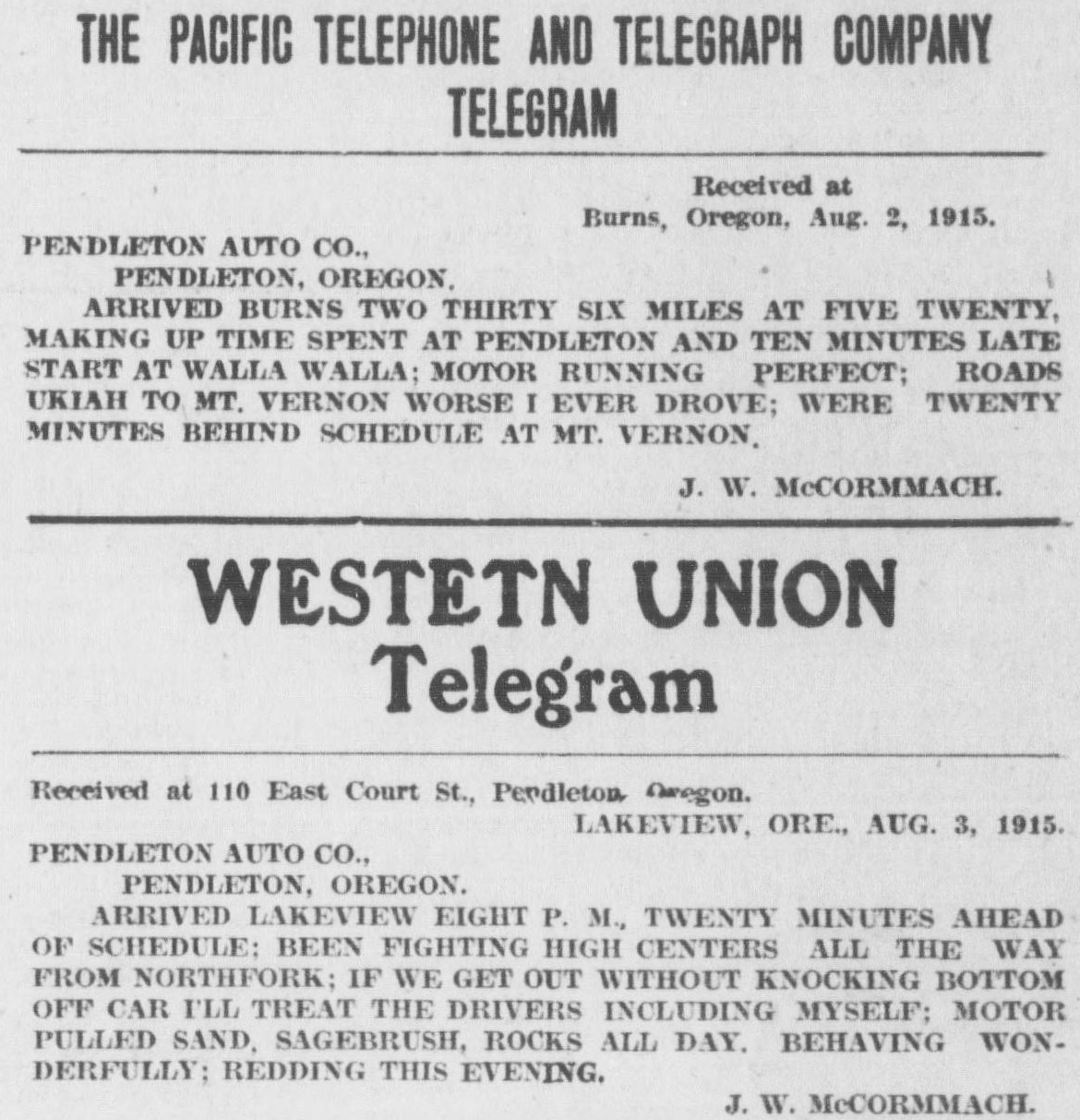
Two telegrams from the road, in the Pendleton Auto Co. ad. East Oregonian, August 5, 1915, page 5. Library of Congress, Chronicling America. Click the clipping to read it full size.
South of Burns, the desert road was even worse “because of stones and sand dunes.” A photographer caught the Franklin beside a lonely signpost out there. The magazine that printed it called it “the one sign post in one hundred and fifty miles of desert.”
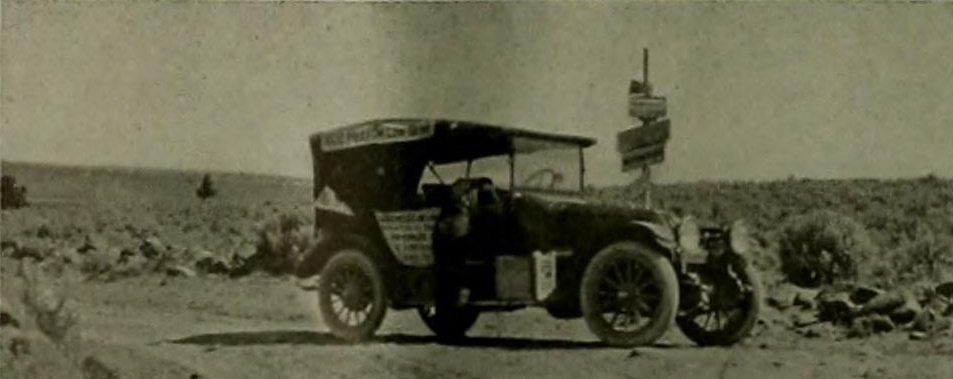
“The one sign post in one hundred and fifty miles of desert.” The Franklin on its way to San Francisco. San Francisco News Letter, August 28, 1915, page 34. Internet Archive, public domain. Click the picture to see it full size.
Missing the Ferry by Six Feet
By Wednesday, August 4, McCormmach’s Franklin was in California. At 12:18 p.m. a wire came from Winters: “DRIVING MAXIMUM SPEED; TRYING MAKE OAKLAND FOUR TODAY.” Maximum speed in low gear was not very fast.
Back then, cars crossed the water around San Francisco on ferryboats. The men got special permission to keep the engine running on board. Between Benicia, California, and Martinez, California, the ferry “had just pulled out of the wharf when McCormmach drove up.” That cost them nearly an hour.
At 4:20 p.m. they reached Oakland, California, “only to miss the ferry for San Francisco by six feet,” the San Francisco News Letter said. The next boat came half an hour later. They finished at “McLain’s place” in San Francisco, California, the company that would check the seal, after “83 hours and 40 minutes” of driving. The engine had never stopped once. The picture at the top of this page shows the Franklin at the finish, with a banner on its roof.
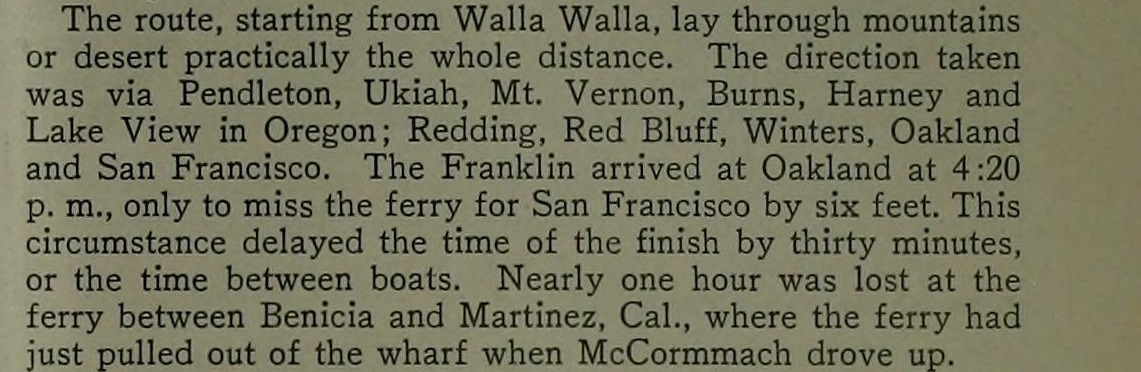
San Francisco News Letter, August 14, 1915, page 23. Internet Archive, public domain. Click the clipping to read it full size.
The Gears Came in Last
That night McCormmach sent the Pendleton Auto Co. a night letter, a long telegram sent cheaply overnight. “Get after express office and rush high and intermediate gear as it has not arrived and the express company should at least be as fast as a Franklin on low gear,” he wrote. The baggage that left a day early had beaten the car by one hour.
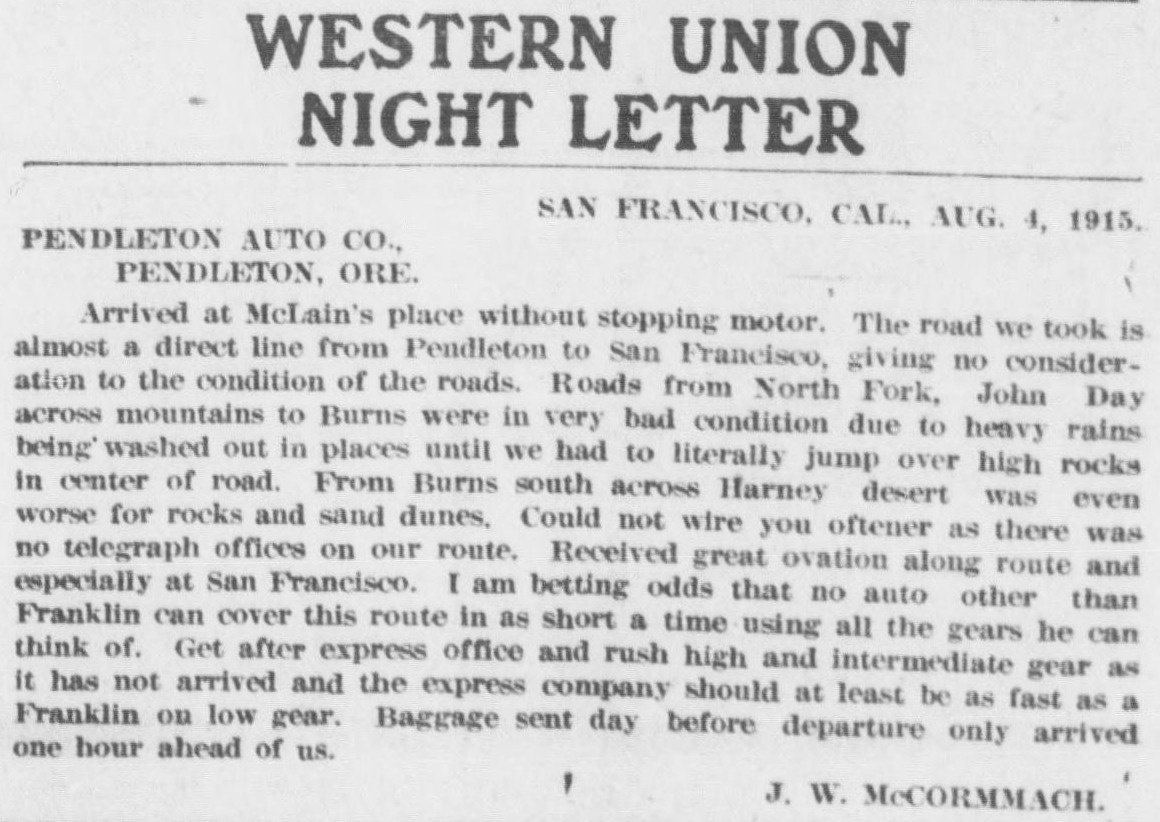
McCormmach’s night letter from San Francisco. East Oregonian, August 5, 1915, page 5. Library of Congress, Chronicling America. Click the clipping to read it full size.
McCormmach was ready to bet on it, too. He was “willing to wager that no other car than a Franklin can do the same feat with all of the gears,” the East Oregonian reported. Not everyone agreed on the distance, though. The Pendleton paper said 1,000 miles. The first report printed in San Francisco said 860.
Bragging in Phoenix, Arizona
The Franklin company in Syracuse, New York, wired the news to its dealer in Phoenix, Arizona, and the Arizona Republican had fun with it. “George Hageman, local Franklin dealer, was all puffed up, and hardly condescended to look at common people yesterday,” the paper said. In other words, he was too proud to say hello.
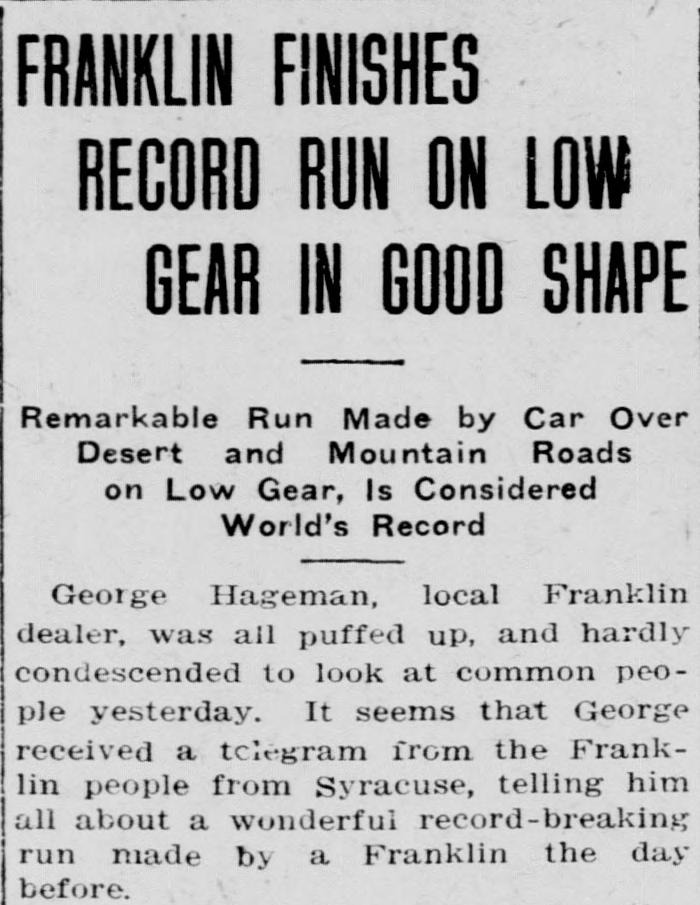
“Franklin Finishes Record Run on Low Gear in Good Shape.” Arizona Republican, Phoenix, Arizona, August 6, 1915, page 2. Library of Congress, Chronicling America. Click the clipping to read it full size.
Home to Pendleton, Oregon, and Into a Cornerstone
McCormmach drove the same Franklin home to Pendleton at the end of August, “using all gears this time.” His gears had finally caught up. They “did not reach the exposition city until after McCormmach did,” the paper said. San Francisco was holding a world’s fair that year, the Panama-Pacific International Exposition. Bob Riggs of Dayton, Washington, rode with him both ways.
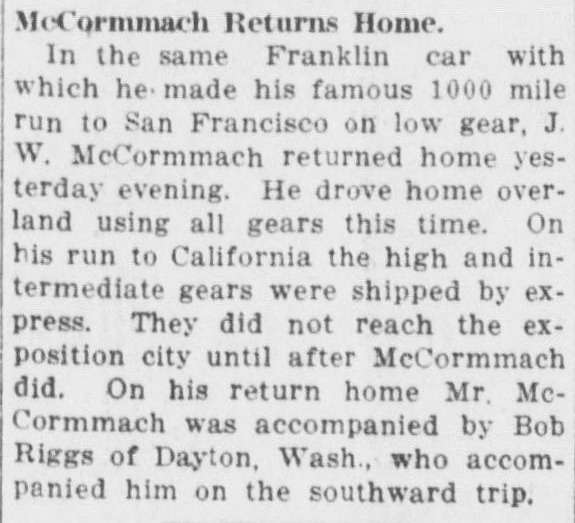
East Oregonian, September 1, 1915, page 5. Library of Congress, Chronicling America. Click the clipping to read it full size.
On September 22, 1915, Pendleton laid the cornerstone of its new federal building, the home of its post office and federal court. On that day “a multitude of souvenirs went beneath the cornerstone,” the East Oregonian said. One was a buckskin whip lash from 1874, “when Dave Horn first drove mail through Pendleton.” Another came from McCormmach: an “Advertisement of the world’s record auto drive on low gear from Pendleton to San Francisco.”
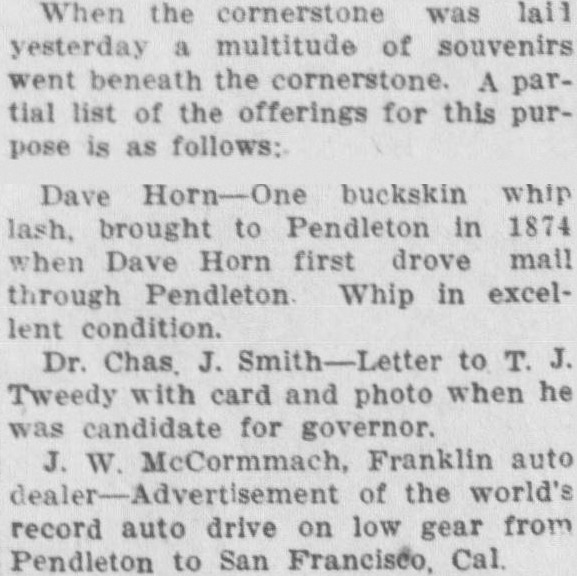
Two pieces of one story, joined. East Oregonian, September 23, 1915, page 4. Library of Congress, Chronicling America. Click the clipping to read it full size.
So an old mail driver’s whip and the story of a car that beat its own gears went under the same stone. Forty-one years apart, both were about getting there.
Sources
- East Oregonian (Pendleton, Oregon): July 26, 1915, page 1 (the plan); August 2, 1915, page 5 (“Franklin Auto on Test Trip Makes Burns Safely”); August 5, 1915, page 5 (“Franklin Test Car Is at End of 1000 Mile Trip” and the Pendleton Auto Co. telegram ad); September 1, 1915, page 5 (“McCormmach Returns Home”); September 23, 1915, page 4 (the cornerstone souvenirs).
- Arizona Republican (Phoenix, Arizona): August 6, 1915, page 2 (“Franklin Finishes Record Run on Low Gear in Good Shape”).
- San Francisco News Letter and California Advertiser: August 14, 1915, page 23 and August 28, 1915, page 34 (“Franklin Proves Its Worth,” with two photographs, the finish photo by Arthur Spaulding Co.). Internet Archive.
- The Saturday Evening Post, March 18, 1916, page 72 (Franklin ad, “Don’t Blame it All on the High Price of Gasoline”). Internet Archive.
- Newspaper images: Library of Congress, Chronicling America. Magazine pages: published in the United States in 1915 and 1916, public domain.
- Cover: “Finish of 1,000 mile low-gear test, Walla Walla to San Francisco, Franklin Car,” photo by Arthur Spaulding Co., San Francisco News Letter, August 28, 1915, page 34 (Internet Archive), public domain.