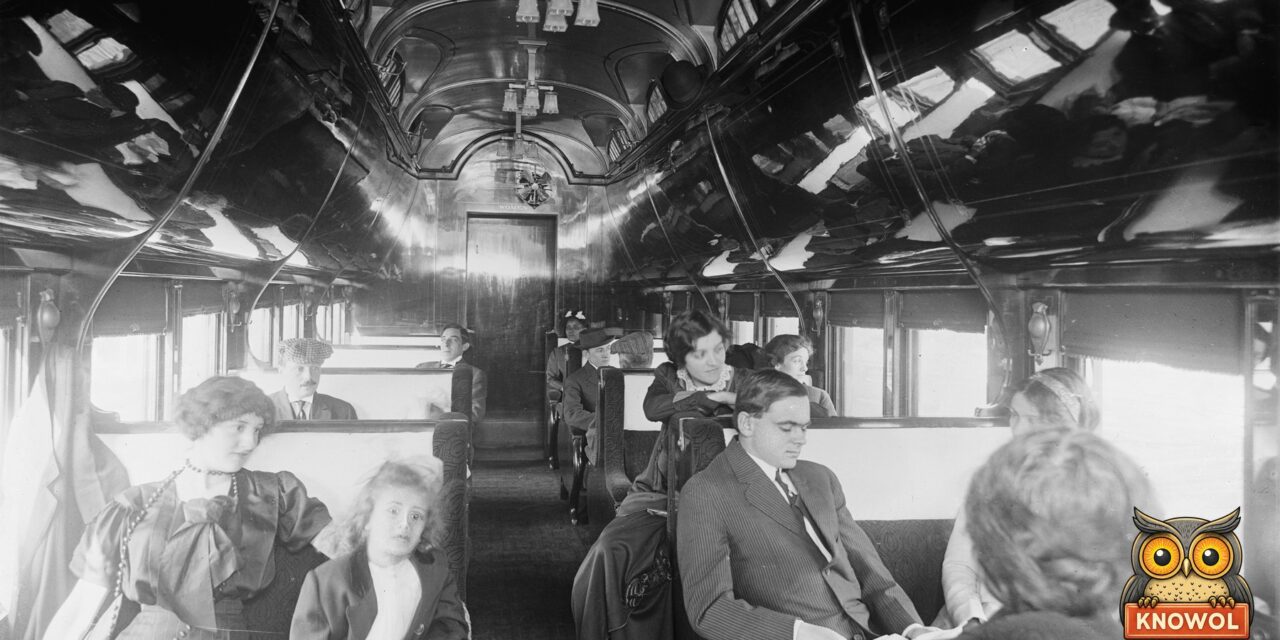
On Friday, September 23, 1870, a short special train rolled from Baltimore, Maryland, to Washington, D.C. Up front was a decorated engine. Behind it came a plain baggage car. Then came the reason for the trip: two brand-new sleeping cars named the Baltimore and the Wheeling. The train kept stopping along the way so people could “feast their eyes on the splendid pieces of work,” the Washington Evening Star said.
Both cars had been built in Wilmington, Delaware, at the Jackson & Sharp Company’s car works. Reporters rode them, ate lunch in the baggage car and wrote them up in Baltimore and Washington. Back home, the Delaware Tribune reported it with pride: “The Washington reporters went quite wild over the Pullman cars.”
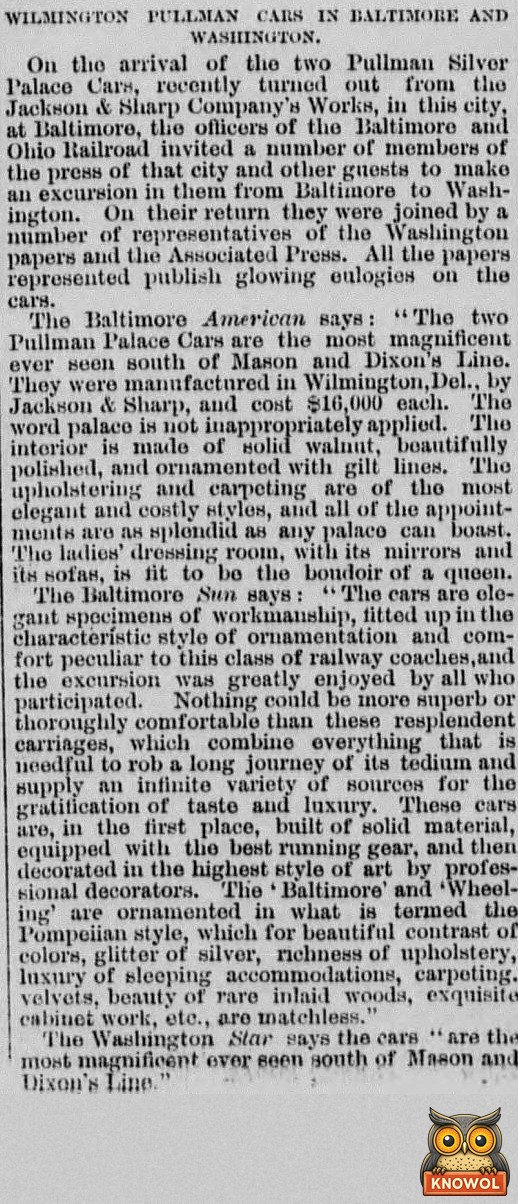
“Wilmington Pullman Cars in Baltimore and Washington.” The Delaware Tribune, Wilmington, Delaware, September 29, 1870, page 3. Library of Congress, Chronicling America. Click the clipping to read it full size.
Wilmington, Delaware, Gets Its Chance
The story of the Wilmington sleeping cars started that spring. On April 7, 1870, the Delaware Tribune, a weekly paper in Wilmington, shared some happy news. “It affords us decided pleasure to notice that Mr. Pullman has ordered our three Wilmington car-shops to build for him eighteen of his great Palace Sleeping Cars,” it said.
Mr. Pullman was George Pullman of Chicago. His company, the Pullman Palace Car Company, ran fancy sleeping cars on many railroads. A sleeping car is a train car with beds, so people on long trips can lie down instead of sitting up all night.
Wilmington already built plenty of train cars. Until then, the Tribune said, travelers knew Wilmington’s best work from cars “built on the Woodruff pattern,” a rival design. This order was a step up. “The travelers on our great railroads have never yet had an opportunity of seeing what our artisans can do,” the paper said. Artisans are skilled craftsmen. Then came the line that sums up the whole story: “This order will give them the chance.”
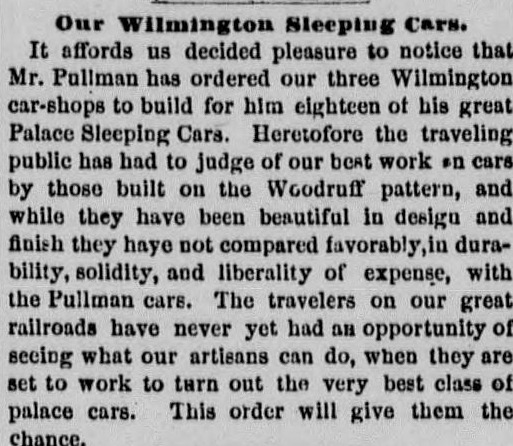
“Our Wilmington Sleeping Cars.” The Delaware Tribune, Wilmington, Delaware, April 7, 1870, page 1. Library of Congress, Chronicling America. Click the clipping to read it full size.
A day earlier, the Smyrna Times, from a town farther south in Delaware, had spread the same news: “Eighteen of the celebrated Pullman Palace Cars are being manufactured” in Wilmington.
Three Wilmington Shops Go to Work
Over the next months, the Delaware Tribune reported Pullman cars taking shape in three places in Wilmington: the Jackson & Sharp Company, the Harlan & Hollingsworth Company, and the car shops of the Philadelphia, Wilmington and Baltimore Railroad.
Jackson & Sharp had just become a company on April 1. Its president, Job H. Jackson, had “built it from small beginnings to its present importance,” the Tribune said. J. F. Sharp, the general superintendent, had always run the mechanical department, where the cars were actually built.
In June, the paper checked in. “The Pullman Silver Palaces, building by this Company, are beginning to assume form and shape,” it said, “but the work on them is not far enough advanced to give any idea as to their appearance when finished.” By late July, the cars at the railroad’s shops were “being rapidly pushed forward toward completion.”
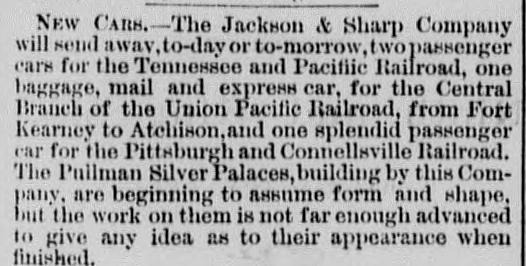
“New Cars.” The Delaware Tribune, Wilmington, Delaware, June 9, 1870, page 3. Library of Congress, Chronicling America. Click the clipping to read it full size.
How the Wilmington Cars Hid Their Beds
Here is the clever part of a Pullman car like the ones built in Wilmington. By day, it looked like a fancy parlor on wheels, with soft seats facing each other. At night, it turned into a bedroom. The beds were there all day long. You just could not see them.
The Evening Star explained it. “When the sleeping berths are not in use they are so adroitly concealed by the polished walnut pannels that form their under surface that no person would suspect their existence,” it said. A berth is a bed on a train or a ship. The top beds folded up against the wall above the windows. That shiny wooden panel you admired by day was really the bottom of a bed.
The seats changed, too. The Star said they looked so neat “that it is scarcely to be believed that a dexterous turn or two will convert them into the most comfortable of lounges.” Dexterous means quick and handy. A couple of moves, and two seats became a bed.
There was even a light for reading in bed. “There is a lamp to each section,” the Star said, so a traveler who could not sleep “can read all night, if he chooses.” A section was one pair of seats by day and an upper and a lower bed by night.
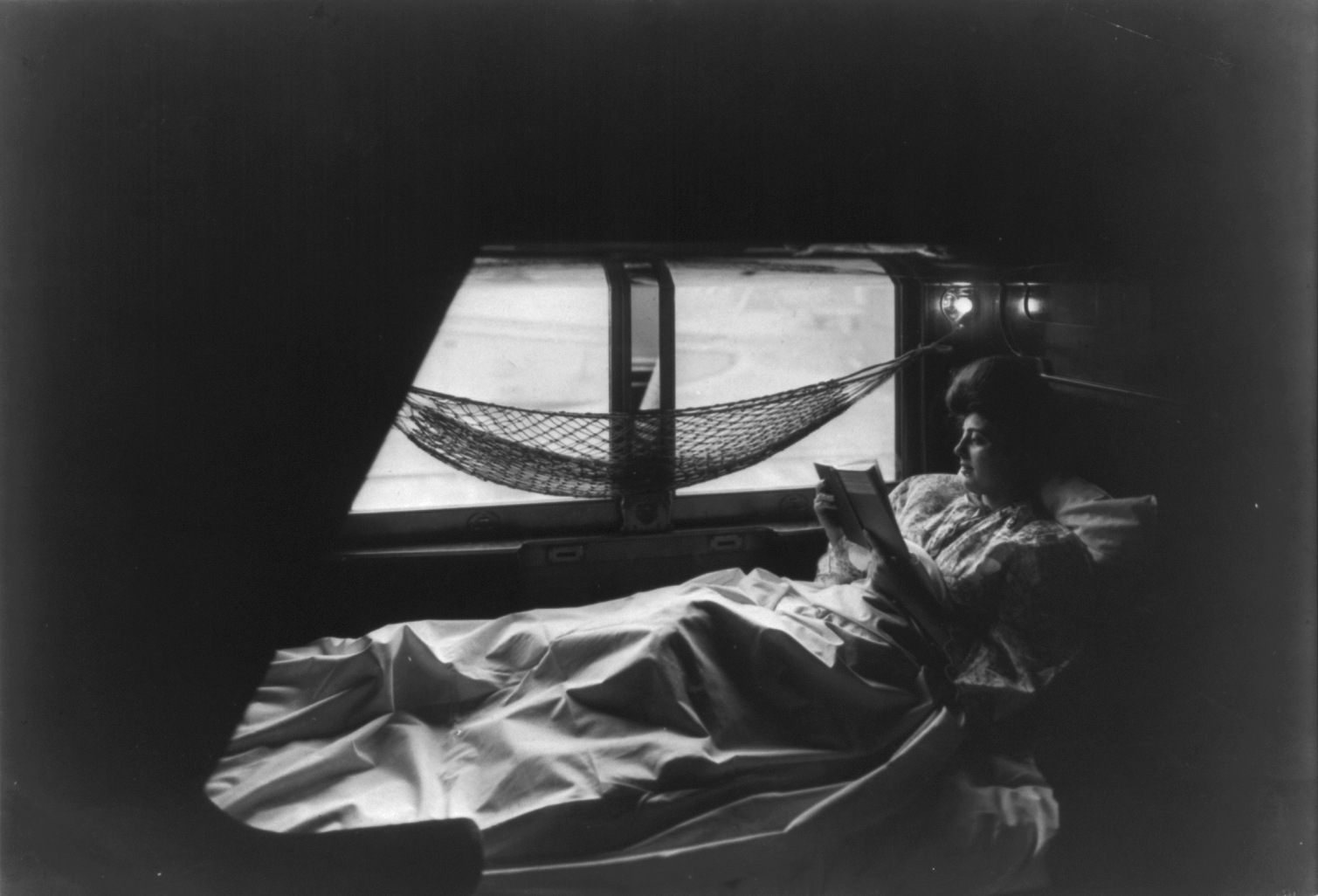
A woman reads in a Pullman berth made up for the night, about 1905, 35 years after the Wilmington cars. Photo by the Geo. R. Lawrence Co., Library of Congress. Click the picture to see it full size.
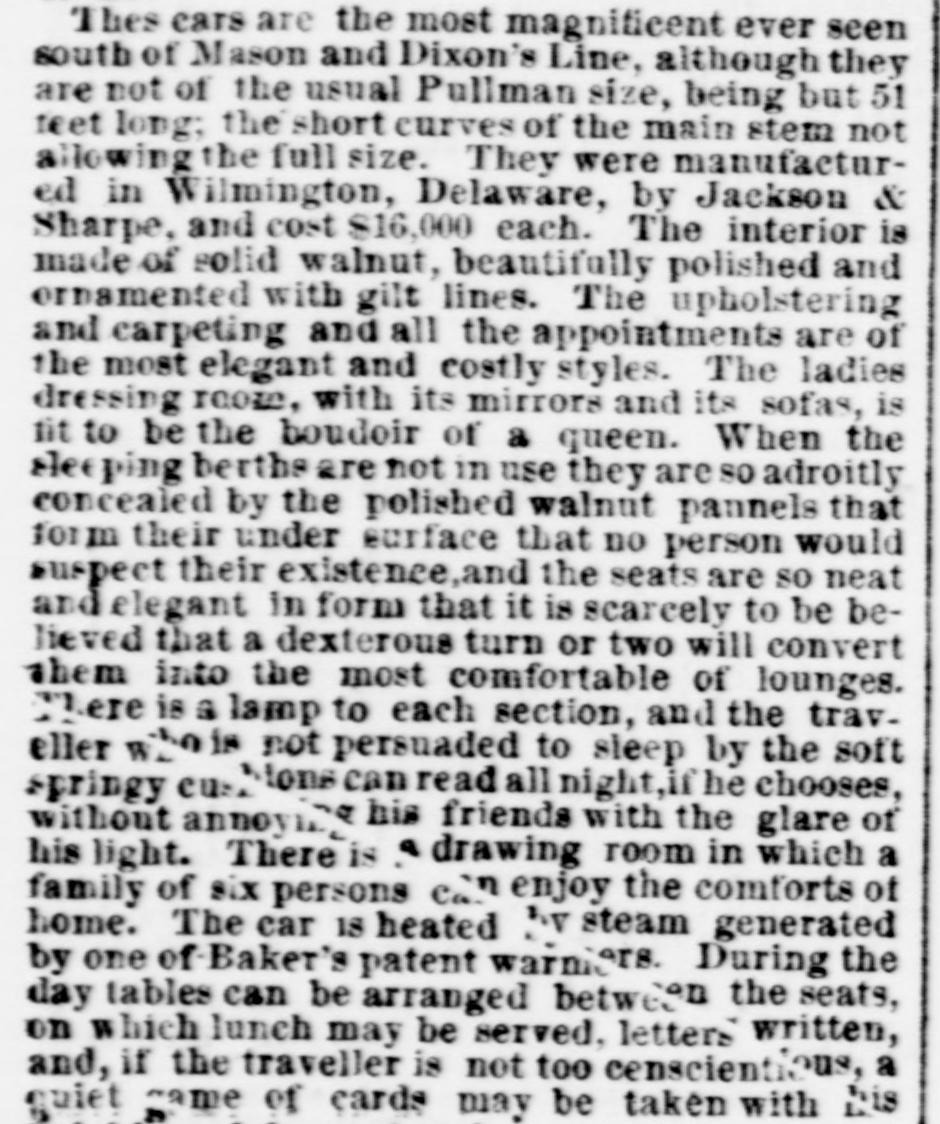
How the beds hid, and the queen’s boudoir. Evening Star, Washington, D.C., September 24, 1870, page 4. Library of Congress, Chronicling America. Click the clipping to read it full size.
“Fit to Be the Boudoir of a Queen”
The Baltimore and the Wheeling, the two cars from Wilmington, were built for the Baltimore and Ohio Railroad’s run from Baltimore to Wheeling, on the Ohio River in West Virginia. The Star called them “the most magnificent ever seen south of Mason and Dixon’s Line.” That old surveyed line between Pennsylvania and Maryland was where people said the North ended and the South began.
The cars were a little short for Pullmans, “being but 51 feet long.” The Star said “the short curves of the main stem” did not allow the full size. The railroad’s main line simply bent too sharply for a longer car.
Inside, the cars were “made of solid walnut, beautifully polished and ornamented with gilt lines.” Gilt is a thin coat of gold. Ladies had their own dressing room. “The ladies dressing room, with its mirrors and its sofas, is fit to be the boudoir of a queen,” the Star said. A boudoir is a lady’s private sitting room. In the daytime, tables could be set up between the seats for lunch, letter writing or a game of cards.
Each car cost $16,000. The Star printed that price, and so did the Baltimore American. The Baltimore Sun added: “Nothing could be more superb or thoroughly comfortable than these resplendent carriages.” Riding along that Friday was the Postmaster General, J. A. J. Creswell, the head of the United States mail.
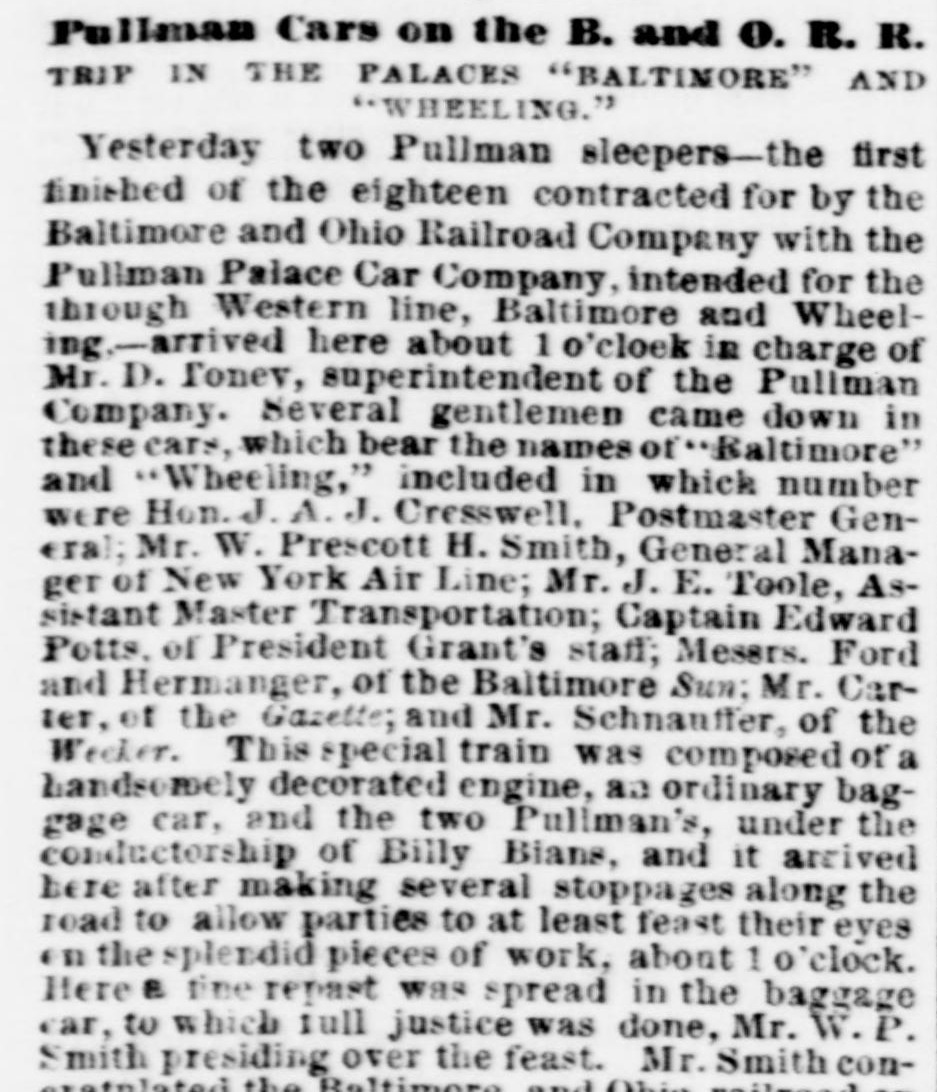
“Pullman Cars on the B. and O. R. R. Trip in the Palaces ‘Baltimore’ and ‘Wheeling.'” Evening Star, Washington, D.C., September 24, 1870, page 4. Library of Congress, Chronicling America. Click the clipping to read it full size.
Silver Lamps From Harlan & Hollingsworth in Wilmington
In late October 1870, the Harlan & Hollingsworth Company in Wilmington rolled out two Pullman cars of its own. “Their names are the Ionia and the Saronac, and they are intended to run over the Pennsylvania Railroad,” the Delaware Tribune said. They would carry travelers between Philadelphia and Pittsburgh.
These cars sparkled. The Tribune said “everything metallic about the cars, whether for use or ornament, is of heavily plated silver.” It added, “The silver lamps are very beautiful.” The windows were double, made of plate glass. A heater sent hot water through pipes to keep the car warm.
The Tribune called the cars “palaces on wheels in which the traveller may traverse a continent surrounded by all the comforts of home.” It also gave credit to the people who built them: “the efficient foreman of their car shops, Mr. Bowers, and the skillful men under his direction.” Then the cars went to West Philadelphia to be shown off for a few days.
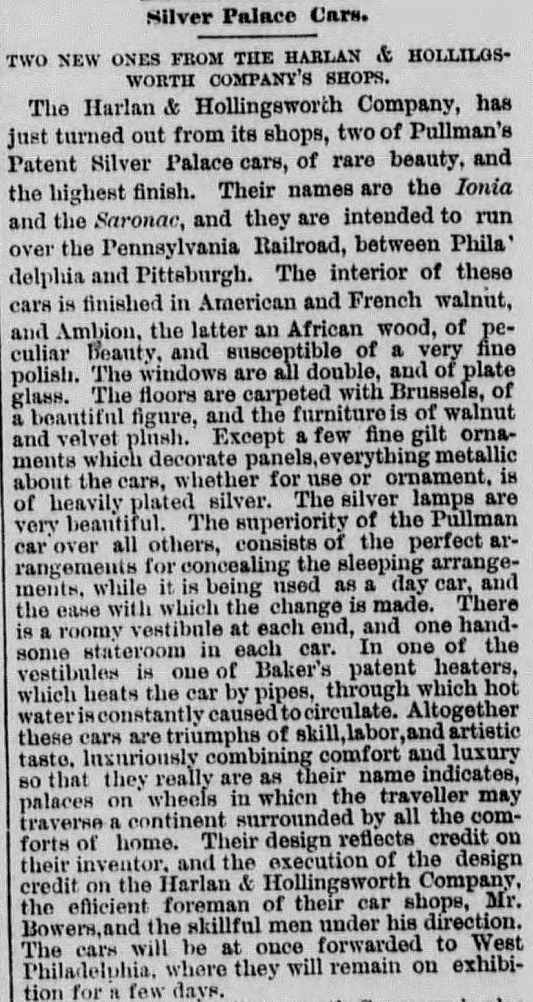
“Silver Palace Cars. Two New Ones From the Harlan & Hollingsworth Company’s Shops.” The Delaware Tribune, Wilmington, Delaware, October 27, 1870, page 1. Library of Congress, Chronicling America. Click the clipping to read it full size.
What Wilmington’s Car Shops Built Next
The palace cars kept coming out of Wilmington. In March 1871, the Nashville Union and American described a sleeping car seen at the depot in Chattanooga, Tennessee. “It was manufactured at the famous car works of Jackson & Sharpe, Wilmington, Delaware,” the paper said. It had silk seat cushions, 24 mirrors, and a light at each seat “concealed during the day by a beautiful sliding mirror.” The carpet alone cost $700, and the whole car $20,000. “Twelve similar cars are being manufactured at Wilmington,” the paper added.
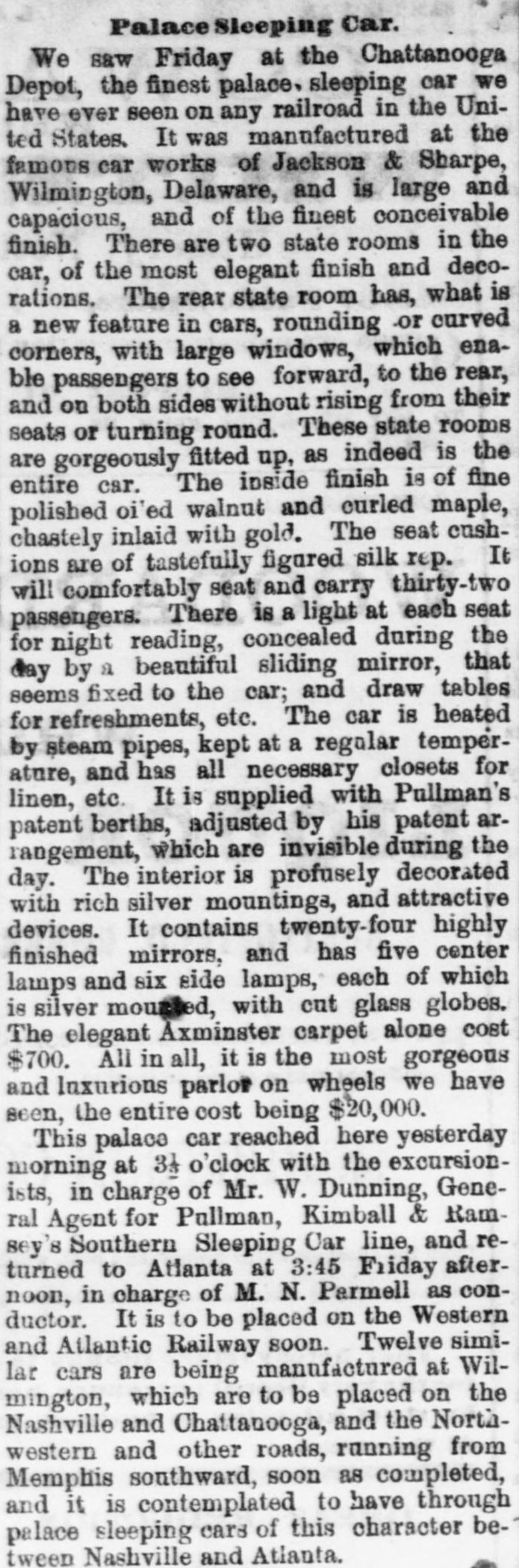
“Palace Sleeping Car.” Nashville Union and American, Nashville, Tennessee, March 5, 1871, page 4. Library of Congress, Chronicling America. Click the clipping to read it full size.
Wilmington kept building fine passenger cars for decades. A history written for the Historic American Engineering Record, a federal program that records old factories and bridges, says Harlan & Hollingsworth became known across the country for them. By 1880 it had more than 1,000 workers, and its plant covered 43 acres between the railroad and the Christina River. Railroad cars were built there until 1939.
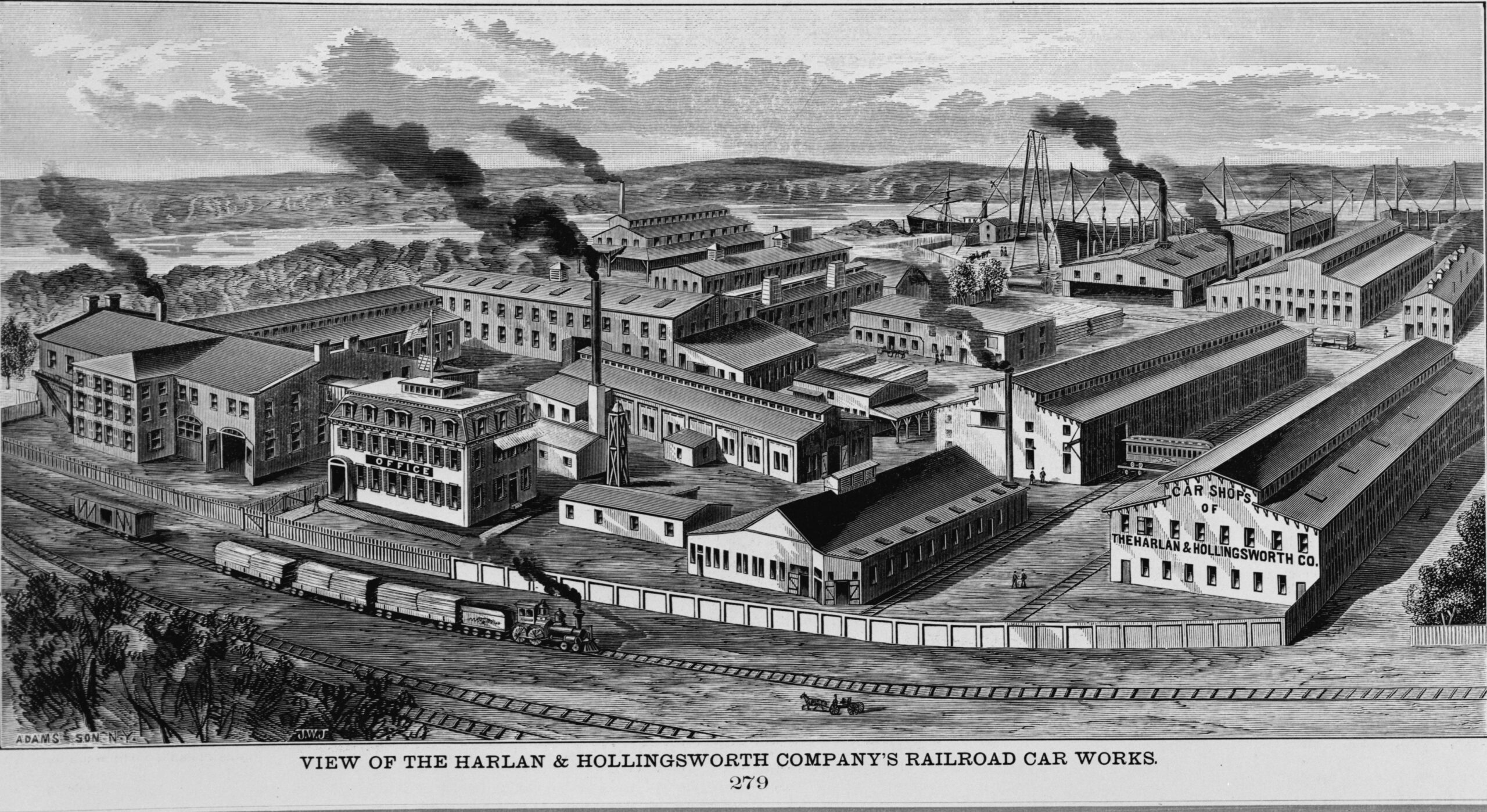
The Harlan & Hollingsworth car works in Wilmington, with “Car Shops” painted on the big building at right and a passenger car beside it. An engraving from page 279 of an old book, copied for the Historic American Engineering Record. Library of Congress. Click the picture to see it full size.
The Beds Are Still Hiding in the Picture
The photograph at the top of this page was not taken in Wilmington, Delaware. It shows a Pullman car on the Overland Limited, a deluxe long-distance train. The Detroit Publishing Company took it between 1910 and 1920, some forty years after the Wilmington cars. Look at the shiny curved panels over the windows. Those are the upper beds, folded away for the day, just as the Star described in 1870.
In the spring of 1870, a Wilmington paper hoped the city’s workers would finally show “what our artisans can do.” By fall, their cars had carried reporters, railroad men and the Postmaster General from Baltimore to Washington. And the reporters could not stop writing about the walnut, the silver and the beds nobody could see.
Sources
- “Our Wilmington Sleeping Cars,” The Delaware Tribune (Wilmington, Delaware), April 7, 1870, page 1. Library of Congress, Chronicling America.
- “The Jackson and Sharp Company Organized,” The Delaware Tribune, April 7, 1870, page 4. Library of Congress, Chronicling America.
- State and Locals, Smyrna Times (Smyrna, Delaware), April 6, 1870, page 2. Library of Congress, Chronicling America.
- “New Cars,” The Delaware Tribune, June 9, 1870, page 3. Library of Congress, Chronicling America.
- Local news, The Delaware Tribune, July 28, 1870, page 3. Library of Congress, Chronicling America.
- “Pullman Cars on the B. and O. R. R.,” Evening Star (Washington, D.C.), September 24, 1870, page 4. Library of Congress, Chronicling America.
- “Wilmington Pullman Cars in Baltimore and Washington” and local items, The Delaware Tribune, September 29, 1870, page 3. Library of Congress, Chronicling America.
- “Silver Palace Cars,” The Delaware Tribune, October 27, 1870, page 1. Library of Congress, Chronicling America.
- “Palace Sleeping Car,” Nashville Union and American (Nashville, Tennessee), March 5, 1871, page 4. Library of Congress, Chronicling America.
- Historic American Engineering Record, Harlan & Hollingsworth Company Factory, Wilmington, Delaware (HAER DE-8), history and photographs. Library of Congress Prints and Photographs Division.
- Detroit Publishing Co., “Standard pullman car on a deluxe overland limited train,” between 1910 and 1920. Library of Congress Prints and Photographs Division. No known restrictions on publication.
- Geo. R. Lawrence Co., photograph of a lady reading in a Pullman berth with the curtains up, about 1905. Library of Congress Prints and Photographs Division. No known restrictions on publication.
- The newspapers, photographs and engraving were all published or made before 1931 and are in the public domain.