In November 1921, a mother in Tulsa, Oklahoma, could hand over her baby the way you hand over a coat. She carried the baby down to the basement of the First Baptist church, where a churchwoman pinned a numbered tag to the back of its little dress. The mother got a matching tag. Then she walked off to hear Billy Sunday, the leading revival preacher of the day, while somebody else watched her baby. A revival was a run of big church meetings, held day after day, to stir up people’s faith.
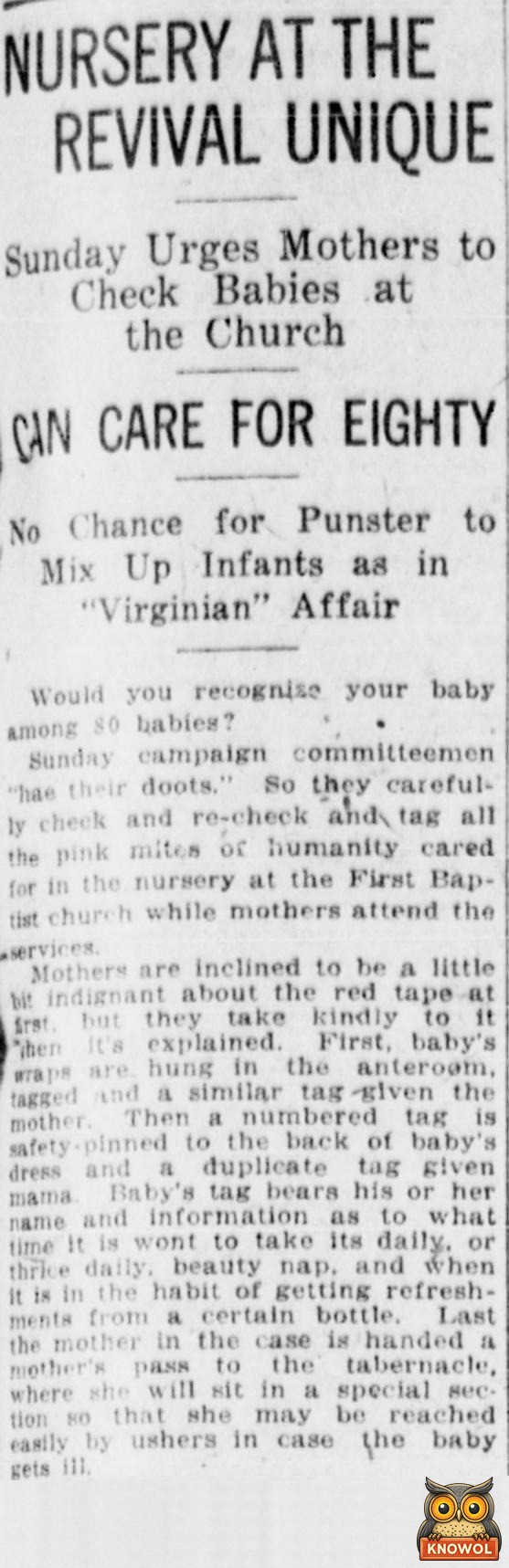
The Morning Tulsa Daily World asked the question every mother was thinking: “Would you recognize your baby among 80 babies?” The people running the meetings “hae their doots,” the paper joked, in Scottish talk for “have their doubts.” So the helpers “carefully check and re-check and tag all the pink mites of humanity cared for in the nursery at the First Baptist church while mothers attend the services.”
The Morning Tulsa Daily World, Tulsa, Oklahoma, November 14, 1921, page 5. Library of Congress, Chronicling America. Click the clipping to read it full size.
How the Baby Check Worked in Tulsa
The nursery at First Baptist in Tulsa ran like the coat check at a theater, only with babies. “First, baby’s wraps are hung in the anteroom, tagged and a similar tag given the mother,” the World said. “Then a numbered tag is safety-pinned to the back of baby’s dress and a duplicate tag given mama.”
Each baby’s tag also carried its name and its schedule. It told what time the baby was “wont,” or used, “to take its daily, or thrice daily, beauty nap, and when it is in the habit of getting refreshments from a certain bottle.” In plain words, it listed nap time and bottle time.
Last of all, the mother got “a mother’s pass to the tabernacle.” It sent her to a special section of seats, “so that she may be reached easily by ushers in case the baby gets ill.” If her baby needed her, an usher knew right where to find her.
Not every mother liked all the rules. The paper said mothers were “inclined to be a little bit indignant about the red tape at first, but they take kindly to it when it’s explained.” Red tape means fussy paperwork.
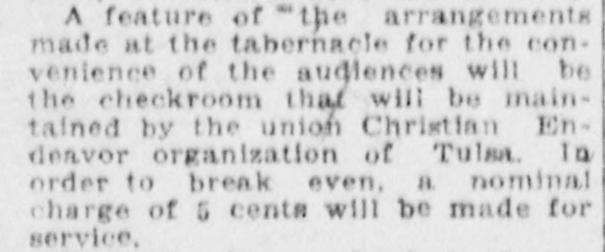
Grown-ups checked their coats at the tabernacle itself, at a check room run by a young people’s church group. “In order to break even, a nominal charge of 5 cents will be made for service,” the World said. The paper never said what it cost to check a baby.
The Morning Tulsa Daily World, Tulsa, Oklahoma, November 4, 1921, page 16. Library of Congress, Chronicling America. Click the clipping to read it full size.
The Little Girl Whose Mother Lost the Ticket
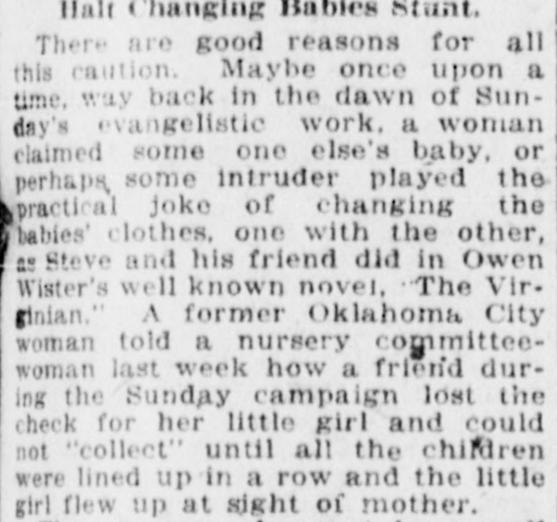
The Tulsa helpers had a story that showed why the tags mattered. “There are good reasons for all this caution,” the World said. Then it told what one woman had heard:
“A former Oklahoma City woman told a nursery committeewoman last week how a friend during the Sunday campaign lost the check for her little girl and could not “collect” until all the children were lined up in a row and the little girl flew up at sight of mother.”
No ticket meant no baby, even for the baby’s own mother. So the helpers lined up every child, and the little girl settled it herself. She ran straight to her mother. The paper did not say which city that happened in. Billy Sunday had preached in Oklahoma City, Oklahoma, in June 1920, the year before.
The Morning Tulsa Daily World, Tulsa, Oklahoma, November 14, 1921, page 5. Library of Congress, Chronicling America. Click the clipping to read it full size.
The headline promised “No Chance for Punster to Mix Up Infants as in ‘Virginian’ Affair.” A punster is a joker. The paper worried about someone pulling “the practical joke of changing the babies’ clothes, one with the other, as Steve and his friend did in Owen Wister’s well known novel, ‘The Virginian.'” In that 1902 cowboy story, two pranksters swap the clothes on the babies at a dance, and the families ride home with the wrong babies.
Inside the Nursery at First Baptist Church in Tulsa
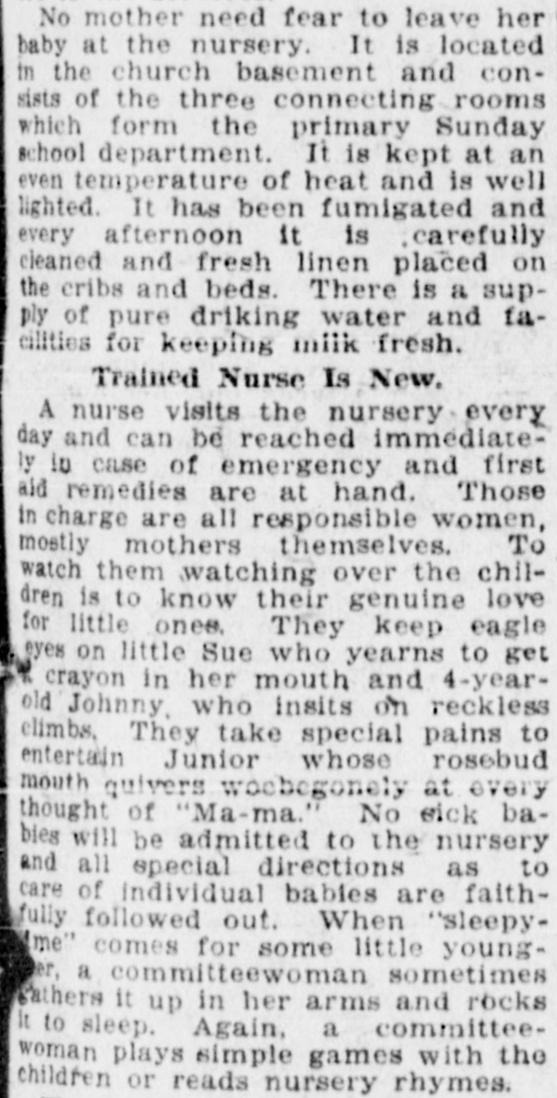
The Tulsa nursery filled three connecting rooms in the church basement, the rooms where the youngest Sunday school classes met. It was kept warm and bright, cleaned every afternoon, with “fresh linen placed on the cribs and beds,” clean drinking water, and a way to keep milk fresh. “A nurse visits the nursery every day,” the World said, and no sick babies were let in.
The helpers were “all responsible women, mostly mothers themselves,” the paper said. They watched little Sue, who kept trying to put a crayon in her mouth, and 4-year-old Johnny, “who insits on reckless climbs.” That’s how the old paper spelled “insists.” They took special care of a boy called Junior, “whose rosebud mouth quivers woebegonely at every thought of ‘Ma-ma.'” Woebegone means very sad. When a little one got sleepy, a helper sometimes rocked it to sleep in her arms.
The Morning Tulsa Daily World, Tulsa, Oklahoma, November 14, 1921, page 5. Library of Congress, Chronicling America. Click the clipping to read it full size.
The playroom had five small round tables. There the children looked at picture books, drew “rude pictures with crayons,” which meant rough little drawings, and cut out “paper dolls with blunt scissors.” Small chairs sat on a carpeted floor, near toys and “a low swing.”
“Eighty children can be accommodated,” the paper said, and “The youngest baby visitor was 11 weeks old.” Children up to 5 years old were welcome. The nursery opened at 1:30 in the afternoon and 6:30 in the evening, an hour before each meeting, so mothers could get to their seats in good time.
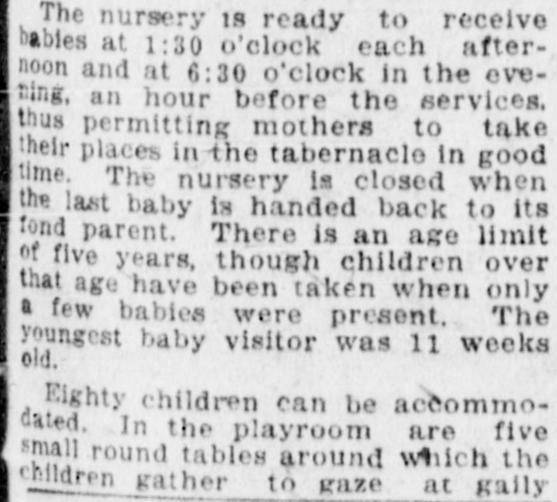
The Morning Tulsa Daily World, Tulsa, Oklahoma, November 14, 1921, page 5. Library of Congress, Chronicling America. Click the clipping to read it full size.
What Tulsa Mothers and Grandmothers Said
The nursery in Tulsa had 43 children on its first Sunday. On some days that week far fewer came, because “many mothers do not know about it,” the paper said. The ones who came, though, kept coming. “The baby who is brought once is brought again.”
The children liked it too. “One little girl who has been a frequent nursery guest almost cries every time her mother comes to take her away,” the World said. A gray-haired grandmother who came with her daughter put it best: “They never had anything like this in my day. I think it’s just fine.”
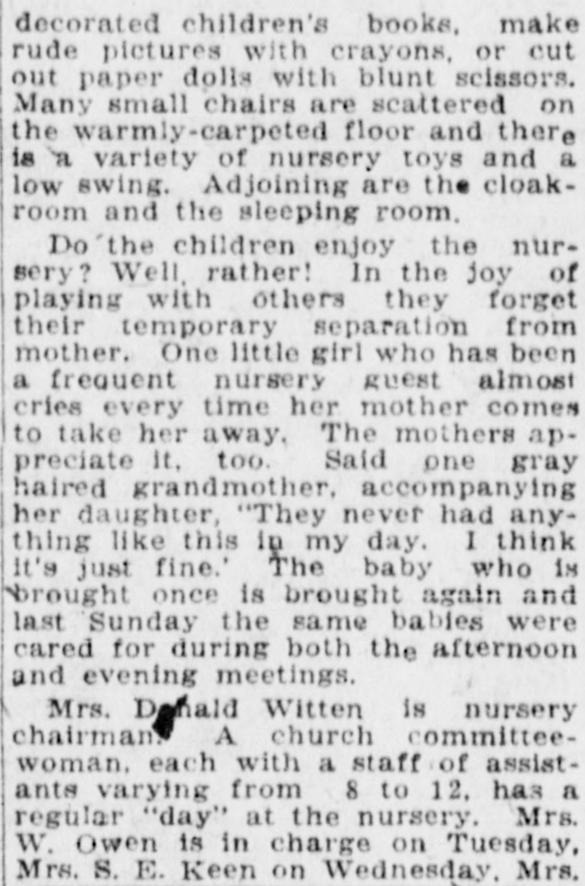
The Morning Tulsa Daily World, Tulsa, Oklahoma, November 14, 1921, page 5. Library of Congress, Chronicling America. Click the clipping to read it full size.
A Mrs. Witten ran the nursery. Each day a different churchwoman took charge, with 8 to 12 helpers of her own.
Billy Sunday’s Big Wooden Tabernacle in Tulsa
Billy Sunday had been a baseball player before he became a preacher. An Ardmore, Oklahoma, paper called him a “Former Baseball Star, Now Leading Revivalist.” He never lost his love for the game. “Wouldn’t take a cold million for my baseball experience,” he told a crowd in Oklahoma City in 1920.
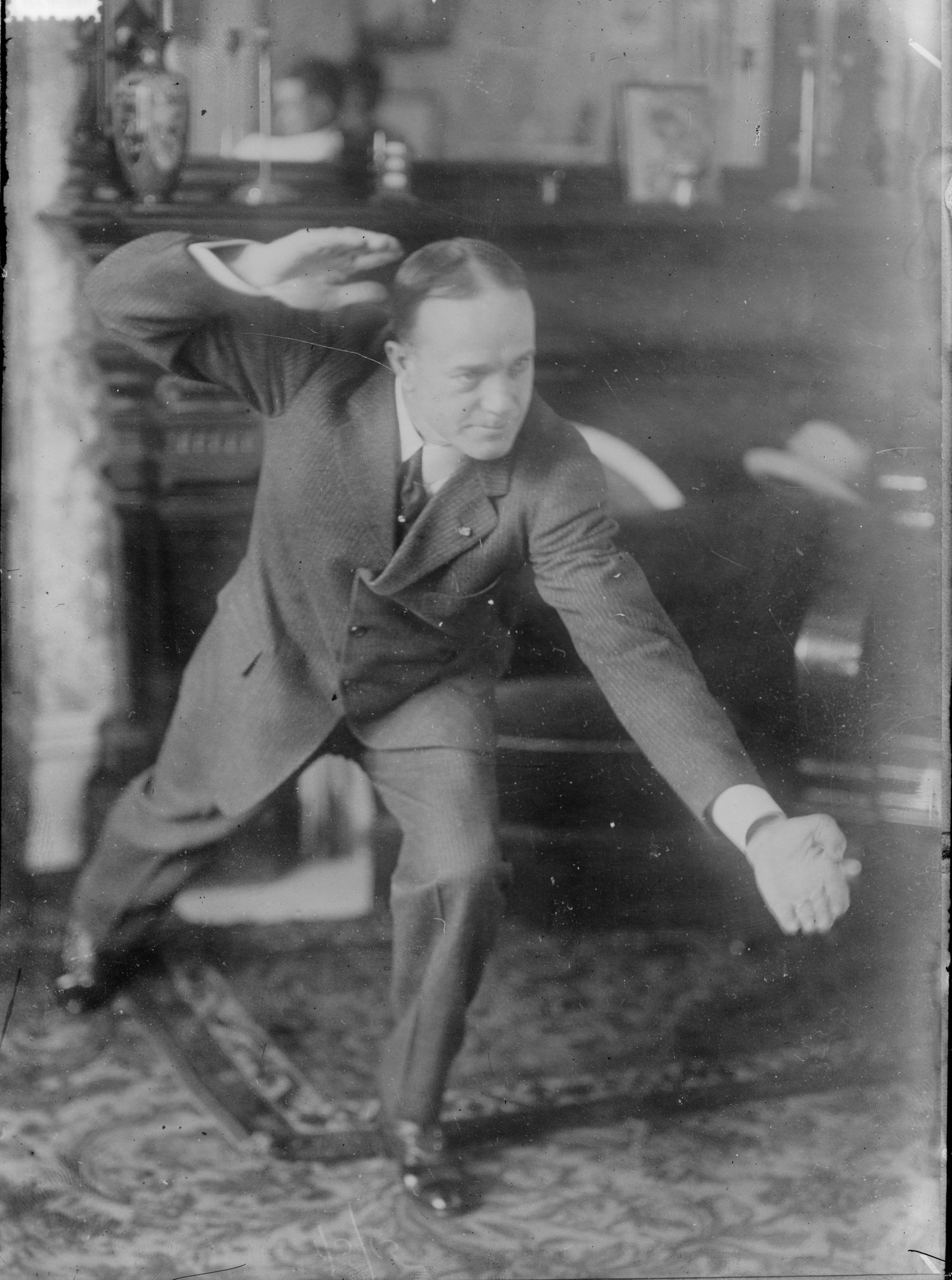
Billy Sunday in 1917, striking a pose like a pitcher making a throw. Bain News Service, Library of Congress. Click the picture to see it full size.
For his six weeks in Tulsa, the campaign put up a tabernacle, a giant wooden meeting hall, on South Elgin between Third and Fourth streets. The World said it would cost $14,000. It was one story high and 136 by 234 feet, most of the length of a football field. “Over 5,000 people can be accommodated in the auditorium and about 1,000 on the platform,” with six aisles and 18 doors. Sawdust covered the floor.
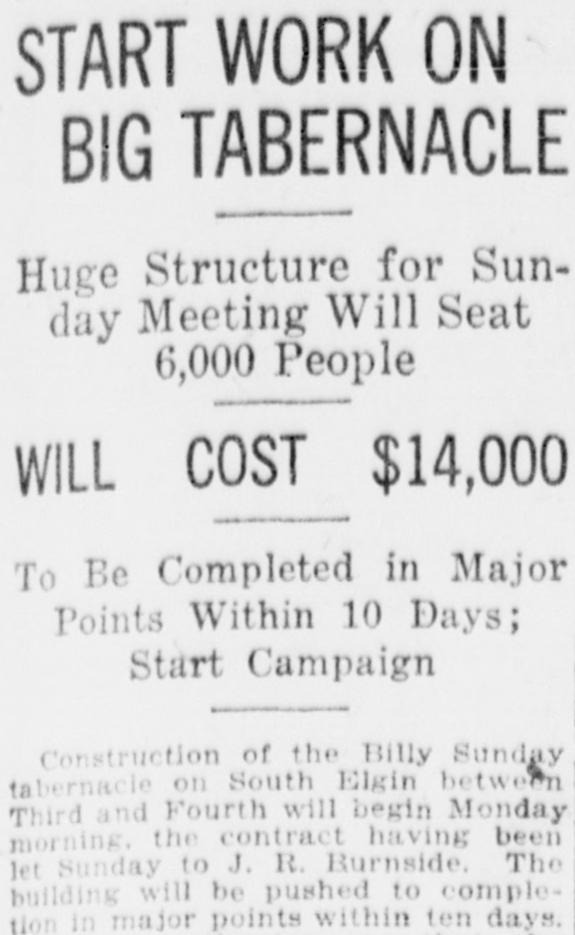
The Morning Tulsa Daily World, Tulsa, Oklahoma, October 2, 1921, page 3. Library of Congress, Chronicling America. Click the clipping to read it full size.
The campaign built no nursery onto the tabernacle, “because of the nearness of the tabernacle to several churches where room can be provided for this purpose.” The campaign opened on the morning of November 6, 1921, with a choir of 800 singers and 200 ushers.
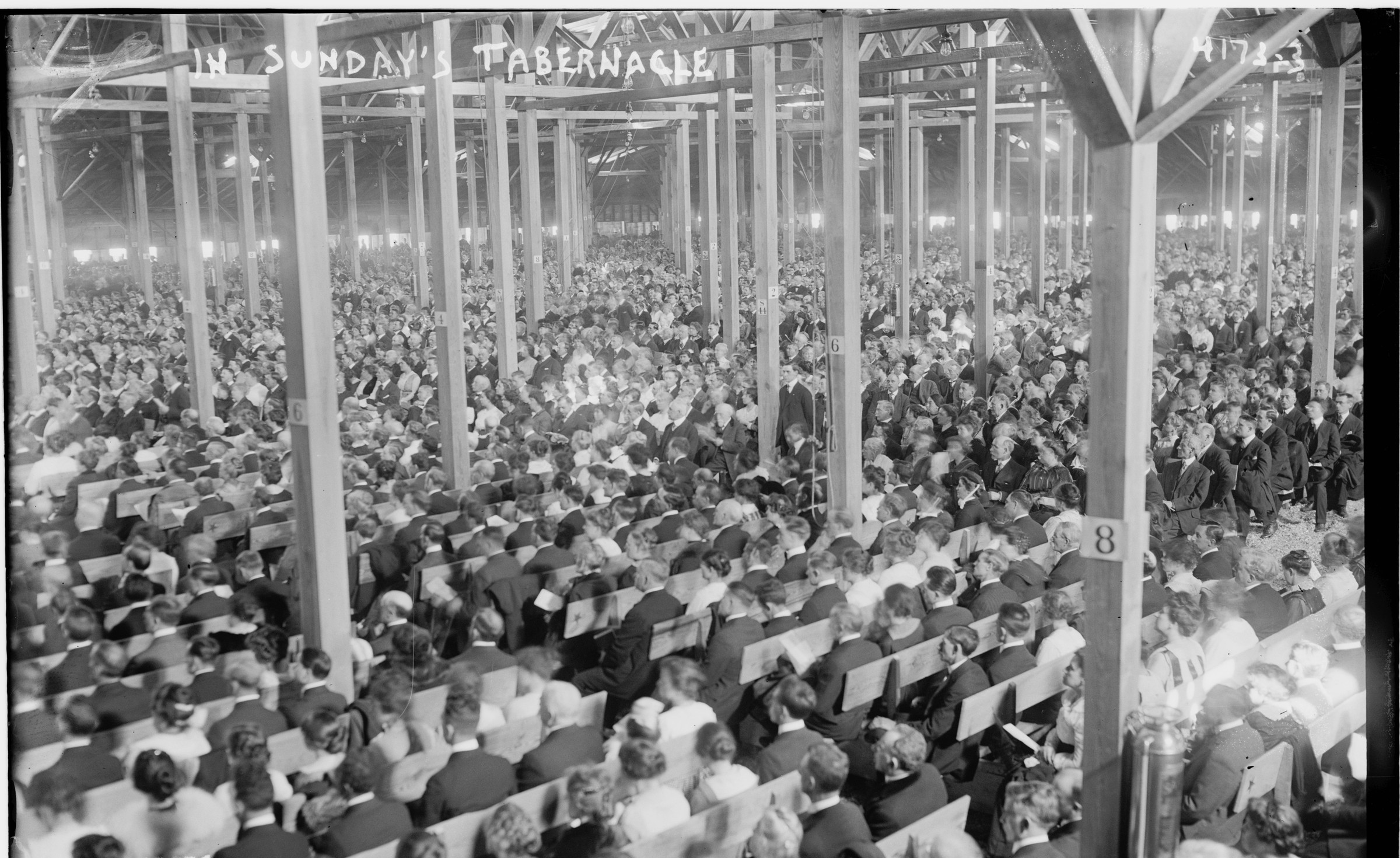
A crowd under the wooden posts of a Billy Sunday tabernacle during his New York City revival, a building like the one in Tulsa. Bain News Service, between about 1915 and 1920. Library of Congress. Click the picture to see it full size.
Checking Babies Before Tulsa
Baby check rooms went wherever Billy Sunday went. In Philadelphia, Pennsylvania, on January 22, 1915, the Evening Public Ledger reported that “60 infants of varying ages had been checked in the nursery adjoining the big auditorium.” That nursery had “piles of sand in which the little ones played happily,” and a policeman, William Gooding, guarded its door.
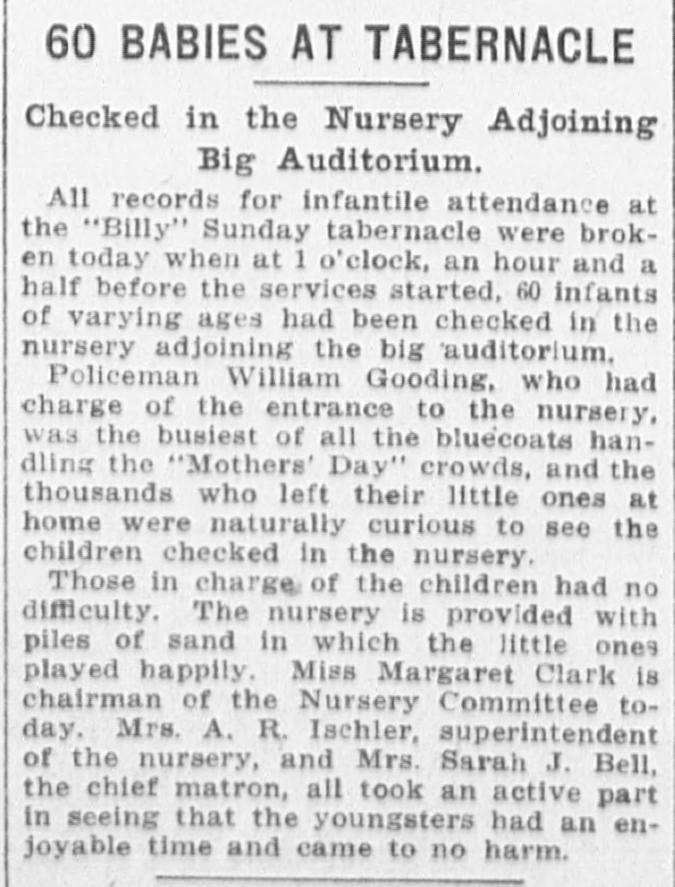
Evening Public Ledger, Philadelphia, Pennsylvania, January 22, 1915, page 2. Library of Congress, Chronicling America. Click the clipping to read it full size.
The idea was well known enough to become a joke. In 1912 a paper in Skowhegan, Maine, printed a joke about two women talking in a department store. One said the babies at a revival nursery were easy to keep track of: “They tag them.” Her friend wanted no part of it. “I tried that once when Billy Sunday was in town,” she said, “and my baby ate the tag.”
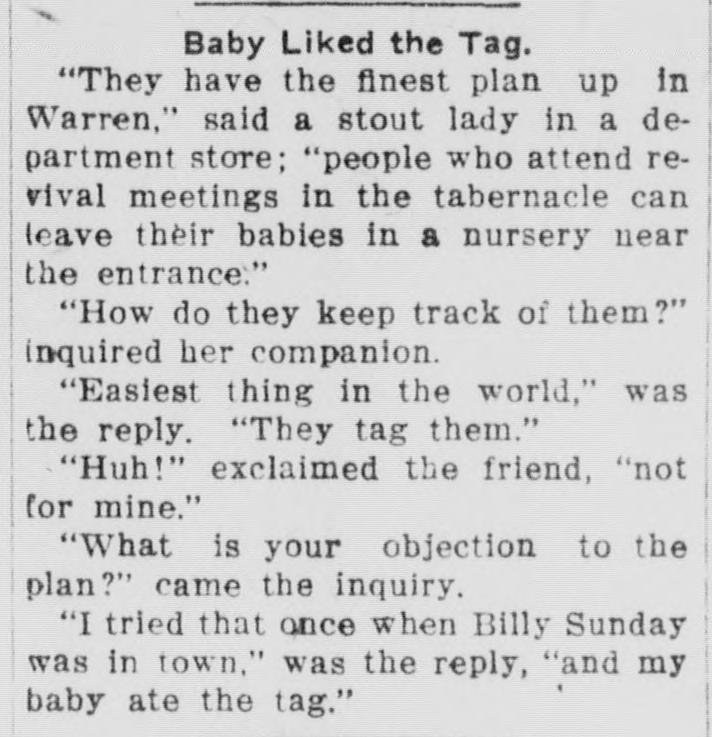
A joke from The Independent-Reporter, Skowhegan, Maine, March 14, 1912, page 9. Library of Congress, Chronicling America. Click the clipping to read it full size.
When the Last Baby Went Home in Tulsa
Billy Sunday’s Tulsa campaign ended on Sunday night, December 18, 1921. The World wrote that the next day “the great tabernacle at Fourth and Elgin will stand empty, silent, its closed doors turning blank and lonesome faces to the street.”
The $14,000 tabernacle “sold for $2,239.10 cash at public auction” on Wednesday afternoon, December 21. Even the “scoop shovel (used to distribute the sawdust over the tabernacle floor)” went up for sale. It brought $1.60. The building stayed up a little longer, for Tulsa’s automobile show.
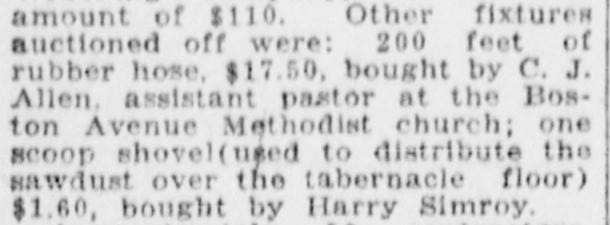
The Morning Tulsa Daily World, Tulsa, Oklahoma, December 22, 1921, page 18. Library of Congress, Chronicling America. Click the clipping to read it full size.
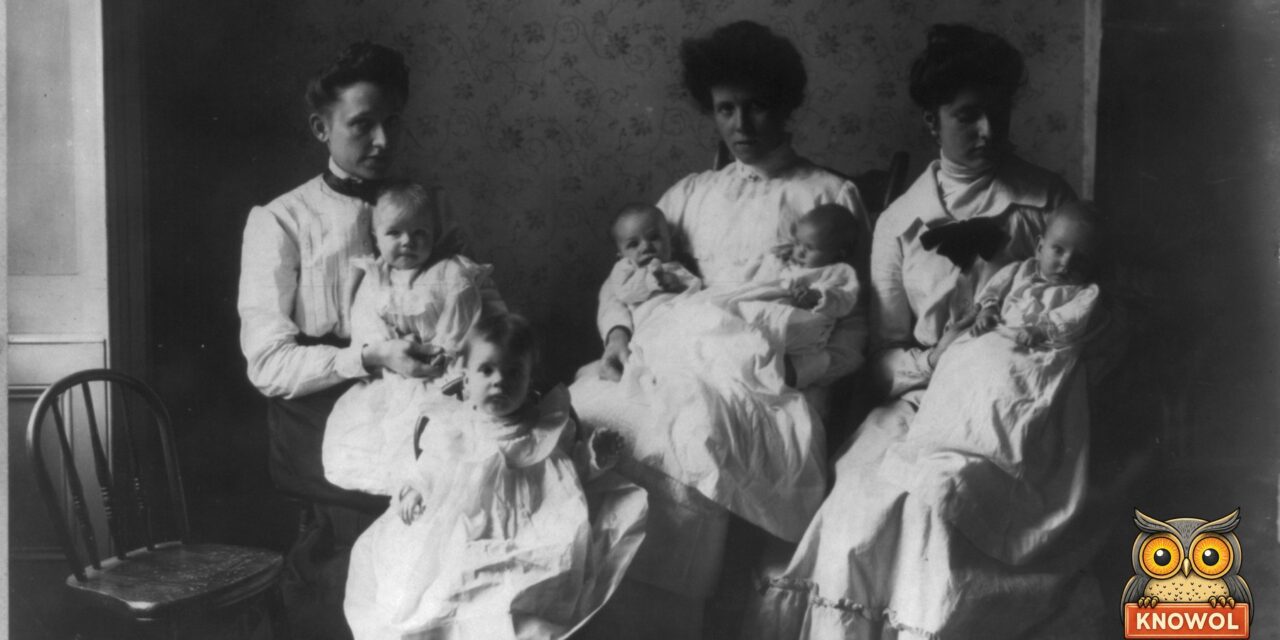
Every afternoon and every evening, the nursery in the church basement kept the same simple promise. Babies went in with a number pinned on their backs, and mothers came back with the matching tag. In the paper’s words, “The nursery is closed when the last baby is handed back to its fond parent.” The photo at the top of this page is not the Tulsa nursery. It shows three women holding five babies in a day nursery, possibly in New York City, about 1910, from the Bain News Service.
Sources
- “Nursery at the Revival Unique,” The Morning Tulsa Daily World (Tulsa, Oklahoma), November 14, 1921, page 5. Library of Congress, Chronicling America.
- “Start Work on Big Tabernacle,” The Morning Tulsa Daily World, October 2, 1921, page 3. Library of Congress, Chronicling America.
- “5,000 People in Revival Machine,” The Morning Tulsa Daily World, November 4, 1921, page 16. Library of Congress, Chronicling America.
- The Morning Tulsa Daily World, December 18, 1921, page 7 (the campaign’s last day). Library of Congress, Chronicling America.
- “Tabernacle Sold at Auction Sale,” The Morning Tulsa Daily World, December 22, 1921, page 18. Library of Congress, Chronicling America.
- “7 Boosters Hit Sawdust Trail,” The Morning Tulsa Daily World, June 17, 1920, page 13. Library of Congress, Chronicling America.
- “Billy Sunday, Evangelist, Former Baseball Star,” The Daily Ardmoreite (Ardmore, Oklahoma), January 18, 1920, page 11. Library of Congress, Chronicling America.
- “60 Babies at Tabernacle,” Evening Public Ledger (Philadelphia, Pennsylvania), January 22, 1915, page 2. Library of Congress, Chronicling America.
- “Baby Liked the Tag,” The Independent-Reporter (Skowhegan, Maine), March 14, 1912, page 9. Library of Congress, Chronicling America.
- 3 women holding 5 babies in day nursery, New York City (?), Bain News Service, about 1910 (the cover). Library of Congress Prints and Photographs Division. No known restrictions on publication.
- Billy Sunday, Bain News Service, 1917. Library of Congress Prints and Photographs Division. No known restrictions on publication.
- In Sunday’s Tabernacle, Bain News Service, New York City revival. Library of Congress Prints and Photographs Division. No known restrictions on publication.
- The newspapers and photographs above were all published or made before 1931 and are in the public domain.