One evening after supper, a young woman in Richmond, Virginia, sat down on a stool beside her father’s armchair. He had his slippers to the fire and “a good cigar between his lips.” She handed him a short note. It came from the man who read new books for Richmond’s biggest bookseller, and it said no to the novel she had worked on for years.
“I regret that the young author’s anxiety to regain possession of her bantling has prevented me from reading more than a few pages of the story,” the note said. A bantling is a baby. “Judging from what I have read, however, I should not advise you to publish it upon speculation.” In plain words: don’t risk your money on it.
“For a whole minute there was no sound in the room but the bubbling song of the soft coal,” she remembered. Her head sank onto her father’s knee. His cigar had gone out. Then “he had folded the scrap of paper into a spile, and was lighting it.” A spile was a folded strip of paper used like a long match. “He touched the dead cigar with the flame,” and when it was going again, he spoke.
“I believe in that book! I shall send it back to Morris, to-morrow, and tell him to bring it out in good style and send the bill to me.”
“But,” she gasped, “you may lose money by it!”
“I don’t think so. At any rate, we will make the experiment.”
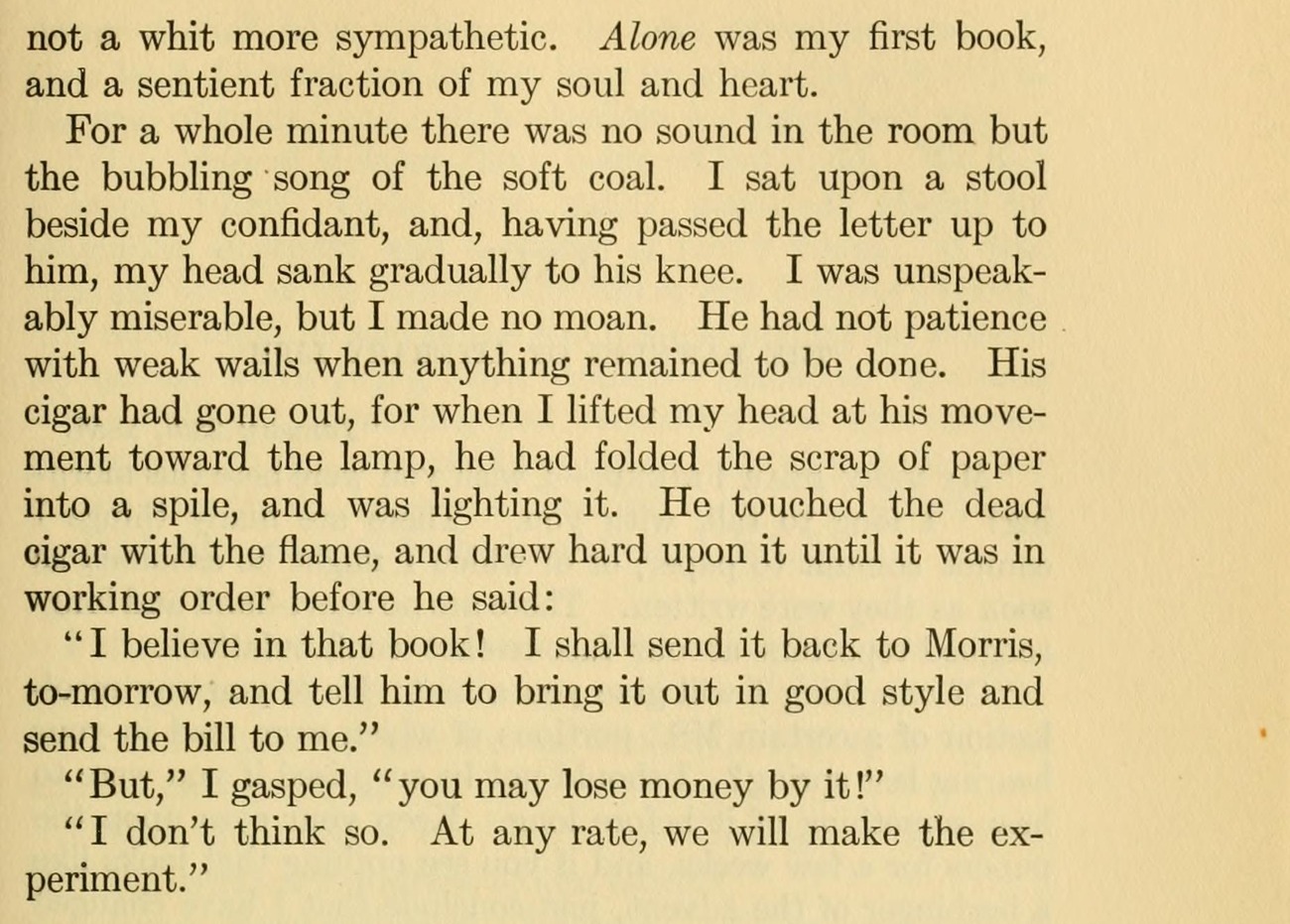
Marion Harland told the story of the cigar in Marion Harland’s Autobiography (Harper and Brothers, 1910), page 245. Library of Congress copy, Internet Archive. Public domain. Click the clipping to read it full size.
The young woman was Mary Virginia Hawes. The world would soon know her as Marion Harland. Her book was called Alone, and her father’s experiment did not lose money. Within a year, the book’s ads in a Richmond church paper sounded like this:
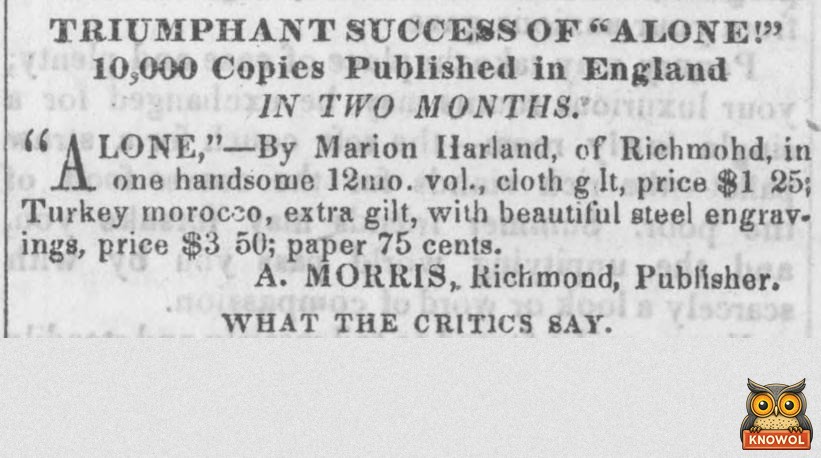
Watchman and Observer, Richmond, Virginia, May 24, 1855, page 4. Library of Congress, Chronicling America. Click the clipping to read it full size.
A Secret Book and Rainy Nights in Richmond
Mary Virginia Hawes started her book at home in Richmond as a teenager. “When I was sixteen I began to write a book,” she wrote in her autobiography in 1910. Every person in it was based on someone she knew, and she kept it to herself. “I spoke to nobody of what I was doing.” She had also been sending stories to papers under made-up names since she was 14. One of them won a $50 prize, signed “Marion Harland,” which she called “a hint of my name.”
In the late spring of 1853, she sat in the parlor with her sister, Mea, and her brother Herbert “on a wild night when it rained as rain falls nowhere else as in the seven-hilled city.” Richmond is built on hills. Herbert was reading the Southern Literary Messenger, a magazine printed right there in Richmond. “I had dragged out the rough copy of my book from the bottom of my desk that day,” she wrote.
She came to a scene about a girl named Celestia Pratt starting school and laughed out loud. She read it to her sister, who knew exactly who the real girl was. “To the life!” her sister said. “Go on!” Then Herbert tossed his magazine aside. “This is stupid after what you gave us. Haven’t you ‘anything more of the same sort?'”
“They kept me reading until nearly midnight,” she wrote. The next day she started rewriting the book, “and we welcomed stormy evenings for the next two months.” At the end she wrote a thank-you page to the two of them and kept it secret. “They did not suspect it until they read it in print.”
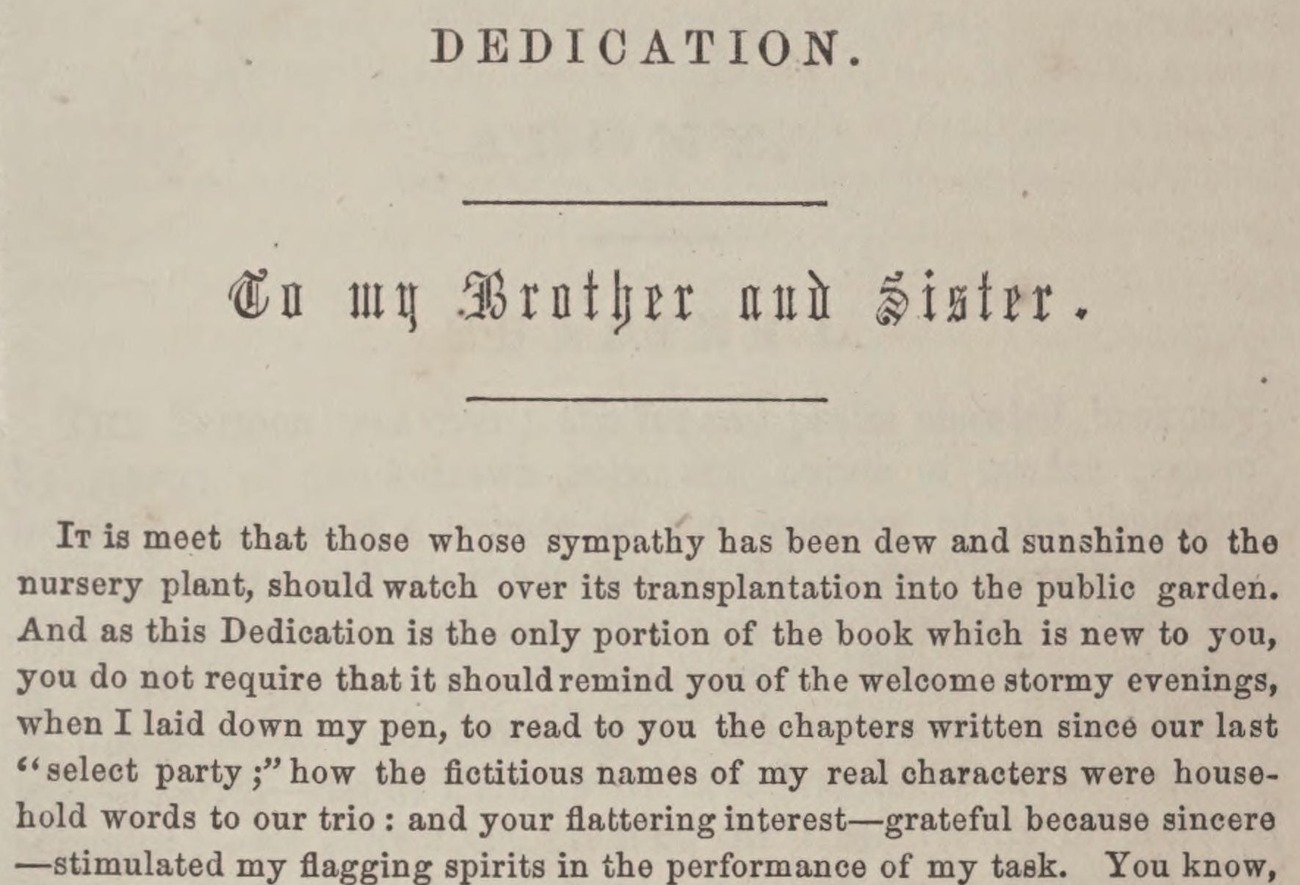
The dedication of Alone, by Marion Harland (Richmond: A. Morris, 1854), remembering “the welcome stormy evenings.” Library of Congress copy, Internet Archive. Public domain. Click the clipping to read it full size.
Two Months Waiting on a Richmond Bookseller
The biggest bookstore in Richmond belonged to Adolphus Morris, “a warm personal friend of my father.” Mary Virginia went to see him by herself. She could tell he was being kind to a friend’s daughter, without “the smallest grain of faith” in her book. “I am willing to submit your manuscript to my reader,” he said at last.
The reader ran the Southern Literary Messenger, the same magazine Herbert had tossed aside. “The reader kept the manuscript two months,” she wrote. Her father finally wrote and asked for it back, and it came home with the note that lit his cigar.
This time the book went ahead. In February 1854 the Richmond Enquirer called it “the first literary adventure of the writer.” It was printed in Philadelphia, because “Not a printer in this city could finish it before the 1st of May,” she told a friend.
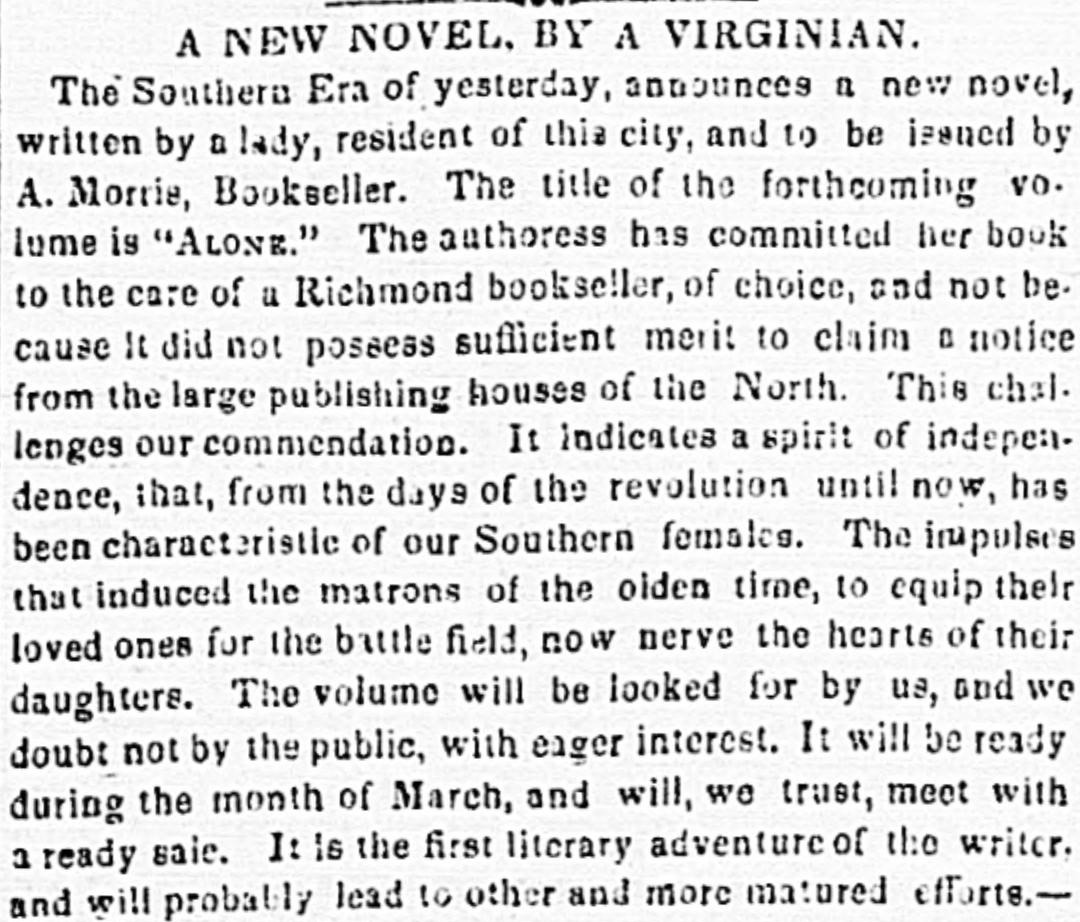
Richmond Enquirer, Richmond, Virginia, February 28, 1854, page 4. Library of Congress, Chronicling America. Click the clipping to read it full size.
The Morning Alone Came Out in Richmond
Mary Virginia Hawes was stepping out for a walk in Richmond “one balmy May morning” in 1854 when the family doctor, Doctor Haxall, “reined in his horses at the gate” and took her for a drive. He stopped at Morris’s bookstore, marched up to Mr. Morris, and said, “Good-morning! I have come for a copy of this young lady’s book!”
“If I had ever fainted, I should have swooned on the spot,” she wrote. There on the front counter, “in heaps and heaps,” lay her book “in bindings of dark-blue, and purple, and crimson, and leaf-brown,” with “Alone” stamped in gold. “Opened this morning!” Mr. Morris said. Outside, a porter was tacking up signs: “JUST OUT!! ALONE! By Marion Harland.”
On the ride home, with a purple copy on the seat between them, the doctor said, “Well, my dear child, I congratulate you, and I hope a second edition will be called for within six months!”
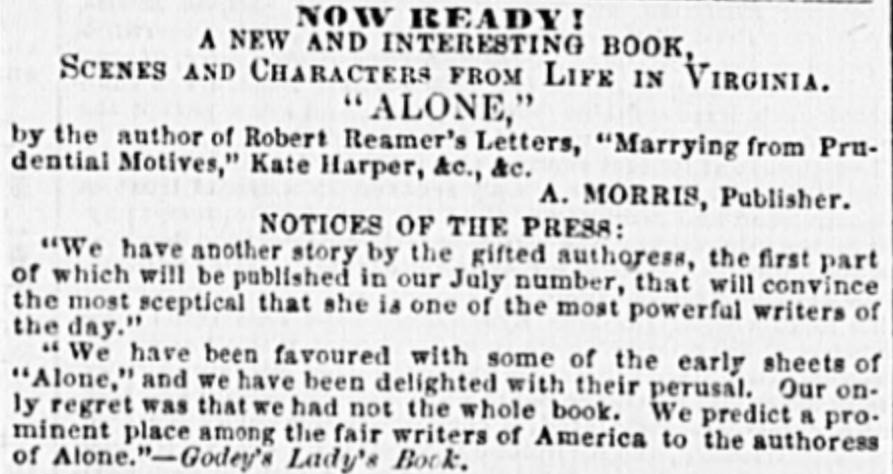
Richmond Daily Whig, Richmond, Virginia, May 22, 1854, page 3. Library of Congress, Chronicling America. Click the clipping to read it full size.
That afternoon her father shut himself in a room with the book. “It was two o’clock in the morning before he reached the last page,” she wrote. After prayers the next morning, he hugged her and kissed her. “I was right about that book, daughter!”
What Alone Cost and How It Sold in Richmond
Morris sold Alone in Richmond in three styles. A paper-covered copy cost 75 cents. A cloth copy trimmed in gold cost $1.25. The fanciest, in “Turkey morocco,” a soft goatskin leather, with fine pictures called “steel engravings,” cost $3.50. A whole year of the Watchman and Observer, the church paper that ran the ad, cost “$2 50 per annum.” So one cloth copy cost as much as half a year of the paper.
The doctor did not have to wait six months. By June, Morris’s ad said “SECOND THOUSAND IN THREE WEEKS.” By December it said “SEVEN THOUSAND ALREADY CALLED FOR.”
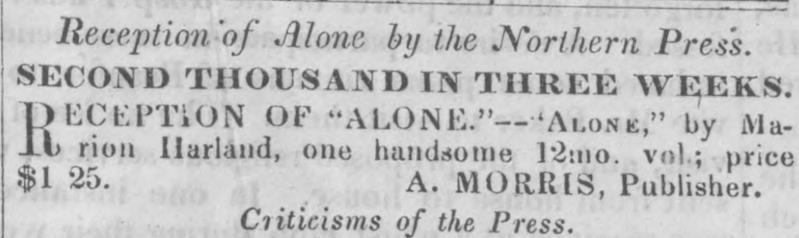
Watchman and Observer, Richmond, Virginia, June 8, 1854, page 3. Library of Congress, Chronicling America. Click the clipping to read it full size.
The Library of Congress copy of Alone says “FIFTH EDITION” on its title page, still dated 1854. Someone later wrote her real name in by hand.
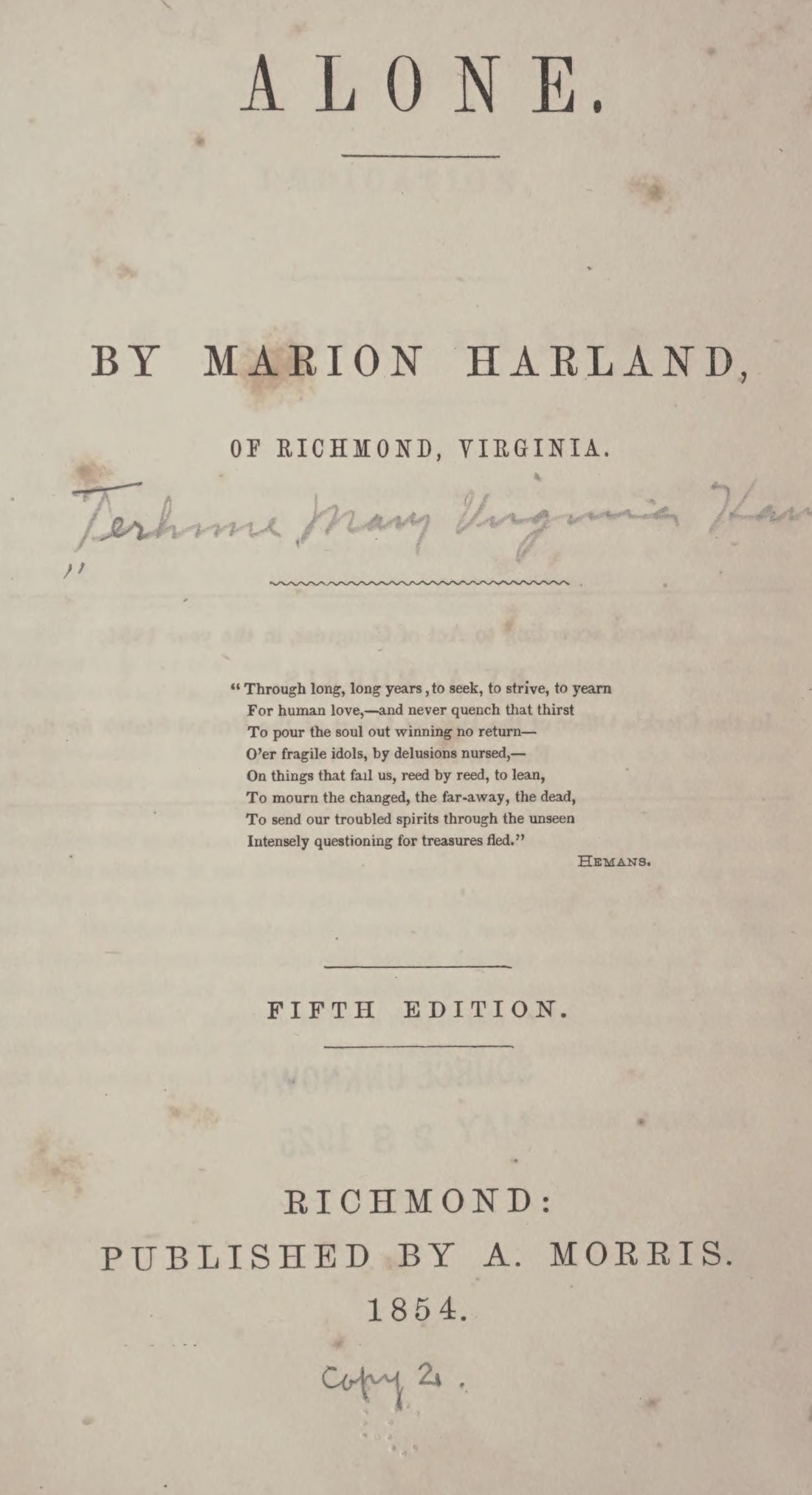
Title page of Alone, by Marion Harland (Richmond: A. Morris, 1854), fifth edition, with her real name written in by hand. Library of Congress copy, Internet Archive. Public domain. Click the clipping to read it full size.
Even the magazine run by the reader who said no, the Southern Literary Messenger, praised the book. “We think she has accomplished more than she intended,” it said.
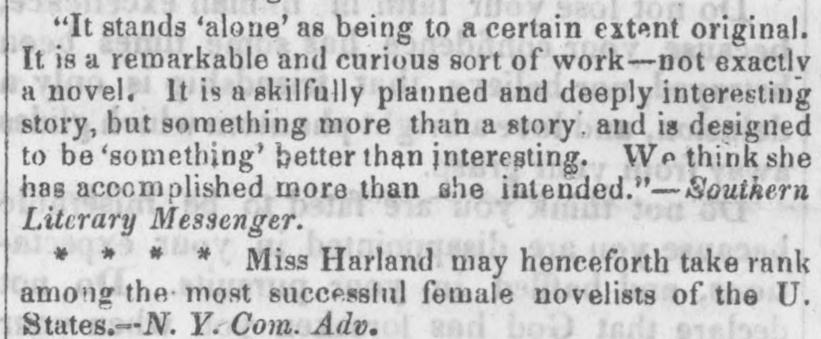
The Southern Literary Messenger’s praise, quoted in the Alone ad in the Watchman and Observer, Richmond, Virginia, May 24, 1855, page 4. Library of Congress, Chronicling America. Click the clipping to read it full size.
The Minister Who Said Marion Harland Walked Well
Many readers did not know that Marion Harland was Mary Virginia Hawes of Richmond. In 1856 the Evening Star in Washington told them. A nom de plume is a pen name.
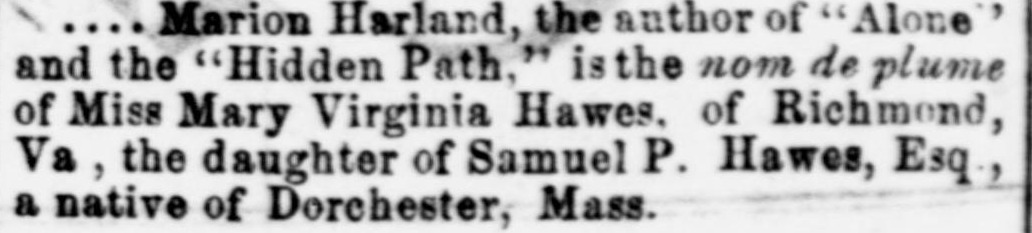
Evening Star, Washington, D.C., February 22, 1856, page 2. Library of Congress, Chronicling America. Click the clipping to read it full size.
Not long after Alone came out, Mary Virginia met a young minister, Edward Payson Terhune. She had made up her mind never to marry a minister. “Upon that I was determined,” she wrote. One evening he and two friends walked her home. At the corner, thinking he was out of earshot, he said, “Your friend, Miss Hawes, walks well.”
“Every word floated back to us,” she wrote. She laughed and said, “If that man ever asks me to marry him, I shall have to do it! I vowed solemnly, long ago, to marry the first man who thinks me handsome, if he should give me the chance. Let us hope this one won’t!” Her father added, “His cloth rules him out.” The cloth meant the church.
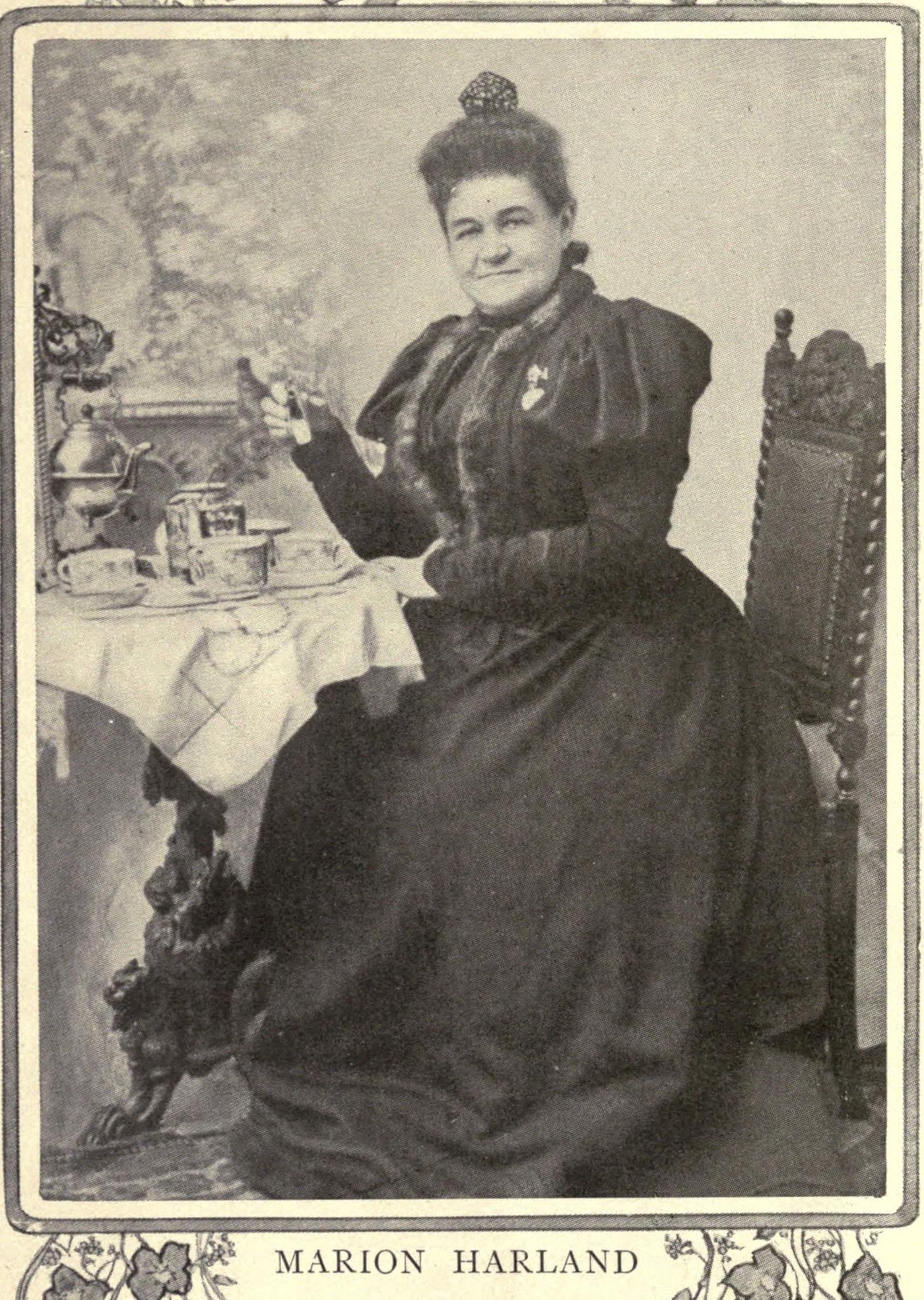
Marion Harland at a tea table, from the front of Marion Harland’s Complete Cook Book (Bobbs-Merrill, 1903). Internet Archive. Public domain. Click the picture to see it full size.
Two years later, the newspapers had the rest of the story.
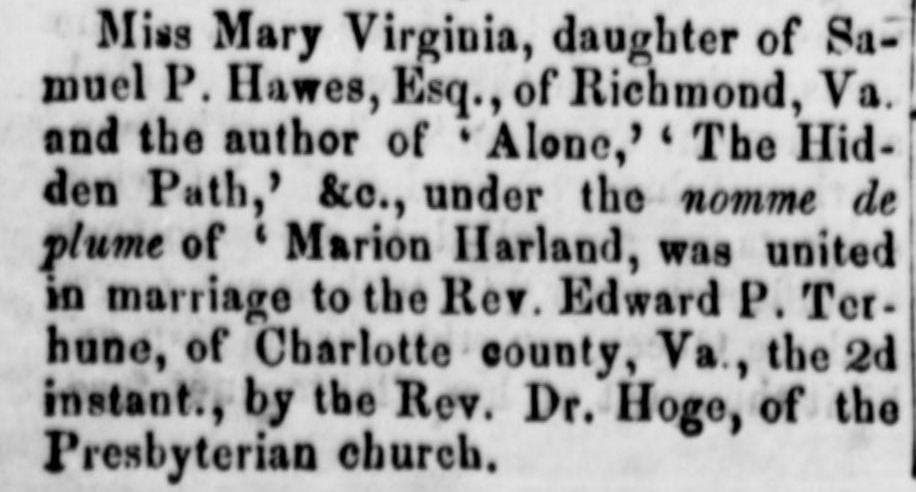
The Westerly Echo, Westerly, Rhode Island, September 18, 1856, page 2. Library of Congress, Chronicling America. Click the clipping to read it full size.
Marion Harland’s Last Chapter
Marion Harland never stopped writing after her start in Richmond. She wrote “more than sixty books,” the Evening Public Ledger of Philadelphia said, but “she was best known as the author of cook books.” She died in June 1922, at 91.
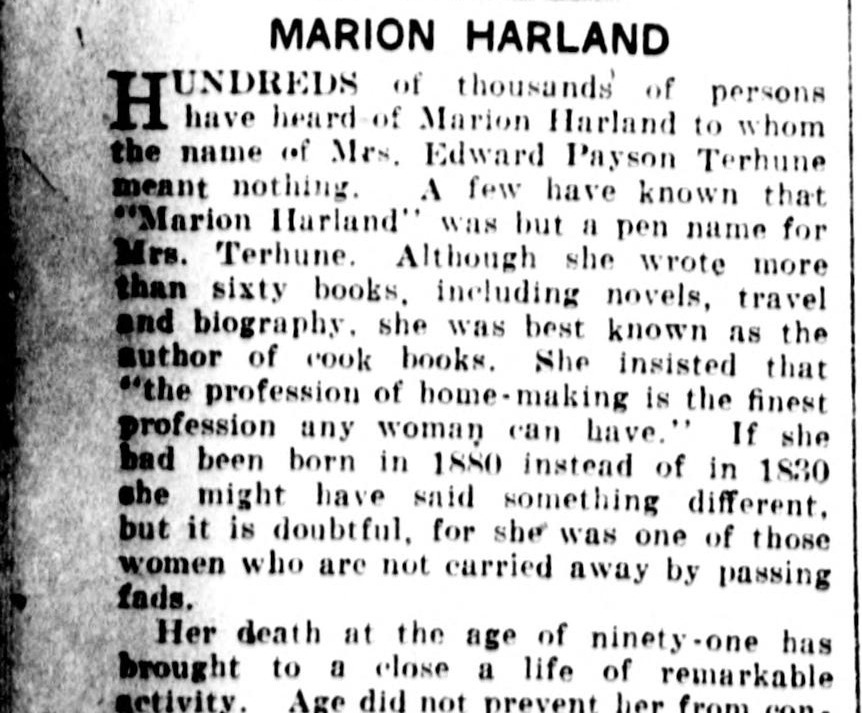
Evening Public Ledger, Philadelphia, Pennsylvania, June 5, 1922, page 10. Library of Congress, Chronicling America. Click the clipping to read it full size.
The New York Herald said her name was known everywhere, “as if she had been a President of the United States.”
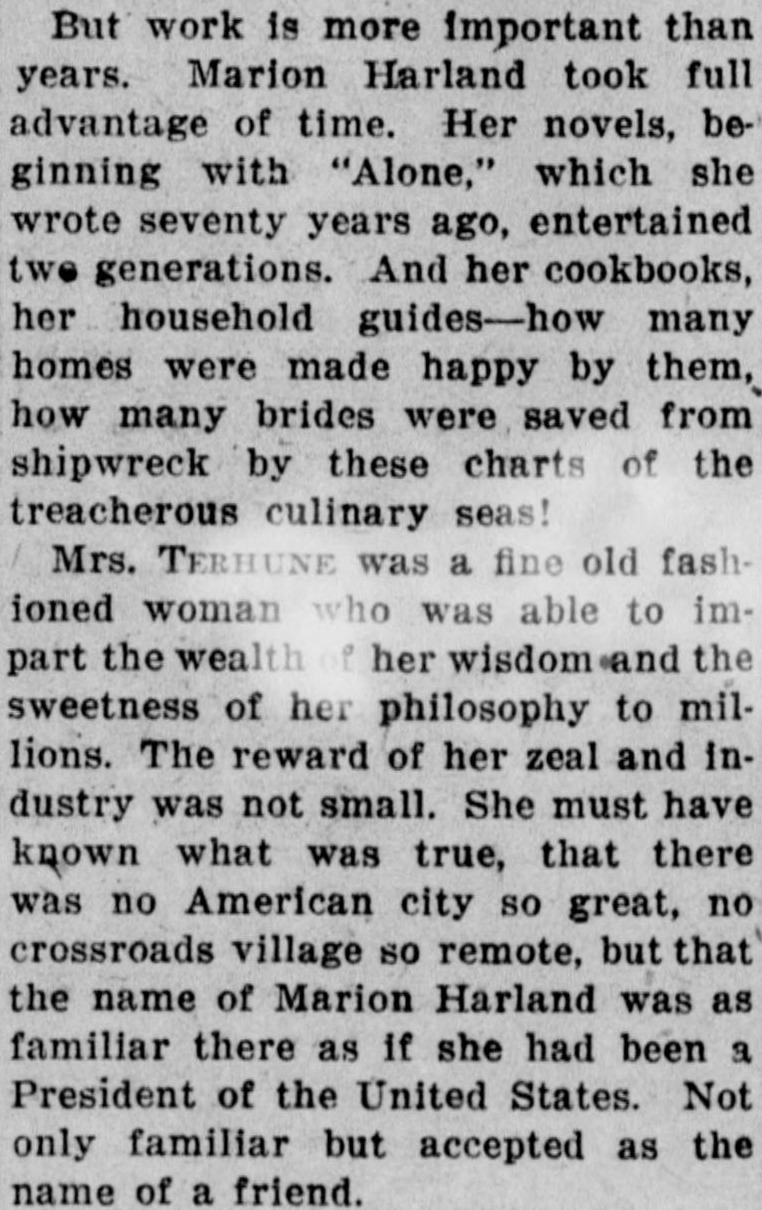
New York Herald, New York, New York, June 5, 1922, page 8. Library of Congress, Chronicling America. Click the clipping to read it full size.
Her father read every one of her books the way he read the first. They “numbered a score before he died,” which means about 20. She never found “another reader like him,” she wrote. When she told her life story in 1910, she gave the book to him.
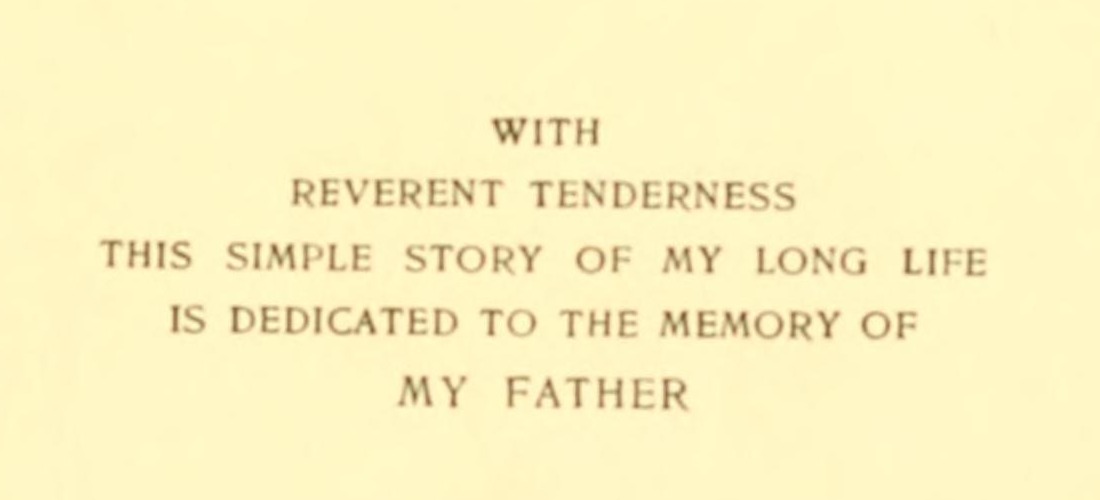
The dedication of Marion Harland’s Autobiography (Harper and Brothers, 1910). Library of Congress copy, Internet Archive. Public domain. Click the clipping to read it full size.
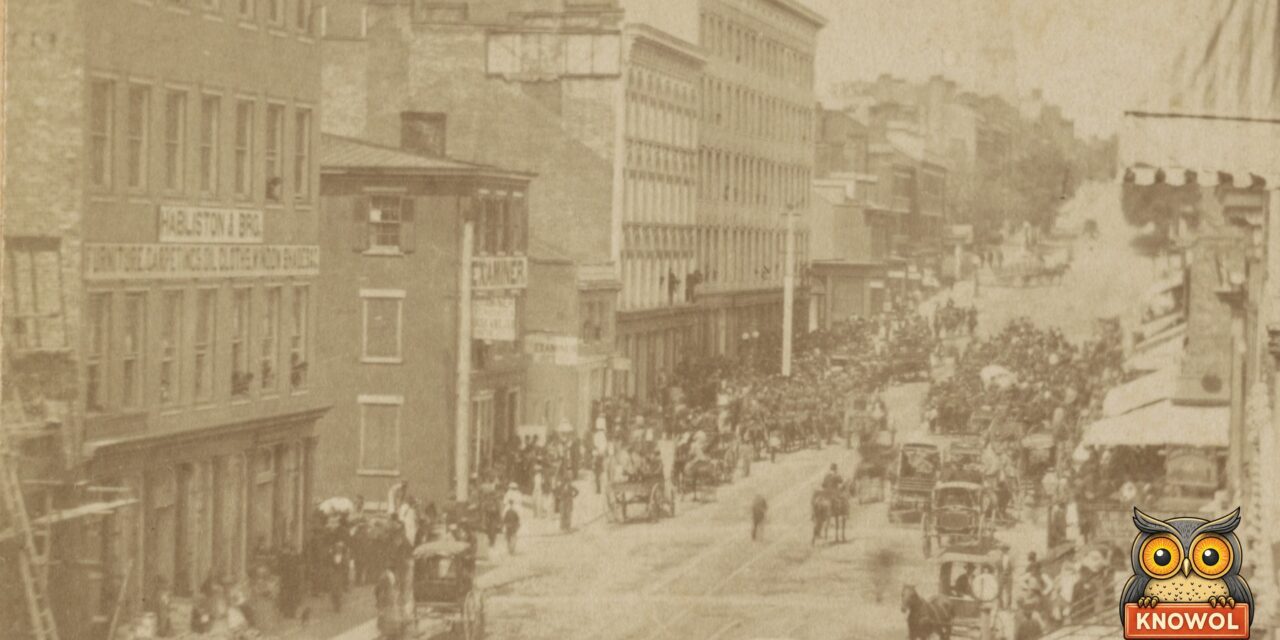
It all started with a note that said no, and a father who used it to light his cigar. The photo at the top of this page shows Main Street in Richmond, the street where Adolphus Morris had his bookstore. It is a stereograph by D. H. Anderson of Richmond, probably taken in the early 1860s, a few years after Alone came out, and it may not show Morris’s block.
Sources
- “Triumphant Success of ‘Alone!'” advertisement, Watchman and Observer (Richmond, Virginia), May 24, 1855, page 4. Library of Congress, Chronicling America.
- Watchman and Observer, May 24, 1855, page 1 (the paper’s price). Library of Congress, Chronicling America.
- “A New Novel, by a Virginian,” Richmond Enquirer (Richmond, Virginia), February 28, 1854, page 4. Library of Congress, Chronicling America.
- “Now Ready!” advertisement, Richmond Daily Whig (Richmond, Virginia), May 22, 1854, page 3. Library of Congress, Chronicling America.
- “Second Thousand in Three Weeks,” Watchman and Observer, June 8, 1854, page 3. Library of Congress, Chronicling America.
- “Seven Thousand Already Called For,” Watchman and Observer, December 7, 1854, page 3. Library of Congress, Chronicling America.
- Evening Star (Washington, D.C.), February 22, 1856, page 2. Library of Congress, Chronicling America.
- The Westerly Echo (Westerly, Rhode Island), September 18, 1856, page 2. Library of Congress, Chronicling America.
- Evening Public Ledger (Philadelphia, Pennsylvania), June 5, 1922, page 10. Library of Congress, Chronicling America.
- “Marion Harland,” New York Herald (New York, New York), June 5, 1922, page 8. Library of Congress, Chronicling America.
- Marion Harland’s Autobiography: The Story of a Long Life (Harper and Brothers, 1910), Library of Congress copy. Internet Archive.
- Alone, by Marion Harland (Richmond: A. Morris, 1854), fifth edition, Library of Congress copy. Internet Archive.
- Marion Harland’s Complete Cook Book (Bobbs-Merrill, 1903), portrait of the author. Internet Archive.
- View of Main Street, Richmond, Virginia, stereograph by D. H. Anderson, between 1861 and 1865? (the cover). Library of Congress Prints and Photographs Division, Robin G. Stanford Collection. No known restrictions on publication.
- The newspapers, books and photograph above were all published or made before 1931 and are in the public domain.