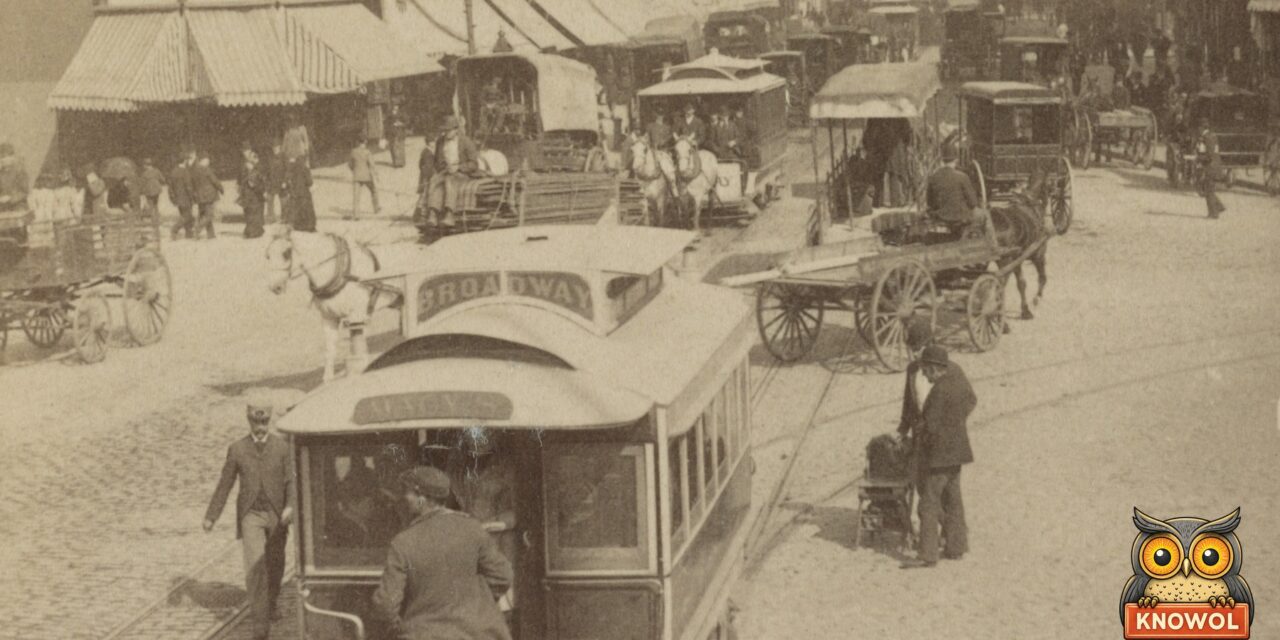
Picture Broadway in 1877. Horses pull coaches and wagons over the stones. People hurry past tall stone stores. And at the corner of 19th Street, behind a tall iron fence, a cow is eating grass.
The cow belonged to Peter Goelet, one of the richest men in New York City. On Sunday, January 21, 1877, the New York Herald ran a long story about the city’s oddest houses and the people inside them. His house came first.
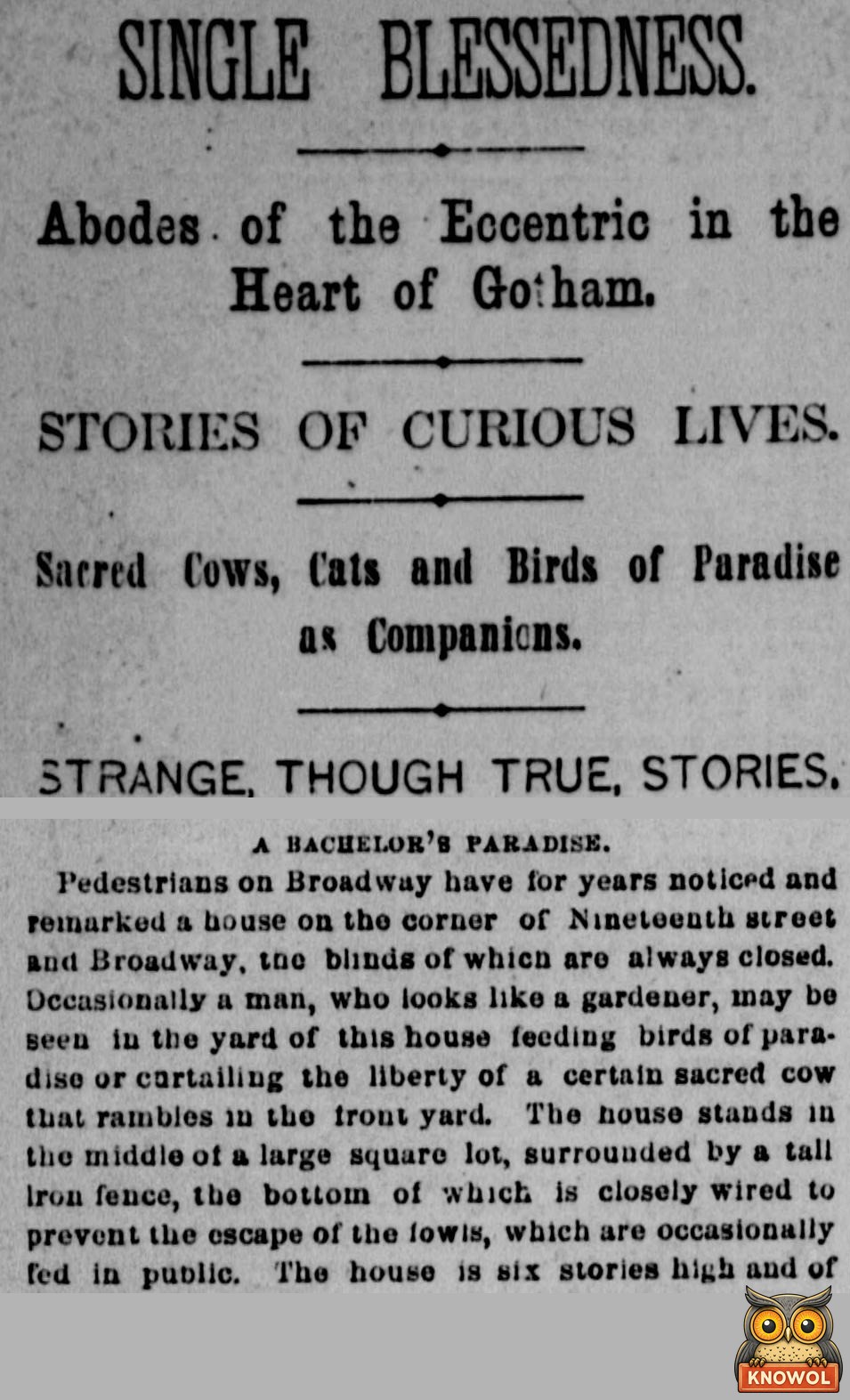
“Single Blessedness. Abodes of the Eccentric in the Heart of Gotham.” The New York Herald, New York, New York, January 21, 1877, page 14 (the headline and the part about the house on Broadway, joined). Library of Congress, Chronicling America. Click the clipping to read it full size.
The house with the closed blinds
“Pedestrians on Broadway have for years noticed and remarked a house on the corner of Nineteenth street and Broadway,” the Herald wrote. The blinds on its windows were always shut. Now and then a man “who looks like a gardener” came out to feed the birds, “or curtailing the liberty of a certain sacred cow that rambles in the front yard.” In plain words, he kept the cow from wandering off. “Sacred cow” was the paper’s joke. This was one cow nobody bothered.
The yard had “a tall iron fence, the bottom of which is closely wired to prevent the escape of the fowls.” Fowls are birds people raise, like chickens. Without that wire, they would have strolled right out onto Broadway.
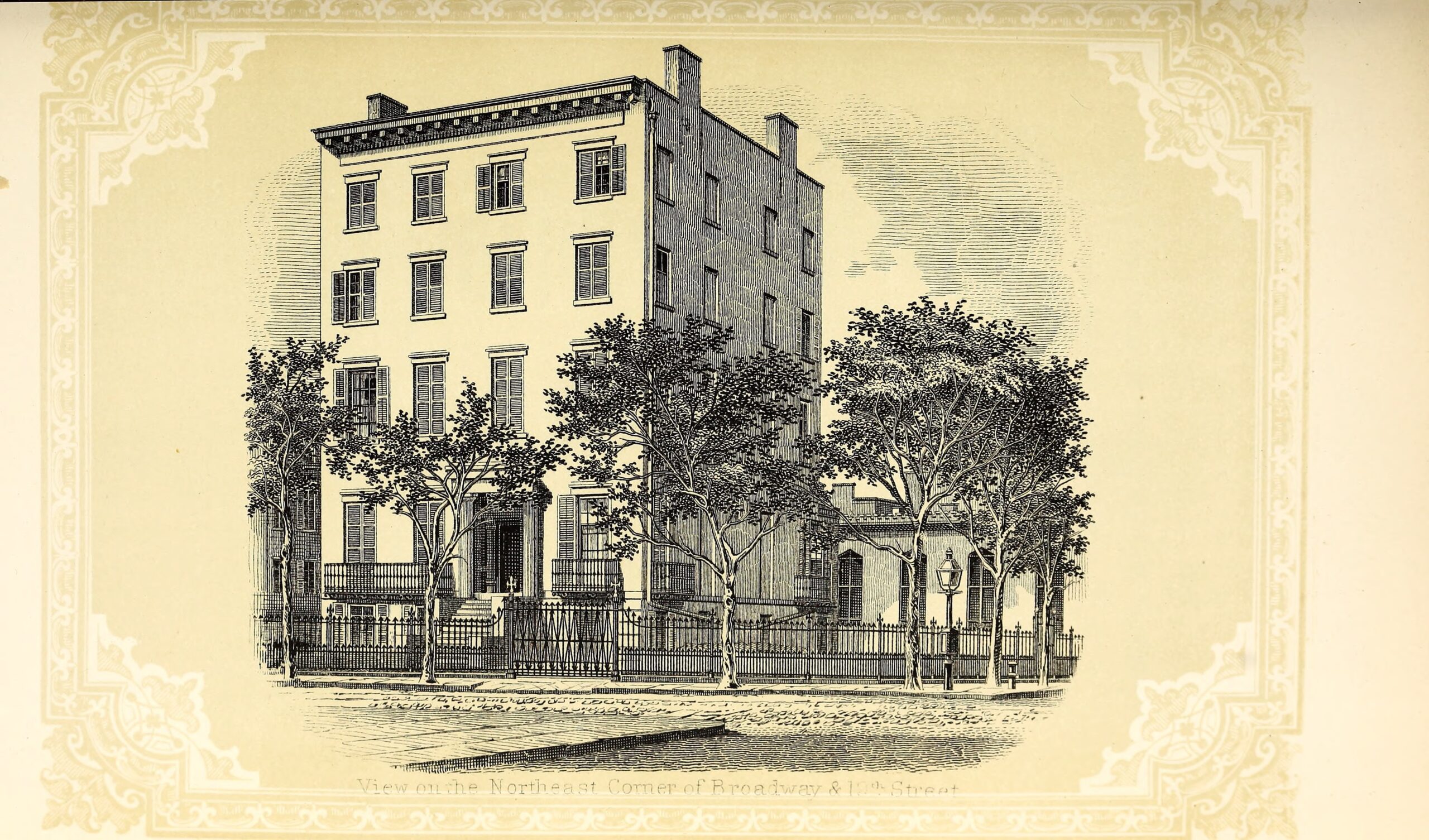
Peter Goelet’s house on the northeast corner of Broadway and 19th Street, with its trees and iron fence, as drawn for Valentine’s Manual of the City of New York in 1870. Wikimedia Commons, public domain. Click the picture to see it full size.
A farm in the busiest part of town
The Herald mentioned birds of paradise. Other papers gave a longer list. The Sun counted “the peacock, the stork, the pheasant, and the common domestic fowl.” A New York letter writer added “a cow, a dozen guinea hens, a stork or two, and a fine lot of chickens.”
The star of the yard was the stork. “He passes most of his time standing on one leg, near the iron gate, apparently engaged in counting the passers by,” the Sun said in 1876. “Why he does this nobody has yet been able to discover.” The birds were “a never-failing subject of study and amusement to the small boys of the neighborhood.” In other words, the neighborhood boys loved to stand at the fence and watch.
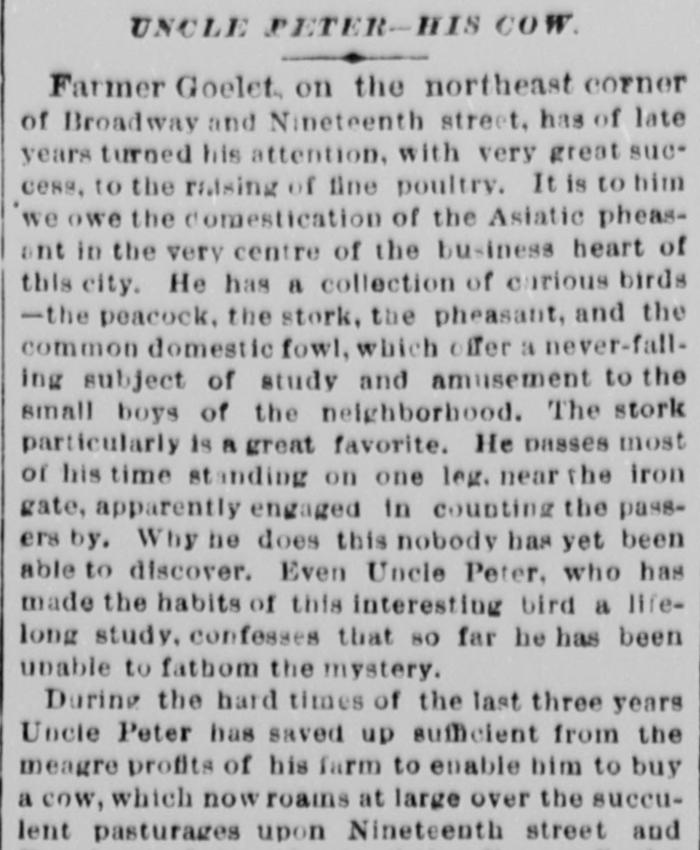
The Sun’s “Uncle Peter” story about the stork and the cow. The Sun, New York, New York, November 24, 1876, page 2. Library of Congress, Chronicling America. Click the clipping to read it full size.
Who was Uncle Peter?
Peter Goelet never married. People called him “Uncle Peter.” His great-grandfather and grandfather had made the family’s money “in the hardware trade,” selling tools and iron goods. Then the family bought land all over the city. One letter writer guessed his fortune at “from twenty to thirty millions” of dollars.
Still, he hated to waste anything. The Chicago Tribune said a friend once found him at his bank “with his coat off.” Next to him sat “a small tin work-box” full of thread, needles and buttons. “The old man was repairing his coat.” He tore the blank backs off old letters and envelopes and saved them as scrap paper. “His rent receipts were always drawn on these scraps.” In his basement he kept “a forge and tools of all kinds” and made things for the house himself.
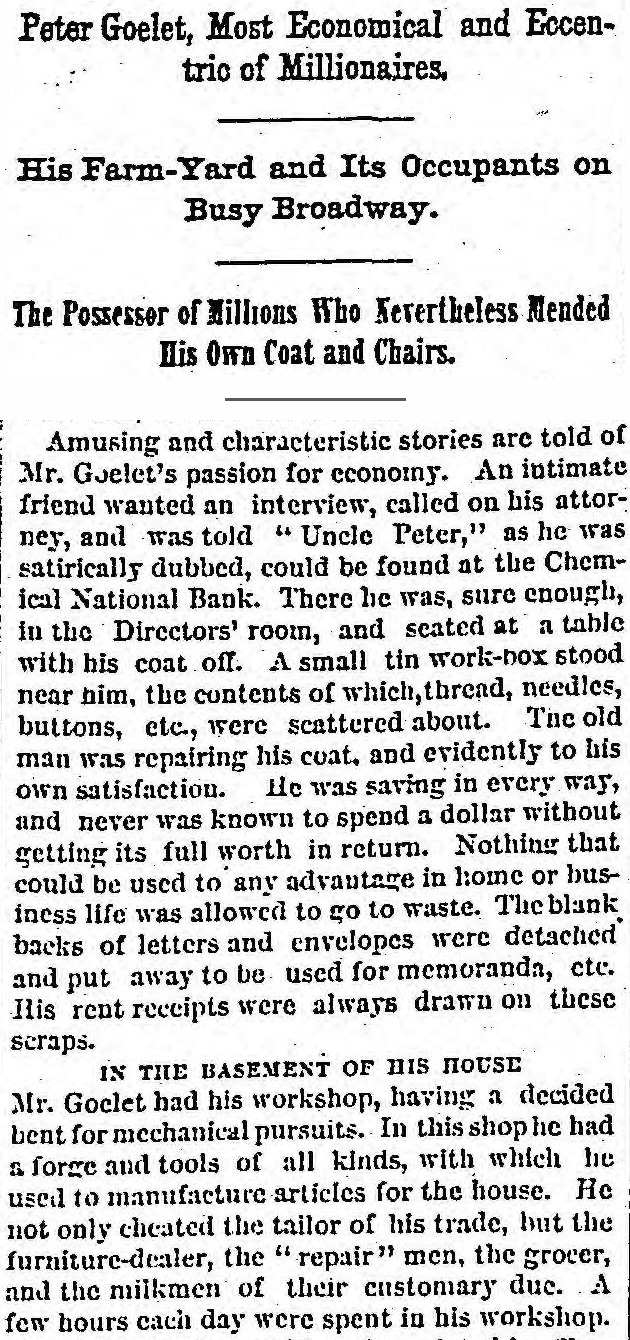
“The Possessor of Millions Who Nevertheless Mended His Own Coat and Chairs.” Chicago Daily Tribune, Chicago, Illinois, April 1, 1877, page 16 (two parts of the story, joined). Library of Congress, Chronicling America. Click the clipping to read it full size.
What his milk really cost
Here is the strange part. Goelet’s corner was some of the most valuable land in the city. He could have rented it out for stores and collected big rent every year. Instead, he kept it as a pasture.
The letter writer, whose New York letter ran in the Cheyenne Daily Leader in Wyoming, did the math. “Counting interest, it costs him twenty thousand dollars per year to keep that cow, which makes the milk come, I should suppose, at about a dollar a drop.” That was a joke, but the point was real. The land could have earned that money, and the cow was eating it.
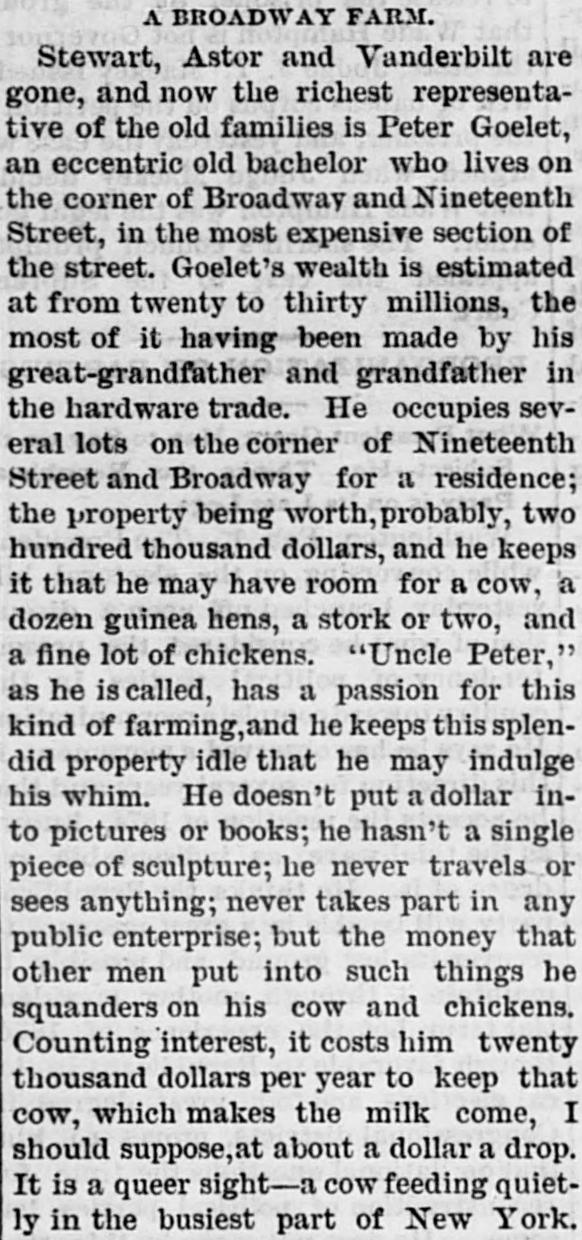
“A Broadway Farm,” from a New York letter. The Cheyenne Daily Leader, Cheyenne, Wyoming, February 2, 1877, page 1. Library of Congress, Chronicling America. Click the clipping to read it full size.
Then the Freemasons, a big club of men with its own meeting halls, came calling. “Before the Freemasons built their beautiful hall on Twenty-third street they offered the old gentleman who lives in this house $450,000 for the property, but he refused to sell at any price,” the Herald wrote. The paper figured the corner would stay his home “as long as he lives.”
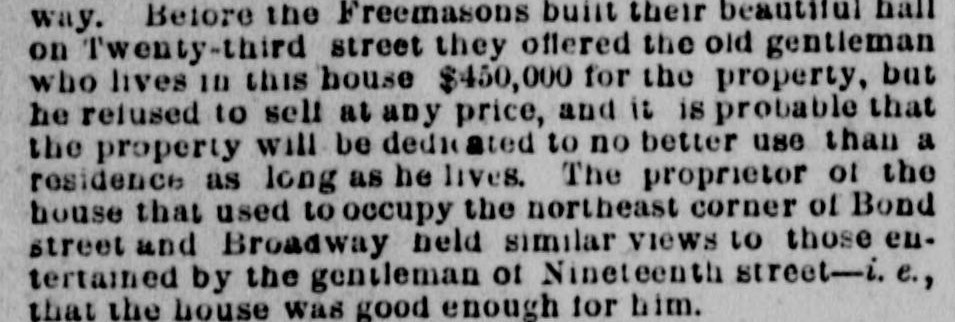
The $450,000 offer. The New York Herald, New York, New York, January 21, 1877, page 14. Library of Congress, Chronicling America. Click the clipping to read it full size.
By the numbers
- 1 cow, in the front yard on Broadway
- 1 stork (or two), standing on one leg by the gate
- A dozen guinea hens, plus peacocks, pheasants and chickens
- $20,000 a year, one writer’s guess at what the cow’s pasture cost him
- $450,000 offered by the Freemasons, and turned down
The cow stayed
In March 1877, Goelet fell very sick. Papers as far away as Chicago printed the story of his odd life. He got better. He kept his yard full of animals for the rest of his life, and he died in November 1879, at about 80. His sister, Mrs. Gerry, was the last person to live in the old house.
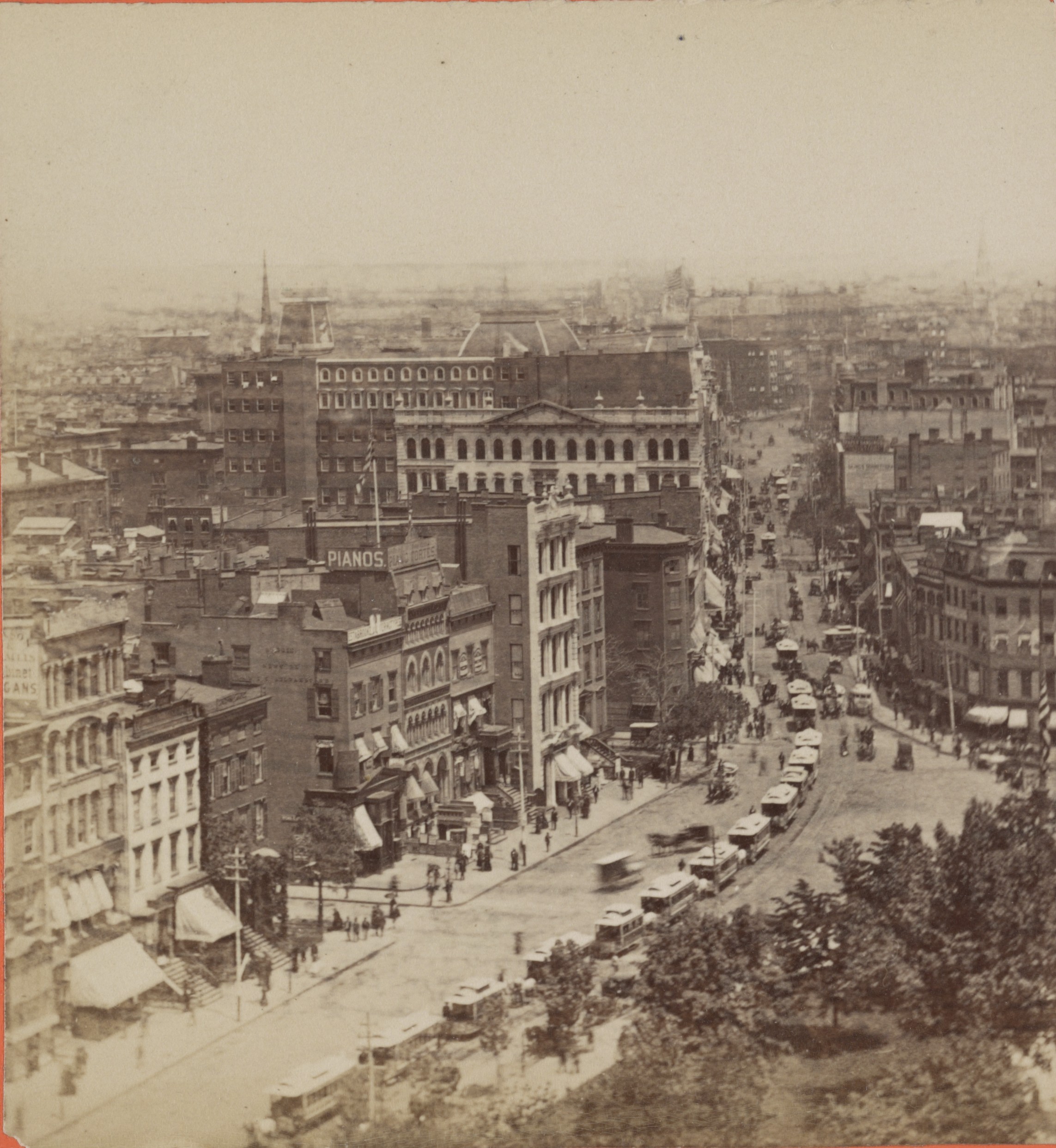
Union Square and Broadway, looking north, in a stereograph photo made between 1868 and 1878 by P. F. Weil. Peter Goelet’s corner at 19th Street was a few blocks up Broadway. Library of Congress. Click the picture to see it full size.
In April 1897, plans were filed for a store building on the corner. The New York Journal looked back. There had been “peacocks, guinea pigs, Chinese pheasants and other strange beasts and birds, as well as a meek-eyed Jersey cow, quartered in the dooryard.” Then came the best line: “Children and grown folk, too, used to gather outside the fence to watch the show, and jocular New Yorkers told their country cousins that the place was an adjunct to Central Park.” Jocular means joking. An adjunct is an add-on. New Yorkers teased visitors that the corner was a little piece of the big park. (Central Park had real animals, and they once had a wild day in the papers of their own.)
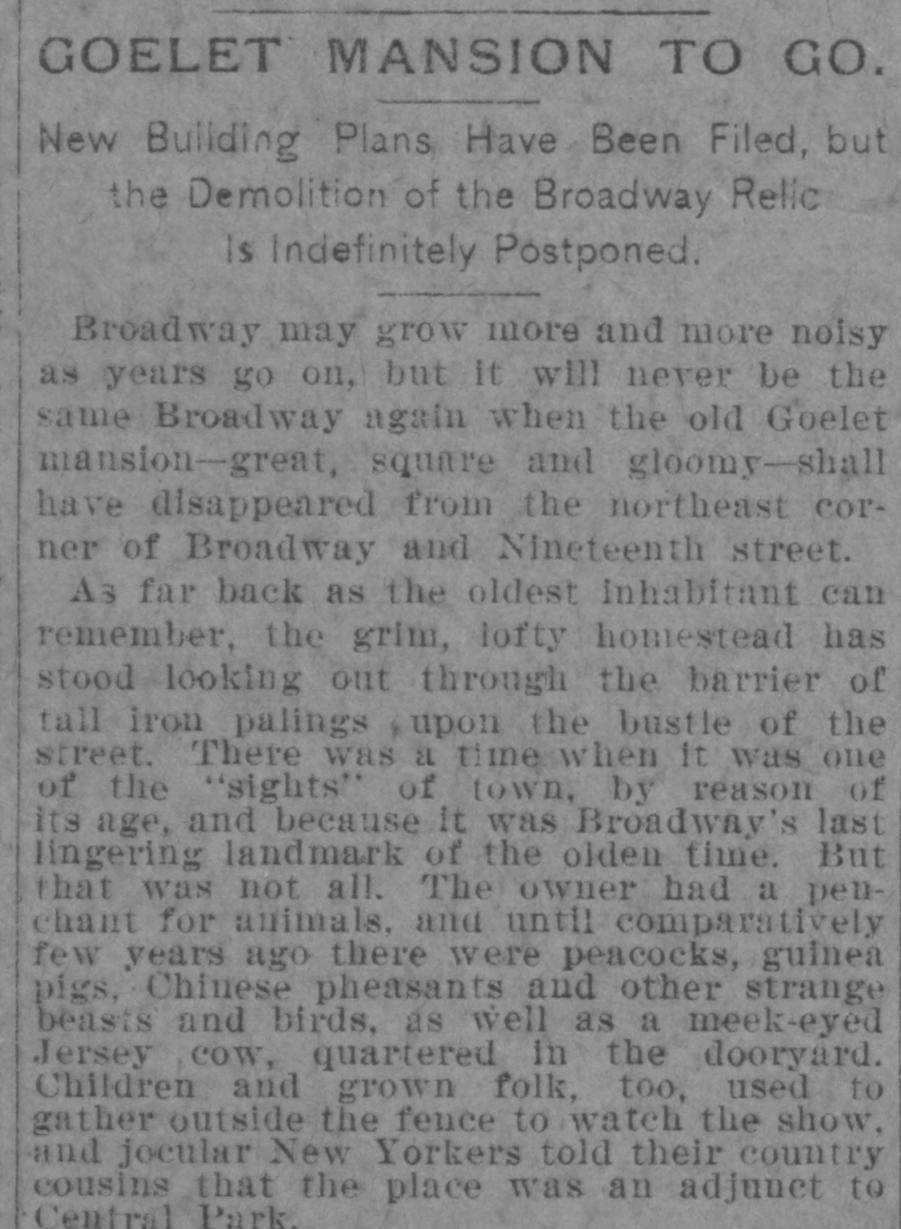
“Goelet Mansion to Go.” New York Journal and Advertiser, New York, New York, April 2, 1897, page 8. Library of Congress, Chronicling America. Click the clipping to read it full size.
The photo at the top of this story shows Broadway between Union Square and Madison Square in 1892. That is the same stretch of street where Uncle Peter had his yard. It is packed with horsecars, wagons and people in a hurry. For years, right in the middle of all that, a cow chewed her grass, and a stork stood on one leg by the gate, counting the people going by.
Sources
- The New York Herald (New York, New York): January 21, 1877, page 14 (“Single Blessedness,” the section “A Bachelor’s Paradise” and the Freemasons’ offer).
- The Sun (New York, New York): November 24, 1876, page 2 (the stork, the birds and the cow).
- The Cheyenne Daily Leader (Cheyenne, Wyoming): February 2, 1877, page 1 (“Our New York Letter: A Broadway Farm”).
- Chicago Daily Tribune (Chicago, Illinois): April 1, 1877, page 16 (the mended coat, the scrap paper and the basement forge).
- New-York Tribune (New York, New York): March 26, 1877, page 5 (his illness, and the pheasants, storks, peacocks and cow).
- His death in November 1879, at about 80: Springfield Weekly Republican, November 28, 1879, page 1; Orleans County Monitor (Barton, Vermont), December 1, 1879, page 2.
- New York Journal and Advertiser (New York, New York): April 2, 1897, page 8 (“Goelet Mansion to Go”).
- Cover photo: Strohmeyer & Wyman, “Broadway from Union Square to Madison Square, New York”, stereograph, 1892. Library of Congress Prints and Photographs. No known restrictions on publication.
- Union Square photo: P. F. Weil, “Looking North showing Union Square and Broadway”, stereograph, between 1868 and 1878. Marian S. Carson Collection, Library of Congress. No known restrictions on publication.
- The house drawing: “View on the Northeast Corner of Broadway & 19th Street,” Manual of the Corporation of the City of New York (Valentine’s Manual), 1870, Wikimedia Commons. Public domain.
- All newspaper images: Library of Congress, Chronicling America. Published 1876 to 1897.