In May 1920, a man in East St. Louis, Illinois, put a little ad in the paper. It sat in the want ads of the East St. Louis Daily Journal, between apartments for rent and a man looking for a cottage. It was only a few lines long. One of those lines kept him busy all summer: “I will trade for anything that don’t eat or bite.”
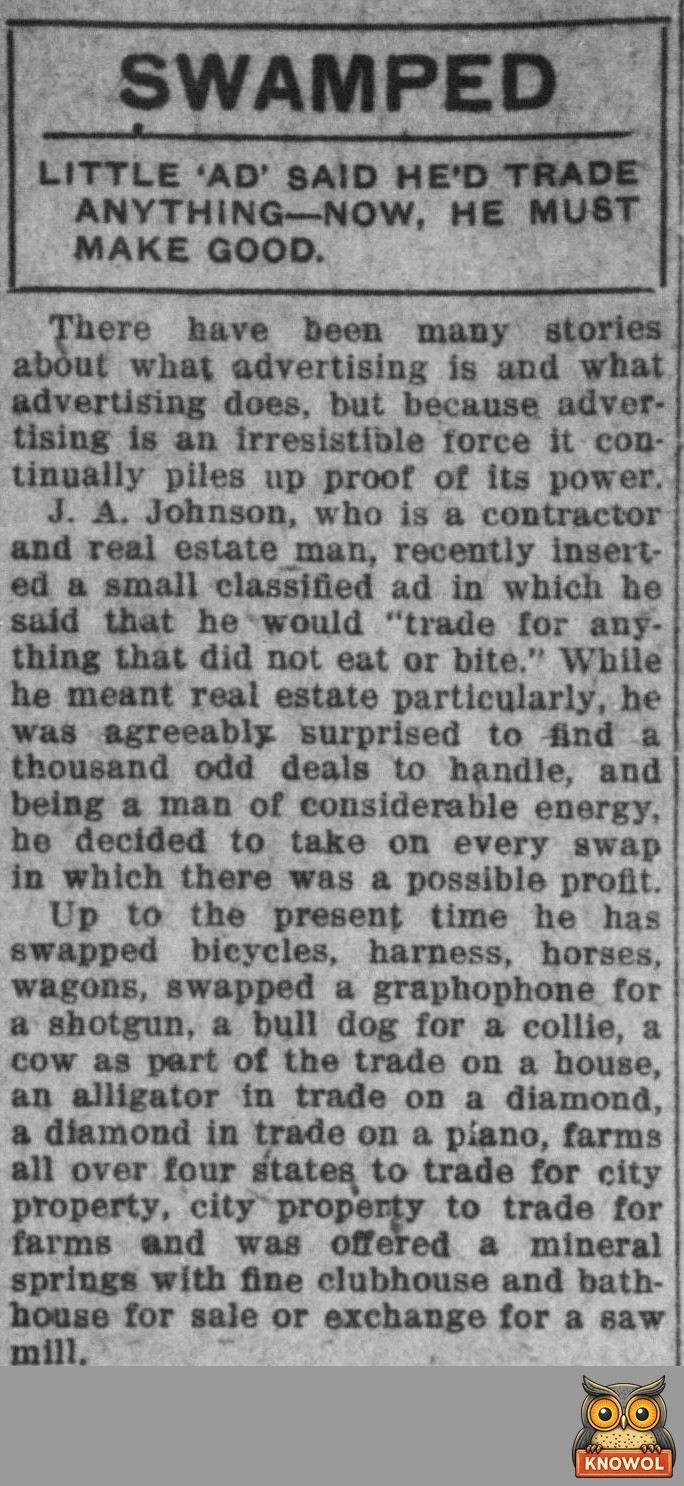
“Swamped.” East St. Louis Daily Journal, East St. Louis, Illinois, August 3, 1920, page 5 (the headline and the first part of the story). Library of Congress, Chronicling America. Click the clipping to read it full size.
The ad
The man was J. A. Johnson. The Journal called him “a contractor and real estate man.” He was a builder who also sold houses, lots and farms. East St. Louis sits on the Illinois side of the Mississippi River, right across from St. Louis, Missouri, and Johnson had houses “all over town.”
His ad on Sunday, May 9, 1920, read like a handshake. “I have anything you want and want anything you have,” it began. “It is up to you to tell me your house troubles.” Then came the big promise. “What do you want to buy, sell or trade? I will trade for anything that don’t eat or bite. Easy terms.” Easy terms meant you could pay a little at a time.
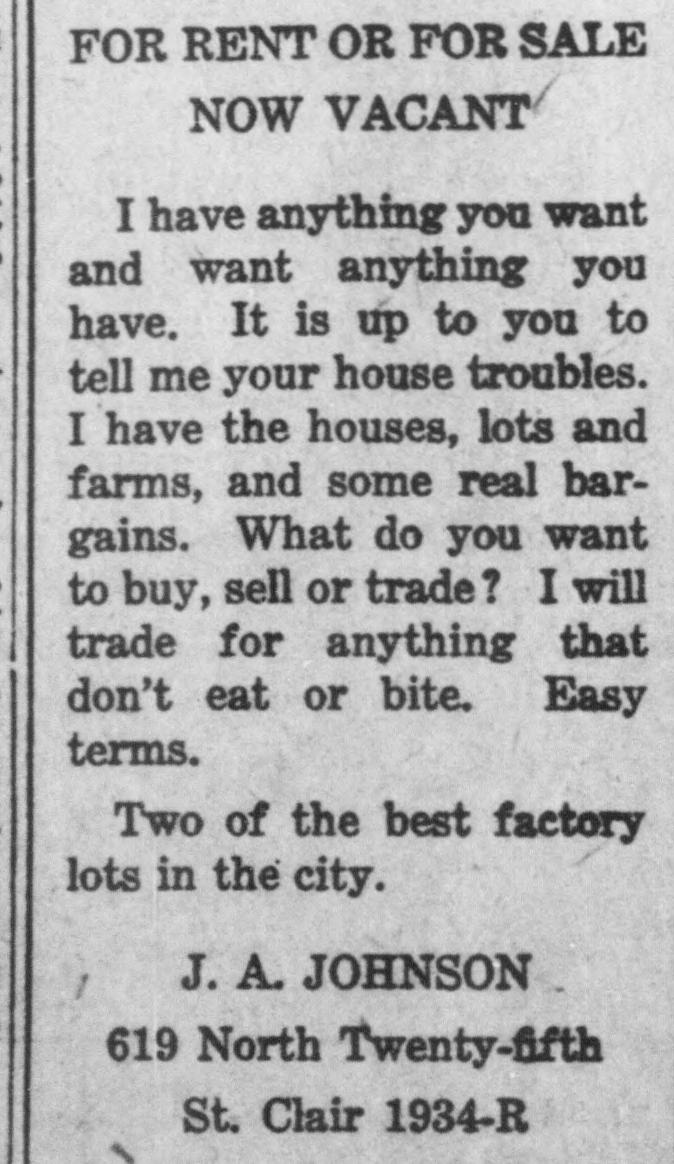
J. A. Johnson’s ad: “I will trade for anything that don’t eat or bite.” East St. Louis Daily Journal, East St. Louis, Illinois, May 9, 1920, page 10. Library of Congress, Chronicling America. Click the clipping to read it full size.
A week later he called himself “The Easiest Term Man in the Business.” He made the same promise, a little more politely this time: “I trade for anything that doesn’t eat or bite.” His telephone number was St. Clair 1934-R.
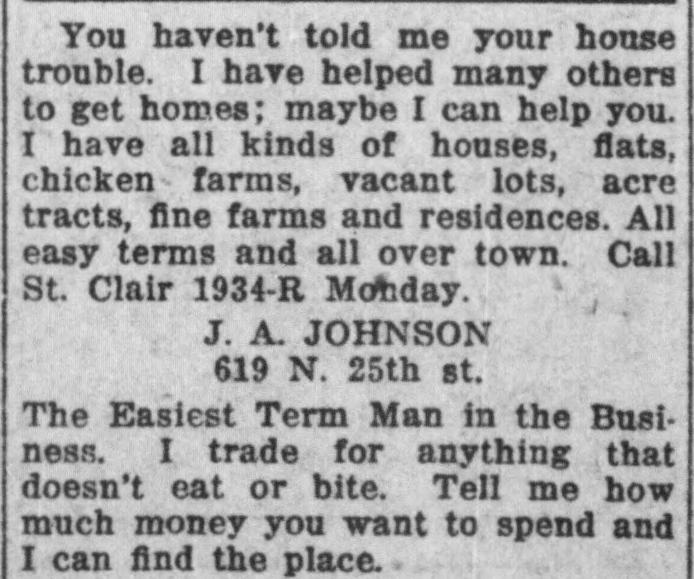
“The Easiest Term Man in the Business.” East St. Louis Daily Journal, East St. Louis, Illinois, May 16, 1920, page 12. Library of Congress, Chronicling America. Click the clipping to read it full size.
Then the town answered
Johnson meant houses and land. Trade him your farm, and he would find you a house in town. That was the plan.
East St. Louis had other ideas. On August 3, 1920, the Journal told the story under one big word: “Swamped.” Johnson “was agreeably surprised to find a thousand odd deals to handle,” the paper said. And “being a man of considerable energy, he decided to take on every swap in which there was a possible profit.” In plain words, he said yes to almost anything that could make him a little money.
What he swapped
Here is the list, straight from the paper. He “swapped bicycles, harness, horses, wagons.” He “swapped a graphophone for a shotgun.” A graphophone was a wind-up record player. He traded “a bull dog for a collie.” He took “a cow as part of the trade on a house.” Then came the best line of all: “an alligator in trade on a diamond, a diamond in trade on a piano.”
Think about that for a minute. A man who said he’d only take things that didn’t eat or bite ended up trading two dogs, a cow and an alligator. Every one of them eats. The dogs can bite. And an alligator is famous for both.
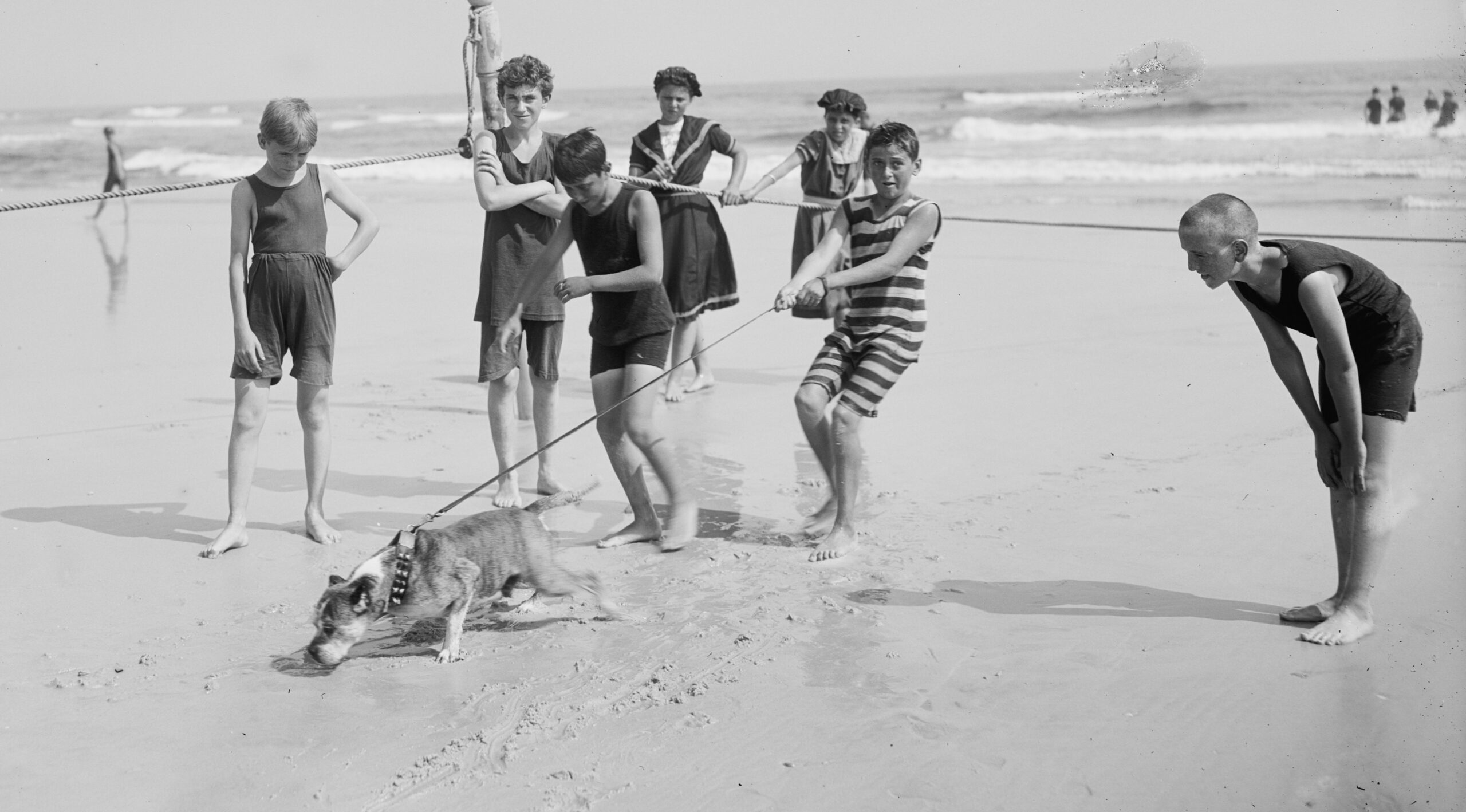
A bulldog on its leash at the beach, between 1900 and 1910. Johnson traded “a bull dog for a collie,” but no picture of his dog is known; this one is a stand-in. Detroit Publishing Co., Library of Congress. Click the picture to see it full size.
The offers kept coming
The Journal also listed the offers people made him. It didn’t say which ones he took. Someone offered him “a mineral springs with fine clubhouse and bathhouse” for a saw mill. A mineral spring was a place where people bathed in spring water they thought was good for their health. Others offered a sorghum mill, a machine that squeezes sweet juice out of sorghum cane to boil into syrup, for an automobile. There was “a farm in Arkansas for a team of mules,” a watch for a bicycle, and “stone work in trade for a carpet.” One person wanted to trade a restaurant for a rooming house, a big house that rents out single rooms.
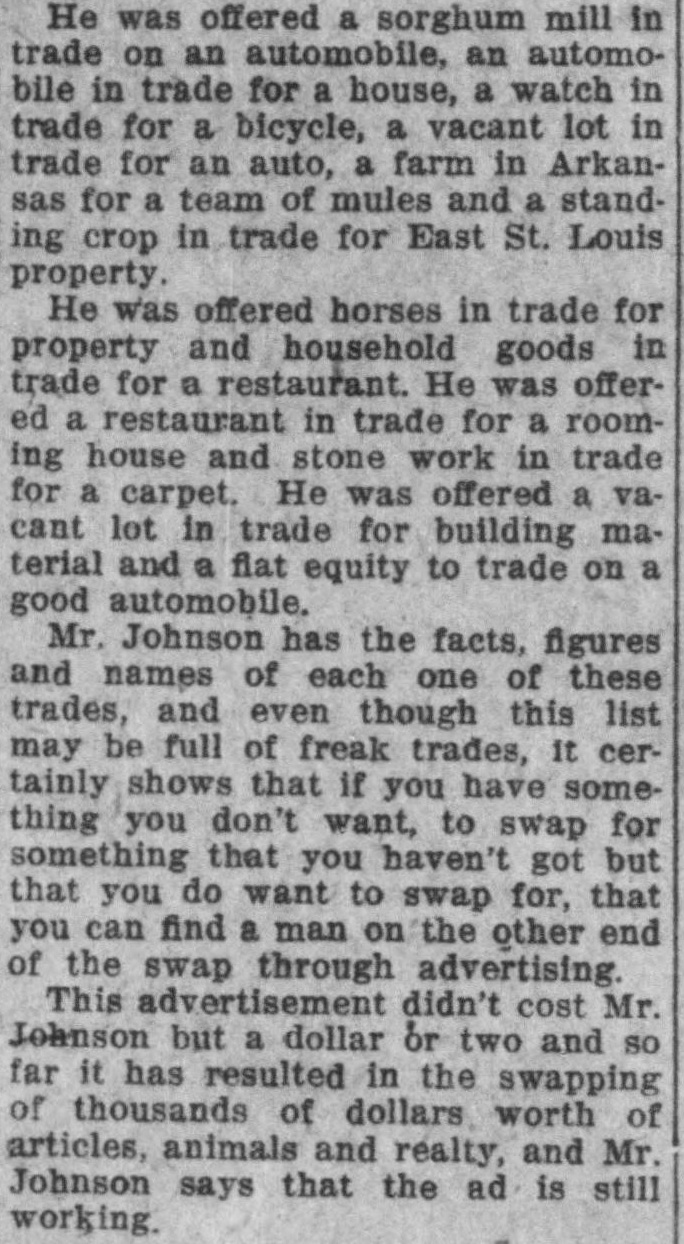
The rest of the list, and the ending. East St. Louis Daily Journal, East St. Louis, Illinois, August 3, 1920, page 5. Library of Congress, Chronicling America. Click the clipping to read it full size.
By the numbers
- A few lines in the want ads, run in May 1920
- “a dollar or two,” what the ad cost him
- Farms “all over four states” offered in trade for city property
- 2 dogs, 1 cow and 1 alligator, plus horses, wagons and bicycles
- “thousands of dollars worth of articles, animals and realty” swapped by August
Why the paper told it
The Journal had its own reason to print all this. It sold those little ads. The story opened like a sales pitch, saying advertising “continually piles up proof of its power.” The paper said Johnson “has the facts, figures and names of each one of these trades.” Even if the list was “full of freak trades,” it showed that you could always find “a man on the other end of the swap.”

Visitors look into the pens at the South Beach Alligator Farm, probably the St. Augustine Ostrich and Alligator Farm in Florida, about 1910. Panorama by George Reddington, Library of Congress. Click the picture to see it full size.
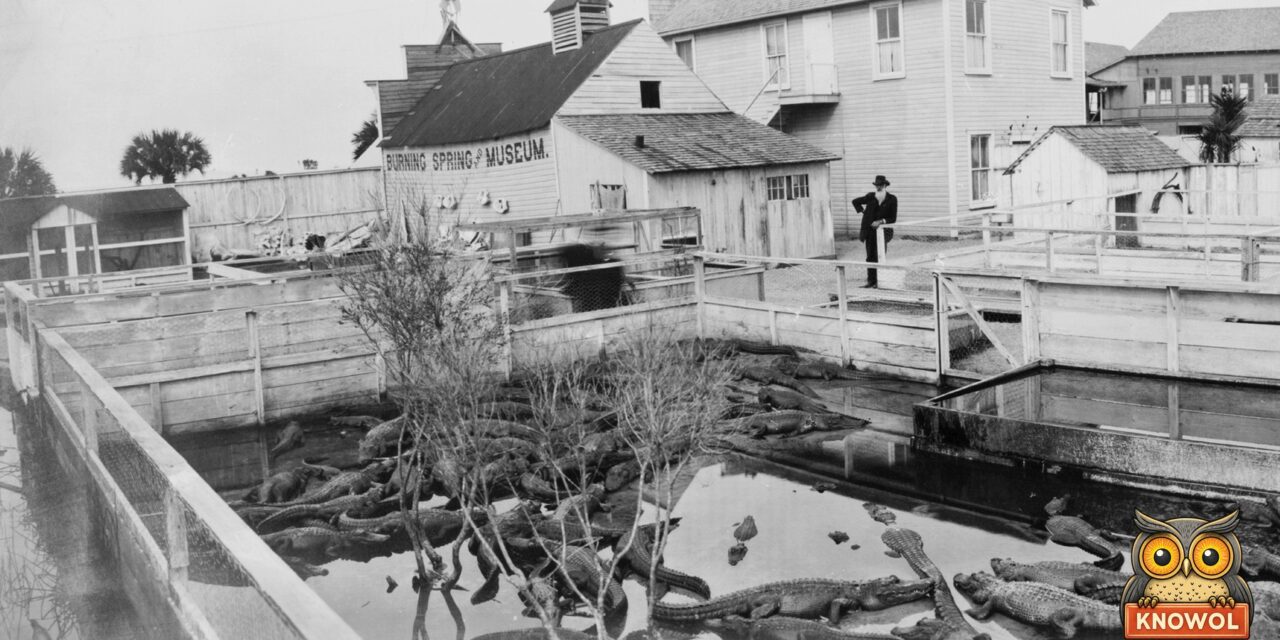
The photo at the top of this story, and the one above, show alligators at a Florida alligator farm in 1910, not in East St. Louis. That farm had a whole pen of them. Johnson only had to deal with one. The paper never said where his alligator went next, or who ended up with the piano.
It did say how the summer ended. “This advertisement didn’t cost Mr. Johnson but a dollar or two,” and by August it had brought him bicycles, horses, a cow, a collie and an alligator. Then came the last line of the story: “Mr. Johnson says that the ad is still working.”
Sources
- East St. Louis Daily Journal (East St. Louis, Illinois): August 3, 1920, page 5 (“Swamped,” the story of J. A. Johnson’s swaps).
- East St. Louis Daily Journal (East St. Louis, Illinois): May 9, 1920, page 10 (J. A. Johnson’s ad, “I will trade for anything that don’t eat or bite”).
- East St. Louis Daily Journal (East St. Louis, Illinois): May 16, 1920, page 12 (his ad, “The Easiest Term Man in the Business”).
- Cover photo and the visitors photo: George Reddington, “South Beach Alligator Farm – B” and “South Beach Alligator Farm – A”, panoramic photographs, about 1910. Library of Congress Prints and Photographs, Panoramic Photographs. No known restrictions on publication.
- Bulldog photo: Detroit Publishing Co., “Bulldog on the beach”, between 1900 and 1910. Library of Congress Prints and Photographs. No known restrictions on publication.
- All newspaper images: Library of Congress, Chronicling America. Published 1920.