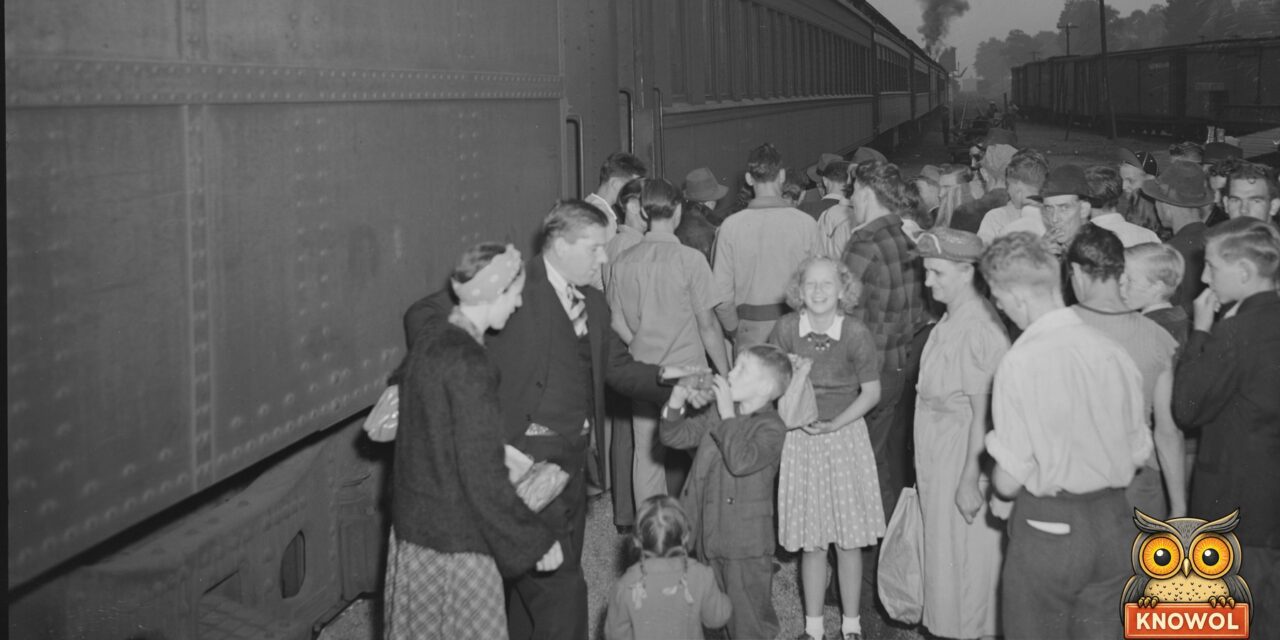
A girl in a polka-dot skirt is laughing out loud. She holds a paper sack. Around her, a crowd of boys, girls, mothers and fathers waits on the gravel beside a long line of railroad cars. Far up the track, black smoke rolls out of the engine. It was September 1942 in Richwood, West Virginia, and about 300 people from this little mountain town were about to ride one train all the way to New York to save somebody else’s harvest.
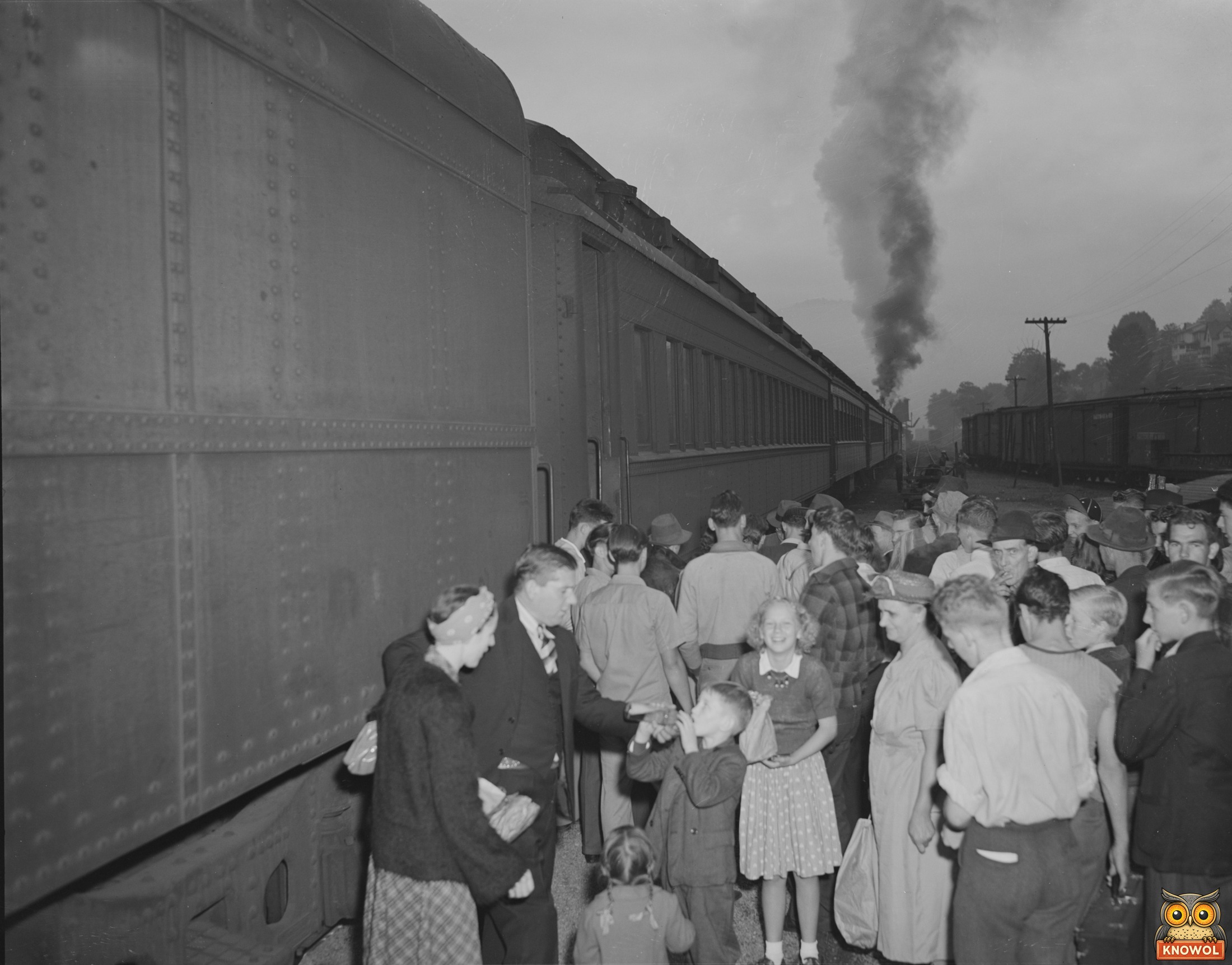
“Richwood, West Virginia. Boys and girls, single men and families, waiting to board special train which will carry them to Batavia, New York where they will help bring in the harvest.” Photo by John Collier Jr., September 1942, for the Farm Security Administration and Office of War Information. Library of Congress. Click the picture to see it full size.
Who Took the Picture in Richwood
The man behind the camera in Richwood, West Virginia, was John Collier Jr., a 29-year-old photographer who worked for the government. He belonged to a small team first hired by the Farm Security Administration, or FSA, a New Deal office that helped poor farm families. Its photographers were sent all over the country to show how ordinary Americans lived and worked. By 1942 the team also made pictures for the Office of War Information, which told the country about the war effort at home.
Collier had a hard start. He was hurt in a car accident when he was 8, and the injury left him with trouble hearing and learning. He never got far in school. But he could see. Later in life he became a teacher and helped build a whole new field, visual anthropology, which means studying people’s lives through photographs.
In Richwood, Collier did what the FSA photographers did best. He didn’t take one picture and leave. He followed the people. He shot the sign-up office, the families at home, the train, the ride, and the camp where they landed. Then he wrote a caption card for each picture. Those cards are still in the Library of Congress, and they tell this story in his own words.
Why Richwood, West Virginia, Needed Work
Richwood was a lumber town of about 5,000 people in the mountains of Nicholas County. Its mills made boards, paper and clothespins. Its people were proud of it, too. Collier noted that the Chamber of Commerce put on a show once a year called “Spuds and Splinters,” a name that probably nodded to the town’s potatoes and its lumber.
But in 1942 the work was running out. One of Collier’s pictures shows a quiet mill with this card: “Last spring this mill was producing paper. Shortage of raw materials and outdated machinery forced it to close.” Another shows an old tannery, a place where animal hides were made into leather, with only its chimneys left.
Hundreds of miles north, farmers had the opposite problem. America had joined World War II the winter before. Young farmhands were going off to the Army or to better-paying jobs in war factories. By the spring of 1942, the country was short about a million farm workers, says Michael Eula, the historian for Genesee County, New York. Tires and gas were rationed, so the usual traveling crews couldn’t easily drive from farm to farm. In the rich fields around Batavia, New York, the crops were ripe and there weren’t enough hands to pick them.
The Sign-Up in Richwood
The FSA’s answer was a simple trade: the government would carry the workers to the farms. In Richwood, the mayor’s office was turned into a recruiting hall. Families sat at tables with the FSA man and the United States Employment Service and signed contracts to go north for the harvest.
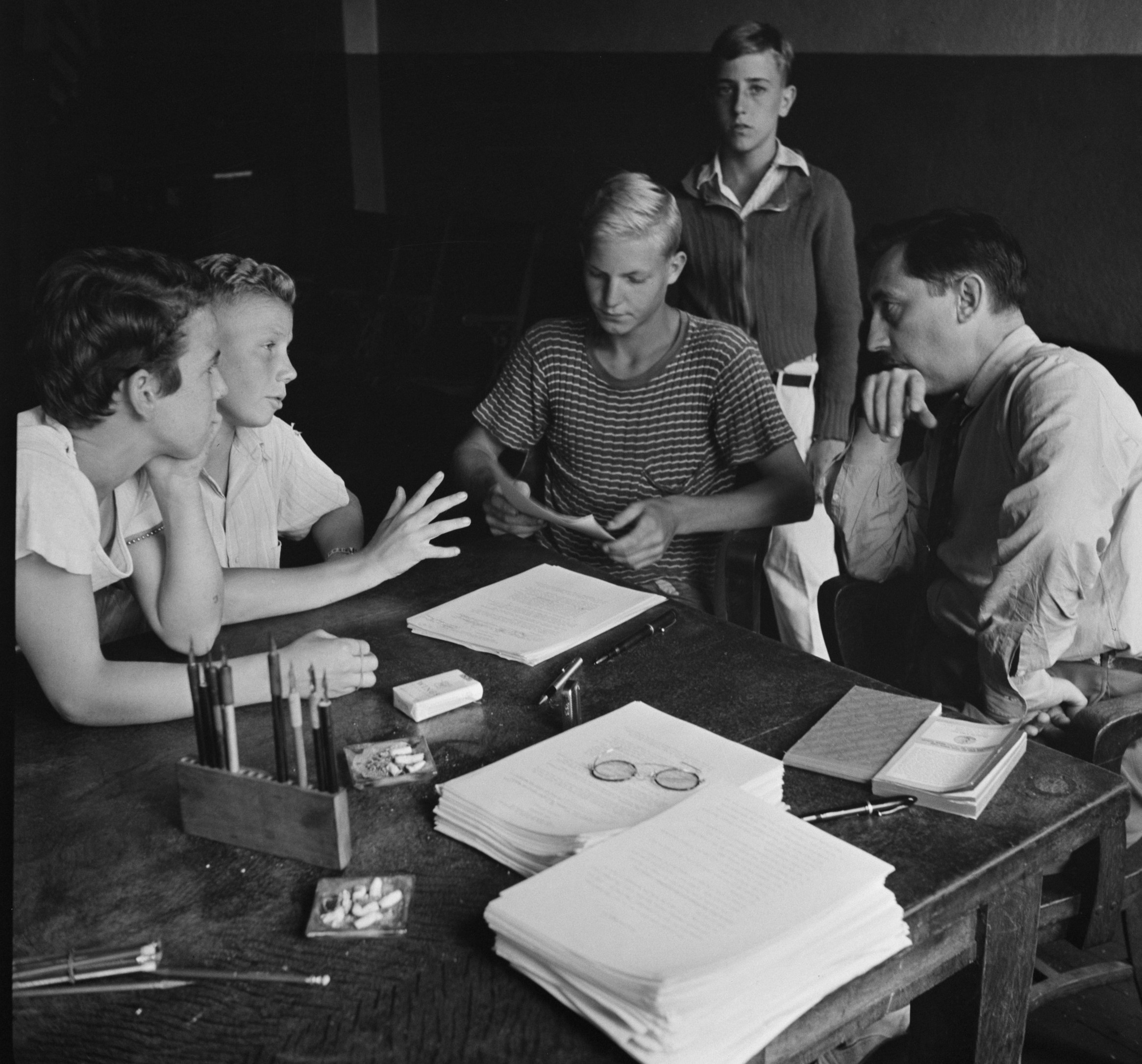
“Richwood, West Virginia. A high school boy who is slightly under age is trying to convince the FSA (Farm Security Administration) representative that he should go to New York state to help bring in the harvest.” Photo by John Collier Jr., September 1942. Library of Congress. Click the picture to see it full size.
Plenty of high school kids wanted to go. Collier caught one of them at the sign-up table. His card says the boy “is slightly under age” and “is trying to convince” the FSA man to let him go anyway. The card doesn’t say who won the argument. Another card names a boy who did go: “Charles Lindbherg Rhone, sixteen years old, and ready to lick the world.”
Not everyone in Richwood liked the idea. Collier asked people in town, and he wrote down what they said. William Thomas, who ran a hardware store, told him, “I worked in the wheat fields when I was eight.” The editor of the weekly paper let his own son go, but he worried the trip would cut into the kids’ schooling for good. A woman named Mrs. Burt Marshall thought girls shouldn’t go and boys should be at least 17. Still, she thought the program was good for the boys, because it helped them “participate in the war effort.”
The Special Train Leaves Richwood
The Baltimore and Ohio Railroad sent a whole special train just for them. Collier’s card says it would “carry the 300 men, women and children to upper New York state where they will work in the harvest.” Workers loaded sandwiches on board, and free coffee was poured on the way.
That’s the moment in the big picture. Look at all the paper sacks. People carried their lunch and their things in them. A man in a suit leans down to a little boy at the front of the crowd. Lots of people are smiling. Some of them had probably never been out of the mountains before.
The ride north was long. Collier rode along and kept shooting: the Friend family in their seats and boys and girls riding together in the coach.
A Rainy Welcome in Batavia, New York
The train from Richwood pulled into Batavia, New York, in what Collier called “a drizzling rain.” Many of the newcomers went to the Elba FSA farm labor camp near Batavia, a field of big canvas tents. The town of Elba sits on “muck,” the black, rich soil of an old swamp, famous for onions.
The first day was rough. The Red Cross served the travelers lunch and dinner, their first hot meal since they left home. Before the groceries came, a group gathered outside the camp’s recreation tent “discussing the problem of getting something to eat.” And then the kids did what kids do. Collier’s card says, “Despite rain and empty stomachs, the boys and girls just off the train from West Virginia started a ball game.”
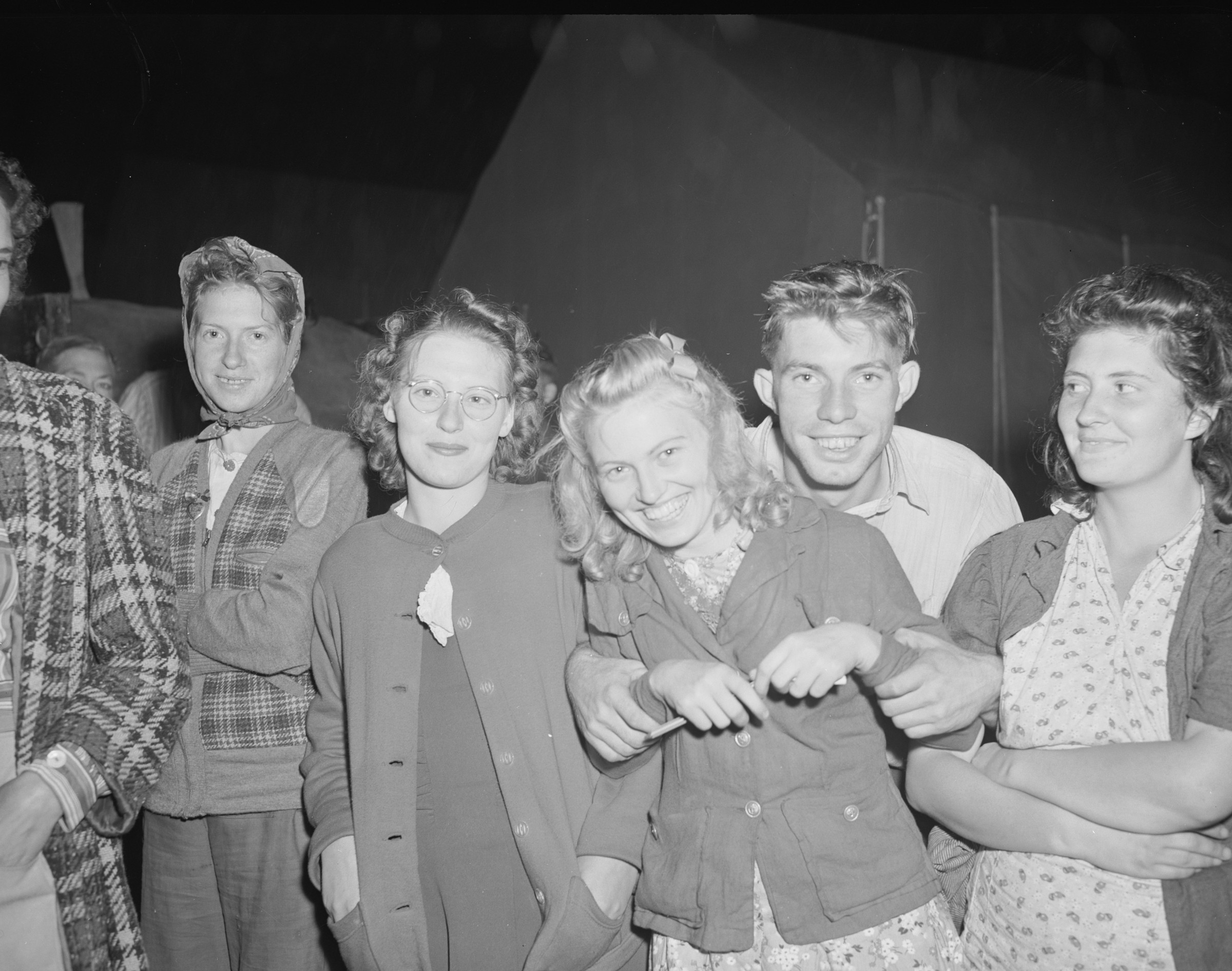
“Batavia, New York. Elba FSA (Farm Security Administration) farm labor camp. Boys and girls from West Virginia., who came to upper New York state to help in the harvest.” Photo by John Collier Jr., September 1942. Library of Congress. Click the picture to see it full size.
The best line in the whole set came at that camp. A group of young people from West Virginia lined up arm in arm for Collier’s camera. His card says the boy in the middle told him, “Please take my picture now; I want the world to see me when I am happy!”
The Friend Family From Richwood
Collier followed one family the whole way: Bryant and Hazel Friend, their son Darriell, and Grandfather Friend. Back in Richwood, he photographed their home near town, which had one room, “twenty by twenty feet,” about the size of a big living room today. All four of them slept there.
In New York, a farmer named David Nesbitt signed up the Friends to work on his farm near Albion. They got a house to live in, rent free. It had been empty for years, and Collier shot Hazel Friend sweeping it out. The pay was “forty cents an hour, with a five cents an hour bonus if they stay thirty days.” The farm needed help so badly that the Friends were out working in his fields “even before the Friends had moved in.”
The high school kids had a deal of their own. A group of boys and girls from West Virginia bargained with two tomato farmers. Collier wrote that the kids “will not be separated, so the farmer must hire them as a group.” In camp, a man named William Sloan cooked for one group of boys and kept them “out of trouble.” The plan was for the students to go home to school later in the fall.
What the Richwood Photo Still Shows
Collier’s negative of the big picture still has its number, 83891-C, scratched into the film edge, and the Library of Congress still files it that way. Anyone can look it up and see every face. The photo shows a town that was losing its mill jobs, and a country that was short of farm hands, meeting on a gravel railroad platform. And right in the middle is a girl laughing, with her paper sack, on the day she left home to help bring in the harvest.
Sources
- The photo: John Collier Jr., “Richwood, West Virginia. Boys and girls, single men and families, waiting to board special train which will carry them to Batavia, New York where they will help bring in the harvest,” September 1942. Farm Security Administration / Office of War Information Photograph Collection, Library of Congress, LC-USF34-083891-C. No known restrictions.
- Other Collier caption cards from the same September 1942 shoot, Library of Congress: the 300 men, women and children; the closed paper mill; the under-age boy; Charles Lindbherg Rhone; William Thomas; Mrs. Burt Marshall; the ball game; “when I am happy”; the Friends’ pay.
- Michael J. Eula, Genesee County Historian, “Depression Children Go To War: Genesee County, New York, 1941-1945” (the farm labor shortage, rationing, Elba’s onion fields).
- John Collier Jr.: Wikipedia (life and work, read for leads). Richwood’s population (5,051 in 1940) and clothespin mill: U.S. Census and Richwood, West Virginia, on Wikipedia.
- All photos: Library of Congress, Prints and Photographs Division, FSA/OWI Collection. U.S. government work, no known restrictions.