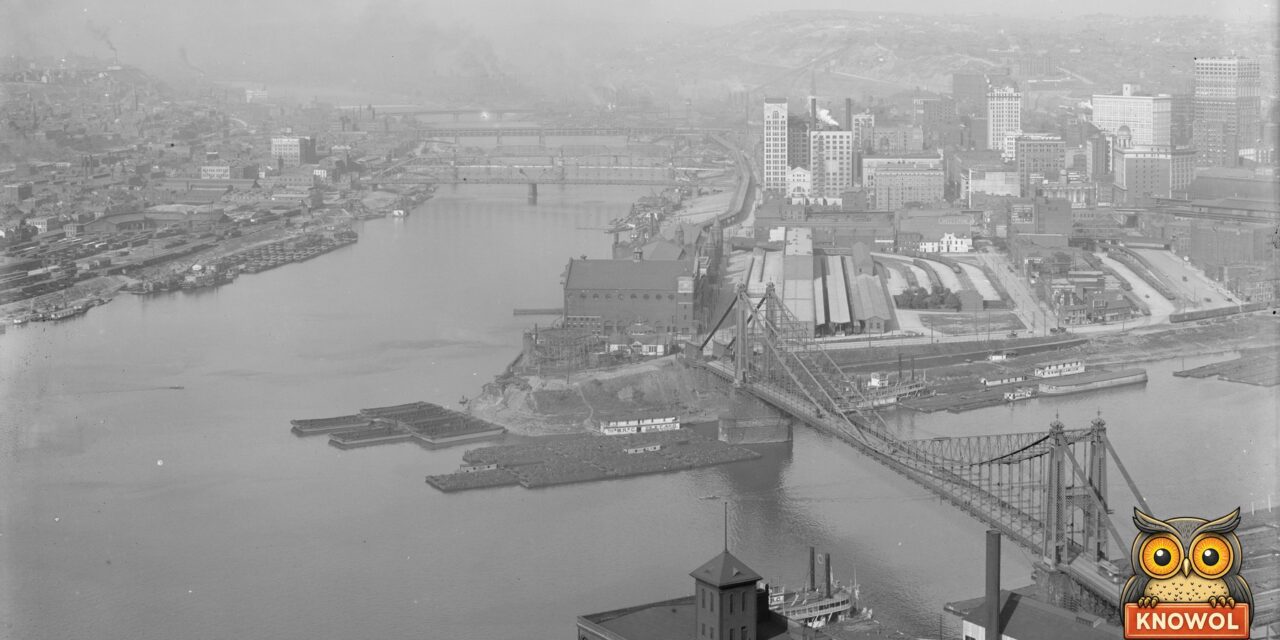
On the last day of July 1889, a woman from California sat down in Pittsburgh, Pennsylvania, to write a long letter home. Her name was Leila J. Lindley, and the letter went to the Sacramento Daily Record-Union in Sacramento, California. The paper printed it on August 11. She wrote about parks, bridges, boats and buildings. But the line that tells the biggest story is about a shirt collar.
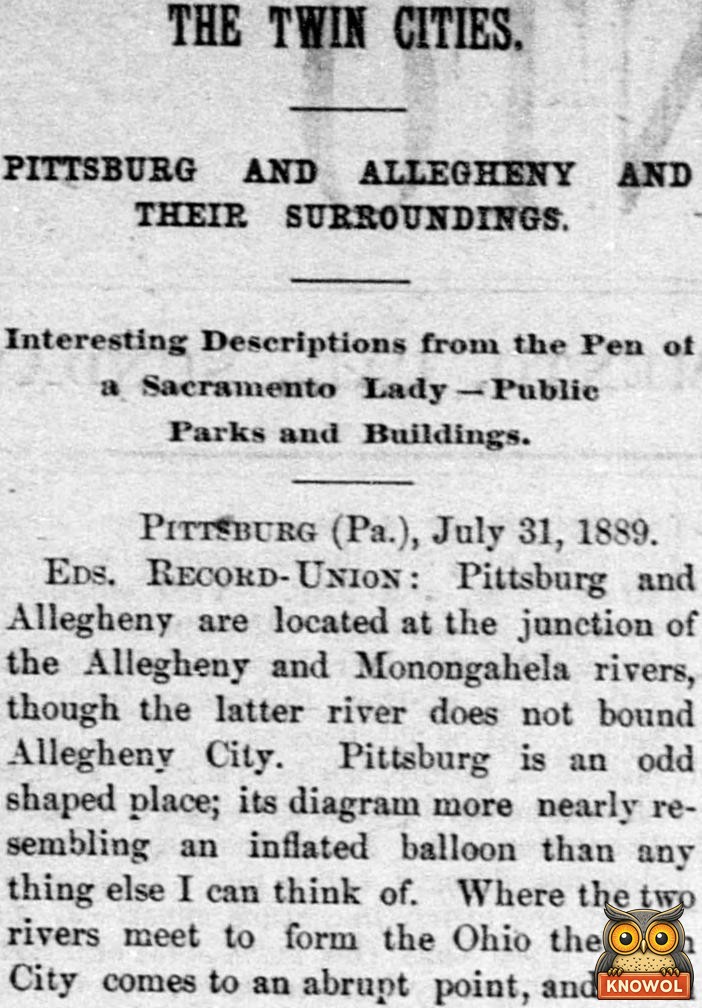
“The Twin Cities. Pittsburg and Allegheny and Their Surroundings. Interesting Descriptions from the Pen of a Sacramento Lady.” Sacramento Daily Record-Union, Sacramento, California, August 11, 1889, page 2. Library of Congress, Chronicling America. Click the clipping to read it full size.
“Now there is no need to call it the Smoky City,” she wrote, “for a linen collar can venture forth and return in something like the state it was in when starting out.” Men back then buttoned a stiff white collar onto their shirts every morning. In plain words, Lindley was saying you could now walk out the door in a clean white collar and come home with it still white. Then she added the surprising part: “But once such a thing could not be done with impunity.” That means that a few years before, nobody could get away with it.
The Smoky City
Pittsburgh made iron, steel and glass. (Back then the papers usually spelled it Pittsburg, with no h.) For years its mills and homes burned soft coal. The smoke hung over the city like a lid, and soot drifted down on everything below.
Lindley could still see the marks it left. Some of the finest buildings, she wrote, looked “like old antiquated ruins blackened with age.” Stone buildings “that were once white and majestic looking” now looked “old and tattered.” Inside, they were elegant. Outside, they were black.
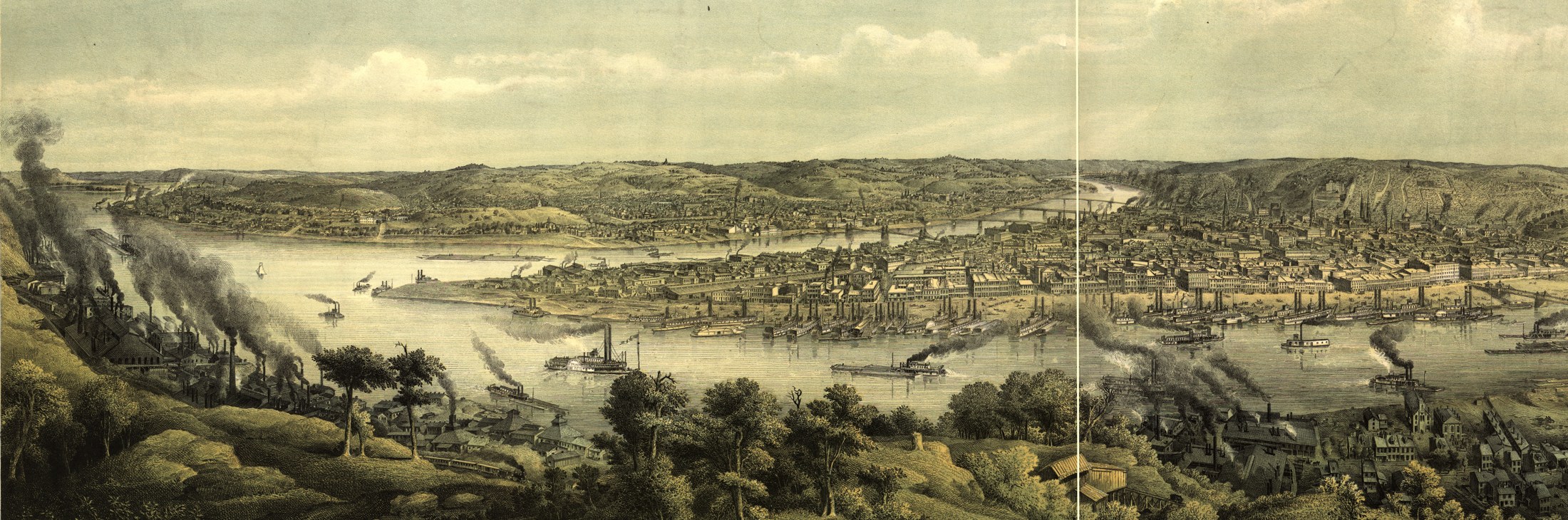
Pittsburgh, Allegheny and Birmingham in 1871, drawn by Otto Krebs from the hills south of the city. Look for the smoke pouring from the mills along the rivers. Library of Congress, Geography and Map Division. Click the picture to see it full size.
The gas under the ground
The change started in somebody’s yard. A story in the Roanoke Times of Virginia later told how. The value of natural gas, it said, “was not recognized till 1884, when George Westinghouse, Jr., struck a heavy flow while drilling an artesian well on the grounds surrounding the residence in the Twenty-first ward of this city.” Westinghouse was a Pittsburgh inventor, and the home was his own. An artesian well is a deep well for water. He went looking for water and hit gas instead.
Soon pipes were carrying gas from deep wells into the city. Mills and homes burned it instead of coal. Natural gas burns hot and clean, with almost no smoke. By the next year, the sky over Pittsburgh was clearing.
Other cities noticed. In 1885 the Philadelphia Times poked a little fun at its neighbor, in a story reprinted by the National Republican in Washington, D.C. “The people of Pittsburg are rubbing their eyes and trying to discern if possible what is the matter with their city,” it said. “Several Pittsburg residents have been astonished of late by their ability to recognize old acquaintances across the street.” Pittsburgh ladies, it joked, had always been surprised to visit other cities in winter “and find that snow is white.” Not anymore. “The snow will be white in Pittsburg after this.”
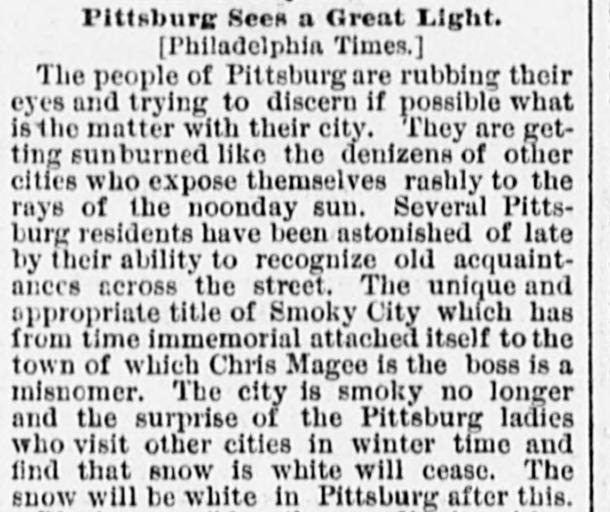
“Pittsburg Sees a Great Light.” From the Philadelphia Times, in the National Republican, Washington, D.C., September 26, 1885, page 4. Library of Congress, Chronicling America. Click the clipping to read it full size.
The same story promised Pittsburgh “the hitherto unknown luxury of clean cuffs and collars.” So four years later, when Lindley wrote home about her collar, she was telling Sacramento something Pittsburgh already knew. It was still new enough to be news.
What a visitor from Sacramento saw
Lindley’s letter is a fun tour of the city in 1889. Pittsburgh was an odd shape, she said, “more nearly resembling an inflated balloon than any thing else I can think of.” The two rivers meet at a sharp point and make the Ohio, and the city spreads out wide behind it.
She rode a “tramway” up Mt. Washington, the steep hill across the Monongahela River. That was an incline, a little railway car pulled straight up the hillside by a cable. From the top she watched the steamboats “coming down the two rivers, meet, and sail side by side down the beautiful Ohio.”
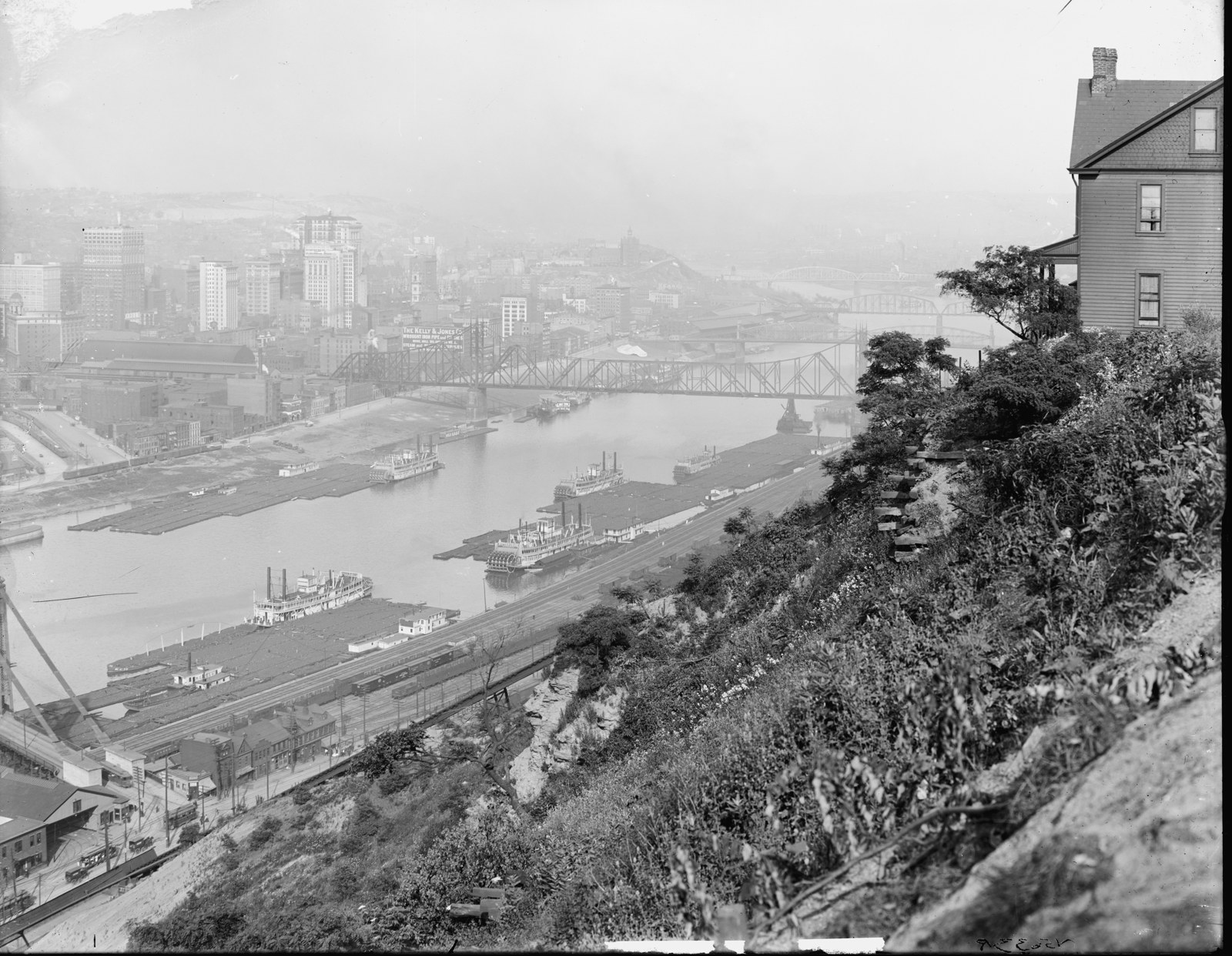
Steamboats and coal barges tied up along the riverbank below Mt. Washington, seen from the Duquesne Incline in the early 1900s. Detroit Publishing Co., Library of Congress, Prints and Photographs Division. Click the picture to see it full size.
The rivers were busy. She saw “shanty boats,” which were little wooden houses built on rafts, where whole families lived and floated along. “Great numbers of these funny little houses can be seen daily floating about,” she wrote, “and coal barges can be counted by the hundreds.” She counted eight bridges over the Allegheny River and five over the Monongahela. Two of them, she noted, were “among the few bridges in the country over which horses are allowed to go at a faster gait than a walk.” Many bridges then made drivers slow their horses to a walk, so the pounding hooves would not shake the bridge.
Once more the Smoky City
The 1885 story had added a small warning. The new fuel had come to stay, it said, “just as long as the supply lasts.” It did not last.
On New Year’s Day, 1891, a report from Pittsburgh ran in the Roanoke Times under the headline “Once More the Smoky City.” It began: “Some months ago Pittsburg discarded the name of Smoky City and has been referred to since that time as the Gas City.” The wells were running low. “But time has demonstrated that relief from dark clouds and constant showers of soot was only temporary,” the story went on. “The natural gas bubble has burst.” The gas companies told the mills to find another fuel. At home, gas now cost so much more than coal that “many house-wives are compelled to put wood in their stoves to get enough heat for cooking.”
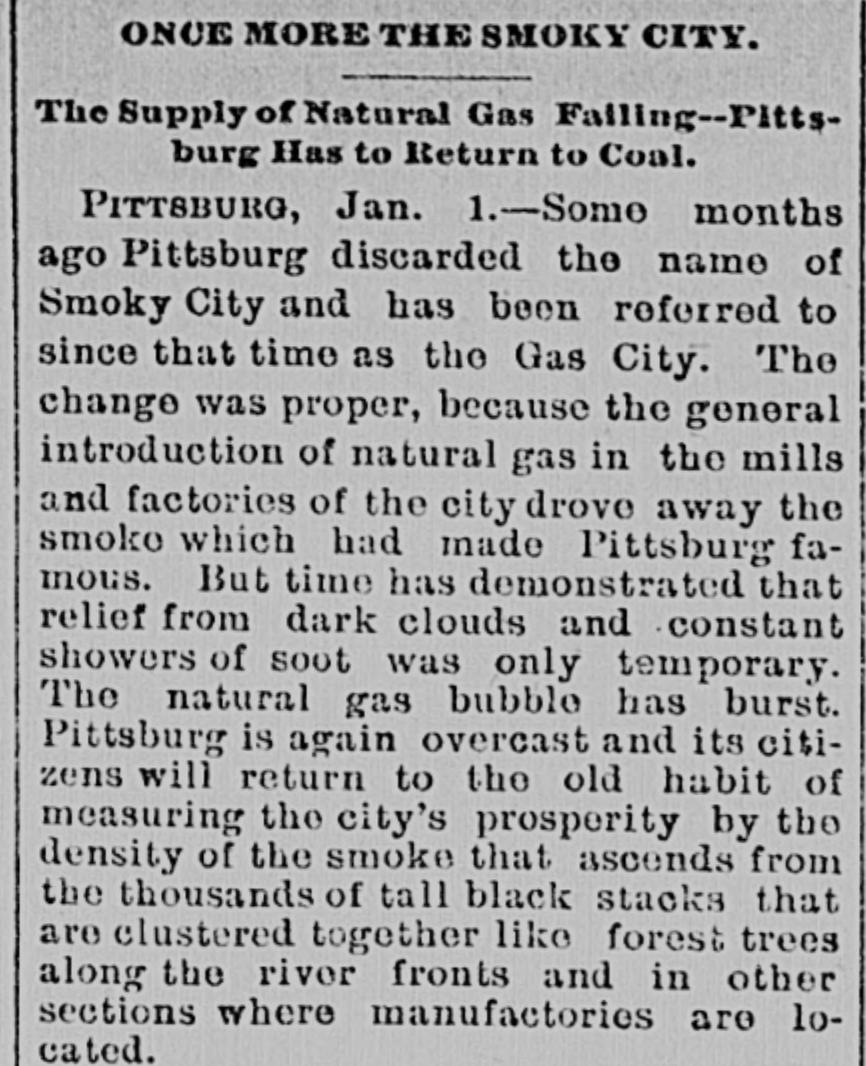
“Once More the Smoky City. The Supply of Natural Gas Failing. Pittsburg Has to Return to Coal.” The Roanoke Times, Roanoke, Virginia, January 2, 1891, page 5. Library of Congress, Chronicling America. Click the clipping to read it full size.
By 1892 a letter writer who went by “Rixy” told readers of the Indiana State Sentinel that the mills had gone back to coal, “and hence the smoke cloud hangs over the place as of yore.” It was “thick enough to cut and slice.” The photograph at the top of this story was taken from the Duquesne Incline in the early 1900s. Look past the bridge, and you can see the haze hanging over the hills again.
The summer of the clean collar
Leila Lindley had caught Pittsburgh at just the right time, in its few clean summers. Near the end of her letter, she told about a trip to Economy, a quiet village on the Ohio River about 18 miles away. In a big garden there, she saw “a huge bed of California poppies, which quite took me back to my native heath.” Native heath means home ground. Far from home, a Sacramento woman found a little bit of California in bloom. And she told everyone back home the best news from Pittsburgh: for now, a white collar could come home white.
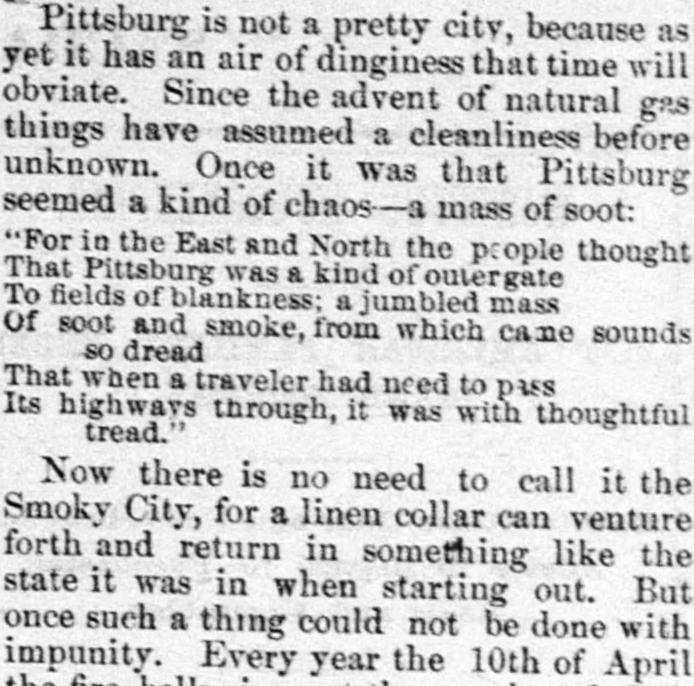
“A linen collar can venture forth and return…” Sacramento Daily Record-Union, Sacramento, California, August 11, 1889, page 2. Library of Congress, Chronicling America. Click the clipping to read it full size.
Sources
- “The Twin Cities. Pittsburg and Allegheny and Their Surroundings,” letter signed Leila J. Lindley, Pittsburg, July 31, 1889. Sacramento Daily Record-Union, Sacramento, California, August 11, 1889, page 2. Library of Congress, Chronicling America.
- “Pittsburg Sees a Great Light,” from the Philadelphia Times. National Republican, Washington, D.C., September 26, 1885, page 4. Library of Congress, Chronicling America.
- “Once More the Smoky City.” The Roanoke Times, Roanoke, Virginia, January 2, 1891, page 5. Library of Congress, Chronicling America.
- “Pittsburg. ‘Rixy’ Writes About a Large Pennsylvania City and Other Matters.” The Indiana State Sentinel, Indianapolis, Indiana, March 30, 1892, page 5. Library of Congress, Chronicling America.
- Cover and photograph: “The Point, Pittsburgh, Pa,” a pair of glass negatives taken from the Duquesne Incline, between 1900 and 1915. Detroit Publishing Co., Library of Congress, Prints and Photographs Division. No known restrictions on publication.
- Bird’s-eye view: “Pittsburgh, Allegheny & Birmingham,” drawn and published by Otto Krebs, 1871. Library of Congress, Geography and Map Division. Published 1871, public domain.
- Newspaper clippings printed from 1885 to 1892 are in the public domain.