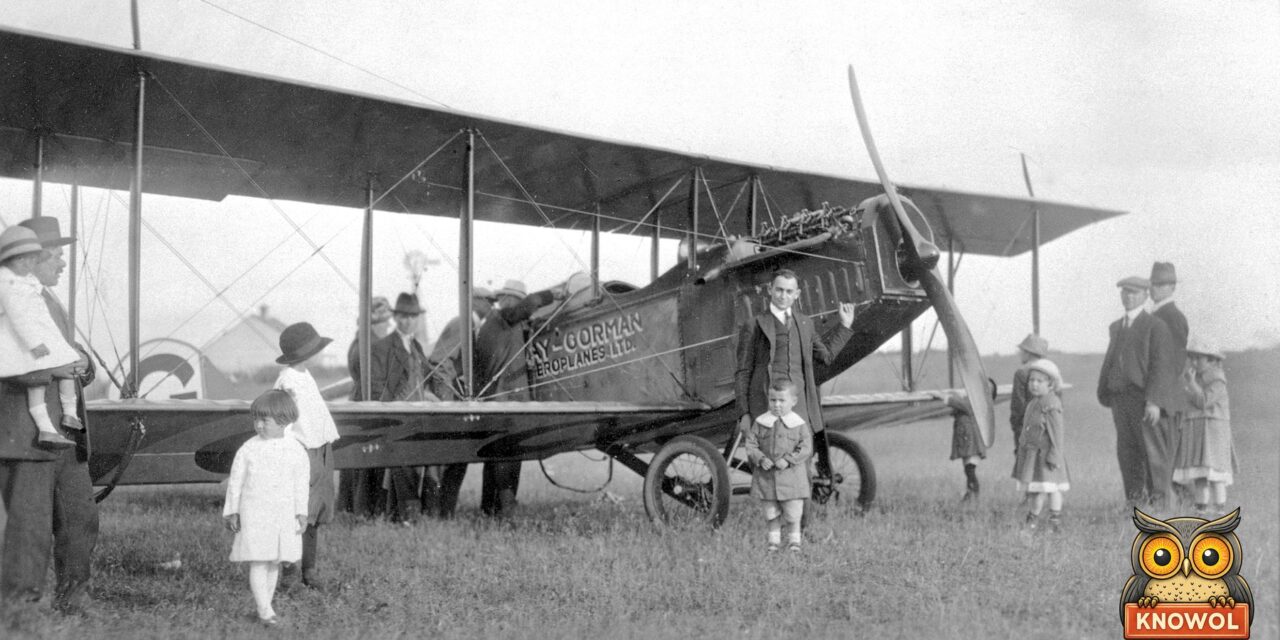
On Tuesday afternoon, August 19, 1919, Leo Jenks got a ride home from the little town of Dedham, Iowa. It wasn’t in a buggy, and it wasn’t in a Ford. It was in an airplane. Leo lived about 10 miles northeast of Audubon, Iowa. And he had an airplane of his own that was almost finished. He was building it himself, because he didn’t have the money to buy one.
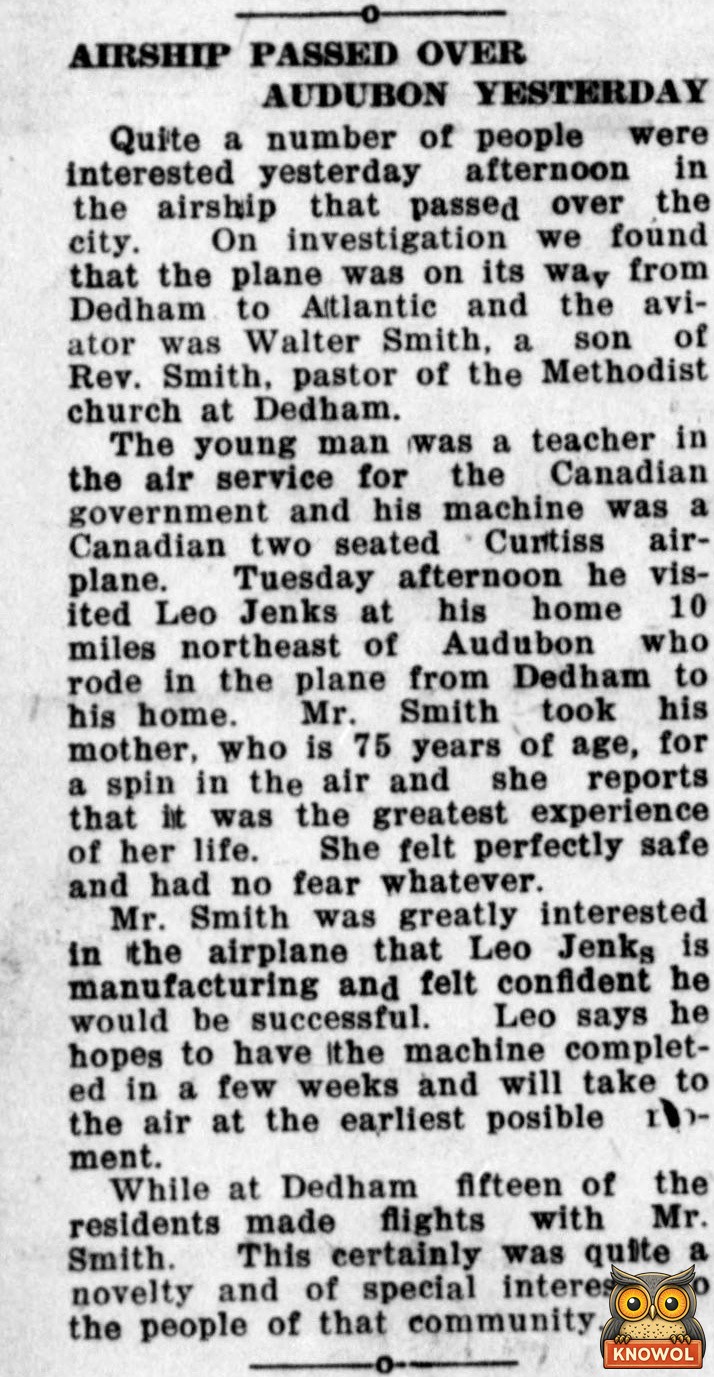
“Airship Passed Over Audubon Yesterday.” Audubon Republican, Audubon, Iowa, August 21, 1919, page 1. Library of Congress, Chronicling America. Click the clipping to read it full size.
The pastor’s son and his Curtiss
The pilot was Walter Smith, the son of Rev. Smith, pastor of the Methodist church in Dedham. The Audubon Republican said “the young man was a teacher in the air service for the Canadian government.” In plain words, he had worked for Canada, helping train its flyers. Now he was home, and he had brought a plane with him: “a Canadian two seated Curtiss airplane.” That was a biplane, with two wings stacked one over the other and two open seats, one behind the other. Canada built its own Curtiss trainers during World War I, and flyers called them Canucks.
Walter gave his neighbors the ride of their lives. “While at Dedham fifteen of the residents made flights with Mr. Smith,” the paper said. One of them was his own mother. She was 75 years old. She came down and said “it was the greatest experience of her life. She felt perfectly safe and had no fear whatever.”
The picture at the top of this story shows a Curtiss two-seater owned by a Canadian flying company, with families crowded around it, about 1920. It is not Walter’s plane, but it is the same Canadian kind.
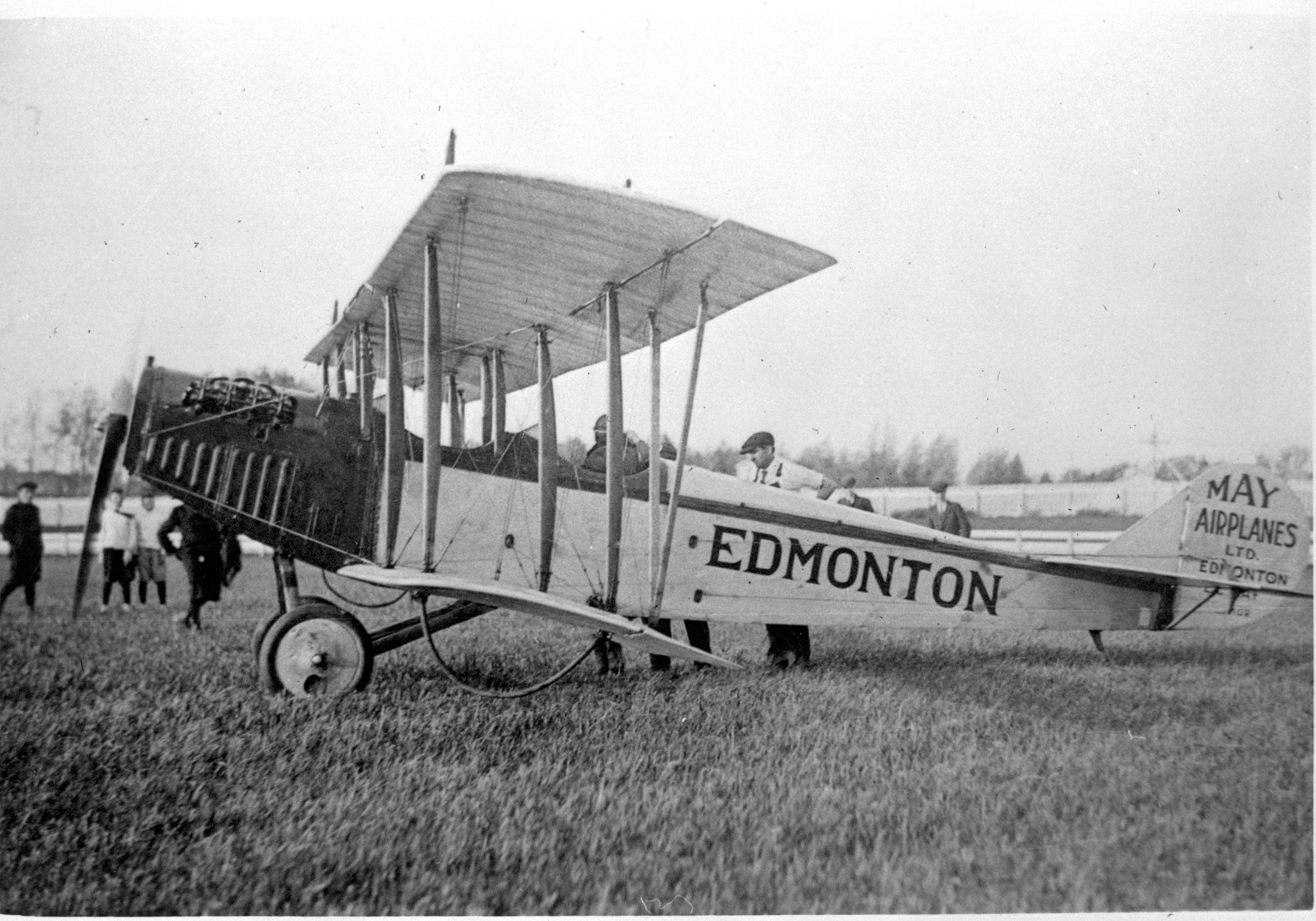
A Canadian Curtiss two-seater like the one Walter Smith flew, at Edmonton, Alberta, in 1919. Provincial Archives of Alberta (A11660), by way of Wikimedia Commons. No known copyright restrictions. Click the picture to see it full size.
Our young inventor of airships
Leo had wanted to fly for a long time. Back in July 1911, the Viola Township news column told about a balloon ascension, a show where a balloon goes up into the sky, at “the Center” on a Saturday night. Leo was supposed to ride along. He didn’t make it. “Leo Jenks, our young inventor of airships failed to ascend, letting the balloon go without a passenger. It was found in Higley’s corn field.”
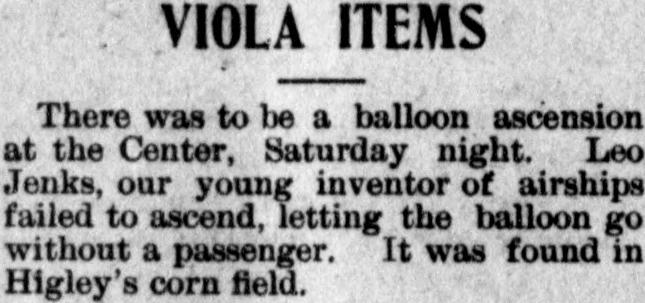
“Viola Items.” Audubon Republican, Audubon, Iowa, July 27, 1911, page 8. Library of Congress, Chronicling America. Click the clipping to read it full size.
Leo loved anything with a motor. In the summer of 1914 the paper reported that he “turned turtle,” which means he flipped upside down, in what it called his “mile a minute Ford.” A mile a minute is 60 miles an hour. Then came the part that tells you who Leo was. He “stopped to take a picture of the machine and then proceeded on his way home.”
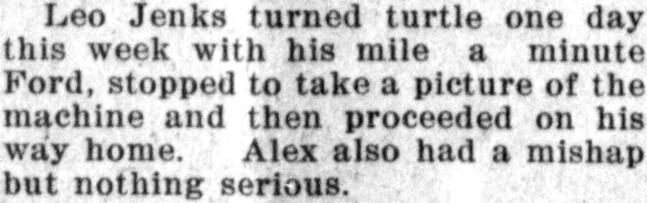
Local and Personal column. Audubon Republican, Audubon, Iowa, July 2, 1914, page 10. Library of Congress, Chronicling America. Click the clipping to read it full size.
By 1917 he had a job in town at the Crescent Theatre, where the paper called him the “machine operator.” That meant he ran the movie projector. That May he married Miss Horton, a young woman from near Dedham. He mailed a card from his honeymoon in Denver to his boss, Don Preston, and said he was “having the time of his life.”
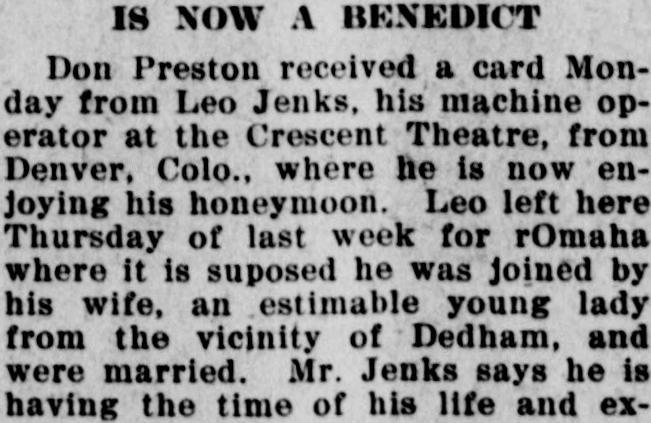
“Is Now a Benedict.” Audubon Republican, Audubon, Iowa, May 31, 1917, page 1. A benedict was an old word for a man who had just married. Library of Congress, Chronicling America. Click the clipping to read it full size.
No money, so he made one
In April 1919, Leo walked into Audubon with something to show people. He had “an aeroplane model made of tin which proved to be a neat contrivance.” A contrivance is a clever gadget. The paper thought a full-size machine built from it looked like it could do the job.
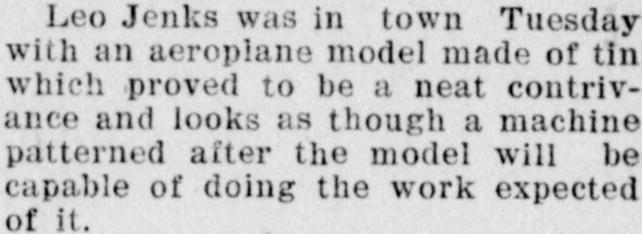
Audubon Republican, Audubon, Iowa, April 3, 1919, page 4. Library of Congress, Chronicling America. Click the clipping to read it full size.
Then he started on the real thing. By August, news of it had traveled clear across Iowa. A paper in Decorah, almost 200 miles away, printed it under the headline “Makes His Own Airship.” It said Leo was the son of a Viola Township farmer, with “a natural aptitude for mechanics,” a knack for machines. It also said why he was doing it the hard way. He had “no money with which to buy an airplane and so is making one himself. He has the machine almost completed.”
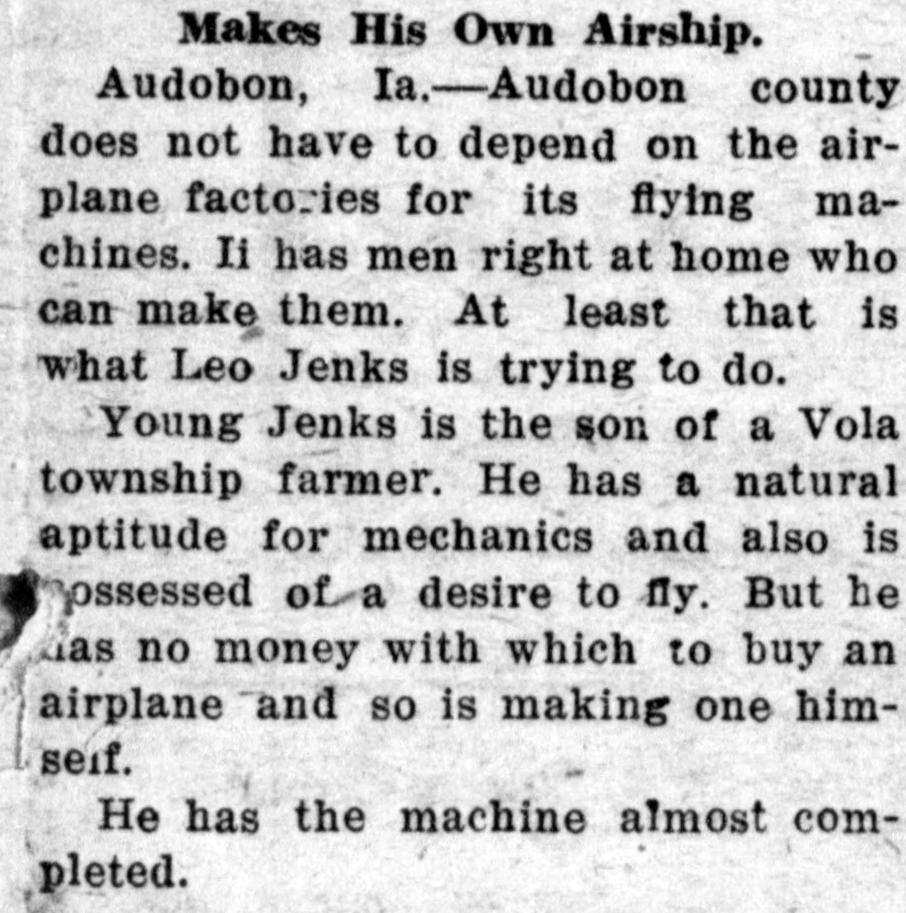
“Makes His Own Airship.” Decorah Public Opinion, Decorah, Iowa, August 13, 1919, page 3. Library of Congress, Chronicling America. Click the clipping to read it full size.
A ride home in a real one
Six days after that story ran, Walter Smith came calling. He visited Leo at his home, and Leo “rode in the plane from Dedham to his home.” Picture it: a man who had spent months building an airplane with his own hands, riding over the farms between Dedham and home in a real one.
Walter, the flying teacher, took Leo’s project seriously. The paper said he “was greatly interested in the airplane that Leo Jenks is manufacturing and felt confident he would be successful.” Leo told the paper he hoped to have it done “in a few weeks,” and then he would “take to the air.”
The next afternoon, Walter flew on toward Atlantic, Iowa, and his route took him right over Audubon. People in town stopped and looked up. “Quite a number of people were interested yesterday afternoon in the airship that passed over the city,” the Audubon Republican wrote. It took some asking around to find out whose plane it was. The paper called the whole visit “quite a novelty.”
What happened to Leo’s airplane
Here is the honest answer: we don’t know. We read through the Audubon papers for the next two years and found no story about Leo’s airplane taking off. Maybe it never flew. Maybe it flew and nobody wrote it down.
We do know Leo kept building. In June 1921, the Audubon Republican said Leo Jenks, of Viola Township, had just finished a racing car. He named it “Checkers.” The paper said it “has tremendous speed,” and that Leo “has confidence that he will win some of the big purses,” the prize money at the races. He hoped to race it at the fairgrounds in Audubon that September.
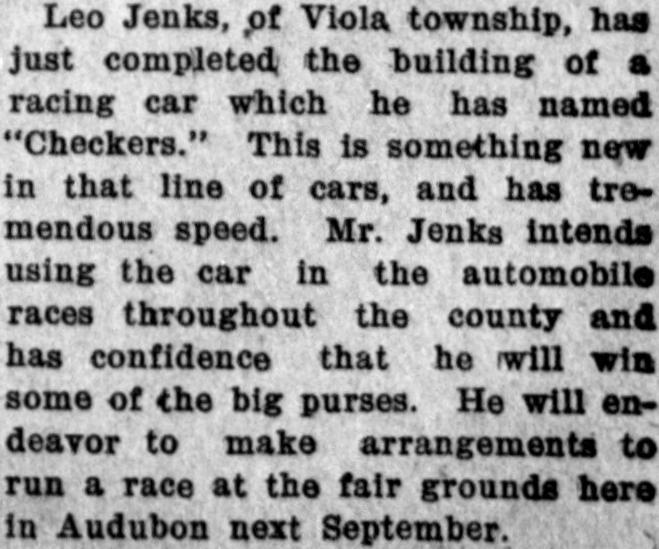
Audubon Republican, Audubon, Iowa, June 9, 1921, page 1. Library of Congress, Chronicling America. Click the clipping to read it full size.
So the young man whose balloon once floated off without him never stopped tinkering. And on one August afternoon in 1919, Leo Jenks finally went up. He rode home through the sky in a real airplane, while his own sat waiting to be finished.
Old words, plain talk
- Turned turtle: flipped upside down, like a turtle on its back.
- A mile a minute: 60 miles an hour, very fast for a 1914 Ford.
- Aeroplane: the older spelling of airplane.
- Airship: what many papers still called any flying machine in 1919, even an airplane.
- Contrivance: a clever gadget or invention.
- Benedict: a man who has just gotten married.
Sources
- “Airship Passed Over Audubon Yesterday.” Audubon Republican, Audubon, Iowa, August 21, 1919, page 1. Library of Congress, Chronicling America.
- “Makes His Own Airship.” Decorah Public Opinion, Decorah, Iowa, August 13, 1919, page 3. Library of Congress, Chronicling America.
- Leo Jenks and his tin aeroplane model. Audubon Republican, April 3, 1919, page 4. Library of Congress, Chronicling America.
- “Viola Items.” Audubon Republican, July 27, 1911, page 8. Library of Congress, Chronicling America.
- “Local and Personal.” Audubon Republican, July 2, 1914, page 10. Library of Congress, Chronicling America.
- “Is Now a Benedict.” Audubon Republican, May 31, 1917, page 1. Library of Congress, Chronicling America.
- Leo Jenks’s racing car “Checkers.” Audubon Republican, June 9, 1921, page 1. Library of Congress, Chronicling America.
- Cover: Curtiss JN-4 biplane owned by Wop May’s company, May-Gorman Aeroplanes Limited, about 1920. Provincial Archives of Alberta (A9993), by way of Wikimedia Commons. No known copyright restrictions.
- Photograph: May Airplanes Curtiss JN-4 (Canadian) “Canuck” biplane, Edmonton, 1919. Provincial Archives of Alberta (A11660), by way of Wikimedia Commons. No known copyright restrictions.
- Newspaper clippings printed from 1911 to 1921 are in the public domain.